Get in touch with UDTECH Company


Updated September 2026 · Written by Aurora
Pancake production line planning is an industrial process-fit exercise, not a race to find the highest pieces-per-hour number. One useful decision connects batter condition, depositing, heat transfer, release, cooling, packaging, utilities, hygiene, operators and acceptance evidence in one boundary.
This guide is an informational assessment worksheet. It does not publish a fixed price, rank suppliers, or claim a UDTECH model capacity or certification. Configuration and quotation intent belongs to the separate pancake production line solution page.
Direct answer: Define the product and recipe first, then map every handoff from batter to pack. Convert nominal rate into saleable output after yield, rejects, uptime, changeovers, cooling and packaging limits. Finally, require specification-based, calibrated tests under worst-case conditions at the factory and again at the buyer’s site.
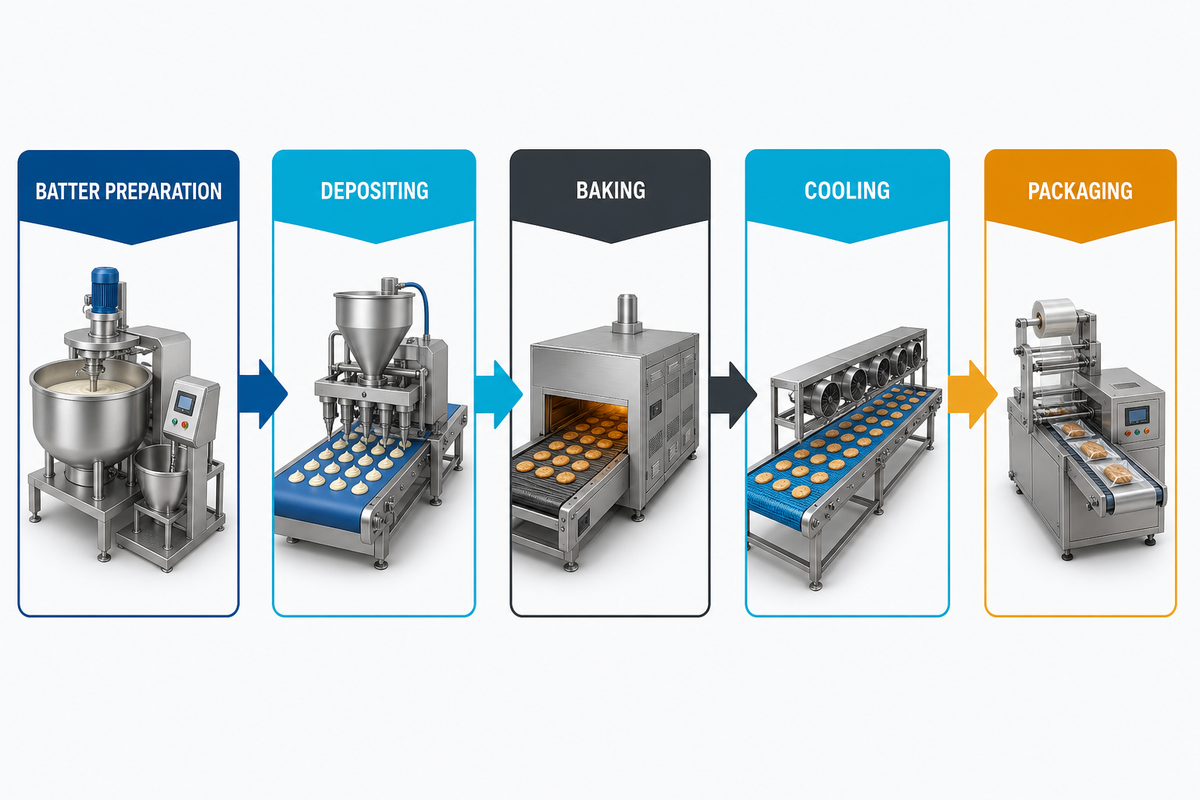
ProcessBatter → deposit → bake → cool → pack
CapacitySaleable packs, not nameplate pieces
EvidenceLimits, variation, calibration, exceptions
Site fitUtilities, hygiene, labor, service access
Scope boundary: A line may include batter preparation, metering, depositing, griddles or ovens, turning, cooling, filling, stacking, wrapping, checkweighing and case packing. Your project boundary should show what is included, what is existing, and the exact infeed and outfeed state for every module.
What a Pancake Production Line Actually Includes
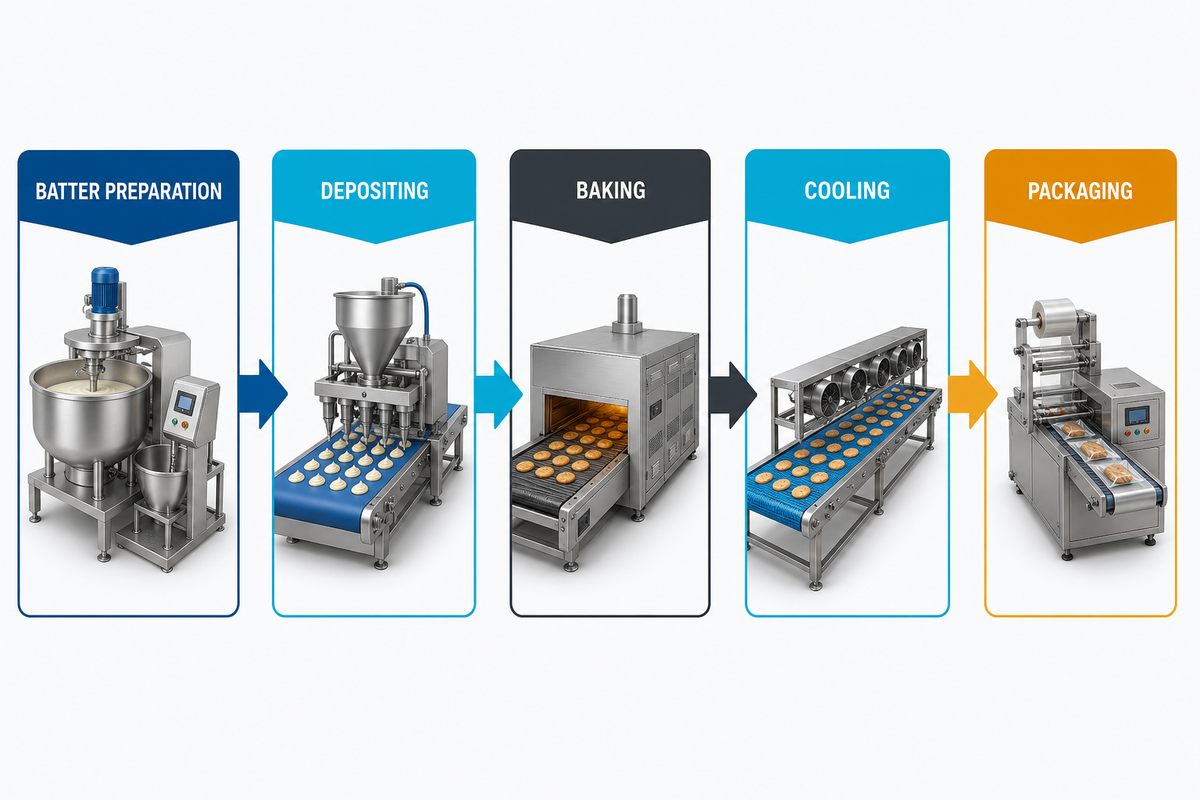
The production line is an integrated chain of material and thermal handoffs, not merely a baking machine or standalone machinery. An industrial pancake production line should be mapped for continuous production from defined infeed through accepted outfeed. Historical continuous-pancake equipment links batter deposit, heated-surface travel, discharge and conveyor handoff; modern filling and packaging modules must still be defined step by step.
| Stage | Input state to record | Output state to record |
|---|---|---|
| Batter preparation | Recipe, viscosity range, temperature, rest time, allergens | Agitated, screened or held batter ready for dosing |
| Depositing | Deposit weight, diameter, spacing and cycle timing | Consistent portions entering the bake zone |
| Baking and release | Plate temperature, heat-up, oiling and release condition | Color, texture, moisture and dimensions within limits |
| Cooling and transfer | Exit temperature, airflow and dwell capacity | Stackable product at the specified pack-infeed state |
| Filling and packaging | Filling dose, wrapper, label and seal requirements | Accepted packs, rejects and traceable records |
Mark every infeed, outfeed, buffer and operator intervention on a one-page drawing. If an existing mixer, freezer, wrapper or case packer remains outside the project, state its rate and product condition so a fast module isn’t mistaken for a balanced line.
Product format can include plain pancakes, sandwich pancake builds, dorayaki-style filled products or cake-like formats. If the brief calls for a dorayaki production machine, describe whether the filled sandwich needs a smooth pancake surface and assess that finish. Record whether an electric heater, a servo drive, or another servomechanism is part of the proposed boundary; “electricity” availability alone is not a performance specification. For scope context, consult the UDTECH food production machinery overview while keeping this worksheet supplier-neutral.
For historical context, the continuous pancake-machine patent record separates depositing, heating, discharge and conveyor handoff; use it as background rather than a current capability benchmark.
Start with Batter and Depositing, Not the Oven Brochure
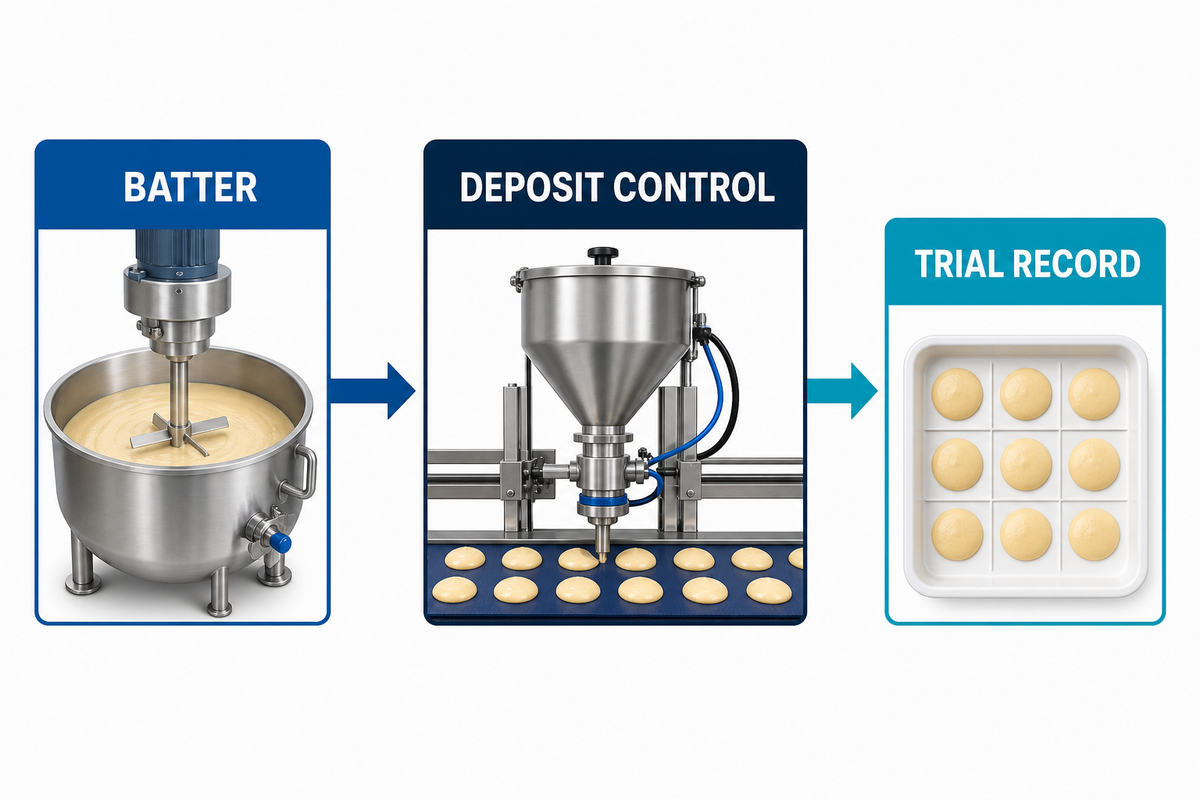
Batter condition controls the first repeatable portion and can influence spread, browning, release and downstream stacking. Record viscosity or another agreed consistency measure, batter temperature, rest time, agitation method, particulate size, deposit weight, diameter, thickness and the range of recipes that must run without a long sanitation stop.
Heat-to-Handoff Loop: Treat batter condition, plate heat, release, cooling dwell and pack readiness as one loop. Changes at the first step can appear later as color spread, sticking, excess moisture, unstable stacking or seal defects. Test the loop with the actual recipe and packaging materials instead of accepting isolated module demonstrations.
Allergen controls belong in the same worksheet. List major allergens by recipe, identify shared food-contact parts, define cleaning and inspection evidence between recipes, and specify label verification before a changeover is accepted. This is a buyer control plan, not a claim that one machine is certified for every market.
Run a short trial matrix: low, nominal and high batter temperature; the lower and upper deposit weights; the longest intended run; and the most difficult changeover. Record what changed, what was cleaned, which measurements moved and whether the line returned to the target without manual sorting.
The historical pancake equipment description also shows why depositor timing and handoff conditions should be written into the trial record, not inferred from an oven brochure.
Check Baking Plates, Heat Transfer and Release Behavior
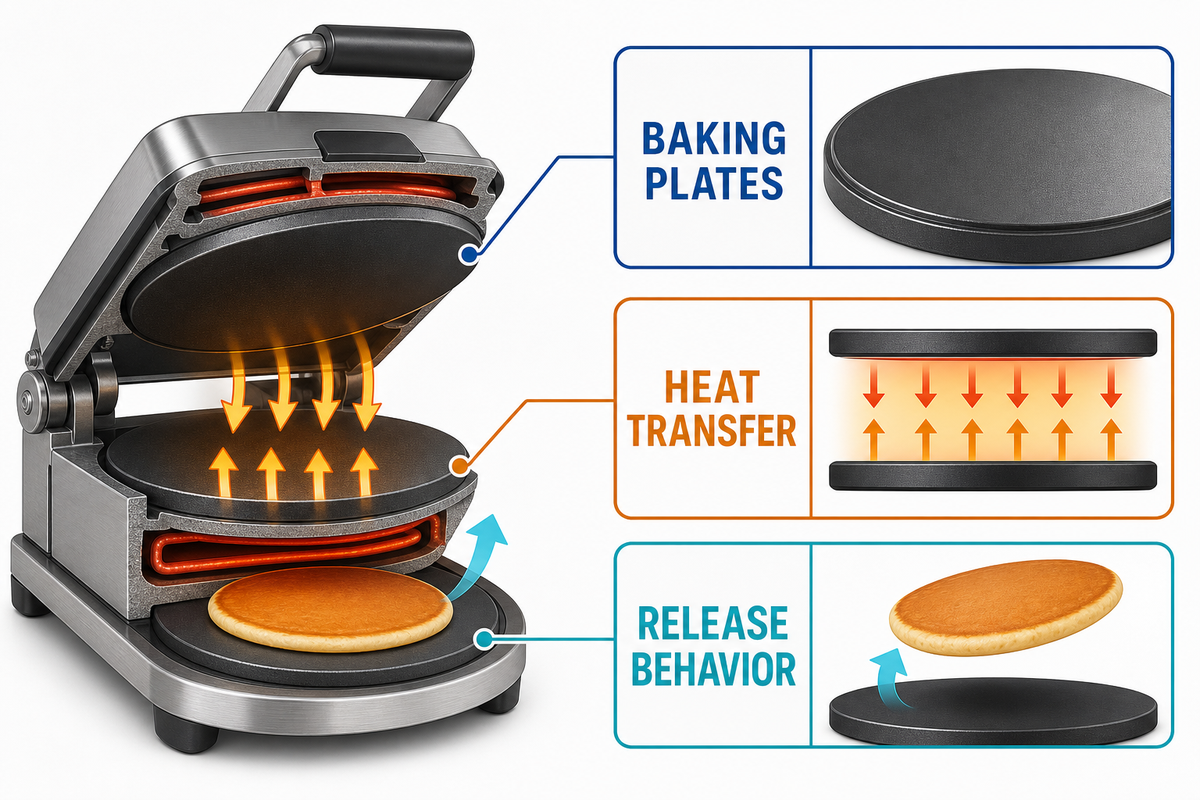
One stated baking speed says little about thermal recovery or release stability. Carry forward the depositor timing and handoff record so thermal claims can be checked against the incoming portion. Ask how many zones are controlled, where temperature is measured, how heat recovers after a cold load, how plates are cleaned and inspected, and what happens when a portion is underweight, off-center or needs to flip cleanly. For products that must cook both sides, define the visual and texture evidence required at release.
| Check | Record | Why it changes the decision |
|---|---|---|
| Thermal profile | Setpoint, measured surface or product temperature, recovery time | Separates a stable zone from a short demonstration peak |
| Release | Sticking events, oiling method, plate condition and cleaning interval | Connects maintenance and sanitation to rejects |
| Product limits | Weight, diameter, thickness, color, texture and moisture | Defines saleable output rather than visual acceptability |
| Non-fit case | Products needing a different bake profile, filling order or surface | Prevents forcing an unsuitable SKU into a line design |
Record calibrated instruments and their identification in the test file. If a result depends on an operator’s visual judgment, add a reference sample or measurable threshold so two shifts do not apply different acceptance rules.
Use the OSHA bakery-equipment standard as a United States baseline for guarding, safe access, operation and maintenance; confirm the buyer’s local requirements separately.
Design the Cooling and Packaging Handoff as One System
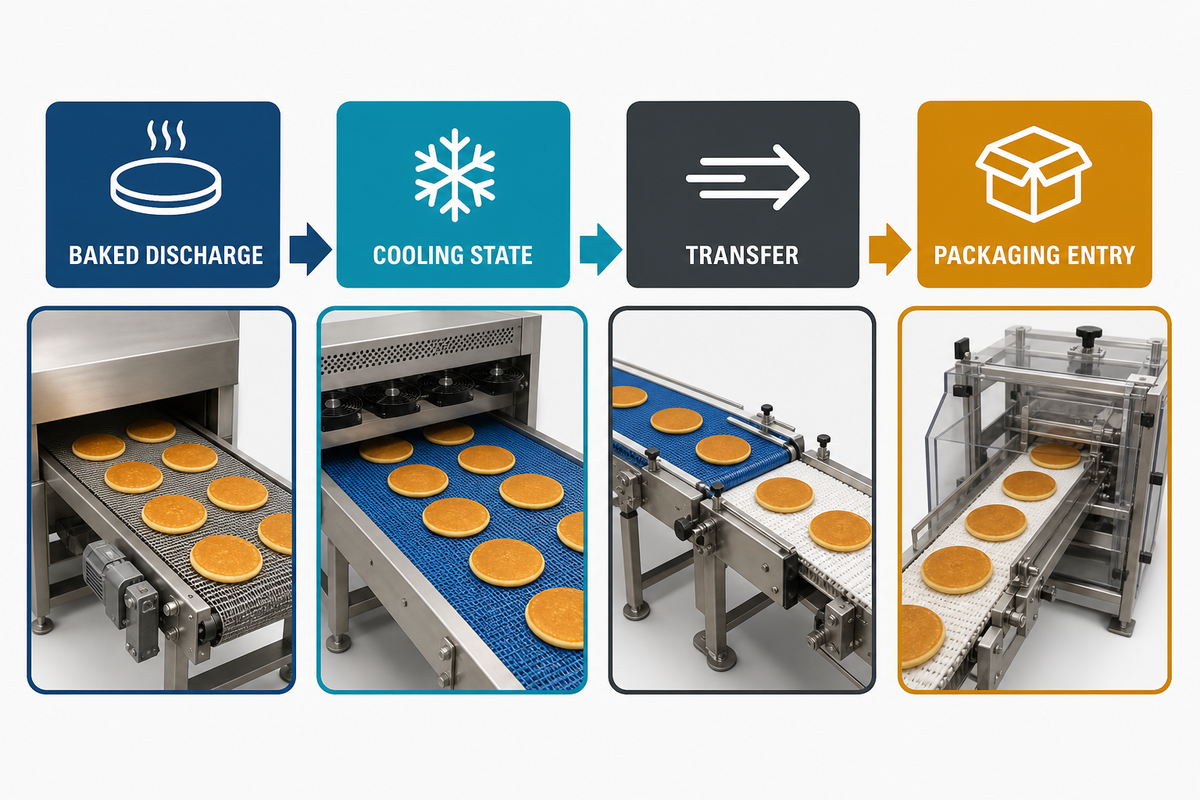
Even a good bake can fail at the wrapper when product arrives too warm, too moist, misaligned or difficult to stack. Check safe access and maintenance context at this handoff, because a packaging fix still has to be serviceable. Define the maximum queue time and product state at each handoff; then check whether cooling, filling and packaging can sustain the same accepted rate as the bake zone.
| State | Measure | Failure signal |
|---|---|---|
| Oven exit | Temperature, moisture, spacing and release | Condensation risk, sticking or unstable transfer |
| Cooled product | Dwell, airflow, surface condition and stack geometry | Queue growth, deformation or excessive drying |
| Pack infeed | Filling dose, wrapper alignment, seal window and checkweight | Wrapper stoppage, seal rejects or manual rework |
Packaging is often the practical bottleneck because it has its own film, label, seal, checkweighing and operator constraints. Ask how the proposed sealing unit would align a row of pancakes without hiding rejects or queue effects. Request a sustained run using the final wrapper and label, not a hand-packed sample that hides the queue.
Use the FDA Food Code 2022 as a jurisdictional hygiene reference when defining cooling, handling and pack-infeed controls; the buyer must confirm the edition and local rules that apply.
Build a Site-Fit Sheet for Utilities and Layout
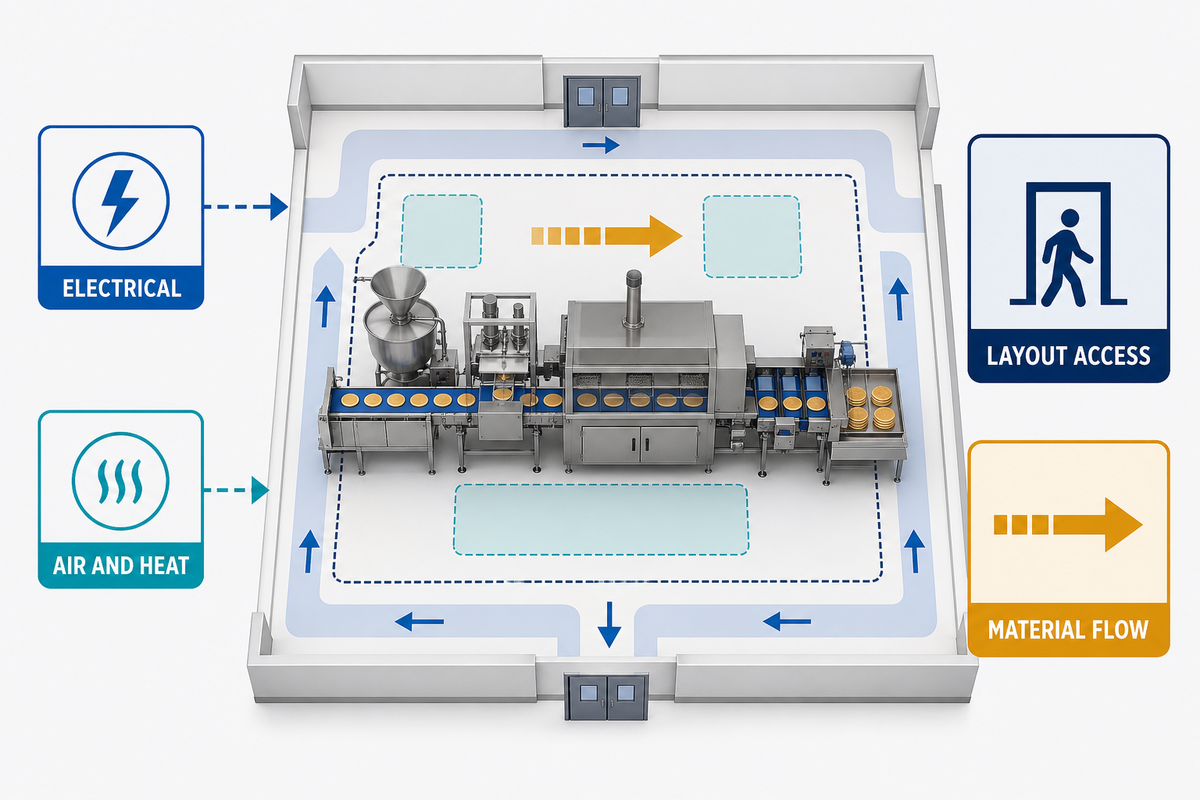
Freeze the measured floor plan and utility schedule before comparing line layouts. Carry the cooling and pack-infeed controls into that sheet so the layout reflects downstream conditions. Record whether the site relies on gas and electricity, and keep the proposed arrangement flexible enough to suit a compact service path. Record electrical voltage and frequency, gas or steam, compressed air quality and pressure, exhaust, water, drainage, floor loading, ambient conditions, hygiene zoning, operator aisles, maintenance clearance and product-flow direction.
Food Code, hygienic-design guidance and workplace rules are jurisdictional inputs, not a universal certification shortcut. Refer to the FDA Food Code 2022, EHEDG hygienic-design principles and applicable local rules, then have the buyer’s food-safety and safety specialists confirm the edition that applies.
Site-fit minimum: Send every bidder the same drawing, utility values, hygiene zones, service clearances and operator assumptions. Layouts that fit on paper can still fail when doors, drains, washdown, forklift routes or maintenance access are measured honestly.
Guarding and safe maintenance are design inputs. OSHA’s bakery-equipment standard and machine-guarding overview are United States references; they don’t replace a site-specific risk assessment or local compliance review.
Use the Saleable Output Bridge to Define Capacity
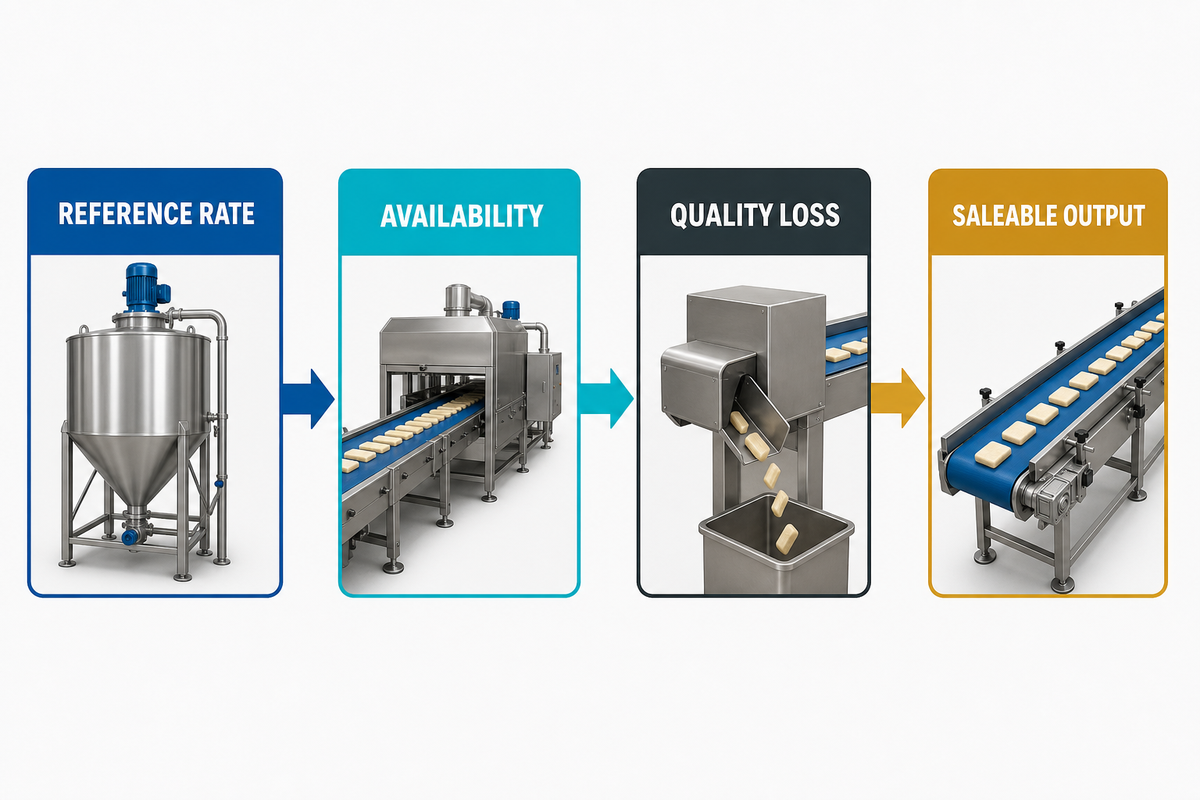
Define one shared output measure when comparing offers. Tie that measure to the site design inputs so the accepted rate reflects the full installation. Use adjustable assumptions for productivity, and tie any high-quality claim to observed acceptance evidence rather than a brochure label. The planning formula is:
The 7-Check Saleable Output Matrix
Saleable packs/shift = nominal units/hour × planned run hours × yield × uptime ÷ units/pack
Then cap the result at the stable capacity of cooling, filling or packaging, whichever is slower.
Then cap the result at the stable capacity of cooling, filling or packaging, whichever is slower.
Illustrative example only: 1,200 nominal units/hour × 7 planned hours × 0.96 yield × 0.85 uptime ÷ 8 units/pack = 856.8, or about 856 packs per shift before downstream limits. If the verified cooling-and-packaging handoff sustains only 780 packs, the planning result is 780 saleable packs, not 856. No value in this example describes a UDTECH machine.
Set buyer-defined measurement units and acceptance limits in the specification: define tolerance, temperature, moisture, seal, cleaning, utility and worst-case limits for the named recipe and packaging. Treat these as buyer requirements to validate, not universal pancake specifications.
Record pilot throughput, stable-run duration, changeover performance, dimensional spread, sample mass, electrical and air values, sensor response, service, access and maintenance fields, plus upstream capacity. Replace each field with measured buyer data before approval.
Do not stop at the average. NIST process guidance explains that manufacturing output has a distribution and measurable spread; process capability is meaningful only against specification limits. Set limits for batter weight, dimensions, bake temperature, color or texture, moisture and package integrity. Record rejects, rework and measurement-system calibration, then show that the process is stable during a representative long run.
The figures in the commissioning matrix are illustrative placeholders for a buyer-defined test plan, not universal pancake specifications or UDTECH performance claims. Replace every value with the buyer’s measured recipe, utility, packaging and acceptance requirement before approval.
| Input | Buyer definition | Evidence |
|---|---|---|
| Nominal rate | Units/hour at named recipe and deposit | Cycle record and recipe sheet |
| Yield and rejects | Accepted definition, reject codes and rework rule | Counted samples and disposition log |
| Uptime and changeover | Planned run window, stops, cleaning and recipe changes | Time-stamped run record |
| Downstream cap | Cooling dwell, filling and packaging stable rate | Sustained handoff test with final materials |
| Metric | Source / benchmark | Decision use |
|---|---|---|
| Deposit weight ±2 g | Recipe trial record | Portion stability |
| Diameter ±1 mm | Dimensional sample | Release and stacking fit |
| Plate reading 180 °C | Calibrated temperature record | Thermal comparison |
| Seal limit 95% | Final wrapper check | Pack acceptance |
| Cleaning 5 min | Changeover observation | Labor and allergen release |
| Run window 4 hr | Time-stamped data set | Stability evidence |
| Sensor response 10 sec | Control-system test | Alarm and recovery review |
| Air supply 6 bar | Utility verification | Site-fit gate |
| Mix input 500 kg/h | Upstream handoff record | Bottleneck check |
The FAO feasibility example makes stage losses visible between incoming material and saleable output. Adapt the principle, not its product numbers, to your pancake recipe.
Turn Factory Acceptance into the FAT Evidence Ladder
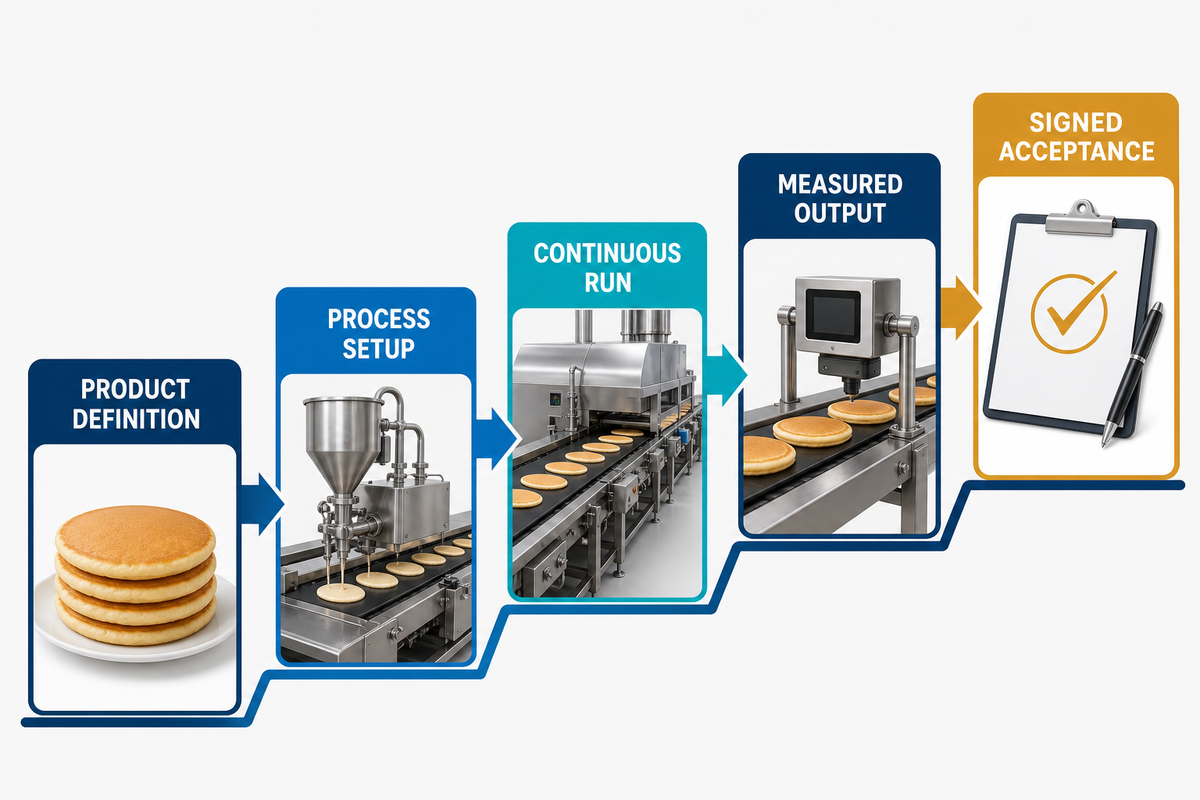
The factory acceptance test should trace each requirement to a planned test, measurement, result, exception and owner. Use the saleable output baseline as the reference point when matching each result to the requirement. NASA’s verification guidance distinguishes verification, qualification and acceptance; that distinction is useful here because acceptance is a selected evidence set, not a promise that every future site condition has been reproduced.
“Acceptance criteria should have been identified for each requirement to be verified.”
The 4-Rung FAT Evidence Ladder
Stage 1 · Recipe and deposit
Run the agreed batter range. Record weights, dimensions, deposit timing, allergens and cleaning between recipes.
Stage 2 · Thermal and release
Check calibrated temperature, recovery, color, texture, moisture, sticking and plate access.
Stage 3 · Sustained handoff
Use worst-case recipe, utilities, operator and final packaging. Count rejects, queues, seals, sanitation and changeover time.
Stage 4 · Site acceptance
Repeat critical checks with buyer utilities, operators, local hygiene controls, labels and actual materials.
Required control note: Name the worst-case continuous-run duration, actual production inputs, instrument calibration status, allergen and label-changeover checks, sanitation records, software or sensor revalidation triggers and allowed exceptions before the test start. Passing a FAT creates a bounded snapshot; it can’t by itself prove durable field readiness when site conditions differ.
Apply the NASA acceptance-data-package model as a documentation pattern, not as a food-equipment certification. The buyer should retain the run file, raw measurements, calibration records, deviations, corrective actions and the date for site recheck.
Decide Whether a Modular or Fully Automatic Line Fits Your Risk Profile
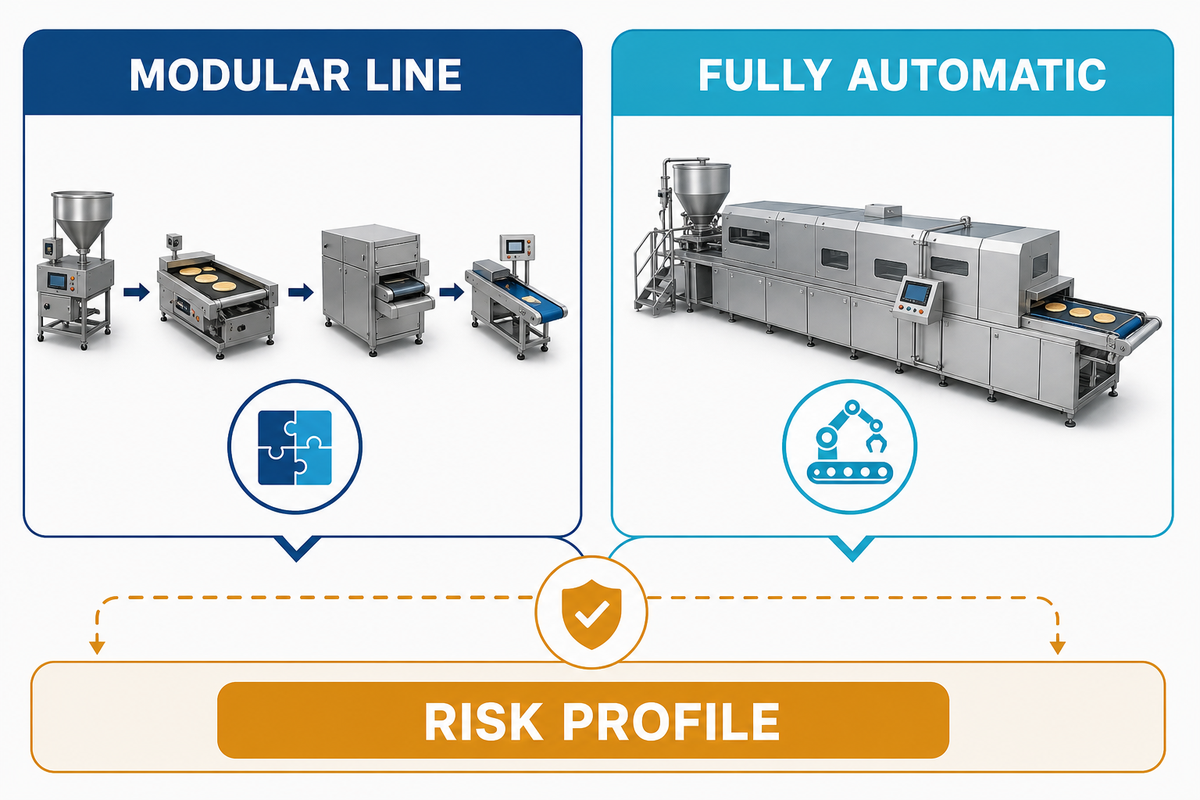
Automation level should match evidence maturity. Link each option to the acceptance record and run file so the chosen level reflects what has actually been proven. Modular lines may reduce commitment while demand, SKU range or packaging is still being proven; a fully synchronized line can make sense when recipes, forecasts, utilities, labor and acceptance criteria are stable. Semi-automatic cells can be safer for a pilot if they expose the right learning without locking in an unverified bottleneck.
A recent Food Engineering automation case reinforces the need to assess people, handoffs and downstream constraints across the full line rather than judge one module in isolation.
| Option | When it may fit | Questions to close |
|---|---|---|
| Modular | Staged demand, changing SKU or uncertain packaging | Interface rates, future expansion, controls ownership and service |
| Synchronized automatic | Stable recipes, forecast, utilities and acceptance data | Worst-case run, failure response, sanitation and spare parts |
| Semi-automatic pilot | Learning is the goal and manual handling is manageable | Labor availability, intervention points and path to scale |
Include sanitation staffing, manual intervention, lockout/tagout exposure, guarding, maintenance access and changeover labor in the lifecycle comparison. A modular design can reduce commitment during a pilot, but less operator involvement doesn’t remove hazardous-energy controls or the need for a cleanable design.
What Current Demand Signals Do, and Do Not, Prove
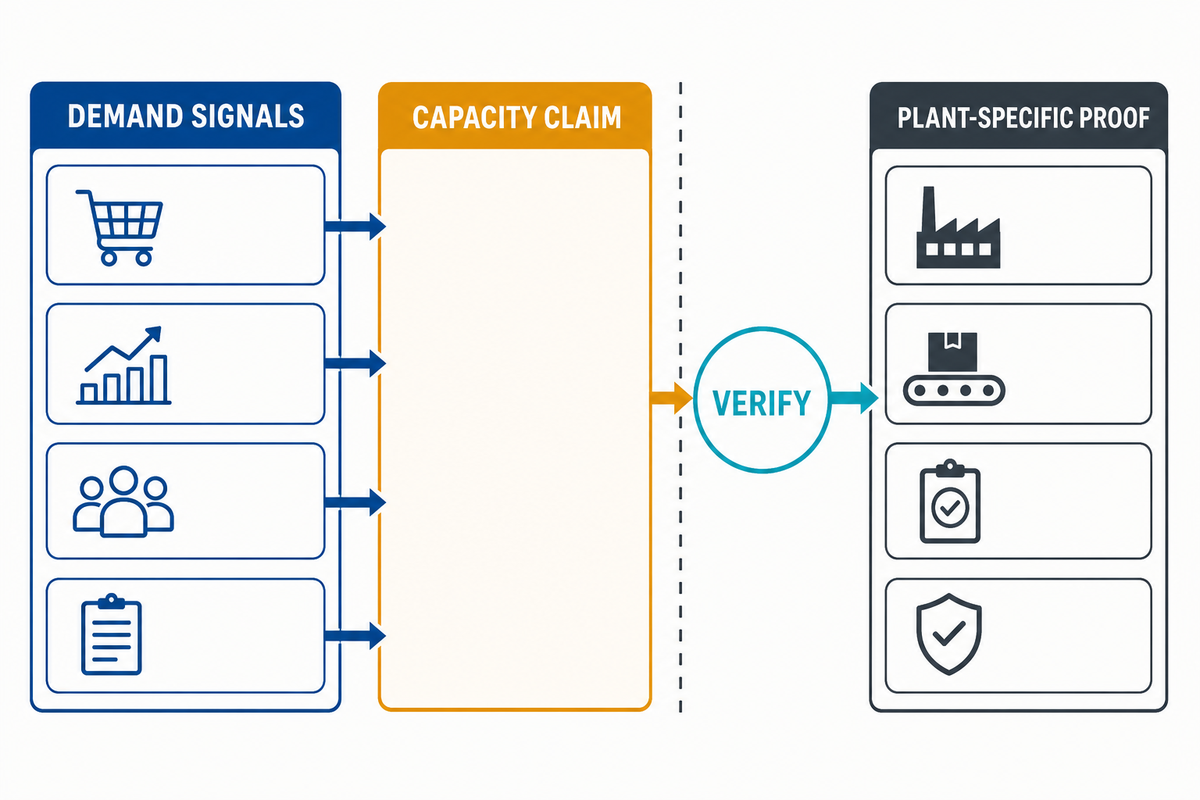
In the current United States search snapshot, DataForSEO returned measurable volume of 10 for the exact focus term and measurable volume for some broader machine terms; many process and capacity phrases returned no volume. Read those signals alongside labor and changeover constraints before translating interest into a line brief. The live result set was product-heavy, with seven visible organic results and no guide result. These observations support an assessment guide format, not a market-size estimate.
Related searches such as pancake machine, automatic pancake machine and popcake pancake machine price point to adjacent comparison questions. Treat them as prompts to define format, automation scope and evidence needs, not as proof of a standard specification or price. For project support beyond this worksheet, the UDTECH engineering services page describes the broader service context without changing this guide’s assessment focus.
Decision boundary: Search volume can help decide what questions to explain. It cannot prove customer orders, a forecast, a required line capacity, a price band or a technology-adoption rate. Use signed demand, SKU forecasts, pilot yield and site data for sizing.
Recheck search and regulatory signals when the project moves from education to procurement. Keep the content’s date and evidence boundary visible so a future reader does not mistake a small keyword sample for a production plan. For brand context, review the UDTECH company background without treating it as product-performance evidence.
Prepare a Supplier-Neutral Information Pack
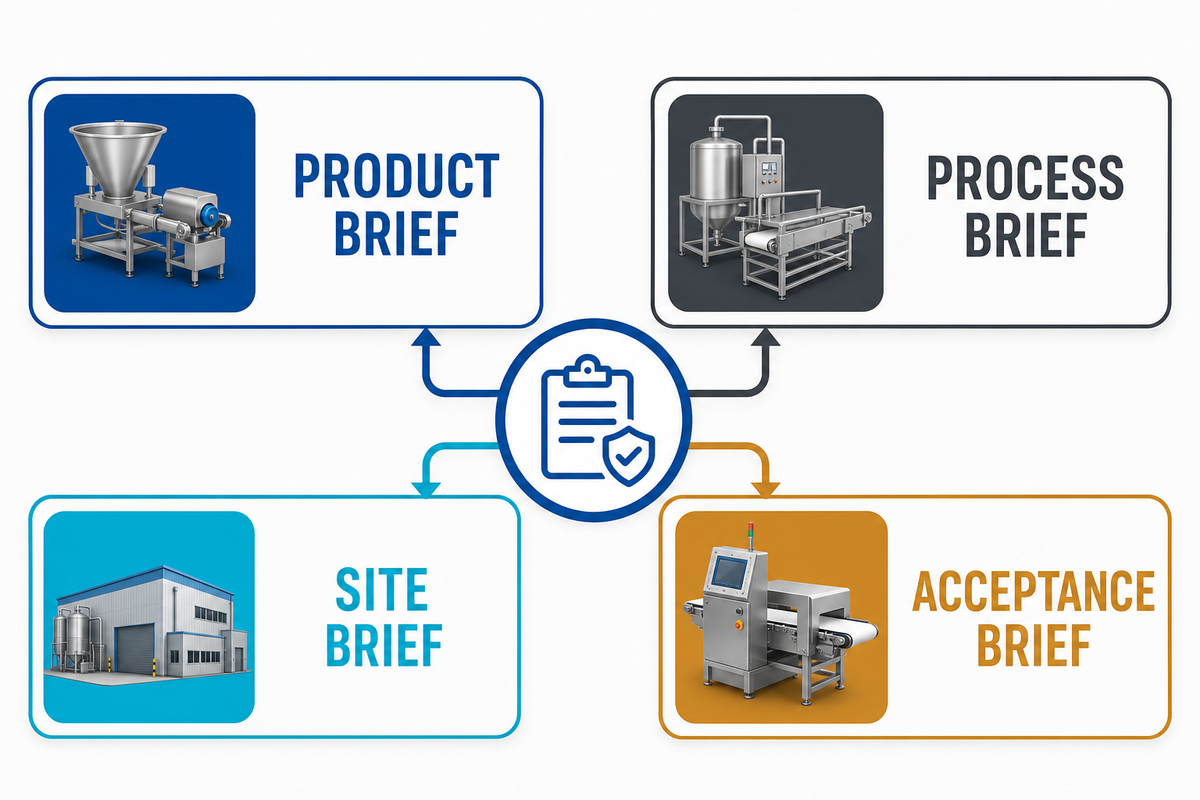
Give every bidder the same inputs. Comparable proposals are easier to audit than polished brochures because each number has a product, site and acceptance context.
| # | Category / field | Minimum detail |
|---|---|---|
| 1 | Product format | Diameter, thickness, weight, filled or plain |
| 2 | Recipe and allergens | Ingredients, viscosity range, shared-contact risks |
| 3 | Target saleable output | Packs/shift, pack count and planned run window |
| 4 | Specification limits | Weight, dimensions, color or texture, moisture, seal |
| 5 | Reject and rework | Codes, disposition and reporting rule |
| 6 | Pack and label | Wrapper, seal window, label verification and case format |
| 7 | Utilities | Power, gas or steam, air, water, exhaust and drainage |
| 8 | Floor plan | Measured footprint, loading, aisles and service clearance |
| 9 | Hygiene zoning | Raw, production, cooling and finished-goods separation |
| 10 | Sanitation/changeover | Cleaning method, labor, inspection and allergen release |
| 11 | Labor model | Operators, maintenance, intervention and training |
| 12 | Market requirements | Applicable food, electrical and safety rules |
| 13 | FAT/SAT expectations | Stages, duration, worst-case inputs, exceptions and owners |
| 14 | Measurement plan | Instrument IDs, calibration, sampling and data package |
| 15 | Service and revalidation | Response, spares, software or sensor change triggers |
When those fields are complete, you can ask a supplier to discuss a configuration without turning the guide into a quote-first page. The commercial solution page remains the correct place for a tailored equipment conversation; this article’s job is to make the request measurable. You can then review a pancake production line configuration brief against those inputs.
Ready to move from assessment to configuration?
Use the checklist above, then open a scoped discussion with the pancake-line team. Bring your recipe, target saleable output, site utilities and acceptance criteria.
FAQ, Pancake Production Line Planning Questions
What is the difference between a pancake machine and a pancake production line?
One machine usually performs one operation, while a line coordinates batter handling, depositing, baking, release, cooling and optional filling or packaging. Bring the recipe, output and site inputs together in the information pack before comparing offers. The correct boundary depends on your product and the equipment you already own. Document the infeed and outfeed conditions, recipe range and sanitation method before comparing offers. This prevents a single high-speed module from being mistaken for a complete, balanced process.
How should I calculate pancake production line capacity?
Start with cycle rate and piece weight, then adjust for planned changeovers, rejects, cooling and packaging limits, and realistic uptime. The Saleable Output Bridge makes those assumptions visible. The supplier’s nominal pieces/hour is only one input. Request the same test recipe, run duration, specification limits and yield definition from every supplier so the comparison is saleable packs per shift rather than an unqualified nameplate number. Use one named run window and report gross and saleable output on the same baseline.
What should a factory acceptance test prove?
Use the FAT Evidence Ladder: run recipe/deposit, thermal/release, worst-case continuous, cooling/packaging, allergen/label changeover and sanitation checks. Record calibrated weights, dimensions, color or texture, moisture or seal limits, uptime, rejects, changeover and cleaning. Note the sample window, instrument IDs and exceptions. Repeat critical checks at site with buyer utilities, operators and final materials; a FAT pass is not proof of durable field readiness.
What determines pancake production line cost?
Cost depends on product format, modules, automation, utilities, packaging, hygiene, controls, installation and service. Search results do not establish a price band. Ask for a line-item scope and tie each item to a measurable FAT/SAT requirement for your site and recipe.
Do I need cooling before packaging?
Cooling depends on moisture, product temperature, wrapper and storage route. Packaging too warm can create condensation or seal problems, while excessive dwell can hurt throughput. Validate dwell and airflow with the final packaging or freezer process; do not copy a generic line diagram.
References and Sources
- U.S. Food and Drug Administration, Food Code 2022 (jurisdictional food-safety reference).
- OSHA, 29 CFR 1910.263 Bakery Equipment (United States workplace baseline).
- OSHA, Machine Guarding Standards (guarding and safe-access context).
- EHEDG, Hygienic Design Principles (hygienic-equipment design reference).
- FAO, Food-processing feasibility and yield-loss example (method only; not a pancake yield claim).
- NIST, Hierarchical Structure of Key Performance Indicators (throughput, availability, efficiency and quality framing).
- NIST/SEMATECH e-Handbook, Process Variation and Stability (variation and stable-run boundary).
- NIST/SEMATECH e-Handbook, Process Capability (specification-limit principle).
- NASA, Product Verification, Qualification and Acceptance (evidence-package model; not food-equipment certification).
- U.S. Patent US2922356A, Machine for continuously producing pancakes and the like (historical process-boundary background only).
Sources were reviewed for the bounded principles stated here. Regulatory applicability, recipe safety, product specifications and line acceptance remain the buyer’s responsibility in the target jurisdiction.