Get in touch with UDTECH Company

How to Plan Sachima and Specialty Snack Lines from Product Brief to Accepted Output

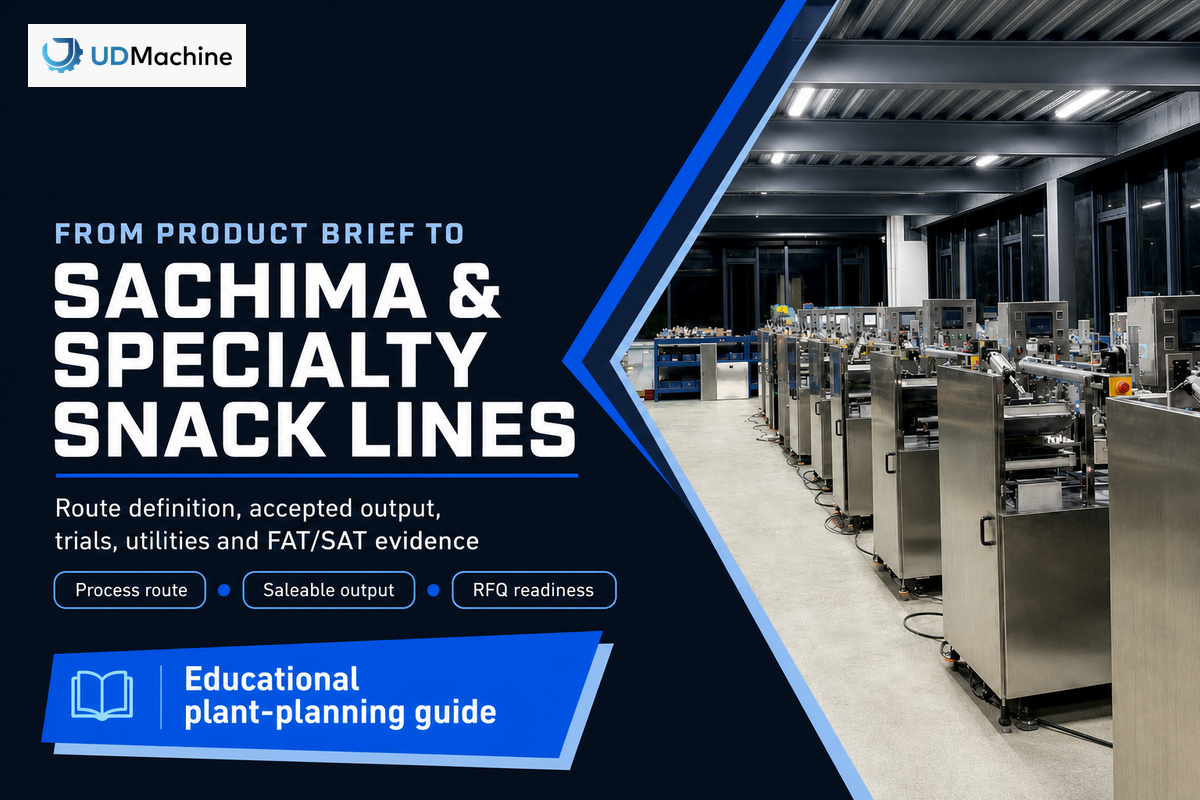
Industrial planning guide · Sachima and specialty snack production
Sachima & Specialty Snack Lines is a product-and-process decision inside a wider food-processing route. Define structure, method and result before choosing equipment. Start with (1) fried dough or noodle structure, (2) syrup binding, (3) finished geometry, (4) accepted output in package form, (5) required utilities, and (6) sanitation boundaries with evidence handover. Once those inputs are clear, food-manufacturing buyers can compare a specialty snack production line and build an objective, defensible brief and comparable RFQ.
What “Sachima & Specialty Snack Lines” Covers
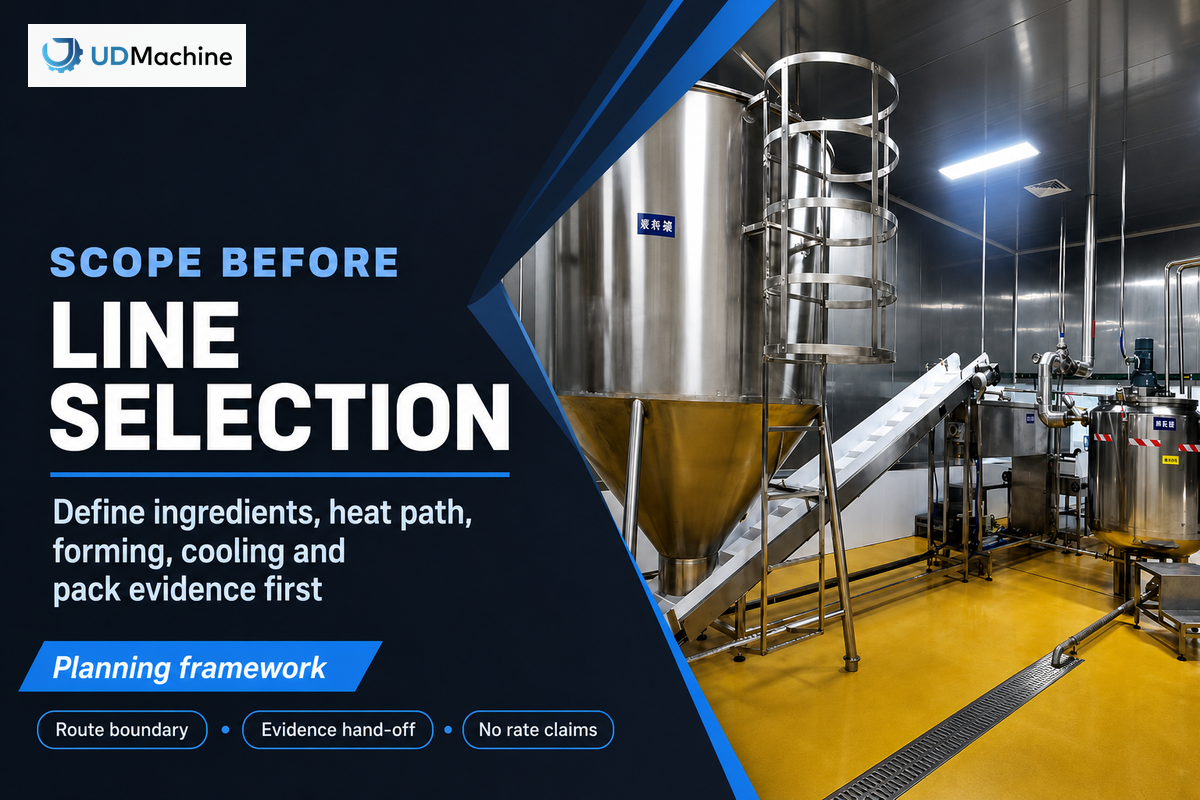
Sachima (also known as saqima) consists typically of a sweet Chinese snack made from fried flour or egg-dough and bound with sugar syrup. UDTECH line decisions involve ingredient selection, the appropriate heat path, inclusions and their preparation, forming or cutting technology, and the package. Production goals must be stated and supported by a defensible process that yields a sellable product; ingredients can describe a product, but cannot document a process.
Use the scope breakdown below to “disentangle education” and “protect and separate product claims” within your procurement document:
| Planning question | This guide covers | Solution-page hand-off |
|---|---|---|
| What route fits the product? | Fried strands, syrup binding, forming, cooling and alternative baked, extruded or filled routes. | Review the UDTECH’s sachima and specialty snack line solutions for available configurations. |
| What evidence makes a quote comparable? | Accepted output, trial inputs, utilities, hygiene, FAT/SAT and exclusions. | Ask the supplier to map the brief to a model and quotation. |
| What is not asserted here? | No universal capacity, price, patent ownership, customer result or certification is invented. | Verify any specification or commercial promise on the current first-party page and contract. |
Five-Question Route Boundary Test: Are strands fried before binding? Is syrup the structural binder? Is the piece formed or cut after mixing? Are variants driven by inclusions and flavor rather than a different heat path? Can accepted output be measured in the intended pack? A “no” at the first three questions is a signal to examine a baked, extruded, filled or hybrid route instead of forcing every product into a sachima label.
A procurement risk appears when a supplier quote uses a different definition of “line” or “output” than the buyer’s brief. Record the mismatch, ask which production route and acceptance criteria are included, and keep the RFQ hand-off explicit before requesting a model review.
How Flour, Frying and Sugar Syrup Move the Sachima Route to Cut Product
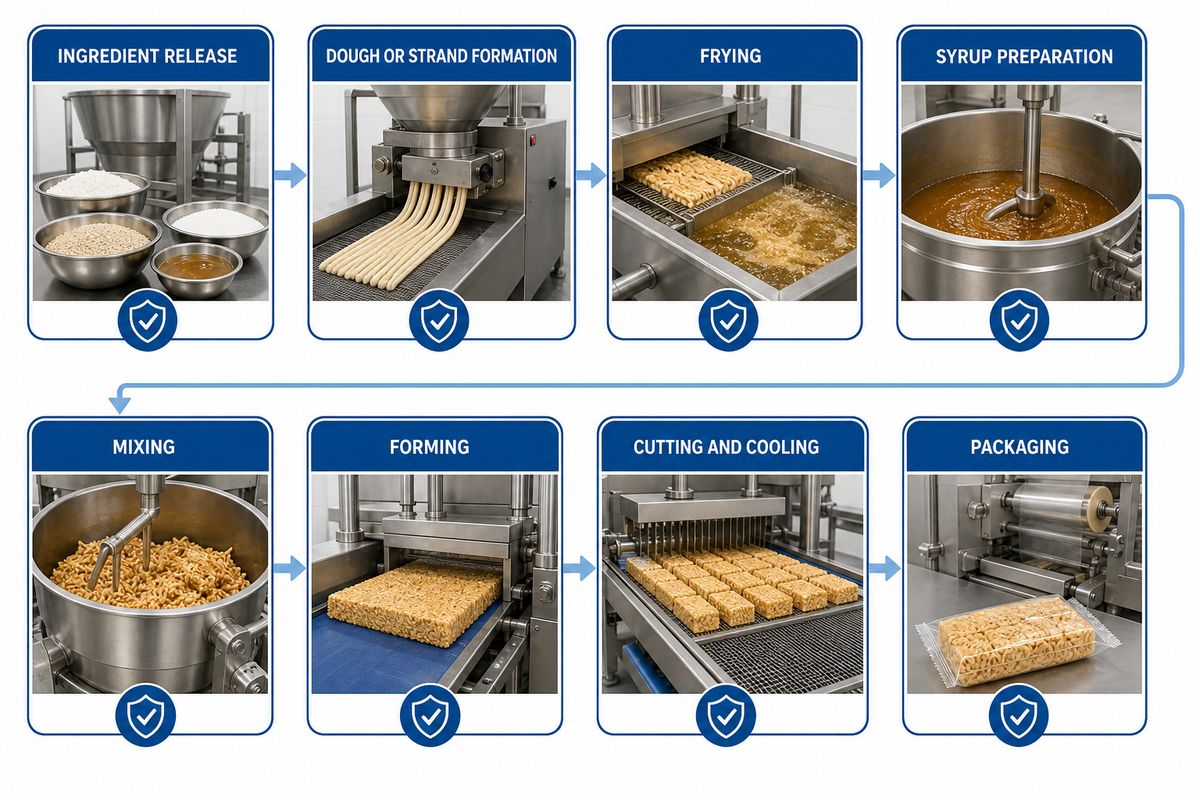
A useful process map treats each hand-off as a control point in the food-processing route. Competitor supplier descriptions and recipe sources commonly separate dough or fried noodles preparation, frying, syrup preparation, mixing, forming or cutting, cooling and packaging. Those sources are external context, not proof of UDTECH performance, but the hand-offs are a practical way to structure trials and check consistency.
Route risk is easiest to expose when each control point has a cause and an acceptance record: because oil condition, syrup temperature and cooling can change the result, a buyer should compare a documented trial against the applicable food-safety plan and acceptance criteria. An illustrative 1 kg sample is a worksheet prompt only, not a supplier benchmark.
A worksheet can also reserve a 30-piece sample, a 20 min observation window, a 2 mm geometry check and a 165 °C fry log; these are example fields for a trial record, not published line performance.
- Ingredient release: record flour, egg, water, sugar, oil and inclusion lots, plus allergen status.
- Dough or strand formation: hold the thickness, strength and feed condition that create the intended airy structure.
- Frying: log oil condition, temperature, residence time and removal of fines; these affect color, expansion and oil carryover.
- Syrup preparation: define the syrup family, concentration window, temperature and hold time rather than saying only “sweet.”
- Mixing: distribute syrup and inclusions without crushing strands or creating unbound pockets.
- Forming: set slab thickness, compression and edge definition for the target bar, bite or piece.
- Cutting and cooling: fix cut length, cooling endpoint and transfer conditions before packing.
- Packaging: specify pack weight, seal, barrier, coding and inspection so “output” means a saleable pack.
The [TSHS process description] is a competitor reference for this sequence. A [recipe explanation] is useful for ingredient and texture vocabulary. Neither source should be copied as a UDTECH capacity or compliance claim.
What is Sachima made from?
Consumer and recipe sources describe fried flour or egg-dough strands, sugar syrup and optional sesame, nuts, raisins or other inclusions. For a plant trial, convert that description into a controlled formulation range, ingredient lot record, strand geometry, syrup condition and inclusion matrix. If a flavor or allergen changes, treat it as a new trial condition until mixing, changeover and package evidence show that the original acceptance basis still holds. Record the formula revision and accepted sample before comparing runs.
Which Specialty Snack Products Need a Different Route?
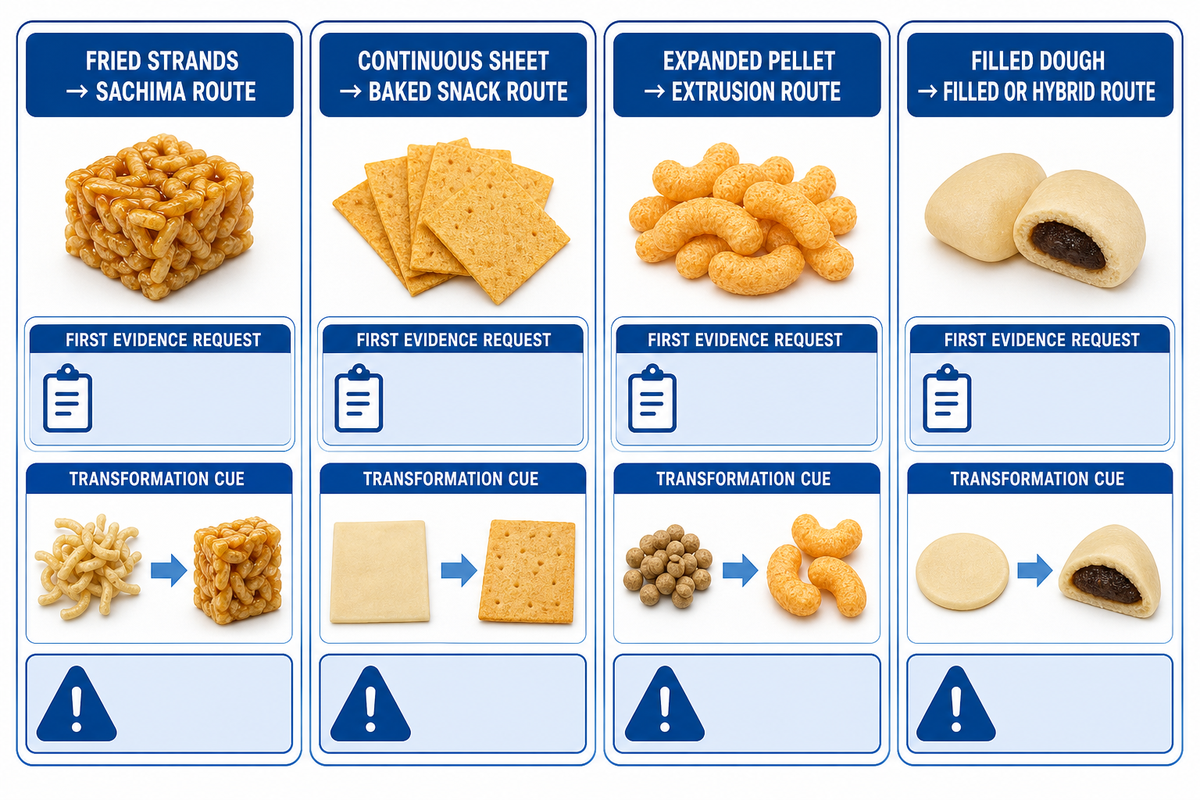
“Specialty snack line” is a portfolio label, not a heat-transfer method. Route choice follows the finished-product transformation. A baked sheet, an extruded pellet, a filled dough piece and a fried strand may all be sold as snacks, yet they load, heat, form, cool and clean differently.
The practical failure mode is a route mismatch: a factory trial may feed or heat the wrong form even when the sales label says “snack.” Ask the supplier to identify the production line, die or forming boundary, and the evidence that the proposed route fits the buyer’s actual product. For a United States project, pair that route review with the buyer’s FDA food-safety planning reference before freezing the process boundary. The UDTECH sachima solution scope can then be checked against that route brief.
| Finished-product signal | Route to investigate | First evidence to request |
|---|---|---|
| Fried strands bound by syrup; airy or chewy bite | Sachima route | Fry and syrup windows, strand geometry, forming pressure, cooling and pack acceptance. |
| Continuous sheet or dry baked profile | Baked snack route | Oven profile, moisture endpoint, sheet handling and breakage evidence. |
| Expanded pellet or extruded shape | Extrusion route | Feed moisture, die geometry, expansion, drying and seasoning controls. |
| Cold dough wrapped around a filling | Filled or hybrid route | Filling rheology, seal integrity, allergen segregation and post-form cooking. |
How does Sachima compare with a Rice Krispies treat?
Both can be light, sweet and bound, but a sachima route starts with fried flour or noodle-like strands and syrup, while a cereal treat starts with a different base and binder behavior. This comparison matters because strand frying, oil management, syrup distribution and cooling create different control points. Use sensory similarity to generate a trial question, never as evidence that one line, recipe or acceptance limit transfers unchanged to the other.
How to Define Saleable Output Before Comparing Lines
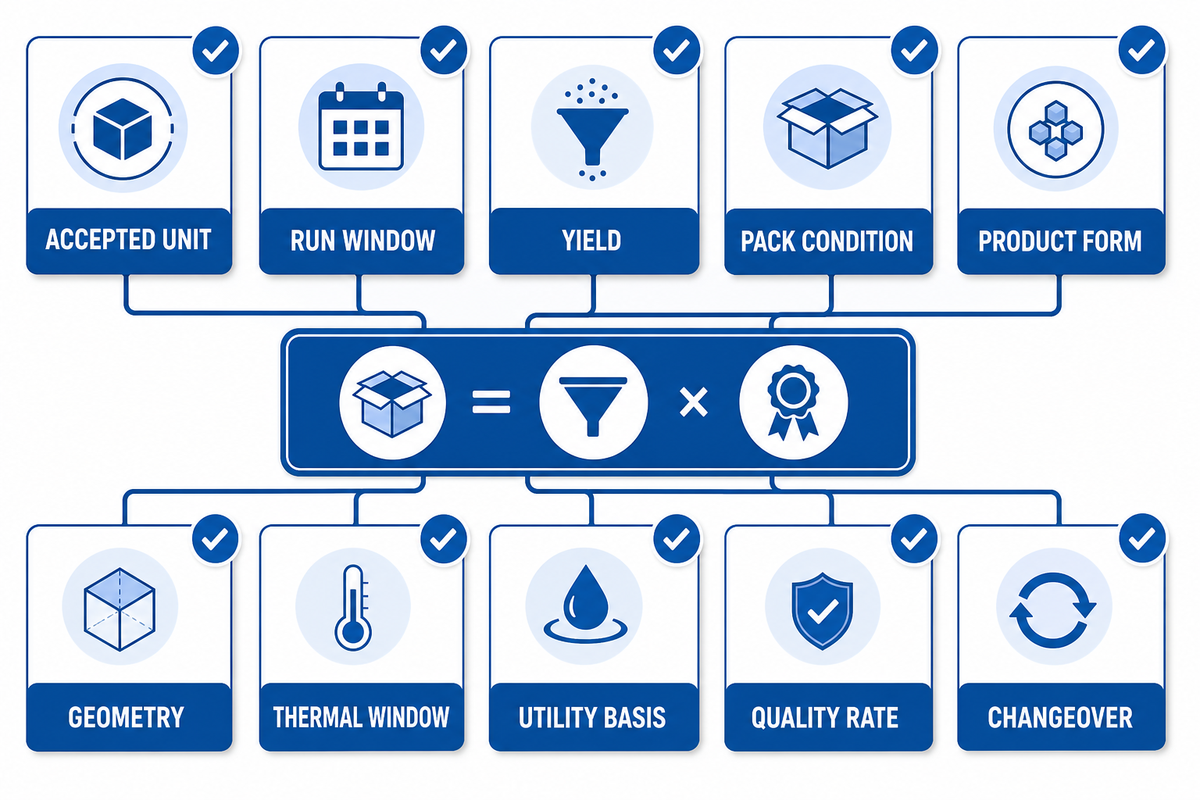
Nameplate speed is not a business-case output. The buyer should define the product that passes inspection, the run window, the yield and the pack format. This is the Accepted-Output Definition Card: it carries the route distinction from the previous section into a comparable output test. The same documented basis supports the preventive-control record expected under the current eCFR Part 117 reference where that jurisdiction applies. Keep the resulting brief beside the line configuration route when commercial details are requested.
“Accepted output is a documented condition, not a nameplate number.”
| Field | Write down | Why it prevents a false comparison |
|---|---|---|
| Accepted unit | kg, piece, bar or finished pack; include tolerances. | A line quoted in pieces/hour may not match a line quoted in saleable kg/hour. |
| Run window | Start-up exclusion, steady-state minutes, planned stops and sample count. | A five-minute peak can hide warm-up, changeover and cleaning losses. |
| Yield | Accepted output divided by input, with rework and scrap definitions. | Gross throughput can rise while accepted product falls. |
| Pack condition | Weight, seal, coding, barrier and visual criteria. | Unpacked or leaking pieces are not saleable output. |
| Product form | Strand, slab, bar, bite or filled piece. | Forming and cutting evidence must match the actual SKU. |
| Geometry | Length, width, thickness and tolerance in mm. | Piece count is meaningless when dimensions drift. |
| Thermal window | Fry and syrup temperatures in °C, residence time in minutes. | Texture and color need a recorded condition. |
| Utility basis | Power in kW, air pressure in bar, water and drain limits. | Peak demand and connection scope become visible. |
| Quality rate | Accepted percentage, reject reason and rework rule. | Yield can be compared without hiding defects. |
| Changeover | Minutes, allergen sequence and cleaning release. | Portfolio flexibility has a measurable cost. |
Use variables in an early business case: saleable kg/h = gross kg/h × yield × uptime factor. Insert supplier values only after the recipe and acceptance basis are frozen. The low-volume related keyword data returned during research is not a capacity benchmark, and no supplier rate is generalized here.
Illustrative card labels only: a blank trial sheet can reserve fields such as 1 kg sample, 10 min run, 2 mm strand, 120 °C syrup, 5 kW service, 3 bar air, 90% acceptance and 15 min changeover. These numbers are placeholders to demonstrate units, not UDTECH or supplier performance.
| Worksheet field | Example placeholder | How to use it |
|---|---|---|
| Sample mass | 2 kg | Label the retained sample and recipe revision. |
| Trial duration | 20 min | Record the stable window used for scoring. |
| Strand width | 3 mm | Measure geometry at the agreed inspection point. |
| Slab thickness | 12 mm | Check compression and cut setup against the brief. |
| Fry temperature | 165 °C | Log the condition with oil and residence-time data. |
| Syrup hold | 8 min | Capture the hold used before mixing, not a generic recipe claim. |
| Line service | 7 kW | Compare the placeholder with the supplier utility schedule. |
| Air pressure | 4 bar | Confirm the plant connection and pressure tolerance. |
| Cooling target | 25 °C | Define the transfer point before sealing. |
| Cut length | 40 mm | Use the same gauge for trial and acceptance checks. |
| Pack weight | 50 g | Pair the target with a stated tolerance and seal test. |
| Changeover target | 25 min | Time cleaning, adjustment and first-good-pack separately. |
| Acceptance sample | 30 pieces | State the sample count and defect classification. |
| Yield factor | 92% | Keep the factor as a project variable until measured. |
| Humidity assumption | 55% | Record the test environment for texture comparisons. |
| Oil turnover check | 6 hr | Log the planned observation interval during a controlled run. |
| Inspection tolerance | 1 mm | Write the allowed dimensional variance beside the gauge method. |
| Airflow note | 2 m³ | Use the actual exhaust requirement from the site survey. |
Every value in this worksheet is an illustrative placeholder. Replace it with recipe-specific, site-specific evidence during trials; none is a claimed UDTECH specification.
Interface worksheet placeholders: a planning sheet may also reserve 400 V supply, 60 Hz controls, 16 A branch protection, 0.5 MPa air, 300 kPa washdown, 1.5 m/min transfer, 70 °F room check, 500 ppm cleaner, 2 W/mK insulation note and a 0.5 mm gasket gap. Replace each placeholder with the site survey and approved supplier utility schedule.
| Type | Primary transformation | Evidence to compare |
|---|---|---|
| Sachima strands | Fry and syrup bind | Fry, syrup, mix and cooling record |
| Sesame variant | Inclusion changeover | Allergen and distribution check |
| Nut variant | Inclusion and feed | Feeding and sanitation check |
| Raisin variant | Moist inclusion | Mixing and package check |
| Baked sheet | Oven heat path | Moisture and breakage record |
| Extruded pellet | Die and expansion | Feed, die and drying record |
| Filled dough | Filling and seal | Rheology and seal record |
| Hybrid snack | Two heat/form paths | Interface and recipe matrix |
| Pack-only module | Cooling to sealed pack | Temperature and seal record |
What Ingredients, Texture and Geometry Must Be Fixed for Trials?
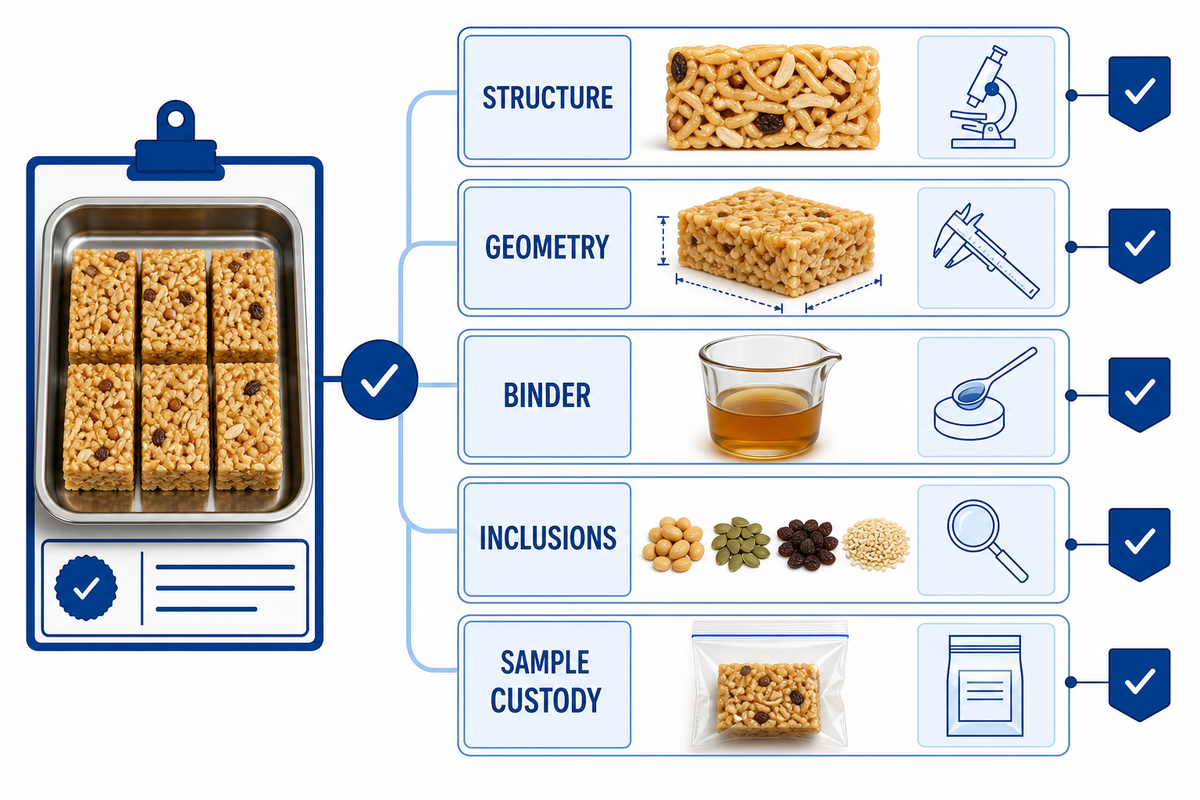
Trial results become unhelpful when the recipe changes while the machine is being judged. Freeze a condition-bound trial card with ingredient lots, flour and egg range, syrup type and temperature window, inclusions, strand width, slab thickness, cut length, target texture, package and allergen sequence. Record what may vary and what must not; the output definition above becomes the reference for this trial.
That control prevents a repeat-test risk: when a parameter changes without a record, the team cannot explain a failure or prove that the next sample is comparable. Link the trial card to the factory log, the buyer’s acceptance criteria and any applicable eCFR preventive-control reference or local food-safety review.
- Structure: airy, chewy, crisp or soft must be translated into break, compression, stickiness and visual criteria.
- Geometry: strand or piece dimensions need a measurement method and a tolerance, not a photograph alone.
- Binder: syrup distribution and set point should be recorded with time and temperature.
- Inclusions: sesame, peanut, raisin or regional flavors can alter feeding and changeover; list each separately.
- Sample custody: retain recipe revision, operator, date, line settings and pack sample so a later defect has a traceable cause.
Consumer flavor descriptions are useful prompts, but a plant acceptance test needs repeatable observations. If the team cannot say how a texture is scored—whether the target is crunchy, chewy or soft—the trial is still product development rather than equipment acceptance.
Accepted-Output Definition Card
Keep this named card with the trial packet. It ties kg/h, pieces/h, pack weight, yield, geometry in mm, thermal windows in °C and changeover minutes to one approved recipe revision. Later quotes can then be checked against the same evidence rather than against a marketing headline.
How to Balance Frying, Syrup, Forming, Cooling and Packaging
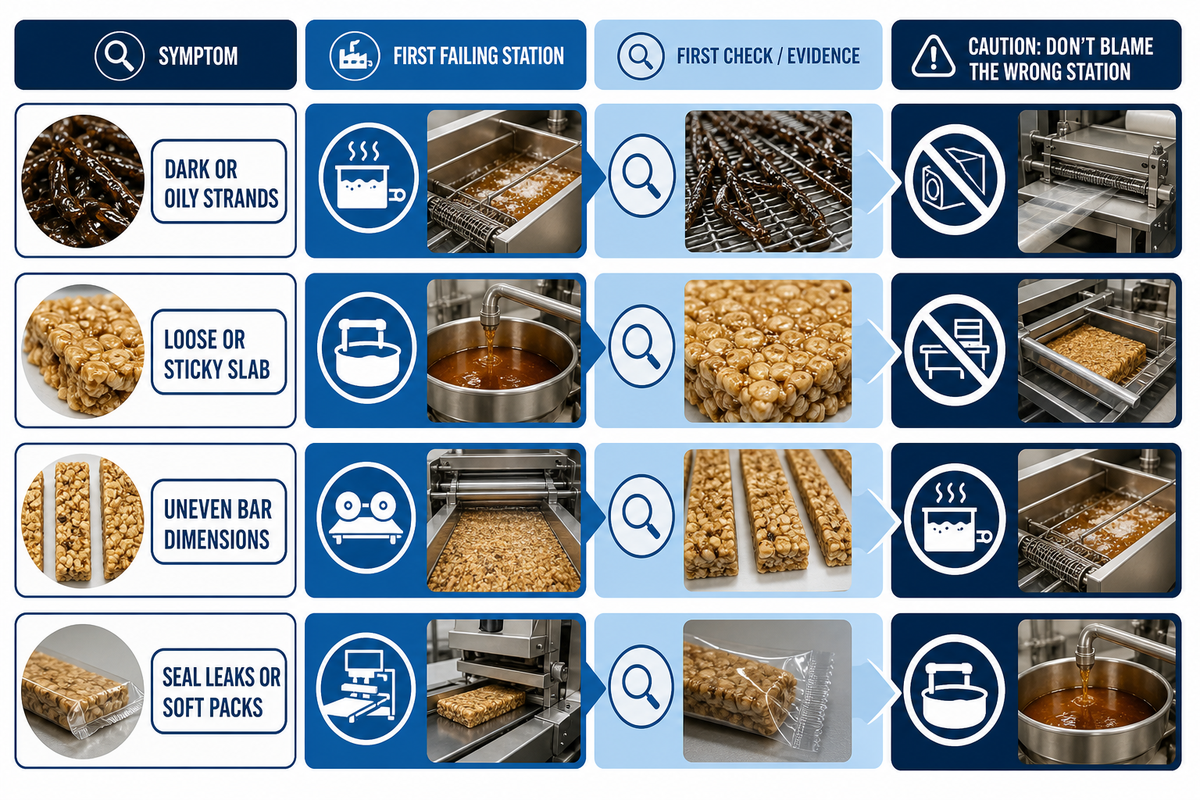
When output drifts, adjust one evidence-backed variable at a time. The First-Failing-Station Log records the symptom, last-good sample, station, variable changed, operator and accepted result. It stops downstream rework from masking an upstream problem; the trial card supplies the condition to compare.
Use the log during a factory trial and a production-line review, especially when a reject, leak or rework event appears after cooling or packing. The station owner, evidence reference and corrective action should travel with the sample rather than being inferred later.
| Symptom | Check first | Do not conclude yet |
|---|---|---|
| Dark or oily strands | Oil condition, fines, fry exposure and removal. | Do not blame the cutter before the fried structure is stable. |
| Loose or sticky slab | Syrup condition, mixing distribution and cooling endpoint. | Do not increase compression blindly; it can hide a binder issue. |
| Uneven bar dimensions | Forming pressure, feed spread, knives and transfer timing. | Do not compare pack counts until geometry is accepted. |
| Seal leaks or soft packs | Cooling, product temperature, film and sealing window. | Do not treat packaging as an unrelated downstream add-on. |
A good log makes a shift-to-shift conversation concrete: which condition changed, when did the first failure appear, and which sample passed afterward? That is more useful than a single “line speed” number without context. A peer-reviewed wafer-process study likewise shows why thermal distribution, sheet thickness and colour, and production rate should be read together; it is a comparison method, not a sachima setting. For U.S. planning, the sanitation and preventive-control boundary can be checked against the eCFR Part 117 text before a corrective action is closed.
What Utilities, Layout and Manufacturer Interfaces Should Be Confirmed?
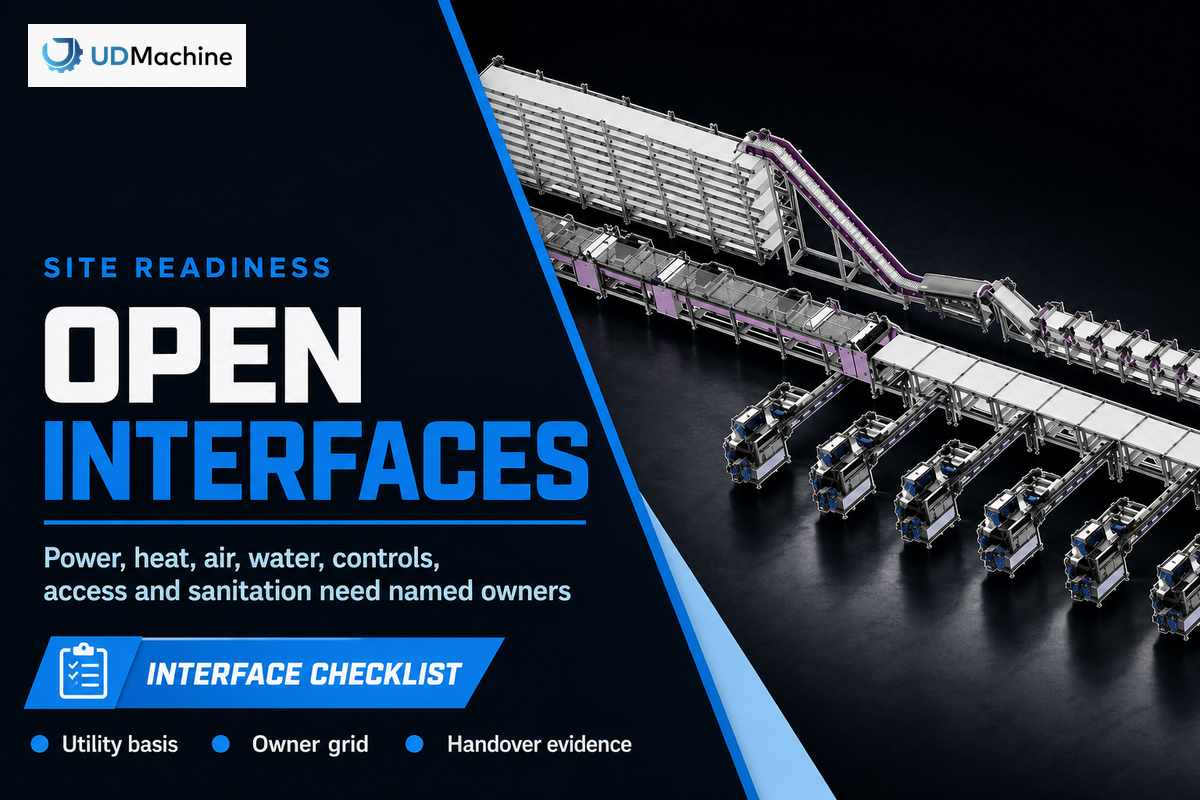
Installation risk often lives at the interfaces. Build an Open-Interface Owner Grid before a layout is frozen. For every utility or connection, name the design value, owner, connection point, isolation method, verification date and evidence required; the station log shows where an interface problem first appears.
| Interface | Questions for the RFQ | Evidence at handover |
|---|---|---|
| Power and heat | Available voltage, peak load, heat source, exhaust and local isolation? | Measured service values, drawings and commissioning record. |
| Air, water and drainage | Pressure/quality range, drains, washdown zoning and backflow controls? | Utility test, drain route and sanitation responsibility map. |
| Controls | Signals, alarms, recipes, permissions, historian and packaging handshake? | I/O list, alarm test and approved recipe revision. |
| People and access | Operator side, maintenance clearance, lifting path and emergency access? | Walkdown sign-off and updated layout. |
“Food grade” is not an interface specification. Teams still need to decide who supplies extraction, drains, conveyors, coding, inspection, guarding, training and documents. The eCFR sanitation reference is a useful U.S. checklist prompt for access, cleanability and responsibility boundaries, not a promise that one layout is compliant.
Open-Interface Owner Grid
Use this grid as a sign-off artifact: one row for power, heat, air, water, drainage, exhaust, controls, packaging, access and sanitation. Each row names an owner, design value, connection point and verification date.
How to Verify Cleanability, Allergen Changeover and Regulatory Fit
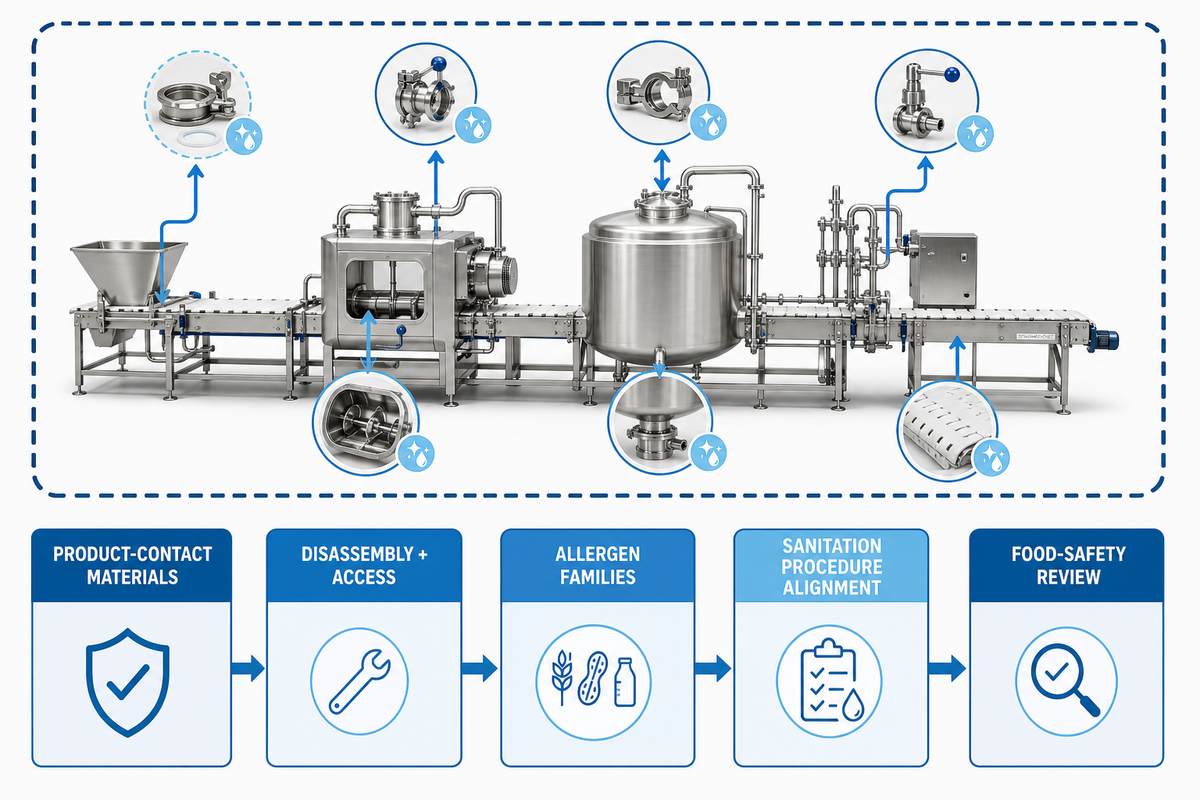
Separate four questions: can product-contact areas be accessed, can the operating team clean them, can an allergen changeover be verified, and which rules apply in the buyer’s jurisdiction? Current [21 CFR Part 117 text] is a United States planning reference for current good manufacturing practice and preventive controls where applicable. It is not a blanket certification of any equipment.
- List product-contact materials and any finish or gasket information supplied for the actual build.
- Mark disassembly points, dead-leg risks, access tools, cleaning agents and drying steps.
- Define allergen families, sequence, swab or other verification method, and release owner.
- Align the sanitation procedure with the recipe revision and the acceptance sample.
- Have the buyer’s food-safety lead confirm hazard analysis, local rules and any required validation.
A competitor may advertise an automatic cleaning system; that statement remains a competitor self-claim. Ask for the cleaning boundary, procedure, evidence and responsibility split for the line you are actually buying.
How to Build an Acceptance Evidence Pack (FAT and SAT)
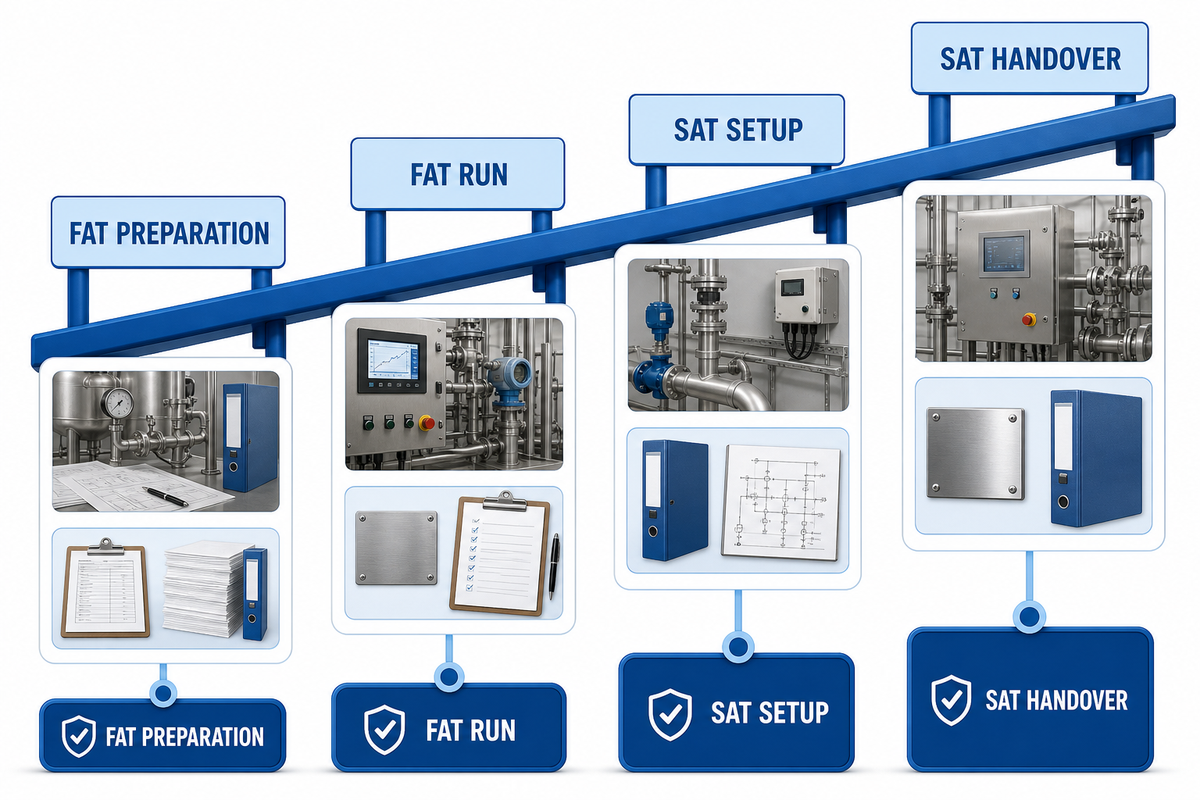
Factory acceptance testing and site acceptance testing become comparable when the condition is the same. An evidence pack should carry the approved recipe revision, utility condition, run duration, sample count, accepted-output definition, defect taxonomy, instrument identity, witness list and open-action owner; the cleaning boundary and responsibility split should be attached to that pack.
| Stage | Minimum evidence | Release decision |
|---|---|---|
| FAT preparation | Approved recipe, input lots, line scope, test method and safety checks. | Witnesses agree what “pass” means before the run. |
| FAT run | Time-stamped settings, utilities, samples, rejects, pack checks and deviations. | Accept, conditionally accept with owner, or record a repeat test. |
| SAT setup | Site utilities, room conditions, trained operators and recipe revision match. | Any changed condition is documented before output is compared. |
| SAT handover | Final samples, cleaning/changeover record, manuals, spares, training and punch list. | Operations owns a reproducible route, not just a running machine. |
This evidence ladder avoids the common surprise where FAT passes at a supplier site but SAT appears lower because the recipe, utility, cooling time or acceptance criterion changed. A conditional acceptance can be valid when the condition and owner are explicit; silence is not acceptance. Keep the applicable FDA FSMA planning reference beside the test pack so food-safety ownership is reviewed with the mechanical result.
How to Prepare a Comparable RFQ Without Hiding Exclusions
Use the Changeover Evidence Ladder to connect recipe revision, sanitation proof, trial sample, operator instruction and release sign-off. An RFQ should include an “included / excluded / owner / evidence” column for every item that can change the price or schedule.
An opaque exclusion is a procurement risk: it can create a cost gap, delay a factory handover or leave the buyer without a test report. Require the supplier to state the responsible owner, the evidence due and the acceptance consequence for every omitted conveyor, utility, sanitation or packaging item.
- Attach the product brief: ingredients, allergens, texture, geometry, pack, markets and variants.
- State accepted output, run window, yield definition, planned uptime and sample count.
- Describe utilities, room zoning, drainage, exhaust, controls and packaging interfaces.
- Request the trial plan and what the supplier will measure, retain and report.
- List FAT/SAT, manuals, drawings, spare parts, training, remote support and service geography.
- Require every exclusion to name its owner and the evidence due before handover.
The existing [UDTECH solution page] is the correct next step when this brief is ready to map to a configuration. Keeping model and quotation detail there preserves intent separation: this article helps the buyer ask a better question; the Page handles the commercial answer.
Changeover Evidence Ladder
Start with the base recipe, add one variant, verify sanitation and allergen release, run the accepted sample, then obtain operations sign-off. The ladder records what changed and which evidence must be repeated.
What 2025–2026 Snack Trends Change in Line Planning
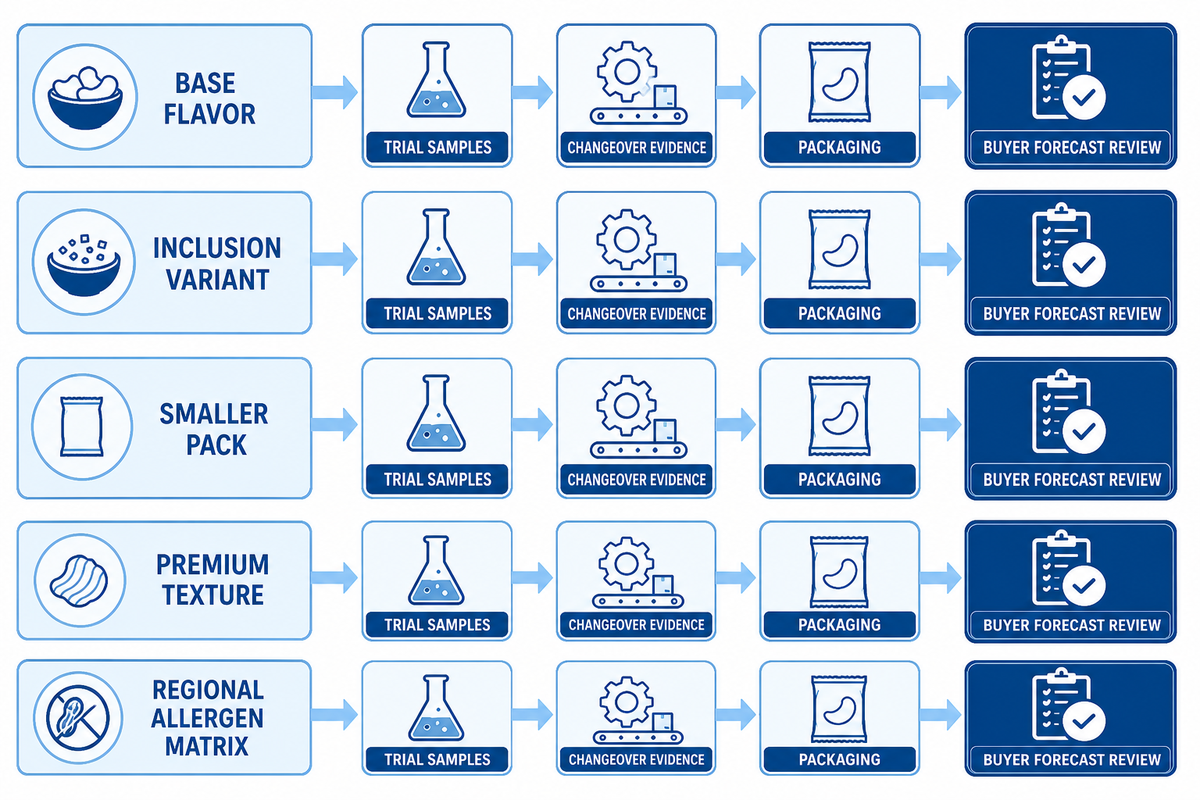
Euromonitor, SNAC and Food Business News describe value, global flavors, texture variety and occasion-based snacking as current category signals. They do not prove demand for a specific sachima line. Translate them into reversible scenarios: a base flavor, an inclusion variant, a smaller pack, a premium texture or a regional allergen matrix. Then validate each with samples, changeover evidence and a buyer-side forecast.
Planning around scenarios is safer than hard-coding a trend headline into capacity. A flexible brief can ask what changes between variants, how much sanitation time is required, what packaging modules are shared and which acceptance tests must be repeated. The applicable eCFR planning reference also keeps a market-led variant decision tied to documented preventive controls where required.
The planning risk is overbuilding from a macro signal that never becomes a confirmed order. Keep a reversible scenario matrix for the buyer and supplier, connect each forecast assumption to a factory trial or documented market evidence, and review food-safety and packaging implications before any production-line expansion.
FAQ
What does sachima mean?
Sachima, also written saqima, is a Chinese sweet snack or pastry generally described as fried flour or noodle-like strands bound with sugar syrup. For a plant, that definition is only a starting point: formulation, strand geometry, syrup condition, inclusions, cooling and pack format must be fixed before equipment trials or capacity comparisons. Consumer descriptions and recipes should not be copied as machine specifications.
What does sachima taste like?
Sachima is commonly described as sweet, lightly fried, chewy or fluffy, with texture changing by formulation, fry exposure and syrup binding. A buyer should turn those sensory words into acceptance language—break, chew, stickiness, color, inclusions and package integrity—and agree how samples will be scored. “Tastes right” alone is not a reproducible commissioning criterion or a substitute for a retained sample.
How do I choose a specialty snack line?
Choose by transformation, not supplier label. Decide whether the product is fried strands bound with syrup, baked sheet, extruded pellet, filled dough or hybrid. Freeze output, geometry, utilities, hygiene and acceptance evidence before reviewing UDTECH configurations or requesting a quotation.
Are there different flavors of Sachima?
Yes. Plain, sesame, nut, raisin and regional variations can change feeding, allergen changeover, mixing, cutting and packaging. Treat each flavor as a trial condition with a defined base recipe and documented changeover evidence; one successful variant does not prove every variant.
How should Sachima be stored?
Storage depends on recipe, water activity, package barrier, seal quality and local food-safety requirements. Specify the shelf-life study, cooling endpoint, residual-moisture target and pack integrity for the intended market, and record every assumption in the trial brief for each planned product variant.
Include the storage temperature, humidity assumption, carton or case configuration, coding and release owner in the product brief. If a nut, sesame or raisin variant is introduced, repeat the relevant allergen and package checks. A retail label can guide a question, but only a documented shelf-life study can set the commercial storage instruction for a finished product.
Where does the UDTECH solution Page fit?
The existing Page at /sachima-snack-lines/ holds UDTECH solution scope and configuration details. This guide covers product, route, interfaces, hygiene evidence, acceptance tests and RFQ questions before a request; keep model names, specifications, pricing and terms on the Page or quotation.
Ready to turn the brief into a line discussion?
Bring your product form, accepted-output basis, utilities, variants and FAT/SAT questions. Open the UDTECH enquiry form or review the sachima and specialty snack line solution scope.
Bring your product form, accepted-output basis, utilities, variants and FAT/SAT questions. Open the UDTECH enquiry form or review the sachima and specialty snack line solution scope.
References & Sources
External sources are used for context and are not recast as UDTECH performance claims. Competitor statements remain competitor self-claims; regulatory applicability remains jurisdictional.
- TSHS Sachima Machine and Equipment Supplier — competitor process description.
- World Grain: Sachima, a sweet snack with cult status — trade context.
- China Sichuan Food: Sachima — recipe and texture context.
- Electronic Code of Federal Regulations, 21 CFR Part 117 — United States planning reference.
- U.S. Food and Drug Administration, FSMA — food-safety planning context; applicability remains jurisdictional.
- Applied Sciences wafer-baking study — methodological analogy for thermal distribution, sheet thickness/colour, and production-rate variables; not sachima or UDTECH evidence.
- Euromonitor: Five key snack trends for 2025, SNAC International and Food Business News: snack trends to watch in 2026 — directional industry outlook.
Prepared for UDTECH technical review. Company-history and patent statements supplied in the brief are treated as attributed background pending independent verification. This guide does not replace a site-specific hazard analysis, validation plan or commercial contract.