Get in touch with UDTECH Company

Soft Waffle Production Line — 32, 60 and 80 Mold Configurations
- Quotation within 1 business day
- 9–13 weeks to factory acceptance
- 1,800 / 3,500 / 5,000 kg per 24 h
- Natural gas or LPG fired
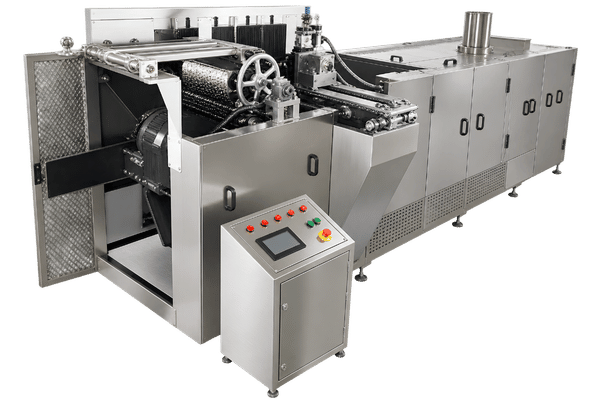
This soft waffle production line is a continuous gas-fired tunnel that deposits batter, bakes, releases and cools in one pass. You choose it by mold count — 32, 60 or 80 — and every figure below is published per configuration so you can size the line before contacting anyone.
Layouts and drawings you upload are encrypted.
- Quotation turnaround
- Within 1 business day
- Lead time
- 9–13 weeks, signed agreement to factory acceptance
- Minimum order
- One complete line
- Warranty
- 12 months on core components from factory acceptance, plus remote support for the machine’s life
- Installation
- 5–7 days on site with our commissioning engineers
- Power supply
- 380 V / 50 Hz three-phase standard; 220 V / 60 Hz on request
Three Mold-Count Configurations
Every configuration carries the same PLC control and the same automatic depositing, baking and release sequence. What changes is tunnel length and mold count, which sets output, floor run and gas demand together.
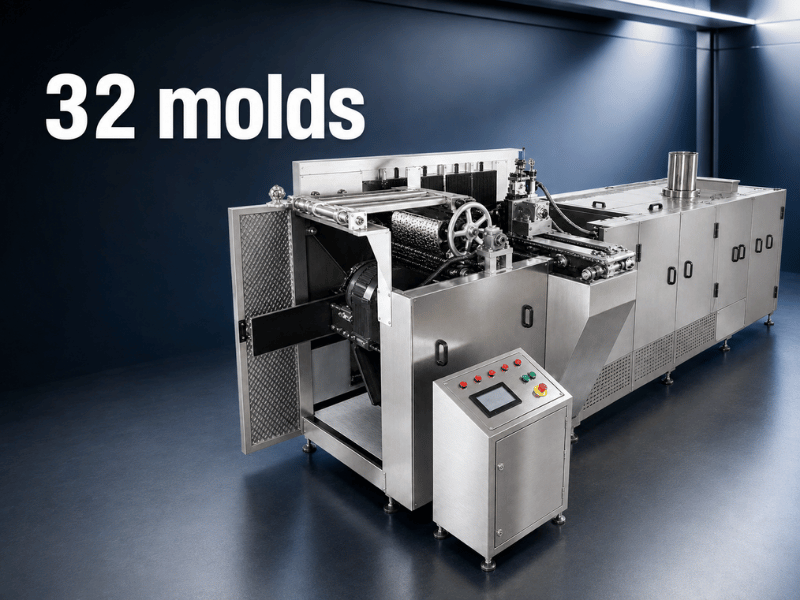
32 molds
- ~1,800 kg per 24 h
- 6.0 × 1.6 × 1.9 m
- 3 kW electrical
- Gas 8 m³/h or LPG 4 kg/h
The entry build, for a 6-metre free run.
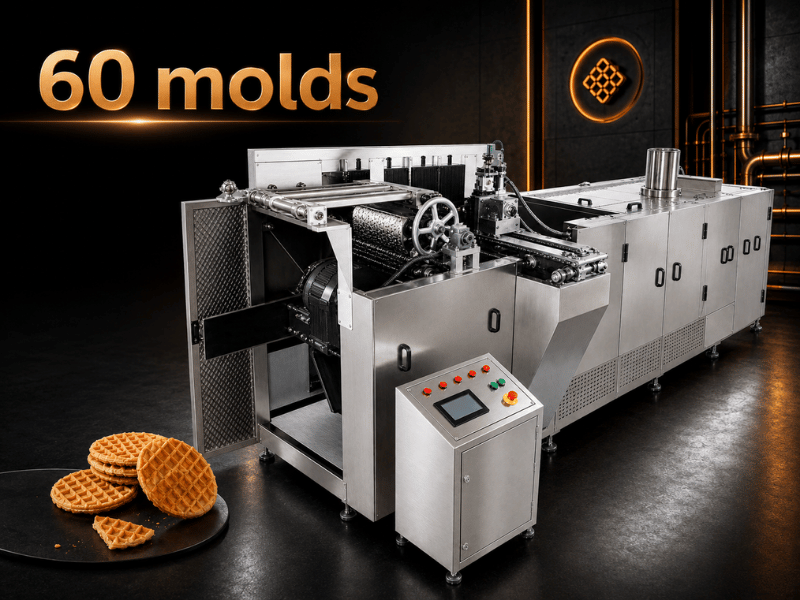
60 molds
- ~3,500 kg per 24 h
- 9.8 × 1.6 × 1.9 m
- 3 kW electrical
- Gas 14.5 m³/h or LPG 8 kg/h
Nearly double the output on the same electrical load, because the heat is gas-fired.
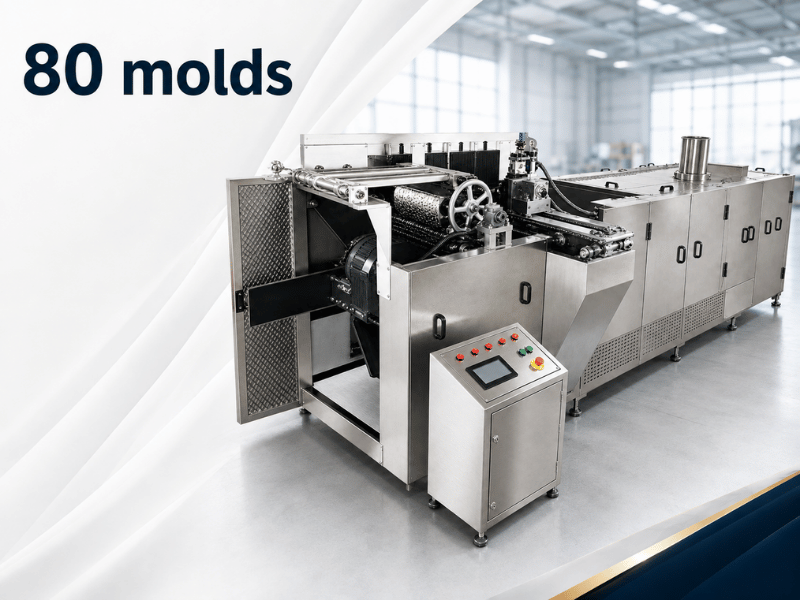
80 molds
- ~5,000 kg per 24 h
- 12.0 × 1.6 × 1.9 m
- 5 kW electrical
- Gas 19 m³/h or LPG 14 kg/h
Published research puts continuous industrial waffle baking at up to 200 kg of raw material per hour.
The bay-length ceiling: size from the building first
Most buyers start from a demand forecast and work down to a machine. That gets the order wrong: your free floor run is a hard limit no budget moves.
- Measure the longest uninterrupted run you can give the line, plus side access.
- Eliminate the mold counts that do not fit: 6.0, 9.8 or 12.0 metres.
- Only then check whether what fits meets your volume.
“Bigger is not always better. Think of ‘Goldilocks and the Three Bears’ … too small may not help you meet your goals, but too big might overwhelm your processing system.” — University of Idaho Extension, Bulletin BUL 1035
Formats this platform runs
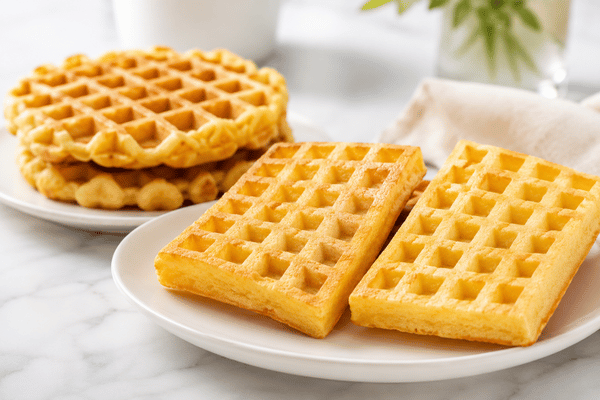
- Round scallop-edge soft waffles
- Rectangular grid waffles
- Small-diameter round waffles
- Pancake and flat baked formats on a baking-template change
- Shells for sandwich waffles, with the filling step downstream of the discharge conveyor
Not sure which configuration your building will take?
Send your bay dimensions and target output →Food-Contact Materials and Product Formats
Two things decide whether a baked-goods line clears a US food-safety audit: what the food touches, and whether those surfaces can be cleaned. Both are regulated and checkable.
- Food-contact surfaces — 304 stainless steel, with a food-grade non-stick coating on the baking plates.
- Plate substrate — ductile (nodular) cast iron, chosen for heat capacity, conductivity and resistance to closing pressure.
What “food-grade” has to mean in the United States
- A polymer coating used as a food-contact surface falls under 21 CFR 175.300, and for baking the category is Condition A — high temperature heat-sterilized (e.g., over 212 °F).
- Perfluorocarbon resins must meet the identity definition and extractives limitations of 21 CFR 177.1550.
- Ask any supplier which section their coating is qualified under, and for paperwork that matches your destination market.
One chassis, more than one product
The baking template defines the finished product, not the machine, so the same tunnel platform runs pancake and other flat baked formats on a template change.
Depositing, Baking, Demoulding and Cooling
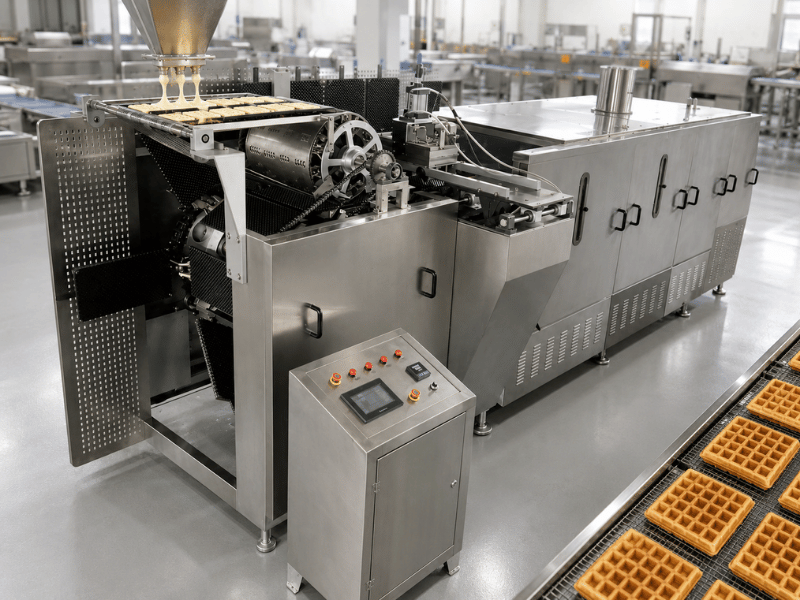
The supplied line starts at batter depositing and ends at the discharge conveyor. Waffle batter is poured rather than sheeted like a bread dough, so upstream you need a dosing room, not a dough line.
Stage
What happens
What it needs from your plant
Depositing
Metered batter enters each mold under the head.
Stable batter temperature and viscosity.
Baking
The mold closes and travels the heated tunnel while the structure sets.
Gas service sized to the build, plus extraction.
Demoulding
The mold opens; release is by needle take-off or air blow.
Treated compressed air at 0.6 m³/min if air blow is specified.
Cooling and discharge
Product leaves on the discharge conveyor at a controlled rate.
Cooling run and packing interface sized to your product.
Why the tunnel is a clock, not a conveyor
Baking time is set by conveyor speed, so at a fixed chamber length choosing the speed is choosing the bake time. Published practice puts the waffle window at 140–180 °C for 110 to 180 seconds.
A longer tunnel does not bake faster: it holds more molds in the same dwell time, so mold count and output move together.
The same principle runs across our baked-snack equipment; we have written up how batter dosing and heated-mold baking are controlled.
Two release methods, selected at order
Vertical needle take-off is the standard release method in industrial waffle production. Air blow is the alternative, where mechanical contact is undesirable.
If you specify air blow, specify the air quality with it
FDA cGMP requires compressed air used on food-contact surfaces to be treated so food is not contaminated.
ISO 8573-1 is the classification standard written into specifications. The British Compressed Air Society’s Guideline 102 (BPG102-1, revised June 2022) puts direct-contact air at class 2:2:1, a pressure dew point of −40 °C. It is a voluntary code, and the dryer and filter train are plant side.
The release paradox worth knowing before you buy any waffle line
The instinct is to judge a release system by the force needed to lift the waffle off the plate. On instrumented trials the metric inverts.
- Under identical bake conditions on the same equipment, a potato-starch formulation stuck on under 7% of waffles.
- A rice flour formulation stuck on almost 50% — roughly a sevenfold swing in scrap from a recipe change alone, hardware unchanged.
- Sticking is not only scrap: it interrupts baking, forces a cleaning stop and restarts the energy-intensive warm-up, and that is the real risk a release decision manages.
- Both options share the same mold-chain geometry, so the acceptance criteria are measured on your product at the factory acceptance test, because release follows the recipe.
Full Specification Table by Configuration
Every figure comes from the manufacturing specification for this line. Rows marked derived are this page’s own arithmetic, shown so you can check them.
| Specification | 32-mold | 60-mold | 80-mold |
|---|---|---|---|
| Mold count | 32 | 60 | 80 |
| Overall dimensions | 6.0 × 1.6 × 1.9 m (19.7 × 5.2 × 6.2 ft) |
9.8 × 1.6 × 1.9 m (32.2 × 5.2 × 6.2 ft) |
12.0 × 1.6 × 1.9 m (39.4 × 5.2 × 6.2 ft) |
| Output per 24 h | approx. 1,800 kg (3,970 lb) |
approx. 3,500 kg (7,720 lb) |
approx. 5,000 kg (11,020 lb) |
| Output per hour (derived) | 75 kg/h | 146 kg/h | 208 kg/h |
| Output per 8-hour shift (derived) | 600 kg | 1,167 kg | 1,667 kg |
| Output per 16-hour day (derived) | 1,200 kg | 2,333 kg | 3,333 kg |
| Electrical load | 3 kW | 3 kW | 5 kW |
| Natural gas | 8 m³/h (283 ft³/h) | 14.5 m³/h (512 ft³/h) | 19 m³/h (671 ft³/h) |
| Heat input (derived) | approx. 293,000 Btu/h | approx. 530,000 Btu/h | approx. 695,000 Btu/h |
| LPG alternative | 4 kg/h (8.8 lb/h) | 8 kg/h (17.6 lb/h) | 14 kg/h (30.9 lb/h) |
| Compressed air | 0.6 m³/min | 0.6 m³/min | Confirmed with your order |
| Supply voltage | 380 V / 50 Hz three-phase standard; 220 V / 60 Hz on request | ||
| Control | PLC control with an operator panel | ||
The same-clock test: reading a kg/24h figure against a competitor’s kg/h figure
Throughput is quoted on at least three bases and they are not interchangeable: a line advertised at 364 kg/h is not necessarily larger than one at 5,000 kg per 24 h.
The three derived rows put every build on the same clock: divide by 24, then multiply by your shift.
They are nameplate figures with no discount for availability or yield — our method for discounting nameplate output by real operating efficiency applies directly.
Reading the gas figure: compliance, then cost
At the US average heat content of 1,036 Btu per cubic foot, all three builds sit above OSHA’s 150,000 Btu/h threshold.
Above it, a direct-fired oven must be pre-ventilated with four complete changes of the baking-chamber atmosphere before ignition.
The flame-failure rule is written per burner, not per oven: any individual burner over 150,000 Btu/h needs a safeguard reacting within two seconds. Confirm burner count on the gas-train drawing.
For cost, compare energy per kilogram, not per hour: a peer-reviewed study of an industrial wafer baking oven reports 3.20 kWh of gas per kilogram.
Quotation, Lead Time and What a Quote Includes
Price follows configuration, heat source, control package, certification scope and the interfaces at each end. There is no catalogue price; your figure comes back itemised.
What moves your number
Driver
Effect on cost
How to control it
Mold count
Sets tunnel length, chain length and burner count.
Size from your bay and shift plan.
Heat source
Gas and LPG builds differ in train and safety devices.
Confirm the fuel your site will run.
Release method
Needle take-off and air blow are different mechanisms.
Decide from a trial on your recipe.
Certification scope
Marks are issued against the configuration shipped.
Name your destination market at enquiry.
Interfaces
Batter delivery upstream, cooling and packing downstream.
Fix both at drawing review.
How your quotation is produced
Send your target output, fuel, bay dimensions and destination market. We reply within 1 business day with a configured quotation, a scaled calculation sheet and a reference list.
Stage
Elapsed time
What it covers
Signed agreement to factory acceptance
9–13 weeks
Build, assembly, acceptance test.
Sea freight
Scheduled separately
Varies by destination, quoted with your shipment.
Installation and commissioning
5–7 days
Set-up, calibration, production qualification.
Operator training
2–3 days
Operator and maintenance tracks; handbook in English and Chinese.
Lead time starts at signed agreement and excludes sea freight and installation. Minimum order is one complete line.
The cost that outlives the invoice
Bakery equipment buyers are documented as anchoring on purchase price because it is the only tangible number in front of them. On a tunnel oven that is the wrong anchor: what it costs to equip the bay opens a ledger that runs for decades.
“Reading Bakery Systems puts the service life of an industrial baking oven at 30–40 years in production.”
— Tremaine Hartranft, VP Technical Growth and Strategy, Reading Bakery Systems, in baking+biscuit international“Ovens account for 35–45% of the total site carbon emissions of a bakery. A peer-reviewed review of tunnel ovens reports the share of supplied heat absorbed by the product can fall to around 16% in direct-fired operation.”
That is why we publish the gas rate per build: put 8, 14.5 or 19 m³/h against your own tariff.
Contact Materials, Hygiene, Machine Safety and Documentation
A US plant judges a waffle line by three separate reviews — food safety, machine safety, electrical acceptance — and clearing one does not mean clearing another.
- Assembly inspection against the configuration in your written quotation.
- Dry running of the chain, mold opening and closing, and control sequence.
- Factory acceptance test with your product, run to the written acceptance procedure.
- Documentation set packed with the line before dispatch.
FDA cGMP is specific about what a food-contact surface has to be, not only what it is made of: corrosion-resistant, nontoxic, and designed to withstand food and cleaning compounds.
- Seams must be smoothly bonded to minimise food particles and allergen cross-contact.
- Conveying systems must be designed so they can be kept in an appropriate condition.
- Compressed air on food-contact surfaces must be treated so food is not contaminated — the clause that decides whether air blow is acceptable in your plant.
- Changeover between formats is an allergen question for your sanitation plan, not a machine datasheet.
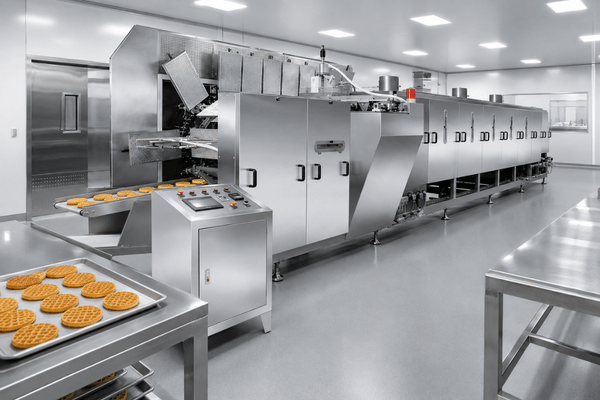
Machine safety and gas-train items to confirm at order
OSHA’s bakery equipment standard applies to the design, installation, operation and maintenance of machinery used within a bakery.
Item
What the rule requires
Pre-ignition purge
Four complete atmosphere changes before ignition, repeated after any safety shutdown.
Flame failure
A safeguard reacting within two seconds, manual reset before restart.
Main gas shutoff
One manual shutoff per oven, ahead of all other valves, lockable closed.
Electrical isolation
A main disconnect, quickly reachable, lockable open.
Emergency stops
Buttons near the points where operators are stationed.
Guarding
Gears enclosed; sprockets and V-belt drives enclosed within 8 ft 6 in of the floor.
Oven siting
Not adjoining lockers, lunch or sales rooms, passageways or exits.
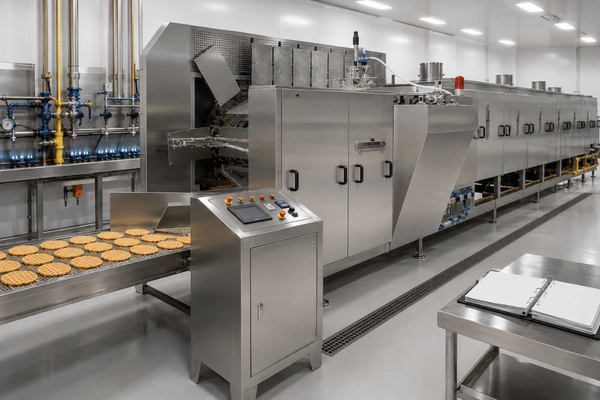
Standards your auditor will name
- NRTL listing — electrical equipment is acceptable in a US workplace only if listed by a Nationally Recognized Testing Laboratory, and industrial LPG appliances are on OSHA’s list.
- ANSI Z50.1 and Z50.2 — bakery equipment safety and sanitation, explicitly voluntary.
- NSF/ANSI 2 names bakery processing equipment in its scope; NSF/ANSI 4 covers commercial cooking equipment and is the wrong reference.
- EU 1935/2004 Article 16 requires a written declaration of compliance. EU 2023/1230 replaces Machinery Directive 2006/42/EC from 20 January 2027.
From Enquiry to Running Production
01
Send your requirement
output, format, fuel, bay dimensions, destination market.
02
Configuration review
we confirm which mold count fits your bay and volume.
03
Written quotation
within 1 business day — itemised, with a scaled calculation sheet and a reference list.
04
Trial run
we bake your own raw material and send video and photo evidence.
05
Build and factory acceptance
9 to 13 weeks from signed agreement. If the line does not meet the procedure, it does not ship.
06
Installation and training
5 to 7 days on site, then 2 to 3 days of operator and maintenance training.
Site readiness checklist
Every item below is yours to confirm, and every one has stopped a commissioning somewhere.
Check
What to confirm
Electrical service
208/120 V or 480/277 V, phase configuration, full-load current, and whether an isolation transformer is needed.
Gas service
Pressure and capacity against 293,000 / 530,000 / 695,000 Btu/h, plus regulator and relief.
Ventilation and heat load
Exhaust routing and make-up air. Bakery studies link temperatures above 35 °C to worker health risk and reduced output.19
Floor run and clearance
6.0, 9.8 or 12.0 m straight, access both sides, 1.9 m height.
Oven siting
Not adjoining lockers, lunch or sales rooms, or exits.
Compressed air
0.6 m³/min if specified, treated to your scheme’s class.
Batter supply
Published trials keep batter in the low-to-mid 20s °C, below a 300-second flow-cup time.1
Cooling and packing
Run length and packing rate matched to your configuration.
A maintenance obligation that names the manufacturer
Ask any supplier how they will meet the annual part before you sign.
OSHA requires all safety devices on ovens to be inspected not less than twice a month by an especially appointed, properly instructed bakery employee, and not less than once a year by representatives of the oven manufacturers.
What We Can Show You Before You Order
Buying capital equipment overseas is a confidence problem before it is a specification problem. A machinist on a trade forum put it plainly:
“I think that one major difference is the confidence factor … So I find it difficult to gamble large on them.” — Practical Machinist forum thread on imported machine tools
- Reference list of comparable installations
- Our factory acceptance test procedure
- Our inspection-notice procedure
- A line-by-line breakdown of the quotation
- A factory trial on your own raw material, with video and photo evidence
- Specification and machine video in place of a physical sample unit
- Witnessed factory acceptance, in person or remotely
Dimensional and visual inspection by an independent body is a recognised conformity-assessment activity under ISO/IEC 17020, with US accreditation through A2LA. Name the body at enquiry and we schedule the factory acceptance test around their availability.
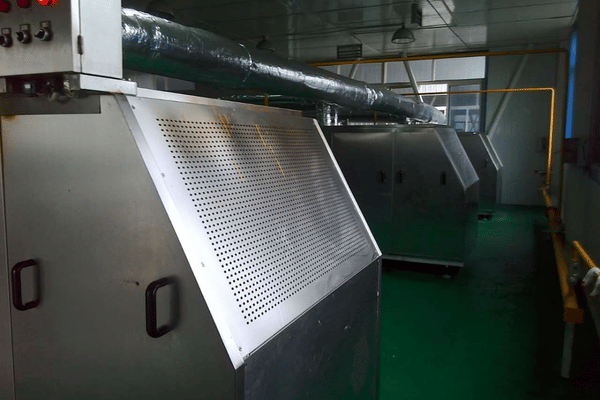
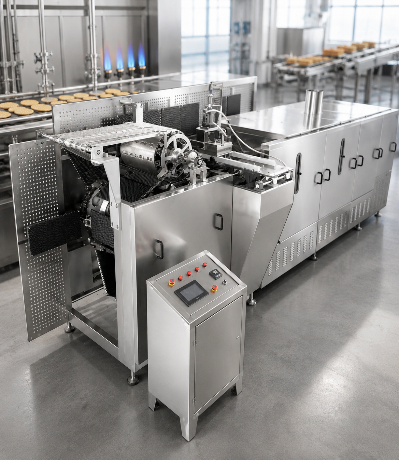
A line of this type installed and running in a food plant, exhaust duct routed overhead.
Start with the reference list rather than the price. It is the fastest way to find out whether we are worth a quotation —
When This Line Is Not the Right Choice
A continuous tunnel is the right answer for sustained volume on a stable format. Three situations make it the wrong call.
- The trade-off is worth stating plainly: a longer tunnel buys you output and costs you warm-up time, floor run and thermal mass on every restart.
- That is why bigger is not always the safer purchase, and why the third column below says where to look instead.
| Situation | Why it works against you | What to do instead |
|---|---|---|
| Free floor run under 6 metres | The shortest build is 6.0 m before access clearance, and no mold count solves a bay that is too short. | Look at a rotary batch machine, or re-plan the run. |
| Frequent changeovers across small runs | A tunnel rewards long runs; every stop re-pays the start-up heat, and a longer tunnel has more thermal mass to bring back. | Size down rather than up, or group volume per run. |
| Batter room not in place yet | This line starts at depositing and cannot compensate for batter arriving unstable in temperature or viscosity. | Fix the mixing side first, then commission into a stable supply. |
One honest limit applies to any waffle line, ours included: release is a property of the recipe as much as of the machine, so a supplier who guarantees it on a formulation they have never run is guessing.
Adjacent equipment that is not this machine
- If your product is rolled or filled after baking, see why a roll-forming line is a different machine category.
- For baked wafer and egg-roll formats, see our gas-fired wafer egg roll line.
Not sure which of these three you are in? Send the bay dimensions, format and run lengths you expect —
Get a straight read on fit →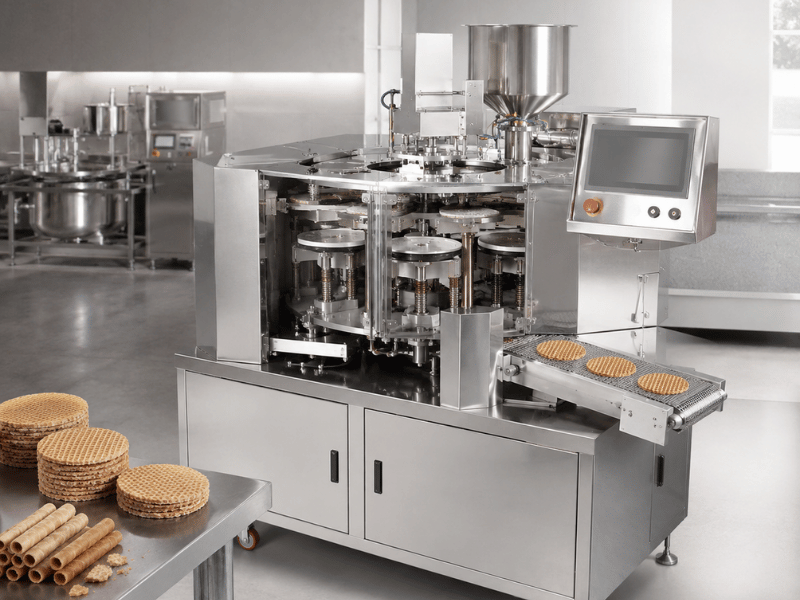
Soft Waffle Production Line: Engineering & Planning Tools
Mold-Count Selector
Calculate the exact mold configuration required based on your target capacity and maximum available bay length.
Gas and Energy Cost Estimator
Project your 24-hour thermal input and electrical load demands against local utility tariffs to benchmark operational costs.
Shift Output Planner
Translate maximum nameplate capacity into realistic shift yields using configurable efficiency and uptime variables.
Frequently Asked Questions
Technical clarity and operational answers on line sizing, facility fit and factory acceptance for industrial baked-goods production.
We quote by mass, because pieces per hour depends on your finished unit weight. Send your target unit weight and format and the quotation converts it.
The machines are 6.0, 9.8 and 12.0 metres long, 1.6 m wide and 1.9 m high, plus side access. Note that 29 CFR 1910.263 prohibits siting an oven adjoining lockers, lunch or sales rooms, passageways or exits.9
Two methods, selected at order: vertical needle take-off, the standard in industrial waffle production, and air blow. Which suits your product is a question for a trial — published research shows sticking swinging from under 7% to nearly 50% on identical equipment from a recipe change alone.1
The baking template defines the finished product. Send the product you want to add and we confirm whether it is a template change or a different mold geometry.
Our engineers carry out set-up, recipe calibration and production qualification over 5 to 7 days. Operator training follows over 2 to 3 days in two tracks, with the handbook supplied in English and Chinese.
It depends on the configuration, the release method and how your packing end is arranged, so it is confirmed against your layout in the quotation rather than published as one number.
Not reliably. Research on industrial waffle production found that, in contrast to bread flour, waffle quality cannot be predicted from classical rheological parameters such as the farinogram or extensogram1 — which is why we run a trial bake on your own material.