Get in touch with UDTECH Company

Seaweed Egg Roll Machine for Nori-Wrapped Wafer Snack Lines
Ships in 25–40 working days
30% deposit, 70% before shipment
Single-machine orders accepted
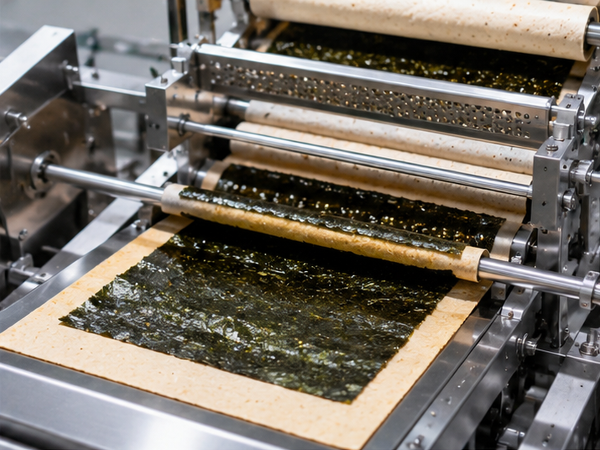
A seaweed egg roll machine bakes a thin wafer and lays a nori sheet onto it in the same timed pass, then slits the continuous roll to a set length. It’s a baking line, not a frying line. If you came here for a Korean rolled-omelette recipe, this page is about the production machinery instead.
Send a sample, not a specification
Send the roll you want to make and we work back from the product.
Technical Specifications
Output
About 500 rolls per hour on the standard four-zone build
Footprint
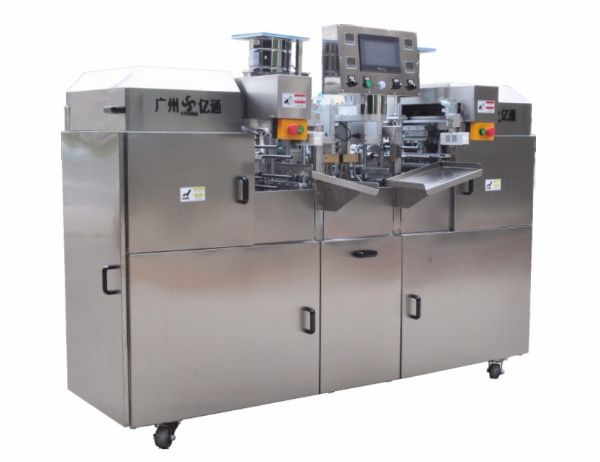
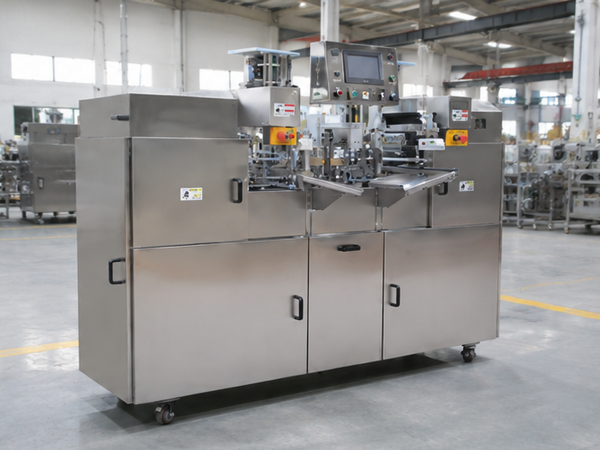
2,120–2,200 × 1,450 × 1,560 mm (83.5–86.6 × 57.1 × 61.4 in)
Connected load
4 × 2.5 kW heating plus 1.1 kW drive
Power supply
Three-phase four-wire 380 V ±10%
Compressed air
0.2 m³/min at 0.6 MPa or above
Minimum order
Single machines, no minimum order quantity
Warranty
12 months from installation, materials and workmanship
Build time
25–40 working days after your deposit clears
Nori Lamination, Station by Station
Hand-rolling this snack caps a plant at what a team can finish in a shift, and the nori sheet is the part that goes wrong. It tears, it slips out of register, and the bake is judged by eye.
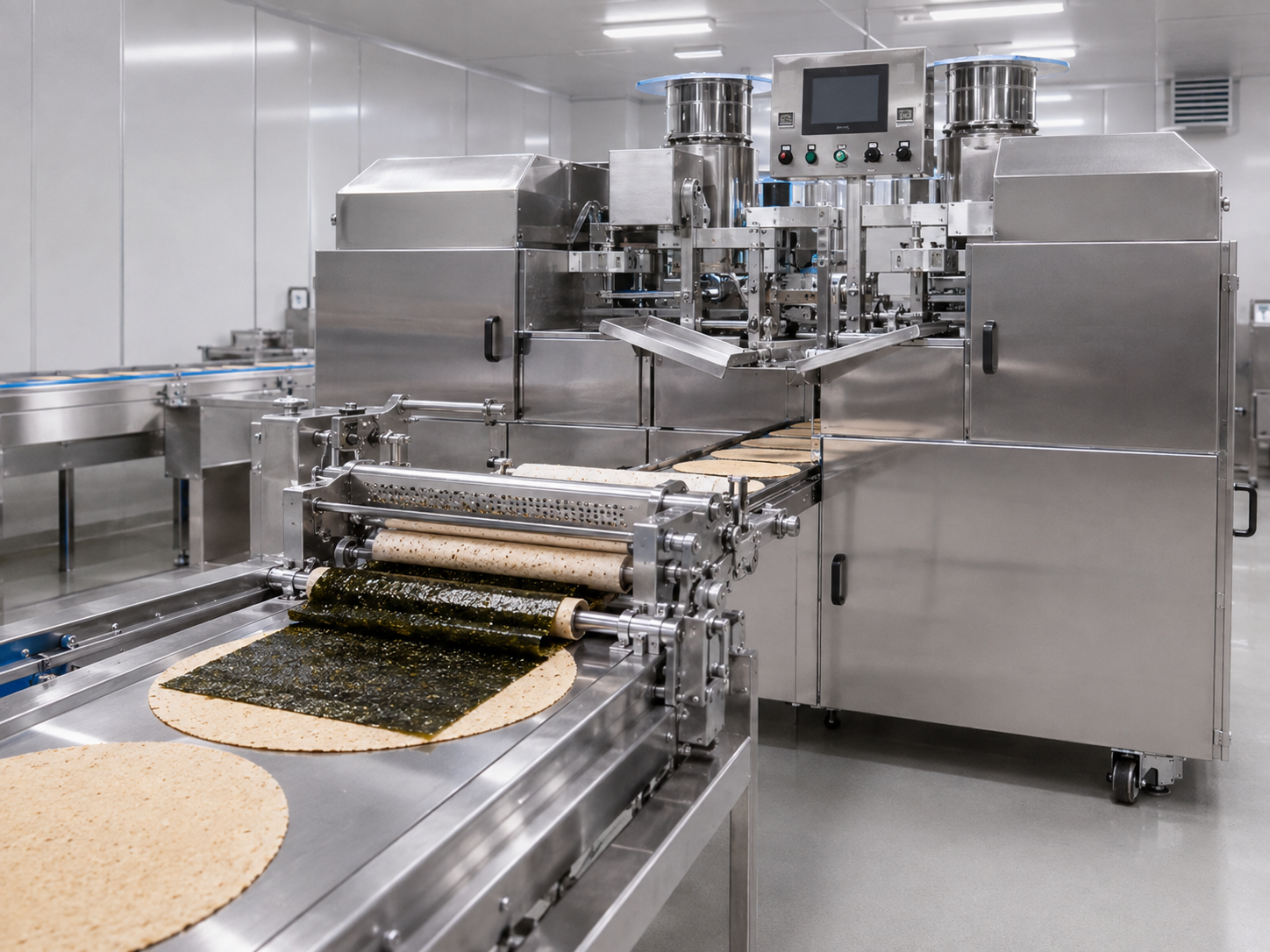
The four stations, in order
Station 01
Pre-forming
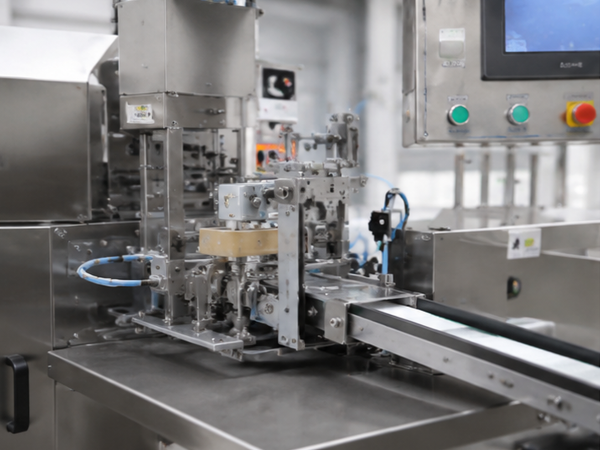
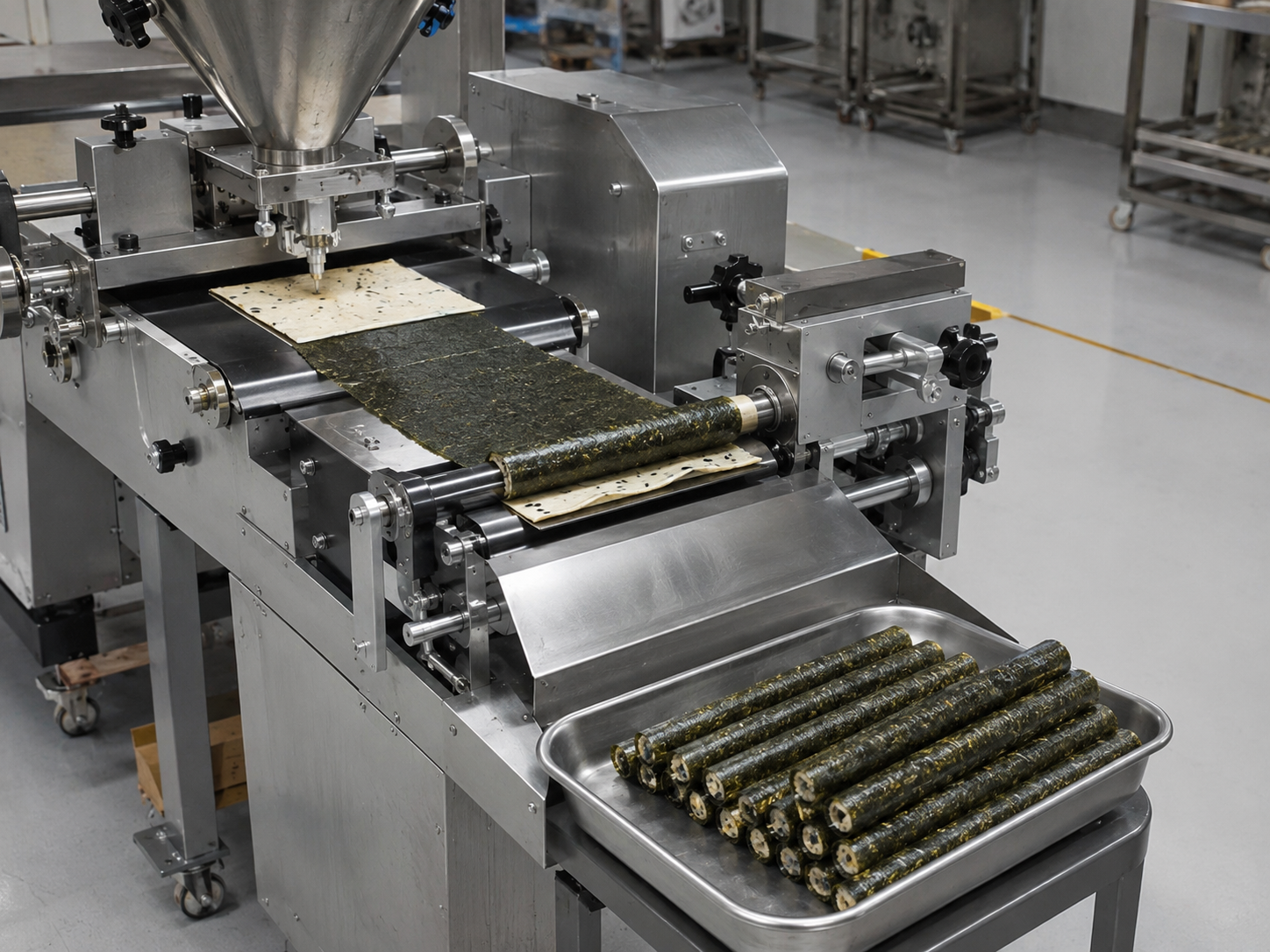
The frame carries a slurry supply, a nori sheet supply and the pre-forming assembly. Batter is metered onto the mould while the sheet supply places the nori beneath it, and the strip takes its first shape against temperature-controlled moulds.
Station 02
Conveying
A belt carries each strip into the forming unit while holding its registration. Register is the whole problem here: sheet and strip have to arrive together, in the same place, every cycle.
Station 03
Three-stage wrapping
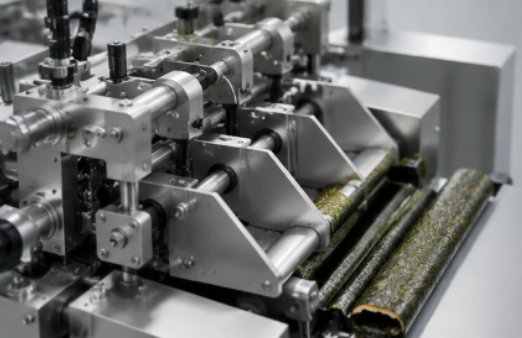
A single-sided wrap, then a reverse wrap that closes the coverage, then a compaction pass that sets the final roll.
Station 04
Slitting
A high-precision slitting unit with twin conveyor knives cuts the continuous wafer roll to the length you set.
Which stations are food area
In EN 1672-2 zoning terms the pre-forming station and the three wrapping stages are food area, the slitting and discharge side is splash area, and the drive enclosure is non-food area. That is the map a hygienic-design engineer needs before walking the line, and it is why plate access drives both the changeover and the clean.
Why the thermal window matters more than the roll speed
The line is built around one constraint, and it isn’t speed. The wafer-baking literature puts the plate surface at 150–180 °C, and Tiefenbacher reports plates working continuously between 170 and 200 °C.
A 2025 study of flat wafer sheet baking measured the sheet leaving the plate at 120–127 °C, and that’s the surface the nori meets — which is why register and timing are one problem in production rather than two.
The same study measured sheet thickness at about 2.8–3.2 mm, thin enough that a few seconds of drift shows up as colour before it shows up as a reject.
Baking a liquid batter between closed plates raises around 1–1.3 bar of internal steam. Vapour that isn’t vented gives uneven colour and brittle patches, because the moisture left behind is what makes the sheet stick.
Those are flat wafer sheet figures from the published literature, not this machine’s setpoints. We publish them because they’re the physics the line has to work inside; your own settings are confirmed against your recipe at the pre-shipment test.
Three Ways a Line Puts Nori on the Roll
“Seaweed egg roll machine” covers three different machines in our range, and they are not three settings of one machine. We separate them by nori entry point — where in the sequence the sheet meets the wafer — because that one choice decides the finished format, the rate and whether a filling is even possible.
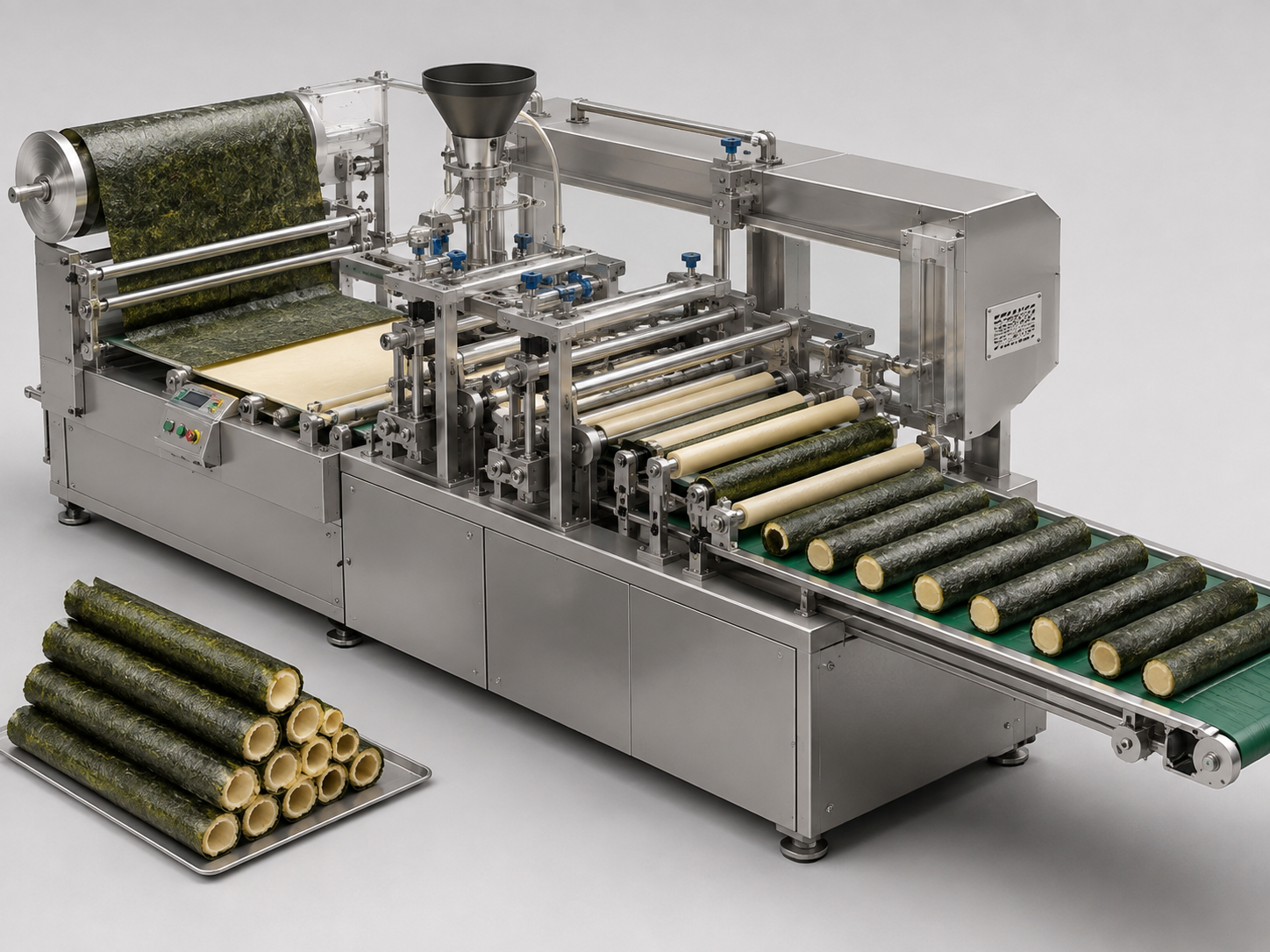
Route 01
In-line synchronised forming
UD-HT
How the nori enters
The pre-forming station meters batter and feeds the nori sheet in the same pass, then three wrapping stages close the coverage.
Finished roll
Fully nori-wrapped wafer roll.
Rate
About 500 rolls / hr
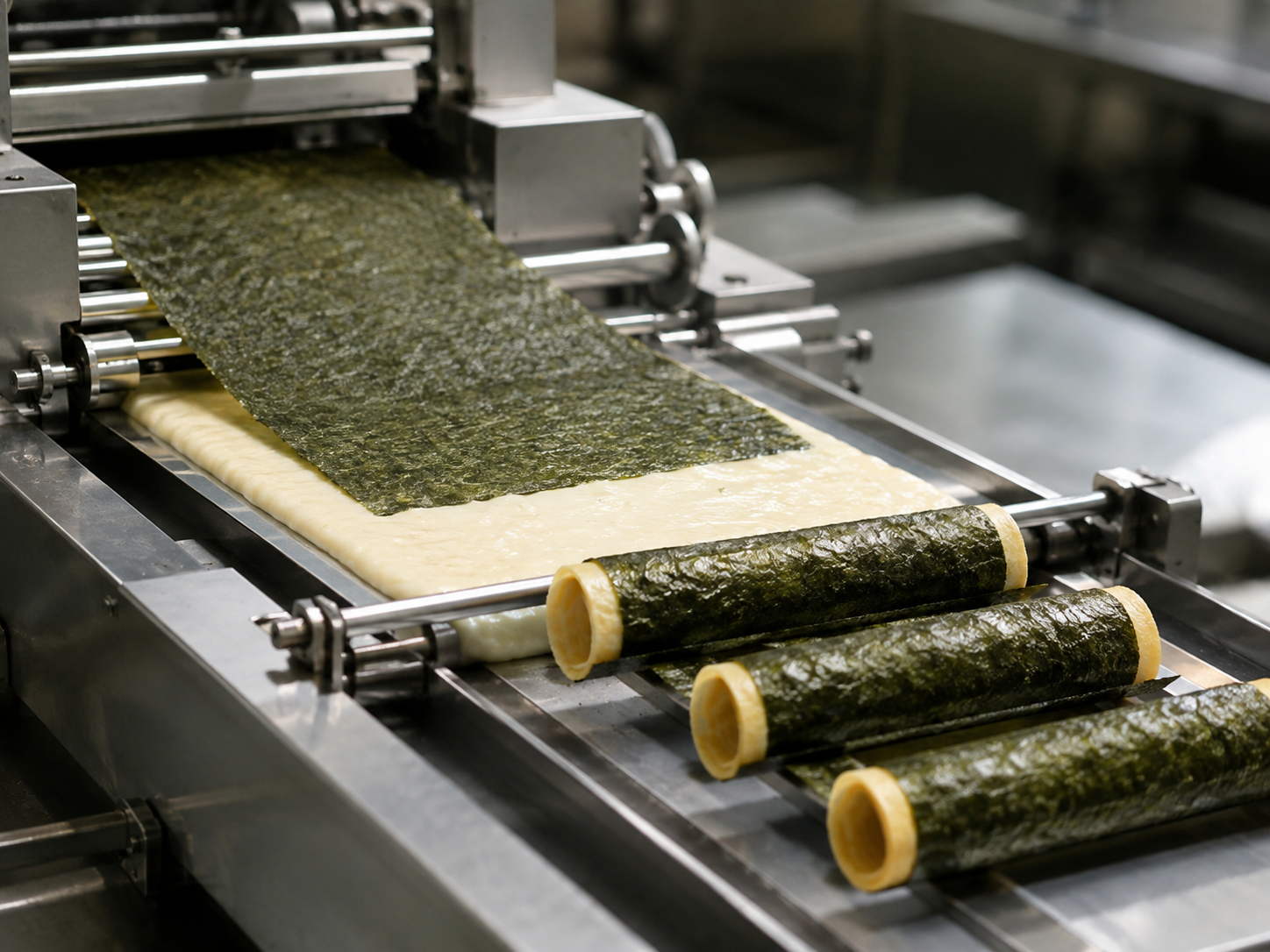
Route 02
Rotary station placement
Phoenix roll machine
How the nori enters
The rotary station places the nori, meters the batter, bakes, folds, rolls and discharges with no operator between stages. Granular and powder fillings are added at the same station.
Finished roll
Phoenix roll with nori and a filling.
Rate
720–780 pieces / hr
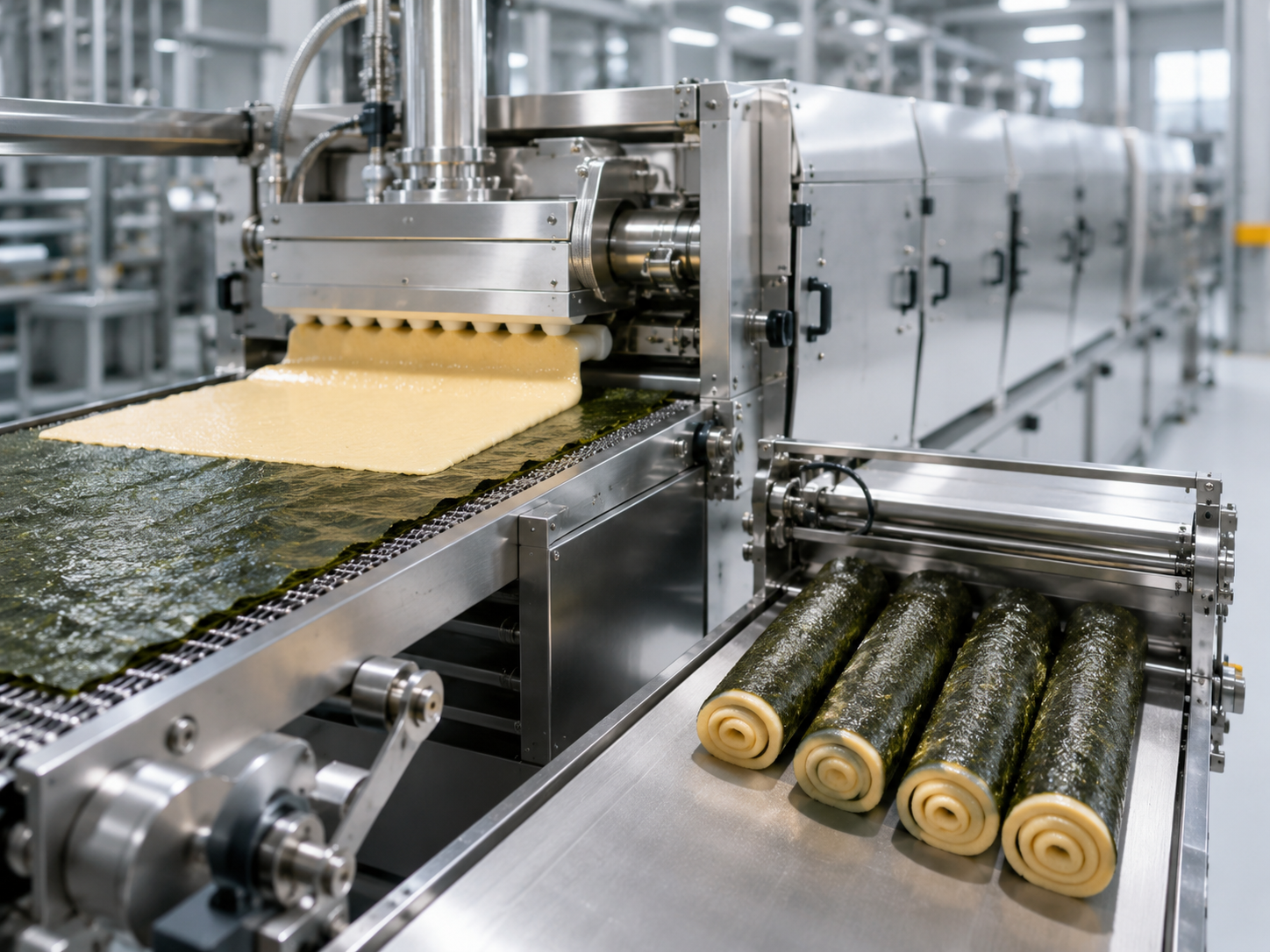
Route 03
Eight-mould rotary placement
Mini roll machine
How the nori enters
Slurry feed, baking, automatic nori addition and folding run as one uninterrupted sequence across eight moulds.
Finished roll
Small-format nori roll.
Rate
720 rolls / hr
-
Running one nori-wrapped roll as a continuous line item — the in-line route, because the wrap is part of the forming pass rather than a second operation.
-
Selling a filled premium roll into gift and e-commerce channels — the rotary phoenix route, because the filling station is already in the cycle.
-
Packing a small-format snack in single-serve counts — the eight-mould route, because the mould set is sized for it.
Send the finished roll you want to make. If none of the three routes suits it, we will say so rather than sell you the closest machine we happen to build.
Send the roll you want to makeRoll Length, Flavour and Format Options
On a continuous wafer roll line the cut decides the length. The hot strip is wound into a continuous tube and a downstream cutting device separates it into rolls of a predetermined length, a sequence documented in the wafer-forming patent record since 2001.
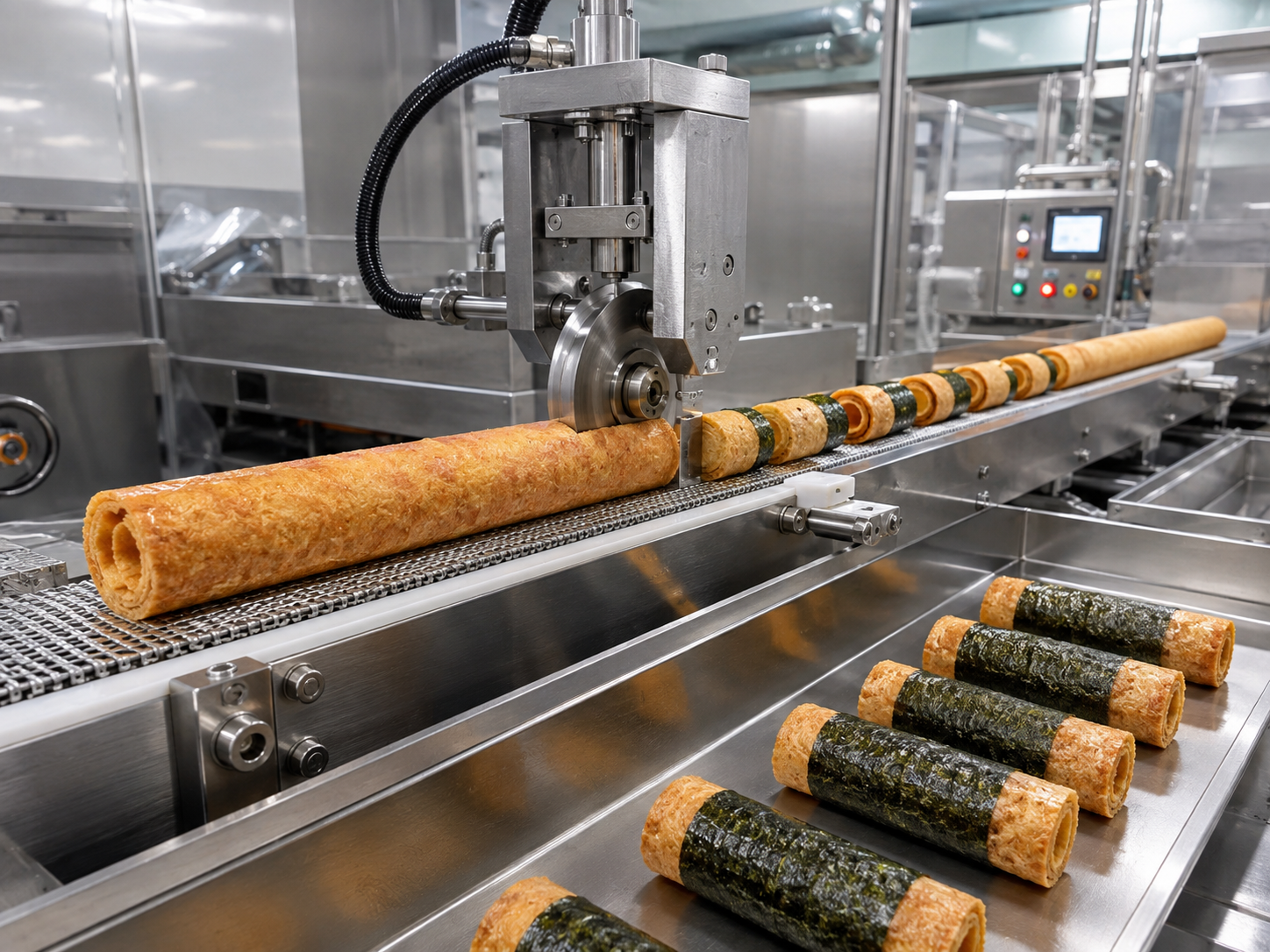
- Cut length — the slitting unit is set to the figure fixed on your order and confirmed against your own finished roll at the pre-shipment test. Changing the length later is not always a setting. On some wafer-cutting machinery length is decided by blade spacing, so we confirm at quotation which applies to your build — that is what decides whether a later format change is a control change or a tooling change.
- Flavour batches — the egg roll family in this range runs plain, sesame and spring-onion batters in batches.
- Filling — granular and powder fillings are available on the rotary phoenix roll machine. The dedicated in-line seaweed former carries no filling station.
- Roll weight and finished dimensions follow your recipe and your cut length, so we take them from you rather than publish a figure of our own.
Not sure which format your buyer wants?
Ask us to check your recipe against the line before you talk price →
Specifications
Specifications and Site Requirements
Two documents in our own records give the overall length of the in-line machine as 2,120 mm and 2,200 mm; width and height agree in both. So we publish the band — 2,120–2,200 mm — and confirm the exact figure on your order. Picking whichever number reads better would be the easier thing to do and the wrong one.
Resources
The Before-the-Crate Check
Run the Before-the-Crate Check while the machine is still being built, not when it lands. Every row below is something your own contractor confirms on your floor.
Price Basis, Lead Time and Payment
The mistake on a configured line is treating a catalogue figure as the price. Cost that is not quoted up front does not disappear, it is discovered later as a switchgear change, a second conveyor, or a delay while a drawing is revised. UD Company prices against mould count, heating zones, and how much of the feeding and discharge is automated, so your number comes back in a written quotation rather than off a list.
| Driver | Effect | How to hold it down |
|---|---|---|
| Mould count | Sets the rate and most of the build cost. | Size to the product you will actually run, not to the peak week. |
| Heating zones | More zones means finer thermal control and more connected load. | Four zones cover the standard build; add zones only if your recipe needs them. |
| Feed and discharge automation | Automating the sheet feed and the discharge conveyor adds cost at both ends. | Keep one manual station where your labour is already committed. |
| Destination electrical build | Wiring to a supply other than 380 V three-phase changes the electrical package. | State your voltage and frequency at enquiry so it is quoted, not discovered. |
We cannot tell you what this line returns, because that depends on a selling price we do not know. We can give you the two running costs that do not depend on your market, and the ratio between them.
| Running cost | Figure | Where it comes from |
|---|---|---|
| Electricity, one hour at full connected load | 11.1 kWh, about $1.02 | Nameplate 11.1 kW against the US industrial average of 9.17 cents per kWh published by the Energy Information Administration for June 2026. |
| One production operator, one hour | $24.67 | US food-manufacturing production and non-supervisory average hourly earnings, Bureau of Labor Statistics, July 2026. |
| Ratio | 1 : 24 | One operator-hour costs about 24 times the machine’s electricity. Substitute your own tariff and your own wage in the calculators to get your ratio. |
Commercial terms
- A configured machine ships in 25–40 working days after your deposit clears. The clock starts when the configuration is confirmed, because the build cannot begin before the mould set is fixed, and it excludes ocean transit.
- We work on telegraphic transfer terms: 30% deposit with the order and the 70% balance before shipment.
- We accept single-machine orders. There is no minimum order quantity.
- Packaging equipment and any downstream line are quoted separately.
Caveats: Two caveats you should hold us to. The 11.1 kW is nameplate connected load, so it is a full-load ceiling rather than a metered average, and the wage is what the worker is paid rather than your loaded cost.
Before the Machine Ships and After It Lands
Buyers of imported production machinery name the same three failures when the manufacturer is on the other side of the world: parts take weeks, the manual is unreadable, and support goes quiet across the time zone. Those are the three we commit to in writing.
What we commit to
- Every machine is run and tested before dispatch, and we send pre-shipment test photos or a live video walkthrough before the balance falls due.
- The operating manual and an installation and operation video ship with the machine.
- Warranty runs 12 months from installation and covers defects in materials and workmanship.
- Installation guidance and operator training on the temperature and timing settings are included. On-site installation and commissioning by our engineers are quoted separately.
- The machine is wired to your local supply — state your voltage, frequency and plug standard with your enquiry.
- Wear parts are shipped worldwide and are charged at cost once the warranty period ends.
What a US plant has to confirm before installation
These are your checks, not our certificates. Below is what each one asks for and what we supply toward it.
| What your team checks | Where it comes from | What we supply toward it |
|---|---|---|
| Whether the electrical equipment can be accepted into the plant: approval status, classification by voltage and current capacity, durable ratings marking, a lockable disconnecting means, and working space around the panel. | 29 CFR 1910.303 | The full nameplate above, plus the envelope your contractor needs to plan clearance. Tell us what else your electrical inspector wants to see and we confirm at quotation what we can supply. |
| Safeguarding on bakery machinery: guarding of drives and conveyors, stopping devices, interlocks. | 29 CFR 1910.263 | Your safety officer’s checklist goes into the pre-order confirmation, answered item by item against the build rather than against a general statement. |
| Cleanability and allergen cross-contact: equipment adequately cleanable, installed so it can be cleaned, food-contact surfaces corrosion-resistant and non-toxic, seams smoothly bonded. | 21 CFR 117.40 with EN 1672-2 |
Disassembly and inspection access walked through against your own cleaning procedure at quotation, in the zone language your hygienic-design engineer already uses. |
| Compressed air treatment where the circuit can discharge onto product or a food-contact surface. | 21 CFR 117.40(g) | Compressed air here drives the pneumatic actuators at 0.2 m³/min and 0.6 MPa. Tell us where your food-safety plan requires treated air and we confirm the circuit layout and filtration at quotation. |
Codex Alimentarius general hygiene principles sit on your side of that line, not ours — they are written for food business operators and cannot be met by a machine. EN 1672-2 and ISO 12100 sit on the machine-design side, and they answer different questions: one protects the food, the other protects the operator.
From Your Sample to a Running Line
- 01 Send the product — a sample roll or clear photographs, your target output, and your power supply.
- 02 Feasibility — we confirm which of the three routes fits and re-confirm the rate against your own product rather than a catalogue number.
- 03 Proforma and configuration — mould count, heating zones, electrical build and cut length are fixed in writing.
- 04 Deposit and build — 30% starts the build; the schedule runs 25–40 working days.
- 05 Pre-shipment test — the machine is run on our floor and you see photos or a live walkthrough. If it does not hold the rate we confirmed against your product, that is ours to correct before it ships.
- 06 Balance, crating and dispatch — the balance clears, the machine is crated for export, and the manual and operation video travel with it.
How the acceptance test is defined
Before the pre-shipment test we agree the acceptance criterion in writing. A rate with no measurement boundary is not a commitment, it is a brochure number.
What is fixed in writing
Why it decides the result
The count basis is conforming rolls, not machine cycles.
A machine can index at rate and still hand you scrap.
Roll length, roll weight and nori sheet format.
Rolls per hour means nothing without the roll it is producing.
The nori condition and batch used in the test.
Sheet moisture and grade vary crop to crop, and they change how the wrap behaves.
The run duration that counts as one window.
Any line looks good for ninety seconds.
The defect allowance for tearing, incomplete coverage and length deviation.
Without it, “it ran” and “it ran acceptably” are the same sentence.
How planned and unplanned stoppages are treated.
It decides whether a changeover counts against the rate.
The Machines That Feed Nori In Line
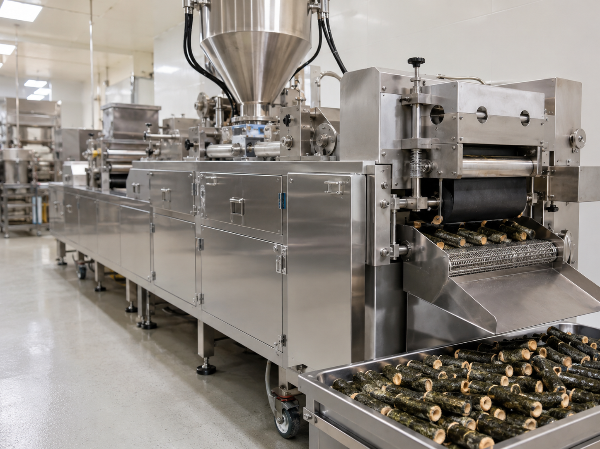
The in-line route: batter and nori sheet meet at the pre-forming station.
- The dedicated seaweed roll former, about 500 rolls per hour.
- The rotary phoenix roll machine, 720–780 pieces per hour.
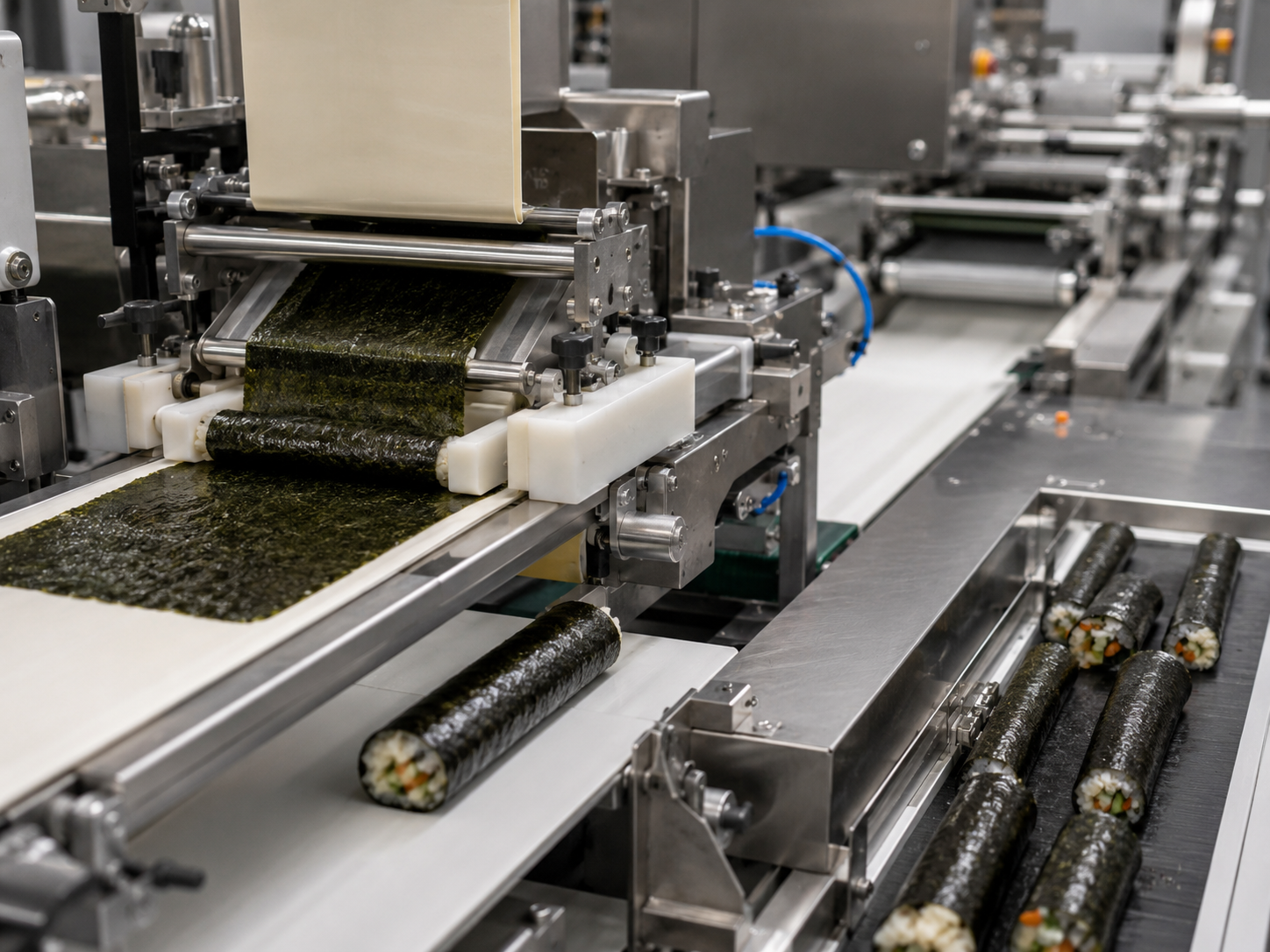
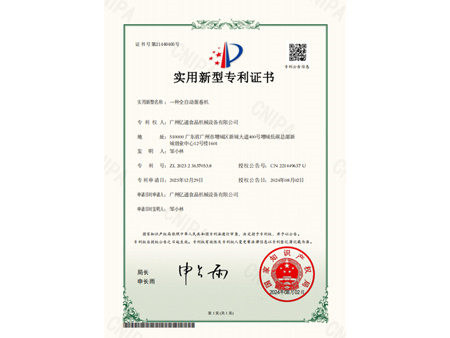
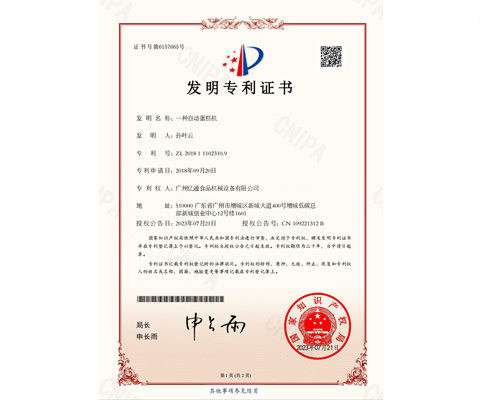
UD Company has manufactured egg roll and phoenix roll machinery since 2003, from two production bases — one in Guangzhou and one in the Xinyu Hi-Tech Development Zone, Jiangxi. That is twenty-three years of building this one family of machines, and the egg roll and phoenix roll series are developed in-house rather than bought in and rebadged. For process scope, the USPTO classification places shaping baked wafer products under A21C 15/02; our nori feed is the station configuration we specify within that process.
Want to see one of these running before you commit? Ask for a video walkthrough of the machine on our floor →Our Engineering Perspective
We publish the nori-lamination sequence and the full nameplate because that is what an engineer can check against their own line. Nobody can verify a claim about our quality; anyone can verify whether three-phase four-wire 380 V and 0.2 m³/min of compressed air exist at the position they had in mind. We would rather be checked than believed.
EQUIPMENT SELECTION & DISQUALIFICATION MATRIX
Where This Line Is Not the Right Choice
Four of the ten results for “seaweed egg roll machine” are recipes, and most machinery that ranks for “egg roll machine” makes something else entirely. The mistake is buying on the word rather than on the mechanism. Here is where to look instead when this line is the wrong answer.
| [01] |
You make the fried, filled roll served in Chinese restaurants. |
That product is vegetables and meat inside a flattened dough wrapper, folded and deep-fried. Unlike this line, the machine that makes it needs a sheeter and a fryer. US Patent 3,450,067, granted in 1969, describes exactly that machine, and it shares no forming mechanism with a baked wafer line. |
Instead: Spring roll making machine with a sheeting, filling and fry section. |
| [02] |
You make sushi or rice rolls. |
Rice-and-nori rolling is a separate machine class. This line bakes a batter and does not handle cooked rice, so buying it for rice is the wrong call. |
Instead: Roll sushi forming machine. |
| [03] |
You want cream-filled wafer sticks. |
This is not an automatic wafer stick machine. Wafer sticks are core-injected after baking, and this line laminates a nori sheet instead of injecting a filling, so the two are not interchangeable. |
Instead: Wafer stick machine with a core injection unit. |
| [04] |
Your recipe is rice-slurry based and you need the quoted rate guaranteed. |
Batter and rice slurry do not run at the same speed. Wafer batter is a pourable liquid at roughly 52–60% water, and changing that changes the bake. Quoting a rate on batter is not a substitute for measuring it on your slurry. |
Instead: Send us the recipe. The rate is re-confirmed against your own product before it is written into the acceptance criterion. |
| [05] |
Your nori supply is not secured. |
Japan’s nori output hit a 51-year low in the 2022 harvest year after a red tide in the Ariake Sea, and leading processed-seaweed makers planned price rises of up to 40%. Machine speed buys you nothing against a raw-material shortage; it consumes the shortage faster. |
Instead: Lock the sheet supply and grade first, then size the line to what you can feed it. |
| [06] |
The rest of your production line cannot absorb the output. |
A faster former in front of a slower packing station moves the bottleneck rather than removing it, and it costs you the throughput it appeared to promise. |
Instead: Size the machine against the slowest downstream stage, not against the best case. |
Seaweed Egg Roll Machine Engineering & Planning Tools
Shift Output Calculator
Calculate your expected roll yield per shift. Optimize production schedules based on your specific machine configuration.
Energy Cost Estimator
Estimate power consumption and utility expenses. Accurately forecast your operational energy costs for the production line.
Floor Space and Clearance Planner
Map out machine dimensions against your facility layout. Ensure adequate operator clearance and maintenance access.
Labour Substitution Comparator
Compare manual production costs versus automated lines. Calculate your expected return on investment and payback period.
Seaweed Egg Roll Machine FAQ
What does a seaweed egg roll machine actually make?
A crisp baked wafer roll with a nori sheet laminated onto it, cut to a set length. The wafer is baked between heated plates, not fried, and the seaweed is applied during forming rather than wrapped on afterwards.
How is this different from a spring roll machine or a sushi roller?
A spring roll machine sheets dough, deposits a filling, folds it and sends it to a fryer. A sushi roller forms cooked rice against a nori sheet. This machine meters a liquid batter onto a heated plate and laminates nori onto the baked sheet, so all three share a word and nothing else.
How does the machine put the nori sheet on the roll?
The pre-forming station holds a slurry supply and a nori sheet supply. The sheet is placed under the pre-forming assembly as the batter is metered, and three wrapping stages then close the coverage: a single-sided wrap, a reverse wrap and a compaction pass.
What is the output capacity, and under what conditions does it hold?
About 500 rolls per hour on the standard four-zone in-line build. That figure holds against a stated roll length, roll weight and nori sheet format, all fixed in writing before the pre-shipment test along with the defect allowance and how stoppages are counted.
Can the line run a rice-slurry recipe as well as a batter?
The pre-forming station meters rice slurry or batter. The rate isn’t the same for both, so we re-confirm it against your own recipe before it goes into the acceptance criterion rather than after the machine arrives.
What roll lengths and flavours can it produce?
Cut length is set on the slitting unit to the figure you specify. The egg roll family in this range runs plain, sesame and spring-onion batters in batches, and the rotary phoenix roll machine adds granular and powder fillings.
What power supply and floor space does the machine need?
Three-phase four-wire 380 V ±10%, about 11.1 kW connected on the in-line machine, and compressed air at 0.2 m³/min and 0.6 MPa or above. The envelope is 2,120–2,200 × 1,450 × 1,560 mm, plus your own service clearance on the plate-access side.
My plant runs 480 V at 60 Hz — is that a problem?
Tell us your voltage, frequency and plug standard with the enquiry and the machine is wired to your local supply. Buyers who skip that step find out after the crate lands, and switchgear changes after arrival cost far more than specifying them up front.
How long does a changeover and a cool-down clean take?
Plate access drives both. We walk the disassembly and inspection route against your own cleaning procedure at quotation, because the time depends on your sanitation standard rather than on the machine alone.
Which parts wear, and how are spare parts supplied?
Moulds, plate surfaces and the slitting knives are the wear items. Wear parts are shipped worldwide and are charged at cost once the 12-month warranty period ends.
What warranty and after-sales support come with the machine?
Twelve months from installation, covering defects in materials and workmanship. The operating manual and an installation and operation video ship with the machine, and operator training on the temperature and timing settings is included; on-site commissioning is quoted separately.
What is the lead time and how does payment work?
A configured machine ships in 25–40 working days after your deposit clears. Terms are telegraphic transfer, 30% deposit with the order and the 70% balance before shipment, and we accept single-machine orders with no minimum order quantity.


![Egg Roll Machine Energy Consumption [Calculation Guide]](https://udmachine.com/wp-content/uploads/2026/09/electric-egg-roll-machine-guide-featured-150x150.png)