Get in touch with UDTECH Company

Automatic Phoenix Roll Machine — UD-02 Six-Station Rotary Line for Seaweed and Pork Floss Rolls
The UD-02 automatic phoenix roll machine forms the savoury rolled wafer snack that carries a nori sheet and a pork floss filling, continuously, across six rotary stations under one controller. It is built for food companies at the ceiling of hand-rolling.
Process & Capabilities
720 pieces per hour
Six rotary stations, one controller
Filling changeover is a recipe change
We run your recipe on the line before it leaves the factory
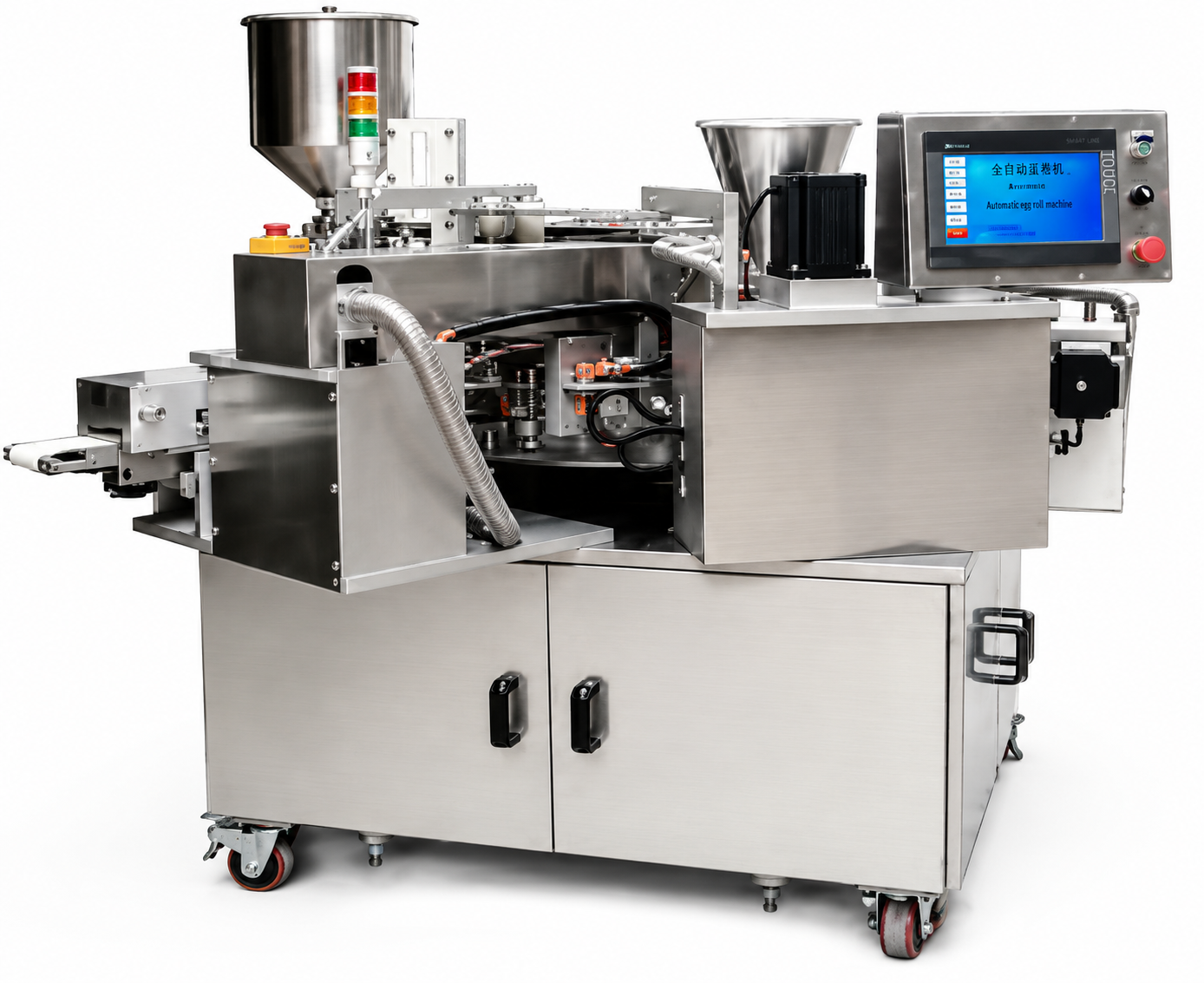
This is an industrial food machine for filled wafer rolls. It is not a spring roll or lumpia wrapping machine, not a domestic egg roll maker, and not a pre-roll machine of any other kind.
Rated output
720 pcs/h, continuous
Connected load
12 kW
Power supply
Three-phase 380 V
Compressed air
0.2 m³/min at 0.6 MPa
Overall size
2300×2000×1400 mm, 960 kg
Forming stations
Six rotary, one controller
Fillings
Seaweed, pork floss, powder
Min order
One line
Process Engineering
The Six-Station Rotary Cycle Behind Every Phoenix Roll
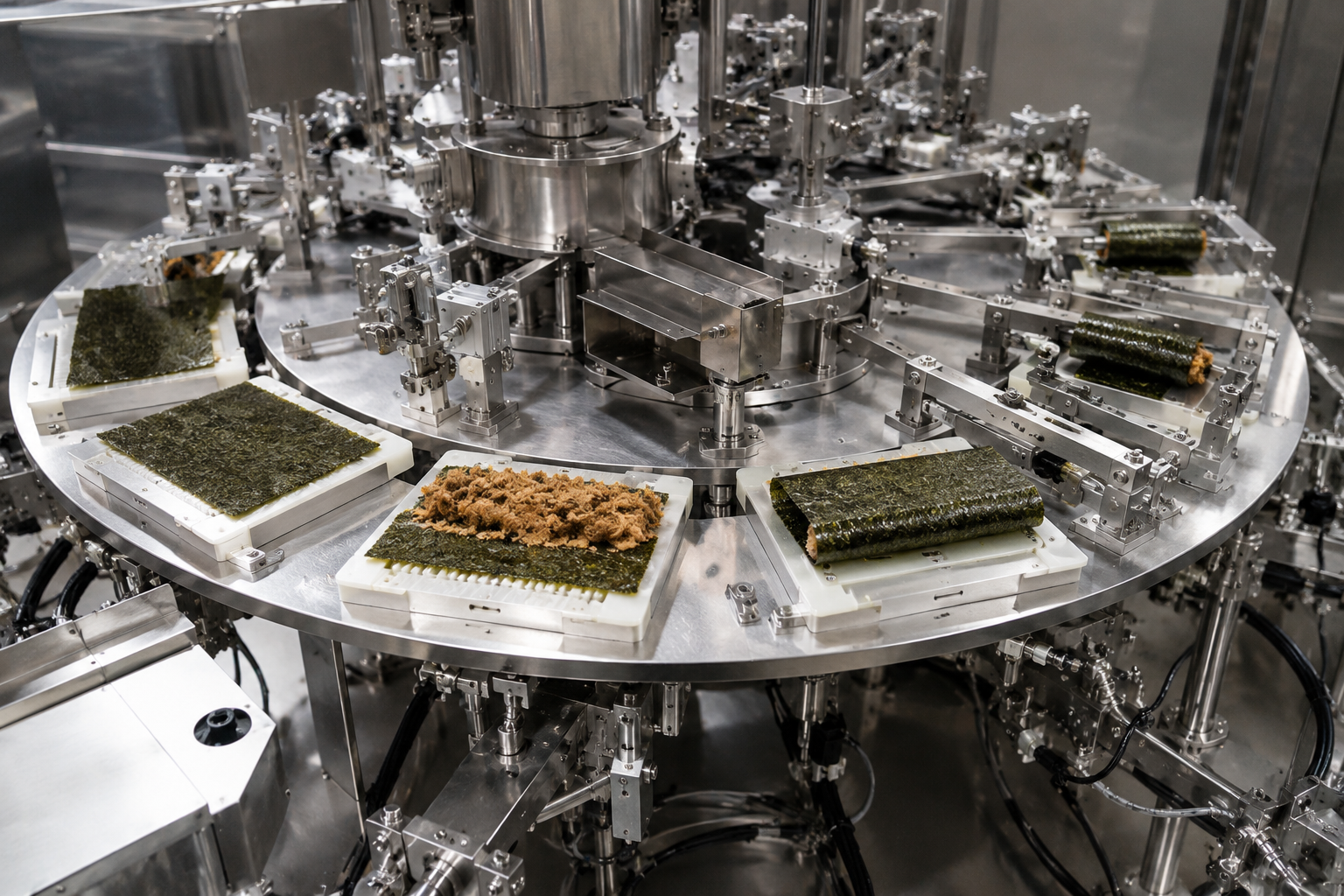
The wafer is laid, filled, baked, folded and rolled inside one continuous rotation, not baked flat and folded later. Every station hands the product to the next in the state the next one needs.
The whole sequence runs on one rotary table under CNC PLC control:
- Multi-channel servo linkage drives the stations electronically, not off one cam
- Station timing is a programmed value, not a fixed gear ratio
| Station | What happens | Why it decides the finished roll | Control | Status |
|---|---|---|---|---|
| 1 · Lay seaweed | A nori sheet is placed and registered before any batter lands. | Off-register here and every later station compounds it. | Fibre-optic photoelectric check | Unattended |
| 2 · Inject paste | A servo depositor meters the filling onto the sheet. | The wrong depositor compresses fibrous floss instead of placing it. | Servo volumetric dosing | Unattended |
| 3 · Heat | Temperature control bakes the wafer to its forming window. | Firm enough to hold, pliable enough to fold. Miss it and it cracks. | Closed-loop temperature control | Unattended |
| 4 · Fold cake | The wafer is folded around the filling. | Fold before the sheet sets and it tears; after it cools and it fractures. | Servo linkage, timing in the PLC | Unattended |
| 5 · Roll | The folded cake is rolled tight. | Roll tension sets the crunch and keeps the filling from migrating. | Servo linkage | Unattended |
| 6 · Demould and convey | The roll is released onto the cooling conveyor. | It sets its final structure as it cools; bruising it undoes five stations. | Pneumatic, 0.2 m³/min air supply | Unattended |
The Forming Window Is Set by Recipe as Well as Heat
Published wafer research is clear that hot pliability is not a temperature setting alone: sugar content and the period before molten sugar resolidifies on cooling both shape what makes a wafer rollable. So the heating profile is stored in the recipe.
“The seaweed station is why this is a dedicated machine and not a retrofitted egg roll former. You cannot lay a nori sheet, register it, then inject a fibrous filling on top with a depositor designed for smooth batter — so we put the laying station ahead of the depositor and gave it its own servo drive.”
— UDTECH Engineering Team
Operation Requirements
What Still Needs an Operator
- Loading nori stock, batter and filling hoppers
- Loading a different recipe when the product changes
- End-of-shift strip-down and cleaning of the contact zone
Fillings the UD-02 Runs, and Why Pork Floss Is the Hard One
Three filling classes run on this line without a hardware change. What separates them is not the wafer but how the material behaves in a depositor.
Another filling
Send it with your product sample and we will run it before the machine is built. If it does not run, you hear that from us rather than after delivery.
Request a configured quotationEngineering Focus
Metering a difficult material is a problem in its own right, not a matter of running a normal depositor more slowly. US Patent 9,439,441 B1, granted in 2016 for a high-viscosity dough depositor, states it plainly: the die delivers a set quantity rather than shaping the material.
| Filling class | Form | How it is handled | Changeover |
|---|---|---|---|
| Seaweed and nori sheet | Dry sheet, laid whole | Registered ahead of the depositor. A sheet cannot be metered; it has to be positioned before anything wet lands on it. | Recipe change |
| Pork floss | Low-density fibrous strands | Metered at a rate set independently of table speed. Force floss through a port sized for batter and you compress it into a mat. | Recipe change |
| Granular powders and blends | Free-flowing granular and powder fills | Same depositor, different dosing profile. Variants in use: matcha, coffee, sweetened blends. | Recipe change |
- That patent oversizes the transfer port by at least about 50 percent against a conventional die
- It drives supply speed and cutting cycle from two independently variable drives
- The UD-02 gets there differently: a servo depositor whose dosing rate is set in the recipe, independent of table index speed
Finished Roll Formats, Recipe Changeover and Sanitation Changeover
Changing what this line makes involves two jobs with different owners. Treating them as one is the fastest way to a compliance problem.
| Format | What it is | Where it sells |
|---|---|---|
| Filled savoury phoenix roll | Crisp rolled wafer wrapped around nori and pork floss | Gift boxes, e-commerce multi-packs, premium retail |
| Powder-filled roll | Same wafer, granular or powder fill loaded by recipe | Seasonal and flavour-line extensions |
| Hollow sweet egg roll | An unfilled or cream-cored rolled wafer | Our automatic egg roll machine, not this line |
| Wafer sticks | Straight filled wafer sticks rather than a wrapped roll | A separate wafer stick machine format; see the table below |
Recipe changeover
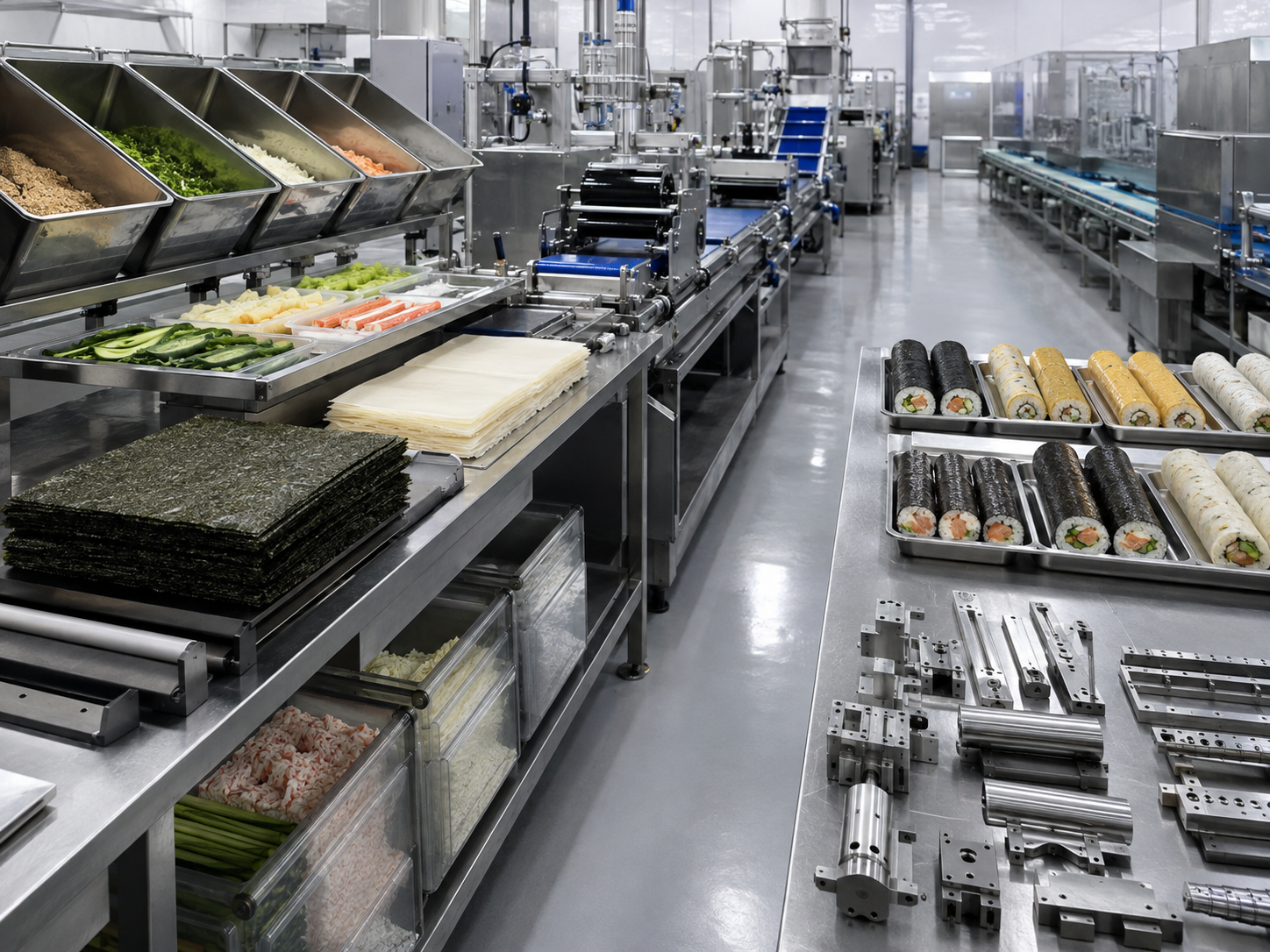
Switching from seaweed and floss to a powder fill is a recipe change plus a change of hopper contents. No forming part is swapped and no tool is required, which is the commercial point: one line covers a seasonal range instead of standing idle.
Sanitation changeover
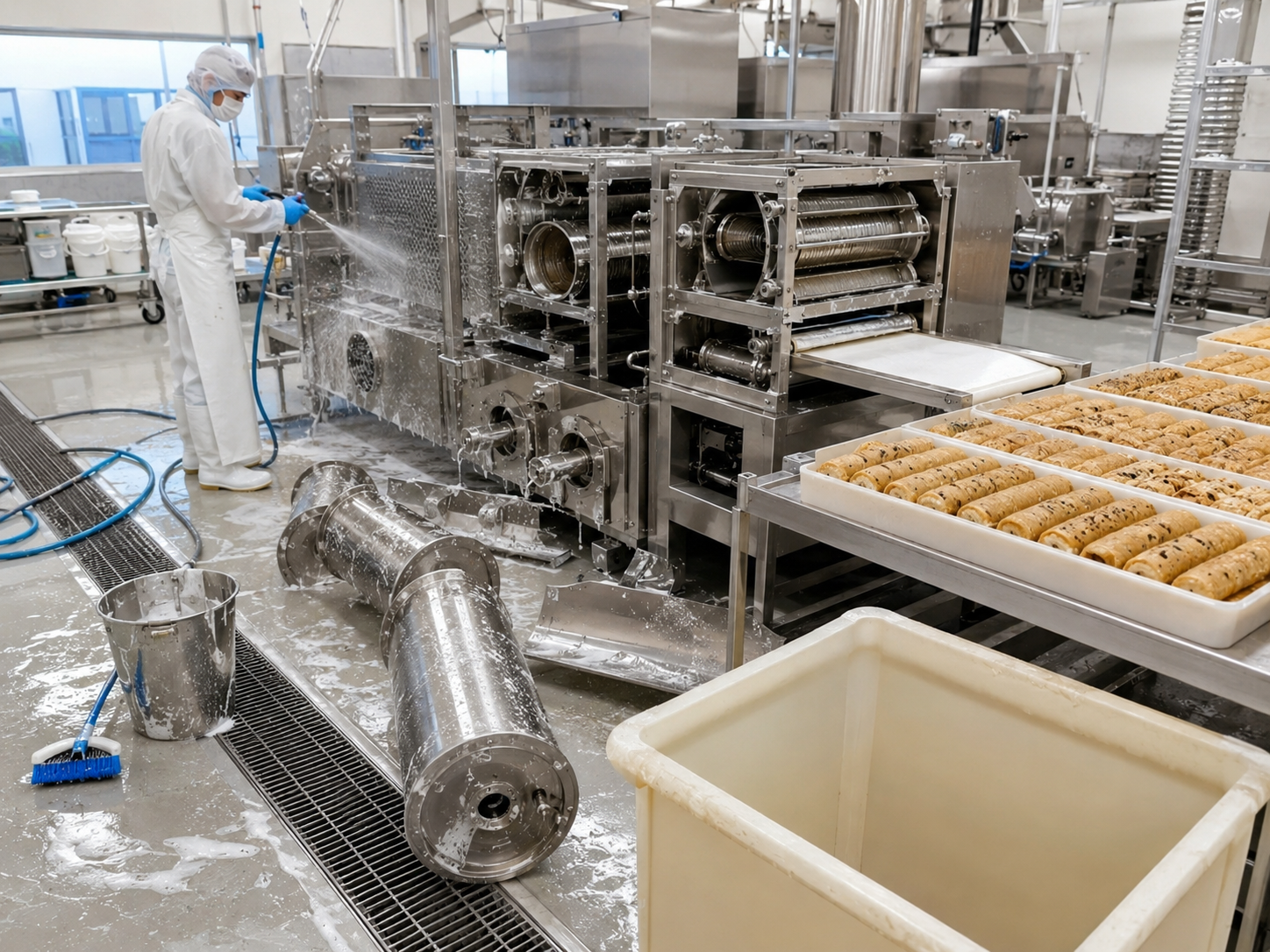
Where the next product has a different allergen profile — pork floss to a non-pork fill, or an egg-based batter to something else — the shared food-contact surfaces have to be cleaned first. That is a separate job from loading a recipe.
Which case a sequence falls into depends on the allergen difference, and it is not symmetrical in both directions. Open the changeover planner to sort your own sequence and price the break against your shift.
UD-02 Specifications and Utility Requirements
Every figure below comes from the UD-02 product data. Size your supply and your floor before you talk to anyone about price.
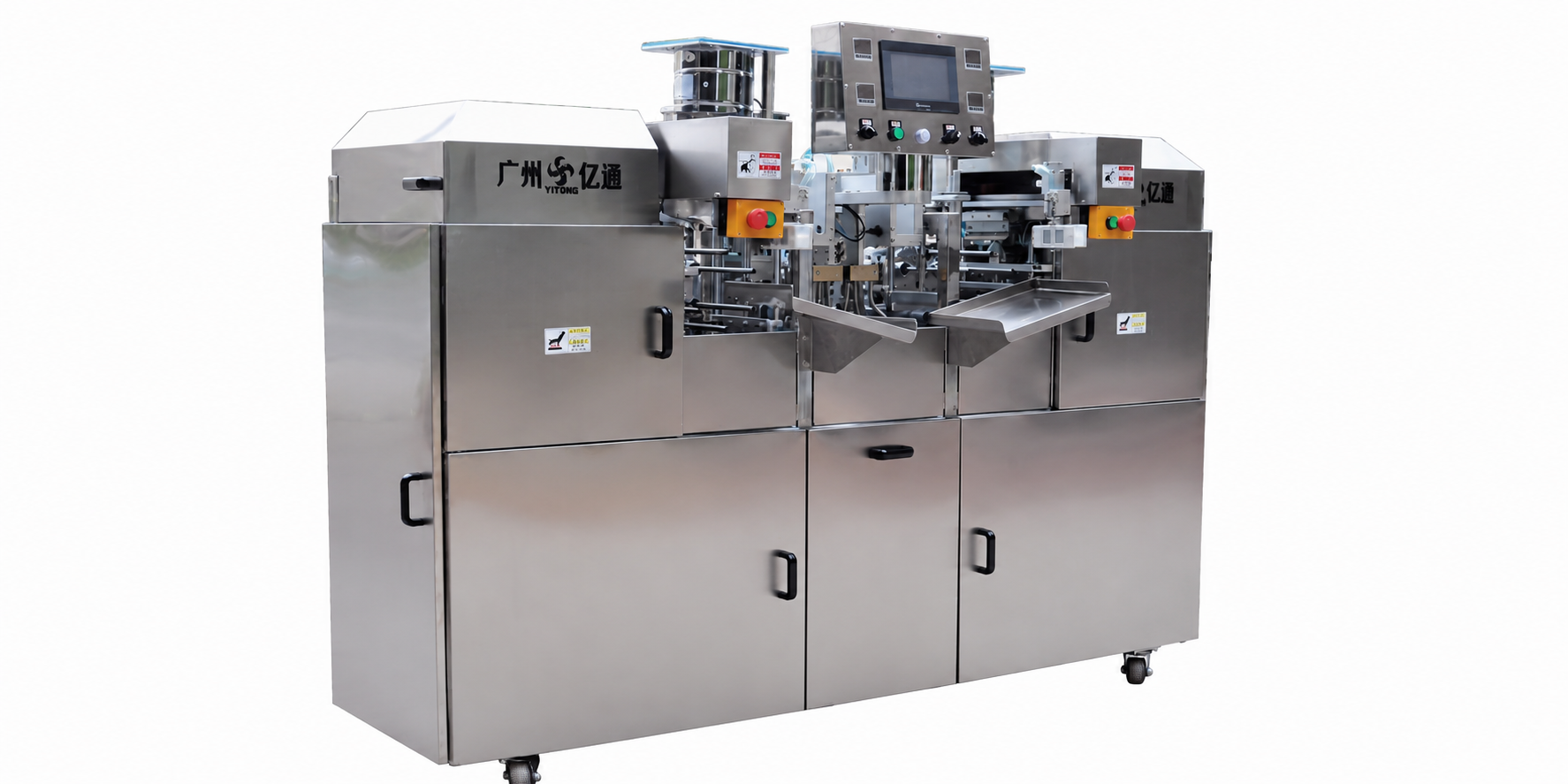
Rated output
720 pcs/h, continuous
Forming stations
Six rotary stations on one table
Connected load
12 kW
Power supply
Three-phase 380 V
Compressed air
0.2 m³/min at 0.6 MPa or above (7.1 cfm at 87 psi or above), continuous during production
Overall dimensions
2300 × 2000 × 1400 mm (90.6 × 78.7 × 55.1 in)
Installed footprint
4.6 m² (49.5 ft²), before operator clearance
Net weight
960 kg (2,116 lb)
Food-contact construction
Fully stainless-steel enclosed contact zone
Structural frame
Aluminium alloy
Control system
CNC PLC programming with multi-channel servo linkage
Position sensing
Fibre-optic photoelectric, station by station
Filling classes
Three, plus custom blends, all by recipe change
Output is a continuous rate. Piece weight varies with your recipe, so we confirm the gram basis against your own product rather than publishing someone else’s.
Check the Numbers Against Your Own Plant
-
Open the supply sizing check
Air and power supply sizing check
Turns 0.2 m³/min and 12 kW into a feeder current and a breaker frame.
-
Open the output planner
Pieces to kilograms output planner
Ratings are per hour; purchase orders are in kilograms.
Commercial & Engineering Scope
UD-02 Quotation Basis and Production Scheduling
Price follows the filling-system configuration, the control tier, the spare-parts package and any integration scope. There is no fixed price list, and your figure comes back as a written quotation with each item shown separately.
| Driver | Effect on cost | How to reduce it |
|---|---|---|
| Filling system configuration | A depositor for one fill class costs less than one specified across seaweed, floss and powders | Tell us the full range at enquiry |
| Control tier | Recipe count and interface options move the controller specification | Name the recipes you need stored |
| Spare-parts package | A larger kit costs you more on the invoice and buys you a shorter first breakdown | Size it against your distance from us |
| Integration scope | Upstream mixing or downstream cooling and packing adds engineering | Send your layout so we quote the gaps |
01
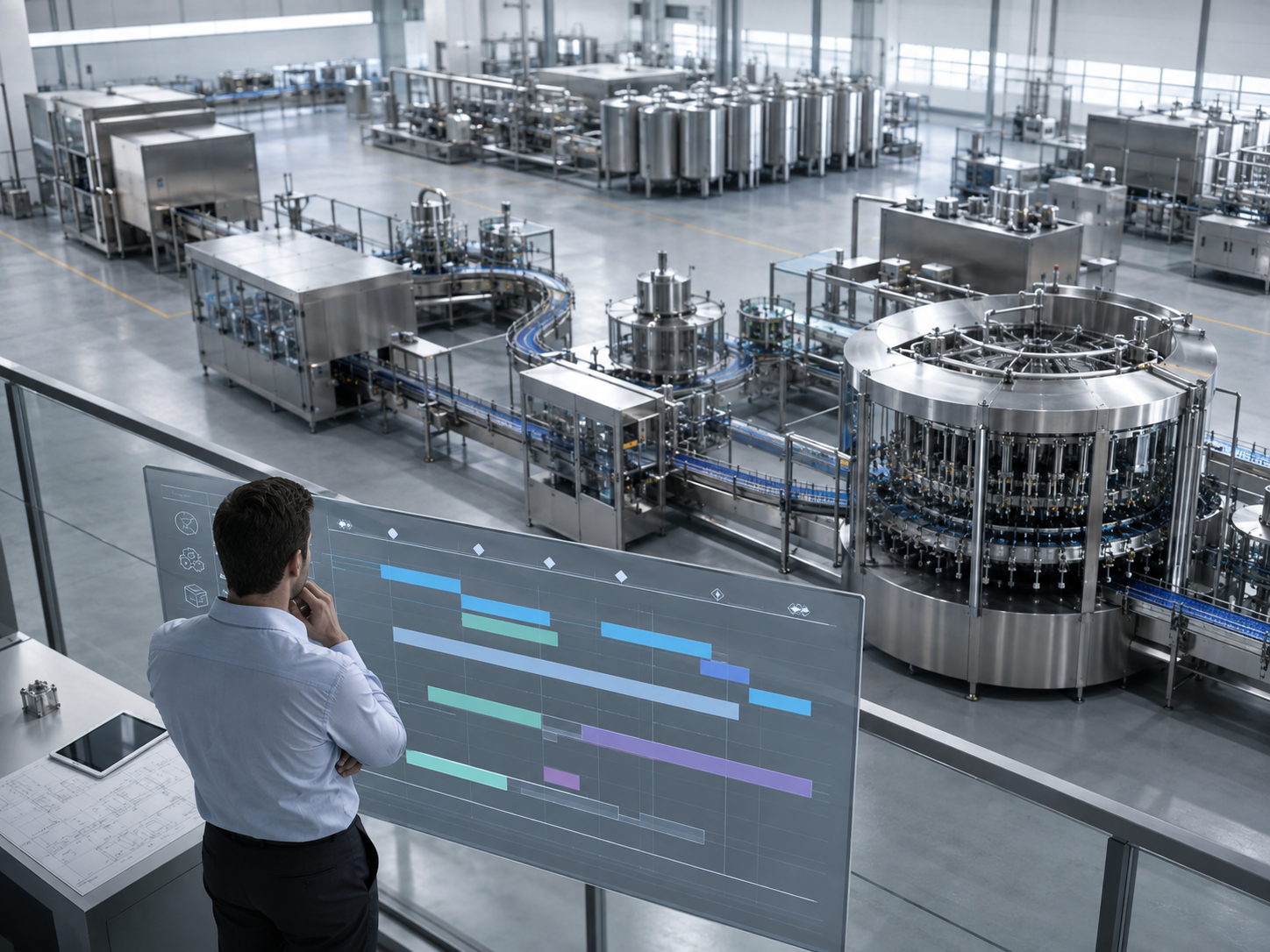
Production Scheduling
UDTECH issues a dated completion schedule at order, and coordinates production, factory acceptance testing and packing against it. Shipping and installation are scheduled separately by destination.
02
Sizing the Supply, Not the Bill
- The UD-02 is rated at 12 kW on a three-phase 380 V supply
- Size feeder, breaker and cable against the nameplate rather than an average
- Size the compressor and dryer to hold 0.2 m³/min at 0.6 MPa continuously
We publish no energy-per-roll figure: the US Department of Energy defines energy intensity as measured consumption over output, a number your plant produces
03
What Belongs in the Total, Beyond the Purchase Price
- Engineering, site preparation, installation and commissioning
- Utilities in production, plus the sanitation labour a shared line requires
- Maintenance, wear parts, and operator training as staff turn over
These are broken down further in the note on what drives the cost of an industrial egg roll machine.
Build, Hygiene, Pre-Shipment Testing and What Is Covered After
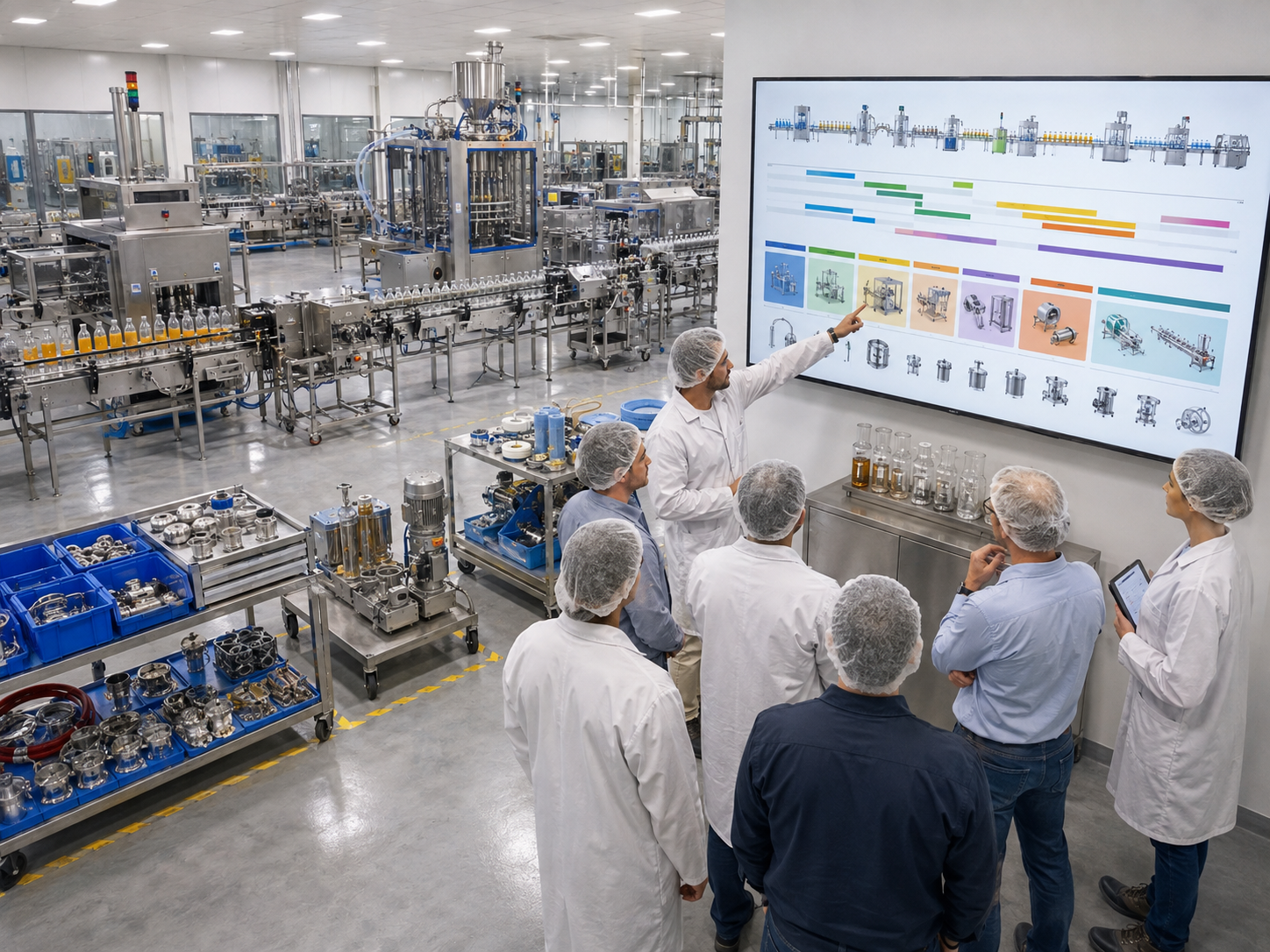
Buyers in this category do not believe a machine until they watch it run, and a systems integrator quoted in Food Processing puts it bluntly: video or photos are not enough. So our quality case centres on a run you can attend.
- The complete machine is assembled and run at our factory before packing.
- We run your recipe on the line before it leaves the factory, and you are welcome to attend that run or receive it recorded.
- Our factory acceptance test procedure and inspection-notice procedure are available on request, so you can review what will be checked.
- Commissioning is signed off on your floor, on your recipe, in live production.
Acceptance testing and commissioning are deliberately separate. ANSI/ISA-62381-2026, adopted identically from IEC 62381:2024, covers factory acceptance, site acceptance and site integration testing, and its scope note excludes loop checks and commissioning.
Hygienic Construction
Warranty and Support
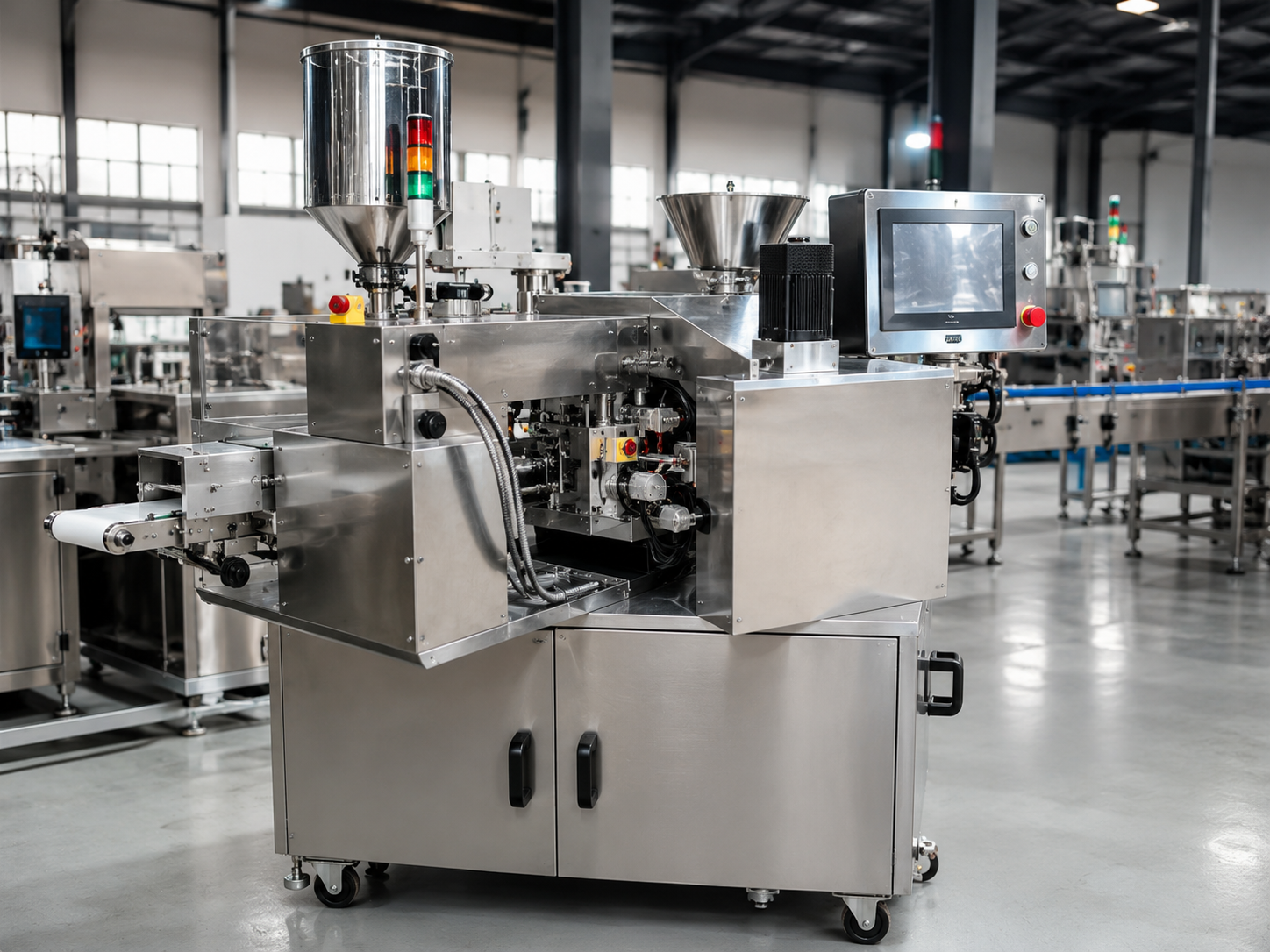
The food-contact zone is fully enclosed in stainless steel and the structural members are aluminium alloy. Material alone is not hygienic design: EN 1672-2 and ISO 14159 set hygiene requirements for food processing machinery, and ISO 14159 makes the intended-use information a duty of the manufacturer.
- 12 months on main components, counted from the factory acceptance test
- Remote support by phone, email and video for the life of the machine
- A recommended spare-parts kit ships with the machine, so the first failure is not a shipping problem
- Operating and training manuals in English and Chinese, other languages on request
The Checklist to Bring to Any Machine, Including Ours
| Property | What to look at | Published benchmark |
|---|---|---|
| Surface finish | Roughness of every food-contact surface | Ra below 0.8 µm is the long-established threshold, supported by EHEDG and 3-A; cold-rolled 2B and ground surfaces are both delivered below it |
| Crevices | Metal-to-metal contacts that are not welds | Uncleanable, and usually a design error |
| Dead zones | Pockets outside the flow of cleaning liquid | Receive far less cleaning energy than the surfaces around them |
| Drainability | Whether surfaces slope to a drain point | Equipment should be self-draining so chemicals clear |
| Whole-life condition | Whether the surface stays that way in year five | Applies for the entire functional lifetime |
Ra alone is a major simplification: two surfaces with different topography, and different cleanability, can carry the same Ra value. Bring the whole list to every machine you evaluate.
From Enquiry to Live Production
Eight steps, and the ones that usually get skipped in this trade are steps two and six.
-
01
Send your product — a sample of the roll, your target output and the channels you supply.
-
CRITICAL STEP 0202
Product review — we run your recipe against the line and tell you what it does, including badly.
-
03
Written quotation — itemised by configuration, control tier, spares and integration.
-
04
Order and dated schedule — a completion date is issued at order, not estimated later.
-
05
Build — the machine is assembled and run before packing.
-
CRITICAL STEP 0606
Pre-shipment run on your recipe — attend it, or receive it recorded.
-
07
Installation and commissioning — on your floor, tuned in live production.
-
08
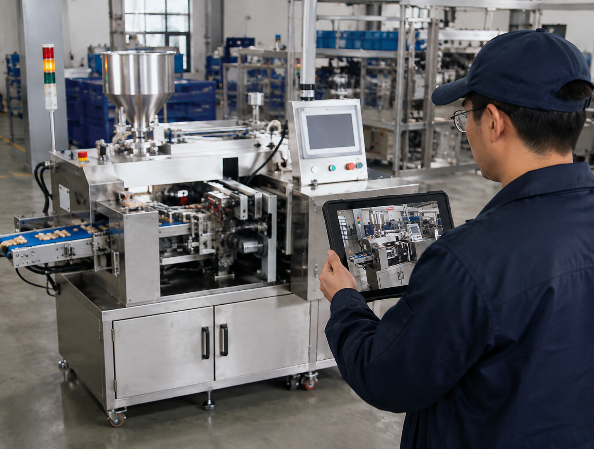
Two-level operator training — operation and cleaning, then maintenance and troubleshooting.
What to Put in the Purchase Order
| Clause | What to specify | Why it protects you |
|---|---|---|
| Approved specification revision | Attach the exact spec revision | Stops a later “that was not the version we quoted” argument |
| Ex-factory date and notification duty | A dated completion point plus a duty to notify delay | Turns lead time into a commitment, not an expectation |
| Pre-shipment acceptance | What is run, on whose recipe, who signs | Separates factory acceptance from commissioning |
| Wear parts list with intervals | Parts list at order, flagging wear items | Makes running cost visible before the build |
| Training scope | Who is trained, on what, for how long | Inadequate training and unclear handover are named repeatedly as what stalls new equipment |
EQUIPMENT SPECIFICATIONS
Choosing Between the UD-02 and the Rest of the UDTECH Roll Line
Every rolling machine in the range shares the same rotary forming principle, and several share a footprint and a power draw. The honest way to choose is by what comes off the end, not by the spec sheet.
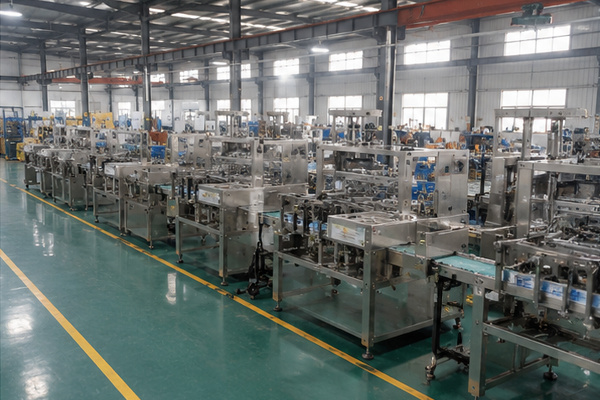
| Model | Finished product | Output as published | Overall size (mm) | Power as published |
|---|---|---|---|---|
| UD-02 | Filled savoury phoenix roll — nori and pork floss | 720 pcs/h | 2300 × 2000 × 1400 | 12 kW |
| UD-02D | Eight-mould egg roll baby machine — a smaller hollow roll | 720 pcs/h | 2300 × 2000 × 1400 | 12 kW |
| UD-02DJ | Nine-mould egg roll, optional cutting and sesame dosing | 500–600 pcs/h, about 18 kg | 2700 × 2100 × 1500 | 9 × 2.5 kW heating, 1.5 kW drive |
| UD-02G | Specialty rolled wafer | 550 pcs/h | 1900 × 1700 × 1400 | 12 kW |
| UD-12 | Hand-style egg roll, larger batch machine | About 600 pcs/h, 12 kg | 2200 × 900 × 1480 | 4 × 2.5 kW heating, 1.1 kW drive |
| UD-06 | Hand-style egg roll, compact machine | About 300 pcs/h, 6 kg | 1400 × 900 × 1480 | 2 × 2.5 kW heating, 0.8 kW drive |
| UD-12HT | Seaweed roll formed integrally with the wafer | About 500 pcs/h | 2200 × 1450 × 1560 | 4 × 2.5 kW heating, 1.1 kW drive |
| UD-02H | Eight-mould soft waffle | 1100 pcs/h | 2100 × 2300 × 1400 | 17.5 kW |
How Our Output Figure Compares With What Others Publish
| Published by | Machine | Figure as published | Stated basis |
|---|---|---|---|
| UDTECH | UD-02 phoenix roll machine | 720 pcs/h | Continuous rate; piece weight confirmed against your recipe |
| PY Group | Four-head wafer stick machine | 1,600–2,000 pcs/h, with 720 pcs/h as its own two-head baseline | No product size or fill state stated |
| HG Machine | Wafer stick line | Hollow 25–30 kg/h, filled 50–60 kg/h | Published by weight rather than by piece |
Read the first two rows carefully: the UD-02 and the UD-02D publish the same output, footprint and power, and are still different machines. Choose on the product.
- Sweet hollow roll, not filled savoury → automatic egg roll machine
- Seaweed formed integrally, not wrapped → seaweed egg roll machine
- The full range → food machine
When the UD-02 Is Not the Line You Need
The risk in buying a forming line is not automating. It is buying something that cannot change when your product mix does — the Food Institute describes failed projects leaving stranded equipment on plant floors.
| Situation | Why this line works against you | What to do instead |
|---|---|---|
| You need materially more than 720 pcs/h on one product | A single rotary table has one index speed; pushing it is not how you get more rolls | Run parallel lines, or tell us your target and we will size it |
| Your product is a sweet hollow or cream-cored roll | The seaweed station and floss depositor are the expensive parts, and you would use neither | The automatic egg roll machine is built for that |
| You want the seaweed formed integrally with the wafer | Different forming principle, not a recipe change | The UD-12HT forms the roll and the nori together |
| Your range is mostly soft waffles or pancakes | Rolling is the whole point of this line | The UD-02H, or the wider range under food machine |
| You are automating one bottleneck at a time | Piecemeal automation leaves a patchwork that is hard to coordinate later | Decide the line’s boundaries before ordering |
Peer-reviewed modelling finds dedicated resources cost-efficient but limited to one product, and flexible resources more versatile but dearer. That trade-off is the real decision, and the optimum often combines both, which is where the UD-02 sits: dedicated hardware, flexible by recipe. The same trade-off against keeping the work manual rather than automatic is set out there.
Phoenix Roll Machine Planning Tools
UD-02 Air and Power Supply Sizing Check
Calculate and validate exact utility requirements for your facility prior to installation, including electrical loads and compressed air sizing.
Phoenix Roll Output Planner
Project production yield based on your operational hours. Accurately estimate raw material consumption and finished roll output capacity.
Changeover Planner
Plan filling recipe changes and estimate turnaround times. Map out hopper swap and sanitation procedures for continuous operation.
Phoenix Roll Machine — Buyer Questions Answered
What is a phoenix roll?
A crisp rolled wafer wrapped tightly around a savoury filling, most often nori seaweed with pork floss. It is a rolled wafer product, in the same family as the wafer roll and wafer stick.
How is a phoenix roll machine different from an egg roll machine or a spring roll machine?
- Spring roll machine — wraps a pastry sheet around a wet filling, usually deep fried. Nothing on this line will fry anything.
- Egg roll machine, in the wafer sense — a sweet hollow or cream-cored rolled wafer, so no seaweed station and no fibrous-filling depositor.
- Phoenix roll machine — the savoury, filled, nori-wrapped case, which is why it is dedicated.
The naming is looser than the machinery: a rolling machine, a roll making machine and an egg roll making machine can all point at the same wafer-roll former, and the same machine may be filed under commercial egg roll machine, chinese egg roll machine or fully automatic egg roll roller machine depending on who wrote the page. Match on the finished product, not the name, because those names are not interchangeable in practice.
Is a kuih kapit machine or a love letter biscuit machine the same thing?
Close relatives, not the same machine. Kuih kapit is a thin wafer folded or rolled after baking, usually unfilled. Tell us at enquiry: the forming end changes.
Is a wafer stick machine the same as this?
No. Wafer sticks are straight filled tubes; an automatic wafer stick machine rolls a sheet around a core injection and cuts it to length. A phoenix roll wraps a laid sheet and a metered fibrous filling.
What is the capacity and power requirement of the UD-02?
720 pieces per hour, continuous, from a 12 kW connected load on a three-phase 380 V supply. Size feeder and breaker against the nameplate, not an average draw.
What compressed air supply does the machine need?
0.2 m³/min at 0.6 MPa or above — about 7.1 cfm at 87 psi — held continuously, not as a peak. It drives the demoulding and discharge actuators at station six.
How much floor space and floor loading does it need?
2300 × 2000 × 1400 mm, 4.6 m² before operator clearance, and it weighs 960 kg. Check door and lift access against the 2300 mm length before delivery.
Can it run on a supply other than three-phase 380 V?
Tell us your voltage and frequency at enquiry and we will confirm what the machine needs before anything is built.
How does the machine lay the seaweed sheet without misaligning it?
It is registered at a dedicated station ahead of the depositor, with fibre-optic photoelectric sensors tracking it as the table indexes. That ordering is deliberate: batter fixes a misplaced sheet in place.
Can it handle pork floss without crushing the fibres?
That is what the servo depositor is for. Its dosing rate is set in the recipe, independent of table index speed, so the floss is laid rather than pressed.
Which stations run unattended, and what still needs an operator?
All six forming stations run without hands in the product. A person handles supply and turnaround: nori stock, hoppers, recipe loading, end-of-shift strip-down.
How long does a filling changeover take?
A recipe change plus a change of hopper contents — no forming part swapped, no tool needed. We publish no time in minutes, because it depends on your hopper handling and cleaning requirement rather than on the machine.
What has to be cleaned when I switch between a pork-floss product and a non-pork one?
Where allergen profiles differ, shared food-contact surfaces have to be cleaned first, and validating the routine is your own programme. The closest published evidence is an FDA study of wiping and cleaning, run in retail kitchens rather than production lines.
What finished roll sizes and weights can it make?
Roll length and diameter follow the forming setup and recipe, so we confirm them against your sample rather than publishing one figure.
What is covered by the warranty and what support comes after commissioning?
12 months on main components, counted from the factory acceptance test, plus remote support by phone, email and video for the life of the machine. A recommended spare-parts kit ships with it.
How is the machine tested before it ships, and what is the quotation based on?
The complete machine is assembled and run at our factory, and we run your recipe before it leaves. The quotation is built from configuration, control tier, spares and integration.