Get in touch with UDTECH Company


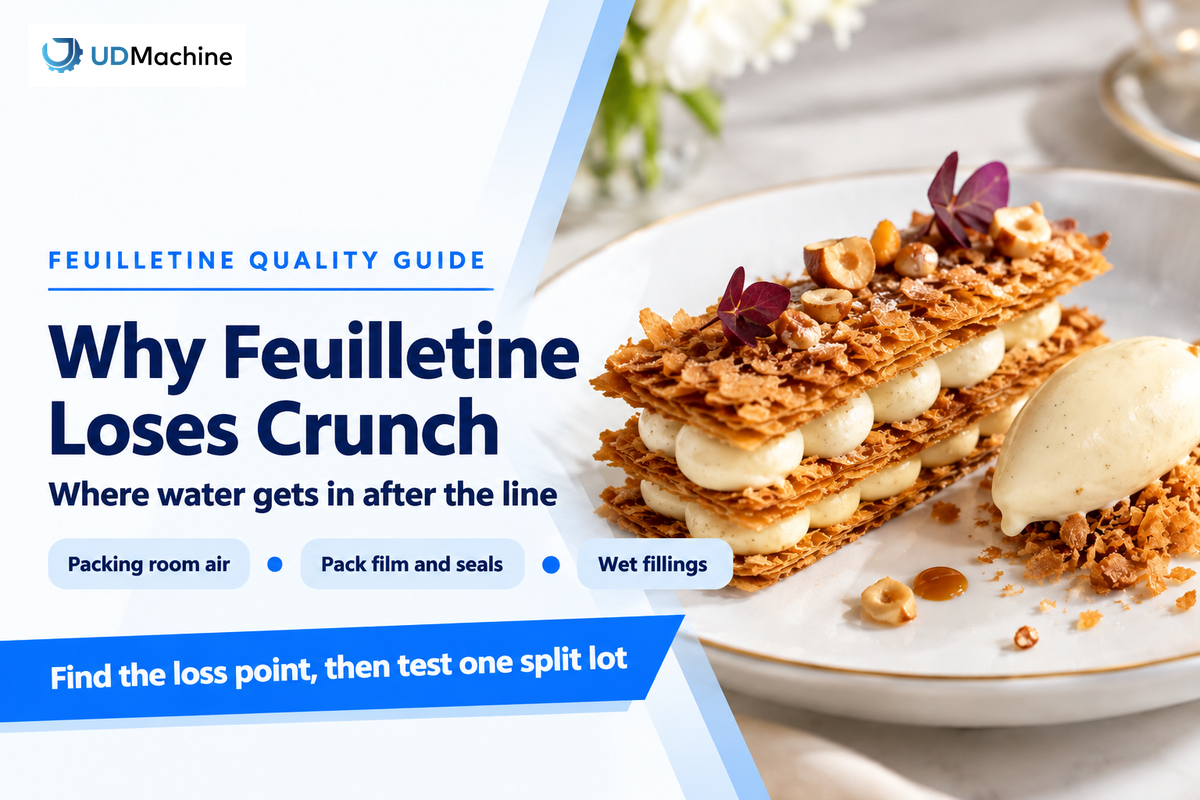
Why feuilletine loses crunch comes down to water: a brittle flake that takes up water turns soft, and tasters rejected similar dry snacks at water activity 0.35 to 0.50. Thin feuilletine flakes take that water back from humid air, wet fillings and condensation. The glassy sugar and starch soften and the snap is lost.
At home the solution is quick: coat the flakes with chocolate, keep the container sealed and keep it out of the fridge. In a factory, moisture gets in at five places between the packing room and the customer’s cake, and each area has its own check.
Feuilletine loses crunch when its flakes absorb water from humid air, wet fillings or condensation. Dry crisp snacks lost their crispness at water activity 0.35 to 0.50, and a gain of about 3 g of water per 100 g of dry matter was enough.
Key points
- A harder, tougher bite can be the first sign of water pickup: crisp bread grew stronger and less brittle before it turned soft.
- Thin wafer sheets soften earlier than chips and crackers; a Nestlé wafer patent application places the start of crispness loss above water activity 0.3.
- A sealed bag still lets water in through its film and its seals, and in one package study the seals carried about a quarter of it.
- Fat keeps flakes crisp and water softens them: chocolate and nut pastes protect feuilletine, while butter is 16 to 17.5% water.
Updated October 2026.
Quick Specs: where feuilletine loses its crunch
| Water activity where dry crisp snacks turned soft | 0.35–0.50 (Katz and Labuza, 1981) |
| Water gain that softened cellular snacks | About 3 g per 100 g dry matter |
| Room air in balance with flakes at water activity 0.30 | 30% relative humidity |
| Dew point of 30 °C air at 80% relative humidity | About 26 °C |
| Example water budget, 10 kg bag | About 290 g of water |
| Storage trial test days | Day 0, 7, 14 and 28 |
Why Feuilletine Loses Crunch: What Water Does to a Brittle Flake
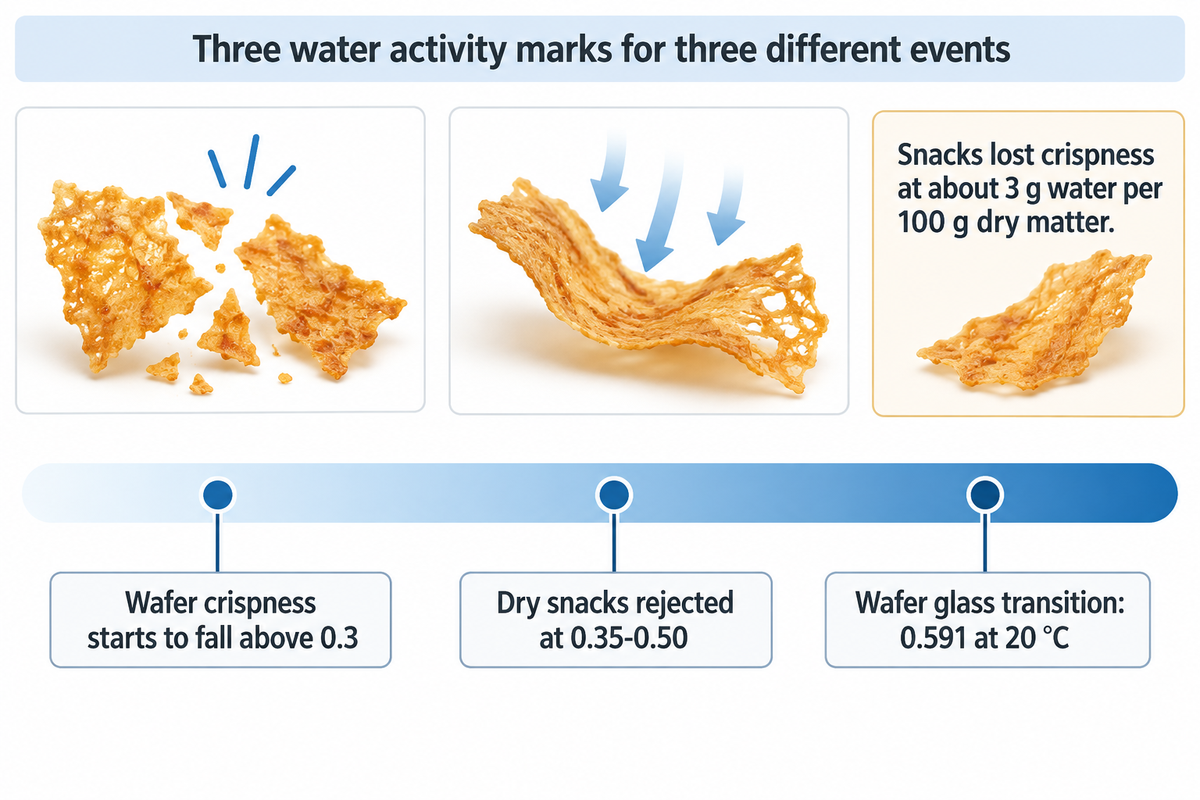
Dry crisp snacks lost their crispness at water activity 0.35 to 0.50 in a 1981 tasting study. About 3 g of water per 100 g of dry matter was enough to make them lose their crispness. Feuilletine follows the same physical laws. Absorbed water turns it from a brittle glassy state into a softer, bendable solid.
Katz and Labuza equilibrated potato chips, popcorn, puffed corn curls, and saltines over a series of salt solutions and asked testers to evaluate crispness. Their critical water activity results for snack crispness put the point of rejection in that band. The 3 g figure comes from the same work, as summed up in a later crisp-bread study in the Polish Journal of Food and Nutrition Sciences.
Feuilletine starts as a thin batter of flour, sugar, butter and egg white, spread thinly and baked golden brown. Water bakes out, and the sheet becomes light and becomes brittle. Crush rolls then break it into feuilletine flakes. The dry ingredients set into a glassy matrix when the water evaporates. Cacao Barry sells its version under the trademark Pailleté Feuilletine, a name often written paillete feuilletine. Homemade versions bake on parchment paper and cool on a wire rack, before breaking apart. Our guide to how feuilletine is made industrially covers the bake that sets the starting water.
Three published numbers mark three different events. In a Nestlé patent application on moisture-resistant wafers, the applicant states that a standard wafer tends to lose perceived crispness progressively above water activity 0.3. Commercial wafers reached their glass transition at 20 °C only at water activity 0.591, where a three-point bend test showed abrupt changes, in a 2004 study on wafer glass transition. Tasters notice the loss of crispness long before the material turns rubbery. A plant sets its own reject line from a storage trial on its own flakes.
The Polish crisp-bread study found an earlier warning in rye and fibre crisp breads. The breads strengthened and became less brittle as they absorbed water. Peak fracture stress was found at water activities 0.255 and 0.319. Above these water activities the breads became softer. The breads absorbed about 6 g of water per 100 g of solids, between water activities 0.274 and 0.560, and became non-crisp. Thus the first complaint about flakes could be a harder, tougher bite. The flake gains flexibility and turns tender and leathery later on.
Why Do Some Crisp Flakes Soften Almost at Once While Others Stay Crisp?
Flakes soften quickly upon contact with water, as in a wet cream filling, cake frosting, or the water-bearing side of a moist sponge. Fat, which is relatively dry, doesn’t present a problem, so flakes inside fat stay crisp. Contact with water is much faster than contact with humid air, because water reaches the flake directly.
On eGullet, a member reported that flakes mixed into nut paste, or in chocolate, stay crisp a long time. Used to coat a cake, they “sog up” quickly. That poster also mentioned that a commercial brand sprays a very light layer of cocoa butter on a crepe, which is then broken into flakes, to keep them from going soggy so fast. Each flake is so thin that water, once it makes contact, has very little distance to travel.
Water Activity vs Moisture Content: The Number to Trend
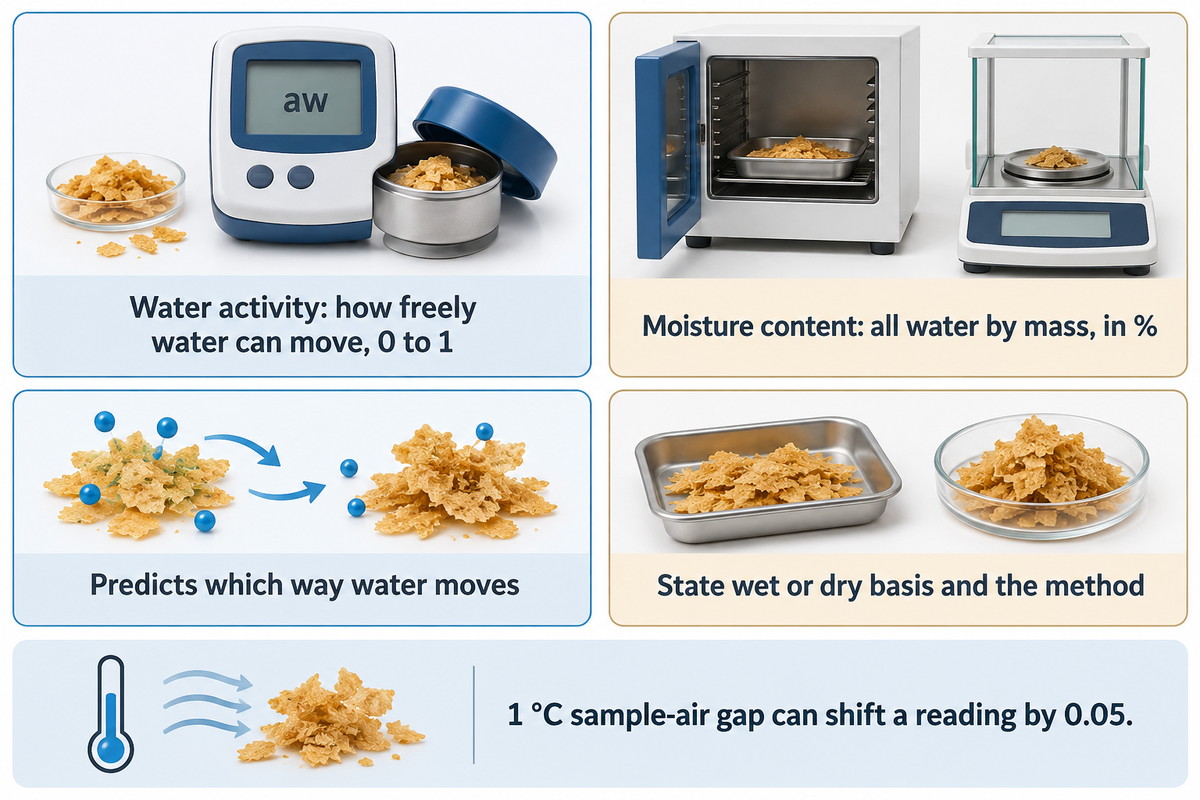
Water activity runs from 0 to 1, measures the freedom of water movement in a flake, and is, alongside moisture content, an indicator of crunch risk. For trending purposes, use water activity at a specified temperature. Retain moisture content in the bake record and the Certificate of Analysis.
“A portion of the total water content present in food is strongly bound to specific sites and does not act as a solvent.”
Bound water is water that’s located in a flake and isn’t moving into anything, so moisture percentages overstate the water that can soften flakes. A model bread-crust study indexed in PubMed measured both parameters separately. Water content fixed the glass transition point. Both parameters affected the judgment of the tasters on the crispness of the bread crust.
Temperature changes the reading. The FDA’s 1984 inspection guide notes that a 1 °C difference between the sample and the air above it can shift a water activity reading by 0.05. That error is as wide as the gap between the 0.30 wafer figure and the 0.35 snack figure above. A 2025 Journal of Food Science study of low-cost water activity meters judged devices against the 0.005 maximum error used in ISO 18787. The cheaper meters claimed accuracies of ±0.03 to ±0.05, too coarse for that window.
| Question | Water activity | Moisture content |
|---|---|---|
| What it measures | How freely water can move, 0 to 1 | All water by mass, in % |
| Which way water moves between flake and filling | Predicts it: toward the lower reading | Cannot tell |
| Sensitivity to temperature | Reading can shift about 0.05 per 1 °C sample–air difference | Low once the sample is weighed |
| Basis to state | Reading temperature | Wet or dry basis, and the method |
| Best use | Crunch risk, storage trials, filling design | Bake control, purchase specification |
| Instrument | Dew-point or capacitance meter | Oven drying or moisture analyser |
Moisture content must be included in the specification. Report it with its basis. Wet-basis and dry-basis figures convert as shown, with flour as the example, in our note on moisture content on a dry basis.
Loss Point 1: Moisture Pickup Between the Crusher and the Bag
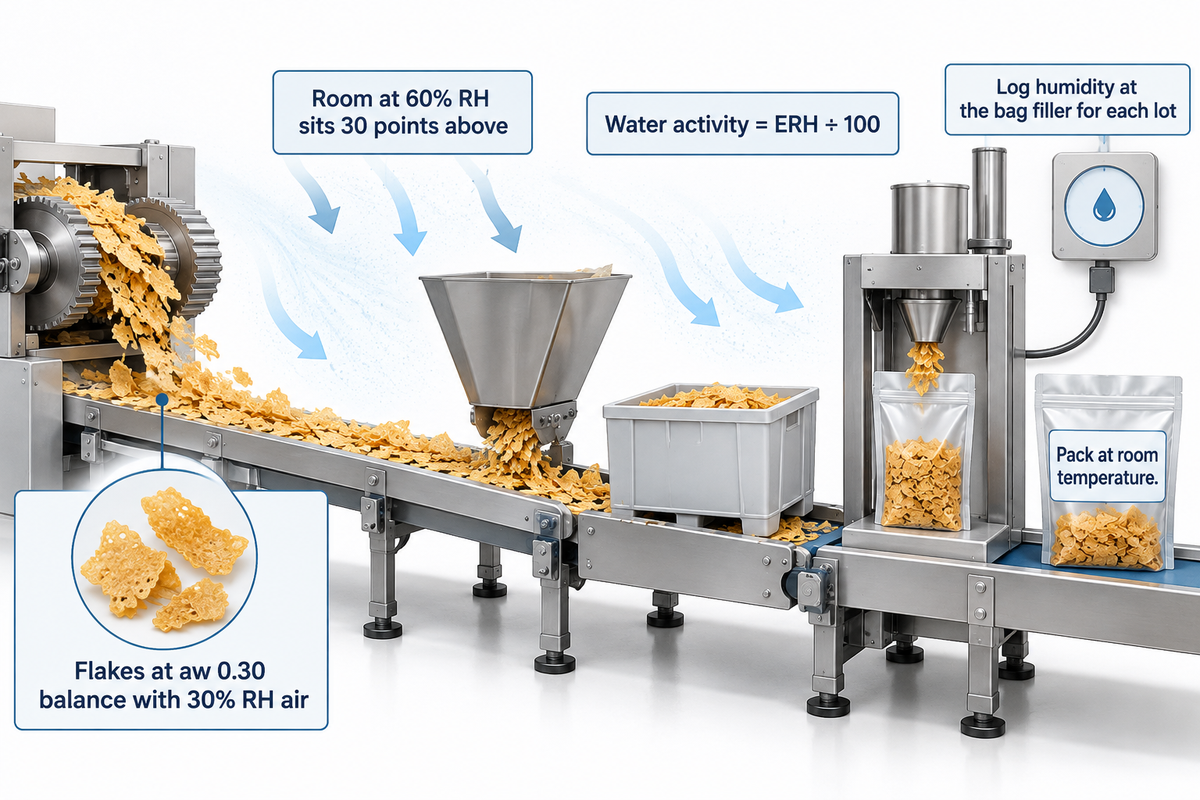
Flakes at water activity 0.30 are in balance with air at 30% relative humidity, so any packing room more humid than that pushes water into them. The FDA guide defines water activity as equilibrium relative humidity divided by 100. That turns a lab reading into a target for the room.
A packing room at 60% relative humidity sits 30 percentage points above the balance point of the flakes, and the flakes close that gap on every open conveyor, hopper and tote between the crusher and the bag. Water the sheet picks up before the crusher is covered in our note on feuilletine cooling before flaking.
💡 Pro Tip
Hang a hygrometer at the bag filler and record room humidity and temperature against each lot number. When a complaint arrives weeks later, that log shows whether the flakes were packed into air drier than their own balance point.
Packing warm adds a second route. Wrapping baked goods before they cool traps condensation inside the wrapper, according to the American Society of Baking’s guidance on wrapping temperature. The crust of crispy products then takes that water back. Bread can go into the bag at 35 to 40 °C for that reason. Dry flakes go in at room temperature, with the pack temperature logged beside the room humidity.
Loss Point 2: Pack Barrier, Seal and a Bag’s Water Budget
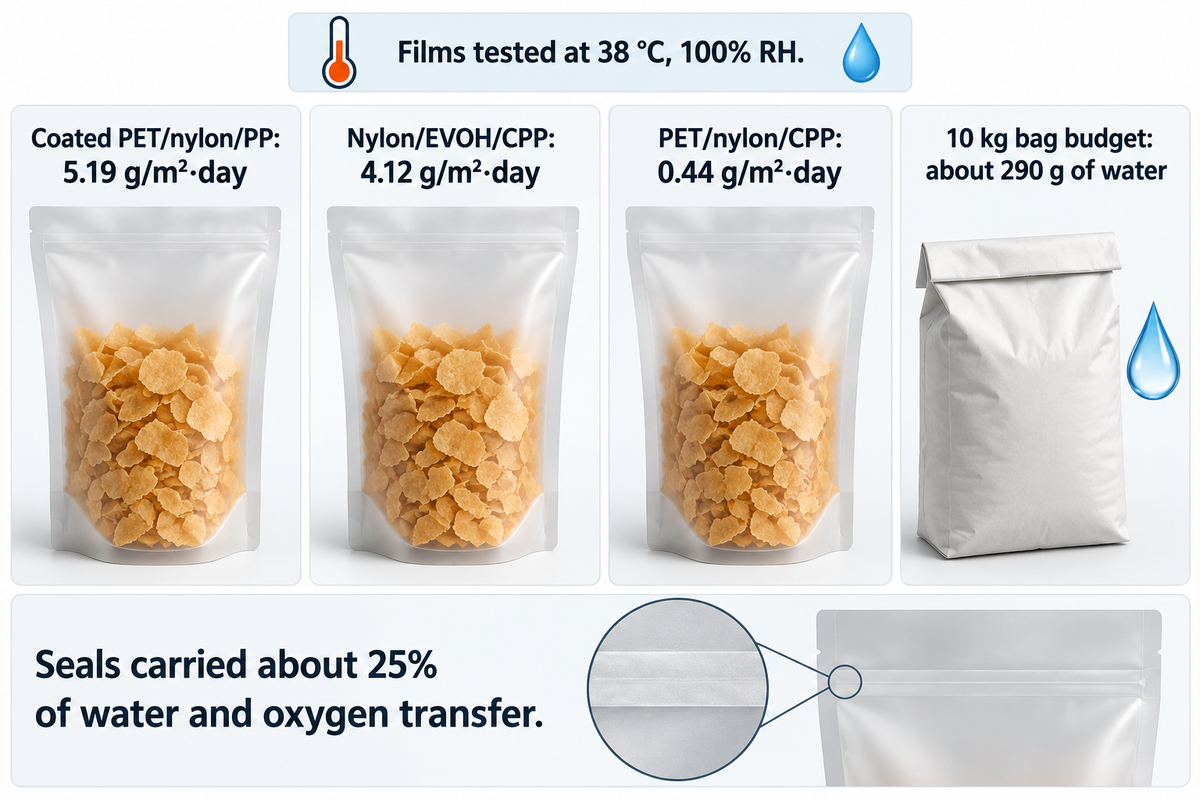
Three polymer retort pouches tested at Washington State University let through 5.19, 4.12 and 0.44 g of water vapour per m² per day before processing. That was at 38 °C and 100% relative humidity. A foil pouch showed no measurable weight loss over 12 weeks at 50 °C. A bag needs a barrier whose water budget outlasts the flakes’ time in storage.
The pouches were measured by ASTM F1249, as reported in the 2016 Washington State University pouch barrier study. The ASTM F1249-25 water vapour transmission method covers films and foils up to 3 mm thick. It was shown to measure from 0.052 to 26 g/(m²·day). Its own note warns that the link between transmission rate and vapour pressure difference does not always hold. Compare films only at the same stated test condition.
The film figure is only a part of the package. In a package study of nylon/PE and PVDC-coated PET/PE packages, regular industrial seals carried about 25% of all water and oxygen transfer. The seal’s contribution was reported in 2016 by Reinas and others. The sealed pouch was a weaker barrier than the film alone.
Example, assumed inputs: a 10 kg bag of flakes at 2.5% moisture and 1.2 m² of film. The flakes go in at water activity 0.30, and the warehouse runs at 30 °C and 80% relative humidity. The bag holds 9.75 kg of dry matter. At 3 g per 100 g, it can absorb about 290 g of water before the crunch goes.
Water crosses the film approximately in step with the vapor pressure difference across it. In the warehouse that difference is 0.80 × 4.24 kPa minus 0.30 × 4.24 kPa, or 2.12 kPa. The test pushed with 6.62 kPa at 38 °C. So the warehouse rate is about 0.32 of the test rate. For the first pouch, that’s 5.19 × 1.2 × 0.32 = 1.99 g a day, and 292.5 ÷ 1.99 = 147 days.
| Pouch structure | WVTR at 38 °C, 100% RH | Days at the test condition | Days at 30 °C, 80% RH, film only | Days if seals add a quarter |
|---|---|---|---|---|
| Coated PET/nylon/PP | 5.19 g/m²·day | 47 | 147 | 110 |
| Nylon/EVOH/CPP | 4.12 g/m²·day | 59 | 185 | 139 |
| PET/nylon/CPP | 0.44 g/m²·day | 554 | 1,732 | 1,299 |
| PET/aluminium foil/nylon/CPP | Not measured; no weight loss in 12 weeks at 50 °C | Not limited by film | Not limited by film | Set by seal quality |
The numbers are based on a steady state situation. In reality, the flakes absorb some water and slow their rate of uptake. The 3 g budget comes from other crisp snacks. Given these assumptions the first two pouches should lose their crunch in 110 to 185 days of humid storage, while the PET/nylon/CPP pouch should take more than three years to use up the budget on paper, with the seals counted, so the seals and the opened bag should decide the outcome.
Loss Point 3: Container Rain and Condensation in Transit
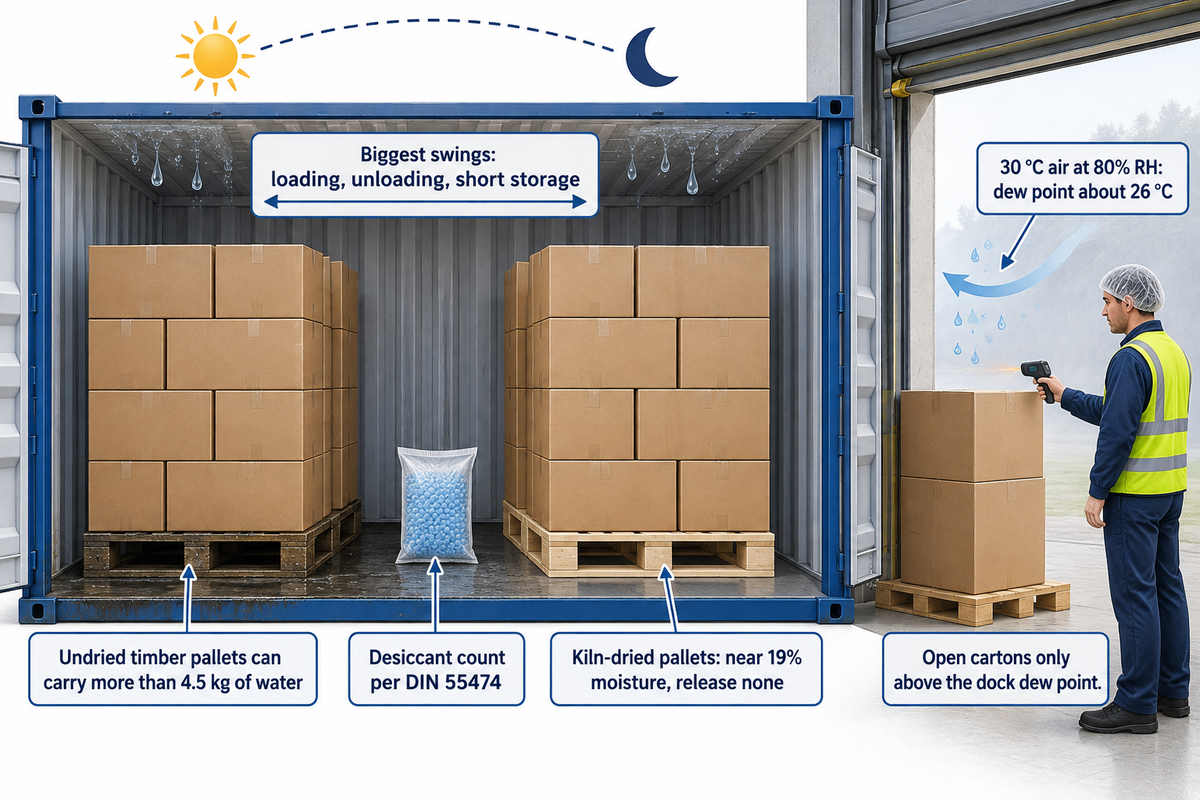
Air at 30 °C and 80% relative humidity has a dew point of about 26 °C, so any carton colder than that collects water the moment it meets that air. Container rain is the same effect in a closed box. Water evaporates from the cartons and pallets in a container as the container heats up, the air inside the container gets saturated, and the water condenses as it cools.
Virginia Tech’s white paper on moisture in sea containers cites a Xerox study that the largest temperature and humidity changes happen before and after the sea leg. During loading, unloading and short storage, changes happen over a few hours, while changes during sea transport happen over days. On the ship, the container sits still and changes slowly.
The same paper identifies three ways to control water. Green wooden pallets at 50 to 100% moisture content can carry more than 4.5 kg (ten pounds) of water. Kiln-dried pallets sit near 19% and release none. Desiccants lower the dew point inside the container, and DIN 55474 sets how many to use. For vents, it quotes the American Institute of Marine Underwriters: “Hot to cold, ventilate bold. Cold to hot, ventilate NOT.”
The National Weather Service dew point explanation gives the kitchen version: water forms on a cold bottle from the refrigerator because the room’s dew point is above the refrigerator temperature. The table uses the Magnus formula from the University of Miami humidity calculator, with coefficients 17.625 and 243.04 °C.
| Dock air temperature | Relative humidity | Dew point |
|---|---|---|
| 25 °C | 60% | 16.7 °C |
| 25 °C | 70% | 19.1 °C |
| 25 °C | 80% | 21.3 °C |
| 30 °C | 60% | 21.4 °C |
| 30 °C | 70% | 23.9 °C |
| 30 °C | 80% | 26.2 °C |
| 35 °C | 60% | 26.1 °C |
| 35 °C | 70% | 28.7 °C |
| 35 °C | 80% | 31.0 °C |
At the receiving dock, keep cartons closed until, with an infrared thermometer, the surface of the cartons reads warmer than the dock’s dew point. With each container, place a temperature and humidity logger. The loggers should show which leg of the shipment caused the damage.
Loss Point 4: Opened Bags at the Pastry or Confectionery Plant
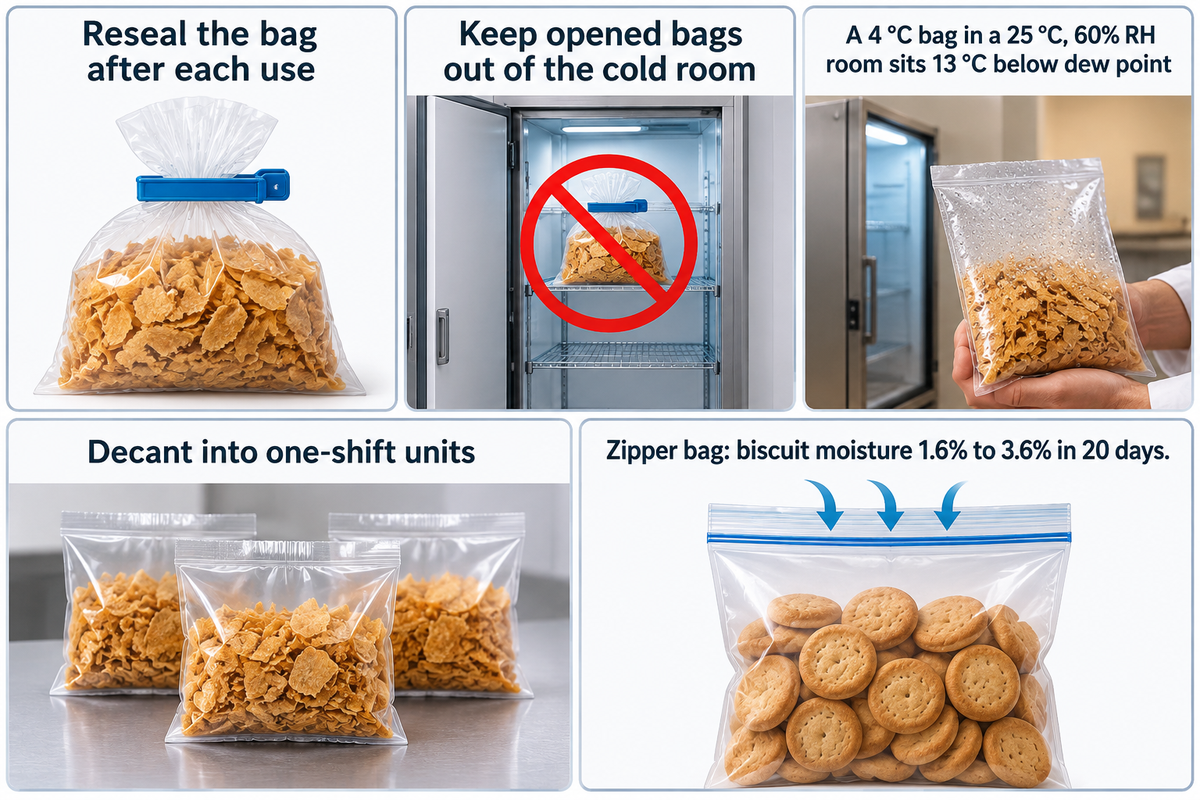
An opened bag of feuilletine stays crisp only if the room air is drier than the balance point of the flakes and the bag is resealed after each use. Keep opened bags out of the cold room, because a bag that goes in will collect condensation when it comes out. Set an opened-bag hold time based on your own tests.
⚠️ Common Mistake
Tipping opened flakes into ordinary zipper bags. In a 2022 Foods study of LDPE zipper bags, biscuits rose from about 1.6% to 3.6% moisture in 20 days at 25 °C and 50% RH. Puffed snacks rose from about 2.1% to 4.9%.
The other trap is cold rooms. A bag carried from a 4 °C cold room into a 25 °C workroom at 60% relative humidity sits about 13 °C below that room’s dew point. Water will form on the bag, and on the flakes within it once it is opened. Store opened bags at room temperature in the driest room you have.
Decant large bags into smaller sealed units sized for one shift or one batch, so each unit is opened only once. A pastry chef scooping from one large bag ten times a day exposes the whole bag ten times.
How Do You Store Feuilletine for Maximum Shelf Life?
Store feuilletine sealed in its original barrier pack in a dry room at stable room temperature and out of the fridge. To preserve the crunch of an opened bag, reseal it, or decant it into smaller airtight containers. The date on a sealed pack assumes the pack stays sealed and dry, so an opened bag is running on its own clock.
Stock should be kept away from outside walls and dock doors, where temperature is the most variable. The oldest lot should be used first and one sealed bag from each lot should be kept as a retained sample for complaints.
Loss Point 5: Water Moving From Cake, Mousse and Ganache Layers
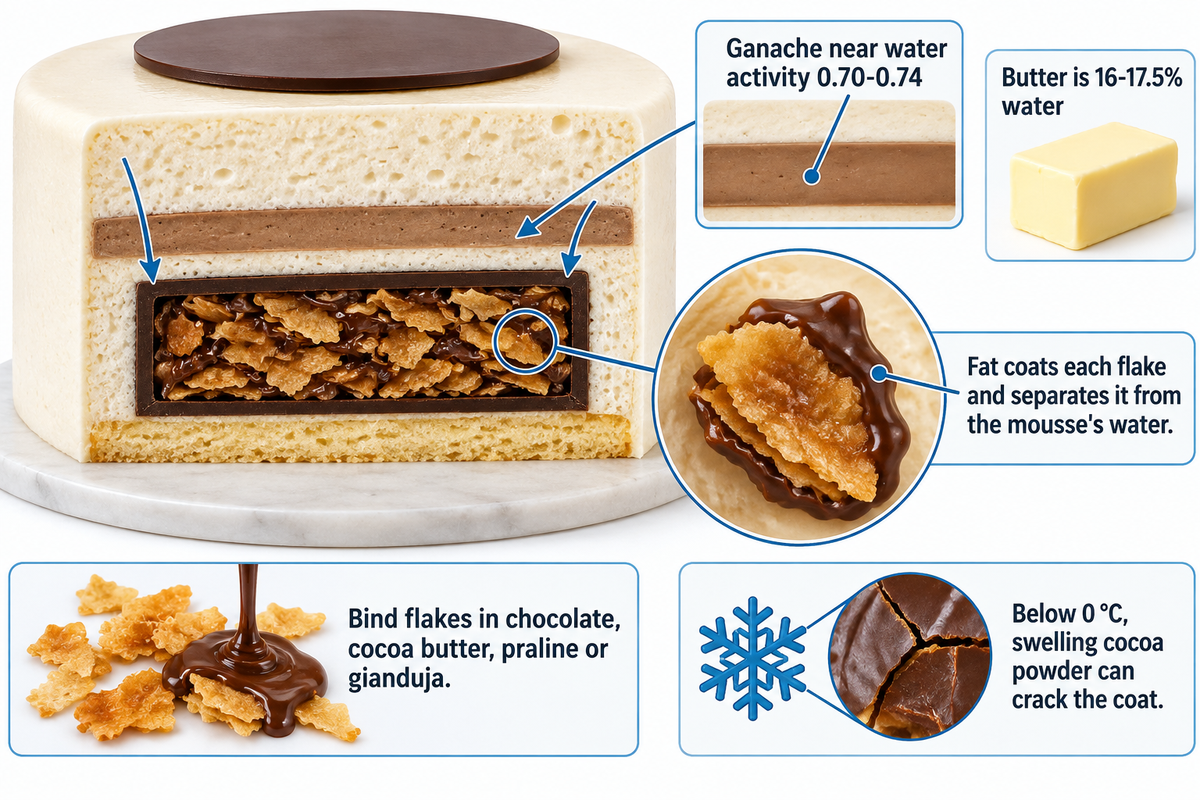
Butter is 16-17.5% water, so a butter-bound crunch layer brings its own water into the flakes, while chocolate and nut pastes, which contain very little water, barely bring any water into the flakes. In a cake, balance is reached when water in the mousse, cream or ganache moves to the drier flakes.
The Center for Dairy Research butter composition notes state that fat content is 80 to 82% and water content is 16 to 17.5%. The Oklahoma State University Extension’s butter fact sheet states that the maximum limit for moisture is 16 g per 100 g. A buttery coat tastes right, but it’s a water source.
Fillings sit far wetter than flakes. Sugar-rich ganaches that keep at room temperature still sit around water activity 0.70 to 0.74, according to a 2024 Foods review of ganache stability. Wafer makers attack that gap from both sides. The Nestlé patent application cites earlier patents for lowering the filling’s water activity with sorbitol, glycerol or hydrocolloids. Another route it cites is coating the wafer with chocolate or another fatty moisture barrier.
Coats differ as barriers. In chocolate-flavoured coatings, water vapour permeability decreased as solid fat content increased, while cocoa powder and lecithin increased it, and sugar decreased it. Below 0 °C the same coatings failed as barriers because swelling cocoa powder cracked them, Ghosh and colleagues found in 2005. Inclusion suppliers coat each piece the same way: barriers stop water moving in and out, and one supplier told Baking Business they keep graham cracker pieces crunchy.
On eGullet, a member making a praline cream with dairy cream folded in flakes and found them “sort of soggy”. The usual pastry fix is to make a separate croustillant. Bind the flakes in melted chocolate, cocoa butter, praline or gianduja paste and spread the mix evenly as a thin layer, and allow it to set. Place it in the centre of the dessert, keeping it away from the airy mousse and whipped cream, or a soaked slice of sponge.
Can a Praline Feuilletine Insert Work Without the Praline?
Yes, a praline feuilletine insert can work without praline when another fat binds the flakes: melted chocolate or cocoa butter, or hazelnut or gianduja paste. The fat coats each flake and separates it from the mousse’s water. Without a fat binder, the flakes rest bare against the filling.
Chocolate and feuilletine is the classic pairing because the chocolate gives the flavour and the barrier. The same holds true for any substitute crunch: crisped rice, corn flakes, wafer flakes, toasted puff pastry crumbs, etc., need the fat coat. The textural contrast lasts only as long as that coat remains whole.
Match the Texture Complaint to the Loss Point
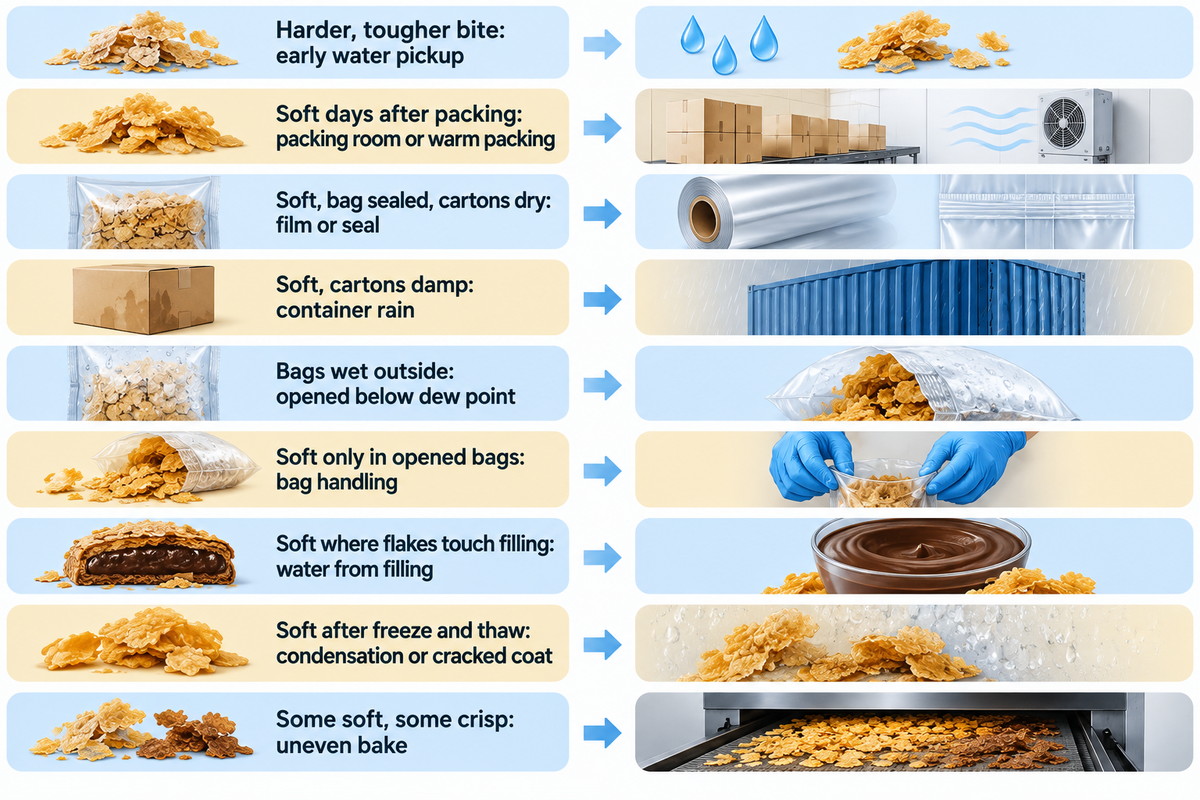
A texture complaint points to its loss point through three clues: when the softness occurred, if the bag was still sealed, and if the cartons were wet. Use the table to pick the first check. Then confirm it with a sealed retained sample from the same lot.
Consider each row a first guess. Texture readings depend on the test method itself, so compare the complaint sample and retained sample with the same water activity and texture method the lot was released with.
| Complaint | Likely loss point | First check | Fix owner |
|---|---|---|---|
| Harder, tougher bite, not yet soft | Early water pickup anywhere in the chain | Water activity of complaint sample vs retained sample | Whoever held the flakes last |
| Soft within days of packing, at the maker | Packing room air or warm packing | Hygrometer log and pack temperature for that lot | Flake maker |
| Soft on arrival, bag sealed, cartons dry | Film barrier or seal | Seal leak test and film WVTR at a stated condition | Flake maker and pack supplier |
| Soft on arrival, cartons stained or damp | Container rain | Logger file, pallet type and desiccant count | Shipper |
| Bags wet outside after unloading | Opened while colder than the dock’s dew point | Carton surface temperature vs dock dew point | Receiving warehouse |
| Soft only in opened bags | Opened-bag handling | Days since opening, where the bag was kept | User plant |
| Soft only where flakes touch icing, cream or sponge | Water from the filling | Filling water activity vs flake water activity | Product developer |
| Soft after freezing and thawing | Condensation at thaw or a cracked coat | Was the pack opened cold; coat checked after one freeze cycle | User plant and developer |
| Some flakes soft, others crisp in one bag | Uneven bake: pale, under-baked patches hold more water | Water activity of soft and crisp flakes tested separately | Flake maker (oven) |
The last row is the one most frequently attributed to storage. Baking mistakes upstream leave some flakes wetter from the start, and no pack or warehouse can dry them again.
How to Run a Split-Lot Storage Trial
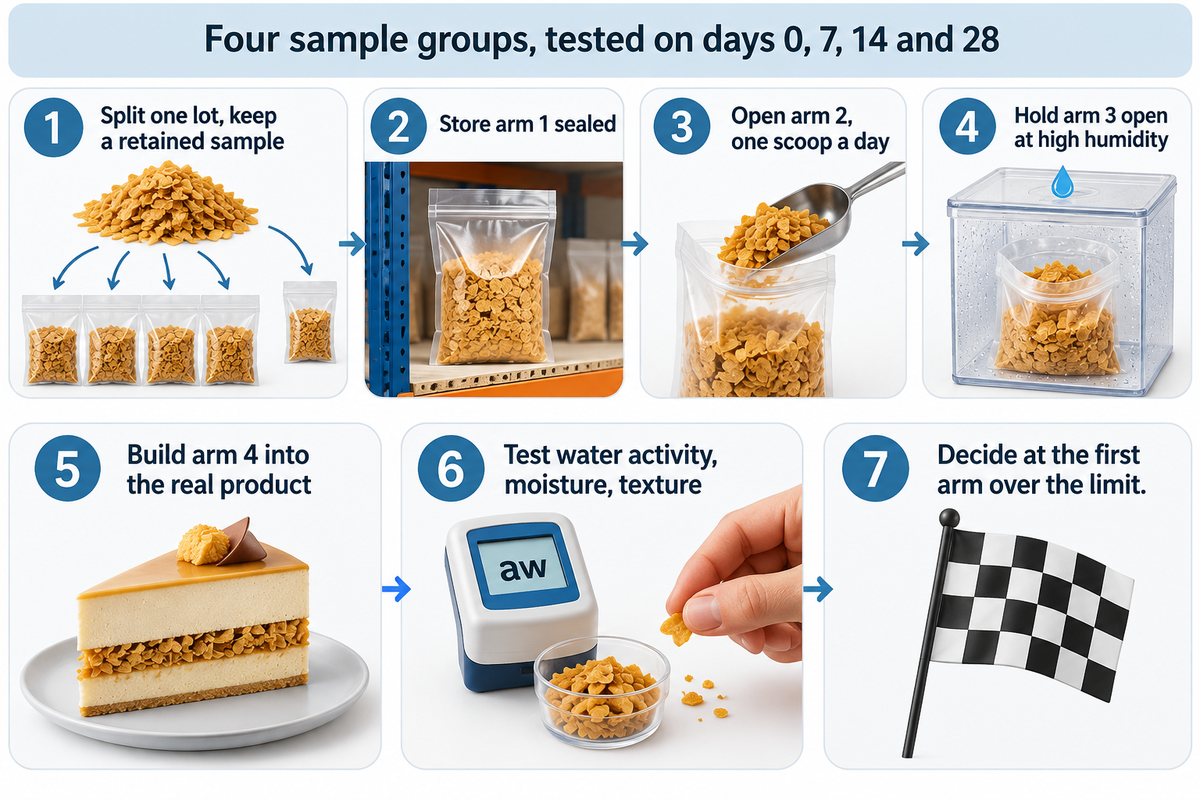
The Split-Lot Storage Trial tests four arms of one production lot on days 0, 7, 14 and 28 to show where crunch is lost. Each arm starts from the same flakes, so the first arm to cross your limit names the loss point. It also gives you the limit to write into the specification.
- Split one lot from a single packing run into four arms, and keep a fifth sealed bag untouched as the retained sample.
- Store arm 1 sealed in the warehouse you actually use, as the control.
- Open arm 2 in the user plant’s workroom and reseal it after one scoop a day.
- Hold arm 3 open in a closed box at a fixed high humidity, logged with a hygrometer, as the humid challenge.
- Build arm 4 into the real cake, insert or bar and store it the way it will be sold.
- Test each arm on days 0, 7, 14 and 28 for water activity at a fixed temperature, moisture content and one texture reading.
- Decide at the first arm that crosses your limit, and write that loss point and limit into the specification.
For all arms and for each test day, use the same water activity method and texture method, keep the settings fixed, and record them. In acoustic and mechanical wafer tests by Carsanba and Schleining, quality grades were best separated with the microphone at 45° and 1 cm, and with a test speed of 0.5 mm/s. Adjusting the microphone angle did not significantly change the test result.
Plan for weeks, not days. Samples in the crisp-bread work still had not reached their target water activity after 49 days over salt solutions. The sealed control may not move in 28 days, so keep it running; the opened and humid arms are set up to fail first. Plan for and manage the trial as described in our food product scale-up process guide, the same way you would plan for and manage a formal process change. One variable per arm, named sampling points, and a written conclusion are essential to the trial.
What to Write Into a Feuilletine Purchase Specification

A feuilletine purchase specification should state a water activity limit at 25 °C, a moisture limit with its method and basis, and the pack structure with its WVTR test condition. Also required is a seal test, storage and shipping conditions and a certificate of analysis for each batch.
Shelf-life wording is for the unopened pack in a stated storage condition, and an opened pack is outside its scope. Readings are to be preferred over adjectives in what a flake supplier or a line maker sends you. Water activity and moisture are to be determined at the oven exit, crusher discharge and in the filled pack. Take those readings from a run on your recipe.
For buyers making their own flakes, the UDTECH feuilletine production line page lists the baking unit and leaves the cooling and flaking sequence as an item to define in the quotation. These readings are to be included in the trial run. Size the hourly output first with the feuilletine capacity planner, to define the process constraints. The checklist below should be included in the request for quotation.
RFQ checklist for feuilletine moisture control, copy these into your quote request:
| Parameter | Recommended range | Why it matters | How to verify |
|---|---|---|---|
| Water activity limit | Set from your storage trial, read at 25 °C | Flakes soften above their critical value | Meter reading on every lot, with reading temperature |
| Moisture content | % by mass, with method and wet or dry basis | Controls the bake and lot-to-lot drift | Method named on the certificate of analysis |
| Pack film | Structure and WVTR at a stated condition, such as 38 °C and 100% RH | Sets the bag’s water budget | Film data sheet with an ASTM F1249 result |
| Seals and whole pack | Leak-free seals; whole-pack moisture gain test | Seals let water in beside the film | Seal test record per shift; whole-pack test once per pack change |
| Packing conditions | Room humidity below the flakes’ balance point; pack at room temperature | Stops pickup before the bag is sealed | Hygrometer log matched to lot numbers |
| Shipping | Kiln-dried pallets, desiccant per DIN 55474, vents closed on cold-to-hot routes, logger | Prevents container rain | Booking instruction and logger file per container |
| Certificate and samples | Certificate of analysis per batch; sealed retained sample per lot | Lets a complaint be traced to its loss point | Lot number on both |
| Shelf-life statement | Tied to the unopened pack and a stated storage condition | Prevents disputes over opened bags | Wording in the specification |
What’s Changing: Recyclable Films and the Moisture Barrier
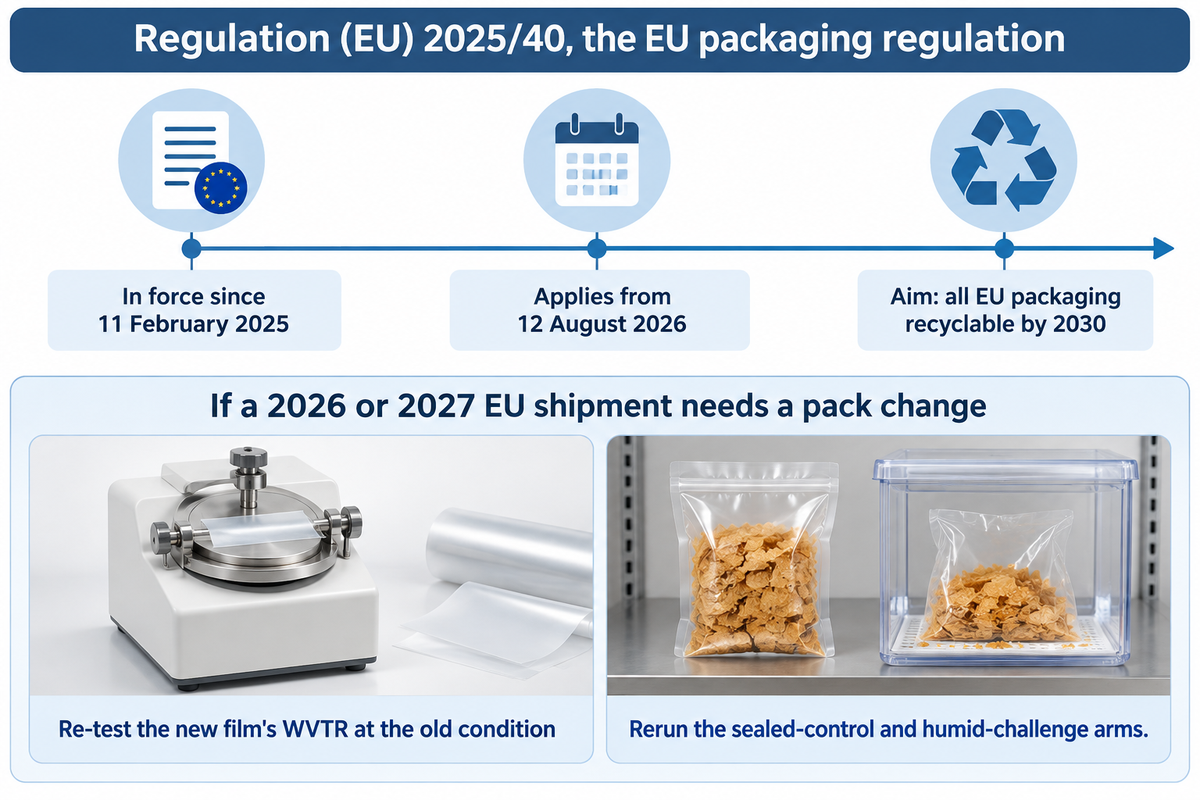
The EU packaging regulation, Regulation (EU) 2025/40, applies from 12 August 2026 and aims to make all packaging on the EU market recyclable in an economically viable way by 2030. Multilayer and foil flake packs may need redesign as its recyclability rules take effect.
The regulation is recorded on the website of the European Commission on packaging waste as in force since 11 February 2025. It replaced the Packaging and Packaging Waste Directive 94/62/EC, which was generally repealed on 12 August 2026. Foil matters for crunch because, in the Washington State tests, it was the only structure that allowed no measurable water to pass through.
If your 2026 or 2027 EU shipment plans require a pack change, new film WVTR testing should be done at the old film’s test condition prior to export. The sealed-control and humid-challenge arms of the storage trial should be repeated on the new film. The specification should be updated prior to the first export lot of the changed pack.
Frequently Asked Questions
Does feuilletine go soggy in the fridge?
Sealed feuilletine keeps in the fridge, but it goes soggy when the cold bag is opened in warm air or when the flakes sit on a moist cake there.
A cold bag is below the room’s dew point, so water condenses on the flakes as soon as air reaches them. On a chilled cake, the hours in the fridge give the filling’s water time to move into the flakes. Let a cold, sealed bag reach room temperature before you open it, and add the flakes to a chilled cake as late as you can.
Can you freeze feuilletine?
Yes, freeze feuilletine only in a sealed, moisture-proof bag, and let the closed bag warm to room temperature before you open it.
Opening it cold pulls condensation onto every flake. Flakes already set into a frozen dessert are a different case: a coat made with plenty of cocoa powder can crack below 0 °C and let water through. Thaw the bag closed on the bench, then open it once it feels as warm as the room.
Can soft feuilletine be re-crisped?
Yes, flakes softened by humid air can be re-crisped by drying them in a low oven, then cooling them fully before you seal them.
Drying removes the water that softened the sugar and starch, so the glassy snap returns. Spread the flakes thinly on a tray and toast them briefly. Flakes softened by cream, butter or a filling won’t come back cleanly. Test one handful first: if it snaps cleanly once cool, dry the rest the same way.
Is soft feuilletine still safe to eat?
Usually yes: soft feuilletine has lost texture, not safety, and stays far drier than the water activity above 0.95 that FDA says lets most microbes grow.
Throw it out if it smells rancid or shows mould.
Why does feuilletine go soft faster in summer?
Summer air holds more water, so opened bags, packing rooms and unloading docks push more of it into the flakes, and the dew point climbs.
At 35 °C and 70% relative humidity the dew point is 28.7 °C, so goods from an air-conditioned store collect condensation outdoors. FDA also notes that water activity rises with temperature. In summer, log room humidity with each lot, shorten the time bags stay open and keep cartons closed until they have warmed.
Does feuilletine stay crunchy in ice cream?
Yes, if it is coated: flakes bound in chocolate or cocoa butter stay crunchy in ice cream, while bare flakes soften as they take up its water.
Pick a high-fat coat, since coats rich in cocoa powder can crack in the freezer.
Making your own flakes? Send your recipe, target flake size, pack and destination climate. The UDTECH team will mark which cooling and flaking items fall inside the quoted scope and which stay as trial items, so you can test the proposal against the checklist above.
About This Analysis
Prepared by Suzhou UDTECH Technology Co., Ltd. from published food-science studies, a film test standard and shipping guidance, with each number traced back to the source listed below. The bag water budget and the dew point table are calculated examples.
Related Articles
References & Sources
- Katz and Labuza, Effect of Water Activity on the Sensory Crispness and Mechanical Deformation of Snack Food Products (1981), University of Minnesota
- Relationship between water activity of crisp bread and its mechanical properties, Polish Journal of Food and Nutrition Sciences
- US20100092612A1, Moisture resistant wafer, Nestec S.A. patent application
- Martínez-Navarrete et al., Water sorption and the plasticization effect in wafers (2004), FAO AGRIS record
- Inspection Technical Guide: Water Activity (aw) in Foods, US Food and Drug Administration
- Water content or water activity: what rules crispy behavior in bread crust?, PubMed
- Use of Low-Cost Devices for Water Activity Determination by Cottage Food Producers (2025), Journal of Food Science, via PubMed Central
- Packaging Temperature, American Society of Baking
- Bhunia et al., Effects of Oxygen and Water Vapor Transmission Rates of Polymeric Pouches on Oxidative Changes of Microwave-Sterilized Mashed Potato (2016), Food and Bioprocess Technology, Washington State University
- ASTM F1249-25, Water Vapor Transmission Rate Through Plastic Film and Sheeting Using a Modulated Infrared Sensor, ASTM International
- Reinas et al., A quantitative approach to assess the contribution of seals to the permeability of water vapour and oxygen in thermosealed packages (2016), Universidade Católica Portuguesa
- Delayed Quality Deterioration of Low-Moisture Cereal-Based Snack by Storing in an Active Filler-Embedded LDPE Zipper Bag (2022), Foods, via PubMed Central
- How to Prevent Moisture in Sea Containers, Virginia Tech Center for Packaging and Unit Load Design
- Dry Bulb, Wet Bulb and Dew Point Temperatures, US National Weather Service
- Temperature, Dewpoint, and Relative Humidity Calculator, University of Miami
- Butter Science 101, Center for Dairy Research, University of Wisconsin–Madison
- FAPC-253 Butter: Chemical and Physical Properties and Health Effects, Oklahoma State University Extension
- Chocolate Ganaches: Formulation, Processing and Stability in View of the New Production Trends (2024), Foods
- Ghosh et al., Moisture migration through chocolate-flavored confectionery coatings (2005), Journal of Food Engineering, Penn State record
- Creating a blockbuster with inclusions, Baking Business
- Carsanba and Schleining, Examination of optimum test conditions for a 3-point bending and cutting test to evaluate sound emission of wafer during deformation (2018), International Journal of Food Studies
- Packaging waste, European Commission