Get in touch with UDTECH Company

Waffle & Pancake Production Lines
Industrial Waffle and Pancake Production Lines
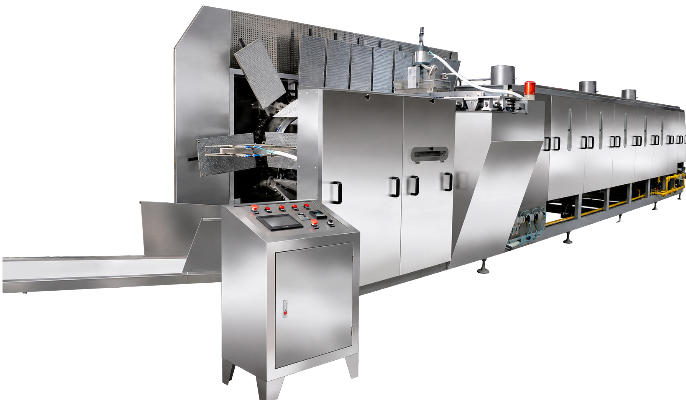
UDTECH builds a waffle production line as one continuous tunnel, sized around your target daily output, the gas supply already on your site and the floor you can give it. Lines are configured by product format, daily output, heat source and the downstream handling you need, and every industrial bakery gets a written proposal within 48 hours of sending its output target and product format. This page publishes the footprint, utility and electrical figures for all five models, because those are the numbers that decide whether a line can be sited at all.
- 1,800 to 5,000 kg per 24 h
- 32, 60 or 80 moulds
- Natural gas, LPG or electric
- Engineered proposal within 48 hours
- Daily output
- 1,800 to 5,000 kg per 24 h on the four tunnel lines
- Models and moulds
- Five models; 32, 60 or 80 moulds, or 8 baking plates
- Machine length
- 6 m to 12 m for a tunnel line; 2.1 m for the rotary machine
- Electrical load
- 3 kW, 5 kW or 13–21 kW by model, three-phase 380 V ±10%, four-wire
- Gas connection
- Natural gas 8 to 19 m³/h, or LPG 4 to 14 kg/h
- Compressed air
- 0.6 m³/min on tunnel lines, 0.2 m³/min at 0.6 MPa on the rotary
Waffle and Pancake Line Capabilities
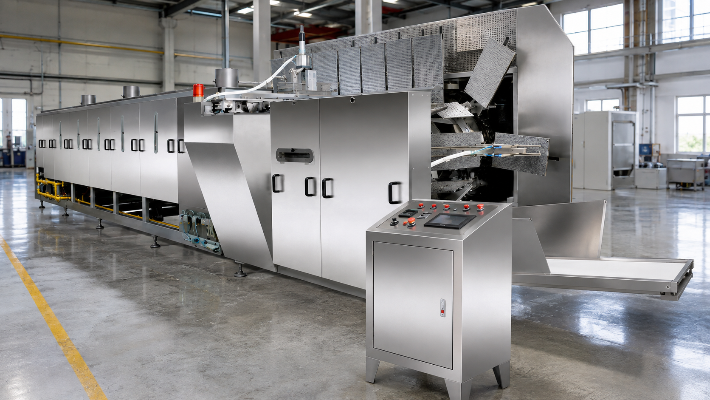
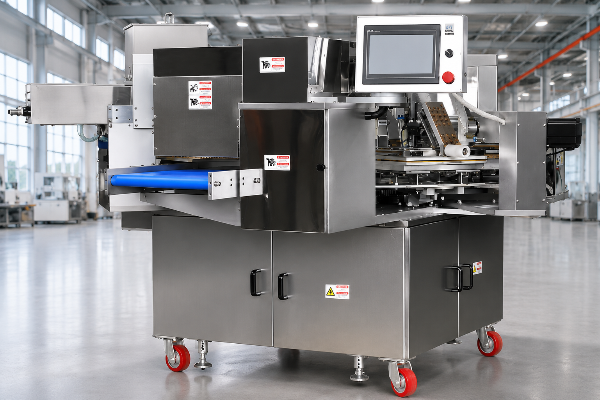
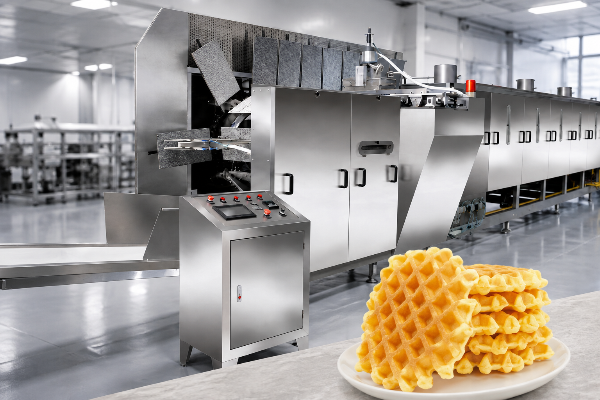
Batter is deposited into steel moulds, cooked through in a continuous enclosed tunnel oven and released onto a discharge conveyor in a single pass. This is moulded baking equipment, not a sandwiching or filling line, so what the machine produces is a finished baked piece ready for cooling and packing. UDTECH has manufactured this equipment since 2003 and designs and develops the automation for it in-house.
Continuous Tunnel Baking
A mould chain carries the batter through the tunnel, so heat transfer happens over a fixed dwell time rather than in batches. Heat comes from natural gas, LPG or electric elements, and the thermal load is what drives the gas connection sizing: 8 to 19 m³/h of natural gas, or 4 to 14 kg/h of LPG, across the four tunnel lines. Baked pieces leave the line hot and need floor space to cool before packing.
Fully Automatic PLC Control
Each line runs under PLC control with an operator panel at the machine. Line speed and baking parameters are adjustable from that panel, and the controller keeps a record of the settings used for each run, which is what makes a recipe repeatable across shifts. That record is also what you compare against when a batch comes out wrong.
Electrical and Utility Connections
- Factory standard supply is three-phase 380 V ±10%, four-wire, at 50 Hz.
- Connected load is 3 kW on the YT-10-32M, YT-10-60M and pancake line, 5 kW on the YT-10-80M, and 13–21 kW on the electric YT-02H.
- US low-voltage services are rated by ANSI C84.1 at 208Y/120, 240, 480Y/277, 480 and 600 V at 60 Hz, so tell us your site voltage and frequency and we settle the supply arrangement in the quotation.
- Compressed air is 0.6 m³/min on the tunnel lines and 0.2 m³/min at 0.6 MPa on the rotary machine.
- Gas-fired models need a natural gas or LPG connection at the flow rates listed by model; there is no electric variant of the tunnel lines.
What Makes Up One Line
- Batter feed and depositing head over the mould chain.
- Interchangeable special-steel baking templates that set the product shape.
- Enclosed tunnel baking chamber with flue stacks.
- De-moulding station with take-off belt.
- Discharge conveyor to your cooling or packing area.
- Floor-standing control cabinet with the PLC and operator panel.
Three Line Families, Each With Its Own Page
Two of the three are closely matched on paper: the pancake line and the mid-size soft waffle line both run 60 moulds down a 9.8 m tunnel and are both rated at 3,500 kg per 24 h, and what separates them is the template set each one carries. The rotary machine is the real break in the range, because it bakes in batches on eight plates and runs on electricity where every tunnel runs on gas. Each card below carries the mould or plate count, the rated output, the footprint and the heat source, which are the four figures that settle a shortlist before anything else is discussed.
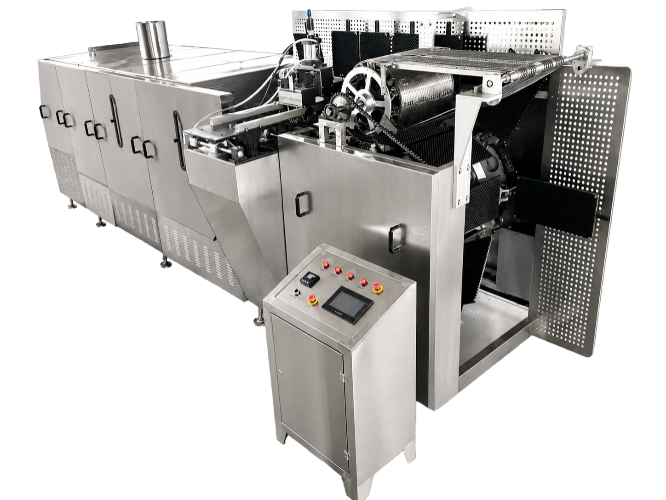
Soft Waffle Production Line
- YT-10-32M · YT-10-60M · YT-10-80M
- 32, 60 or 80 moulds on a continuous mould chain
- 1,800, 3,500 or 5,000 kg per 24 h
- 6 m, 9.8 m or 12 m long × 1.6 m × 1.9 m
- Natural gas 8–19 m³/h or LPG 4–14 kg/h; 3 kW
- Round open-lattice piece from a pourable batter
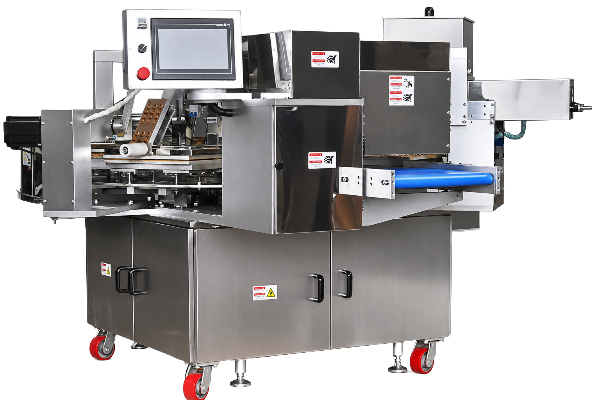
Industrial Soft Waffle Machine
- YT-02H rotary machine
- 8 baking plates on a batch cycle, not a mould chain
- 1,000 pcs/h
- 2.1 × 2.3 × 1.4 m, the smallest footprint in the range
- Electric, 13–21 kW; no gas connection required
- Same round piece as the YT-10 series; compressed air 0.2 m³/min
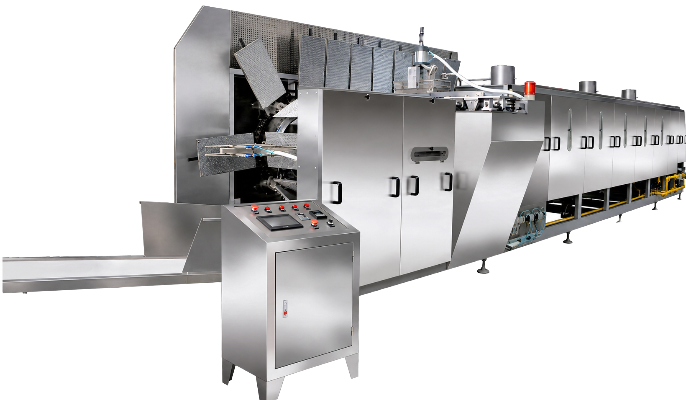
Pancake Production Line
- YT-10 pancake and crisp-biscuit line
- 60 moulds carrying pancake templates
- 3,500 kg per 24 h
- 9.8 × 1.6 × 1.9 m
- Natural gas 14.5 m³/h or LPG 8 kg/h; 3 kW
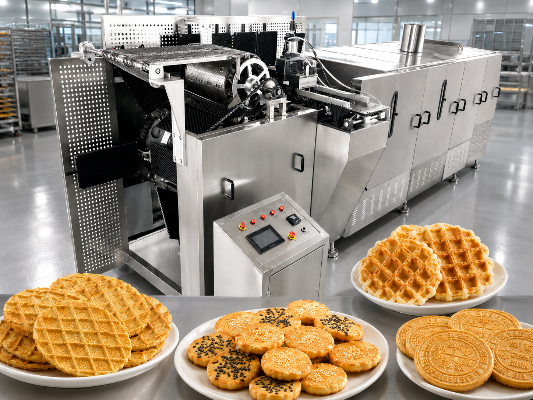
- Runs square biscuit and crisp wafer, mini mesh pancake, and hawthorn slice on template swaps
Product Formats These Lines Run
The baking template is what forms the product, and the templates are interchangeable on the same machine. Changing the template changes the shape, the piece weight and the release behaviour, so the format list below is a list of template sets rather than a list of separate machines.
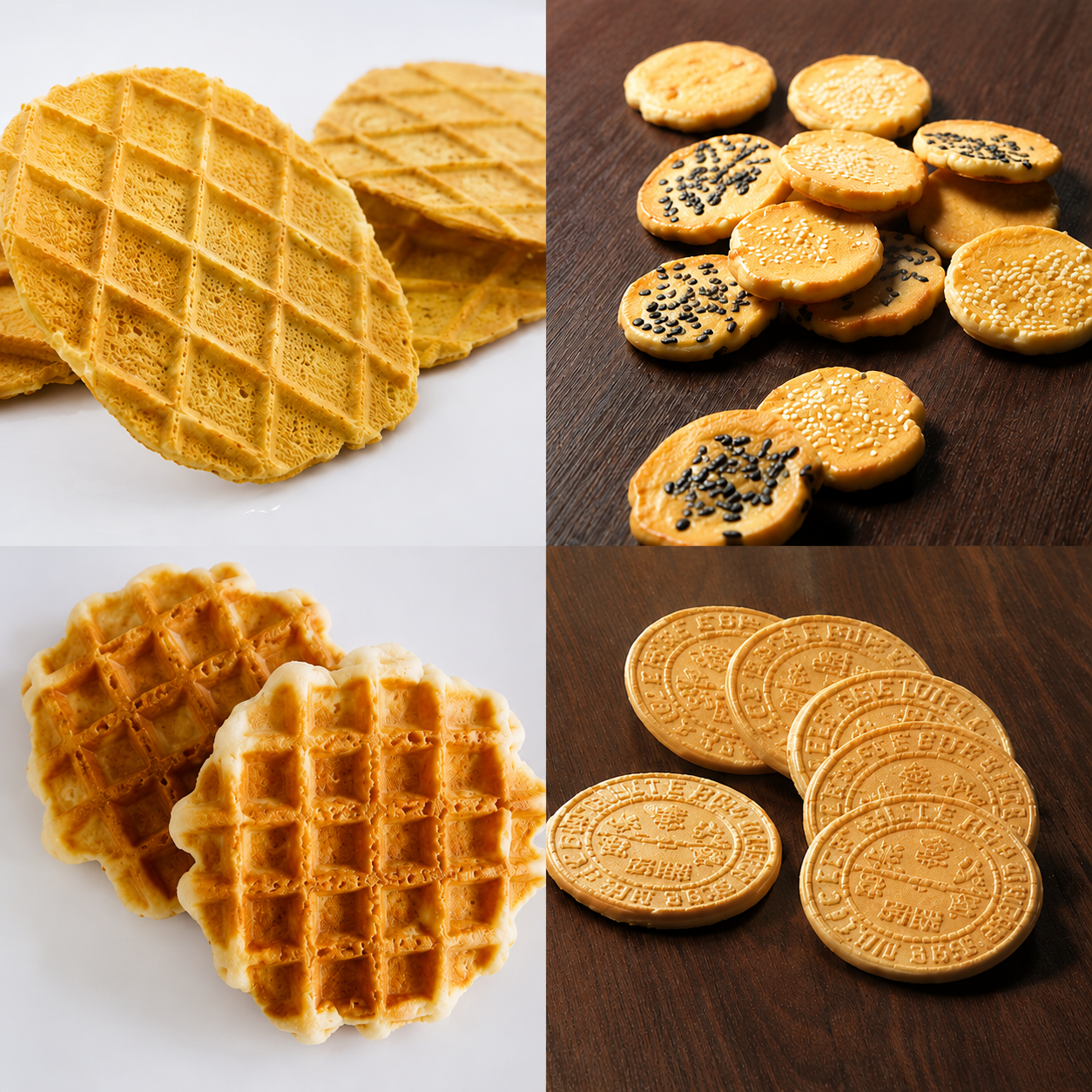
Soft Waffle
Round open-lattice piece with an open crumb, baked from a pourable batter.
Platform
Runs on the YT-10-32M, YT-10-60M, YT-10-80M and on the YT-02H rotary machine.Changeover
Template change is a full template set swap on the mould chain.Square Biscuit and Crisp Wafer
Flat lattice or ribbed piece baked to low moisture, so the crust carries the snap.
Platform
Runs on the YT-10 pancake and crisp-biscuit line.Changeover
Template change is a template set swap plus a batter viscosity change.Pellet and Mini Biscuit
Small individual pieces baked in a dense cavity pattern for high piece counts.
Platform
Runs on the YT-10 pancake and crisp-biscuit line.Changeover
Template change is a cavity template swap; the depositing dose changes with it.Mini Mesh Pancake
Open mesh disc with a wide surface for its weight, used as a pastry base.
Platform
Runs on the YT-10 pancake and crisp-biscuit line.Changeover
Template change is a mesh template swap.Small Round Pancake
Closed round piece with a smooth surface, baked from a thicker batter than a lattice waffle.
Platform
Runs on the YT-10 pancake and crisp-biscuit line.Changeover
Template change is a template set swap.Hawthorn Slice
Thin fruit-paste slice, which is a dough-type feed rather than a pourable batter.
Platform
Runs on the YT-10 pancake and crisp-biscuit line.Changeover
Template change is a template set swap plus a feed head change.De-moulding Methods and Template Changeover
The reason a single answer does not exist is that release also depends on what is in the batter. The American Society of Baking’s wafer reference lists fat as improving release from the plate, lecithin at 0.2% as an emulsifier that improves the release of steam, and notes that fats have to be thermally stable for the sheet to release; added starch changes sheet quality and stability.
Whether a baked piece comes out of the mould cleanly is treated in this category as a property of the machine, and that is the counter-intuitive part: it is at least as much a property of the recipe. Two release actions are available as a configuration choice, and the right one is fixed in the line design rather than changed later on the floor.
Release Method
What It Acts On
Operational Conditions
Release Method
Needle rolling
What It Acts On
The baked piece is lifted off the open mould at the take-off belt by a needle roller.
Operational Conditions
The piece holds together under a mechanical lift at exit temperature, which is a function of its structure and its moisture at that point.
Release Method
Air blowing
What It Acts On
Compressed air releases the piece from the mould cavity from behind.
Operational Conditions
The cavity geometry lets air reach the back of the piece, and 0.6 m³/min of air is available at the machine.
How the Method Is Settled for Your Product
You send the finished piece specification and the batter or dough recipe you intend to run.
UDTECH selects the release configuration for that format when the line is built, and sizes the compressed air accordingly.
We test-run the line on your own batter recipe before it ships, which is where the release setting is confirmed rather than assumed.
If the recipe changes later, the release setting is a parameter to re-confirm, not a machine to replace.
Changeover between formats is a template operation. The special-steel baking templates are interchangeable on the same mould chain, so a format change is a template set swap plus the matching depositing and baking parameters, and the machine itself does not change.
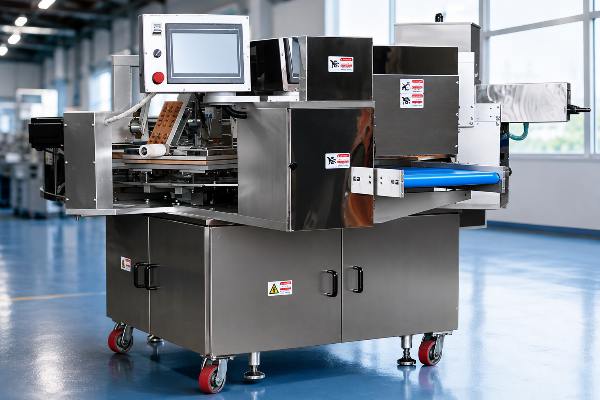
Model Specifications and Line Sizing
Every figure in this waffle production line table comes from the UDTECH equipment specification for the model named in the column heading. Footprints are given in metres and feet so a plant engineer can check the bay before an enquiry goes anywhere.
| Specification | YT-10-32M | YT-10-60M | YT-10-80M | YT-10 pancake | YT-02H |
|---|---|---|---|---|---|
| Baking moulds or plates | 32 moulds | 60 moulds | 80 moulds | 60 moulds, pancake templates | 8 baking plates |
| Footprint L × W × H | 6 × 1.6 × 1.9 m (19.7 × 5.2 × 6.2 ft) |
9.8 × 1.6 × 1.9 m (32.2 × 5.2 × 6.2 ft) |
12 × 1.6 × 1.9 m (39.4 × 5.2 × 6.2 ft) |
9.8 × 1.6 × 1.9 m (32.2 × 5.2 × 6.2 ft) |
2.1 × 2.3 × 1.4 m (6.9 × 7.5 × 4.6 ft) |
| Heat source | Natural gas or LPG | Natural gas or LPG | Natural gas or LPG | Natural gas or LPG | Electric |
| Electrical load | 3 kW | 3 kW | 5 kW | 3 kW | 13–21 kW |
| Natural gas | 8 m³/h | 14.5 m³/h | 19 m³/h | 14.5 m³/h | Not applicable |
| LPG | 4 kg/h | 8 kg/h | 14 kg/h | 8 kg/h | Not applicable |
| Compressed air | 0.6 m³/min | 0.6 m³/min | 0.6 m³/min | 0.6 m³/min | 0.2 m³/min at 0.6 MPa |
| Output | 1,800 kg per 24 h | 3,500 kg per 24 h | 5,000 kg per 24 h | 3,500 kg per 24 h | 1,000 pcs/h |
Output is published in the unit each machine is rated in, and the two units are not interchangeable. Converting kilograms per 24 hours into pieces per hour needs two numbers only you hold: the finished weight of your piece, and the net hours the line will actually be running once cleaning, changeover, maintenance and scrap are taken out.
Planned operation time is planned busy time plus planned downtime, and planned downtime includes scheduled breaks and maintenance. Actual production time counts value-adding production only, with setup time held separately. Availability is actual production time divided by planned busy time.
Terminology of ISO 22400, as set out in the NIST-hosted key performance indicator paper.
The Sizing Rule
-
Start from your finished piece weight in grams, because that is the variable that turns a kilogram rating into a piece count.
-
Subtract your planned downtime from planned operation time first, then divide. A nameplate figure tells you nothing about your own output until cleaning, changeover and maintenance have come out of it.
-
Build the baseline from your own measured hours rather than a borrowed number. Food Engineering reports that 70% of downtime in a consumer-packaged-goods survey fell into minor stops, equipment failures, changeovers and preventive maintenance, and that a baseline needs at least three months of real data covering uptime, downtime, changeover time, volume and scrap.
-
Then pick the model whose gas flow, compressed air and electrical load match the services your site already has, and check the footprint against the bay.
-
One caution on borrowed efficiency numbers. Availability, performance and quality are defined differently by industry and by asset category, so an efficiency benchmark carried across from another plant is not a substitute for your own measured baseline, and a fixed downtime allowance is the most common way a sizing mistake enters a capital budget.
Send Your Target Output for a Model Recommendation
Line Sizing Worksheet
The eight specification rows above, the five model columns and the sizing rule come as one page you can put in front of a procurement team. It carries the arithmetic and the two variables you have to supply.
Open the line sizing worksheet →Utility Cost Estimator
The published gas flow and connected load for each model, multiplied by your own tariff and your own running hours, to an annual figure and a cost per kilogram.
Open the utility cost estimator →Site Readiness Check
Your clear bay dimensions against the five published footprints, and your measured site voltage against the 380 V ±10% band, before an enquiry goes anywhere.
Open the site readiness check →Quotation, Lead Time and Shipping Terms
The common assumption is that a page without a price cannot start a budget, and the opposite is closer to the truth: what a capital buyer needs first is the list of variables that set the number. Price follows mould count, heat source, line length, the number of baking templates supplied, the downstream handling in scope, and the trade term and destination port. There is no price list for a configured line, so your figure comes back in a written quotation.
What Moves the Price of a Line
Driver
What it changes
What to send so it can be priced
Mould count
One choice sets three things at once: mould chain length, tunnel length and gas connection size.
Your target daily output, or the model you have shortlisted.
Heat source
A gas-fired tunnel and an electric rotary machine are different machines, not options on one machine.
Whether natural gas or LPG is available at the site.
Line length and conveyor sections
Adds or removes discharge conveyor length between the tunnel and your packing area.
The distance from the line exit to where the pieces are packed.
Baking templates supplied
Each additional template set equips the line for one more product format, and is tooling priced per set rather than per machine.
Every product format you intend to run in the first year.
Downstream handling scope
Decides where our supply stops and your existing plant starts.
What you already own downstream of the oven.
Trade term and destination port
Moves freight, insurance and export handling in or out of the quoted figure.
Your destination port and the trade term your finance team works to.
How Your Quotation Is Produced
Send the target daily output, the product format and your site gas and electrical supply, and an engineer returns a written proposal within 48 hours with the model, the utility requirement and the footprint. The minimum order is one machine, so a single unit and a complete line are both quoted the same way.
Lead Times by Order Stage
Order stage
Lead time
What it covers
Single machine, standard template set
25-35 working days
Build, assembly and the pre-shipment test run.
Line with custom baking templates
30-45 working days
Adds template tooling for a format that is not an existing geometry.
Complete line with downstream handling
45-90 working days
Adds conveyor sections and integration with the equipment you already run.
Lead time starts at contract signature and excludes ocean transit and customs clearance at your end. Payment is 30-40% deposit on order confirmation, balance before shipment, and we quote EXW, FOB or CIF so your freight forwarder can be compared against ours.
Putting an Energy Figure on the Line You Are Sizing
Running cost is a function of your tariff and your utilisation, so the consumption figures published on this page are the inputs for your own calculation rather than a quoted operating cost.
- Gas-fired tunnel line: 8, 14.5 or 19 m³/h of natural gas by model, or 4 to 14 kg/h of LPG, multiplied by your net running hours and your own gas rate.
- The same tunnel line also draws 3 to 5 kW of connected electrical load for drives and controls, billed at your electricity rate rather than your gas rate.
- Electric rotary machine: 13 to 21 kW multiplied by net running hours and your electricity rate, with no gas input at all.
Comparing a gas burner against electric heating requires converting both to delivered energy on a common basis, because a burner does not put its whole fuel input into the product while resistance heating does. Oklahoma State University Extension publishes the conversion method.
Current industrial electricity and natural gas price series are published by the US Energy Information Administration, and rates move by site, contract and period, so use your own figure rather than a published average.
Control System, Pre-shipment Testing and Documentation
A buyer wiring a deposit to a machinery supplier is carrying three specific risks, and each one has a piece of evidence attached to it rather than a reassurance. The three below are what UDTECH can put in front of you before the line leaves the factory.
Baking parameters are set on the PLC operator panel and the controller keeps the parameter record for each run, so temperature and speed settings are recovered from the machine rather than from an operator’s memory. When a batch comes out wrong, the comparison you need is a stored setting against a current one.
We test-run the line on your own batter recipe before it ships, and the run record travels with the machine. IEC 62381 sets out what factory acceptance, factory integration, site acceptance and site integration tests have to contain, and it puts the scope and the responsibilities in the hands of the owner, buyer and vendor jointly, so you can specify the test rather than accept ours.
Commercial invoice, packing list, bill of lading, certificate of origin and the operation and maintenance manual ship with every order. That set is what your customs broker and your finance team ask for, and it is listed in the quotation so nothing is discovered at the port.
SYS // COMPLIANCE
Where Our Step Ends and Yours Begins
A works test is not a substitute for the site acceptance step you run after installation. Practice reported by ISPE across five automation projects has the factory test executed at the maker’s premises and witnessed by a client representative, site acceptance carried out at the client site after initial commissioning, and protocols marked pass or fail, dated and signed by both tester and witness. Plan the second step into your own schedule; it is your step, not ours.
The Regulations Your Own Site Has To Satisfy
- 21 CFR 117.40 requires food plant equipment to be adequately cleanable, properly maintained and able to prevent allergen cross-contact; that duty sits with you as the operator, and the equipment has to let you discharge it.
- 29 CFR 1910.263 covers guarding on bakery equipment in US plants, and your site layout and guarding acceptance are assessed against it locally.
Ask us for the food-contact material specification for the model you are quoting, and check it against the requirement your own auditor applies.
The YT-02 machine is built with a stainless enclosure and aluminium-alloy structural parts; do not read that construction across to the YT-10 tunnel lines without asking for the specification of the model you are buying.
Project Sequence, From Enquiry to Handover
Output and format confirmation
Output and format confirmation
You send target daily output, finished piece weight, product format and site utilities. We come back with the model that fits and the footprint it needs.
Engineered proposal within 48 hours
Engineered proposal within 48 hours
A written proposal with model, mould count, gas or electrical load, compressed air, footprint and the scope boundary against your existing plant.
Contract and deposit
Contract and deposit
30-40% deposit on order confirmation, balance before shipment, with the trade term and destination port fixed at signature.
Manufacture
Manufacture
The mould chain, tunnel, templates and control cabinet are built and assembled at our own production base in Xinyu.
Pre-shipment test run on your recipe
Pre-shipment test run on your recipe
We test-run the line on your own batter recipe before it ships. If the piece does not come out of the mould the way your specification requires, we correct it here, at our cost, not after delivery.
Container loading and documents
Container loading and documents
The line is packed and loaded, and the shipping document set is issued against the quotation.
What to Send With Your Enquiry
| What to send | Why it changes the answer | Where it lands |
|---|---|---|
| Target daily output in kilograms or pieces | Selects between the 32, 60 and 80 mould chains and the rotary machine. | Model and mould count. |
| Finished piece weight and dimensions | Converts your piece count into the kilogram rating the machines are specified in. | Model selection and template geometry. |
| Site supply voltage and frequency | 380 V at 50 Hz is our factory standard, and US services run to ANSI C84.1 at 60 Hz. | Supply arrangement, settled in the quotation. |
| Natural gas or LPG availability at the site | Decides between a gas-fired tunnel line and the electric rotary machine. | Heat source and gas connection size. |
| Whether a food-contact material specification is required | Your auditor may need the material specification for the specific model before approval. | Document set issued with the quotation. |
Where a Moulded Line Is Not the Right Choice
The biggest line is not always the right call, and the deciding number is usually utilisation rather than budget. A line that runs four days a week at a low fill rate costs more per kilogram than a smaller one that runs full, so the honest starting question is how many net hours you will actually keep it busy.
01
You need a filled or sandwiched product
You need a filled or sandwiched product
Why it works against you
A single-pass moulded line bakes and releases one piece; it does not deposit filling or pair two halves.
What to do instead
Keep the baking line for the shell and add a separate depositing and sandwiching unit, for example for a dorayaki-style cake, downstream of the discharge conveyor.
02
The site has no natural gas or LPG connection
The site has no natural gas or LPG connection
Why it works against you
All four tunnel lines are gas-fired; there is no electric variant, so the trade-off is the wrong one to try to engineer around.
What to do instead
Use the electric YT-02H at 13–21 kW, or budget the gas connection as part of the project rather than as a machine option.
03
You need more than 1,000 pcs/h from a rotary machine
You need more than 1,000 pcs/h from a rotary machine
Why it works against you
The YT-02H bakes in batches on eight plates, so its ceiling is a cycle-time limit that a bigger motor does not lift.
What to do instead
Move to a YT-10 continuous tunnel line, where 32, 60 or 80 moulds set the output instead of a batch cycle.
Request a Line Configuration
A configuration call takes the five items below and comes back with a model, a footprint and a utility requirement. Sending them together is what turns a two-week email exchange into one written proposal.
The minimum order is one machine, so there is no obligation to specify a full line to start. A UDTECH engineer answers within 48 hours.
What to Have Ready
-
01
Target daily output, in kilograms per 24 hours or in pieces per hour.
-
02
Finished piece weight, dimensions and product format.
-
03
Site supply voltage and frequency, and whether natural gas or LPG is available.
-
04
Floor space available for the line and for cooling after it.
-
05
Whether you need the food-contact material specification for auditor approval.
A continuous machine that deposits batter into steel moulds, bakes it in an enclosed tunnel and releases finished pieces onto a conveyor.
A batter feed and depositing head, a mould chain carrying interchangeable special-steel baking templates, an enclosed tunnel baking chamber with flue stacks, a de-moulding station with take-off belt, a discharge conveyor, and a floor-standing cabinet holding the PLC and operator panel.
Tunnel lines are rated in weight rather than pieces, from 1,800 kg per 24 hours on the 32-mould line to 5,000 kg on the 80-mould line. Converting that into pieces per hour needs two numbers only you hold: the finished weight of one baked piece, and the hours the line will actually run once changeover, cleaning, maintenance and scrap have been deducted from the staffed day. The rotary YT-02H is the exception, because it is rated directly at 1,000 pcs/h.
All four YT-10 tunnel lines are gas-fired, at 8 to 19 m³/h of natural gas or 4 to 14 kg/h of LPG. The electric option is the YT-02H rotary machine at 13–21 kW. If your site has no gas connection, the choice is made for you at the model level.
Either a needle roller lifts the piece off the mould at the take-off belt, or compressed air releases it from the cavity. Which one suits your product depends on the piece structure and on the fat, lecithin and starch in your batter, and it is confirmed on your own recipe before shipment.
Yes. The special-steel baking templates are interchangeable on the same mould chain, so a format change is a template swap.
Tunnel lines run from 6 × 1.6 × 1.9 m for the 32-mould machine to 12 × 1.6 × 1.9 m for the 80-mould machine, and the rotary YT-02H needs 2.1 × 2.3 × 1.4 m. Add 3 to 5 kW of electrical load, 0.6 m³/min of compressed air, and a gas connection of 8 to 19 m³/h of natural gas or 4 to 14 kg/h of LPG. Budget floor space beyond the machine itself, because baked pieces leave the line hot and have to cool before packing.
Our factory standard is three-phase 380 V ±10%, four-wire, at 50 Hz. US low-voltage services are rated by ANSI C84.1 at 208Y/120, 240, 480Y/277, 480 and 600 V at 60 Hz, so send your site voltage and frequency with the enquiry and the supply arrangement is settled in the quotation.
Template geometry, mould count, conveyor length and the release configuration are all set at build time against your finished piece specification. We test-run the line on your own batter recipe before it ships, and correct the setup at our cost if the piece does not meet your specification.
25-35 working days for a single machine with a standard template set, 30-45 working days when custom templates are needed, and 45-90 working days for a complete line with downstream handling. Lead time starts at contract signature and excludes ocean transit.
From the factory. The mould chain, tunnel, baking templates and control cabinet are built and assembled at our own plant in Xinyu, Jiangxi, where UDTECH has manufactured this equipment since 2003.
Gas or LPG at 8 to 19 m³/h of natural gas or 4 to 14 kg/h of LPG by model, 3 to 5 kW of connected load on the tunnel lines, 0.6 m³/min of compressed air, one template set for every additional product format, and floor space for the hot pieces to cool before packing. Ocean freight and import duties sit outside the quotation unless the trade term you choose brings them inside it.
Commercial invoice, packing list, bill of lading, certificate of origin and the operation and maintenance manual, plus the pre-shipment test run record.


![Egg Roll Machine Energy Consumption [Calculation Guide]](https://udmachine.com/wp-content/uploads/2026/09/electric-egg-roll-machine-guide-featured-150x150.png)