Get in touch with UDTECH Company

Egg Roll Machine Maintenance: A Practical Guide to Cleaning, Inspection, and Troubleshooting

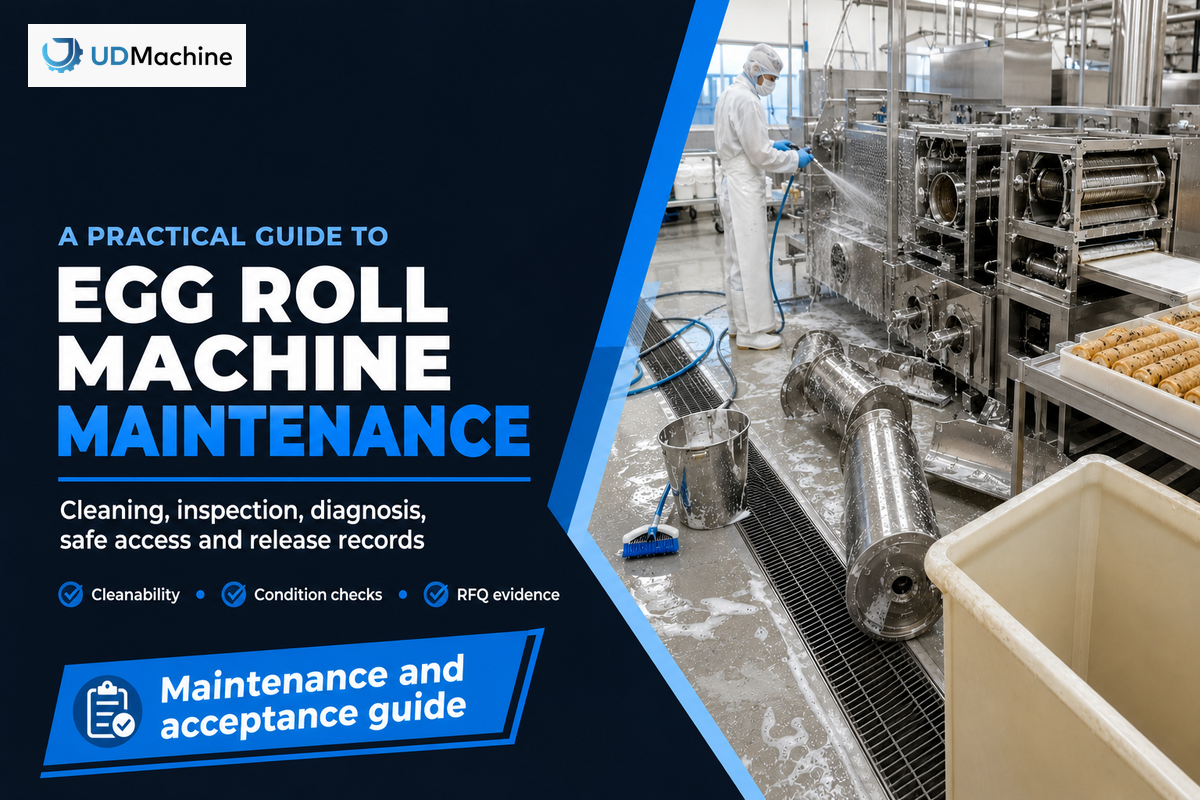
Egg Roll Machine Maintenance is more than wiping batter from a hot plate. Reliable maintenance connects sanitation, safe access, measurement, wear detection and a documented release decision. This guide is intentionally different from a solution page: it explains how to control a machine and prepare a fair maintenance or acceptance conversation, while the commercial page remains the place for models, configuration, specifications and quotations.
Egg-roll equipment combines heat, food-contact surfaces, forming pressure, drives and operator access. A symptom such as sticking or uneven colour can begin with batter moisture, a drifting sensor, residue, a worn mould or a utility change. Treating every defect as a mechanical failure creates unnecessary adjustments and hides the first abnormal condition. The method below keeps the evidence trail visible.
Three control ideas to keep on the work sheet. Access-to-Record Maintenance Loop means every task ends with an observation, person, time and release or escalation decision. Residue-Origin Checkboard separates fresh batter, baked carbon, lubricant and foreign material before anyone chooses a chemical or a spare part. Serviceability Boundary Walkdown checks whether guards, panels, fasteners and utilities can be reached, isolated and cleaned without creating a new hazard.
What Egg Roll Machine Maintenance Should Control
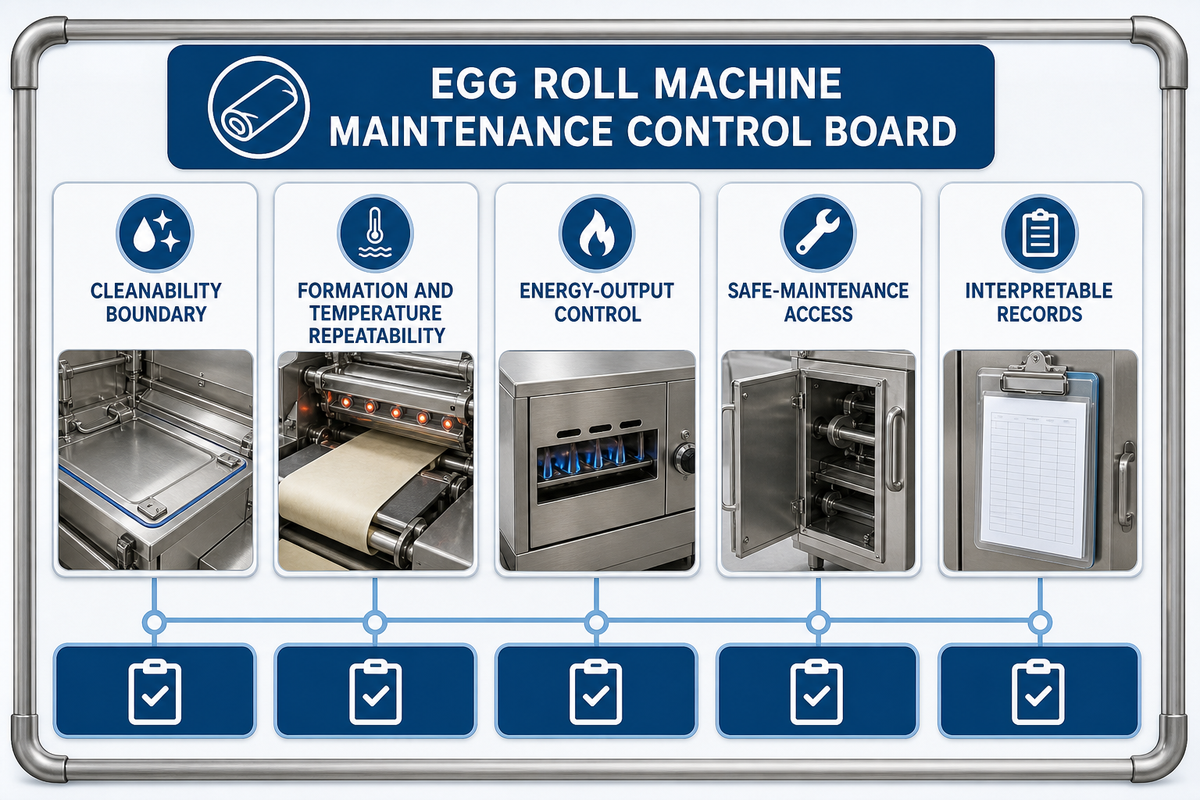
Begin by establishing these five objectives: a surface that can be readily cleaned without cross-contamination risk; formation and temperature repeatability; precise control over energy output; accessibility that enables safe maintenance; and records interpretable by personnel other than the technician who executed the maintenance.
In the US, regulation 21 CFR 117.40 outlines standards for food-contact equipment design, construction, cleaning, and maintenance sufficient to prevent contamination. This standard is a guide for system design, rather than irrefutable proof of compliance for any specific machine or plant, and should be evaluated against applicable local or national regulations as part of a site’s established preventive-controls plan.
The realms of food safety and personnel safety should be regarded as distinct but interconnected concepts. It is possible for a food-contact area to appear clean despite the absence of a protective guard; simultaneously, appropriately safeguarded drive assemblies could retain cross-contaminants. Regulatory provisions of OSHA 1910.147 mandate control of hazardous-energy during machinery servicing. Likewise, OSHA 1910.212 addresses machine guarding for operational points, nip areas and revolving components. Any relevant maintenance record should explicitly incorporate both inspections if both hazards are present on the equipment.
For scope clarity, a commercial egg-roll machine model selector can answer which model, line arrangement or option fits a buyer. This guide answers what to inspect, what to record and when to stop and request technical support.
For process context before a service review, see the egg-roll wafer process guide; use that educational route description to identify hand-offs, not as a substitute for the machine manual or site procedure.
Evidence reference: 21 CFR 117.40 for cleanability and food-contact maintenance, plus OSHA 1910.147 and OSHA 1910.212 for servicing energy control and guarding.
How to read supplier terminology. A making machine, machinery, rolling machine or forming machine may describe one station, while a production line or automatic production line describes connected stations. Search results may also say automatic egg, automatic egg roll, automatic egg roll machine, egg roll making machine, egg roll production, egg roll production solution, making egg rolls, egg roll wrappers, roller machine or spring roll. Treat those labels as vocabulary, not proof of food machinery, food processing or food manufacturing performance. A proposal may mention an inspection machine, factory layout, technical support, after-sales, build quality, production efficiency, processing machines, easy to operate, integrated solutions, optimization, x-ray inspection, fry, production process or customize; ask what is actually included, measured and maintained.
Build a Maintenance Baseline Before Choosing Intervals
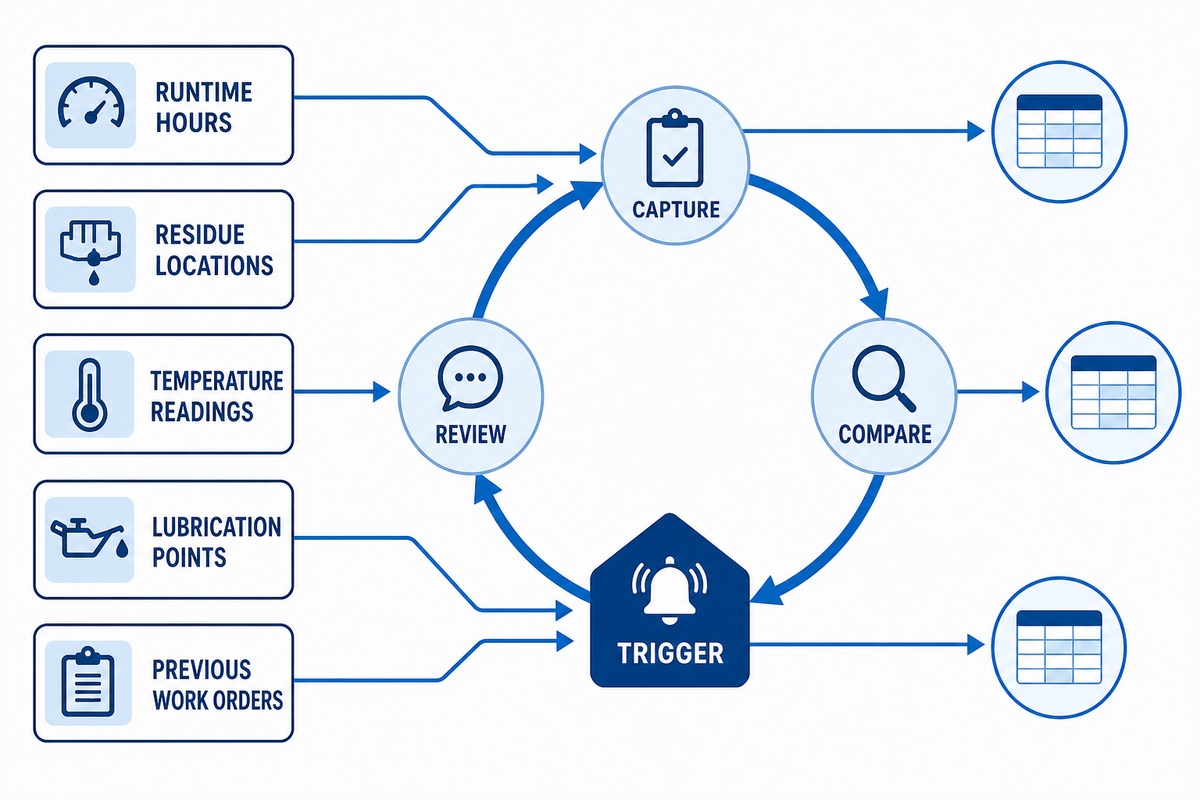
Don’t copy a calendar from another plant and call it a standard. Build a baseline from the actual machine: runtime hours, product and allergen sequence, residue locations, reject types, start-up observations, changeover duration, temperature readings, lubrication points and previous work orders. For example, capture a complete record for 1 shift before setting the first review trigger. Record the first failing station and the condition that preceded it.
Use calendar tasks as a minimum structure, then add condition triggers. A belt that shows fraying, a mould that needs extra release agent, or a temperature loop that takes longer to stabilise may justify an earlier inspection. Conversely, a task that has no defined observation or acceptance criterion is only activity, not control. FDA food-processing guidance describes planned and documented preventive maintenance, critical-parameter monitoring, repair trending and records of routine and emergency work; adapt those ideas to the machine manual and site risk assessment.
| Baseline field | What to capture | Decision it supports |
|---|---|---|
| Runtime and product | Hours, recipe family, allergen sequence, batch size and changeover pattern. | Calendar task, changeover task or condition trigger. |
| Observed signal | Residue map, temperature trend, noise, vibration, sticking, cracks or roll-up failure. | Clean, inspect, measure, isolate or escalate. |
| Evidence owner | Operator, sanitation lead, maintenance technician or quality reviewer. | Who can release the machine after the task. |
| Record field | Evidence source | Decision owner |
|---|---|---|
| Asset identity | Asset tag or line label. | Maintenance lead. |
| Work order | Request number and date. | Planner. |
| Task boundary | Applicable manual section. | Technician. |
| Residue observation | Photo or written note. | Sanitation lead. |
| Instrument status | Instrument ID and due date. | Quality reviewer. |
| Guard status | Inspection note and isolation check. | Safety lead. |
| Part or chemical | Issue note and lot record. | Stores owner. |
| Verification result | Reference reading and sign-off. | Quality reviewer. |
| Release decision | Released, held or escalated. | Production lead. |
Some regulations or customer programs may define their own required inspection frequency. Consider these your minimums to verify instead of your standard Egg Roll Machine Maintenance schedule.
Write units into the record: runtime in h, temperature in °C, pressure in kPa, current in A, and surface or thickness checks in mm where those measures are part of your approved procedure. Units make a trend comparable without turning a local observation into a universal specification.
Template record formats only, not machine limits: runtime 6 hours; reference temperature 180 °C; ambient 72 °F; utility pressure 6 bar; heater reading 4 kW; drive speed 12 RPM; control frequency 60 Hz; supply 230 V; current 4 A; measured wear 0.3 mm; finish 0.8 μm Ra; reject rate 2%; cleaning time 20 min; verification 30 sec; review in 7 days; calibration in 12 months; retention 1 year; reference flow 50 kg/h; clearance 0.5 m; test mass 100 kg; temperature delta 1 °C. A local worksheet might also log 2 batches, 3 shifts, 4 hours of follow-up, a 5-minute response marker, 2 hours of verification, 3 days of trending, 4 weeks of review and 5 months of retention history; those are record-format examples, not machine limits. Your engineering and food-safety teams must set the applicable limits, instruments and review period.
Evidence reference: 21 CFR 117.40 and the Food Safety and Inspection Service sanitation guide support documented, risk-based controls; neither supplies a universal interval for this machine.
Daily Shutdown and Cleaning Routine
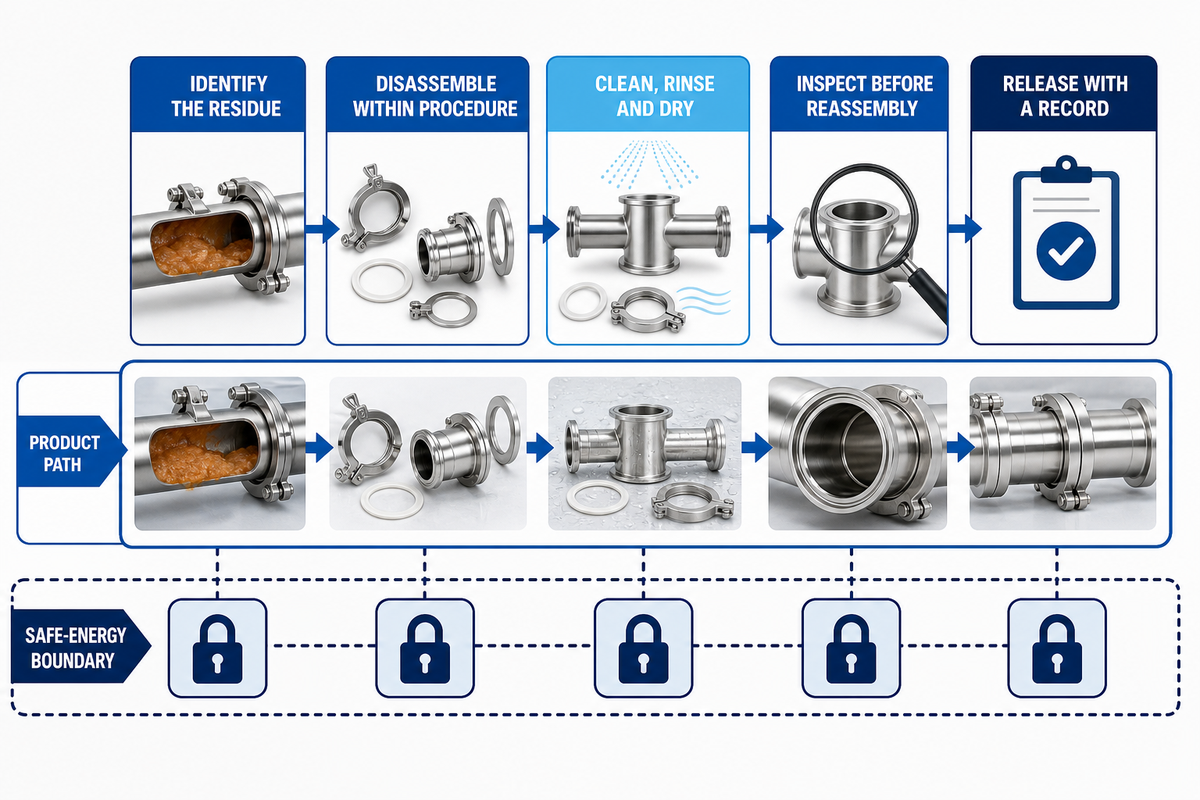
From that baseline, the daily routine should follow the product path, not the order in which panels are easiest to open. Stop production, cool the equipment to a safe handling state and apply the site’s energy-control procedure before entering guarded or hazardous areas. Remove loose product first; otherwise water and detergent can spread residue into seams, bearings or electrical enclosures.
- Identify the residue. Use the Residue-Origin Checkboard to distinguish batter, baked carbon, oil or an unknown contaminant. Quarantine an unknown finding and involve quality.
- Disassemble only what the procedure allows. Protect seals, sensors and electrical components from inappropriate spray. Don’t improvise a tool that damages a food-contact surface.
- Clean, rinse and dry. The exact agent, concentration, temperature and contact time come from the site’s sanitation program and the machine instructions. Cleaning removes soil; sanitizing is a separate, verified step.
- Inspect before reassembly. Look for trapped residue, corrosion, burrs, loose fasteners, damaged scrapers and lubricant migration.
- Release with a record. Note asset, date, person, observations, corrective action and the decision to release, hold or escalate.
University Extension guides and USDA sanitation guidelines both call for documented differentiation between cleaning and sanitizing processes. This food-safety control is important for the operation and its customers, but no university guide or standard will tell you exactly which chemical or temperature to use for your recipe; your organization must define that procedure.
Evidence reference: 21 CFR 117.40 and the Food Safety and Inspection Service sanitation guide frame cleanability and sanitation controls; apply the site’s approved procedure.
Weekly Inspection of Heating, Moulds, Drives and Guards
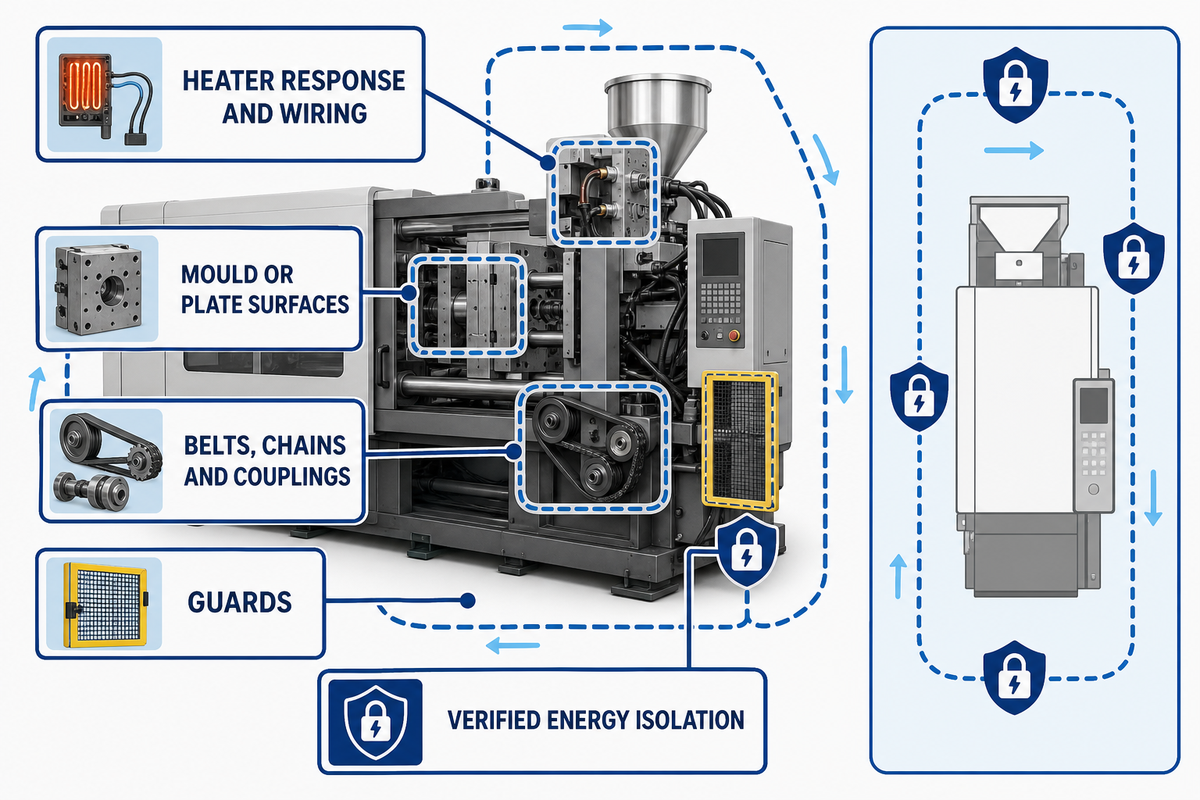
After the daily cleaning check, a weekly inspection is a structured look at the parts that change product quality or access risk. Check heater response and wiring condition without opening energized panels. Compare mould or plate surfaces for wear, distortion, scratches and release-agent build-up. Inspect belts, chains, couplings and fasteners for alignment, tension and unusual marks. Confirm guards are present, secure and not defeating cleaning access.
Walk the Serviceability Boundary Walkdown from the operator side, then from the maintenance side. Can the technician reach the inspection point? Can the energy source be isolated and verified? Can the removed part be cleaned and reinstalled in the correct orientation? If any answer is no, record the boundary as a design or procedure issue rather than hiding it in a comment such as “checked OK.”
Don’t override an interlock for faster cleaning. Repair or document any guard or safety-device damage, then follow the site’s escalation process. Worker protection isn’t compromised for a faster changeover.
Evidence reference: OSHA 1910.147 covers hazardous-energy control during servicing, while OSHA 1910.212 covers guarding at points of operation and moving parts.
Monthly and Condition-Based Tasks
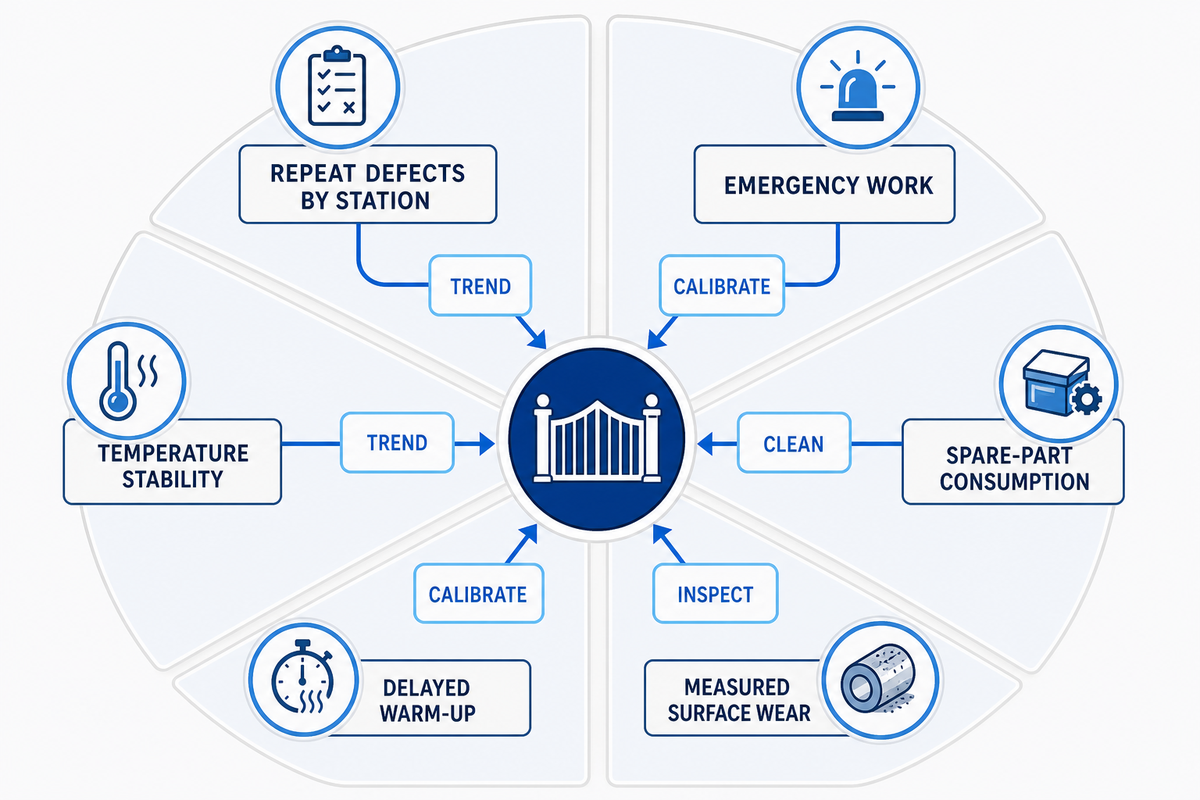
After the weekly inspection, monthly review is useful for trends that are invisible during a single shift: repeat defects by station, emergency work, spare-part consumption, delayed warm-up and repeated sanitation findings. Pair the review with condition checks such as vibration, current draw, temperature stability or measured surface wear where your site has a validated method.
Keep lubricant points away from food-contact surfaces. Confirm use of the approved lubricant class and application method. Don’t assume the label “food grade” by itself is safe: approved quantity, migration path and containment controls are still necessary. Check compressed air, water, exhaust, humidity and room temperature where they may promote browning or release. 21 CFR 117.40 also limits the use of gases on food or contact surfaces in applicable United States operations; include that food-safety boundary in the review.
Calibration status belongs in the same review as maintenance. A stable-looking display isn’t evidence that the temperature probe or reference thermometer is accurate. Record the instrument identity, reference used, result, adjustment and next due date.
Evidence reference: 21 CFR 117.40 sets food-contact and contamination boundaries, and the National Institute of Standards and Technology process-monitoring handbook supports tracking condition signals over time.
Troubleshoot Uneven Browning, Sticking, Cracking or Poor Rolling
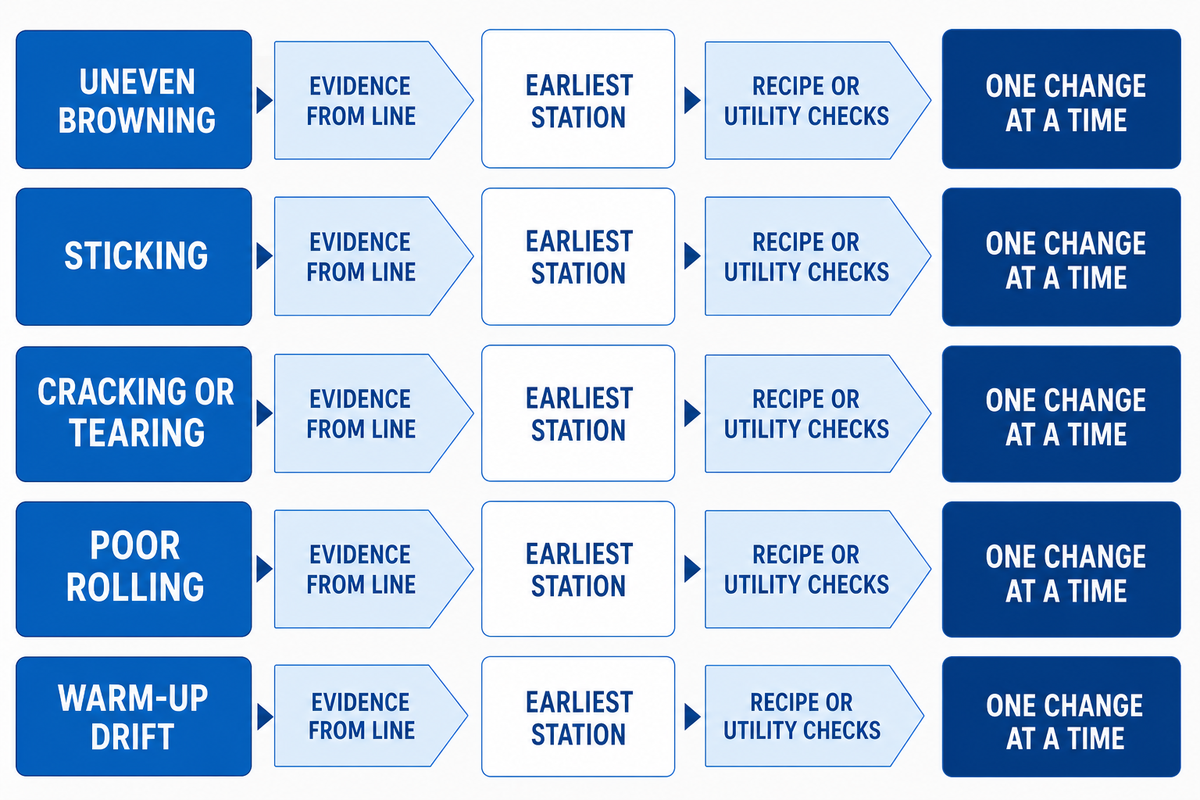
Using those condition trends, use one controlled change at a time. NIST process-monitoring guidance supports looking for a signal that separates common variation from an assignable cause. Before changing a setpoint or replacing a component, preserve a baseline sample and note the earliest station at which the defect appears.
Keep the same discipline for troubleshooting around batter filling, transfer and rolling: write the observation first, then test the smallest safe change and verify the result.
In a factory, a maintenance technician should also confirm that the observed defect is not a handoff or utility problem elsewhere on the production line. That boundary check prevents a local adjustment from hiding a wider process risk.
| Signal type | First checks | Evidence before escalation |
|---|---|---|
| Uneven browning | Recipe moisture, loading pattern, chamber setpoint versus reference reading, heater response, belt speed and exhaust. | Before/after colour notes, reference temperature and location map. |
| Sticking | Residue or carbon, plate surface, release method, batter temperature and alignment. | Clean-surface photo or description, product sample and single-change result. |
| Cracking or tearing | Dough hydration, thickness, plate temperature, pressure, mould wear and cooling transition. | Piece mass/thickness check and first failing station. |
| Poor rolling | Sheet geometry, timing, moisture loss, forming alignment, drive synchronization and downstream handoff. | Short run record with reject count and station observations. |
| Warm-up drift | Start-up time, heater response, sensor agreement and ambient conditions. | Time-to-setpoint in min, reference reading and alarm history. |
| Residue after wash | Disassembly boundary, rinse direction, trapped seams and drying step. | Residue map, cleaning agent record and release signature. |
| Utility-related change | Compressed-air pressure, water temperature, exhaust and room humidity. | Utility readings in kPa or °C and the first affected batch. |
| Instrument disagreement | Probe identity, reference thermometer, calibration status and placement. | Instrument IDs, reference result and adjustment decision. |
| Guard or access issue | Guard fit, interlock function, isolation point and service clearance. | Isolation verification, guard restoration and escalation owner. |
Research shows formulation, moisture, power and baking time can affect colour and texture, so the equipment isn’t automatically at fault. Correct the measured value if the display conflicts with the reference. If a guard, drive or heater acts out of spec, stop and follow the safety procedure instead of extending the trial.
Evidence reference: the National Institute of Standards and Technology process-monitoring handbook describes separating common variation from assignable causes before changing a process.
Records, Safety and Sanitation Release
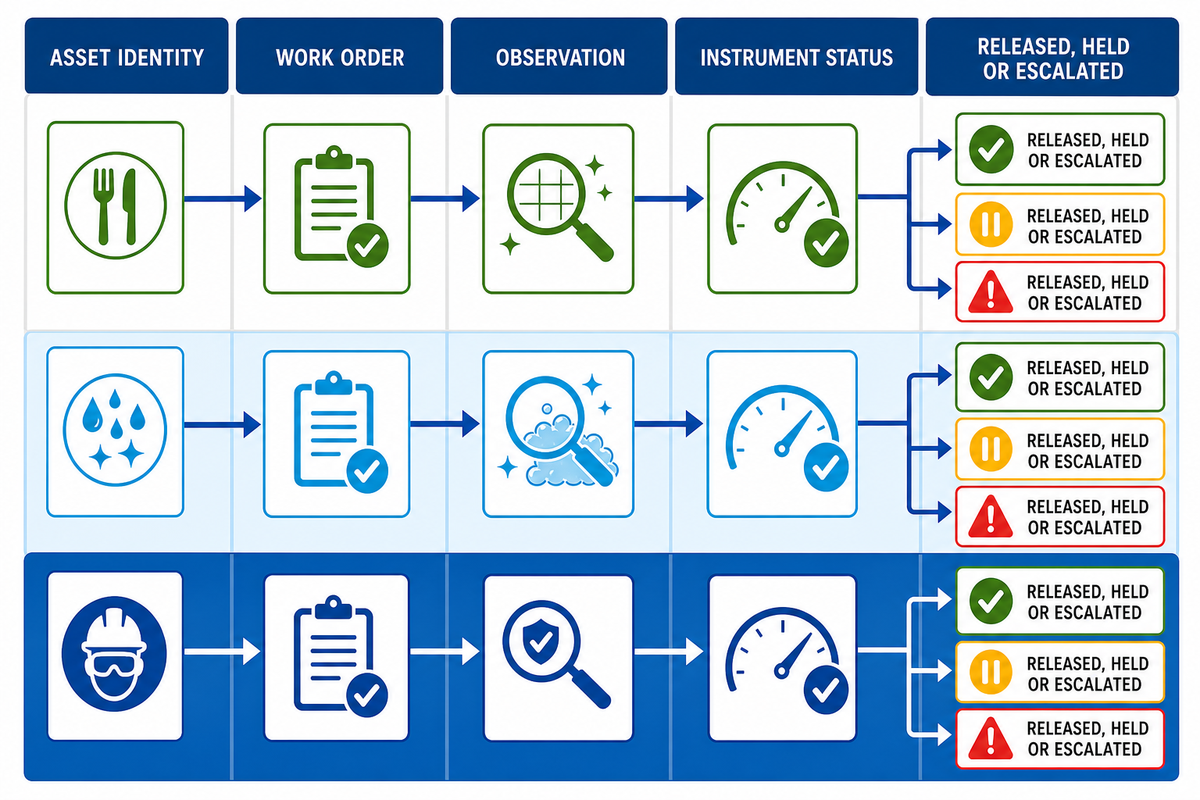
After a controlled cause check, the Access-to-Record Maintenance Loop closes only when another person can reconstruct what happened. A useful entry identifies the asset, work order, task, observation, parts or chemicals used, instrument status, person and timestamp. It ends with one of three decisions: released, held for corrective work, or escalated to the manufacturer or a qualified technician.
Once a cause is tested, this record captures the evidence needed for release.
For an allergen changeover, visual inspection may be only one part of validation. The responsible food-safety team decides whether swabbing, protein testing or another verification is needed. After a repair, quality or production should sign the release against the site’s criteria; a technician’s statement that the machine runs is not the same as a sanitation release.
Keep occupational-safety evidence with the maintenance record: isolation, zero-energy verification, guard restoration and functional safety checks. The exact form and retention period depend on the jurisdiction and site system.
A missed release can carry contamination risk after a long run, so record the batch or runtime context (for example, 6 hours) with the decision. That figure is a local trace, not a universal machine limit.
Evidence reference: Food Safety and Inspection Service sanitation guidance, 21 CFR 117.40, and OSHA 1910.147 support separate sanitation, food-contact and worker-safety records.
Serviceability, Acceptance and RFQ Handoff
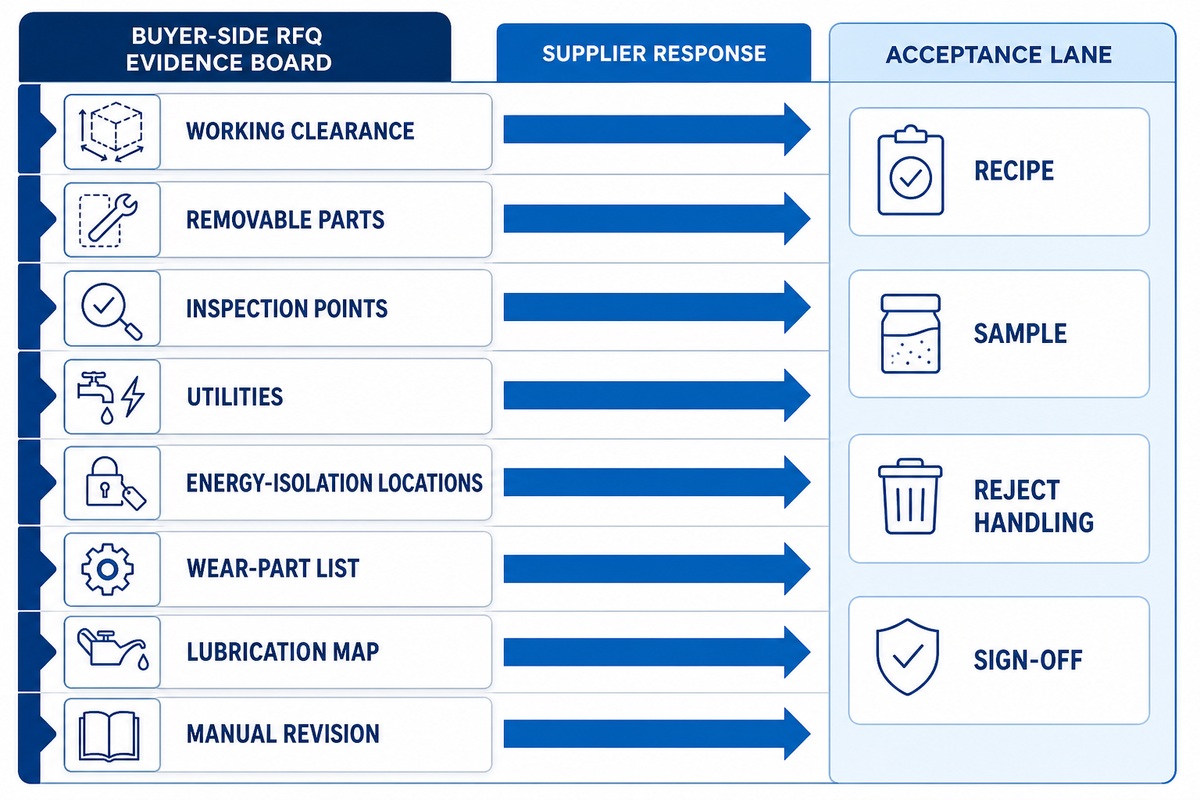
From those records, a maintenance-minded request for quotation asks for evidence, not only a headline capacity. A quoted-capacity comparator can help expose unit mismatches before a supplier discussion. If a condition falls outside the manual, route the evidence to the manufacturer’s technical-support services rather than improvising a repair. Request a marked-up layout showing working clearance, removable parts, inspection points, utilities and energy-isolation locations. Ask for a wear-part list, lubrication map, instrument list, recommended spares, cleaning limitations, manual revision and training responsibility.
Use acceptance tests that match the real recipe and destination process. Define the sample, run window, good-piece criteria, reject handling, temperature measurement method, changeover condition and sign-off roles before the test. A sanitary-design review can check cleanable surfaces, access, seams and material documentation, but it doesn’t by itself prove sustained output or compatibility with every clean-in-place method. NIST distinguishes a one-shot acceptance decision from long-run process control; keep those conclusions separate.
This RFQ and acceptance framework is intentionally educational. The solution page remains the correct place to compare UD machine models, configuration options and a quotation. The requested internal destination /egg-roll-machine-maintenance-guide/ wasn’t linked in this draft because the URL returned HTTP 404 during research; add the internal link after that page is live and reverified.
For non-technical company background, the UD Company profile is a separate first-party reference; it does not replace the maintenance, safety or acceptance evidence required here.
Evidence reference: National Institute of Standards and Technology acceptance-sampling scope distinguishes a one-time acceptance decision from sustained process control; 21 CFR 117.40 remains a planning reference for cleanable equipment.
The 5-Step Maintenance Decision Framework
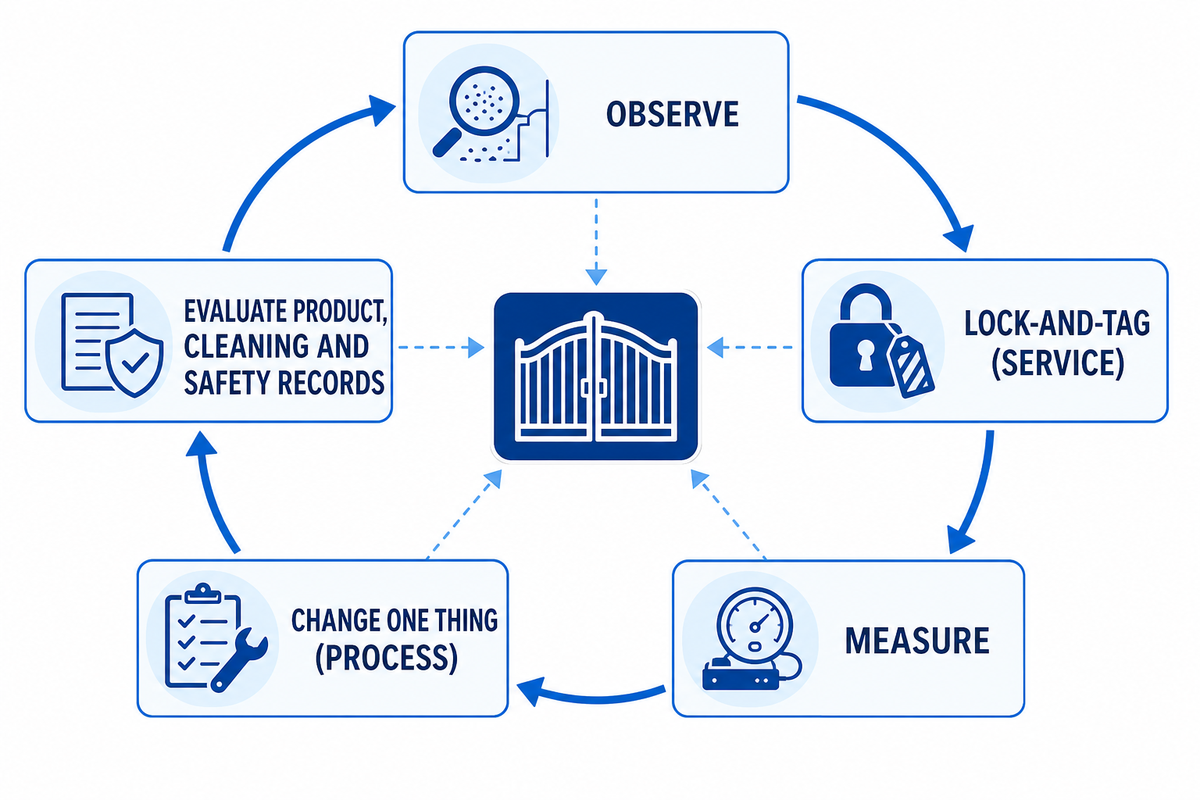
After the release records above, use the preceding observations to run these five steps in order.
- Observe: map residue, defect, access and utility conditions.
- Lock-and-tag (service): safely de-energize all hazardous energy and return guards.
- Measure: use a traceable reference and record the baseline.
- Change one thing (process): perform a single adjustment, cleaning or swap within procedure parameters.
- Evaluate (product and cleaning records): document product, cleanliness, and safety proof; then authorize shipment, holds, or escalations.
If the same signal returns, promote it from a one-off fix to a trend review. That’s how a checklist becomes a maintenance program.
Release rule: A production-line change is ready only when the measured condition, food-safety evidence and worker-safety evidence are recorded by the responsible team. NIST process-control principles support separating a one-time acceptance decision from the ongoing trend review.
Use this sequence on the factory floor with the operator, sanitation lead and maintenance technician present. Compare the evidence after a defined run window, such as 30 minutes or one batch, and escalate when the same risk or defect returns.
Evidence reference: the National Institute of Standards and Technology process-monitoring handbook supports a measured baseline, controlled change and verification loop.
FAQ
How often should an egg roll machine be serviced?
There is no safe universal interval that fits every egg-roll line. Start with the machine manual, the site’s hazard analysis, runtime, recipe and changeover pattern. Use daily sanitation and release checks, a structured periodic inspection and condition triggers for wear, drift or repeated defects. Applicable regulations or customer programs may add fixed reviews, and an extended shutdown may require a pre-start examination. Record the basis for each interval so the schedule can be changed when the evidence changes. Add the responsible owner, the observation that triggers an early review, and the record location so a shift handoff cannot silently reset the schedule. Review the trend after a defined number of batches or operating hours, compare planned work with emergency work, and document why a task was retained, moved earlier or removed. The interval is a controlled decision supported by evidence, not a number borrowed from a catalogue or another recipe.
What should operators check when egg rolls stick to the plate?
First preserve a sample and identify whether the material is fresh batter, baked carbon, oil or an unknown contaminant. Check plate cleanliness and damage, release method, batter temperature and thickness, then compare the temperature display with a verified reference. Change one factor at a time and record the result. If sticking appears with a damaged surface, unusual heater response or unsafe access condition, stop the run and escalate instead of compensating with extra release agent.
Does a clean machine automatically pass a maintenance release?
No. A release should cover at least food-contact condition, allergen or sanitation verification required by the site, restored guards, safe energy state, instrument status and the product criteria for the next run. A machine can look clean while a guard is missing, a temperature probe is out of calibration or a seam traps residue. The responsible production or quality role should sign the release against written criteria; a technician’s “running” note alone is not a food-safety decision.
What maintenance evidence should be requested from a supplier?
Ask for a revision-controlled manual, cleaning and lubrication boundaries, removable-part and wear-part lists, instrument specifications, recommended spares, working-clearance drawings, isolation points, guard and interlock information, training scope and acceptance-test templates. Request evidence for the actual recipe and run conditions rather than a generic demonstration. Confirm which tasks belong to the buyer, which require a qualified technician and how post-repair production release is documented. Keep certification claims separate from sanitary-design observations and verify any certificate with its issuer.
When should a maintenance team call the manufacturer?
Escalate when a safety device, heater circuit, control parameter, structural surface or food-contact material is damaged; when the same defect returns after a controlled check; or when the approved procedure does not cover the observed condition. Provide the asset identity, manual revision, photos or descriptions, measured values, recipe and timeline. Do not send unsupported assumptions such as “the motor is bad.” A concise evidence pack helps the manufacturer distinguish a machine fault from recipe, utility, instrument or sanitation causes and reduces unsafe trial-and-error.
Need a maintenance-ready equipment discussion? Bring your recipe, product samples, run window, sanitation requirements and current failure records. Open the project brief for a scoped conversation; model selection and quotation remain on the commercial solution page.
References & Sources
- Electronic Code of Federal Regulations, 21 CFR 117.40 equipment cleanability, maintenance and contamination boundaries.
- United States Department of Agriculture Food Safety and Inspection Service sanitation guidance sanitation performance and release planning context.
- Occupational Safety and Health Administration 1910.147 hazardous-energy control during servicing.
- Occupational Safety and Health Administration 1910.212 machine guarding and points of operation.
- National Institute of Standards and Technology process-monitoring handbook and acceptance-sampling scope controlled diagnosis and the limit of one-run conclusions.
Regulatory links are planning references, not legal advice or a certification of UD Company, UD machine equipment or any buyer facility. Verify the current edition and local applicability before implementation.