Get in touch with UDTECH Company

Biscuit & Mini Bun Lines: From Dough Route to Accepted Output

Updated September 2026
Biscuit & Mini Bun Lines are not one universal machine sequence. They are production systems whose stages depend on the dough family, product geometry, forming route, proofing requirement, thermal process, cooling behavior, and definition of acceptable output. Useful comparisons begin with those process facts—not a catalogue speed.
In this guide, biscuit manufacturing process, biscuit production process, and process of making biscuits in a factory all mean the controlled transformation from verified ingredients to accepted, pack-ready product. Those phrases describe a process route; they do not identify one universal equipment configuration.
The short answer
- Define the product and split biscuit from yeast-leavened mini bun routes.
- Map seven stages by incoming state, outgoing state, measurement, and handoff.
- Stabilize dough state before changing a former or divider.
- Separate downtime, running-speed loss, and rejects when estimating accepted output.
- Trace a defect to its first failing station instead of its last visible location.
- Specify cleaning, allergen change, utilities, sampling, stability, and restart evidence before acceptance.
This is an educational plant-planning guide. It does not duplicate model specifications, quotation details, lead-time statements, warranty terms, or conversion modules from the existing solution Page. When the educational process route is defined, that Page is where the process route becomes a line specification.
Separate Biscuit and Mini Bun Process Routes Before Comparing Lines
With that commercial boundary set, the word “biscuit” still covers several products, and regional usage makes the label even less precise. An American quick-bread biscuit can use a chemically leavened, deliberately limited-development dough. Cookie-style biscuits may be sheeted and cut, rotary moulded, wire cut, deposited, laminated, or formed by another product-specific method. A mini bun commonly belongs to a yeast-leavened route that may add fermentation, dividing, rounding, intermediate proofing, moulding, final proofing, and either baking or steaming.
Professional baking references from the American Society of Baking and its bread-processing overview support that route split. They are useful process references, not universal recipes. Product mass, fat and sugar system, filling, surface treatment, final texture, shelf-life target, and local product naming still control the actual route.
Biscuit route question
- Which forming family fits the dough and geometry?
- What bake, cooling, moisture, color, and breakage evidence defines acceptance?
Mini bun route question
- Which development, dividing, rounding, forming, and proof states are required?
- Is the final thermal route baking, steaming, or a validated product-specific sequence?
| Route decision | Typical biscuit question | Typical mini bun question | Evidence to record |
|---|---|---|---|
| Dough development | Must development be limited, controlled, or layered? | What fermentation and proof state is required? | Recipe revision, mix history, dough temperature, rest/proof state |
| Forming | Sheet/cut, mould, deposit, wire cut, or another method? | Divide, round, mould, fill, or sheet? | Piece mass, geometry, orientation, surface condition |
| Conditioning | Is rest, relaxation, or layering part of the route? | Is intermediate or final proof required? | Time basis, environmental state, observable endpoint |
| Thermal path | How are bake, moisture removal, color, and structure controlled? | Is the product baked, steamed, or processed in stages? | Product/load identity, residence time, process conditions, exit state |
Do not ask whether one line “can make both” until the two route sheets are complete. Sharing a mixer, conveyor, or oven does not prove that the complete line, change parts, sanitation plan, controls, or accepted-output basis can transfer. Product definition comes first; equipment fit is the later commercial decision.
When a project is limited to the yeast-leavened route, a dedicated mini steamed bun production line can take the commercial handoff after the product and acceptance fields are complete.
What belongs on the product route sheet?
Give each target product a stable identifier and a photograph or drawing with dimensions. Add recipe revision, ingredient and allergen family, target piece mass, thickness or height, surface treatment, filling if used, proof requirement, thermal route, cooling endpoint, packaging presentation, and the measurements that separate accepted, reworkable, and rejected output.
Plain and chocolate-filled biscuits, for example, may share a family name while changing deposit, sealing, allergen, cleaning, and acceptance needs. If several products share a family, state which change parts, settings, contact surfaces, or cleaning steps are expected to change.
If a brief distinguishes sweet from savory products or names taste as an acceptance attribute, write the recipe revision and sensory method instead of treating either label as a line setting. “Flour” alone is not a material specification; bind it to the named product and lot record. For a cutting route, record knife or cutter condition separately from dough state.
Then mark unknowns instead of filling them with guesses. An open question about dough behavior or proof endpoint belongs in a controlled product trial. An open question about model, station count, line footprint, or commercial scope belongs in the later configuration review. Keeping those unknowns visible is safer than allowing a generic line diagram to answer both.
Use the 7-Stage Route Map to Control Handoffs
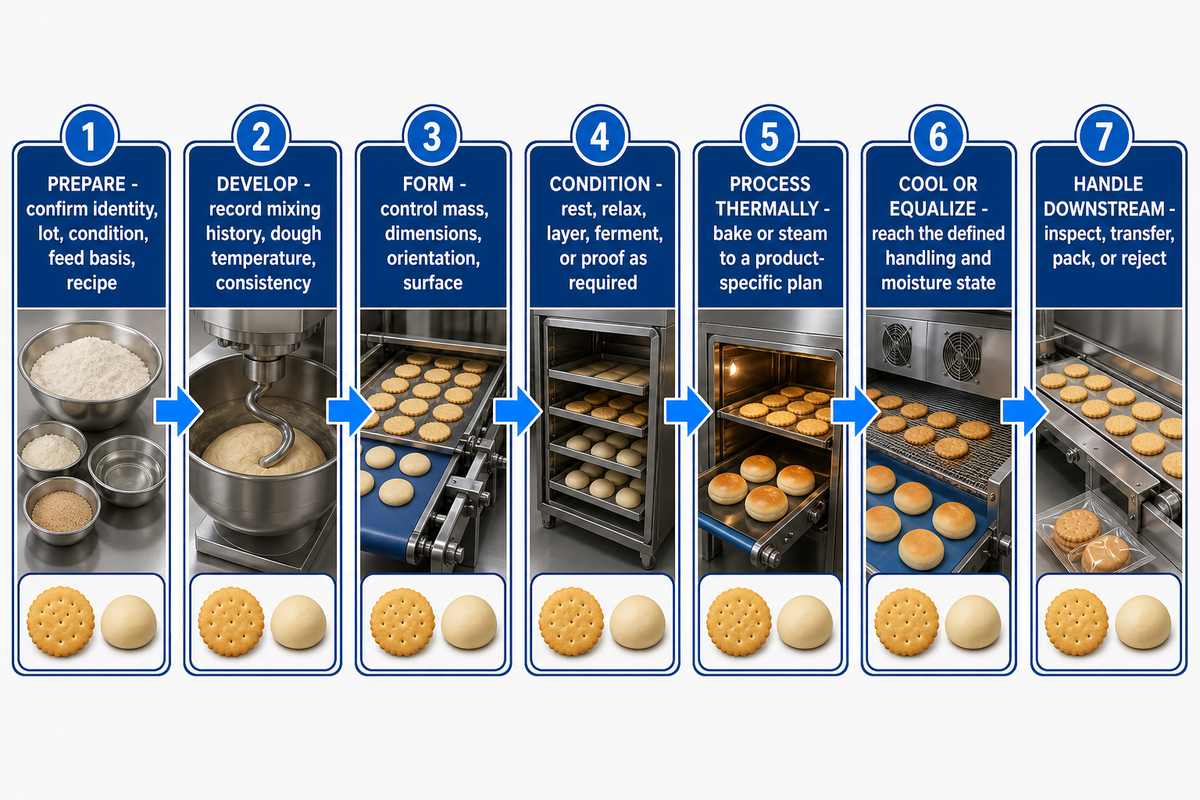
Once both product routes and their unknowns are clear, an equipment list says what is present. Process maps say what must be true when material crosses each boundary. The Seven-Stage Route Map below works for both families because it records state changes instead of forcing the same machine name into every route.
Evidence for those stages comes from a peer-reviewed biscuit process study that provides a bounded example of distinct mixing, forming, relaxation, baking, and cooling; the seven-stage map generalizes the handoff method, not that study’s recipe or settings.
1. Prepare
Confirm ingredient identity, lot, condition, feeding basis, and recipe revision.
Confirm ingredient identity, lot, condition, feeding basis, and recipe revision.
2. Develop
Record mixing history, dough temperature, consistency, and the intended development state.
Record mixing history, dough temperature, consistency, and the intended development state.
3. Form
Create controlled piece mass, dimensions, orientation, and surface condition.
Create controlled piece mass, dimensions, orientation, and surface condition.
4. Condition
Rest, relax, layer, ferment, or proof only where the product route requires it.
Rest, relax, layer, ferment, or proof only where the product route requires it.
5. Process thermally
Bake or steam under a product- and load-specific control plan.
Bake or steam under a product- and load-specific control plan.
6. Cool or equalize
Reach a defined handling, moisture, temperature, or structural state.
Reach a defined handling, moisture, temperature, or structural state.
7. Handle downstream
Inspect, align, transfer, pack, or reject without erasing upstream evidence.
Inspect, align, transfer, pack, or reject without erasing upstream evidence.
For every arrow, write four fields: incoming state, outgoing state, measurement method, and hold/release authority. “Dough enters the former” is too weak. Useful handoff records can include recipe revision, dough temperature at a named point, time since mixing, feed continuity, piece-mass sampling method, and the response required when the defined window is missed.
This map also exposes missing buffers. If the thermal stage pauses, can formed pieces wait without changing? If proofing continues while packaging stops, which product becomes nonconforming first? If the cooler discharges faster than the packer accepts, where will product accumulate, contact another surface, or break? Buffers are not free capacity; they change time, state, traceability, and cleaning needs.
Build a handoff register, not a list of conveyors
For each boundary, name the source station, receiving station, physical transfer, normal product state, allowable wait, inspection point, stop response, restart authority, and record owner. Add a failure question: if the receiving station slows or stops, what happens to product already between the two stations? This reveals whether an accumulation zone preserves the product or merely hides the first constraint.
During a trial, timestamp the first starve, block, overflow, miss, manual intervention, or product-state excursion. Compare that timestamp with the downstream rejection record. That register turns a line video into evidence: the team can see where the state first changed, how long the change persisted, and whether the next station recovered automatically or required an undocumented adjustment.
Stabilize Dough State Before You Blame the Former
When piece mass, shape, release, or surface quality moves, the former is visible and easy to adjust. It is not always the first cause. Ingredient temperature, water addition, mixing energy, dough temperature, rest time, proof state, batch age, feed pressure, and scrap return can all reach the forming station as a changed input.
For biscuit dough or a mini-bun dough ball, record the actual surface and consistency observation; “smooth” must be tied to an agreed check. If an operator samples by hand, document where, when, and how that sample enters the decision.
A peer-reviewed semi-sweet biscuit study separates mixing, sheeting, relaxation, cutting or moulding, and baking in its defined experiment. A separate roll proofing study shows that proof time can change several finished-product attributes. Neither paper supplies a universal production setting. Together, they show why the incoming product state must be recorded before an adjustment is assigned to the machine.
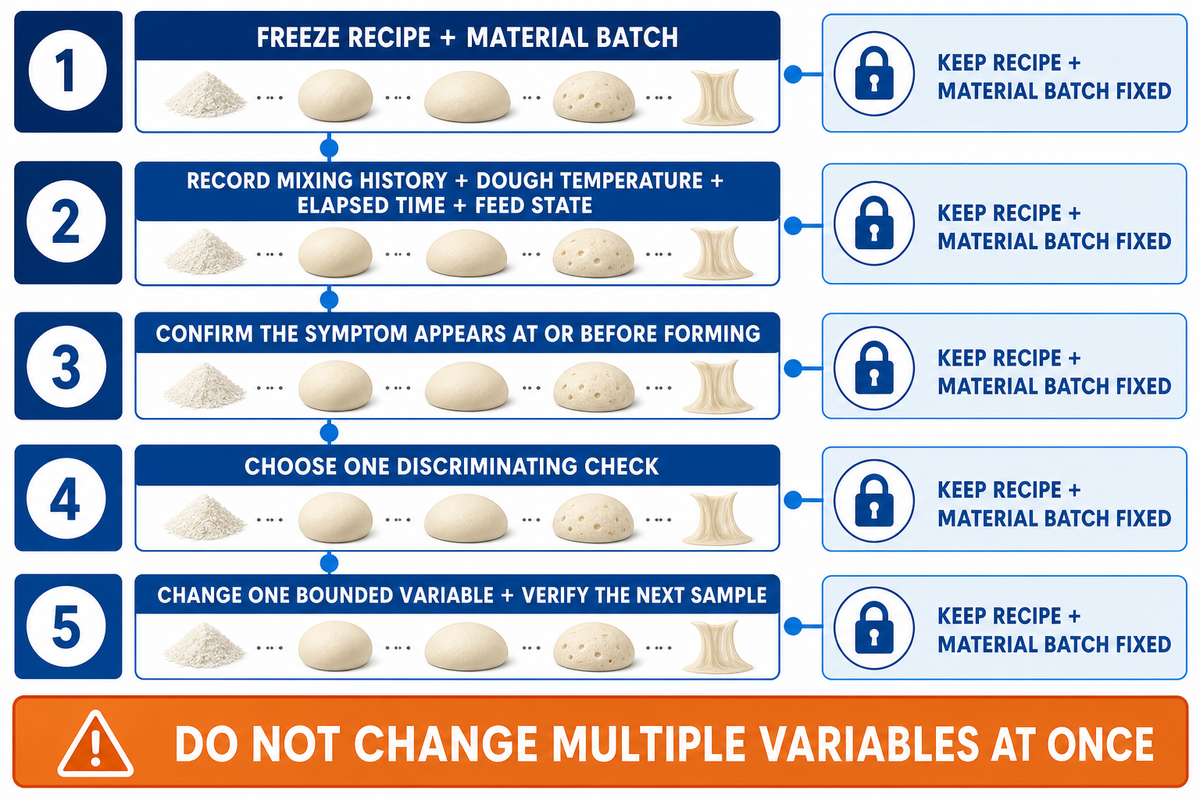
One-variable diagnostic sequence
- Freeze the recipe revision and identify the material batch.
- Record mixing history, dough temperature, elapsed time, and feed state.
- Confirm that the symptom first appears at or before the forming station.
- Choose one discriminating check—piece mass, thickness, release, proof state, or another defined measure.
- Change one bounded variable and verify the next named sample.
Machine settings still matter, but each setting must be interpretable. If several upstream and forming variables move together, an improved sample cannot tell the team which change mattered or whether the result will survive the next batch.
Find the Hidden Bottleneck Behind Rated Capacity
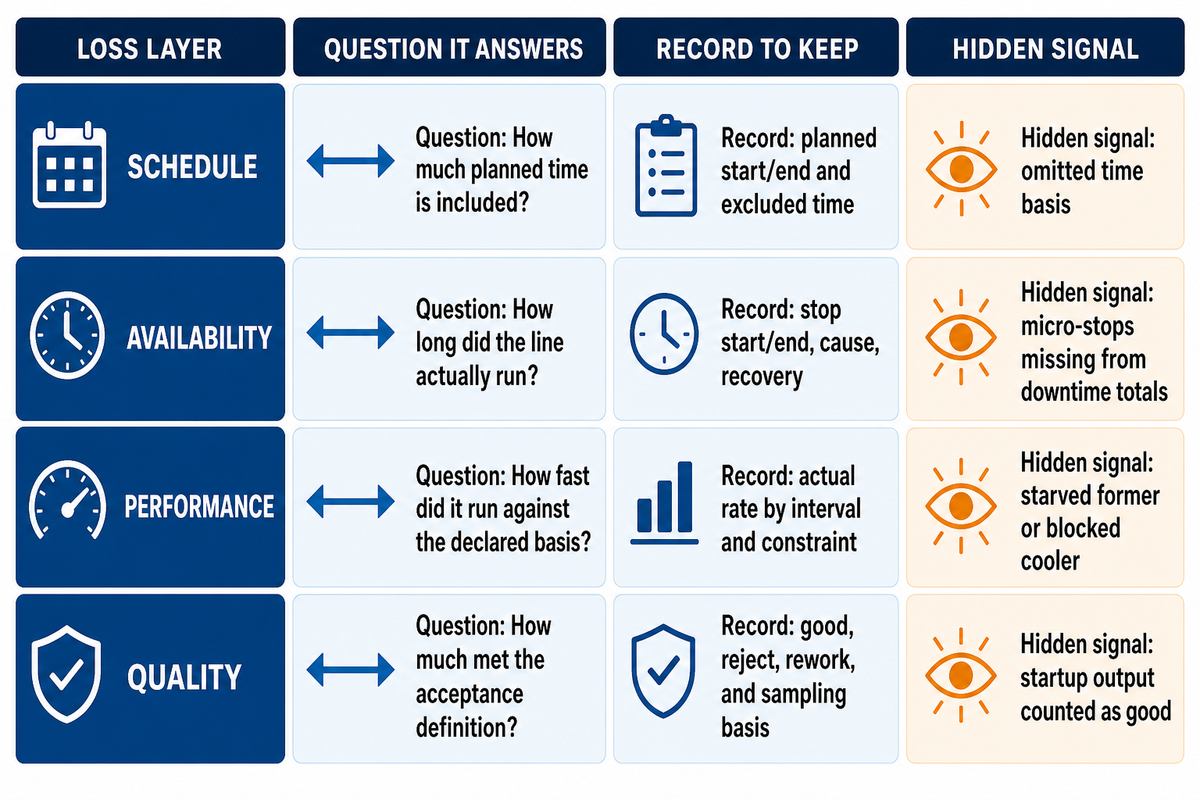
After dough state is controlled, rated kilograms per hour still describes only a declared rate under a stated basis. Accepted kilograms per shift also depends on scheduled time, runtime availability, running-speed performance, and the share of output that passes the agreed first inspection. A 2025 real-world biscuit-line simulation case shows why product mix and reconfiguration make bottlenecks scenario-dependent.
Use the stated time, unit, and product basis check before comparing declared line rates. It keeps a nameplate comparison separate from the accepted-output evidence developed below.
A croissant-line study likewise reports availability, performance efficiency, and quality as separate measures. That separation matters: ten minutes stopped and ten minutes running slowly are different losses, even if they produce the same final mass.
Accepted-Kilogram Ladder — hypothetical planning example
100 kg/h × 8 h × 0.85 runtime × 0.92 running-speed performance × 0.95 first-pass yield = 594.3 accepted kg/shift
Every input is illustrative. This is not a UDTECH capacity, an industry benchmark, or a purchase guarantee. Replace all five inputs with a named product, declared rate basis, measured trial record, and agreed acceptance method.
Key takeaway
Rated lines aren’t accepted-output systems until availability, running-speed performance, quality, product scope, and the measurement window are all defined.
| Loss layer | Question | Record | Typical hidden signal |
|---|---|---|---|
| Schedule | How much time was assigned? | Planned start/end and excluded time | Changeover counted outside the trial |
| Availability | How long did the line actually run? | Stop start/end, cause, recovery | Micro-stops missing from downtime totals |
| Performance | How fast did it run against the declared basis? | Actual rate by interval and constraint | Starved former or blocked cooler |
| Quality | How much met the acceptance definition? | Good, reject, rework, and sampling basis | Startup output counted as good |
Find the first recurring starve or block, not merely the machine with the lowest brochure rate. The active constraint can move when piece geometry, product mix, bake program, cooling time, packaging format, or sanitation sequence changes. Repeat the map for the products and programs that matter to the project.
Use interval records to separate slow running from downtime
Shift totals can’t show whether the line lost output in one long stop, dozens of short stops, sustained operation below the declared basis, or a high reject period after restart. Divide the trial into agreed intervals and record running state, actual rate, first constrained station, good mass, reject mass, and the leading stop or speed-loss code for each interval.
Choose an interval that matches the process and decision; this guide does not prescribe a universal value. It only needs to be short enough to connect a product-state change to the line event that preceded it. When the active constraint moves, preserve both records. Solving one station can reveal the next constraint without increasing accepted output as much as the isolated machine improvement suggested.
Treat Baking, Proofing, Steaming, and Cooling as Different Thermal Paths
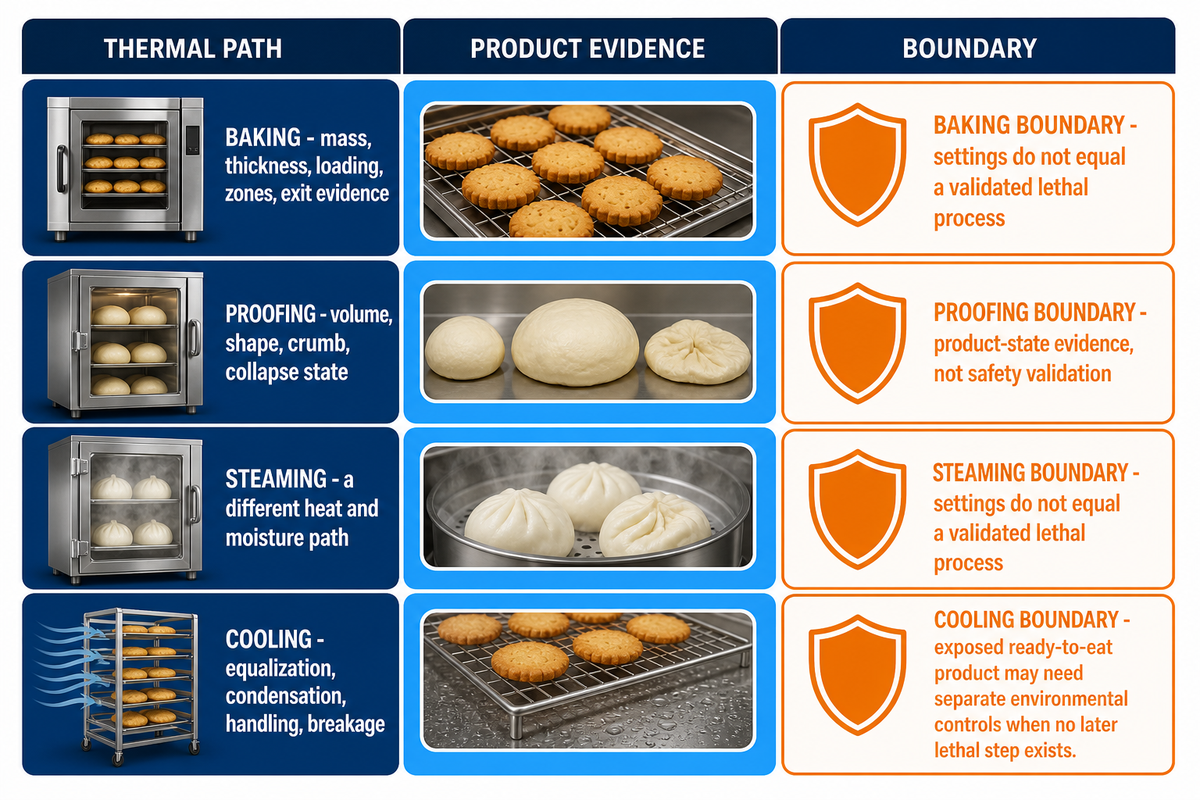
Time and temperature alone do not specify a process. Product mass, thickness, shape, initial state, loading pattern, humidity, heat-transfer mode, zone behavior, residence-time distribution, and the measured outcome determine what the values mean. Copying a number from another product can be directionally interesting and operationally unsafe.
For biscuits, measurement may combine exit moisture, moisture distribution, color, thickness, texture, checking after storage, and breakage after cooling. A 2025 biscuit checking study measures several of those responses together. Its microwave and conventional-oven settings belong only to its low-fat test product. The transferable lesson is the measurement set and the need to watch moisture distribution—not its recipe or targets.
For a yeast-leavened mini bun, proof state can affect volume, shape, crumb structure, and collapse behavior before the thermal step begins. Baking and steaming then create different heat and moisture paths. Cooling is another process state: insufficient equalization can disturb packaging, texture, condensation control, handling, or breakage.
For a pan-loaded or tunnel route, include pan identity, loading position, and zone or residence evidence. Describe hot-product handling explicitly, and translate “light” or “golden” color language into an agreed measurement method and limit.
Food-safety boundary
Thermal settings are not automatically validated lethal processes. Validation, monitoring, verification, and corrective action depend on the product, hazard analysis, facility, and applicable requirements.
For ready-to-eat products exposed after baking or steaming, depanning, cooling, slicing, and packaging may also require separate environmental controls when no later lethal treatment exists. This is a buyer/facility food-safety responsibility, not a claim about any UDTECH line.
Diagnose Defects With the First-Failing-Station Log
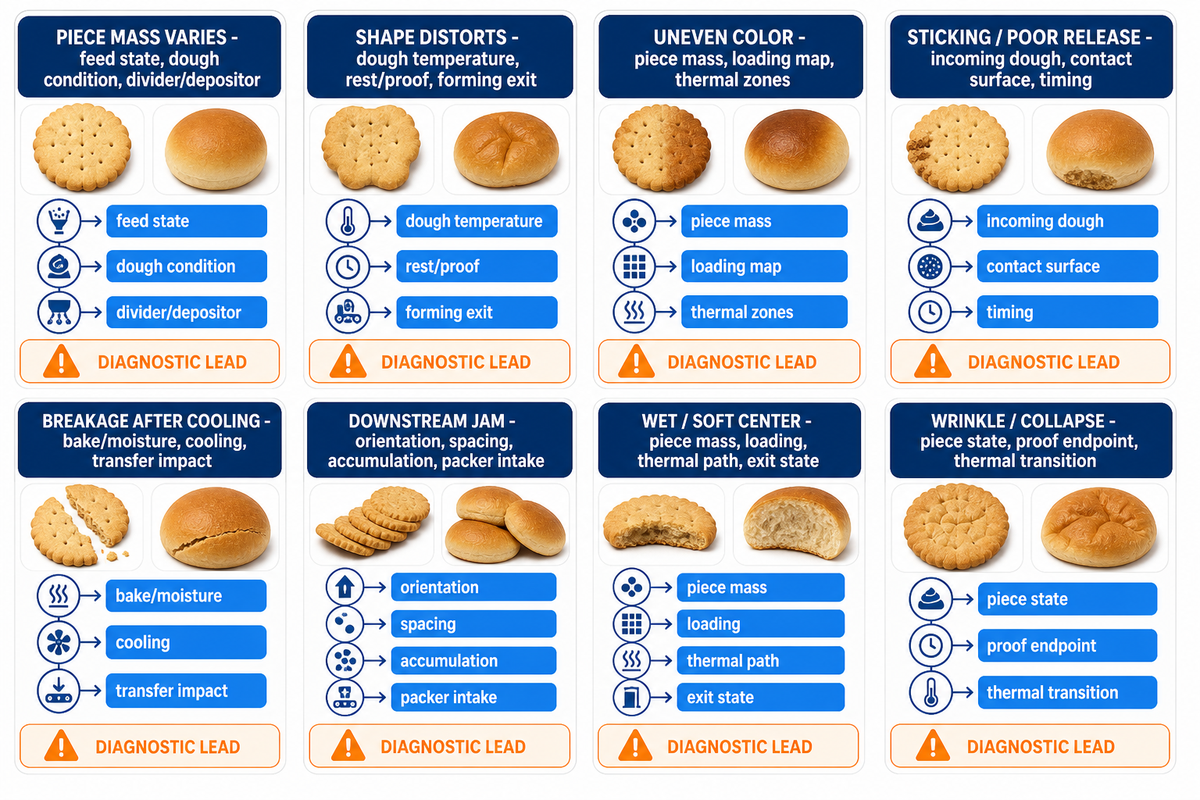
Defects are often named where they become obvious. Cracked biscuits may be noticed at packing even though the first abnormal moisture gradient developed in baking or cooling. Wrinkled buns may be noticed after steaming even though piece mass, forming, or proof state had already moved. The First-Failing-Station Log records the earliest abnormal state that the evidence can support.
One bounded example is a peer-reviewed biscuit checking study that measures moisture distribution alongside checking and fracture behavior; it does not establish universal defect limits.
Use operator language as a lead, not a mechanism. “Fell over,” “stuck,” “too dark,” and “broke at the transfer” are useful observations. Each needs a discriminating measurement before the team changes a cause variable.
| Defect type | First places to inspect | One discriminating check | Do not change together |
|---|---|---|---|
| Piece mass varies | Feed state, dough condition, divider/depositor | Timed consecutive-piece mass sample | Recipe, feed pressure, and cut timing |
| Shape distorts | Dough temperature, rest/proof, forming exit | Geometry at two named stations | Proof conditions and forming geometry |
| Uneven color | Piece mass, loading map, thermal zones | Position-coded color and mass sample | Formula, loading, and several zones |
| Sticking or poor release | Incoming dough state, contact surface, release timing | Residue/location pattern by cycle | Surface treatment, dough, and speed |
| Breakage after cooling | Bake/moisture history, cooling, transfer impact | Breakage by time, location, and product zone | Bake profile, cooling, and transfer height |
| Downstream jam | Orientation, spacing, accumulation, packer intake | First block/starve timestamp | Upstream speed and packer recipe |
| Wet or soft center | Piece mass, loading, thermal path, exit state | Position-coded center and edge measurement | Mass, loading, and several zones |
| Wrinkle or collapse | Piece state, proof endpoint, thermal transition | Pre- and post-process geometry by sample | Formula, proof, and steam/bake conditions |
Complete log rows contain the product and batch, timestamp, symptom, first abnormal station, stable controls, check performed, result, one bounded change, verification sample, and disposition. Preserve failed trials. They prevent the same unhelpful adjustment from becoming plant folklore.
Design Cleaning and Changeover Evidence
Once the first-failing station is identified, cleanability begins with access, materials, joints, drainage, dismantling, and surrounding space, but it does not end there. Current 21 CFR 117.40 requires covered equipment to be adequately cleanable and installed to facilitate cleaning and maintenance of both the equipment and adjacent spaces. That is a facility and equipment-design obligation, not proof of supplier certification.
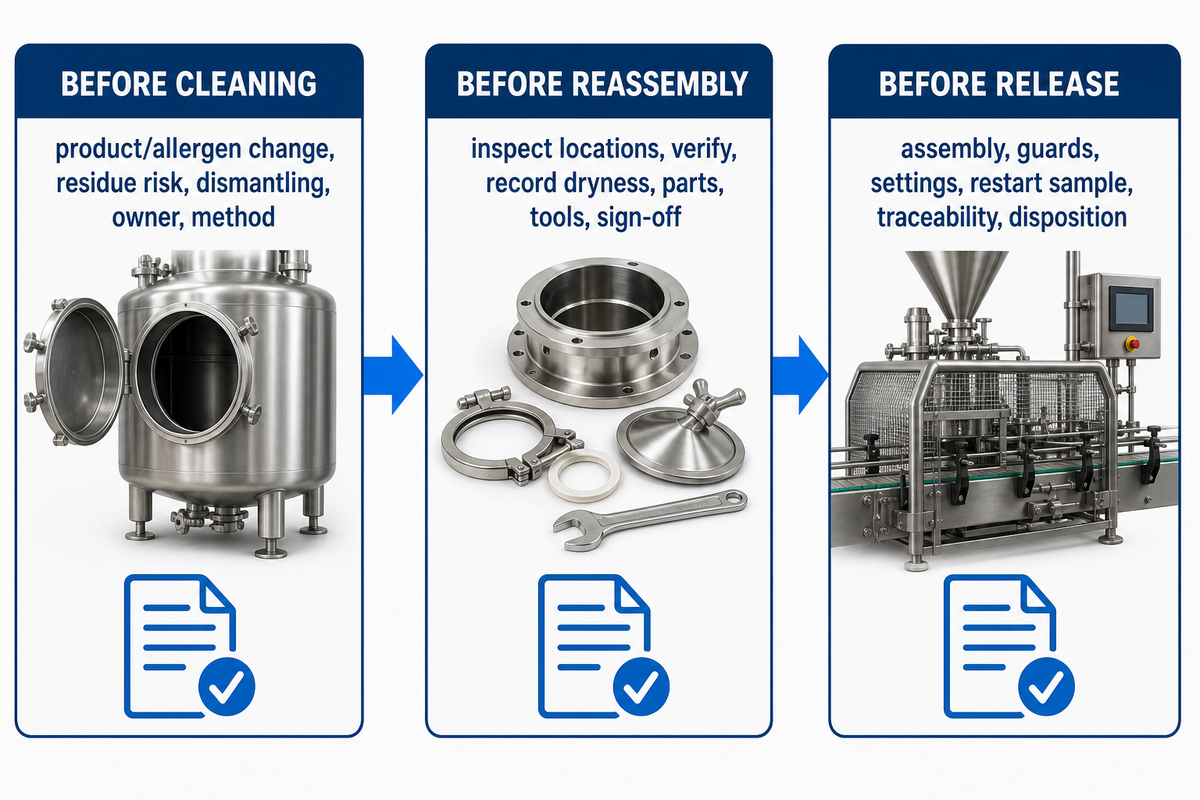
Separate three evidence objects. First, can the relevant area be reached, dismantled where required, cleaned, inspected, dried, reassembled, and released? Second, when products have different allergen profiles, does the change procedure cover every shared step and verify the intended result? Third, for an exposed ready-to-eat product after the thermal step, what sanitation and environmental controls protect the depanning, cooling, handling, and packing zone?
An official FDA bun-facility warning letter illustrates why those questions stay separate: it discusses shared-equipment allergen cross-contact and exposed post-bake ready-to-eat handling as distinct hazards. It is a facility-specific enforcement example, not evidence about UDTECH or another factory.
Before cleaning
Record product/allergen change, residue risk, dismantling boundary, responsible people, method, and protected components.
Record product/allergen change, residue risk, dismantling boundary, responsible people, method, and protected components.
Before reassembly
Inspect named locations, use the agreed verification method, record exceptions, dryness, parts, tools, and sign-off.
Inspect named locations, use the agreed verification method, record exceptions, dryness, parts, tools, and sign-off.
Before release
Verify assembly, guards, settings, first restart sample, traceability, and the disposition of startup output.
Verify assembly, guards, settings, first restart sample, traceability, and the disposition of startup output.
Run the changeover as a measured production event
Start the clock at an agreed line state, not at the first visible cleaning action. Record product removal, dismantling, cleaning, verification, drying, reassembly, setup, startup output, first accepted sample, and final release. If a product or allergen family changes, identify every shared contact or exposure point covered by the procedure. A clean-down duration without its boundary is not comparable.
The restart record should show settings restored, parts accounted for, guards and controls checked, startup material disposition, verification results, and the person authorized to release product. A faster restart is not an improvement if it shifts residue, assembly, or first-piece risk into production. Time and evidence must travel together.
Keep the Pilot Flexible, Then Freeze Interfaces Before Acceptance
After cleaning and restart evidence is defined, early product and process work can still benefit from flexibility. Virginia Tech’s food-processing pilot facility describes movable equipment, drop-down utilities, and flex-space for evaluating new processes and lines. That is useful counter-evidence to the idea that every detail must be fixed before exploration begins, not a commercial-line utility specification.
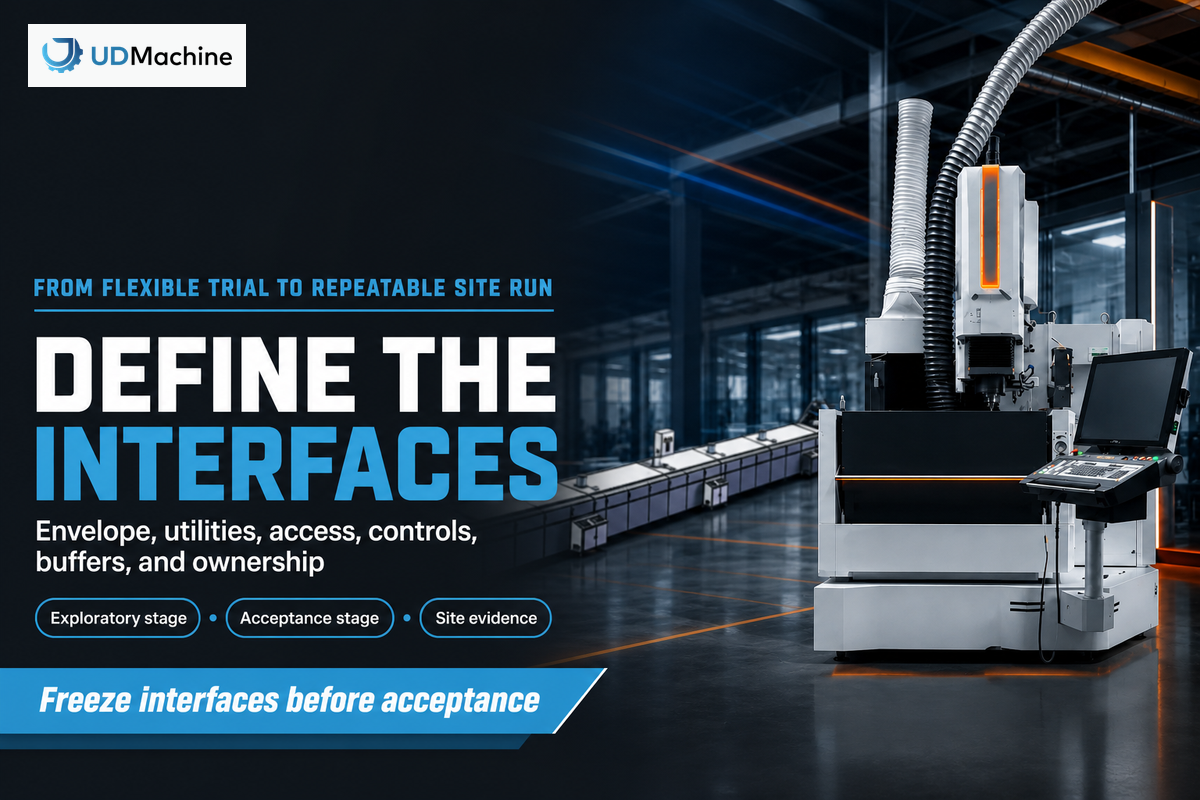
The boundary changes before a commercial acceptance run. At that point, undefined interfaces can make a demonstration impossible to reproduce at site. Freeze the tested product, usable equipment envelope, access route, service and maintenance clearance, utility standard and quality, drainage or exhaust need, environmental condition, control protocol, upstream rate, buffer rule, downstream intake, and who supplies each connection.
Two-stage interface sheet
Exploratory stage: document assumptions, safe limits, temporary connections, movable equipment, and what remains open.
Acceptance stage: freeze connection points, utility conditions, layout revision, access, controls, buffer logic, adjoining rates, measurement points, and exception authority.
A floor-plan rectangle is not enough. Door height, turning radius, floor and support conditions, panel access, cleaning clearance, operator paths, ingredient and packaging flow, waste route, and the position of exhaust or drainage can decide whether the practical envelope is smaller than the drawn footprint. The same sheet should state which values are supplier inputs, buyer inputs, or jointly verified.
Pair the Accepted-Kilogram Ladder With Stability and Sampling Evidence
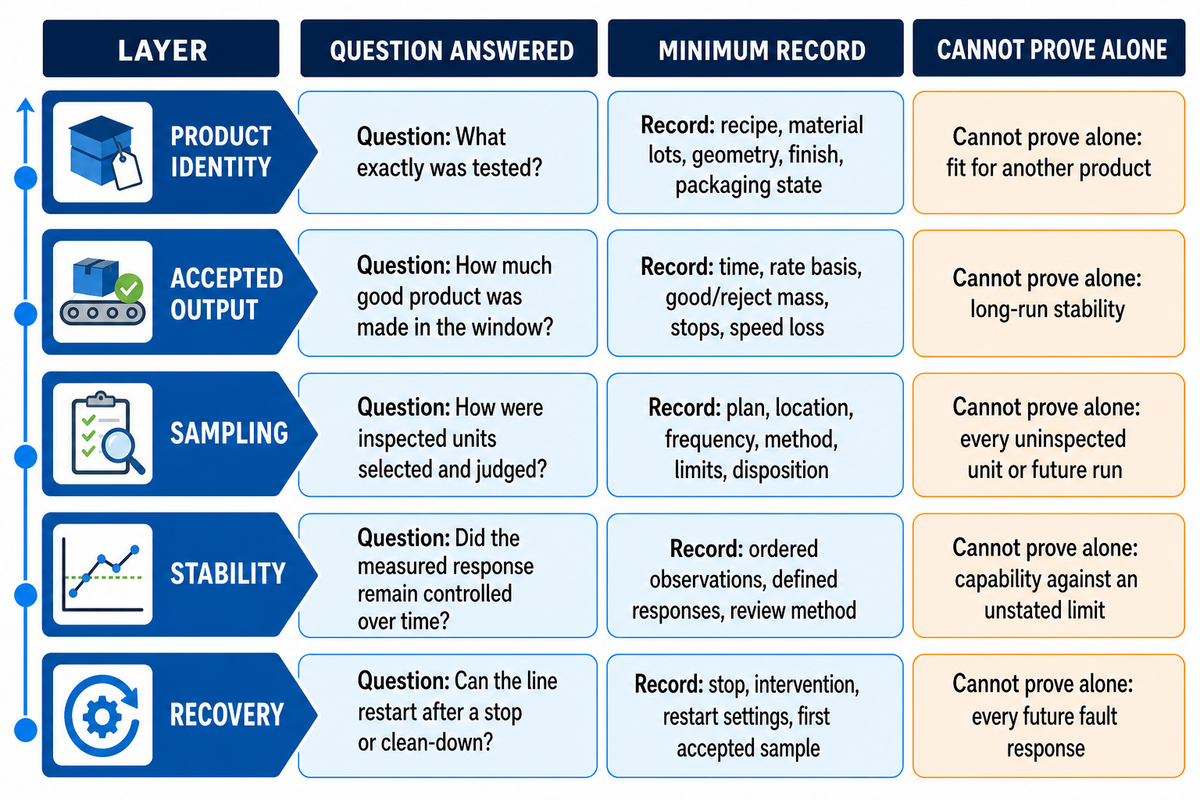
With site interfaces frozen, a trial is repeatable only when the evidence basis is agreed before the run. Define the product, recipe and material revision, scheduled window, excluded time, declared rate basis, actual running intervals, speed loss, good and rejected output, stop codes, sample locations, methods, limits, changeover, restart, and signed exceptions. Do not let the most attractive five minutes stand in for the run.
The accepted-kilogram calculation answers one question: how much measured output met a defined first-pass acceptance basis during the stated window? It does not by itself prove that the process is stable over time. NIST process-stability guidance separates stability from a one-time result. Its sample-count example is not a universal food-line acceptance rule; the buyer and supplier still need a situation-specific plan.
Acceptance sampling answers another question: whether the sampled evidence supports a lot decision under the chosen system. The public overview for ISO 28590 introduces several attribute-sampling systems and emphasizes selecting the appropriate inspection system. It does not authorize one universal sample size, yield threshold, or factory-acceptance duration for these lines.
| Acceptance layer | Question answered | Minimum record | What it cannot prove alone |
|---|---|---|---|
| Product identity | What exactly was tested? | Recipe, material lots, geometry, finish, packaging state | Fit for another product |
| Accepted output | How much good product was made in the window? | Time, rate basis, good/reject mass, stops, speed loss | Long-run stability |
| Sampling | How were inspected units selected and judged? | Plan, location, frequency, method, limits, disposition | Every uninspected unit or future run |
| Stability | Did the measured response remain controlled over time? | Ordered observations, defined responses, review method | Capability against an unstated limit |
| Recovery | Can the line restart after a stop or clean-down? | Stop, intervention, restart settings, first accepted sample | Every future fault response |
A strong request for quotation is therefore an evidence request, not just a target rate. Attach the two route sheets, target products, expected mix, acceptance definitions, planned measurement methods, site-interface sheet, changeover families, and open questions. That package lets the commercial discussion begin without forcing the Blog to act like a model specification.
Define the no-accept decision before the trial
Acceptance evidence is useful only if the team knows what happens when it’s incomplete. Define which missing records pause the run, which deviations can be retested, who may approve an exception, and which changes require a new baseline. Keep product failure, equipment failure, site-interface failure, measurement failure, and documentation failure as separate dispositions.
A no-accept result isn’t necessarily a final rejection of the project. It can be a precise statement that the tested evidence doesn’t yet support release. The next action might be a corrected measurement method, a product reformulation trial, an interface repair, a controlled repeat, or a commercial rescope. That clarity is more valuable than a demonstration that passes because the acceptance question was never written.
Frequently Asked Questions
What is the difference between a biscuit and a bun in industrial production?
A biscuit route may use chemically leavened or otherwise product-specific dough and form it by sheeting, cutting, moulding, depositing, or wire cutting before baking and cooling. A mini bun commonly uses yeast development, dividing, rounding or moulding, proofing, and then baking or steaming. Product definition, geometry, filling, surface treatment, final texture, and packaging state, not the label alone, determine the actual stages.
How is a biscuit manufactured on an industrial line?
A typical route verifies ingredients and recipe revision, mixes the dough, conditions it as required, forms controlled pieces, bakes them, cools or equalizes them, inspects the output, and transfers accepted product to packaging. The forming and conditioning stages vary by biscuit family. Record incoming state, outgoing state, measurement method, and stop response at every handoff. That makes the process traceable without pretending that sheet-and-cut, rotary-moulded, deposited, and wire-cut biscuits use one universal machine sequence.
How do you find the real bottleneck in a biscuit or mini bun line?
Track when each station is starved, running, slowed, blocked, or producing rejected output. Identify the first recurring constraint under the tested product and program. It may move with geometry, proof or bake program, cooling time, packaging format, or changeover, so the lowest nameplate rate doesn’t automatically identify the real bottleneck.
How should a factory trial measure accepted output?
Define the product, recipe and material revision, time window, declared rate basis, runtime, actual running-speed performance, good and rejected mass, stop codes, sample locations, methods, limits, and treatment of startup output before the run. Report accepted kilograms with those fields instead of showing only peak speed.
Add ordered observations that can be reviewed for stability, and document the recovery after a chosen stop, cleaning event, or changeover. Also state who records each value, who may classify an exception, and whether startup, rework, and retest output stays outside the first-pass total. The buyer and supplier must agree the duration, sampling system, limits, and exception authority; this guide doesn’t prescribe universal values.
How much does a biscuit factory cost?
There’s no responsible single cost without product scope, throughput basis, process route, automation boundary, thermal system, packaging handoff, building work, utilities, destination, and acceptance scope. Prepare those inputs first so a supplier can separate equipment, integration, site work, optional modules, and open assumptions in a project-specific quotation.
References & Sources
- American Society of Baking: Biscuits: representative biscuit-family process reference.
- American Society of Baking: Bread Processing: representative yeast-leavened bread and bun route.
- Peer-reviewed semi-sweet biscuit study: bounded stage and dough evidence.
- 2025 biscuit-line simulation case: line balance and product-mix-dependent bottlenecks.
- Croissant-line effectiveness study: separate availability, performance, and quality factors.
- 2025 biscuit checking study: product-specific multi-measurement example.
- 21 CFR 117.40: current United States equipment and cleanability rule.
- FDA 2023 bun-facility warning letter: facility-specific allergen and post-bake hazard example.
- NIST: Assessing Process Stability: stability boundary for production evidence.
- ISO 28590 public overview: acceptance-sampling system selection.
- 2025 bakery digitalization review: monitoring opportunities and adoption constraints.
Editorial and evidence note: This guide combines current public regulations, professional baking references, peer-reviewed studies, independent adversarial review, and transparent planning frameworks. Product-specific values remain attached to their source conditions. No public source reviewed for this article established a UDTECH capacity, savings figure, certification, customer result, patent ownership, or universal process setting; none is claimed here.