Get in touch with UDTECH Company


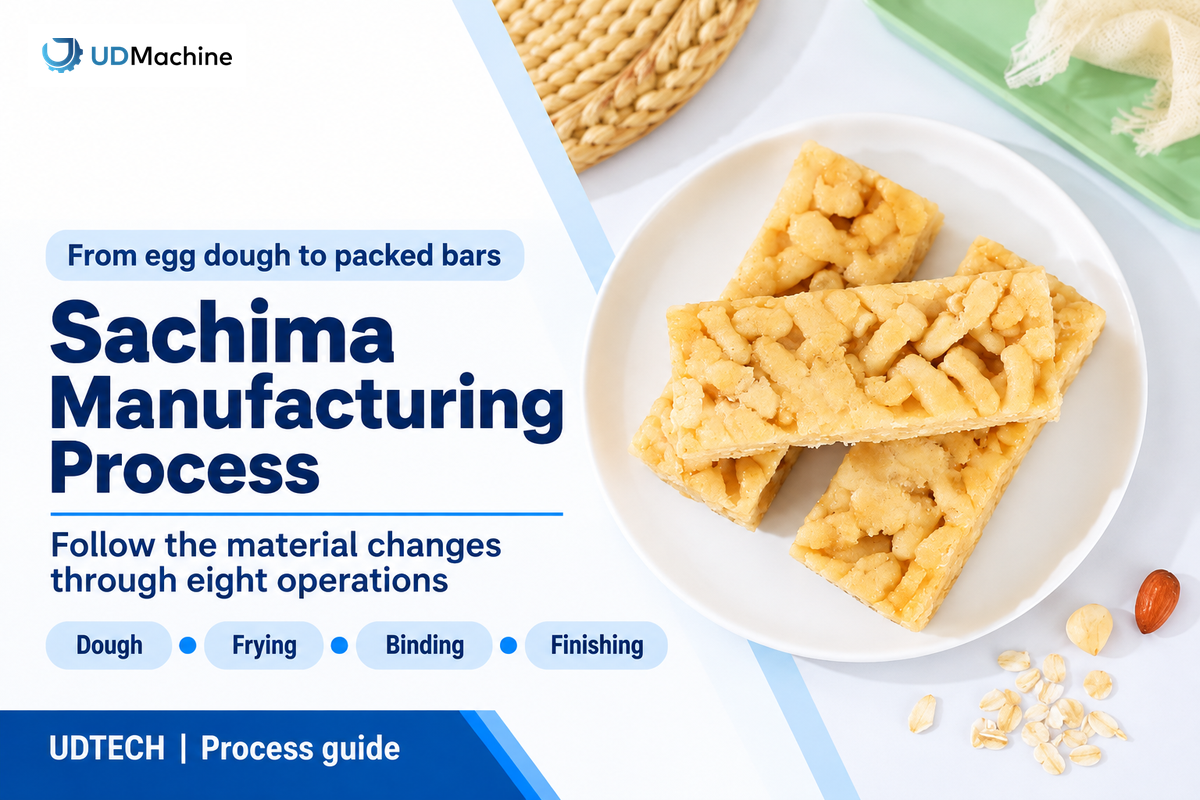
The sachima manufacturing process transforms a flour-and-egg dough into porous fried strands, which are then bonded with cooked syrup, before taking the final shape and being packed. A good bar holds together while leaving space between its strands. Producing that texture starts with understanding what changes at each operation, rather than copying a single frying temperature.
Updated October 2026 | By DD
Process at a glance
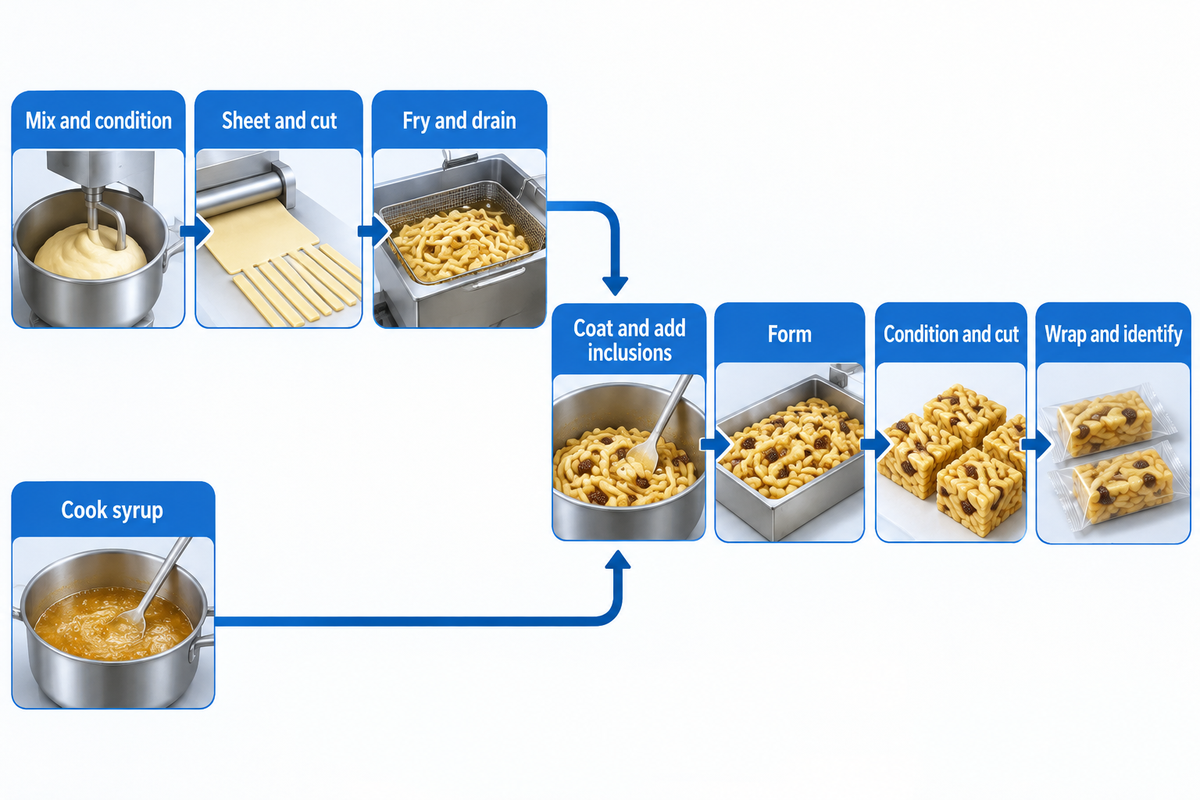
Base: flour-and-egg dough. Structure: individually fried pieces. Binder: cooked sugar syrup. Finishing: forming, conditioning, portioning and wrapping. Syrup preparation runs beside the dough route and joins it at coating.
Sachima manufacturing follows eight main operations: prepare dough, sheet and cut, fry and drain, cook syrup, coat, form, condition and cut, then pack. Each operation changes the material received by the next machine.
Key points
- Fried strand weight reflects both water loss and oil uptake.
- Binder recipe, solids, application temperature and dose need separate records.
- Cooling and cutting order follows the product route.
- A factory trial should carry one identifiable product batch through to the sealed pack.
Sachima manufacturing process: follow the material changes
In Sachima production, cohesive dough is converted through frying into separate porous pieces, which are subsequently bound together with syrup. Changes occurring from a continuous, deformable sheet to a structure of loose strands, and ultimately to a piece which can be broken apart to yield servings (a slab), can be tracked by a process engineer, thereby giving a clearer starting point compared to an equipment list.
What is a sachima?
Sachima is a traditional Chinese sweet snack made with fried dough strands bound together by syrup. Although sometimes described as a flour cake, its light pastry structure differs from a solid sugar candy, even when sesame seeds or nuts are added. A soft version should remain cohesive when lifted while the individual strands remain visible inside the bar.
The 2014 preparation study by Chun Cui and colleagues describes mixing, flattening, cutting, frying, syrup blending, moulding, final cutting and packing on Hsu Fu Chi’s production line. That documented route is a useful starting point; conditioning details follow the chosen recipe and equipment.
Eight operations
- Mix and condition the dough.
- Sheet the dough and cut the strands.
- Fry, drain and transfer the strands.
- Cook the syrup in a parallel preparation branch.
- Coat the strands and distribute inclusions.
- Form the coated mixture.
- Condition and cut in the order selected for the route.
- Wrap, identify and release the finished packs.
How do I make sachima?
Make sachima by preparing an egg-based dough, cutting it into small pieces, frying those pieces, then mixing them with cooked syrup and forming the mixture before portioning. Homemade sachima is prepared using a pan and tray in the kitchen. A factory separates them into controlled operations with defined material transfer conditions.
A cereal bar line making Rice Krispies-style treats uses a different structural base: prepared rice cereal. Shared mixing or forming equipment needs a trial with the intended fried strands: record breakage, coating distribution, sticking and the resulting piece weight. Similar rectangular shape alone can’t be the basis for equipment sharing.
Sachima Material-State Passport
Use the same batch identifier in this record. For the equipment discussions, purchasing carries the material requirements, quality staff link measurements to samples, and production fills in the receiving fields. The passport is a process record, and the limits are determined by the operating limits of the product trial and the food-safety plan of the facility.
| Operation | Material received and change | Record at transfer | Receiving decision |
|---|---|---|---|
| Mixing | Ingredients become cohesive dough | Recipe revision, batch mass in kg | Release the intended formulation |
| Conditioning | Dough relaxes or proofs as specified | Elapsed min, dough temperature in °C | Proceed when the sheet handles correctly |
| Sheeting | Dough becomes a controlled sheet | Thickness in mm, edge condition | Adjust before strand cutting |
| Strand cutting | Sheet becomes separate pieces | Width and length in mm, separation | Avoid sending joined clumps onward |
| Frying and drainage | Pieces expand and lose water | Time in s, oil temperature in °C, sample mass | Compare texture with moisture and fat results |
| Syrup preparation | Sweetener blend reaches application state | Formula, solids method, application °C | Use the matching binder revision |
| Coating | Loose strands become a bound mixture | Strand and syrup kg, inclusions kg | Check distribution and broken strands |
| Forming and portioning | Mixture becomes individual bars | Thickness in mm, piece g, trim kg | Match shape and internal structure |
| Wrapping | Bars become identified sealed packs | Pack condition, net g, reject kg | Apply the defined release checks |
Prepare dough that survives sheeting and frying
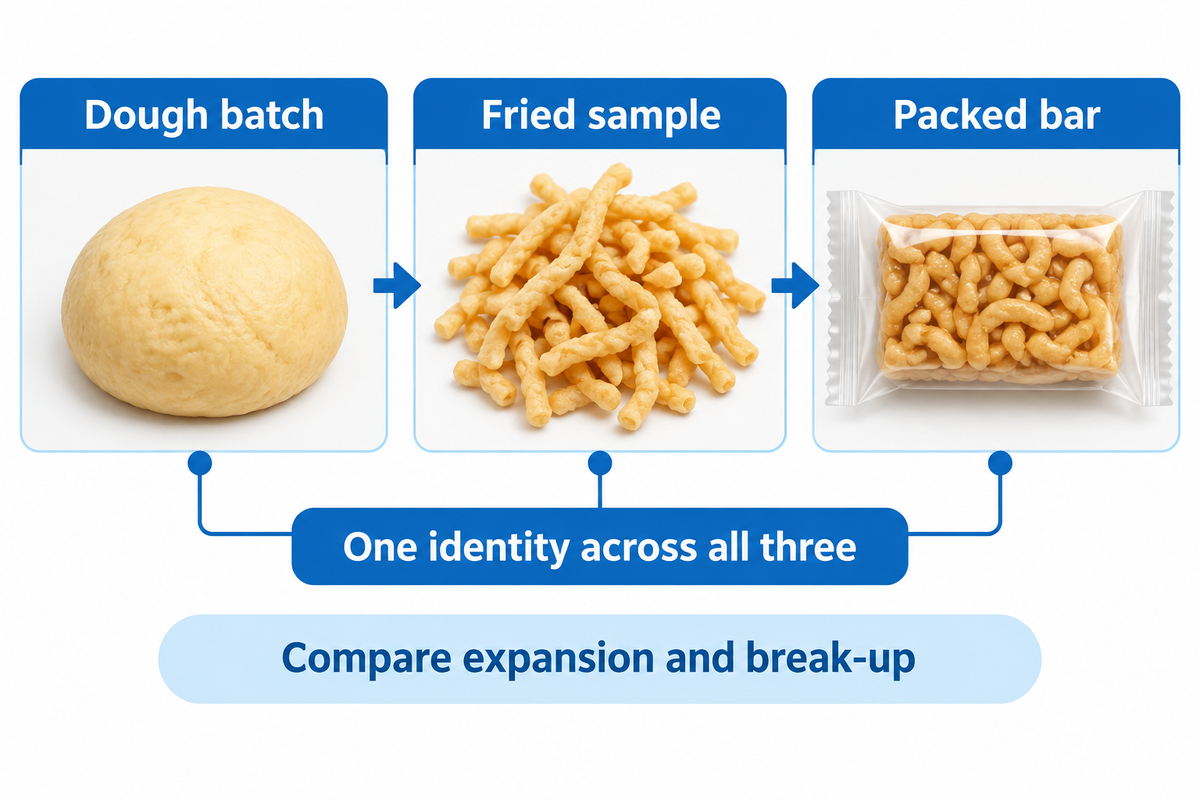
How a dough is prepared determines how it will be handled by the sheeter and fryer. Flour, egg and other ingredients determine how the dough stretches, separates and expands. A change in flour composition can therefore alter the finished strand even when the machine settings appear unchanged, so retain the recipe revision with every trial sample.
In Wang and colleagues’ 2018 Sachima study, whole-wheat substitution changed dough rheology, water behaviour and fried pore structure. Those effects connected dough preparation to both moisture transfer and oil absorption. A flour change reaches further than the ingredient declaration.
A development team may compare a traditional bar with a whole-wheat version. Sheeting the new dough at the old thickness is a good comparison. However, evaluating whether the sheet is satisfactory is just the first observation. Keep separately identified strands before and after frying, then observe and compare their expansion and break-up. Look at the final texture of the bar. If new dough breaks, more binder alone doesn’t establish that the dough problem is solved. A practical decision is whether to adjust dough preparation before changing the coating recipe; changing both together would make the result harder to interpret. This is a proposed scenario with no improvement assumed.
Transfer point: a recipe revision belongs to the dough batch, its fried sample and its packed bar. Use the same identity through all three states.
Sheet and cut strands for consistent expansion
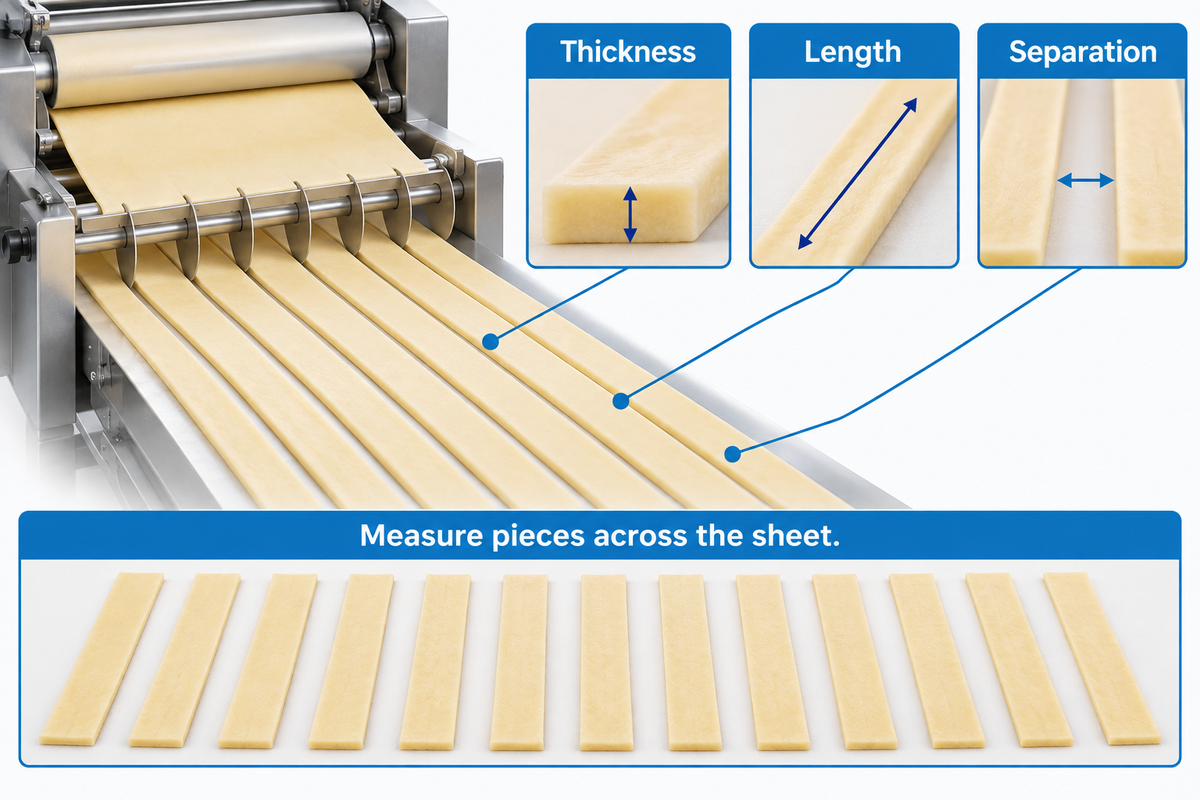
Cutting and sheeting establish geometry that enters the fryer. Strand thickness, length and separation influence how individual pieces of dough heat. Strand thickness, length and separation influence how a bed of strands moves through the next process step. A narrow-looking cutter setting is less useful than measured pieces collected across the sheet, especially when dough recovery changes after cutting.
Note strand dimensions in mm. Indicate joined pieces and heavy dusting. Pieces stuck together enter frying as a larger local mass, rather than as the intended separate strips. The following bar may contain pieces of different structures even if the cutter used a nominal setting.
Cui’s study rolled its dough to 0.2 cm, and cut 2.0 × 1.0 cm pieces. These dimensions are for the study, not a general recommendation for all machines. Different strand geometries require separate heating and texture comparison.
Fry the strands and manage oil carryover
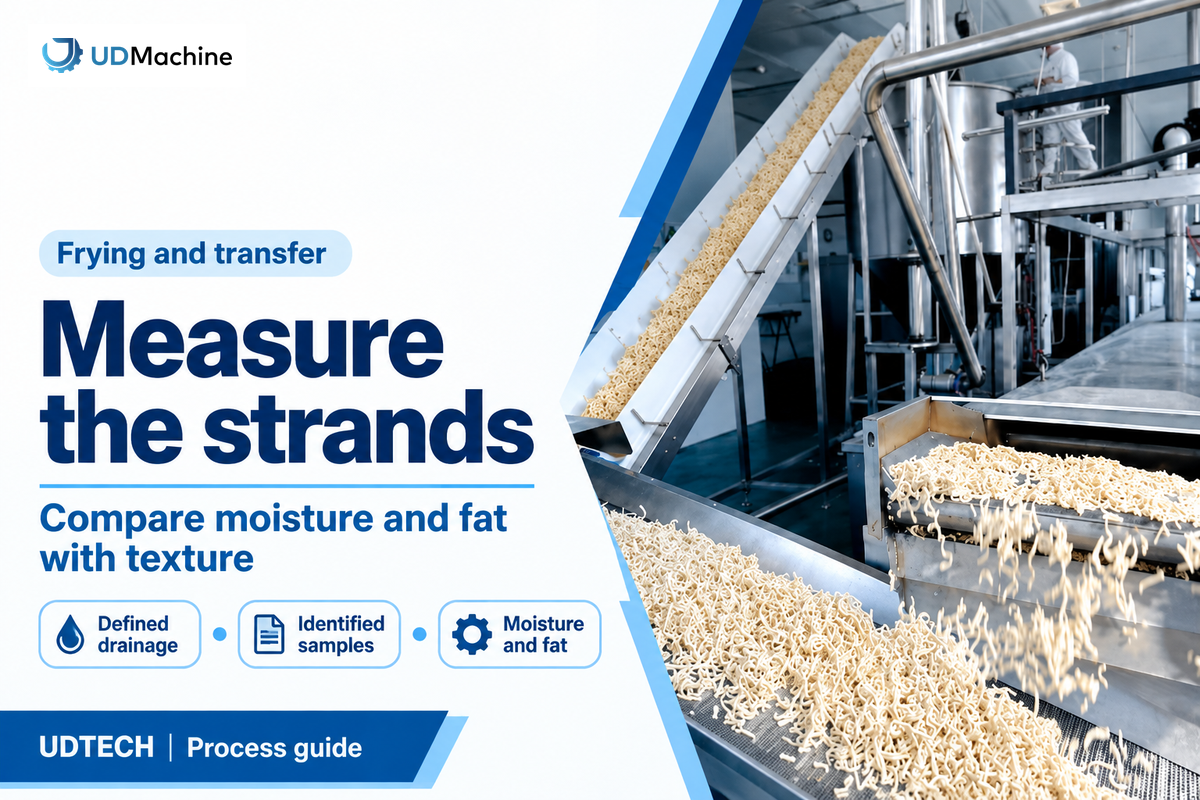
Frying provides a porous structure and changes the texture of the dough. Water is lost, and oil enters or remains on the pieces. Results depend on the history of frying, composition, and the geometry of the pieces. Oil temperature is one of the process variables recorded; finished strand moisture, and fat and structure define the product received at the coating stage.
Cui’s preparation used 160 °C for 30 s. Wang’s different experiment used 170 °C and sampled across several frying times. These historical conditions describe different studies, not competing universal recipes. Wang’s work also found changes in moisture and structural oil with frying time and whole-wheat content.
Keep a defined drainage and sampling procedure when comparing batches. Otherwise, a heavier sample may include more surface oil or a different amount of water. Stage weighing alone cannot separate those contributions. Match the sample identity to independently measured moisture and fat when that distinction drives the process decision.
A soft, cohesive bar needs strands that survive coating without excessive breakage. Compare the fried interior and the coated result together. For an existing line with a recurring fault, the separate Sachima production line troubleshooting guide covers fault isolation and acceptance work.
Cook the syrup and coat the fried dough
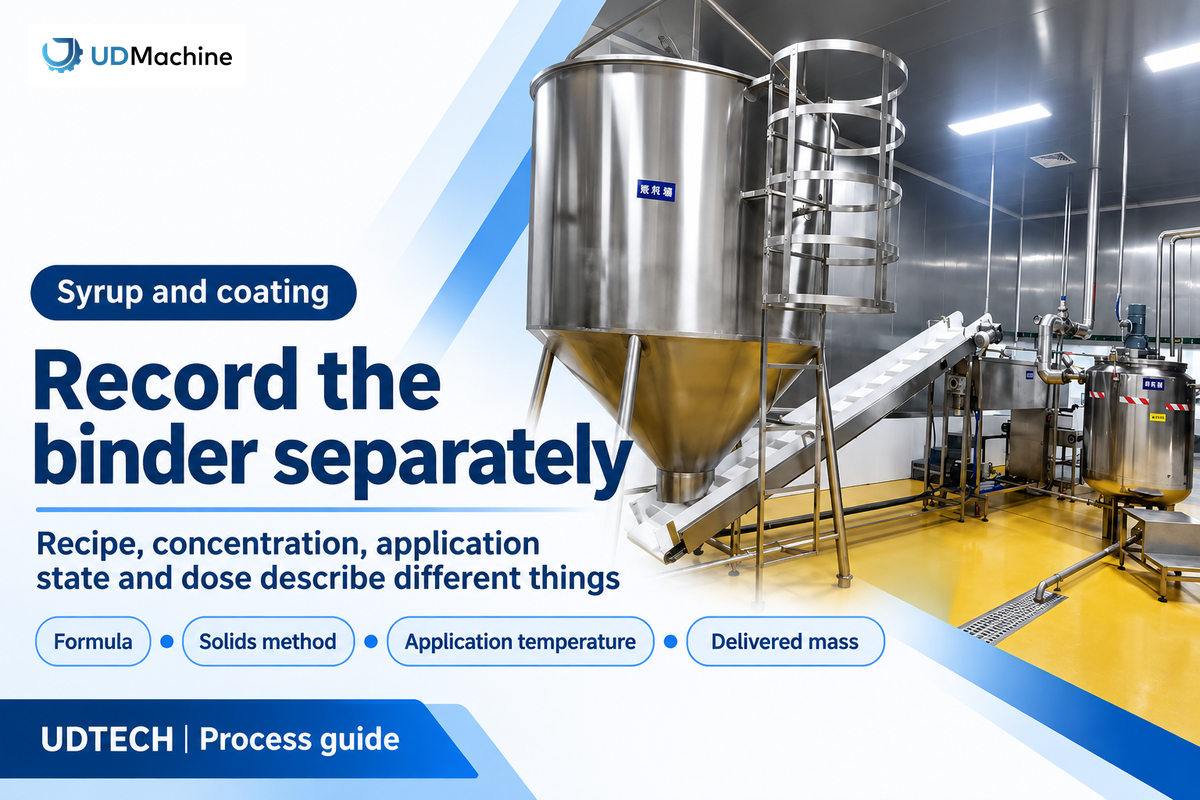
Fried strands mixed with sugar syrup become a bound mass while retaining their individual structure. State the binder’s formulation, measured solids basis, application temperature and delivered mass, separately. Those describe different things, i.e., what binder is used, its concentration, its application state and how much of it reached the strand batch.
In Cui’s study, the syrup was applied at 108 °C. The paper also describes glucose syrup with 80% solids among its materials. Raw-material solids and an application temperature are different measurements; neither value specifies the finished binder dose. Keep a supplier’s solids result in its stated method rather than automatically renaming it a refractometer reading.
When using a refractometer, retain the instrument method and temperature basis with the result. Sugar mixtures need an appropriate interpretation of the reading. Pour or meter the binder into the mixer and record the delivered mass, rather than only the mass loaded into the cooker, because retained material belongs outside the coated batch.
In a trial, keep the fried strand batch constant and compare the effect of a variation of binder. A private-label buyer may prefer a softer bite, while production wants less sticky material at transfer. Judge both from the coated and packed samples. Extra syrup can change piece mass as well as texture, so a softer bar should not automatically be attributed to a better dough. A reader discussion on sweetener substitution in candy illustrates the recipe-specific question, rather than supplying an industrial replacement ratio.
Storage adds another variable. Thorat and colleagues’ 2018 model-sugar study found that sugar identity and storage conditions changed crystallization behaviour. Its freeze-dried sugar mixtures differ from Sachima, but the practical trial question is useful: does the packed bar retain the intended bite over time?
Form, cool and cut without flattening the texture
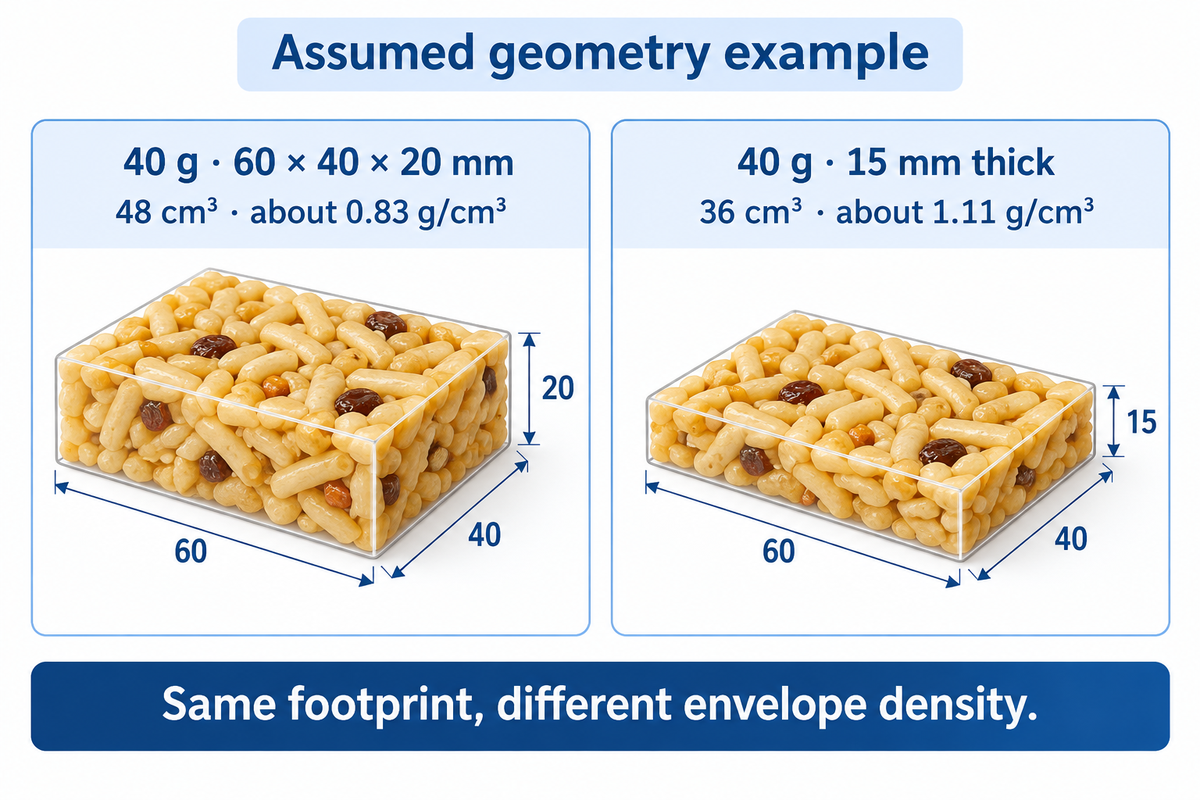
It’s brought to its intended thickness and shape through forming. Conditioning provides the handling state for cutting and wrapping. Compression, binder state and strand breakage affect the internal structure, so evaluate a cut face alongside the outside dimensions and the piece weight.
Set the sequence around the product’s handling characteristics. A tray recipe may portion while warm or after further cooling; a continuous line has its own transfer and cutting arrangement. Production should record the order and elapsed times rather than label every pause as the same cooling step. The cut squares of sachima should retain their shape during transfer to wrapping.
Suppose a product team specifies a 40 g bar at 60 × 40 × 20 mm. The rectangular envelope is 48 cm³, giving an envelope density of about 0.83 g/cm³. A 40 g piece compressed to 15 mm at the same footprint occupies 36 cm³ and reaches about 1.11 g/cm³. Those assumed dimensions show why a weight match can conceal a denser bite. Judge the internal strand structure before approving a thinner bar simply because the wrapper handles it more easily. Envelope density includes the spaces within the bar; it isn’t the density of the dough material.
The forming route should be decided based on the intended sample. The Sachima and specialty snack process guide provides information on wider product-family discussion.
Wrap the finished snack and check storage performance
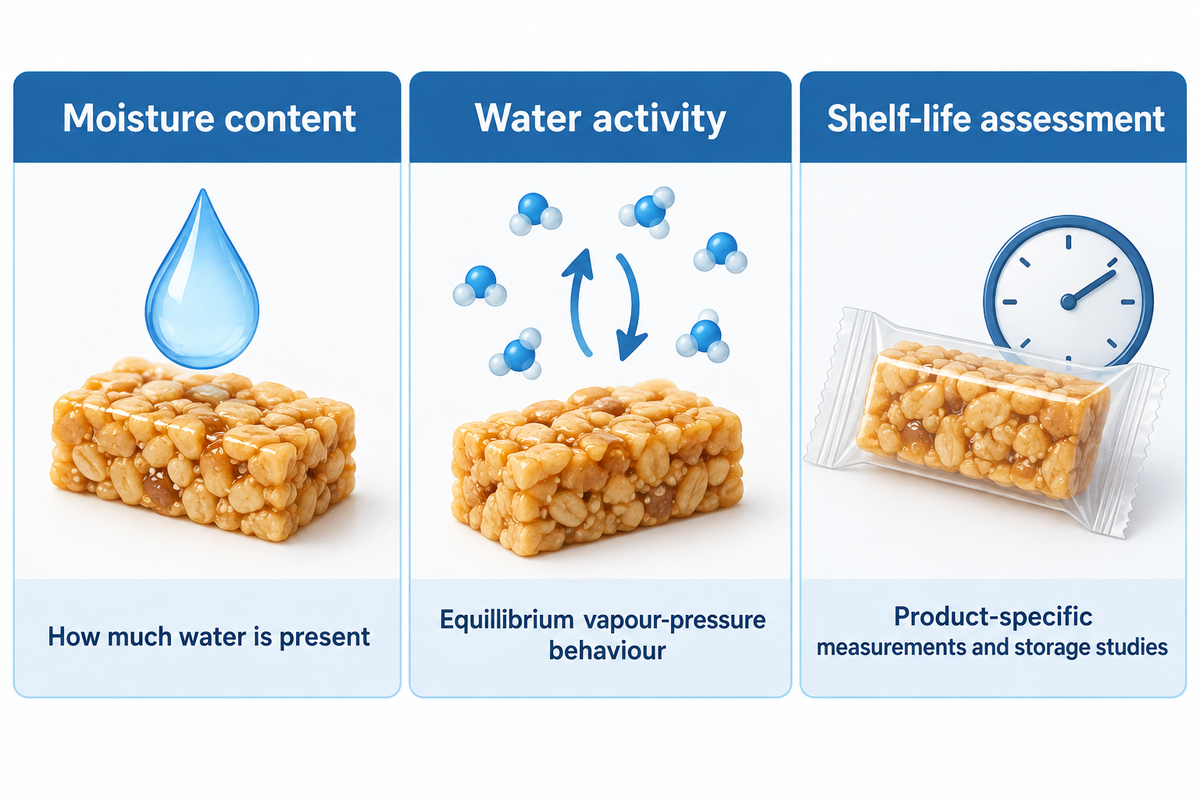
In the wrapping step, the formed product is protected and sealed, and connected by its identification to the release and traceability records. The product must be at the right temperature and in the right condition (i.e. handling state) to be sealed and stored. A clean-looking sealed pack is only one part of the assessment. The recipe, oil stability and moisture behavior also impact the performance of the product during storage.
Moisture content measures how much water is present. Water activity describes equilibrium vapour-pressure behaviour under the measurement conditions. The FDA’s water-activity technical guide explains that physical distinction; the guide dates from 1984. Use product-specific measurements and storage studies when defining the intended shelf life.
Food-contact control continues through syrup mixing, forming, conveyors and cutting. The FDA’s environmental sampling explanation identifies contamination on contact surfaces after a kill step as a significant concern. A frying setting selected for colour or texture needs separate food-safety justification before it is treated as a validated pathogen-control step.
For covered United States facilities, the preventive-controls rule centres on a food-safety plan and hazard analysis, with applicable controls and verification; exemptions and modified requirements exist. Ingredient and shared-equipment reviews also matter: wheat and egg are common to the process, while milk, peanuts or sesame may enter particular recipes. The FDA allergen overview lists those ingredients among the major allergens.
“Critical limits must be scientifically based.”
Trace batch mass from ingredients to packed bars
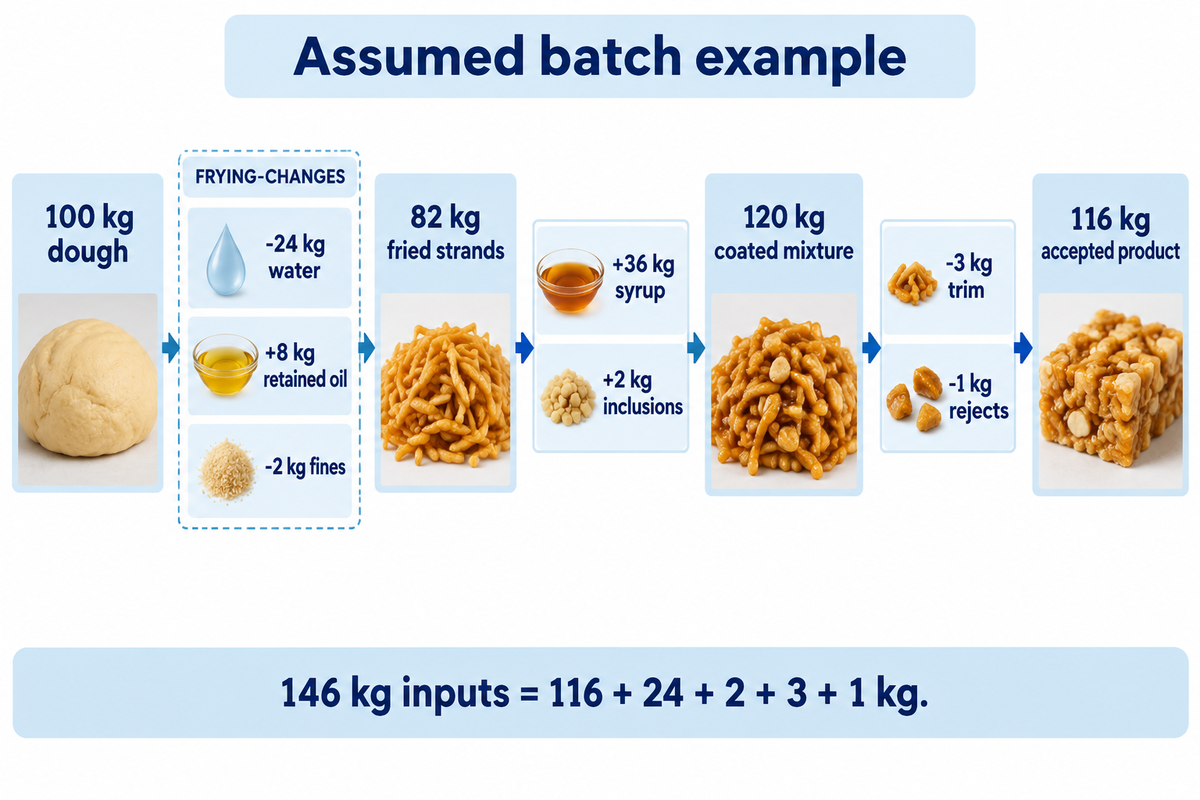
Batch mass accounting separates water removal, retained oil, binder additions and physical losses, and compares dough feed to the final packed output. The finished bar contains ingredients added after the dough is made, so dividing the final mass by the initial dough mass doesn’t reflect solids recovery. Keep one batch boundary and one set of units throughout the calculation.
The Food and Agriculture Organization’s cooking-factor table identifies both water loss and fat change during frying. The Commission for Environmental Cooperation’s mass-balance method also accounts for stock changes and processing adjustments. These methods form the basis for the Batch-to-Bar Mass Balance.
Batch-to-Bar Mass Balance
Example: assumed batch inputs and changes. The calculation starts with 100 kg of dough, tracks a net 8 kg of retained frying oil, then adds 36 kg of cooked syrup and 2 kg of inclusions.
| Material movement | Mass change | Stage total | Measurement basis |
|---|---|---|---|
| Dough entering the route | +100 kg | 100 kg | Net batch weight |
| Water removed during frying | −24 kg | 76 kg | Component balance using moisture results |
| Net frying oil retained | +8 kg | 84 kg | Fat balance; include initial dough fat |
| Fines separated | −2 kg | 82 kg | Collected and weighed stream |
| Fried strands at coating | 0 kg | 82 kg | Stage weight cross-check |
| Cooked syrup delivered | +36 kg | 118 kg | Delivered mass after cooker retention |
| Inclusions delivered | +2 kg | 120 kg | Net addition to coated batch |
| Forming and cutting trim | −3 kg | 117 kg | Separate collected stream |
| Packaging rejects | −1 kg | 116 kg | Product mass without packaging tare |
| Accepted packed product | 0 kg | 116 kg | Sum of accepted product net weights |
The frying stage closes as 100 − 24 + 8 − 2 = 82 kg. After coating, 82 + 36 + 2 = 120 kg. Finishing gives 120 − 3 − 1 = 116 kg. Across the complete boundary, 146 kg of inputs equals 116 kg packed product plus 24 kg water, 2 kg fines, 3 kg trim and 1 kg rejects.
Production and finance can now identify 4 kg of finish loss versus 24 kg of water removed. The binder dose is 36 ÷ 82 × 100, or approximately 43.9 kg binder per 100 kg of fried strands in this case. Keep that denominator attached to the number; it differs from dose per 100 kg of dough.
Independent component measurements remain necessary. A different assumed pair, 20 kg water removed and 4 kg oil retained, also gives 82 kg after the same fines loss. Weighing can’t identify which pair occurred. Moisture and fat measurements, including the composition of separated streams, resolve that question. For a plant record, add opening and closing work in progress, rework movements and measurement uncertainty. A remaining discrepancy is a prompt to investigate, rather than a diagnosis of one lost material.
What formulation research changes in factory trials
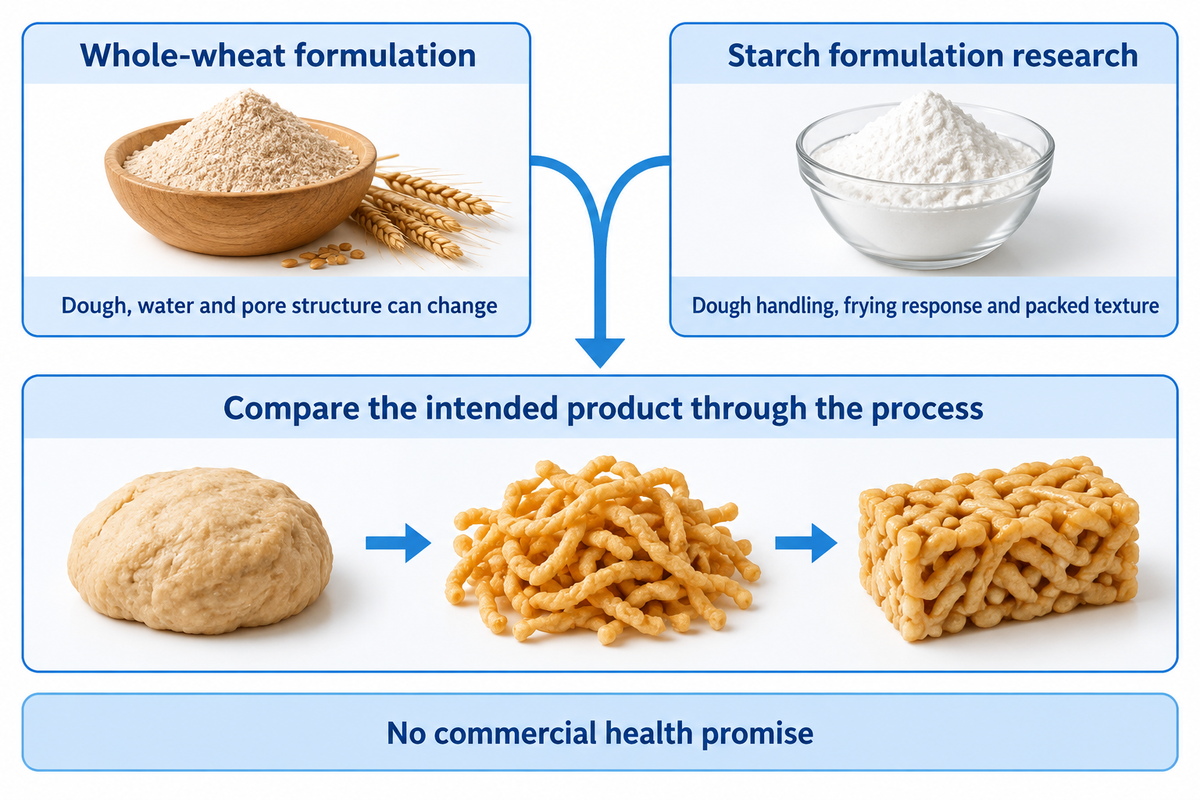
If a processor wants to change the formulation of the flour or starch, that should also be considered a change to the material route. Dough handling, frying response and packed texture can move together. The buyer’s relevant question should be if the proposed recipe reproduces the sample of interest through the required equipment, resulting in the final form and storage performance required.
The September 2026 paper Effects of incorporating three types of resistant starch on quality development and digestibility of fried Sachima reports different quality responses among the starch types in its visible abstract. The development implication is to compare the intended ingredient and formulation through the process. Laboratory digestibility findings shouldn’t become a health promise for a commercial bar.
For products intended for China, the official register lists GB/T 22475-2025, General quality for sachima, published on August 29, 2025, with implementation scheduled for March 1, 2027. As of October 2026, that implementation date is still ahead. Keep the market’s applicable product-quality requirements separate from the plant’s food-safety controls.
Prepare one approved product sample and the recipe revision and Material-State Passport before discussing a new line. Include the desired piece dimensions and net weight, the required capacity and output basis, and handling remarks from frying through wrapping. If upstream strands change, revisit the coating and forming comparison rather than assuming a successful old run transfers unchanged.
Frequently asked questions
What does sachima taste like?
Sachima tastes sweet, with an egg-and-flour pastry flavour and a porous bite.
Individual strands can be tender, chewy or more crispy according to the recipe and processing. A version with roasted sesame seeds adds a seed flavour, while a raisin inclusion changes the bite and sweetness distribution. For a factory sample comparison, agree on the intended texture first, then evaluate the plain base and the inclusion version separately.
What are the different kinds of Sachima?
Sachima varieties differ in strand structure, softness, binder formulation and inclusions.
Chinese cuisine includes regional traditions, including Hong Kong styles, that use different combinations of texture and toppings. The manufacturing brief should describe the desired bar itself: its strand appearance, internal spaces, piece weight and coating behaviour. A classic flavour name is helpful for discussion, but a retained finished sample gives development and production a clearer comparison.
When is the sachima manufacturing process done?
The process is complete after finishing, packaging and the defined product-release checks.
Frying produces the strands, which still need binding, forming and portioning. The chosen route then connects conditioning with wrapping. A release record links pack identification and integrity with the applicable quality and food-safety requirements. Production completion and approval to ship should therefore be recorded as separate decisions when the facility’s release system requires them.
Where can I buy sachima?
Finished sachima is sold through Chinese and other Asian food retailers.
For equipment, contact a manufacturing-line supplier with a product sample and process brief. Buying the dessert and buying a machine are different purchasing tasks.
Can honey replace maltose in a factory recipe?
Treat honey substitution as a new binder formulation rather than an equal-mass swap.
The ingredient’s water and sugar composition can change concentration, coating behaviour and storage texture. Compare the supplier specifications, retain the solids measurement method and test the proposed blend with an identified fried-strand batch. Evaluate forming and the packed product over the intended storage period. A household substitution suggestion is a starting question for development; the factory formula needs its own product results and ingredient declaration.
Is sachima the same as sesame candy or Rice Krispies Treats?
Sachima uses fried dough strands, while the other snacks use different structural bases.
Sesame candy uses seeds; Rice Krispies Treats use prepared rice cereal. Their shared bar shape does not make upstream preparation or binder handling interchangeable.
Does a low moisture reading establish sachima shelf life?
A low moisture reading alone cannot establish a Sachima shelf-life claim.
Moisture content and water activity describe different properties. Storage assessment also addresses changes in the oil and sugar phase, package seals and barrier performance, handling controls and intended distribution conditions. Store retained packs under the conditions defined for that assessment. Use the methods and release criteria established for the product. Retained packed samples should be evaluated over time, with the recipe and packaging revision recorded together. A bar that tastes correct immediately after manufacture can change during storage.
Turn the process record into a line discussion
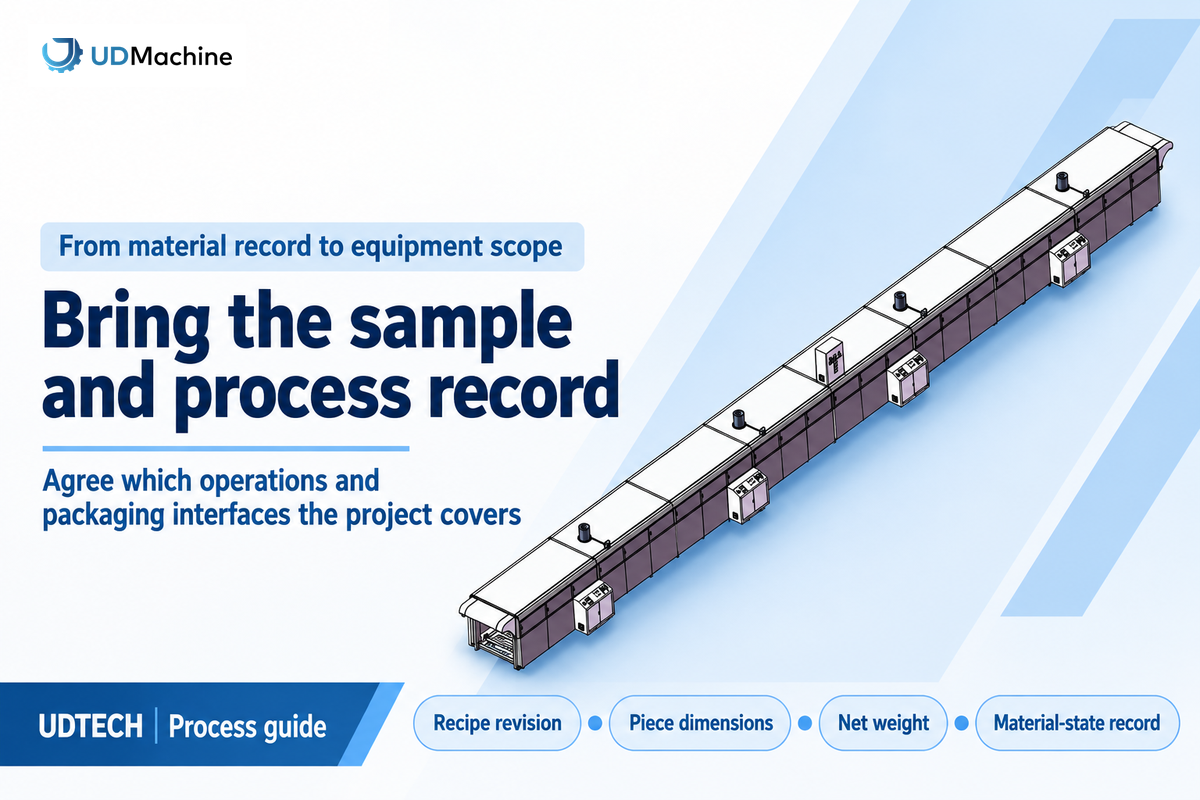
UDTECH supplies Sachima production equipment and develops the line discussion around the intended product and process. Bring the sample, recipe and material-state record to the Sachima production line discussion, then agree which operations and packaging interfaces the project covers.
Learn more about UDTECH’s food-equipment business. Operating limits and product release follow the actual recipe, equipment and facility plan.
References & Sources
- Antioxidant Properties of Maillard Reaction Products from Defatted Peanut Meal Hydrolysate-Glucose Syrup and its Application to Sachima, Cui and colleagues, Food Science and Technology Research, 2014.
- Effect of Whole Wheat Flour on the Deep-frying Kinetics of Chinese Sachima, Wang and colleagues, Journal of Food and Nutrition Research, 2018.
- Effects of Mono-, Di-, and Tri-Saccharides on the Stability and Crystallization of Amorphous Sucrose, Thorat and colleagues, Journal of Food Science, 2018; abstract.
- Water Activity (aw) in Foods, U.S. Food and Drug Administration, 1984 technical guide.
- Environmental Sampling, U.S. Food and Drug Administration.
- FSMA Final Rule for Preventive Controls for Human Food, U.S. Food and Drug Administration.
- Food Allergies, U.S. Food and Drug Administration.
- HACCP Principles & Application Guidelines, National Advisory Committee on Microbiological Criteria for Foods, adopted 1997; hosted by the U.S. Food and Drug Administration.
- Food Composition Data, Table 3.3, Food and Agriculture Organization of the United Nations.
- Mass Balance: Why and How to Measure Food Loss and Waste, Commission for Environmental Cooperation.
- Effects of incorporating three types of resistant starch on quality development and digestibility of fried Sachima, Yang and colleagues, International Journal of Gastronomy and Food Science, September 2026; abstract preview.
- GB/T 22475-2025: General quality for sachima, official Chinese national-standard register.