Get in touch with UDTECH Company

How to Evaluate an Egg Sheet & Hawthorn Crisp Machine for Production

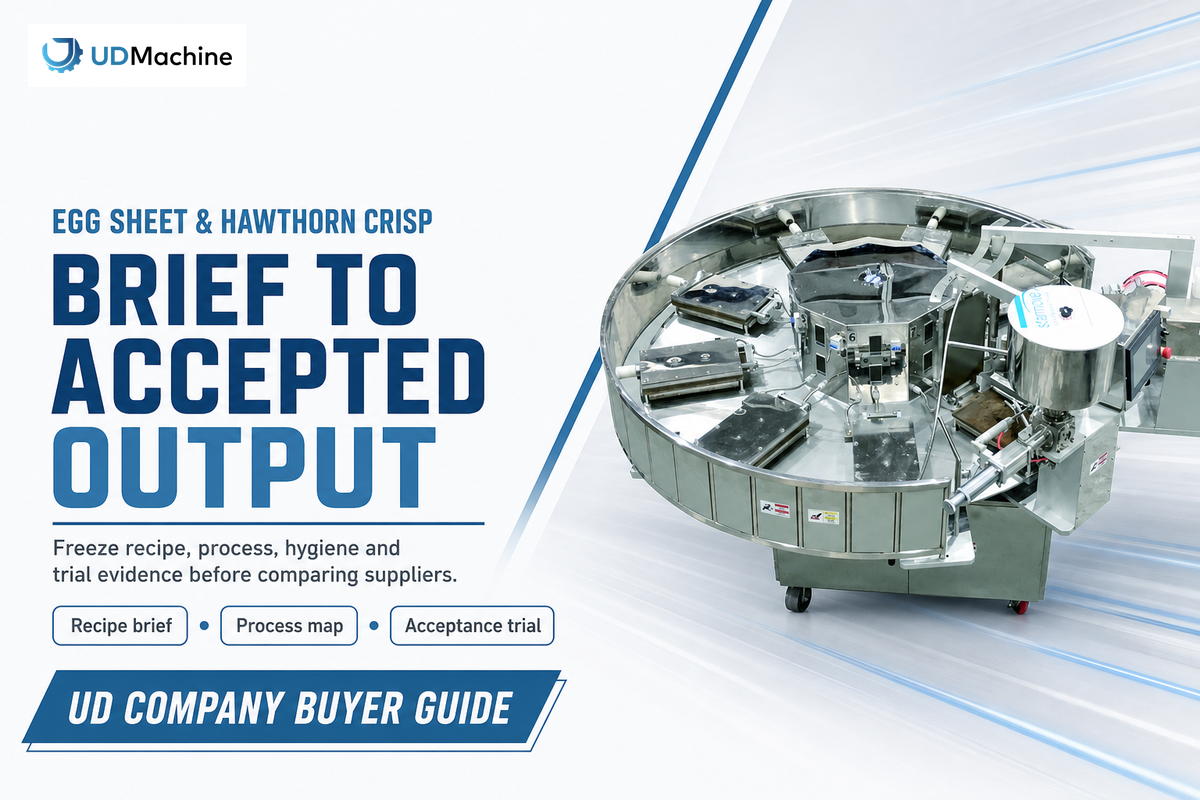
Industrial buyer’s guide
An Egg Sheet & Hawthorn Crisp Machine isn’t chosen at catalog speed alone. An Egg Sheet & Hawthorn Crisp Machine is a production setup that forms, bakes and cools a thin sheet with a controlled hawthorn inclusion. The only responsible choice is based on the brief and linked by: recipe control, sheet forming, heating and cooling, hygiene, acceptance trials and lifecycle cost.
1. What does “Egg Sheet & Hawthorn Crisp Machine” mean?
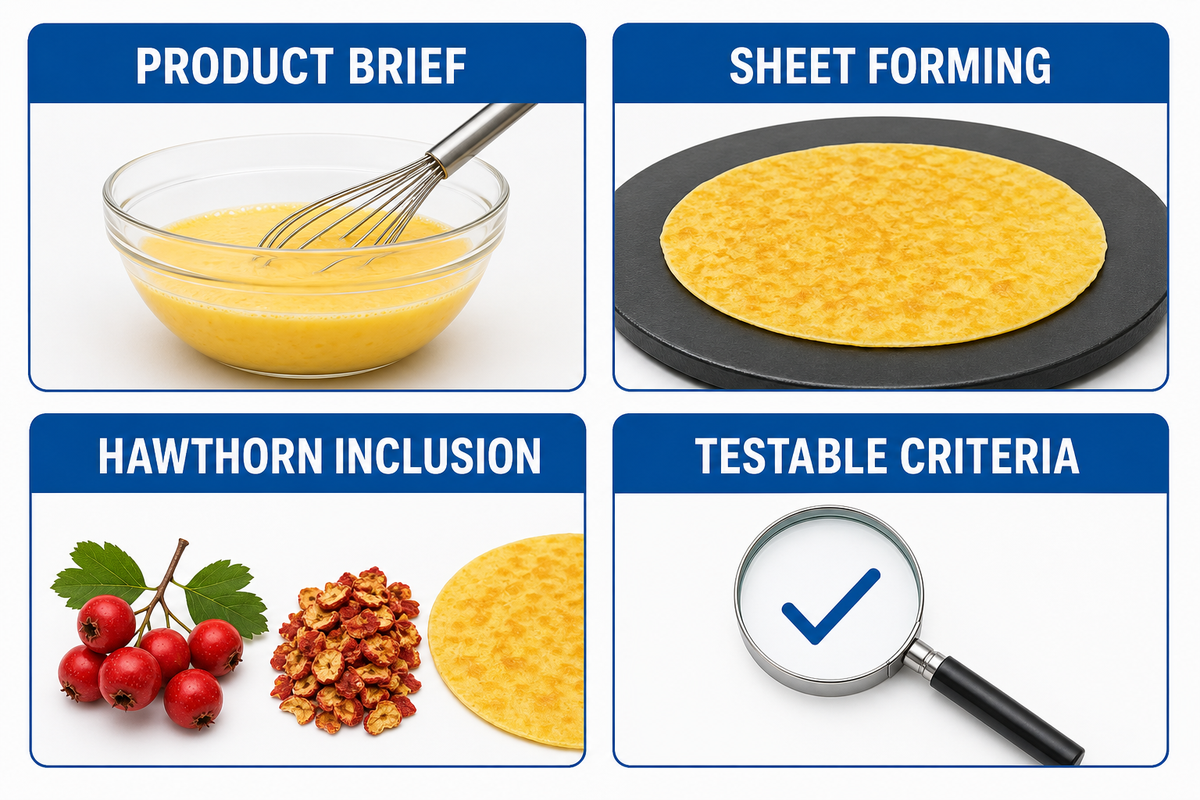
The expression generally implies a production brief, not a single machine standard. For example, “egg sheet” refers to a thin, baked sheet that must eject cleanly from the baking surface and remain stable as it cools. “Hawthorn crisp” adds a product-specific ingredient, flavor or texture target. The solution of feeding, cooking and cooling varies as a function of particle size, solids, moisture and required final product form.
The main risk is an ambiguous scope that sends a supplier to the wrong tooling; the reason to freeze the brief is to make acceptance criteria testable.
So, clearly distinguish the academic issue of “how is the line to be specified?”, from the commercial one of “what does a supplier have to tender”. Good brief outlines: the formula to be produced, sheet characteristics, surface finish target, packing configuration, operating conditions and site regulations before a supplier specifies hardware. While other patents might be known relative to producing egg-rolls, knowledge of a published patent is certainly not confirmation that this has led to commercialized production.
“A rate is useful only when the recipe, uptime, rejects and pack-out definition travel with it.”
2. Process map: batter, sheet forming, hawthorn inclusion, baking and cooling
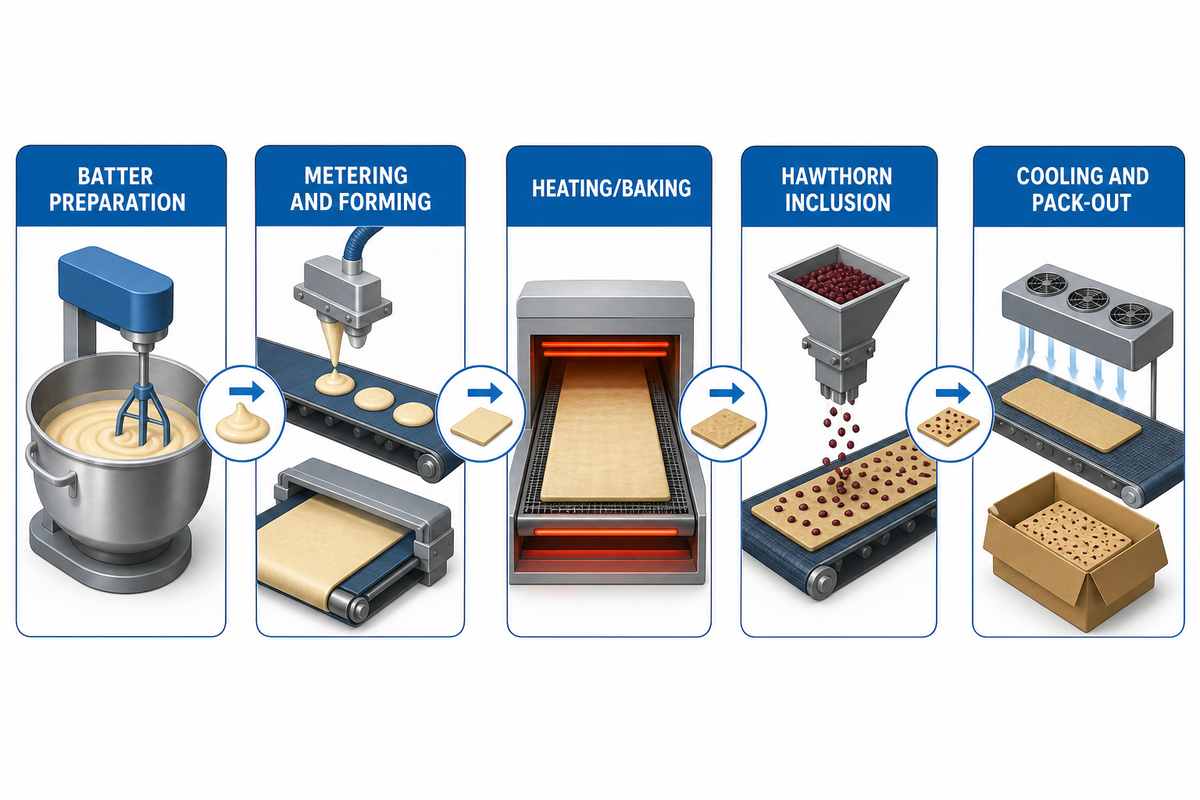
Steady lines are simply a sequence of transfers or hand-offs. That brief therefore becomes a map of what each hand-off must prove. A defect created during batter mixing that can appear to result from issues at a roller, scraper or wrapper, can often be traced back. Map the material and data as the product moves through the hand-offs and look for opportunities for operators to hold or deviate the material.
| Stage | What to control | Evidence to request |
|---|---|---|
| Batter preparation | Solids, viscosity, temperature, particle size and hold time | Recipe revision, batch log and sampling method |
| Metering and forming | Deposit mass, width, thickness and release | Setpoint range, changeover steps and sample sheets |
| Heating/baking | Heat profile, residence time and color | Profile measurement and reject definition |
| Hawthorn inclusion | Particle distribution, inclusion location and bridging risk | Screen size, feeder test and visual standard |
| Cooling and pack-out | Moisture migration, breakage and downstream speed | Cooling time, pack trial and accepted-unit count |
Supplier pages usually display pumps, scrapers and rollers, for instance, so take these descriptions as an input, and don’t expect one type of roller to do the job for every formulation. Your Hand-off Table will be the engineering’s, quality’s, and purchasing’s common language. For a related equipment reference, compare the automatic egg roll machine solution with the process stages in this guide.
3. Product specification inputs that determine machine design
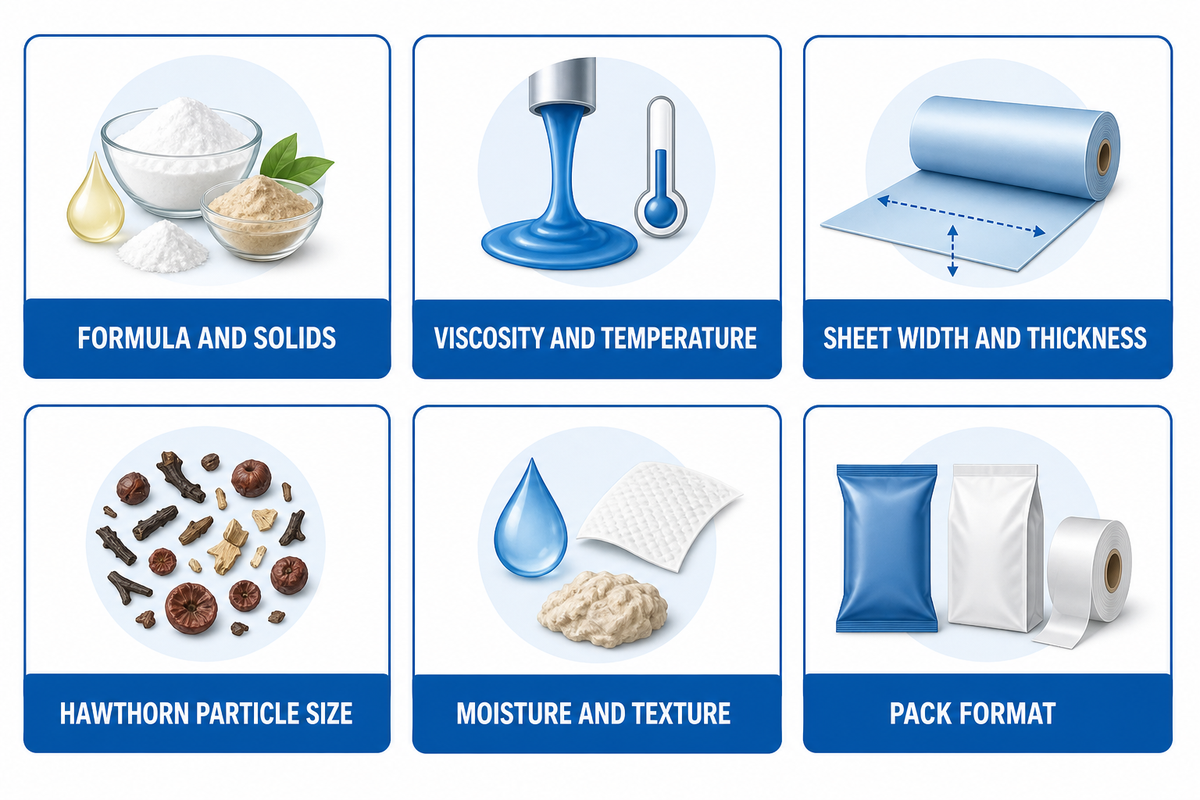
Lock off the product variables before comparing quotes. When these are still open, a low price could represent an incomplete scope. The root cause of many quote disputes is a missing acceptance criterion, so document the measurement method with the input matrix.
| Input | Why it matters | Buyer question |
|---|---|---|
| Formula and solids | Changes flow, release and bake response | Which ingredients are variable by lot? |
| Viscosity and temperature | Defines pump, deposit and hold-window needs | How will viscosity be measured at the machine? |
| Sheet width and thickness | Sets tooling, heat transfer and cut/roll geometry | What tolerance is saleable after cooling? |
| Hawthorn particle size | Affects feeder stability, inclusions and breakage | What is the largest safe particle and its distribution? |
| Moisture and texture | Crispness can change after cooling and storage | When and how will texture be measured? |
| Pack format | Determines downstream rate, orientation and breakage limits | Is the quoted rate before or after pack-out? |
| Buyer question | Record to keep | Decision use |
|---|---|---|
| What is the product boundary? | Approved recipe and sample | Prevents scope drift |
| Which geometry is saleable? | Width, thickness and curl limits | Sets tooling basis |
| How is crispness checked? | Instrument and test timing | Makes quality comparable |
| What counts as a reject? | Reason-code list and samples | Protects usable-output math |
| Which utilities are available? | Design and operating readings | Checks site fit |
| Where does cleaning occur? | Access and drainage plan | Clarifies sanitation work |
| Who owns trial data? | Raw files and sign-off roles | Keeps evidence auditable |
| What is included in the quote? | Included, optional and excluded list | Supports like-for-like review |
| What happens after handover? | Service path and spare-parts list | Tests lifecycle readiness |
Carry the approved Egg Sheet & Hawthorn Crisp Machine solution scope into the same input matrix so the commercial page and this educational guide stay aligned without duplicating specifications.
Illustrative worksheet only: the worksheet records 0.5 mm, 1.0 mm and 1.5 mm thickness checks, a 2% reject ceiling, an 85% uptime assumption, a 92% pack-out factor, a 5-year horizon, 6-inch and 8-inch sample widths, a 10-minute changeover and a spare-parts horizon of 12 months. These examples are planning prompts, not UD specifications.
4. Capacity planning: usable output, not a headline number
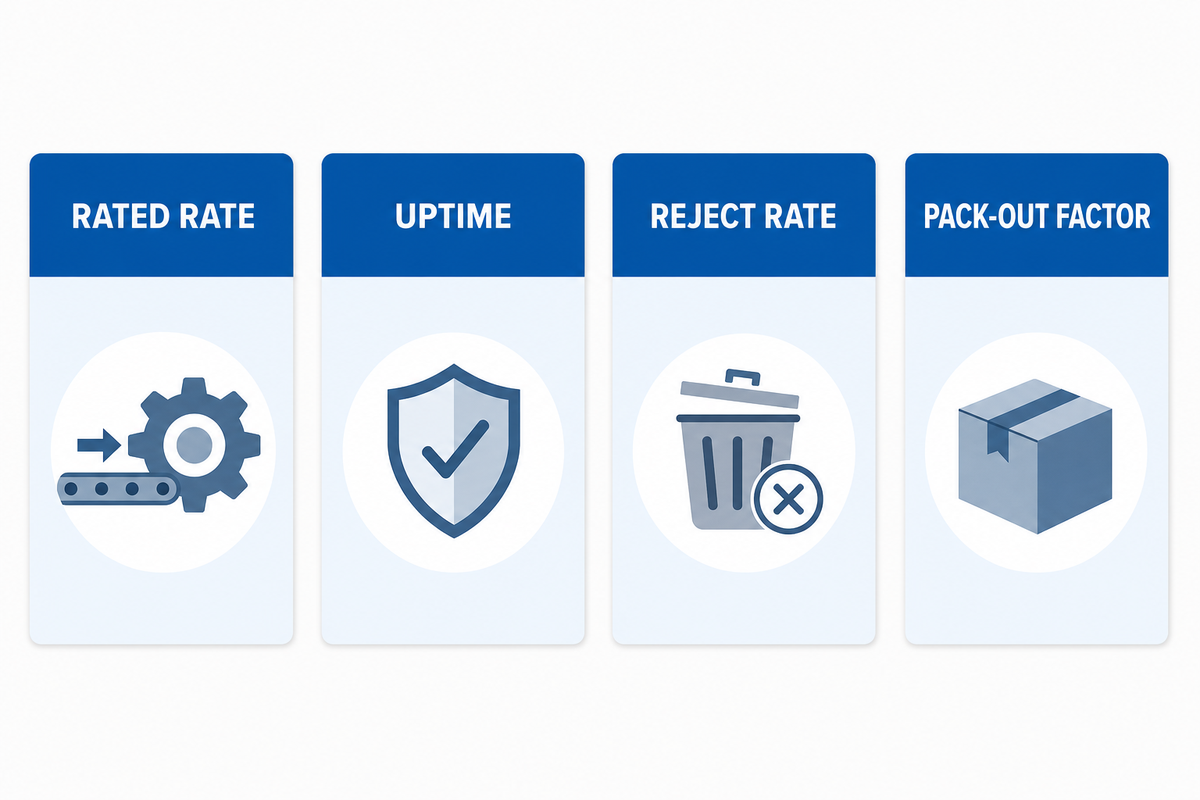
Your supplier may print a pieces-per-hour value—use it as a point of departure, not an output guarantee. The specification inputs above define the assumptions behind that rate. A useful model for planning is:
Usable output = rated rate \* uptime \* (1-reject rate) \* downstream pack-out factor
For example only a machine rated at 2,400 per hour with 85% uptime and 4% reject rate with a 92% pack out rate yields 2,400 x 0.85 x 0.96 x 0.92 = ~ 1,795 acceptable parts per hour. Substitute the values in this for your specific recipe and shift pattern. It doesn’t show the projected output for a specific machine, but demonstrates where your assumptions hide. The trade-off is explicit: the reason to discount a headline rate is to expose downtime and reject assumptions before finance approves capacity.
• Measure micro-stop time (such as, clean up, switch over, warm up, feeder bridging and cool down blockages) separately • Speed can be inversely proportional to breakage. Increased speeds often lead to variation in moisture and labor at pack out.
For the trial sheet, record the 2,400 pieces/hour nominal rate, 85% uptime, 4% rejects, 92% pack-out, 1 hour run, 5-year cost horizon, 10-minute changeover and 2 mm target thickness as separate buyer-model assumptions. Treat the 2,400 figure as a contextual supplier reference, not a UD rating; record any agreed initial-response window separately and never treat it as a service-level agreement. Set the surface-finish requirement and particle-size screen with the applicable hygiene standard and recipe owner rather than assuming numeric limits. These values are illustrative planning inputs—not UD specifications, guarantees, test results or acceptance limits.
5. How to compare forming, heating and cooling architectures
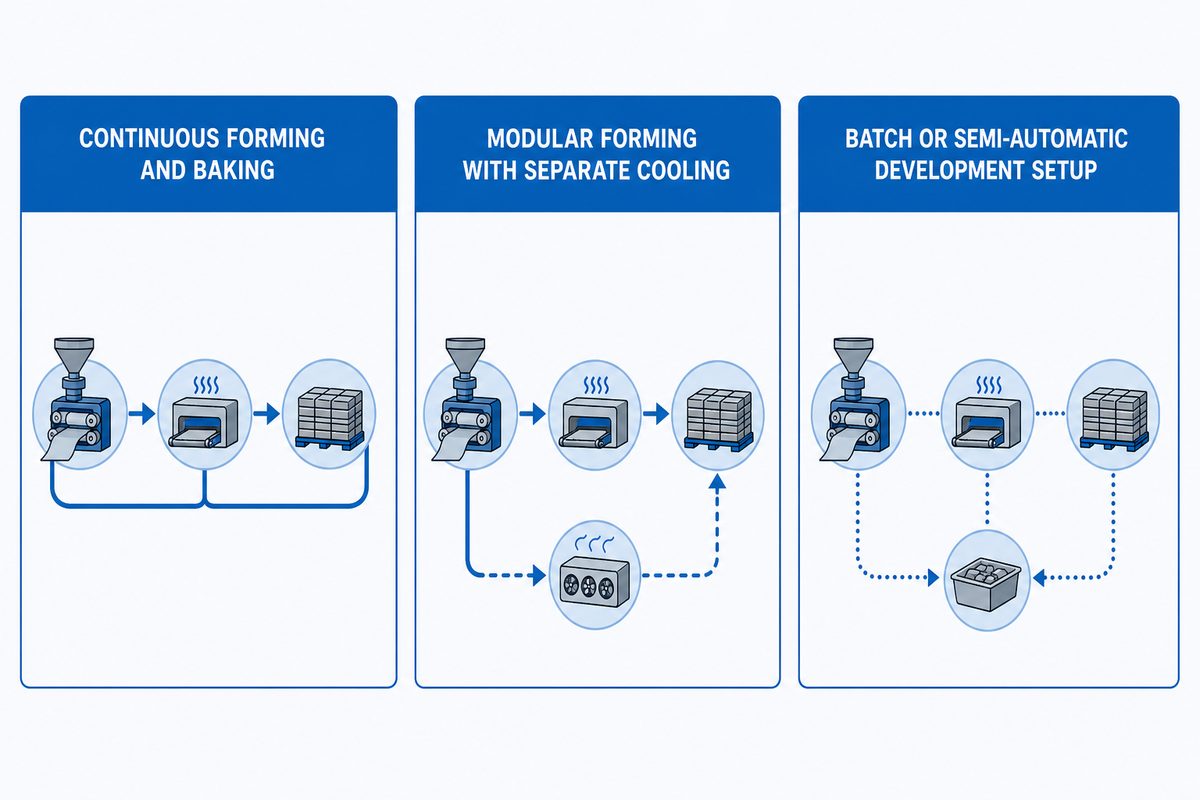
Validate the design against the product brief, not just feature lists. A stable continuous roller can manage high volumes once sheet flow is consistent, but if the hawthorn blend is still being tested, a smaller, easier-to-validate batch setup may be best. The trade-off belongs in the acceptance criteria: document which architecture keeps release, cooling and pack-out stable for the chosen recipe.
| Architecture | Potential strength | Questions before selection |
|---|---|---|
| Continuous forming and baking | Repeatable flow after recipe is stable | How are deposits, release and heat zones adjusted? |
| Modular forming with separate cooling | Easier isolation of cooling and pack-out constraints | Where is the bottleneck during a full-shift trial? |
| Batch or semi-automatic development setup | Lower commitment while formula and particle size evolve | What is the migration path to production scale? |
Request each supplier to distinguish included, optional and excluded modules. This way all the quotes can be compared and you know when a “complete line” quote isn’t covering manual transfers or tooling not quoted in the total value. The UD Company overview is useful context, but it does not replace a recipe-specific trial.
6. Quality, crispness and food-contact hygiene checkpoints
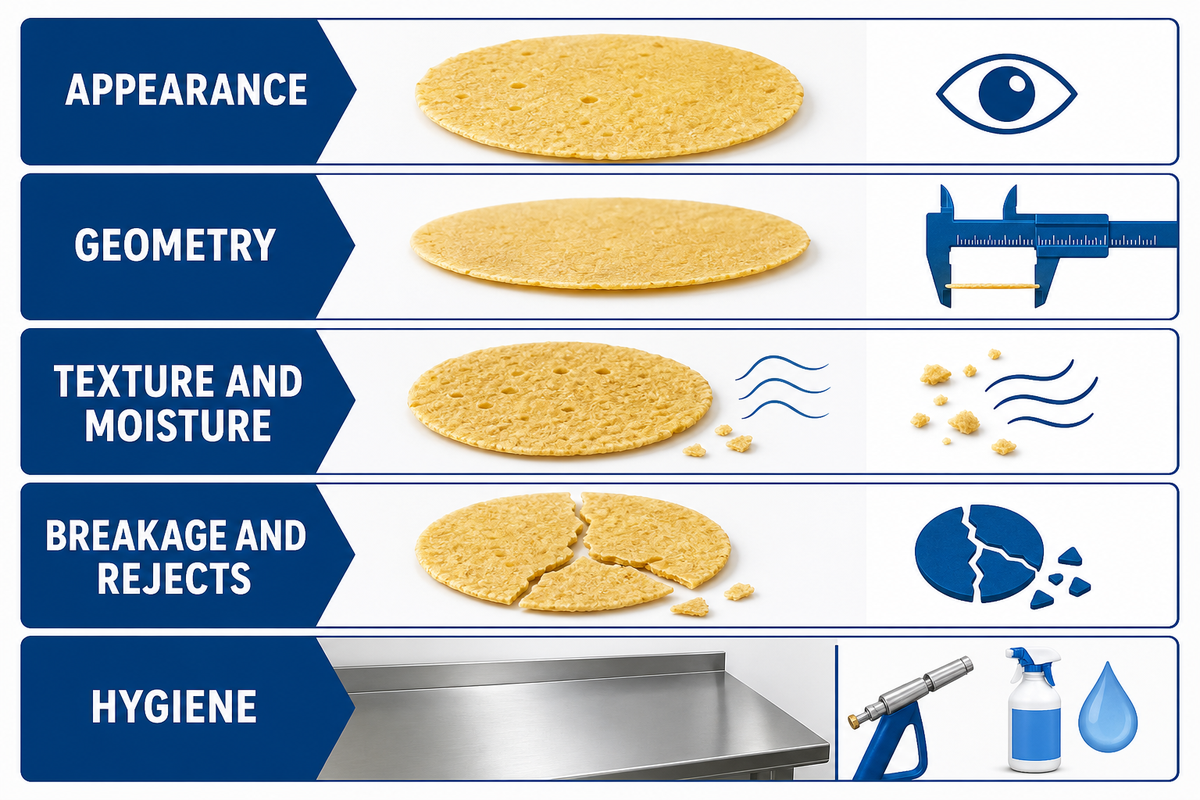
A crisp is a time-dependent product. Test the sheet at a specified time after cooling (and, where applicable, after a short retention challenge). It’s easy and practical to apply a hygienically designed standard; in your Design Review ask the supplier to cover drainability, cleanability, access, no product traps. One surface-roughness value alone does not prove that the equipment can be cleaned.
| Checkpoint | Record | Acceptance example |
|---|---|---|
| Appearance | Color range, blistering and inclusion distribution | Signed visual standard with retained samples |
| Geometry | Width, thickness, length and curl | Tolerance agreed before the trial |
| Texture and moisture | Measurement method and time after cooling | Method, instrument and pass band documented |
| Breakage and rejects | Reject reason by station | Root-cause code, not one blended percentage |
| Hygiene | Food-contact materials, drainage and cleaning access | Quality and compliance sign-off for the applicable jurisdiction |
7. Utilities, layout and sanitation readiness
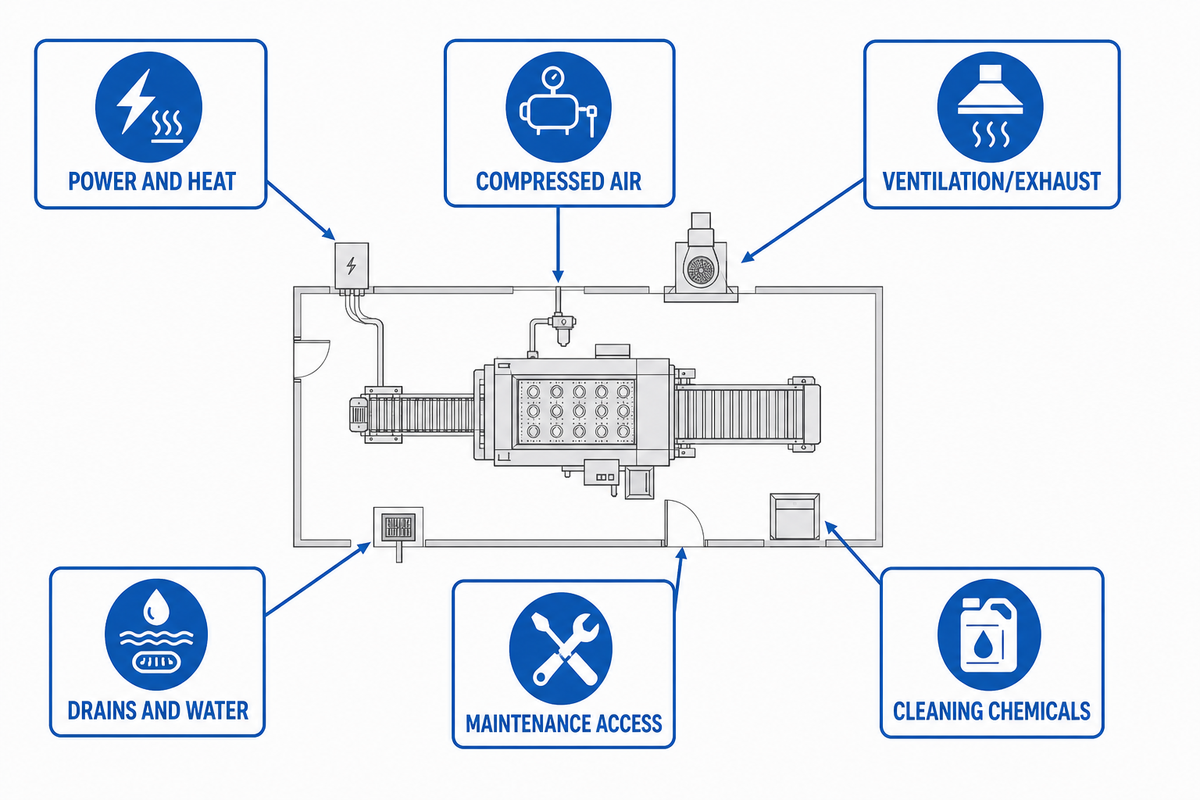
A “utility survey” will form part of the pre-ship check. Make a point of verifying any specified power requirement, the type and availability of your heating fuel or power supply, compressed air quality, ventilation / exhaust (local requirements apply to the discharge point), drain connections, water supply quality, floor loading, maintenance access and the availability of hygienic zoned areas. Your local food-safety and electrical codes will take precedence over anything in the brochures for other areas. The reason to record each utility under load is to turn a hidden risk into an acceptance criterion.
Useful data-sheet fields, not target values, include batter at 20°C, air at 6 bar, a 50 Hz or 60 Hz supply, 15 kW peak load, 30 kg/h process water, 500 mm maintenance access, a 12 mm drain connection and 30 min cleaning verification.
- Mark incoming power, isolation points and control-panel location.
- Confirm air pressure, flow, filtration and condensate handling under peak demand.
- Show heat and vapor exhaust routes; don’t assume room ventilation is sufficient.
- Provide drains, slopes and wash-down boundaries without sending water into sensitive controls.
- Reserve clearance for scraper, roller, feeder and belt removal.
- Define cleaning chemicals, contact time, rinse method and restart inspection.
Ask suppliers to provide a “Utility Schedule” showing design values versus operating values. Identify any significant discrepancies in your contract and get them signed off pre factory trial.
8. Factory trials and acceptance testing that protect the buyer
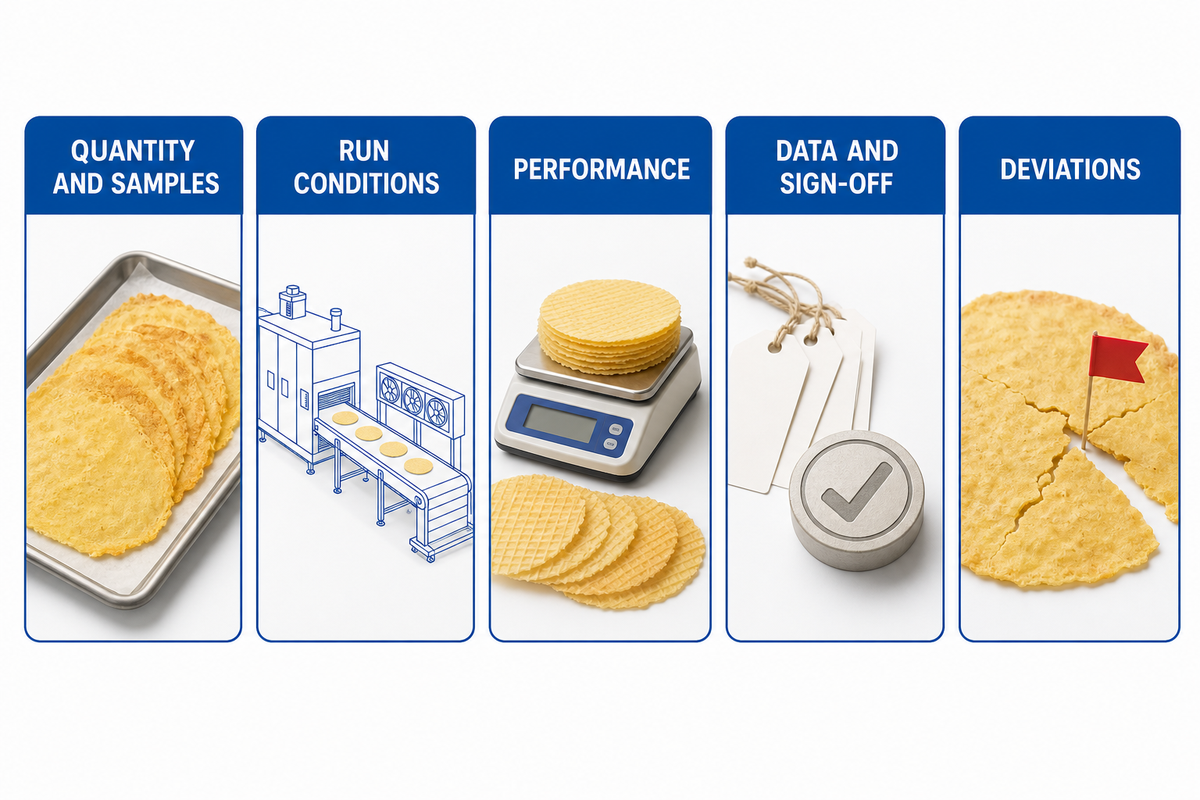
8-Point Quote-to-Trial Acceptance Matrix
You do not run a trial merely to find an “easy” recipe. The utility schedule above becomes part of the trial conditions. A trial is a controlled experiment. Freeze the formula revision, raw-material batch, screen aperture, tooling, run time and product range. Take samples at start-up and at least twice at stable state, including the high-output condition, and include those points in the protocol.
| Protocol item | Minimum record |
|---|---|
| Samples | Quantity, sampling interval, retained samples and test owner |
| Run conditions | Speed, temperatures, deposit setting, utilities and operator count |
| Performance | Uptime, accepted units, reject codes, changeover and cleaning time |
| Data and sign-off | Raw files, calculations, deviations, corrective actions and signatures |
| Category | Type | Pass evidence |
|---|---|---|
| Recipe | Input | Signed formula and lot |
| Geometry | Quality | Width and thickness readings |
| Texture | Quality | Cooling-time result |
| Inclusion | Process | Particle distribution sample |
| Uptime | Performance | Stop log and accepted count |
| Rejects | Performance | Reason-coded rejects |
| Utilities | Site | Peak readings and alarms |
| Cleaning | Hygiene | Timed clean and inspection |
| Documentation | Closeout | Signed deviation list |
Use the same trial protocol for on site, or site acceptance, testing (SAT) the new equipment. The process and documentation required should focus on open deviations which will need owners, dates and retest conditions. You’re now in a position where you can compare the costs of alternative offerings by the use of a neutral selection based on the ability to satisfy your initial criteria. You’ll be able to see if the Hawthorn Crisp Machine or a generic offering can stand up to your needs after you’ve put them side-by-side through your approved trial criteria. For a neutral product-page cross-check, review the Egg Sheet & Hawthorn Crisp Machine solution against the signed scope, and compare its hygiene questions with this hygienic-surface reference. The automatic egg roll machine page can serve as a second equipment cross-check.
9. Total cost of ownership and supplier due diligence
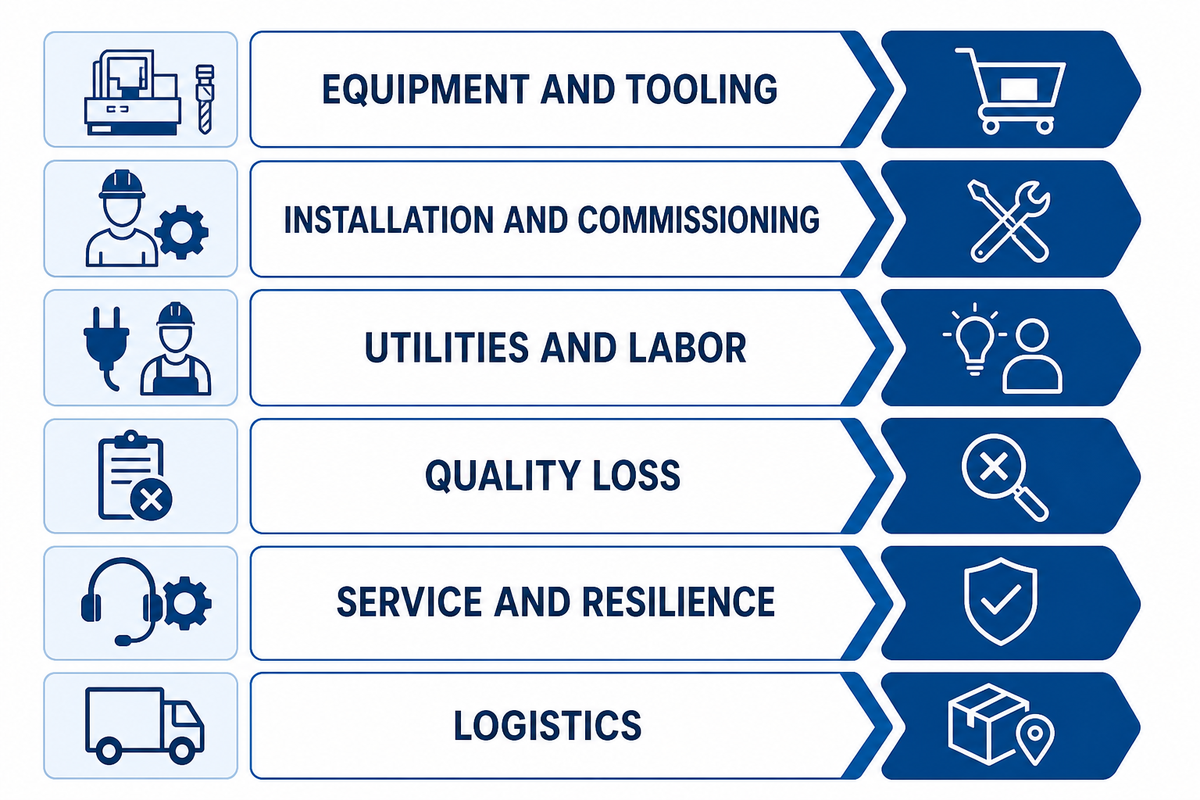
There is much more to ownership cost than the purchase price. Carry the signed trial results into that cost view so the assumptions stay testable. Build a five-year view, or use your finance department’s convention, and detail each line item so its assumptions are clear. The trade-off is not simply fast versus slow; it is the documented cost of uptime, rejects, sanitation and service over that horizon.
| Cost driver | What to request in the quote |
|---|---|
| Equipment and tooling | Base line, options, molds, feeders, spares and excluded items |
| Installation and commissioning | Travel, labor, training, documentation and SAT support |
| Utilities and labor | Consumption assumptions, staffing, cleaning and changeover hours |
| Quality loss | Rejects, rework, start-up waste and pack-out constraints |
| Service and resilience | Response time, remote support, critical spares and obsolescence plan |
| Logistics | Freight, insurance, customs, unloading and floor preparation |
For supplier due diligence, ask for references from other companies making and forming sheets of your size to your specifications. Also ask for details on their repair services and when it gets complicated (e.g. who replaces it and within what parameters). Questions related to removable parts, insuring transport and technical service for breakdowns come to mind, but don’t give too much weight to comments in discussion forum.
10. UD Company context and how to request a relevant review
UD Company was established in 2003. The trial and cost records above show how that company context should support a supplier review. Based on company materials supplied for this guide, the company has invested close to RMB 200 million in the High-tech Development Zone in Xinyu City, Jiangxi Province, China. UD Company operates at two major production facilities, spanning around 130 acres of land. The company’s main focus is the advancement of automation technologies for the food industry, claiming that both their fully automatic egg roll machine and fully automatic phoenix tail roll machine are the result of proprietary development and hold multiple innovation patents.
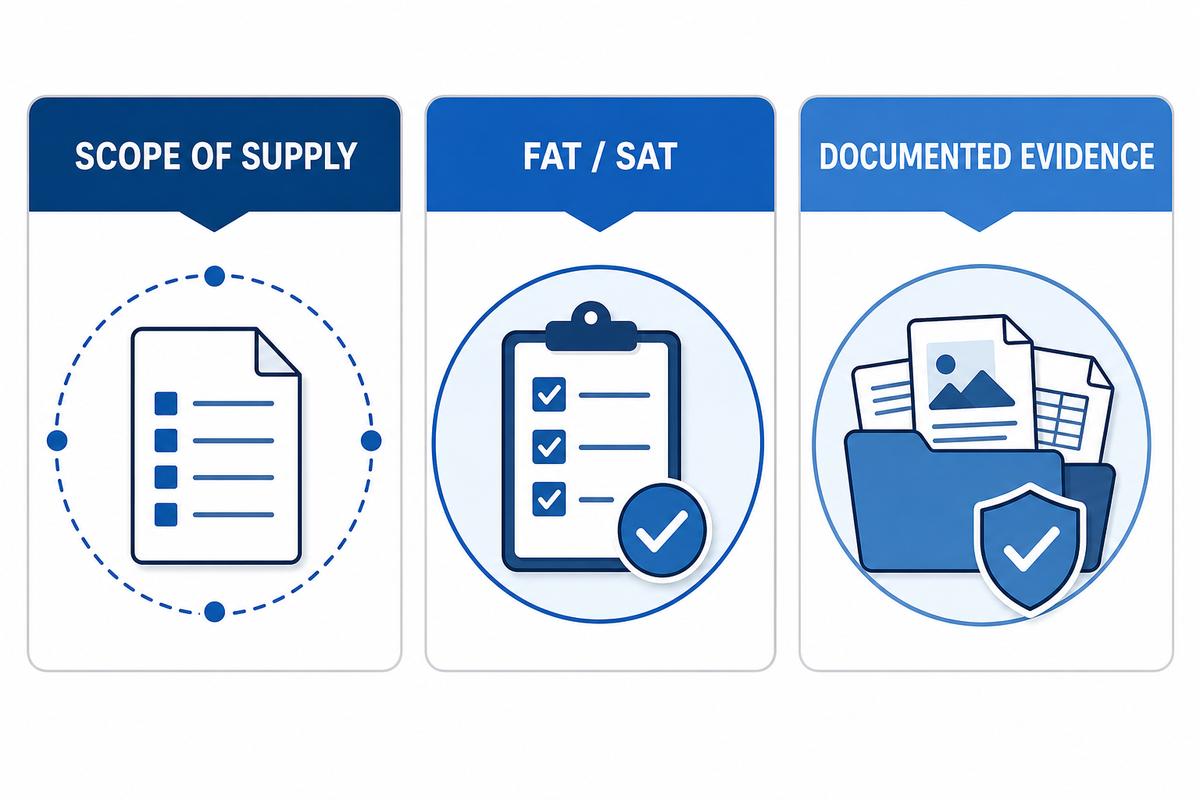
UD Company facts shouldn’t substitute an on-site acceptance test. When preparing for and conducting an on-site test for review, ensure you provide complete information including: recipe, sheet sizes, hawthorn particles specification, textures following cooling, pack formats, shift yield, all the necessary services, and any specific regional regulations. Request a complete Scope of Supply, clarifying what’s included, optional, or requires further confirmation.
RFQ checklist
Product brief · sample recipe and lots · geometry tolerances · usable-output definition · utility schedule · sanitation boundary · FAT/SAT protocol · spare-parts list · data ownership · commercial exclusions.
Product brief · sample recipe and lots · geometry tolerances · usable-output definition · utility schedule · sanitation boundary · FAT/SAT protocol · spare-parts list · data ownership · commercial exclusions.
For procurement research, an egg sheet machine is one part of broader food machinery. Compare line balance and operating efficiency across forming, baking, cooling and pack-out rather than treating one catalog speed as the whole decision.
Frequently asked questions
What is an Egg Sheet & Hawthorn Crisp Machine?
It’s a production brief for making a thin egg-based sheet or crisp product that includes a hawthorn component or hawthorn-inspired texture target. The exact equipment boundary depends on the recipe, particle size, sheet geometry, heating method, cooling time and pack format. Treat the phrase as a starting point for an engineering review, not as proof that every supplier’s machine has the same process or output.
How does an egg-sheet line handle high-volume production?
A high-volume line coordinates batter preparation, metering, heated forming, release, optional inclusion feeding, cooling and packing. The limiting station may be cooling, inspection or pack-out rather than the baker itself. Ask for accepted pieces per hour under your recipe, plus uptime, changeover, reject and staffing data. A headline rate without those conditions isn’t a comparable production promise.
What causes egg sheets to stick or crack?
Sticking and cracking usually have interacting causes: viscosity drift, deposit mass, surface condition, heat profile, release timing, hawthorn particle distribution and handling after baking. Changing one machine setting may hide the symptom without removing the cause. Use a trial matrix that changes one controlled factor at a time, records reject codes and checks the sheet after cooling.
What capacity should I use for an RFQ?
Use a usable-output definition, not only a rated speed. State the accepted piece, run duration, uptime target, reject ceiling, changeover allowance and downstream pack-out factor. Then request the supplier’s calculation and the raw trial data behind it. This lets finance compare suppliers on the same basis and prevents a nominal pieces-per-hour value from being mistaken for saleable output.
Which hygiene documents should a buyer request?
Request food-contact material declarations, hygienic-design drawings and cleaning instructions first. Confirm drainage, access, utility quality and the applicable local standard edition with your compliance team.
How do FAT and SAT differ for this machine?
Factory acceptance testing (FAT) checks the agreed configuration under controlled supplier-site conditions. Site acceptance testing (SAT) confirms installation, utilities, guarding, cleaning access, controls and production behavior in the buyer’s plant. Use the same product specification and measurement method where possible. Record deviations, corrective actions, responsible owners and the condition for final sign-off.
Does UD Company publish a universal capacity or patent number?
The company brief supplied for this guide describes UD Company’s history, investment, facilities, independent development and multiple invention patents, but it doesn’t provide a universal capacity or a patent number for this article. Request project-specific evidence and verify the relevant patent, certification and performance documents for the exact configuration you intend to purchase. In practical terms, that means asking for the exact model scope, the recipe and geometry used during testing, the raw accepted-unit count, the uptime calculation, the reject definitions, the utility readings, the cleaning method and the sign-off authority. A patent statement establishes an intellectual-property position; it doesn’t establish food-contact certification, a guaranteed rate or a result for a different hawthorn formulation. Keep those questions in the RFQ and carry the answers into FAT and SAT records so procurement, engineering and quality teams are evaluating the same evidence.
References & Sources: evidence boundaries
This document in the general process, sanitation, capacity-planning and testing context uses current-run research. Examples are based on USDA sanitation guidance, shell-egg HACCP guidance, research on hygienic surfaces, supplier process descriptions from ANKO, and published patent records, including a related patent record. These sources support bounded educational statements only: they aren’t formal UD machine specifications, certifications, prices or claims of guaranteed output.