Get in touch with UDTECH Company


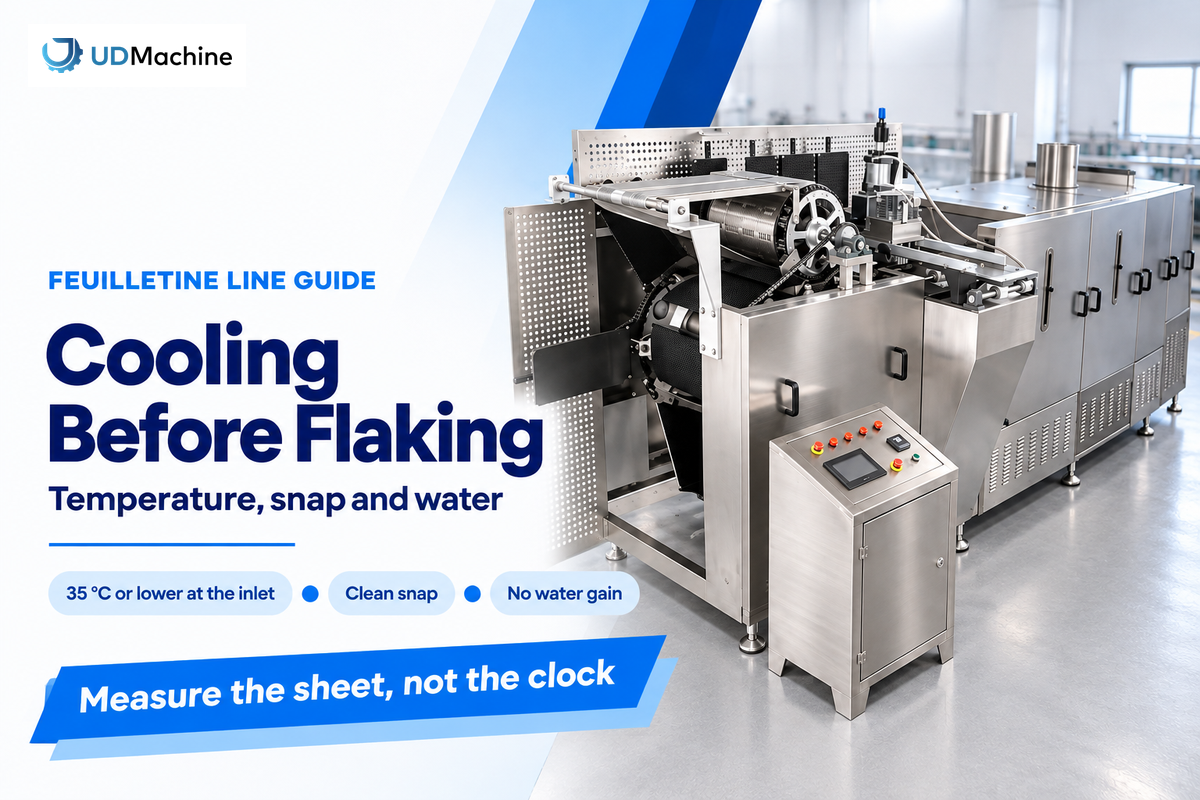
Feuilletine cooling before flaking determines whether the sheet breaks apart into thin, brittle flakes, or bends, tears and disintegrates into dust in the crusher. Home recipes manage this in about 10 to 15 minutes on a baking tray. A continuous line gives the sheet seconds, and its moving belt lets the product pick up water from the surrounding environment, so measured checks are required instead of relying on a clock.
Feuilletine cooling before flaking is finished when the sheet is back at room temperature, snaps cleanly instead of bending and has gained no water from the air. On a moving belt, a 0.3 mm sheet gets there in about 15 to 78 seconds, depending on airflow.
Key points
- The kitchen’s 10 to 15 minutes mostly waits for the tray: a 1 mm steel pan in still air needs about 17 minutes to fall from 150 °C to 35 °C, while a 0.3 mm sheet alone needs about 78 seconds.
- Water decides whether a cool sheet still bends. Dry snacks lost sensory crispness at water activity 0.35 to 0.50, and crisp breads began to soften above 0.255 to 0.319.
- Condensation forms when the product surface is at or below the dew point of the air around it, so over-chilling a sheet can wet it on exit.
- A hand snap screens out a rubbery sheet; the weighed fines share at the crusher discharge is what judges the crusher.
Updated October 2026.
Quick Specs: cooling a feuilletine sheet before the crusher
| Readiness at the crusher inlet | Room temperature (35 °C or lower in a 25 °C room as a starting setpoint), a clean snap, no water gain |
| Critical water activity, dry snacks | 0.35–0.50 (Katz and Labuza, 1981) |
| Water gain that softens cellular snacks | About 3 g per 100 g dry matter |
| Air-side heat transfer coefficient | 2–25 W/m²·K still air, 25–250 W/m²·K forced air |
| Example cooling time, 0.3 mm sheet | About 78 s still air, about 15 s forced air (150 °C to 35 °C) |
| Patent drum-line reference | 150–230 °C drum, 1,160 mm diameter, one turn per 90 s |
Feuilletine Cooling Before Flaking at a Glance
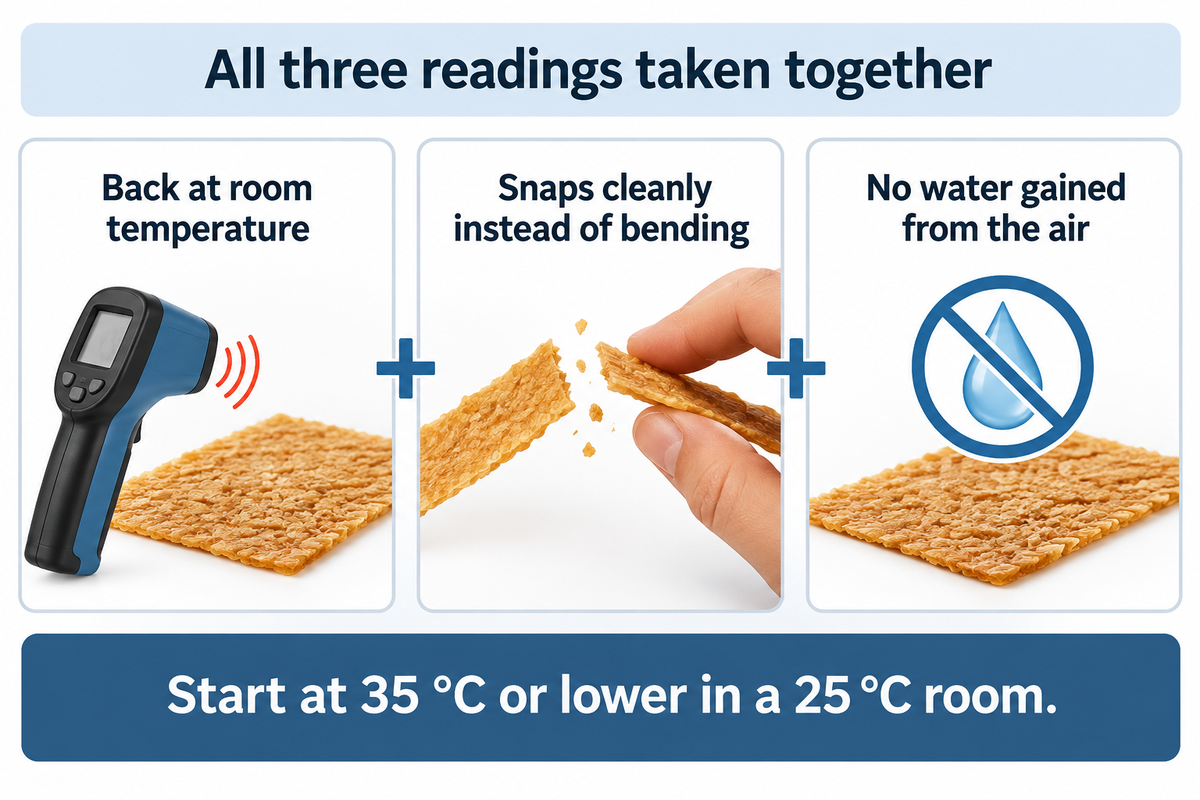
Feuilletine is a crisp caramelised crêpe sheet that’s cooled until its sugar and starch set into a brittle glass, then broken into flakes. Cooling before flaking has one job: creating a sheet that crushes at the target point instead of bending, and keeping it from picking up water from the air as it’s transported there.
The sheet starts out hot. Plates in an industrial wafer oven measured 141.7 to 163.2 °C in a 2025 wafer baking-plate study by Köklü and colleagues, and the crêpe-flake line in Japanese patent application JP2005124452A, filed by Hanamaruki KK, heats its drum to 150 to 230 °C. At these temperatures the thin layer is soft and pliable. As it cools it passes through its glass transition, and that transition sits lower the more water the sheet holds: in a 2025 study of puffed cereals, the glass transition temperature fell as moisture rose (r = −0.95) and sat near 40 °C at 8% moisture.
Treat readiness as three readings taken together. These include surface temperature at room level, a clean snap against a retained reference piece, and water activity of a retained flake below the limit set in your trial. A good starting point is 35 °C or below at the crusher inlet if the room temperature is 25 °C. A failed snap or water activity reading can’t be fixed by more belt length.
A sheet that reaches 35 °C at the crusher inlet sits 5 °C below the 40 °C glass transition measured for puffed cereals holding 8% moisture; feuilletine’s own transition isn’t published, so the snap test confirms the margin, and a sheet that has absorbed water loses it.
The Kitchen Method, and What Changes on a Line
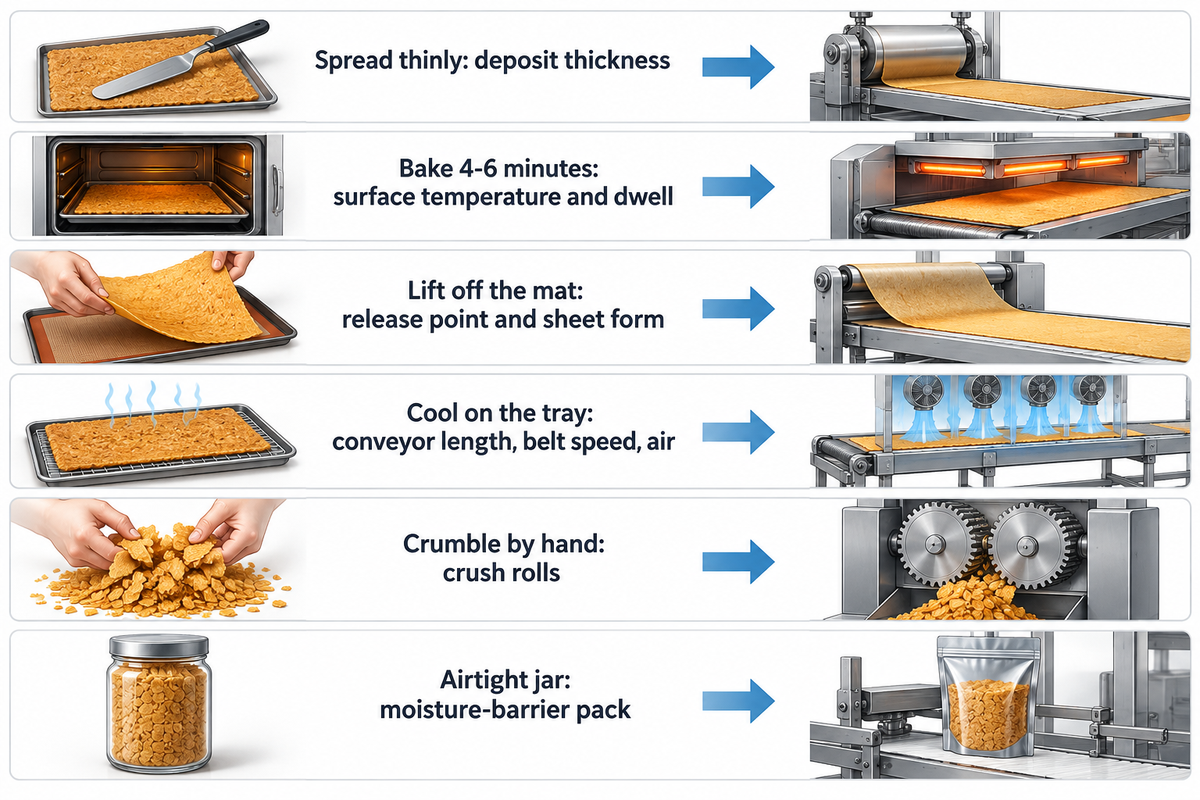
Pailleté feuilletine is made in pastry kitchens from egg white, powdered sugar, flour and melted butter: cooks spread the batter thinly on a silicone mat or parchment, bake it golden brown and cool it before crumbling. On a line, each step along the way becomes a controlled variable, measured at a fixed point.
A typical homemade feuilletine recipe and technique goes like this. Whisk the powdered sugar with the flour, add the egg white, then melt the unsalted butter and incorporate it; some versions add vanilla, salt, baking soda or molasses, and recipes written in cups give the amounts by volume. Use about ½ cup each of flour and sugar. Spread the batter onto a lined baking sheet with an offset spatula, as thin as it will go, and bake in a preheated oven at 350 to 400 °F (177 to 204 °C) for about 4 to 6 minutes. The delicate, lacy sheet cools on the tray for 10 to 15 minutes, at which point it’s crumbled into an airtight container. It retains its crispness for a week to 2 weeks.
The ingredients to make it at scale are the same; the conditions aren’t. A factory keeps the pailleté feuilletine recipe and replaces the culinary hand tools around it with a drum or moulds, a belt and crush rolls. The process from batter to pack is covered in our guide to how feuilletine is made industrially. The table below indicates only what the cooling and crushing handoff inherits from the kitchen.
| Kitchen step | Line variable to measure |
|---|---|
| Spread thinly with an offset spatula | Deposit thickness across the drum or mould; the patent line coats 0.7–1.0 mm of batter |
| Bake 4–6 minutes at 350–400 °F | Baking surface temperature and dwell: 150–230 °C drum in the patent, 141.7–163.2 °C wafer plates |
| Lift the sheet off the mat | Release point and sheet form: a flat web or separate pieces |
| Cool 10–15 minutes on the tray | Conveyor length, belt speed and air condition: seconds, not minutes |
| Crumble by hand | Crush rolls; flake size set by the roll teeth in the patent line |
| Store in an airtight jar | Moisture-barrier pack filled at room temperature, above the hall’s dew point |
Why a Warm Sheet Bends Instead of Snapping
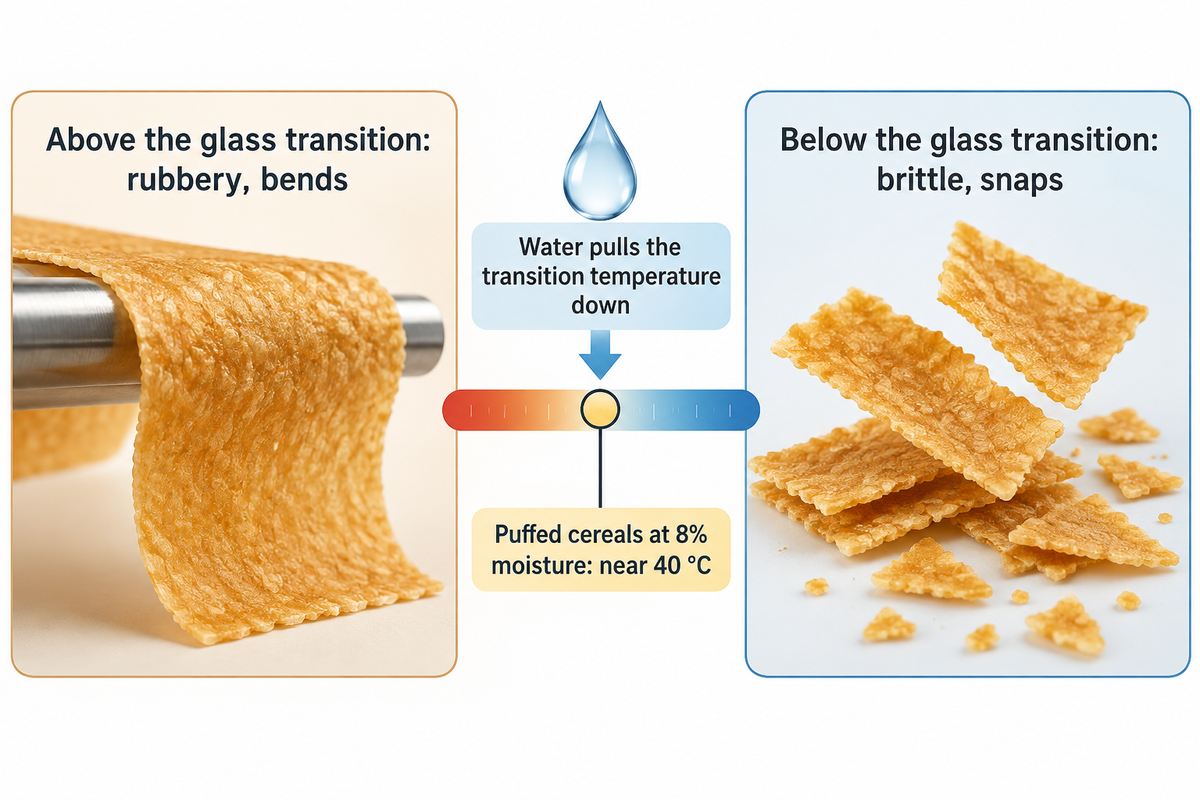
A warm feuilletine sheet bends because the sugar and starch are still above their glass transition, where the layer behaves like a rubbery solid rather than a brittle glass. Cooling takes it below that transition. Water pulls the transition temperature down, so a sheet that has picked up moisture can stay pliable even at room temperature.
That soft window, while a baked good is still hot, is something bakers have long used intentionally. Traditionally, crepes dentelles, the thin Breton caramelised crepes, were made by hand, the still-warm sheet rolled quickly around a wooden tool to form it into shape, as pastry author David Lebovitz describes the dentelle method. The same buttery sheet that rolls into a cigar at oven heat shatters upon cooling.
Setting the snap point is not just a function of temperature. The 2025 puffed-cereal study found fracture turning from brittle to ductile at about 8% moisture, and a model bread-crust study indexed in PubMed found that water content fixed the glass transition point while both water content and water activity changed how crisp tasters judged the crust. Uneven water content within the same sample left some regions crisp and others less crisp.
Why does feuilletine have to cool before crushing?
Feuilletine has to cool before crushing because hot sheets fold, smear and stick to crusher rolls instead of breaking along brittle cracks. Below the glass transition, sheets break into flat, flake-like pieces, with sharp edges. Crushing early also traps steam which is still exiting the product and softens the flakes as they come off the rolls.
The problem is compounded by under-baked zones because pale patches, which hold more moisture, stay pliable, while the rest of the sheet sets. If the sheet comes off the oven with uneven colour, address that first; our note on uneven crêpe dentelle baking covers the usual causes. Extra cooling can’t dry a patch that left the oven with excess moisture.
Puffed cereals holding 8% moisture had a glass transition near 40 °C in the 2025 study, so a feuilletine sheet that reaches 35 °C while still damp sits only 5 °C below the point where it turns rubbery again on a warm day.
How Long the Sheet Needs on the Cooler
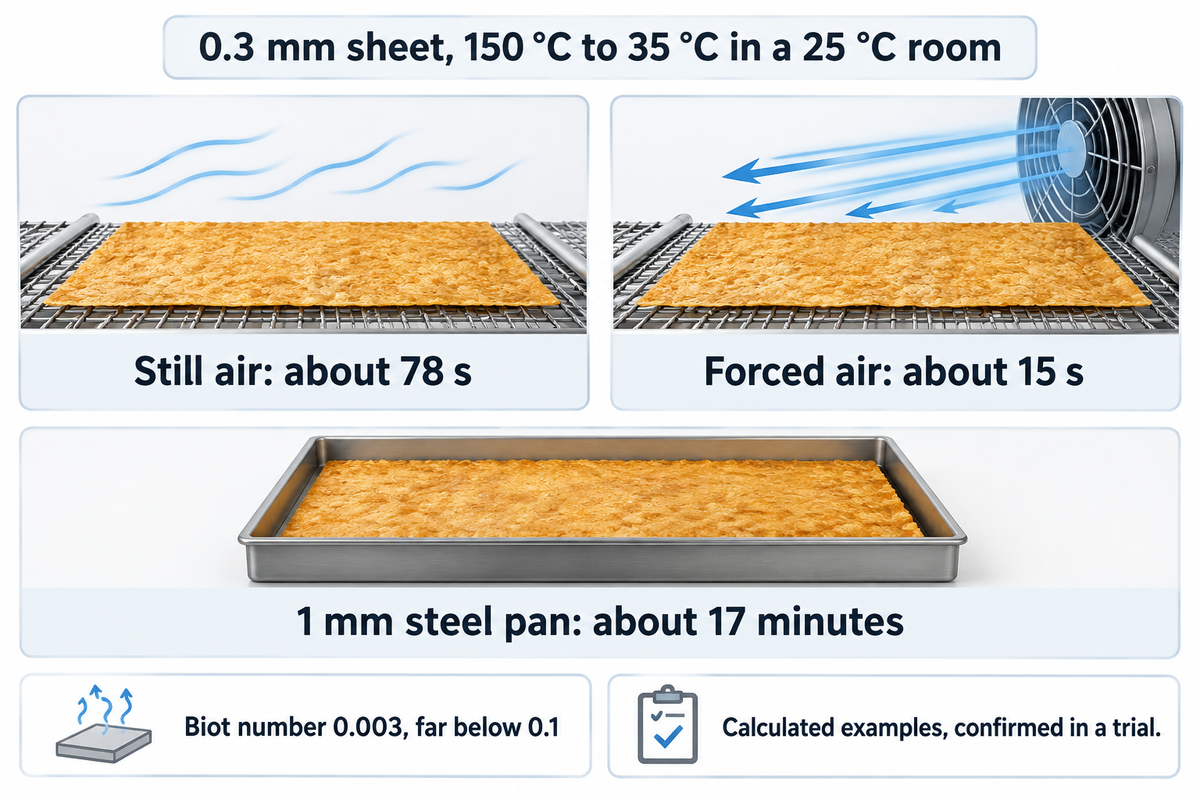
A feuilletine sheet of 0.3 mm thickness takes about 15 seconds of forced air or about 78 seconds of still air to fall from 150 °C to 35 °C in a 25 °C room, based on a lumped-capacitance estimate. Increased thickness of the sheet, increased density of the layers, and decreased airflow increase this time, and the reading at the crusher inlet sets the final length of the belt.
📐 Engineering Note
A thin sheet cooled on both faces of an open mesh belt behaves as one lumped mass when its Biot number, Bi = h·Lc/k, stays below 0.1, with Lc equal to half the sheet thickness. Its temperature then follows (T − Tair)/(Tstart − Tair) = exp(−t/τ), with time constant τ = ρ·c·Lc/h. Density, thickness and specific heat lengthen τ; a higher heat transfer coefficient shortens it.
Example, assumed inputs: density 1,076 kg/m³ and conductivity 0.494 W/m·K, the values reported for Mlinci dough during baking; specific heat 1,900 J/kg·K, inside the 1,875 to 1,942.7 J/kg·K measured for biscuit at 3 to 4% moisture and quoted on the ResearchGate record of the Kulacki and Kennedy cookie-dough property measurements; a 0.3 mm sheet; and h of 10 W/m²·K for still air or 50 W/m²·K for forced air, both inside the typical convection coefficients tabulated from Incropera. The Biot number is 10 × 0.00015 / 0.494 = 0.003, far below 0.1. The time constant is 1,076 × 1,900 × 0.00015 / 10 = 30.7 s. Cooling to 35 °C needs ln(125/10) = 2.53 time constants, so 30.7 × 2.53 = 77.7 s, about 78 s, in still air and 6.1 × 2.53 = 15.4 s, about 15 s, with forced air.
| Sheet thickness | Air condition (h) | Time constant | Time to 35 °C | Belt length at 2.4 m/min |
|---|---|---|---|---|
| 0.2 mm | Still air, 10 W/m²·K | 20.4 s | 52 s | 2.1 m |
| 0.2 mm | Gentle fans, 25 W/m²·K | 8.2 s | 21 s | 0.84 m |
| 0.2 mm | Forced air, 50 W/m²·K | 4.1 s | 10 s | 0.42 m |
| 0.3 mm | Still air, 10 W/m²·K | 30.7 s | 78 s | 3.1 m |
| 0.3 mm | Gentle fans, 25 W/m²·K | 12.3 s | 31 s | 1.3 m |
| 0.3 mm | Forced air, 50 W/m²·K | 6.1 s | 15 s | 0.63 m |
| 0.5 mm | Still air, 10 W/m²·K | 51.1 s | 129 s | 5.2 m |
| 0.5 mm | Gentle fans, 25 W/m²·K | 20.4 s | 52 s | 2.1 m |
| 0.5 mm | Forced air, 50 W/m²·K | 10.2 s | 26 s | 1.0 m |
The sheet speed in that table comes from the patent line’s drum: its 1,160 mm drum turns once every 90 seconds, so the sheet leaves at about 2.4 m per minute. To turn daily demand, hours and yield into the hourly flake mass a line must make, the feuilletine capacity planner does the arithmetic. The same equation also shows the figure in the kitchen. A 1 mm steel pan, using the steel values in the University of Illinois lumped-capacitance lecture (about 8,000 kg/m³ and 502 J/kg·K), cooling from one face in still air needs about 17 minutes to reach 35 °C, and a sheet resting on steel sheet pans stays warm until the pan cools.
What temperature should the sheet reach before the crusher?
The sheet should be at room temperature before it enters the crusher, and 35 °C or lower in a 25 °C room is a good starting point. This margin keeps it under the glass transition of 40 °C for cereals at 8% moisture. The final setpoint is determined by line trials and is measured on the surface of the sheet with an IR thermometer at the crusher inlet.
Read the product, not the air: in a tunnel that blows 20 °C air, a short belt can still deliver a 40 °C sheet, and a sheet that leaves the oven drier than usual can tolerate a warmer inlet. Setpoints found in winter can fail in a humid summer, so the hall temperature should be logged with the reading, and a winter setpoint can’t be reused unchanged.
Lumped-capacitance estimates put a 0.5 mm sheet at about 129 seconds in still air against 78 seconds for a 0.3 mm sheet, so a thicker deposit lengthens the conveyor a line must buy by roughly two-thirds before any airflow is added.
Ambient Conveyor, Forced-Air Tunnel or Spiral Cooler
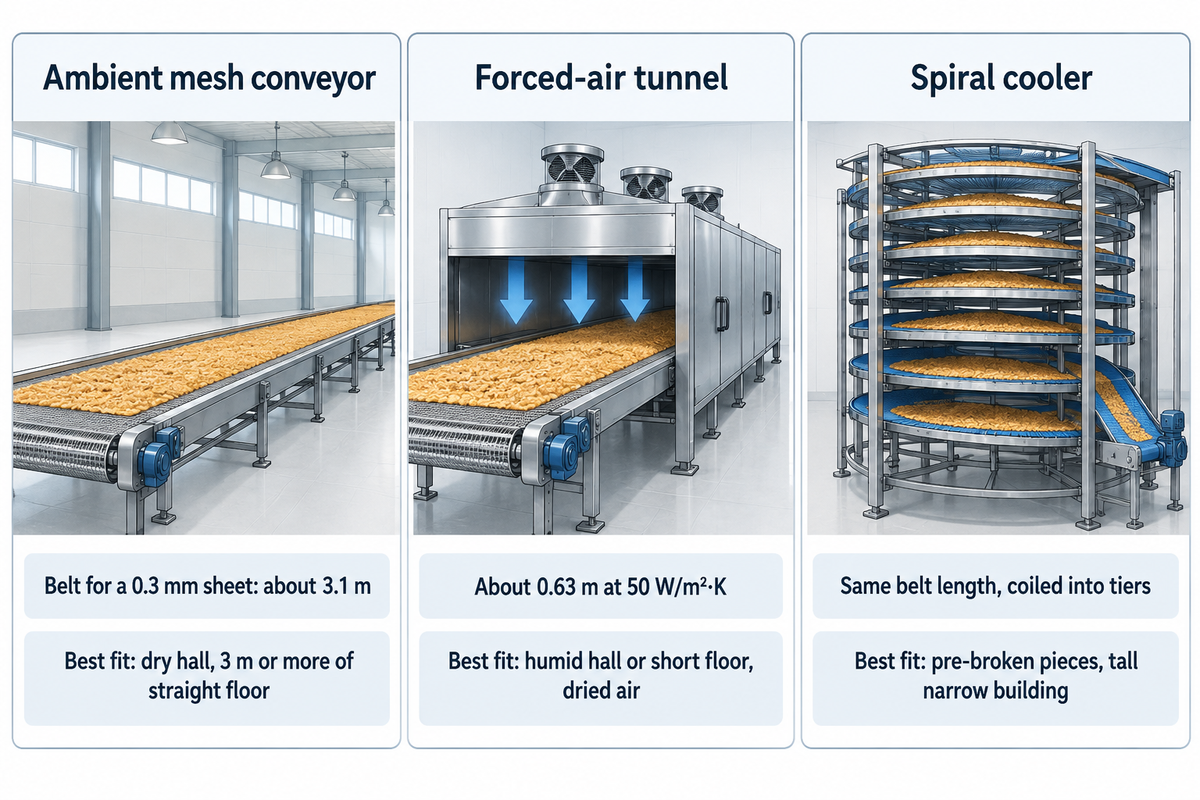
An ambient mesh conveyor suits most feuilletine lines, because a thin sheet cools in a little over a minute of still air; a forced-air section shortens the cooling time about five-fold; and a spiral saves space but curls the path of a brittle web. Choose based on the form the sheet is in, the straight length available, and the dew point of the ambient air.
“Water vapor condenses onto a surface when the temperature of the surface is at or below the dew point temperature.”
| Factor by cooler type | Ambient mesh conveyor | Forced-air tunnel | Spiral cooler |
|---|---|---|---|
| Air-side coefficient | 2–25 W/m²·K | 25–250 W/m²·K | Either, by fan design |
| Belt for a 0.3 mm sheet at 2.4 m/min | About 3.1 m | About 0.63 m at 50 W/m²·K | Same belt length, coiled into tiers |
| Sheet form handled | Flat continuous web or pieces | Flat continuous web or pieces | Pieces; a stiff web cracks on the turns |
| Air the sheet meets | Hall air as it is | Supply air you choose: hall, filtered or dehumidified | Enclosure air |
| Condensation risk | None from the cooler; the product stays above hall dew point | Appears only if supply air chills the sheet below hall dew point | Same rule as the tunnel |
| Moisture pickup on humid days | Highest: the sheet breathes hall air | Lowest with dehumidified supply air | Depends on the enclosure air |
| Cleaning access | Open belt, easiest to inspect | Hoods and ducts to open | Stacked tiers, slowest to inspect |
| Energy | Belt drive only | Belt drive plus fans, plus a dryer if used | Drive plus fans |
| Best fit | Dry hall, 3 m or more of straight floor | Humid hall or short floor, fed with dried air | Pre-broken pieces in a tall, narrow building |
The crêpe-flake line in JP2005124452A relies on natural cooling, as in the first column: the released sheet travels flat through a cooling section where natural cooling removes the heat and sets the sheet, and the patent adds that a fan may be fitted to speed it up. Cooled air is where processes go wrong. The National Weather Service defines the dew point as the temperature at which water vapour starts to condense out of the air, so the number to watch is the sheet’s surface temperature at the exit, not the air set point. Example: a tunnel that brings flakes to 18 °C in a hall with a 21 °C dew point wets every flake as it leaves. Fans and dryers also show up on the power bill, which the feuilletine energy cost estimator helps compare.
A forced-air cooling section is a mesh belt with fans that lift the air-side coefficient from the 2–25 W/m²·K of still air toward 25–250 W/m²·K; feed it room air or dried air, and keep the product warmer than the hall’s dew point when it leaves.
Moisture Pickup and Condensation Before the Crusher
Cooled feuilletine softens as it absorbs water from humid air: dry snacks lost sensory crispness at water activity 0.35 to 0.50 in Katz and Labuza’s 1981 study, which a later crisp-bread paper sums up as a gain of as little as 3 g of water per 100 g of dry matter. The air in the cooling and packing area is as critical as cooling time.
“Critical water activities (ac), where the products became organoleptically unacceptable, generally fell in the 0.35–0.50 aw range.”
Those products were potato chips, popcorn, puffed corn curls and saltines, so treat 0.35 as a ceiling to test against, not a promise. A crisp-bread study in the Polish Journal of Food and Nutrition Sciences found rye crisp bread absorbing about 6 g of water per 100 g of solids between water activity 0.274 and 0.560, and the fracture stress of rye and fibre crisp breads peaking at water activity 0.255 and 0.319 before they softened. Water activity is the ratio of a food’s vapour pressure to that of pure water and, as the FDA water activity inspection guide notes, it rises with temperature, so record the reading temperature with every result.
Those limits describe flakes in equilibrium with the surrounding air. A sheet that crosses a conveyor in under two minutes rarely gets that far; the gain builds at holding points, open totes and the interior of a pack. Measure water activity on flakes taken after your real hold time, not straight off the crusher.
Warm packing adds a second route for water. The American Society of Baking explains packaging temperature: wrapping an insufficiently cooled product leads to condensation inside the wrapper, and the water is reabsorbed and softens crispy products; bread is packed at 95 to 105 °F (35 to 40 °C) for that reason. Feuilletine is far drier, so it’s packed at room temperature. Wafer makers treat the hall air as part of the product; Loacker’s Heinfels plant uses ventilation stations to hold temperature and humidity in every production area, Snack Food & Wholesale Bakery reported.
Does feuilletine stay crunchy after it is packed?
Yes, feuilletine stays crunchy after packing when it goes into a moisture-barrier pack at room temperature, below its critical water activity, and the seal holds. Packed warm, it fogs the bag from the inside. Packed dry and sealed, it keeps its snap until it meets a wet filling such as cream, mousse or a soft ganache.
Pastry kitchens fold the flakes into melted chocolate or praline paste, where they stay crisp because fat carries almost no water, and sprinkled on a moist cake surface they go soggy fast. Flakes that have softened in an opened bag can be re-dried in an oven for about 5 minutes at 150 °C before use.
Crisp breads started to soften above water activity 0.255 and 0.319 in the Polish crisp-bread study, below the 0.35 to 0.50 band reported for chips and saltines, so a feuilletine line should set its own limit from retained flakes rather than borrow a snack figure.
The Bend-or-Snap Test at the Crusher Inlet
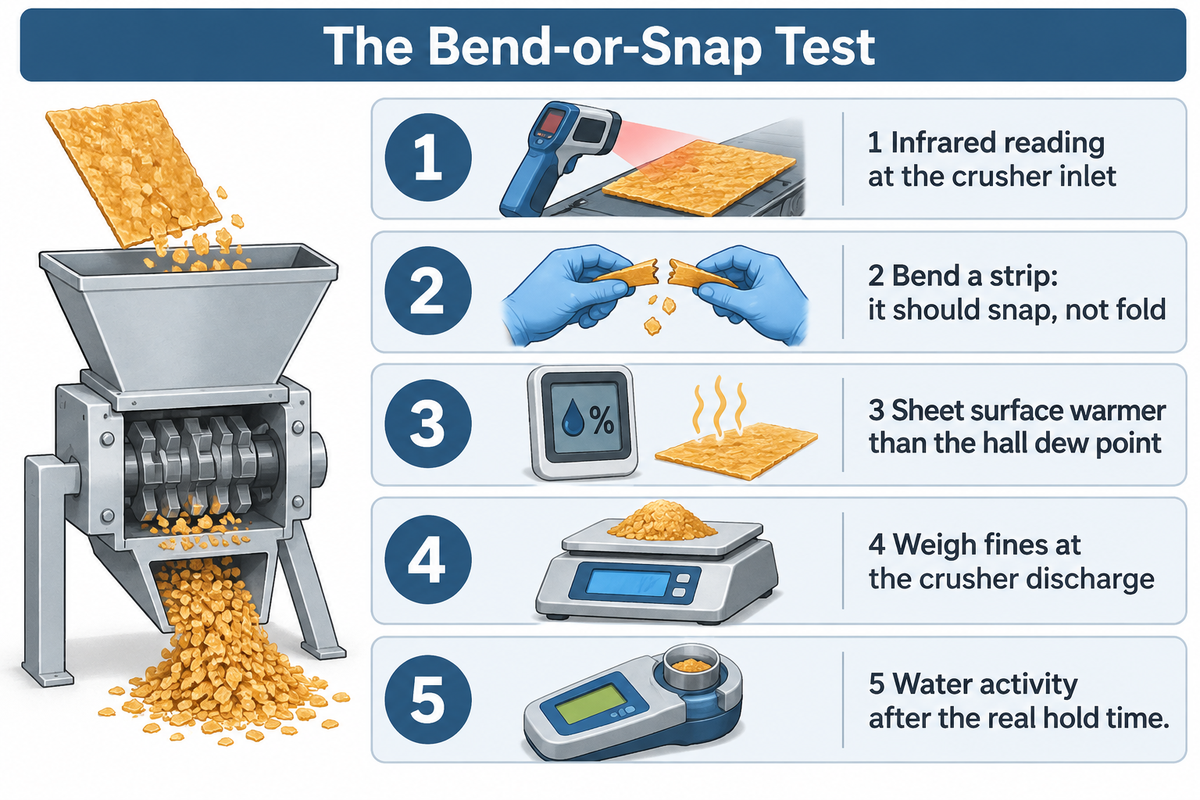
The Bend-or-Snap Test is a start-up check at the crusher inlet that shows if the sheet is cool, dry and brittle enough. The test has five readings. Four of them require an infrared thermometer, a hygrometer and a scale, and the fifth is a water activity test on retained flakes after the line has held the product for its normal time.
- Read the sheet surface with an infrared thermometer at the crusher inlet and compare it with the setpoint from your trial, starting at 35 °C or lower in a 25 °C room.
- Bend a strip taken just before the rolls; it should snap within a few degrees of bending, like the reference piece kept from the accepted trial, while a strip that folds is still rubbery.
- Check the dew point margin by reading the hall’s dew point on a hygrometer and confirming that the sheet surface stays warmer.
- Weigh the fines in a sample from the crusher discharge, using the screen and limit agreed in the trial.
- Test retained flakes for water activity after the real hold time, against the limit set from your own product.
The hand snap catches a rubbery sheet, and the scale catches crusher fines. In three-point bending tests on short-dough biscuits, published in the Journal of Texture Studies in 1997, biscuits fractured at small strain, but fracture strain changed with strain rate. A strip that snaps between two fingers can still shed more fines under fast crusher rolls, which is why step 4 weighs the crusher’s output directly.
Take an infrared reading of 35 °C or less, a clean snap, a positive dew point margin, weighed fines shares, and retained flake water activity, on a sample taken at startup and after any change in hall humidity or sheet thickness.
Keeping Flakes Whole from Crusher to Pack
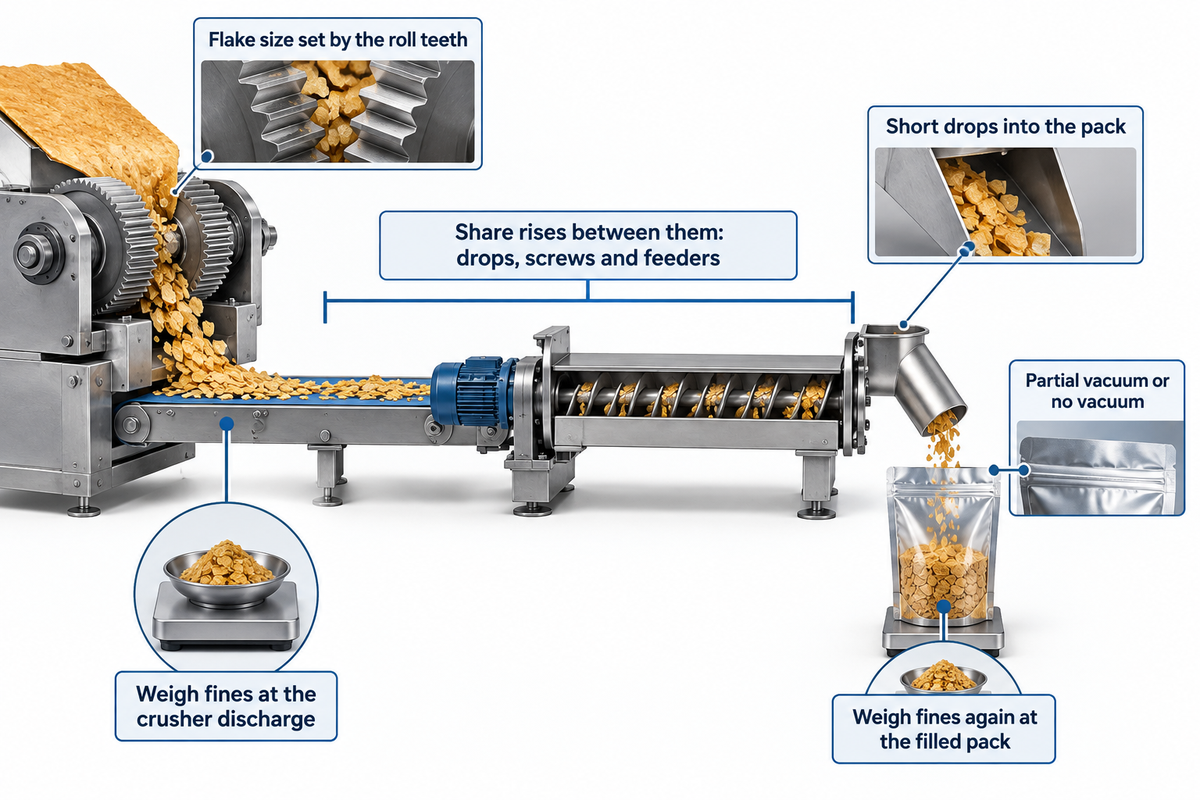
Most of the flake size paid for by the buyer is set at the crusher, but can change after that point as transfers grind the flakes further. Take the fines share at two points, the crusher discharge and the filled pack, before changing the crusher setting; an increase in the share between the two suggests the loss occurred in drops, screws and feeders, not the rolls.
The patent line breaks the cooled sheet with a pair of toothed crush rolls that cut it to a set size. Crushing completes the process in the same continuous run as baking and cooling. A sheet that arrives warm and/or damp folds over and tears, and the edges crumble off. A properly set sheet, under the right roll settings, results in a clean break. Size limits vary, and are set by the finished product; e.g. a praline paste layer for textural contrast and an ice cream topping each need their own flake or chunk size, confirmed in an application test. Roll settings outside the window, e.g. rolls with the wrong tooth size, can be caught during line trials, so write the size limits into your product specification.
Packing can crush the flakes a good crushing step created. Full vacuum packing can crush thin flakes, so pull a partial vacuum or no vacuum and let the moisture barrier do the work. Short drops into the pack help as well. Our egg roll and wafer process guide shows how a thin baked sheet transfers from the baking surface into forming.
Paired meshing crush rolls in JP2005124452A cut a cooled flat crêpe sheet into flakes of a size fixed by the roll teeth in one pass, so an increasing fines share after the crusher points to transfers rather than roll settings.
What to Ask a Line Supplier to Prove in a Trial
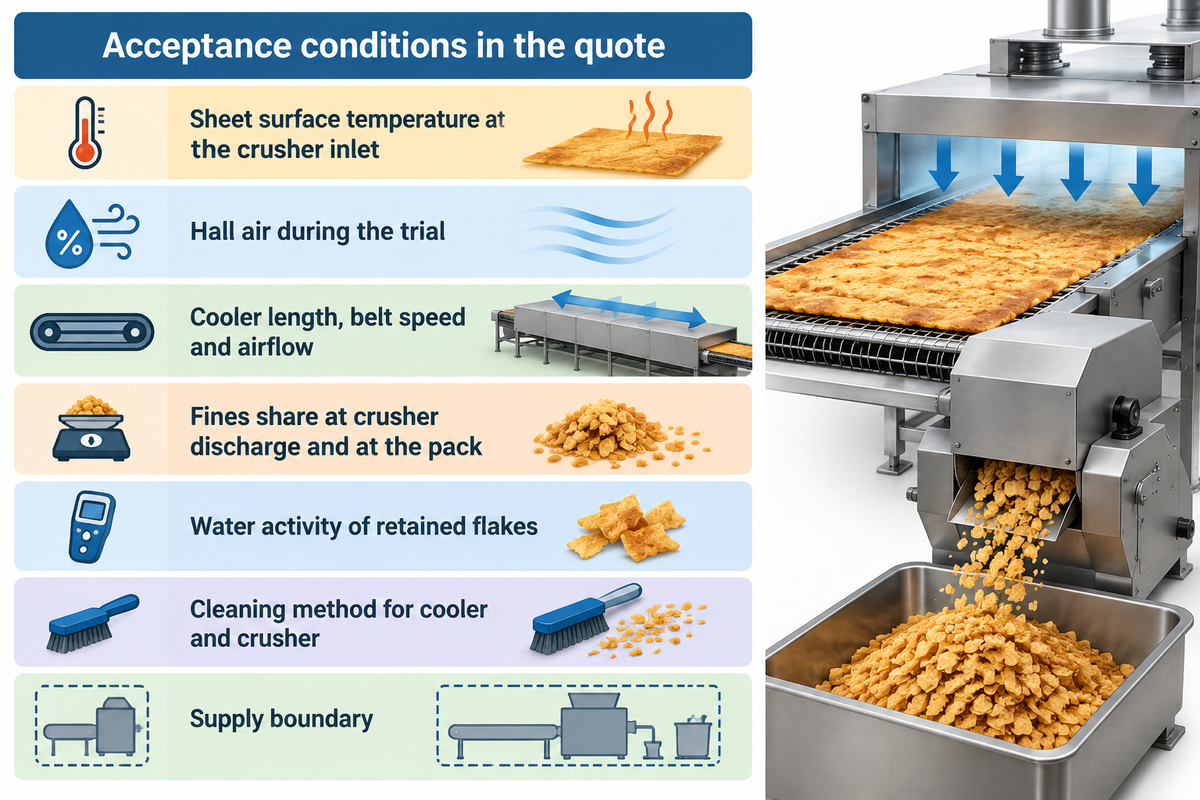
A supplier must provide proof, with your recipe and your hall’s air, that the cooling section of the production line delivers a sheet at or below the agreed inlet temperature, that the crusher meets the agreed fines share, and that the packed flakes hold their water activity limit after the real hold time. Each must be in the quote as an acceptance condition.
UDTECH’s feuilletine production line page lists the YT-10 baking unit with 60 molds, 9.8 m × 1.6 m × 1.9 m and 3 kW of electrical power for the baking unit, and defines utilities and downstream handling in the quotation, with the cooling and flaking sequence listed as an item to define. Run the trial the way our food product scale-up process guide describes: one recipe revision, named sampling points and a written result. Use the checklist below in your request for quote.
RFQ checklist for the cooling and crushing section; copy these into your quote request:
| Parameter | Recommended range | Why it matters | How to verify |
|---|---|---|---|
| Sheet surface temperature at the crusher inlet | 35 °C or lower in a 25 °C hall, or the trial setpoint | Starting margin below the glass transition, confirmed by the snap test | Infrared readings every 15 minutes over a full shift |
| Hall air during the trial | Recorded dry-bulb temperature and dew point at the cooler | Sets moisture pickup and condensation risk | Hygrometer log attached to the trial report |
| Cooler length, belt speed and airflow | About 3.1 m still air or 0.63 m forced air at 2.4 m/min for a 0.3 mm sheet, the patent drum line’s speed; use the quoted line’s speed | Fixes the seconds of cooling the sheet gets | Layout drawing plus measured belt speed |
| Fines share at crusher discharge and at the pack | Agreed in the trial, % by mass at both points | Shows whether loss happens in crushing or handling | Weighed screen samples at both points |
| Water activity of retained flakes | Below the limit set from your product, at or under 0.35 as a starting ceiling | Decides how long the flakes stay crisp | Water activity meter after the real hold time |
| Cleaning method for cooler and crusher | Dry-cleanable belt and rolls with swab access points | Keeps water out of the driest product zone | Design review plus a cleaning demonstration |
| Supply boundary | Named list: cooler, crusher, screen, conveyors, packer interface | Stops gaps between quoted units | Equipment list in the quotation |
What’s Changing: FDA’s 2025 Draft on Low-Moisture Sanitation
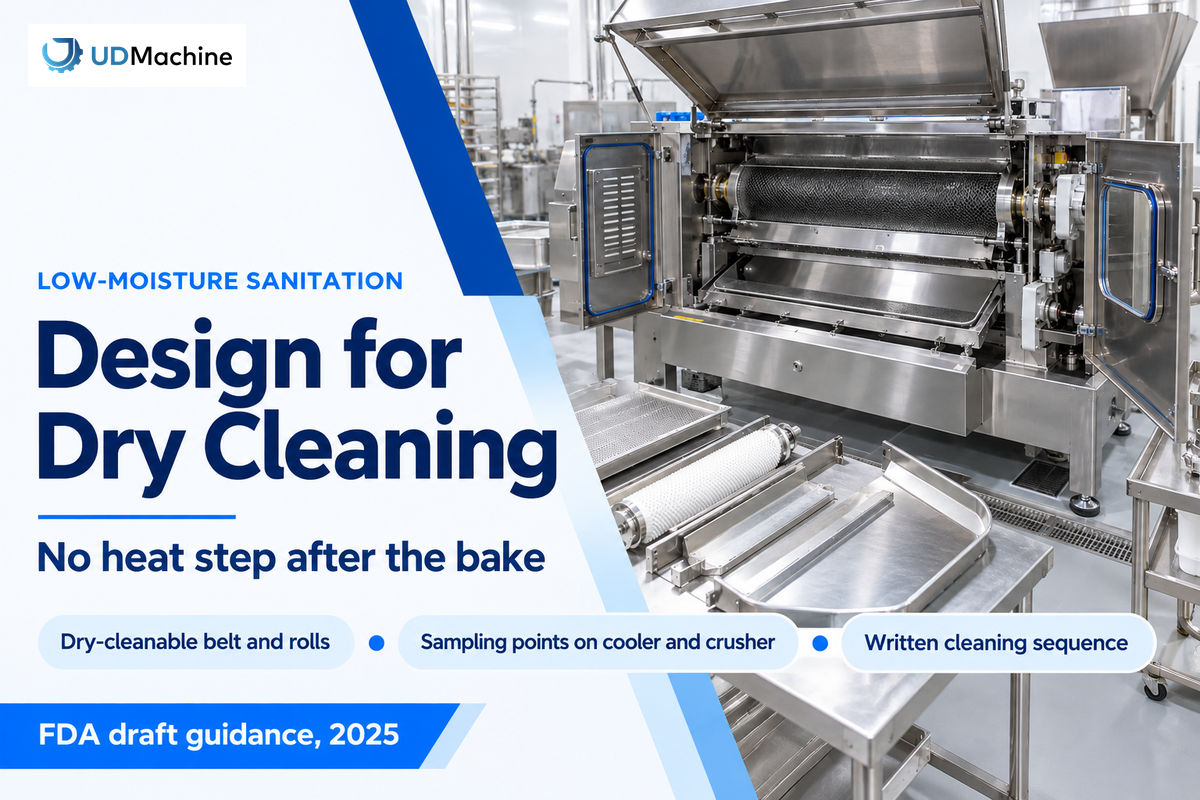
For lines that supply the US market, one document worth reading before specifying a cooler and crusher is the US Food and Drug Administration’s draft guidance on sanitation programs for low-moisture ready-to-eat foods, published on 6 January 2025 with its comment period reopened on 29 May 2025. The draft guidance gives examples including snack foods such as chips and crackers and dry cereal. Feuilletine flakes are dry and ready to eat, so they would likely fall in this category of low-moisture foods.
The FDA draft guidance on low-moisture ready-to-eat sanitation (docket FDA-2024-D-2604) is written to help manufacturers comply with 21 CFR part 117. It covers a routine sanitation program with environmental monitoring, root cause investigation after a pathogen contamination event, sanitizing treatment of food-contact surfaces, identifying affected food, and the limits of relying on product testing alone. Draft guidance states FDA’s current thinking rather than binding rules.
For a feuilletine line, location is everything. After the bake, there’s no further heat step, so the cooling belt, crusher rolls, and all transfers to the pack are open, food contact surfaces of a dry, ready-to-eat product. These are the areas that a sanitation program would swab and clean, and are located in the zone of the product most sensitive to water. EHEDG Guideline Doc. 43 on hygienic belt conveyors (2016), written for plants where wet cleaning is mandatory, treats belt type and cleanability as design choices; for a dry feuilletine zone, agree the dry-cleaning method in the quotation.
When specifying a line in 2026, request three things in the quotation: belt and roll surfaces that can be dry-cleaned and inspected, environmental monitoring sampling locations along the cooler and crusher, and a written cleaning procedure to leave the belt dry before production restarts. Each of these requests will cost little to no extra at the time of purchase, and a great deal to retrofit once the equipment is built.
Frequently Asked Questions
What are feuilletine flakes?
Feuilletine flakes are thin, crisp fragments of baked crêpe dentelle, a caramelised crepe sheet made from flour, sugar, butter and egg white and broken after cooling.
Pastry chefs use them for crunch in praline layers, chocolate bars, entremets and ice cream toppings, and commercial packs are sold as pailleté feuilletine or paillete feuilletine. The flakes are brittle because the sheet is baked dry and cooled below its glass transition before it is crushed. They soften once they absorb water from the air or from a filling.
What is the basic feuilletine recipe?
The basic feuilletine recipe uses egg white, powdered sugar, flour and melted butter, spread very thin and baked golden brown.
Bake it in a preheated oven at 350 to 400 °F for about 4 to 6 minutes on a silicone mat or parchment paper, let the sheet cool completely, crumble it and keep it in an airtight container. Some versions add vanilla, salt, baking soda or molasses for colour and flavour. Scaled up, the same batter is the reference sample a line trial should match.
Can you cool feuilletine in the fridge?
No, cool feuilletine at room temperature in dry air; the fridge leaves it colder than the kitchen’s dew point, so it collects condensation when it comes out.
Water condenses on any surface at or below the dew point of the surrounding air, and a cold container taken into a warm room fogs over almost at once. Feuilletine absorbs that water and loses its snap. When flakes must go into a chilled dessert, coat them in melted chocolate first so the fat keeps moisture away from the crisp layer.
Is feuilletine the same as a wafer?
No, feuilletine is a crisp crêpe sheet broken into flakes, while a wafer is baked between plates into a flat sheet for layering.
Wafer sheets are usually filled with cream and cut into bars.
Why can’t you use ground-up puff pastry instead?
You can, but it won’t behave like feuilletine: ground puff pastry gives laminated, buttery crumbs rather than thin caramelised sheets.
Puff pastry rises in many separate layers as steam lifts the folded dough, and the crumbs break into irregular, flaky shards with a pastry flavour. Feuilletine is a single thin baked layer with caramelised sugar, so each flake is flat, glassy and light. Crushed puff pastry also carries more fat per gram, which changes how it behaves inside chocolate or praline paste.
How long do feuilletine flakes stay crisp in an airtight container?
About one to two weeks: homemade flakes in an airtight container stay crisp that long at room temperature, less in humid climates.
Re-dry soft flakes for about 5 minutes at 150 °C.
What makes feuilletine go soft in a cake or ganache?
Water from the filling softens feuilletine: a moist cake surface, cream or mousse turns it soggy, while chocolate and nut paste keep it crisp because fat carries little water.
Mix the flakes into praline paste or melted chocolate before layering, keep them away from wet creams and curds, and add them as late as the recipe allows. In chilled desserts, condensation inside the fridge or freezer also reaches the flakes, so the fat barrier matters there as well.
Planning a feuilletine line? Send your recipe, target flake size and hall conditions, and the UDTECH team will review the baking unit and mark which cooler and crusher items fall inside the quoted scope and which stay as trial items, so you can test the proposal against the checklist above.
About This Analysis
This guide combines a lumped-capacitance cooling estimate built from published property data for thin baked dough, crispness thresholds from food-science studies and the drum-line layout in patent JP2005124452A. The cooling times are calculated examples; each line confirms its own crusher-inlet setpoint and water activity limit in a trial with its feuilletine recipe. Prepared for buyers of Suzhou UDTECH Technology Co., Ltd. lines; each figure is traced back to the sources listed below.
Related Articles
References & Sources
- Köklü et al., Effects of Wafer-Baking Plates on Thermal Distribution, Wafer Thickness and Colour (2025), Applied Sciences
- JP2005124452A, Method for producing crepe flake and apparatus therefor, Japan Patent Office publication
- Mechanical and Thermal Properties and Moisture Sorption of Puffed Cereals (2025), Foods, via PubMed Central
- Crêpes Dentelle Cookies (Gavottes), David Lebovitz
- Water content or water activity: what rules crispy behavior in bread crust?, PubMed
- ME320 Lecture 12, Lumped Capacitance, University of Illinois Urbana-Champaign
- Transient Heat Transfer, Convective Cooling or Heating, MIT Unified Engineering notes
- Measurement of the thermophysical properties of common cookie dough, Kulacki and Kennedy record
- Typical values of the convection heat transfer coefficient, Michigan Technological University
- FAPC-203 Strategies to Reduce Moisture Condensation in Food Facilities, Oklahoma State University Extension
- Dry Bulb, Wet Bulb and Dew Point Temperatures, US National Weather Service
- Katz and Labuza, Effect of Water Activity on the Sensory Crispness and Mechanical Deformation of Snack Food Products (1981), University of Minnesota
- Relationship between water activity of crisp bread and its mechanical properties, Polish Journal of Food and Nutrition Sciences
- Inspection Technical Guide: Water Activity (aw) in Foods, US Food and Drug Administration
- Packaging Temperature, American Society of Baking
- Loacker adds third plant in Heinfels, Austria, Snack Food & Wholesale Bakery
- Baltsavias, Jurgens and van Vliet, fracture properties of short-dough biscuits (1997), Journal of Texture Studies
- Draft Guidance: Establishing Sanitation Programs for Low-Moisture Ready-to-Eat Human Foods, US Food and Drug Administration
- Conveying Clean: EHEDG Conveyor Guideline Offers Hygienic Best Practices, EHEDG press report