Get in touch with UDTECH Company

Industrial Egg Roll and Wafer Roll Machines
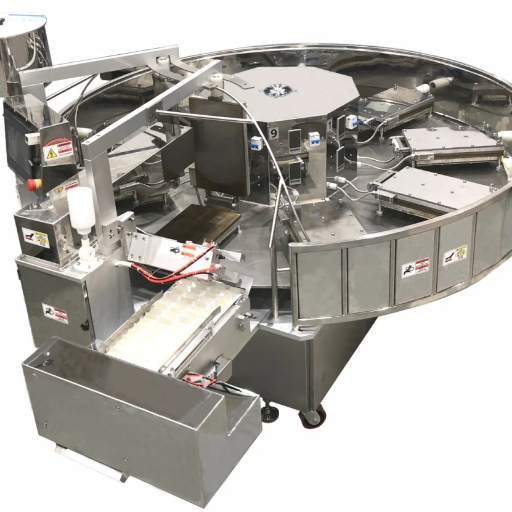
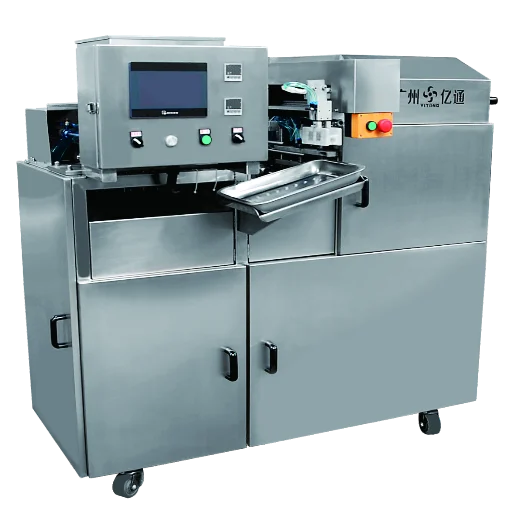
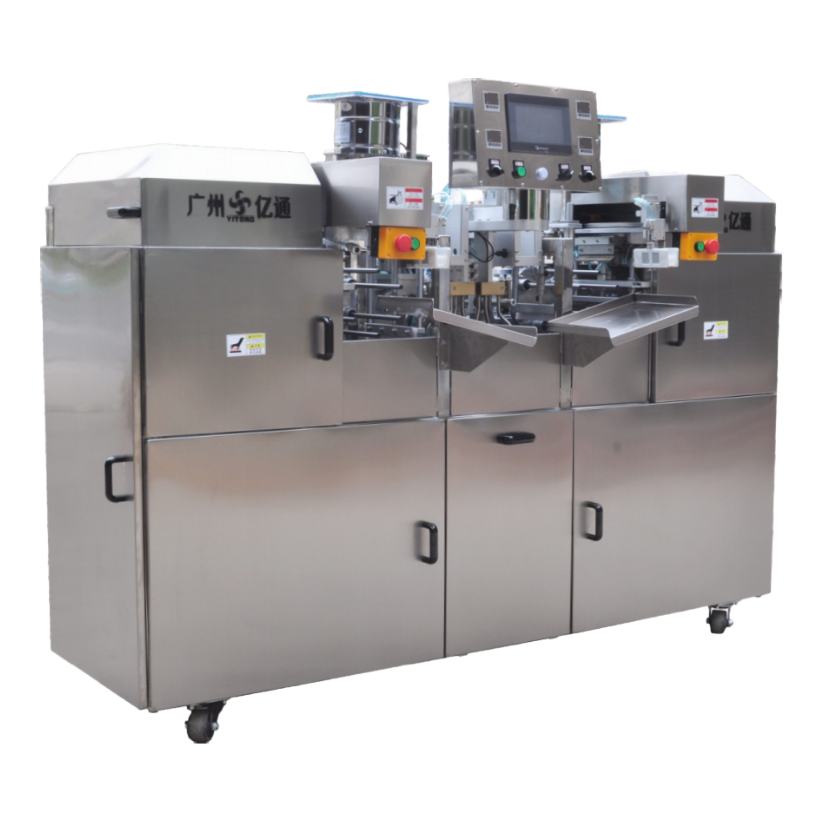
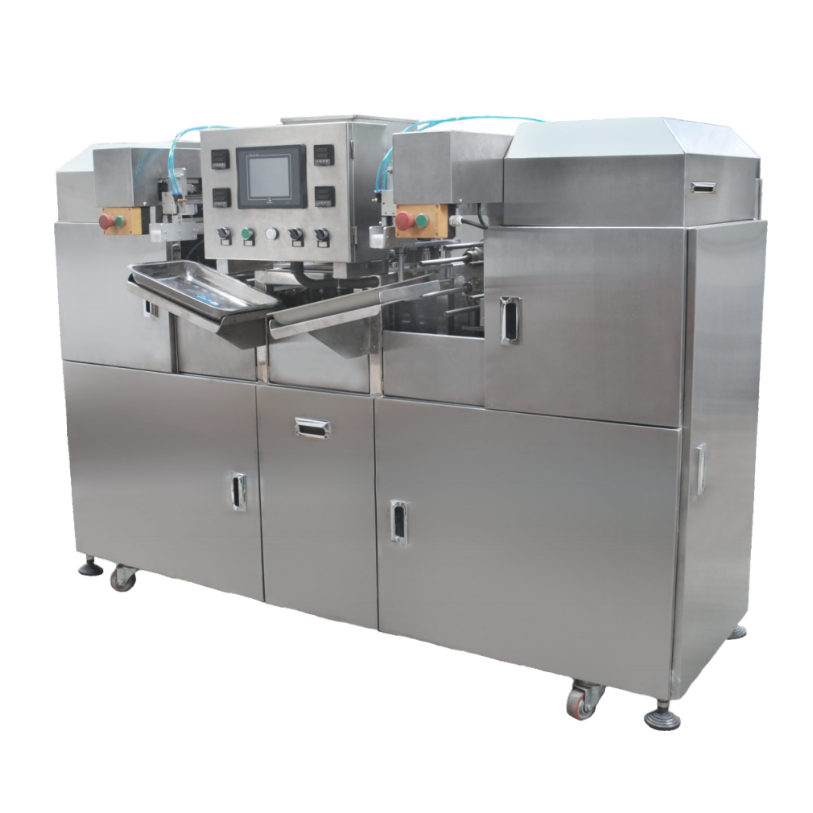
Three different machines are sold under the name egg roll machine, but only one bakes a fine batter sheet and rolls it while hot. UDTECH makes the one that does, in two types: rotary multi-mould machines and gas-fired continuous lines for sweet rolled wafer biscuits. Settle which class your finished article needs first, then match a model to a target output.
- Rotary machines from 125–175 kg per day to 1,100 pieces per hour
- Gas-fired lines at 220 and 330 pieces per minute
- 380 V three-phase, compressed air 0.2 m³/min above 0.6 MPa
- Production in 60 days after the deposit clears
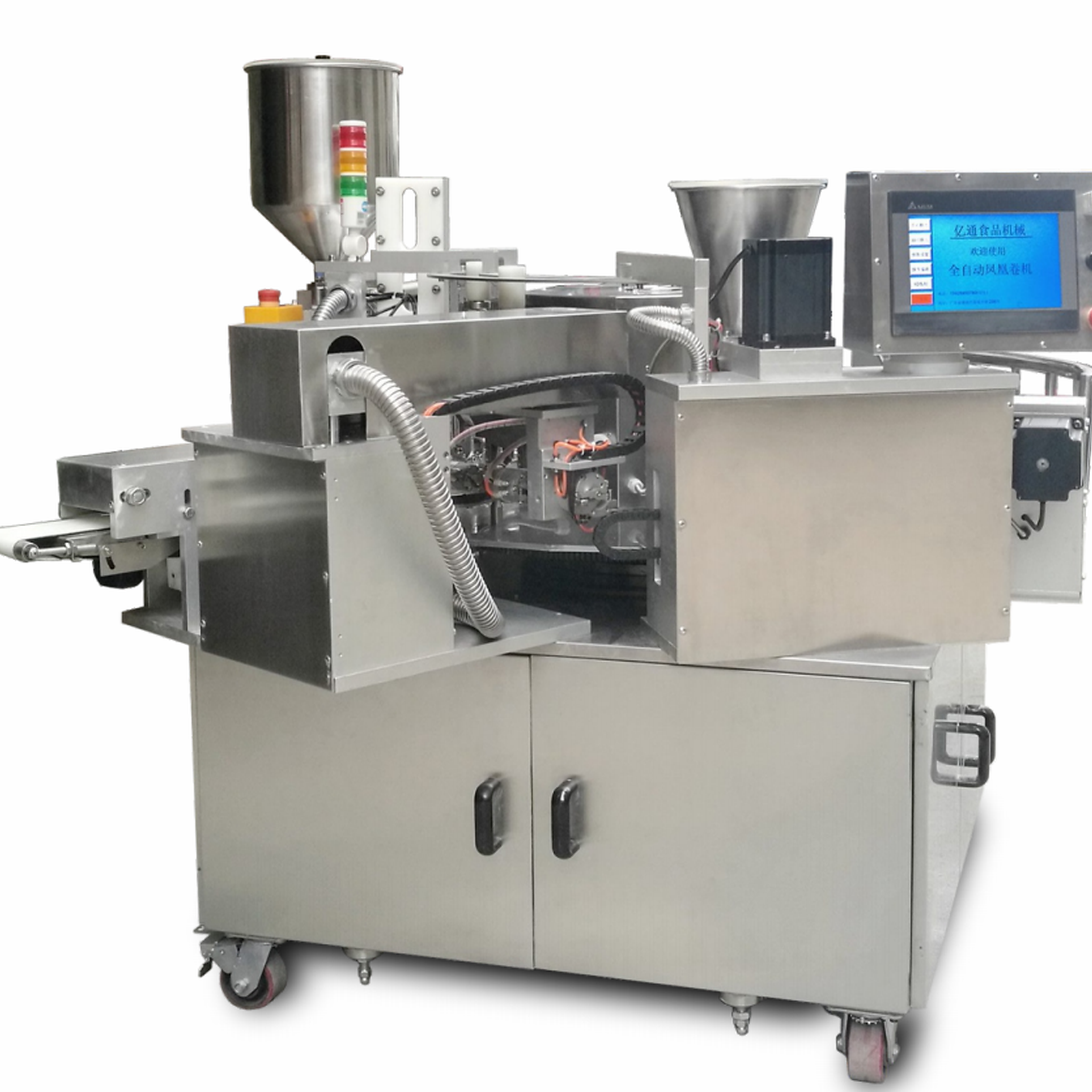
Settle the Machine Class First
Send a photograph and the finished dimensions of the roll you want to make and we will name the machine family that produces it.
- Rotary output
- 500–600 pieces per hour on the nine-mould YT-02DJ, which the workbook also states as 18 kg/h
- Continuous line output
- 220 pieces per minute on the YT05-2 and 330 pieces per minute on the YT05-3
- Hand-style output
- 125–175 kg per day on the YT-06 and 250–350 kg per day on the YT-12
- Electrical supply
- 380 V three-phase throughout; connected load 5.8 kW on the two-mould YT-06 up to 24 kW on the nine-mould YT-02DJ
- Utilities
- Compressed air 0.2 m³/min above 0.6 MPa; the YT05 lines run on natural gas or LPG
- Commercial terms
- One machine is a complete order, 60 days production, 40% by T/T on order confirmation
These are the figures a buyer needs before anything else, each stated in the unit the UDTECH quotation workbook or the 2025 brochure uses: pieces per hour on the rotary machines, pieces per minute on the continuous lines, kilograms per day on the hand-style machines. Converting between them silently is where a capacity comparison goes wrong, and a unit mismatch is the commonest reason two quotations look comparable when they are not.
Three Different Machines Are Sold as an Egg Roll Machine
Buyers cannot tell whether a machine makes their article, because the same three words apply to a baked wafer roll, a fried savoury wrapper and a consumer kitchen gadget. Six of the ten top-ranking results for the head term are domestic egg cookers. The three classes are not interchangeable, and settling which you require costs three checks.
A batter sheet baked on a hot plate then rolled while flexible, or a cold pastry sheet folded around a filling then fried afterwards.
Pieces, or kilograms. Sweet rolled wafers weigh 5–15 g each; a savoury spring roll weighs several times that.
Injected into a hollow roll after baking, or wrapped inside the product before being cooked.
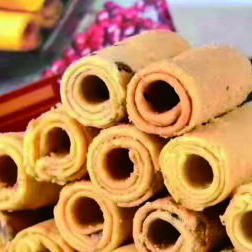
| Machine class | Forming principle | Output unit vendors publish | Finished piece | Built by UDTECH |
|---|---|---|---|---|
| Rotary multi-mould baked roll machine | Batter deposited on a heated plate, baked, folded and rolled hot at a rotating station | Pieces per hour, sized by mould count | Crisp hollow roll, 5–15 g | Yes, the YT-02 and YT-12 families |
| Continuous gas-fired baked roll line | Batter baked on parallel lanes, cored and roll-formed in line | Pieces per minute, plus kilograms per 8-hour shift | Crisp roll with an optional injected core | Yes, the YT05 lines |
| Savoury wrapper and spring roll machine | A cold sheet folded around a filling, fried after forming | Pieces per hour with a stated filling weight | Filled savoury roll; one published model runs 65 g a piece | No |
If the answer is a fried savoury product, then this particular rolling machine class is not the correct one and the remainder of this page is not going to be helpful. If the answer is a baked sweet roll below approximately 350 kg a day, the rotary family is suitable. Above that threshold, or where a cream centre is part of the final article, the gas-fired lines are the correct conversation.
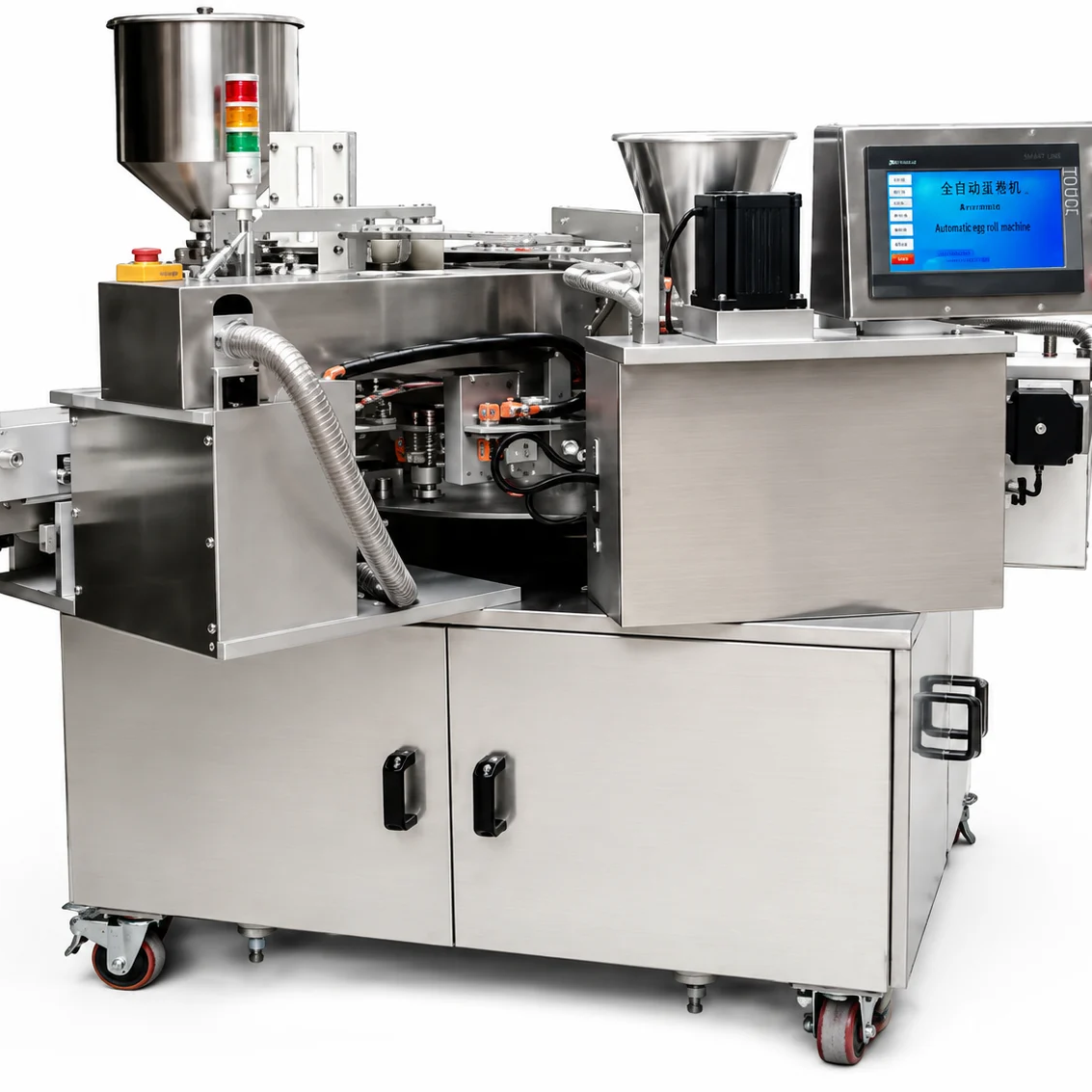
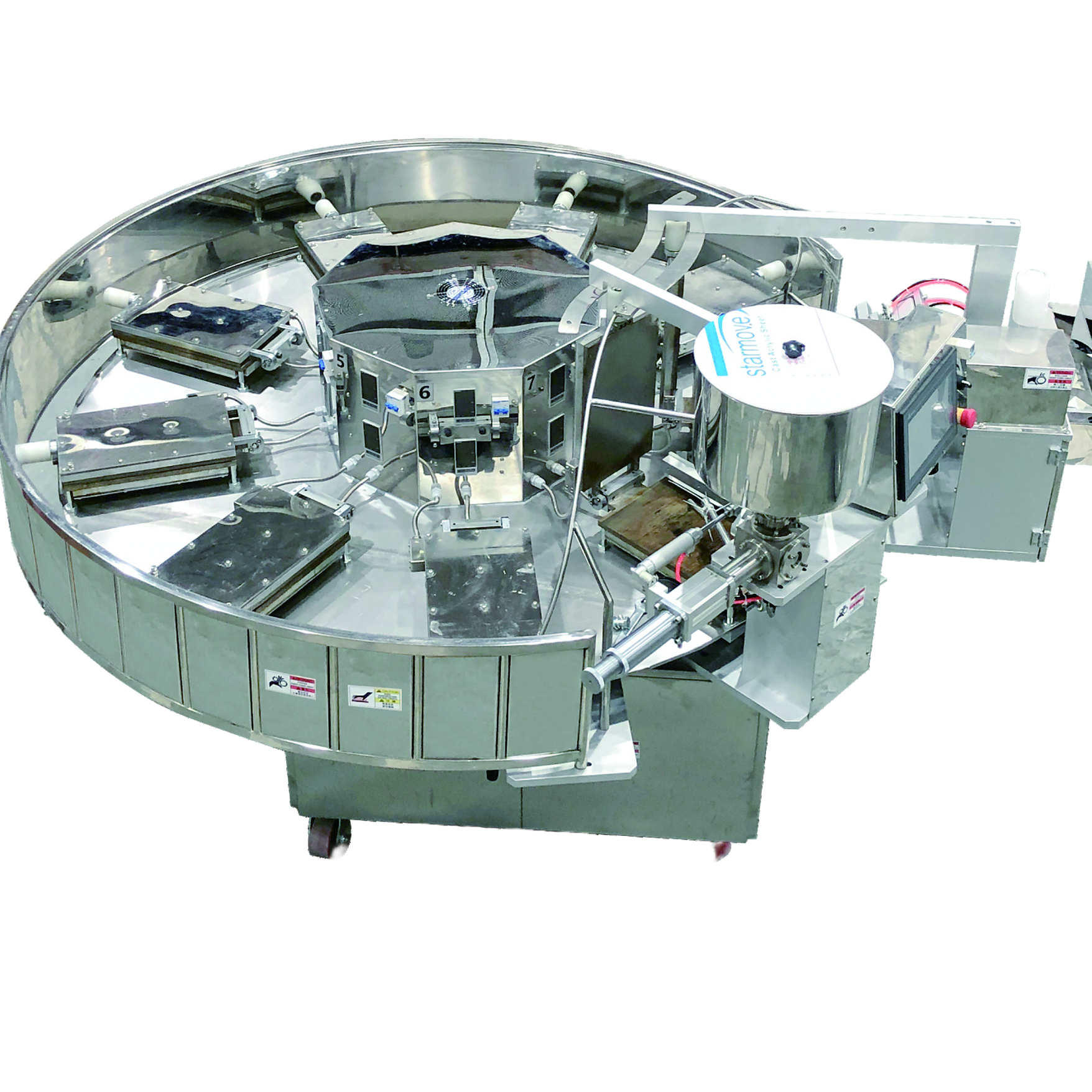
UDTECH Rotary Egg Roll Machine Family
Mould count is the sizing unit across this whole category, from two-mould counter machines to sixty-tong lines. Figures come from the UDTECH quotation workbook dated 22 April 2026.
Suits Bakery counters, tourist-site kitchens and pilot lines where the production is watched by the customer
Suits The same product as the YT-06 at roughly double the daily output, on the same depth of floor
Suits The highest-output rotary machine in the range, and the only one offered in three builds: standard, with cutting, and with cutting plus sesame seeding
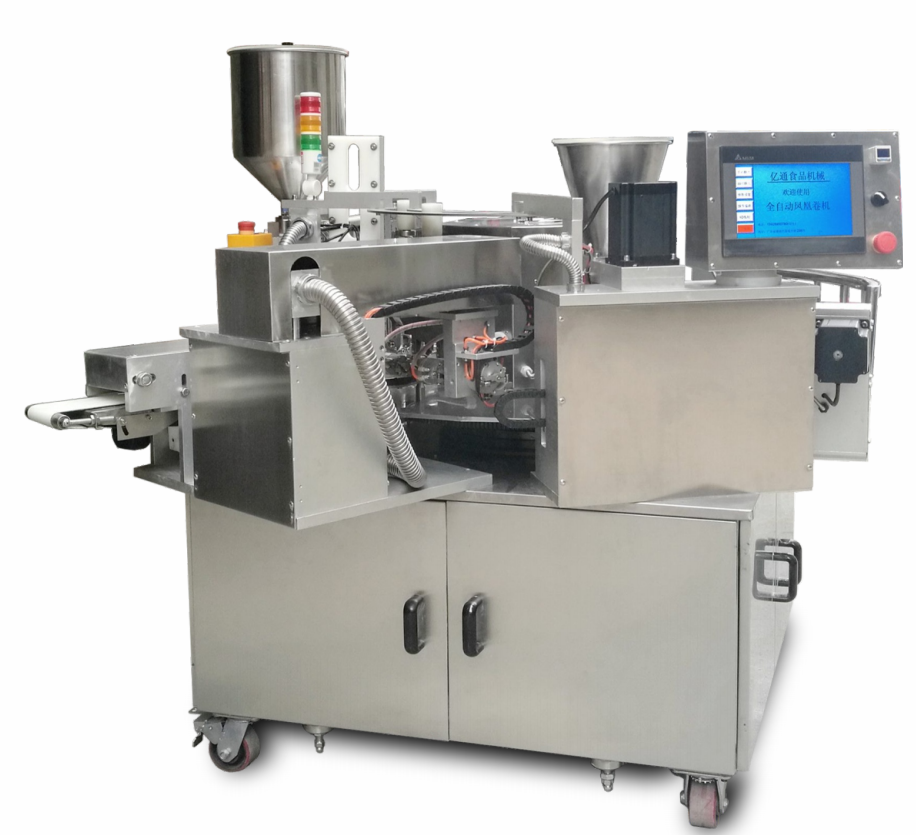
Suits Composite rolls where a seaweed sheet is laid at the first station before the batter is deposited
Suits Snack plants and chain bakeries making a seaweed-and-egg-roll composite as a distinct product line
Suits Soft waffle discs rather than crisp rolls: the mould opens and the piece is discharged flat, with no rolling station
Another format
Send a photograph, the finished length and diameter, and the weight of one piece. We confirm which family produces it and what changes in the build, in writing with the quotation.
- Bake time per piece does not change: nine moulds bake nine pieces in the time two moulds bake two, so a larger machine buys you parallelism and gains nothing for speed.
- Plate temperature uniformity becomes the controlling variable, because the YT-02DJ carries nine separate 2.5 kW heating circuits and a drift on any one of them shows up as a colour and crispness difference in that mould's output rather than as a machine fault.
- Batter consistency must be held over more stations simultaneously, and a deposit volume and viscosity control that a two-mould machine could gloss over becomes very obvious at nine.
- Idle moulds still take heat, so a machine bought for a peak you have not reached yet costs you that energy every hour it runs below capacity, which is the argument against sizing for a forecast.
| Your target output | Model that matches it | Information we need |
|---|---|---|
| Up to 175 kg per day, one operator | YT-06, two moulds | Piece length and diameter, and whether the machine sits in view of customers |
| 250–350 kg per day | YT-12, four moulds | Working hours per day, so the daily figure can be read against shift length |
| 500–600 pieces per hour, cut to length | YT-02DJ, nine moulds, cutting build | Finished roll length and whether sesame seeding is wanted at the same station |
| Around 780 pieces per hour with a seaweed layer | YT-02 phoenix roll machine | Seaweed sheet size and supplier format |
| 1,100 soft waffle pieces per hour | YT-02H, eight moulds | Disc diameter, thickness and target moisture of the finished piece |
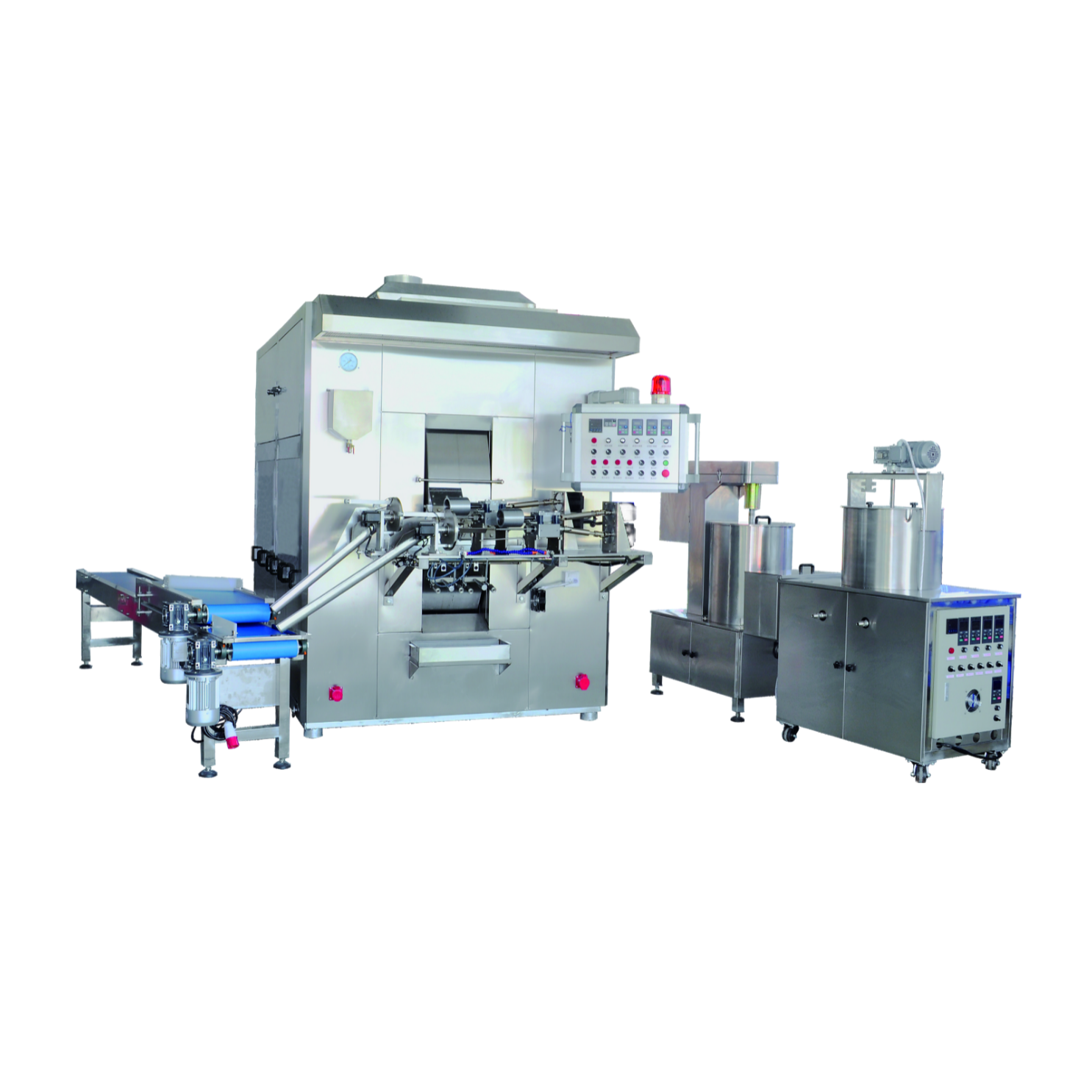
| 600–900 kg per 8-hour shift with an injected core | YT05-2 or YT05-3 gas line | Fuel available at the site, filling recipe and its viscosity, and ceiling height for the flue |
Finished Formats, Cutting, Filling and Seasoning Options
Each option is built-in at quotation, not field retrofit, as the station is an integrated part of the machine assembly.
| Option | How it is produced | Machines that offer it | Effect on the finished piece |
|---|---|---|---|
| Hollow crisp roll, standard | Batter deposited, baked, folded and rolled hot while the sheet is still pliable | All rotary models and both YT05 lines | An empty tube whose wall thickness is set by batter deposit and plate gap |
| Cutting to length | An in-line cutting station after roll forming | YT-02DJ cutting build; both YT05 lines | Roll length becomes a specification you choose rather than a consequence of the mould |
| Sesame seeding | Seed applied in line on the same pass as cutting | YT-02DJ cutting and sesame build | Surface seeding without a second handling step or a manual station |
| Core injection | Filling injected into the tube on the line, before the roll cools and hardens | YT05-2 and YT05-3 | A cream-filled roll; piece weight rises and the shell carries less of the eating quality |
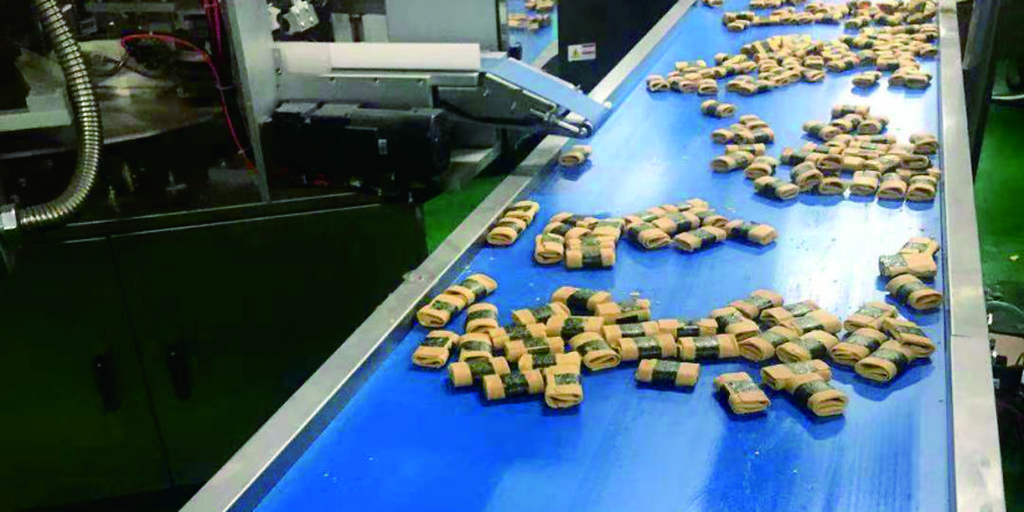
| Seaweed layer | A seaweed sheet placed at the first rotating station before batter deposit | YT-02, YT-02D and YT-12HT | A composite roll with the sheet bonded during baking rather than wrapped afterwards |
| Soft waffle disc | Deposit, bake, open the mould and discharge; no folding or rolling station | YT-02H | A flat soft product rather than a crisp tube, from the same rotary architecture |
Egg Roll Machine Specifications and How to Compare Them
You cannot compare capacity across vendors in this category, because the units do not convert into one another.
Two Formulas That Make a Quoted Capacity Comparable
FORMULA 01
Piece weight (g) = stated kg/h × 1000 ÷ (stated pieces per minute × 60)
A machine quoted in both units implies a piece weight, and that number is the only way to know whether two vendors are baking the same product.
FORMULA 02
Output per m³ (kg/m³) = stated kg/h ÷ stated gas m³/h
Gas volume is not energy, so this comparison only holds between machines burning gas of the same composition at the same reference conditions.
FORMULA 03
Output per MJ = stated kg/h ÷ (stated m³/h × CV in MJ/m³)
Use this one when the two machines you are comparing sit in different countries.
Applied to the UDTECH brochure, the YT05-2 at 220 pieces per minute and 600 kg per 8-hour shift and the YT05-3 at 330 pieces per minute and 900 kg per 8-hour shift both resolve to 5.68 g a piece, so the two published figure sets share one conversion basis. Two competitor pages resolve to 6.9–8.3 g and 2.8–5.0 g on the same arithmetic, a spread of nearly three times on a number none of them prints. A different piece format would explain part of that spread, which is the point: without the piece weight you cannot tell a format difference from an inflated count.
Compare two quoted piece counts without normalising and you risk buying on a number that means different things: at the bottom of that competitor spread, 2.8 g a piece, a given pieces-per-hour figure carries about 49% of the mass the same figure carries at 5.68 g, and at the top, 8.3 g, about 146% of it. Neither quotation shows that gap, because neither page prints a piece weight. Ask for it in writing, and put it in the purchase order beside the capacity figure.
Every figure on this page is a published nominal value: rated power, nominal output at a stated product format, and nominal gas flow. They are not metered results from a single continuous run. Ask any supplier, this one included, for the recipe, the finished piece size, the moisture at weighing, how preheat is handled and how rejects are counted before you set two machines side by side.
— UDTECH Engineering Team
| Model | Rated output | Connected load | Footprint L × W × H | Net weight | Heat source |
|---|---|---|---|---|---|
| YT-06, two moulds | 125–175 kg per day | 2 × 2.5 kW + 0.8 kW | 1,400 × 900 × 1,480 mm (55.1 × 35.4 × 58.3 in) | Not stated in the workbook | Electric |
| YT-12, four moulds | 250–350 kg per day | 4 × 2.5 kW + 1.1 kW | 2,020 × 900 × 1,480 mm (79.5 × 35.4 × 58.3 in) | Not stated in the workbook | Electric |
| YT-12HT seaweed roll former | About 500 pieces per hour | 4 × 2.5 kW + 1.1 kW | 2,120 × 1,450 × 1,560 mm (83.5 × 57.1 × 61.4 in) | Not stated in the workbook | Electric |
| YT-02 phoenix roll | 780 pieces per hour | 12 kW | 2,050 × 1,950 × 1,400 mm (80.7 × 76.8 × 55.1 in) | 960 kg | Electric |
| YT-02D, eight moulds | 720 pieces per hour | 12 kW | 2,050 × 1,950 × 1,400 mm (80.7 × 76.8 × 55.1 in) | 960 kg | Electric |
| YT-02DJ, nine moulds | 500–600 pieces per hour, stated as 18 kg/h | 9 × 2.5 kW + 1.5 kW | 2,700 × 2,100 × 1,500 mm (106.3 × 82.7 × 59.1 in) | 900 kg | Electric |
| YT-02G | 550 pieces per hour | 12 kW | 1,900 × 1,700 × 1,400 mm (74.8 × 66.9 × 55.1 in) | 900 kg | Electric |
| YT-02H soft waffle, eight moulds | 1,100 pieces per hour | 17.5 kW | 2,100 × 2,300 × 1,400 mm (82.7 × 90.6 × 55.1 in) | 1,000 kg | Electric |
| YT05-2 dual-lane line | 220 pieces per minute (600 kg per 8 h) | 9.7 kW electrical | 15.5 m² footprint (4.2 × 3.7 m) | 4,300 kg | Natural gas about 8 m³/h or LPG about 6 kg/h |
| YT05-3 triple-lane line | 330 pieces per minute (900 kg per 8 h) | 12 kW electrical | 15.5 m² footprint (4.2 × 3.7 m) | 4,500 kg | Natural gas about 10 m³/h or LPG about 8 kg/h |
Vendors in this category publish either an electrical rating or a gas rate, and almost never both reduced to one unit. Converting natural gas at 10.55 kWh/m³ and LPG at 13.8 kWh/kg puts the whole range on a single basis. Both are higher heating values, which is the basis gas is billed on, and any buyer can redo the table with the calorific value of their own supply.
| Machine | Rated output | Electrical | Fuel | Total rated input | Rated kWh per kg | Electricity share |
|---|---|---|---|---|---|---|
| YT05-2 on natural gas | 75 kg/h | 9.7 kW | 8 m³/h | 94.1 kW | 1.25 | 10% |
| YT05-2 on LPG | 75 kg/h | 9.7 kW | 6 kg/h | 92.5 kW | 1.23 | 10% |
| YT05-3 on natural gas | 112.5 kg/h | 12 kW | 10 m³/h | 117.5 kW | 1.04 | 10% |
| YT05-3 on LPG | 112.5 kg/h | 12 kW | 8 kg/h | 122.4 kW | 1.09 | 10% |
| YT-02DJ, all electric | 18 kg/h | 24 kW | None | 24 kW | 1.33 | 100% |
A gas machine's electricity is about a tenth of its energy, so any watt-hours-per-piece figure quoted for a gas-fired machine describes the smaller tenth. On total energy the gas lines and the all-electric rotary machine all land between 1.04 and 1.33 kWh/kg, so the trade-off is a fuel-price question rather than an efficiency ranking.
The energy cost calculator puts your own gas and electricity tariffs and your own calorific value into this table and returns the cost per kilogram for each machine, which is the number the tariff question actually turns on.
One competitor publishes its thermal load in kilowatts alongside the electrical load, and its largest model works out at 0.75–1.20 kWh/kg on the same arithmetic, which is an independent cross-check on the band above.
Plate baking runs about 2–2.5 times the 0.53 kWh/kg one published oven study measured baking biscuits, and about 1.2–1.5 times the 0.88 kWh/kg the same study measured baking cake. Both multiples set a rated ceiling against measured figures, so read them as an upper bound on the gap and not as a metered difference.
The mechanism behind that gap is long-established wafer-process physics: batter is 52–60% water that has to be boiled off, and steam reaches 1–1.3 bar between closed plates. A 2025 plate-materials study adds that a plate on continuous duty opens and closes at least 255,000 times a year, shedding a plate-load of heat on every cycle.
Read the table as a ceiling and not as a bill. These are connected-load figures, and one published measurement of a thermostatted baking oven found it drawing power for 15.5 minutes in every 60.
Floor Area the Footprint Figure Leaves Out
The 15.5 m² on the YT05 lines and the millimetre envelopes above describe the machine, not the floor area you need to commission it. Add each of the following before you decide the space is available.
01
Operator position at the discharge end, plus the trolley or conveyor carrying product away
02
Guarding and free space in front of any interlocked access door
03
Anchoring and floor-flatness allowance on a slab able to carry 900 to 4,500 kg over the machine footprint
04
Gas train, isolation valve and pressure regulation for the YT05 lines, which is a services item and not within the machine envelope
05
Make-up air and extraction above the baking plates, and the flue route outside
06
Clearance for plate and mould maintenance, and access for wash-down after a run
Quotation Basis, Payment Terms and Lead Time
There is no price list for configured machinery, so the figure arrives in a written quotation against a signed-off configuration.
| Driver | Effect on cost | How to reduce it |
|---|---|---|
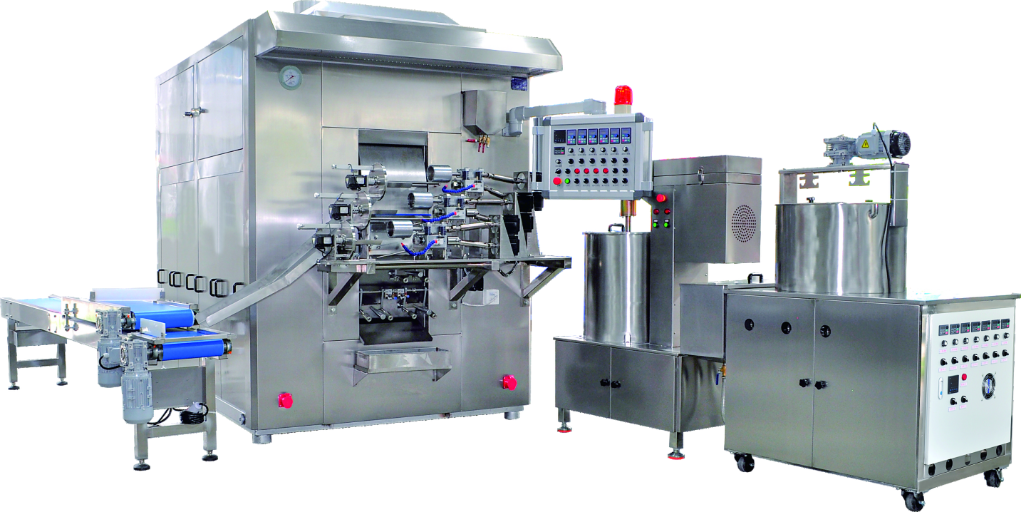
| Mould or lane count | The dominant driver: nine moulds carry nine heating circuits, nine plate sets and a longer frame | Size to the output you will actually run, not to the peak season |
| Station sequence | Cutting and sesame seeding are separate in-line stations with their own drives and sensing | Order the standard build if roll length is set by the mould and never varies |
| Heat source | A gas line adds a combustion system, burner control and a flue interface that an electric machine does not carry | Compare local gas and electricity tariffs against the energy table above before choosing |
| Destination electrical specification | Voltage, frequency and control-language changes are build-time items, not field adjustments | Confirm site voltage and frequency at enquiry rather than after the drawing is frozen |
| Order stage | Lead time | Covered by that stage |
|---|---|---|
| Configuration sign-off | Before the production clock starts | Finished-product sample or specification, target output, site voltage and fuel confirmed in writing |
| Production | 60 days after the deposit clears and the machine configuration is signed off | Build, factory run, and export packing |
| Ocean transit | Quoted with the shipment and not counted inside the 60 days | Port-to-port time for the route and sailing you choose |
Payment is 40% by T/T on order confirmation with the balance against a copy of the bill of lading, and a letter of credit at sight is accepted. These are UDTECH's own terms rather than a market standard, and other structures exist in Chinese export trade. One machine is a complete order.
We quote FOB China as the default trade term, with CFR and CIF on request.
Under ICC Incoterms 2020, FOB applies to sea and inland-waterway transport, and risk passes when the goods are aboard the vessel you nominate.
It stops fitting at the container terminal: the ICC advises considering FCA where goods are handed to a carrier there. Machinery of this size ships in containers, so raise the term with any supplier before the contract is signed.
Machine Hygiene, Operator Safety and Pre-Shipment Documentation
A baking machine that runs seven days a week is a cleaning problem and a hot-surface problem before it is anything else. What follows separates what the UDTECH build sheets state from what you should be writing into the contract with any machinery supplier.
Construction and Control, From the Build Sheets
- The rotary machines are enclosed in stainless steel with aluminium-alloy structural components.
- Control is by programmable logic controller with multi-axis servo linkage and fibre-optic photoelectric sensing at the stations.
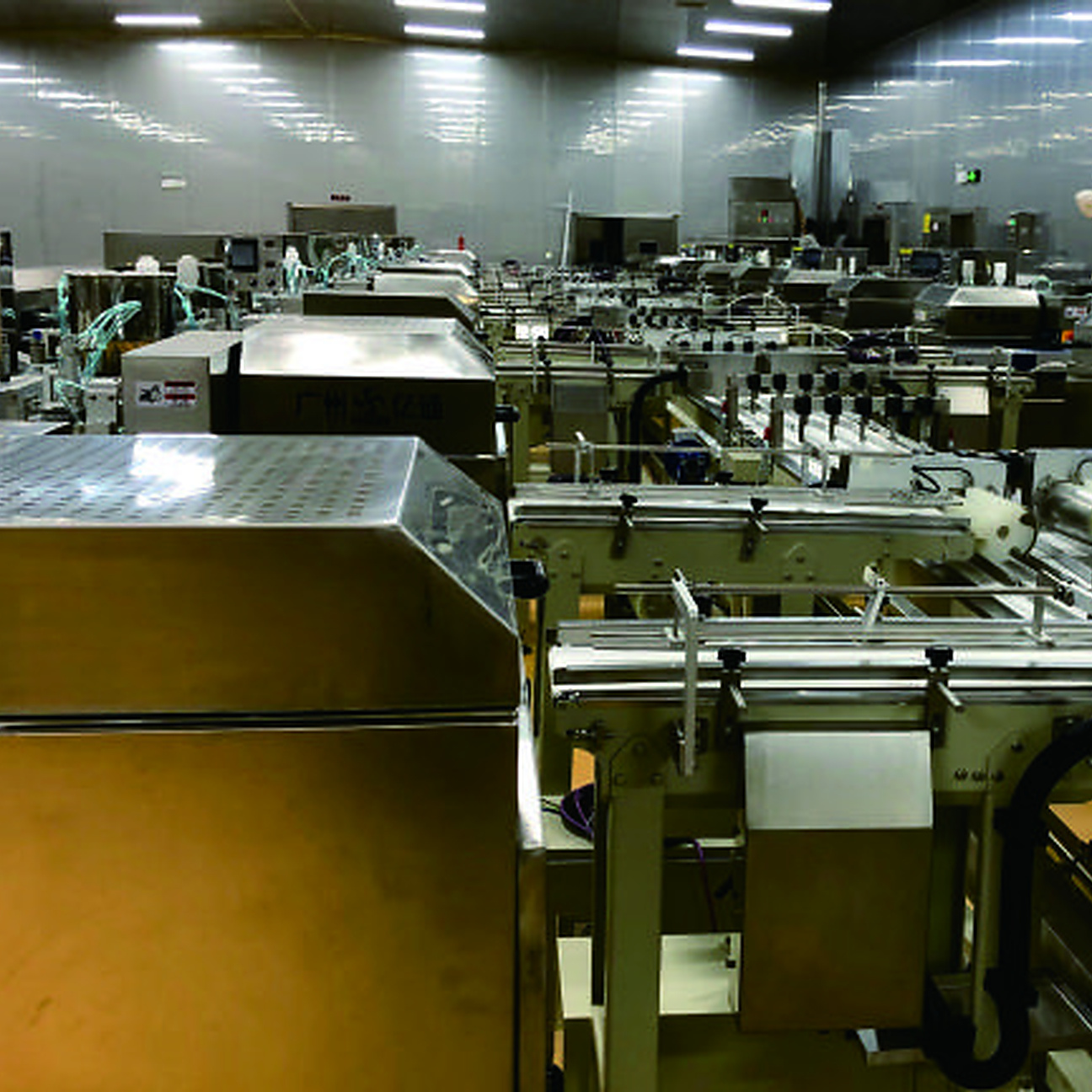
- The rotating stations sequentially carry out the deposit of batter, heating, folding, rolling, and discharging without any form of manual transfer or exchange between them.
- The YT05-2 and YT05-3 carry a fully automatic temperature-controlled combustion system with a safety protection device.
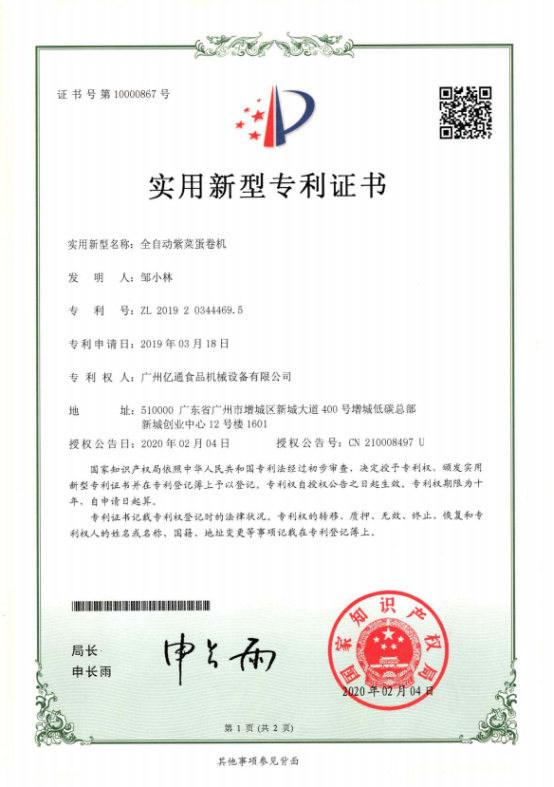
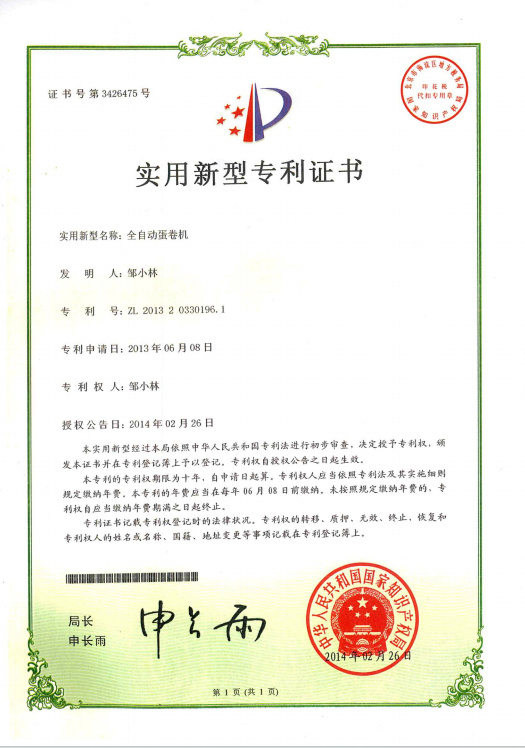
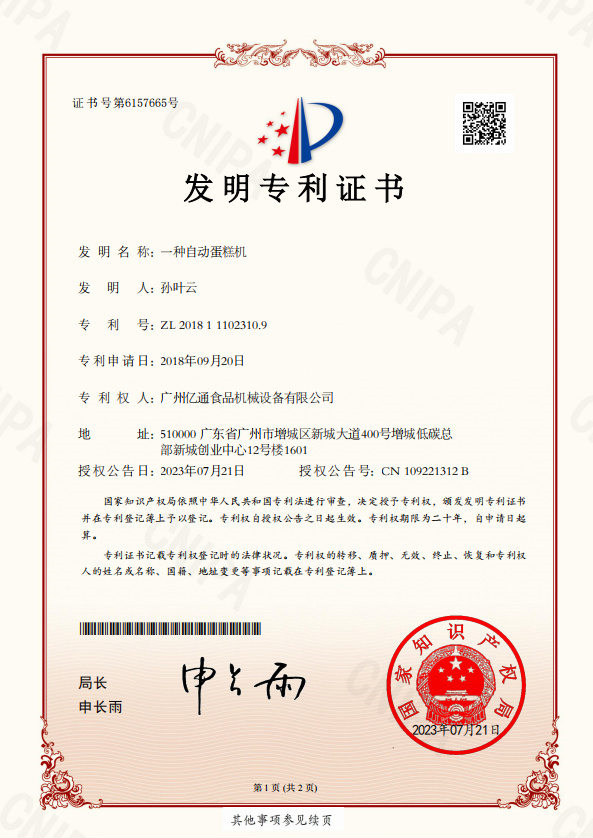
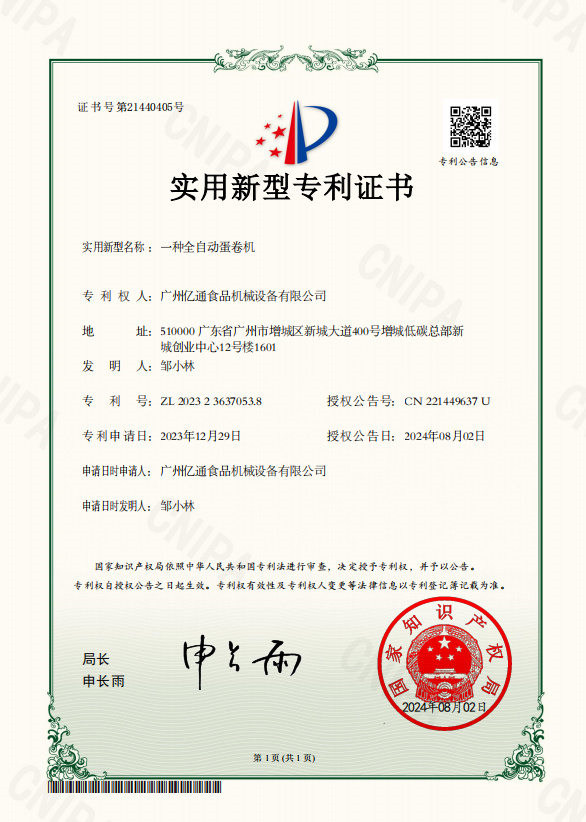
- An English operation manual ships with every machine, together with the electrical schematics and a spare-parts list with part numbers.
Documentation and Safety Items to Specify in the Contract
Put them in the purchase specification rather than assuming them.
| Item to specify | Ask for | Where the requirement comes from |
|---|---|---|
| Food-contact materials | The grade of every surface the batter touches; for the European Union a written declaration of compliance for the plastic parts, which Regulation (EU) 10/2011 reaches, and no declaration for the steel or the rubber seals, which no EU specific measure reaches; for the United States a supplier letter of guaranty naming the parts the materials are cleared under | Regulation (EC) 1935/2004 Art. 16 with Regulation (EU) 10/2011; FDA 21 CFR 175 and 177, guaranty forms at 21 CFR 7.12–7.13 |
| Hygienic design | Weld finish, dead-leg and crevice avoidance, and the tools needed to reach every soiled surface | EN 1672-2; EN ISO 14159:2008 |
| Instructions | Instructions in an official language of the destination market, carrying the manufacturer's full business address | Directive 2006/42/EC, Annex I 1.7.4 |
| Drawings and spares | The descriptions and drawings needed for use, maintenance and repair, plus specifications for safety-relevant spare parts | Directive 2006/42/EC, Annex I 1.7.4.2 |
| Guarding at forming rolls | Fixed or interlocked guarding at every in-running nip, and protection against unexpected start-up | Machinery guarding requirements in the destination market |
| Gas safety | Flame supervision, leak detection and a manual isolation valve upstream of the burner train | Local gas installation rules at the site |
| Factory test record | The run record for your own product format, taken before the machine is packed | Your purchase specification |

When a UDTECH Egg Roll Machine Is Not the Right Machine
A bakery automation integrator, arguing against its own upsell, recommended in a 2021 note that fully automated lines make sense only above roughly 2,000 lb per hour of bread or 1,200 units per hour of cake, and a semi-automated process below that. It was written for bread and cake lines rather than for wafer, so take it for the size of the gap and nothing finer.
Two thousand pounds an hour is 907 kg. The largest line on this page is rated 112.5 kg an hour, about an eighth of that, and the YT05-2 about a twelfth.
The cake half of the threshold is counted in cake units, which is not a wafer roll piece, so it does not convert at all.
These are production-cell decisions, not production-line decisions, and a supplier telling you otherwise is walking you into the wrong call on automation tier.
| Situation | Why it works against you | Better route |
|---|---|---|
| Your product is a fried savoury roll or a filled wrapper | The forming principle is different: a cold sheet folded around a filling, then fried, with piece weights several times a baked wafer roll | Specify a spring roll or wrapper machine; published models in that class run around 65 g a piece and are sized on filling weight |
| Your product is a flat waffle or pancake rather than a rolled one | The value of this machine sits in the rolling step, where the sheet is lifted off the plate and wound while it is still hot. A flat product discharges without that step, so the roll former and the cooling run it needs are cost you never recover | UDTECH builds flat batter products as a separate family: see waffle and pancake production lines, which are sized by mould count and discharge format rather than by roll diameter |
| You sell under about 100 kg a day from one retail counter | Mould count is fixed at purchase, and idle moulds still take heat, so a machine sized for growth costs energy every hour it runs below capacity | Start at the two-mould YT-06, or keep the operation semi-automated until the daily figure is stable |
| You want a single line covering baking through packaging | These machines end at discharge; cooling, inspection, filling into trays and wrapping are separate equipment with separate suppliers | Scope the downstream equipment first, because it decides the discharge format the baking machine has to deliver |
// RESOURCES
GET QUOTE
Engineering & Planning Tools
-
01
Egg Roll Machine Model Selector
Access Tool -
02
Egg Roll Machine Energy Cost Calculator
Access Tool -
03
Quoted Capacity Comparator
Access Tool
Frequently Asked Questions
What machine is used to make egg rolls?
For the sweet crisp roll, a rotary multi-mould machine or a continuous gas-fired line. For the fried savoury roll, a wrapper machine. They share a name and almost nothing else.
How many egg rolls per hour can one machine produce?
Across the UDTECH range, from around 500 pieces per hour on the YT-12HT to 1,100 pieces per hour on the YT-02H, and 220 to 330 pieces per minute on the gas-fired lines. Two machines in the range are quoted in kilograms per day instead, which is a real comparison problem and the reason the two conversion formulas appear on this page.
What does mould count or line count actually change?
Both set how many pieces cook at once, never how fast one cooks. Two lanes give 220 pieces per minute and three give 330. Bake time per piece is unchanged.
Gas or electric heating, which should I specify?
Total rated energy per kilogram lands in the same 1.04–1.33 kWh/kg band either way, so the choice is a tariff question rather than an efficiency one. What differs is the electricity share: about 10% on a gas line against 100% on the all-electric rotary machines. A gas line also brings a burner train, a flue and local gas approval into the project.
What hygiene and operator-safety features should I require on a gas-fired rolling machine?
Write them into the purchase specification rather than assuming them.
On hygiene: the material grade of every food-contact surface, and then the paperwork your own market recognises — a declaration of compliance in the European Union, which Article 16 of Regulation (EC) 1935/2004 attaches to the materials a specific measure reaches rather than to all of them, or a supplier letter of guaranty in the United States. Then hygienic design to EN 1672-2 and EN ISO 14159, which is what determines whether a soiled surface can actually be reached at the end of a run.
On safety: fixed or interlocked guarding at every in-running nip, protection against unexpected start-up, and, on a gas line, flame supervision, leak detection and a manual isolation valve upstream of the burner train.
On paperwork: instructions in an official language of your own market, carrying the manufacturer's full business address, which Directive 2006/42/EC Annex I 1.7.4 requires of anything shipped into the EU.
How much does an egg roll making machine cost?
No supplier in this category publishes a price list, because the number depends on mould or lane count, station sequence, heat source and destination electrical specification. As a public reference point, a competing 60 kg/h gas-fired machine is listed on a trading platform at USD 28,000 per unit and USD 27,000 for two or more; that is another supplier's listing and not a UDTECH price. Ours arrives in a written quotation against a signed-off configuration.
What is the lead time and what are the payment terms?
Production runs 60 days after the deposit clears, with ocean transit quoted separately. Payment is 40% by T/T on order confirmation, balance against the bill of lading copy. One machine is a complete order.