Get in touch with UDTECH Company

Industrial Soft Waffle Machine: A Factory Buyer’s Guide to Process, Acceptance and RFQ Readiness

An Industrial Soft Waffle Machine is factory equipment that forms and bakes a defined soft-waffle product within a coordinated, testable production route. It is not the same as buying a larger countertop waffle maker. Factory lines have to make an agreed product at an agreed rate, with repeatable batter handling, controlled baking, safe release, cleanable contact surfaces and evidence that both sides can sign off. Procurement should ask not “Which machine is fastest?” but “Which process route can our team define, test, accept and operate?”
This guide is deliberately different from a solution page. A solution page should own models, configurations, specifications, pricing, quotation and conversion. This article owns the buyer’s education layer: how to define the product, compare routes, diagnose the first failing station, prepare a factory acceptance test and make an RFQ comparable. No capacity, recipe window, certification, patent number, price or lead time is inferred for a particular UDTECH machine here.
It is also narrower than a full production-line architecture guide: the unit of decision here is the soft-waffle machine and the evidence needed to accept that machine inside a route. Plant-wide conveyor layout, line balancing and complete downstream architecture remain outside this article.
Buyer rule: compare accepted, saleable output under a defined test window—not an unqualified nameplate speed.
What “industrial soft waffle machine” should mean in a factory brief
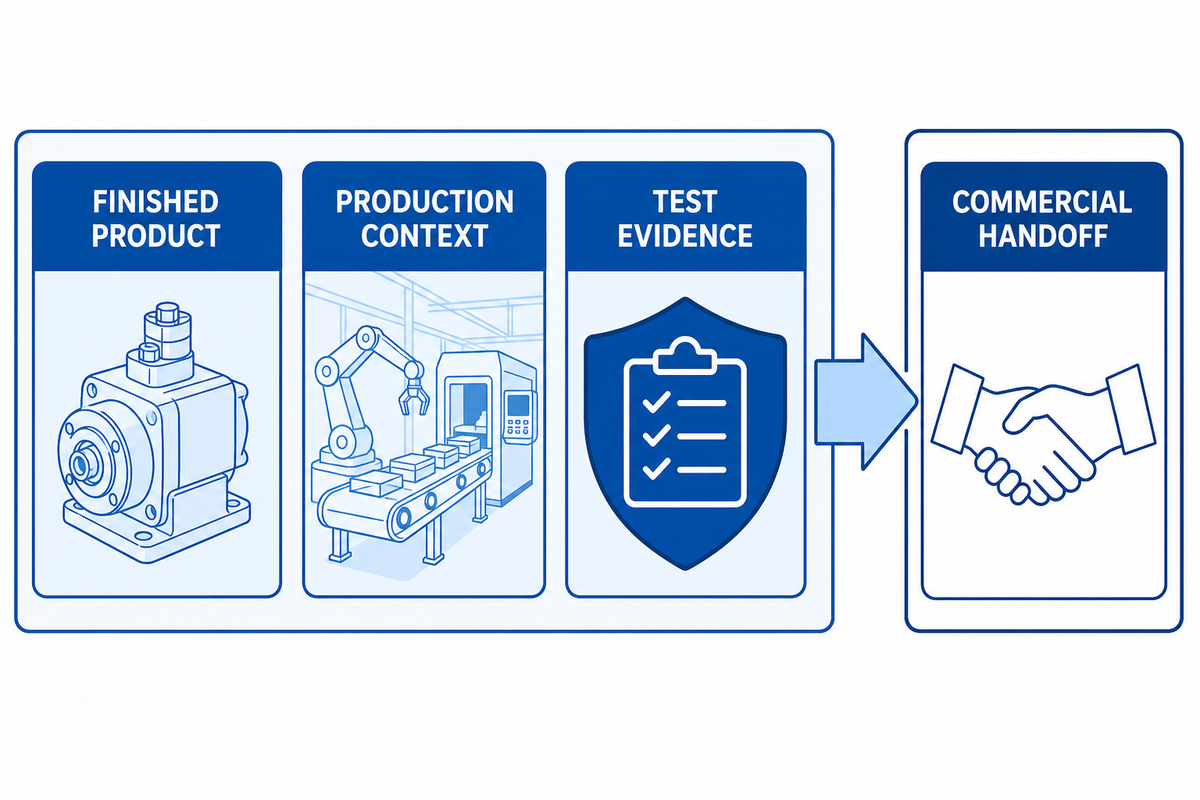
An Industrial Soft Waffle Machine brief should treat the phrase as a starting label, not a complete engineering requirement. In a factory brief, define the finished product first: shape, dimensions, thickness, texture, colour range, inclusions, target pack state and whether the product is sold fresh, chilled or frozen. Then define the production context: planned shift pattern, changeover frequency, expected saleable output, allowable rejects, utilities and the downstream hand-off.
In the search snapshot used for this guide, results for the exact phrase are heavily mixed with countertop and commercial-appliance listings. That is an intent signal, not proof that those appliances can perform a factory duty. Broad trend material is similarly appliance-heavy, so it cannot be used as an industrial demand forecast. Procurement teams should keep that distinction visible when they write the brief and evaluate supplier claims.
For a plant operator, that distinction is a procurement risk: keep the search term separate from the test report and the production-line requirement.
As a baseline for the equipment brief, the current food-equipment requirements in 21 CFR Part 117 are a useful prompt for documenting suitability, cleaning and maintenance responsibilities; they are not a machine certificate.
What is the difference between a commercial waffle maker and a factory line?
Commercial waffle makers are self-contained point-of-sale or kitchen appliances. Factory lines coordinate preparation, dosing, mould handling, baking, release, cooling, inspection and downstream transfer. A buyer should specify interfaces, guarding, cleaning access, training and an acceptance method; a product name alone proves none of these capabilities.
Use five lines in the brief to make the boundary explicit: “product to be made,” “route to be tested,” “accepted output basis,” “quality sample method” and “documents and responsibilities to be handed over.” If a supplier cannot answer those lines without reverting to a single peak-speed number, the comparison is not ready.
Choose the product route before you choose the machine
Soft waffles can be approached through different product and forming routes. Route choice depends on the finished geometry, batter behaviour, plate or mould pattern, release method, cooling requirement and downstream handling. Do not select a machine family because its name sounds close to the product name. Select a route that can be demonstrated with the product sample and measurement method you intend to buy.
For orientation, Belgian waffles made on a Belgian waffle maker, small waffle irons, a timer and a pre-blended waffle mix are comparison terms from the appliance market. They can describe a serving format or a kitchen workflow, but they do not define the coordinated dosing, baking, release and cooling requirements of a factory route. The same search language includes a Belgian waffle iron, commercial waffle iron, mini waffle maker, bubble waffle maker, waffle stick machine, electric waffle maker, rotating waffle and flip waffle iron. A hotel waffle, breakfast buffet, food-truck or restaurant label describes a service setting, not an industrial acceptance result.
Format words also need a measurable definition. A waffle baker, double waffle, square waffle, thin waffles, thick waffles, fluffy waffles, crispy waffles, “crispy on the outside,” even baking, Belgian waffles, yeasted waffles, Liège waffle and Brussels style can all appear in a brief or a search result. Put the chosen term into a product drawing, sample photo or sensory check before it influences equipment selection. Queries such as “best waffle makers” and “waffle maker reviews” may help a team understand market language, but neither is a substitute for a witnessed product trial.
Searchers may also use industrial waffle machine, industrial waffle maker or industrial waffle iron as shorthand. Related queries such as industrial soft waffle machine reviews, industrial soft waffle machine price and industrial soft waffle machine for sale describe buying stages; none replaces a product trial.
For wider context, review the site’s broader waffle-and-pancake process context after writing your product brief. Use it only as a route-context reference; it does not replace a product trial or a configuration review.
Which waffle style should a production line be designed around?
Start with the style that your customer will actually accept: for example, the specified grid or pocket geometry, the desired soft or crisp contrast, and the post-bake pack condition. Record the product sample, not only its name. Belgian, round, filled, mini or other labels can hide differences in batter, mass, thickness and release behaviour. Suppliers should then show which parts of the route are fixed by the sample and which parts still require a test.
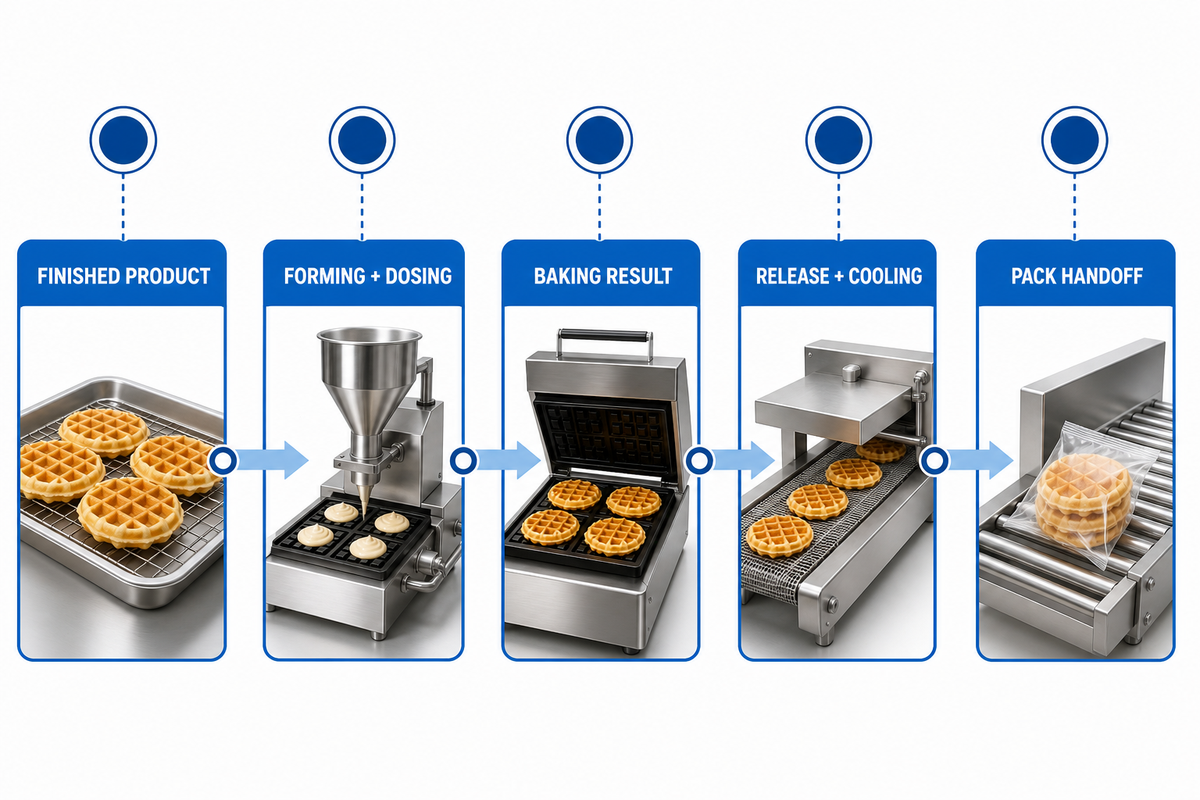
The Product-Route Compass
- Finished product: freeze a drawing, sample photos and acceptance dimensions.
- Forming and dosing: state how batter is deposited and what must be measured.
- Baking: define the observable outcome—colour, texture, moisture or another agreed test—not a copied brochure setpoint.
- Release and cooling: define how the product leaves the plate, reaches the next station and avoids transfer damage or condensation.
- Pack and responsibility: identify the hand-off, inspection record and owner for every interface.
This compass is a decision sequence, not a promise that one route fits every recipe. It tells the buyer what to settle before asking a supplier for a final configuration.
For the wider food-process context behind that route decision, the Codex General Principles of Food Hygiene provide a responsibility and verification reference; the product trial still decides whether the route works.
Once the route is sketched, check the site’s soft-waffle line planning overview for the next set of process questions. It is a related planning reference, not a substitute for agreeing the product sample and trial method.
Size the line from accepted output, not nameplate speed
For this guide, treat nameplate speed as a machine-side number and accepted output as a buyer-measured result. Those figures can diverge because of warm-up, loading gaps, changeovers, stoppages, rejected pieces, cooling limits, inspection holds and packaging constraints. Published vendor figures also depend on product size and shape, so numbers from different lines are not comparable until the product geometry and test basis are fixed.
Record the test window in minutes, and record temperature in °C, sample mass in g, electrical load in kW or air pressure in bar only when those fields are part of the agreed trial; these units are measurement fields, not universal machine specifications.
Use a simple, auditable calculation:
accepted output = saleable product ÷ test time
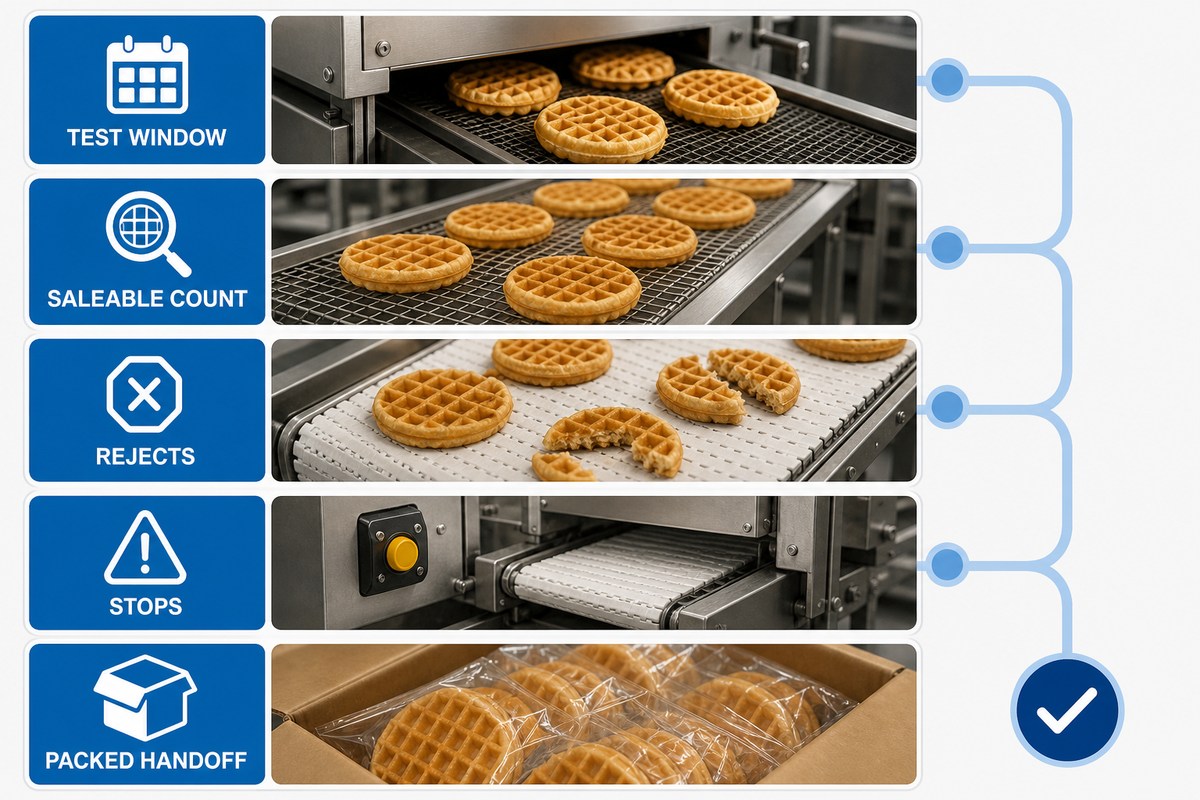
For a rate in pieces per hour, measure a defined test window, count saleable pieces, record rejects and list every stop longer than the agreed threshold. If the line makes 1,000 saleable pieces in a 20-minute window, the observed accepted rate is 3,000 pieces per hour. That is only a worked method, not a UDTECH capacity claim. Any second run with a different product or shorter window must not be blended into the first result.
Also record whether output is counted before or after cooling, inspection and packing. If the packer is the bottleneck, the accepted line output is the packer’s saleable hand-off, not the oven’s instantaneous discharge. Add a headroom discussion only after the accepted baseline is agreed.
For the questions that sit between a product brief and a line calculation, use the site’s line-sizing questions resource. It should support the conversation, not substitute for a witnessed test.
For a second site-readiness check, review the site-readiness questions before a supplier trial. Utilities, access and hand-off constraints can change the accepted-output basis even when the machine-side number is unchanged.
Use a time-ordered record for those observations, consistent with the NIST control-chart guidance on distinguishing process change from an isolated reading.
Why can a nameplate speed overstate packaged output?
Because nameplate speed can omit rejects, changeovers, operator pauses, cooling time and downstream limits. Label each number as theoretical, observed, saleable or packed, and attach the product geometry and test duration. If a field is missing, treat the number as an investigation lead—not a purchase commitment. Repeat the same test window, separate saleable pieces from rejects, and follow the count through cooling, inspection and packing so procurement can see where output was lost.
Control batter dosing and the bake profile as a linked process
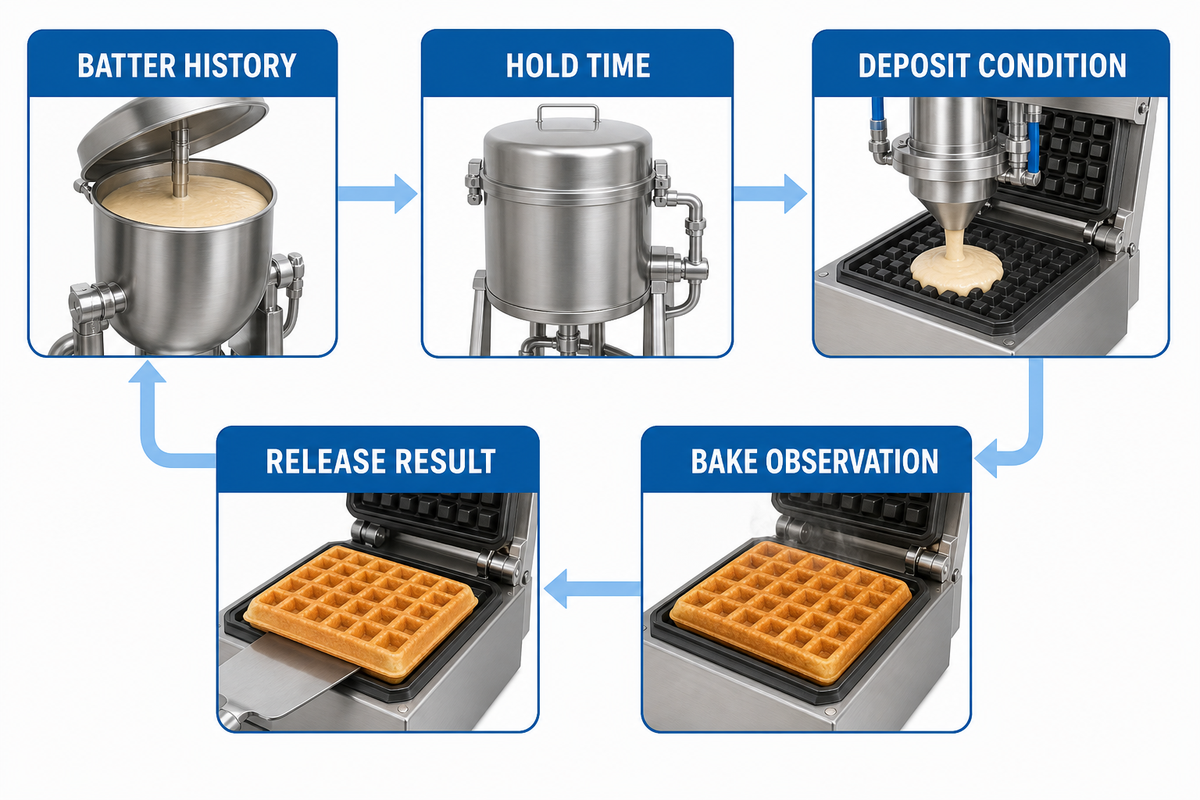
Waffle quality is often blamed on the oven when the variation entered earlier. Batter preparation history, hold time, temperature, viscosity, deposit condition and deposit mass can change the result before a plate closes. Conversely, a dosing change can alter the bake load and the release outcome. The trial should therefore record the batter and bake variables together.
A comparable trial sheet can include: ingredient or batter identification; preparation time; hold time; deposit mass or another agreed dosing measure; plate or mould identification; a recorded heating or dwell condition; colour and texture observations; release result; and repeatability across a defined sample. Its purpose is not to publish a universal recipe window. Instead, it should show whether a change came from the batter, the deposit, the bake or the hand-off.
Keep recipe ownership explicit in the RFQ. State who supplies the approved recipe, who may change it, what sample is the reference and which measurements are required during a trial. Suppliers can propose a process window, but a buyer should not silently convert a trial setting into a guaranteed production setting without evidence.
When a run drifts, change one variable at a time where practical. Record the old value, the new value, the sample identifier and the observed effect. This turns a “machine problem” conversation into a traceable process conversation.
That one-change record follows the measurement logic described in the NIST process-monitoring reference; it does not set a universal batter or bake value.
Plan release, cooling and the first-failing-station diagnosis
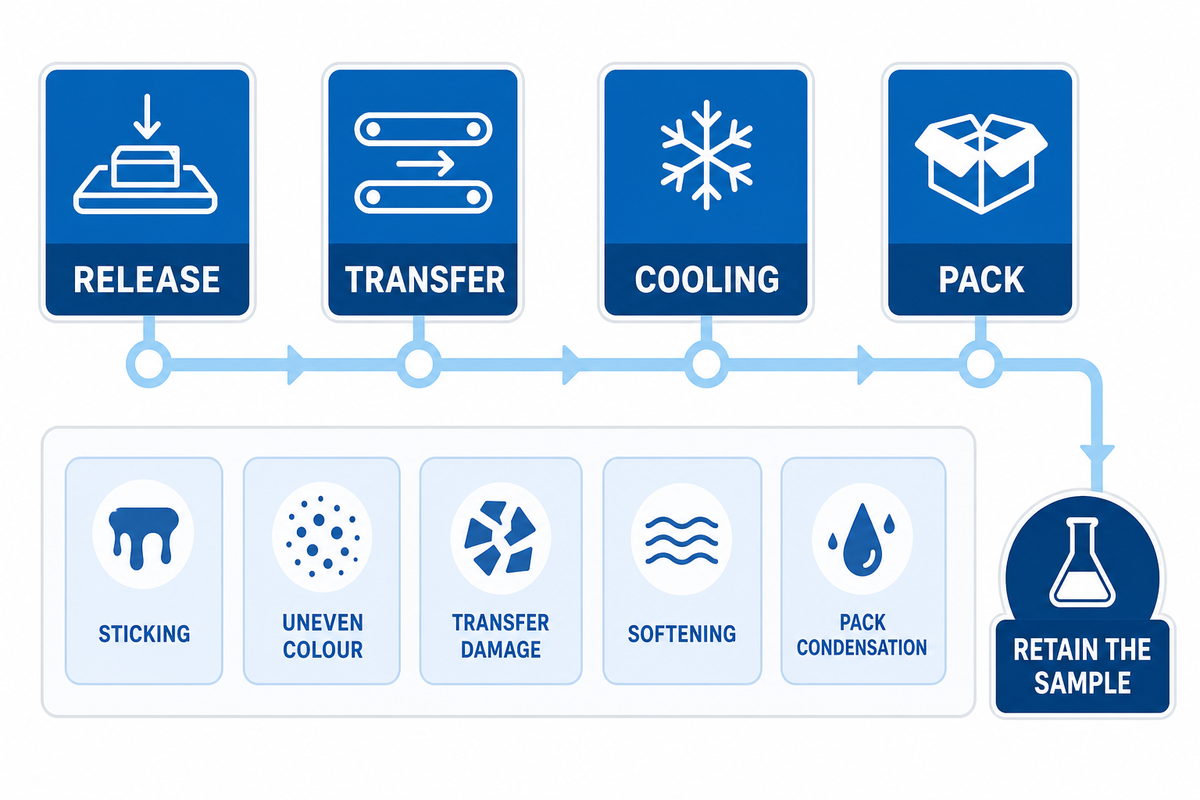
Release and cooling are part of product quality, not an afterthought. One waffle can leave a plate intact and still fail later through transfer damage, surface softening or condensation in the pack. Diagnosis should follow the product through the route and identify the first station where the agreed output is lost.
For an operator, this is a production-line hand-off risk, so retain a test report with the sample as it moves from release through cooling and packing.
| Symptom category | First checks | Evidence to retain |
|---|---|---|
| Sticking or tearing at release | Plate or mould condition, batter state, deposit and release sequence | Sample photos, plate ID, batter record and one-variable change log |
| Uneven colour | Deposit distribution, heating condition, dwell and product geometry | Mapped sample positions and the recorded test window |
| Softening after release | Cooling time, airflow, product stacking and pack timing | Time stamps from discharge to pack and texture check |
| Transfer damage | Alignment, speed matching, guides and hand-off height | Station-to-station observations and rejected-piece count |
| Pack condensation | Product temperature, cooling completion and pack environment | Product/pack temperatures and hold-time record |
| Low pocket fill | Dosing repeatability, batter viscosity and deposit timing | Mass or volume record and cavity photographs |
| Excess batter or overflow | Deposit quantity, plate closure and mould alignment | Spill observation, setting record and retained sample |
| Scorched edges | Heating balance, dwell time and plate surface condition | Colour map, temperature record and plate ID |
| Uneven thickness | Spread pattern, batter level and mould closure | Thickness readings in mm at agreed sample points |
This table is a diagnostic order, not a one-symptom/one-cause rule. Several variables can overlap. Start at the first failed station, preserve the sample and avoid changing three settings before the team has learned which change mattered.
Retain the time sequence and sample identity as part of the food-process record, alongside the Codex hygiene verification principles that inform the facility’s broader controls.
Make cleanability and guarding part of the user requirement
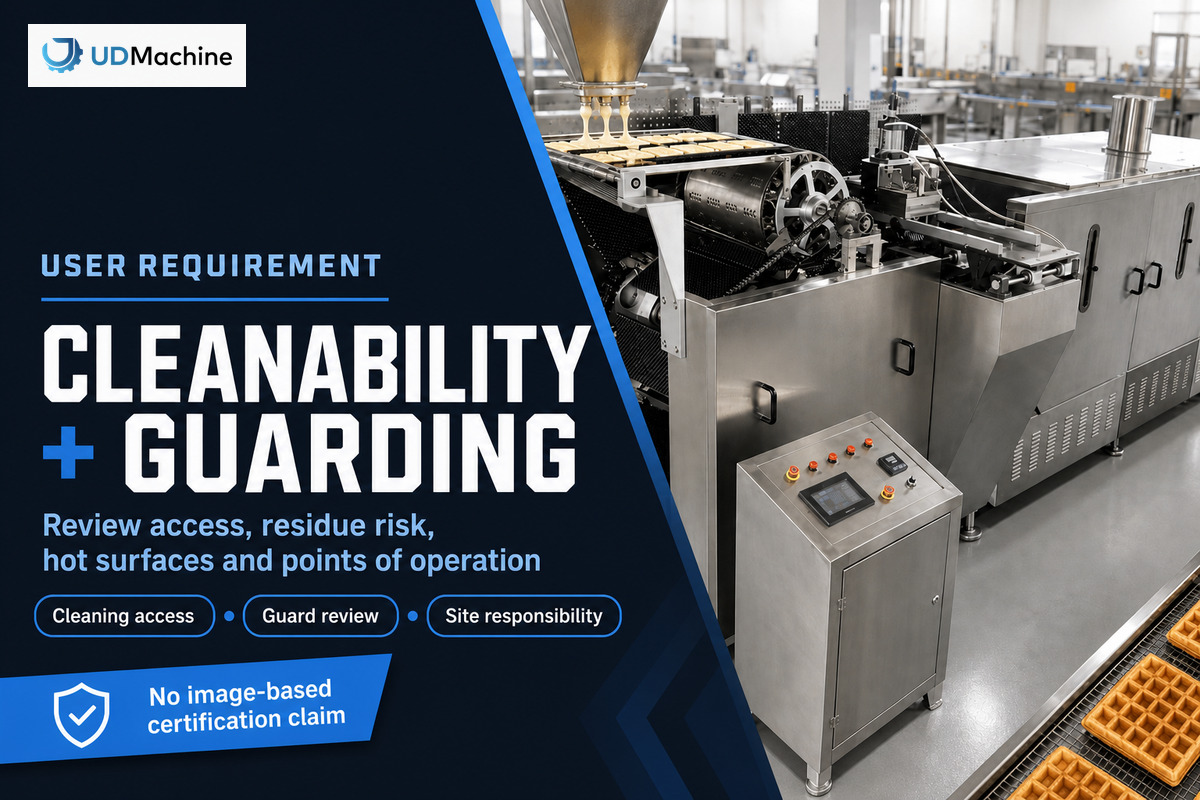
Food contact, residue removal and operator protection belong in the user requirement before a quotation is accepted. In the United States, 21 CFR 117.40 describes equipment and utensils in terms of cleaning, maintenance and protection against contamination. OSHA’s machine-guarding rule, 29 CFR 1910.212, sets a framework for guarding points of operation and other hazards. The Codex General Principles of Food Hygiene and EHEDG hygienic-design guidance are useful design references for hygienic thinking.
Those sources do not certify a particular line, and they do not replace a site’s hazard analysis or jurisdiction-specific review. Convert them into questions:
Appliance listings also use terms such as timer, countdown, digital timer and temperature controls, browning levels, indicator light, removable plates, drip tray, non-stick plates, nonstick or non-stick coating, stainless steel waffle maker, cast iron, dishwasher-safe, easy to clean and cleanup. In an industrial brief, these are prompts to ask about the control interface, contact-material declaration, cleaning method and changeover—not evidence that a supplier’s line has a particular coating, electrical rating or convenience feature. Keep the distinction between a commercial waffle maker’s point-of-sale feature and a factory system’s documented process capability.
- Can food-contact areas be accessed, inspected and cleaned without creating residue traps?
- Which surfaces, seals, drains and tools are included in the cleaning method?
- Are moving parts, hot surfaces and points of operation guarded for the intended task?
- What lockout or isolation steps belong to the buyer’s local safety procedure?
- Which hygiene, allergen, sanitation and worker-safety controls remain the facility’s responsibility?
Use the primary references for the applicable scope: 21 CFR Part 117 Subpart B, OSHA 1910.212, EHEDG hygienic-design principles and the Codex General Principles of Food Hygiene. Cite the requirement you are applying, then identify the owner who will verify it.
Build a factory acceptance test around evidence
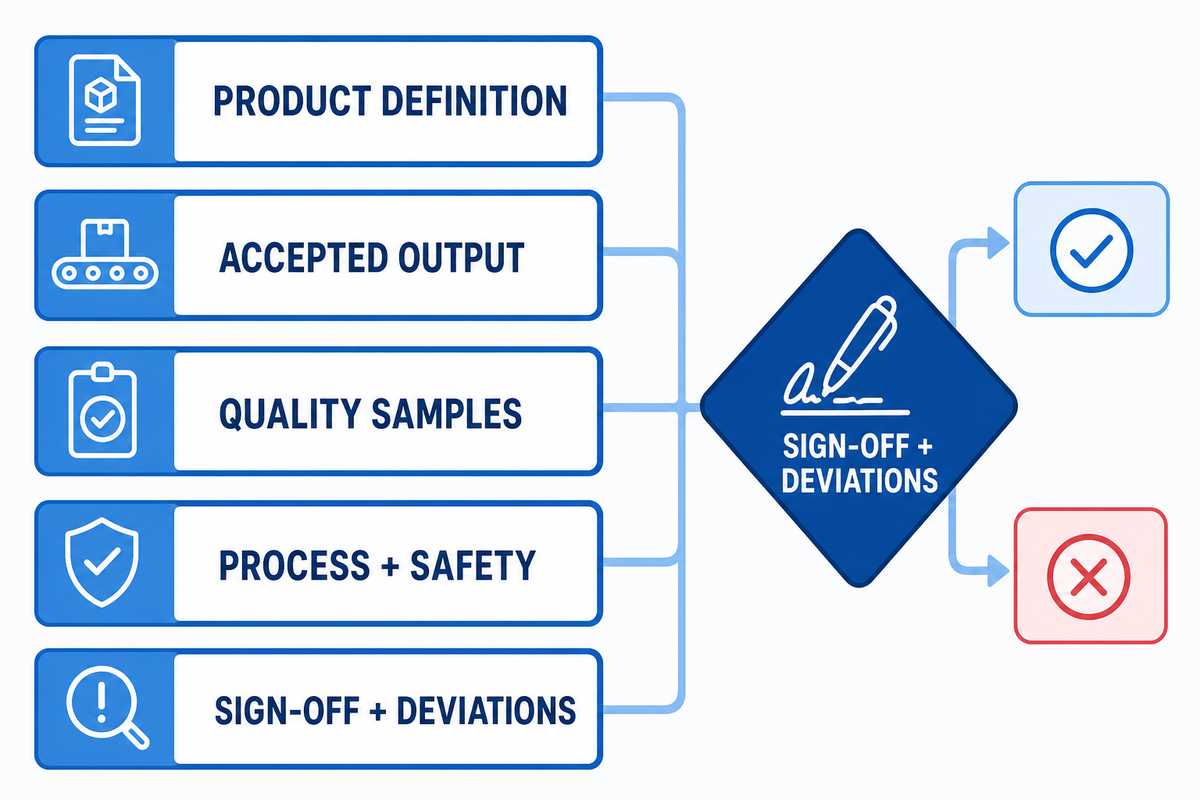
A factory acceptance test (FAT) should prove the agreed scope under agreed conditions. It is not a marketing video, a single peak-speed observation or a photograph of a finished sample. Before the test, both sides should agree the product sample, instruments, test window, observers, data fields, deviation handling and sign-off authority.
The Five-Signal Acceptance Framework: 5 Checks
- Product definition: the drawing, sample and acceptance tolerances are identified.
- Accepted-output basis: the test duration, saleable count, rejects and stops are recorded.
- Quality samples: product positions, texture/colour checks and sample IDs are retained.
- Process and safety evidence: batter/bake records, guarding observations and cleaning-access checks are attached.
- Sign-off and deviations: open points have an owner, due date and agreed closure method.
Separate FAT from commissioning. FAT is normally a pre-shipment or supplier-site demonstration of the agreed scope; commissioning includes installation, utilities, training and site conditions. Those documents can connect, but an FAT pass does not prove that a facility has completed its own installation, hazard or sanitation controls.
If the test misses a requirement, record the actual result and the deviation. Do not replace it with an unqualified “pass” because the machine reached a faster moment later. Transparent deviation lists are more useful than an impressive but unrepeatable peak.
For guarding questions that remain open at FAT, use the OSHA 1910.212 machine-guarding framework as a review prompt and assign the final installation decision to the responsible facility team.
Turn commissioning and the RFQ into a responsibility map
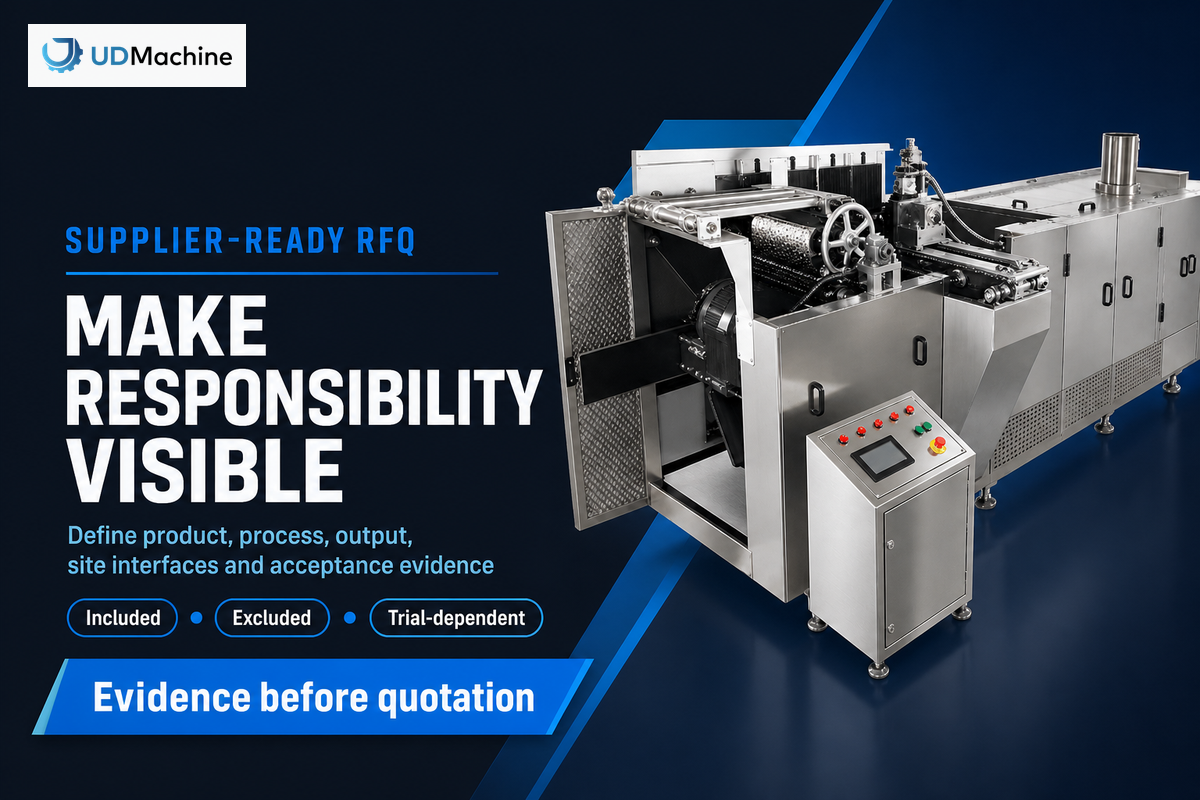
A comparable RFQ should let two suppliers quote the same work. Ask for the product definition, approved sample, batter ownership, utilities, site interfaces, guarding and hygiene boundaries, changeover assumptions, cleaning access, training, spares, documents, warranty scope and the exact acceptance method. Ask each supplier to mark what is included, excluded, assumed or dependent on a trial.
State the applicable equipment-cleaning and maintenance responsibilities explicitly, using 21 CFR Part 117 as a jurisdiction-specific starting point rather than as a blanket supplier certification.
The RFQ Evidence Sheet
- Product: drawing, geometry, texture, pack state, sample and tolerances.
- Process: route, batter record, dosing measure, bake observations, release and cooling hand-offs.
- Output: saleable basis, test duration, reject definition, stops, changeover and headroom assumptions.
- Site: utilities, floor or conveyor interfaces, access, drainage, guarding and local responsibilities.
- Evidence: FAT protocol, instruments, sample retention, training record, manuals and deviation closure.
UD Company reports that it was established in 2003, invested nearly 200 million RMB in Xinyu City’s High-tech Development Zone in Jiangxi Province, covers 130 acres, has two production bases and focuses on food-production automation. The user-provided brief says UD Company independently developed fully automatic egg roll and phoenix tail roll machines; it also mentions multiple invention patents but gives no patent identifiers or assignee records. These statements are marked here as USER-DATA; they do not establish a soft-waffle capacity, certification, patent number, case study or performance result.
Once the education, trial and acceptance fields are clear, continue to UDTECH’s industrial soft-waffle machine solution for configuration and quotation discussion. That destination owns the commercial specification. This guide has done its job when the RFQ tells the supplier exactly what evidence the specification must support.
Frequently Asked Questions
What is the best industrial soft waffle machine for a new factory?
Choose the route that matches your approved product sample and can be demonstrated with a repeatable test, accepted-output definition, cleaning and guarding review, and clear hand-off responsibilities. Do not rank a model from a countertop-style speed claim or a name alone. Compare the evidence packet, trial conditions, service scope and RFQ assumptions first, then ask the supplier to configure the commercial solution. Evidence quality is a better selection filter than a headline model label.
How do I choose an industrial waffle machine for a production line?
Define the finished product, choose the product route, run a documented batter-and-bake trial, and measure saleable output over an agreed window. Next, test release, cooling, hygiene access and guarding, then convert the results into FAT criteria and an RFQ responsibility map. This sequence keeps educational process decisions separate from the solution page’s model and quotation work.
What should be included in an industrial waffle machine quotation?
Request the product drawing and sample basis, process route, batter and recipe ownership, utilities, interfaces, accepted-output calculation, reject and stop definitions, changeover, cleaning access, guarding, training, spares, manuals, warranty scope and FAT protocol. Each field should be labelled included, excluded, assumed or trial-dependent. That makes two quotations comparable without inventing capacity or performance.
Can a commercial waffle maker replace an industrial line?
Usually it addresses a different duty. A point-of-sale appliance does not automatically provide coordinated dosing, cooling, inspection, safe interfaces, sanitation documentation or factory acceptance evidence. Compare the required process and output basis before considering any substitution in a factory acceptance review.
How should waffle quality be checked during acceptance?
Use an agreed sample plan: identify product and position, record batter and bake conditions, inspect colour and texture against the approved sample, count rejects and retain the observations. Repeat the test under the same conditions before changing a variable or accepting the result.
References & Sources
- U.S. Electronic Code of Federal Regulations, 21 CFR Part 117 — equipment, utensils and facility responsibility prompts.
- European Hygienic Engineering & Design Group, hygienic-design principles — cleanability and residue-risk review context.
- FAO/Codex General Principles of Food Hygiene — food-hygiene responsibility and verification context.
- NIST control-chart guidance — distinguishing process change from isolated readings.
- OSHA 1910.212 machine-guarding framework — guarding review prompt; local assessment remains required.