Get in touch with UDTECH Company

How to Choose a Food Industry Machine Manufacturer

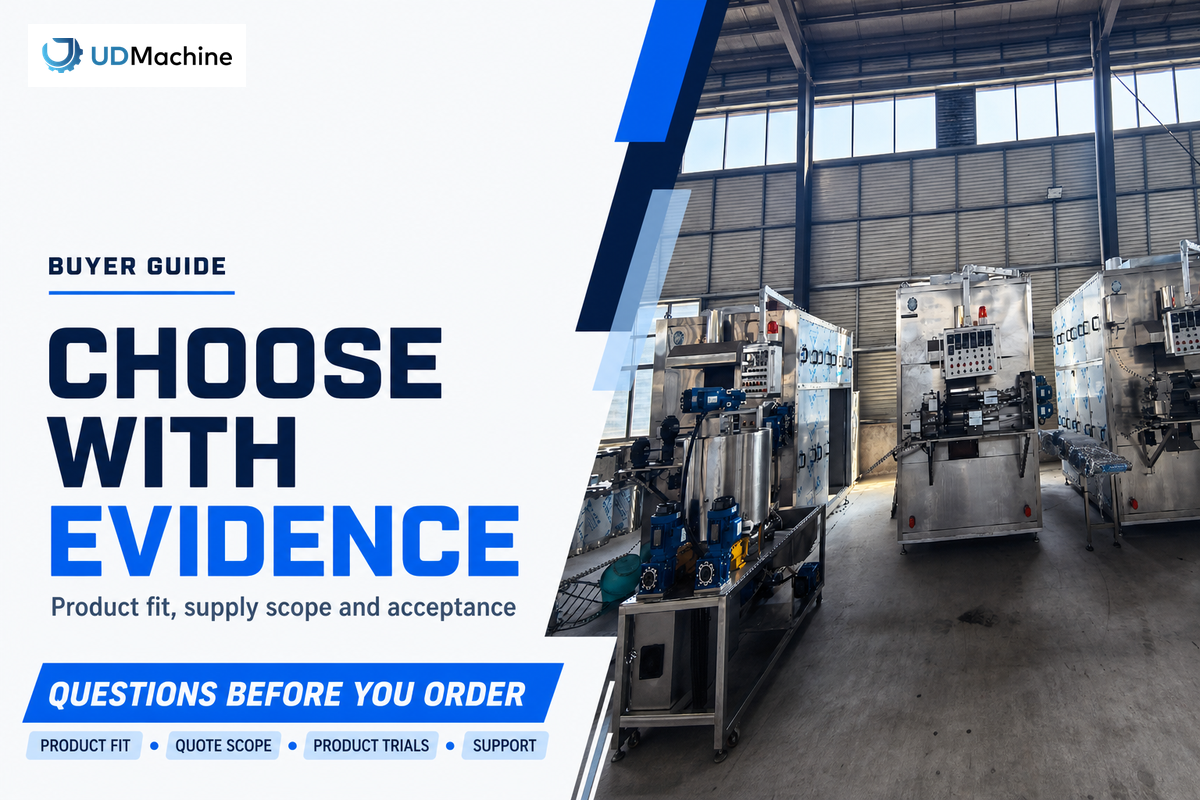
A food industry machine manufacturer is a machinery builder that should be able to tell you how its equipment will process your product, where its supply terminates and what proof exists for the proposed duty. Start there ahead of comparing prices. A machine appearing appropriate in a catalogue can leave your factory with an unresolved cooling stage, an unfamiliar control system or an installation job no-one has priced.
Seven purchasing checks are identified in this guide, followed by a review of automation trends. The worksheets are editorial tools derived from public sources. Their examples are fictitious, so use the questions without believing them to be a supplier test report.
Match Food Processing Equipment to Your Product
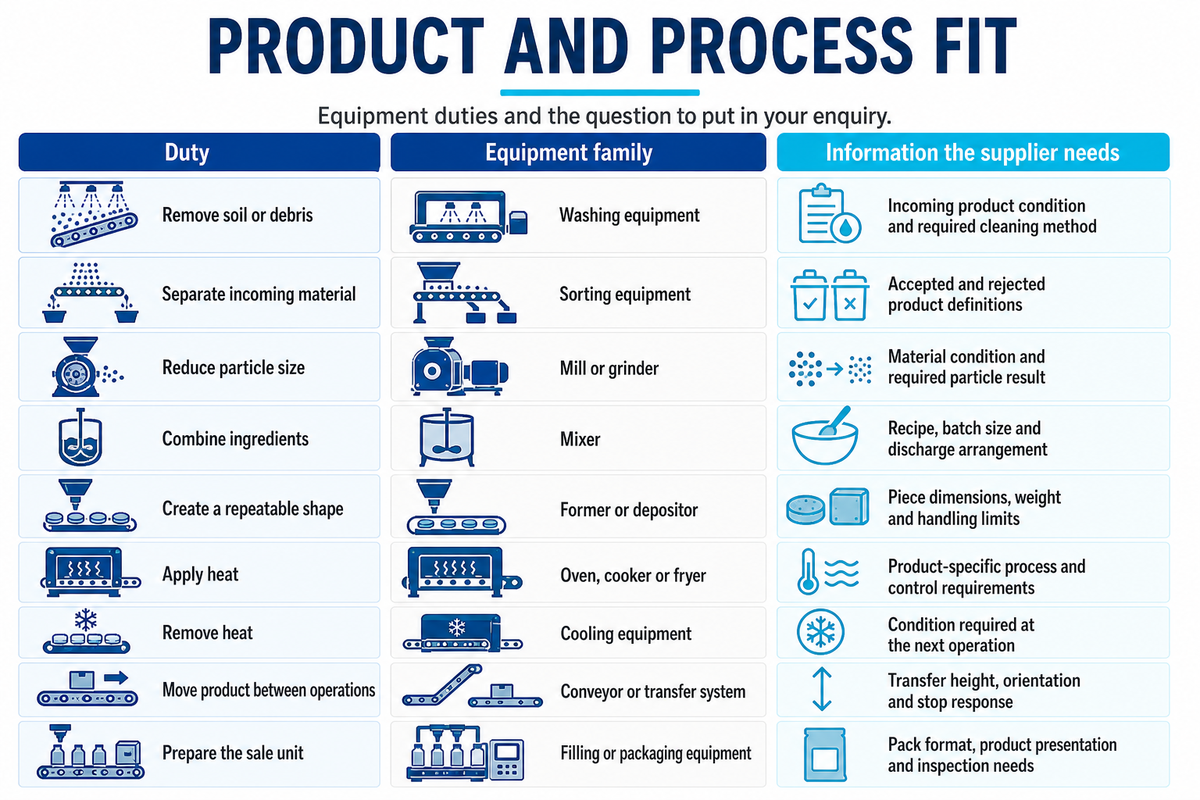
Choose industrial food processing equipment based on the material entering the machine and the product leaving it. Make a note of the formulation, product state, process requirement and handoff to the next operation. The supplier can then explain the proposed machine’s constraints against your production needs, instead of quoting from an image and a headline capacity.
Oklahoma State University’s equipment purchasing guide puts product characteristics, performance criteria, system interfaces and utilities in the written specification. Food manufacturers can use that starting point to specify industrial food production. When choosing food processing machinery for a specialty food processor, the difficult detail may be a sticky filling or a fragile surface that changes how the next conveyor can handle the product.
What types of machinery are used in the food industry?
Equipment for food preparation in processing plants may be needed for washing, sorting, cutting or grinding. Further processing can include mixing, forming, heating, cooling and portioning prior to filling or packing. Protein processing, dairy and beverage production will also require their own product and process specification. A mill and a grinder alter particle size; fluid handling equipment transfers liquid ingredients; a forming machine determines product shape.
Different duties call for different industrial food machinery. Compare the range of food processing duties you need against the builder’s actual scope, even when it advertises a wide range. Commercial kitchens and foodservice operators purchase commercial food processing equipment, but a kitchen product’s duty may not reflect the sustained work required in food manufacturing. Describe your food products and process first. This table is a selection of purchasing questions and not intended as a supplier audit report.
| Duty | Equipment family | Information the supplier needs |
|---|---|---|
| Remove soil or debris | Washing equipment | Incoming product condition and required cleaning method |
| Separate incoming material | Sorting equipment | Accepted and rejected product definitions |
| Reduce particle size | Mill or grinder | Material condition and required particle result |
| Combine ingredients | Mixer | Recipe, batch size and discharge arrangement |
| Create a repeatable shape | Former or depositor | Piece dimensions, weight and handling limits |
| Apply heat | Oven, cooker or fryer | Product-specific process and control requirements |
| Remove heat | Cooling equipment | Condition required at the next operation |
| Move product between operations | Conveyor or transfer system | Transfer height, orientation and stop response |
| Prepare the sale unit | Filling or packaging equipment | Pack format, product presentation and inspection needs |
Bakery shows why processing equipment must be matched to product groups. Biscuit and bun equipment families and waffle and pancake lines should be discussed against their own recipes and forming routes. The common food manufacturing equipment label can’t prove the same machine is suitable for both.
Who Builds, Integrates and Supports the Line?
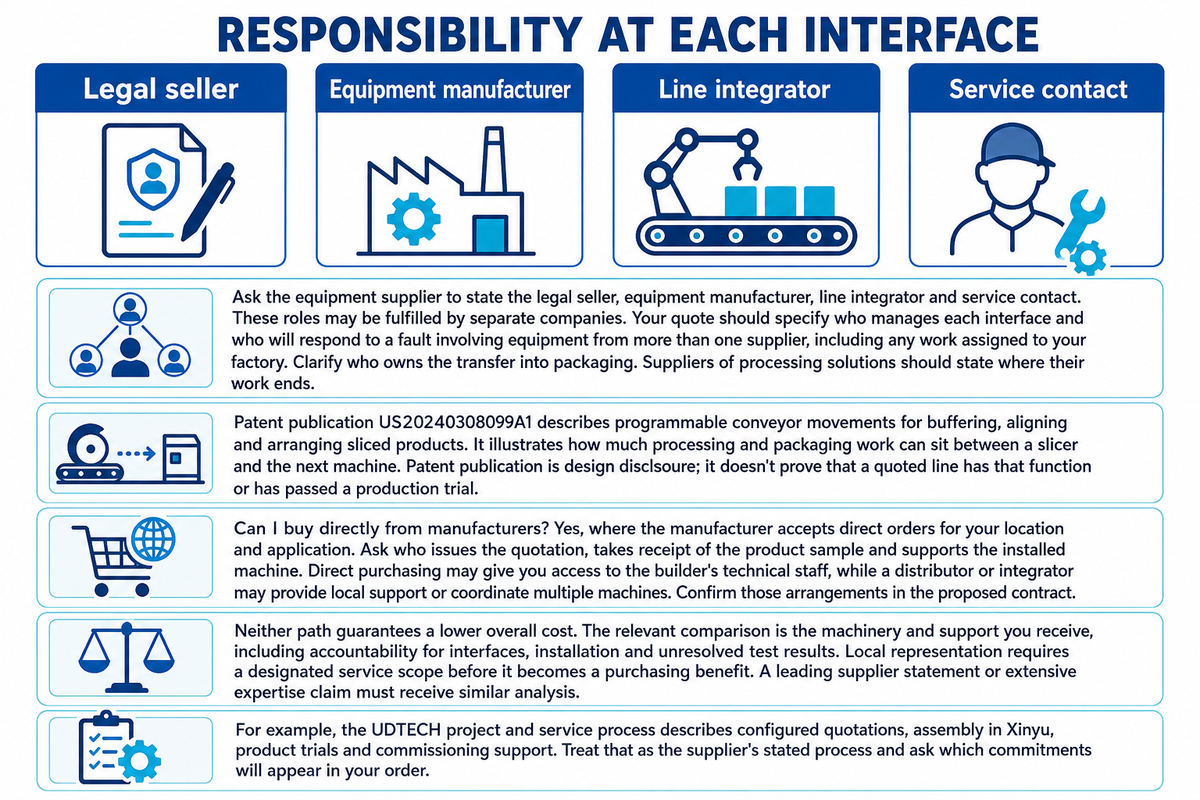
Ask the equipment supplier to state the legal seller, equipment manufacturer, line integrator and service contact. These roles may be fulfilled by separate companies. Your quote should specify who manages each interface and who will respond to a fault involving equipment from more than one supplier, including any work assigned to your factory.
Clarify who owns the transfer into packaging. Suppliers of processing solutions should state where their work ends. Patent publication US20240308099A1 describes programmable conveyor movements for buffering, aligning and arranging sliced products. It illustrates how much processing and packaging work can sit between a slicer and the next machine. Patent publication is design disclosure; it doesn’t prove that a quoted line has that function or has passed a production trial.
Can I buy directly from manufacturers?
Yes, where the manufacturer accepts direct orders for your location and application. Ask who issues the quotation, takes receipt of the product sample and supports the installed machine. Direct purchasing may give you access to the builder’s technical staff, while a distributor or integrator may provide local support or coordinate multiple machines. Confirm those arrangements in the proposed contract.
Neither path guarantees a lower overall cost. The relevant comparison is the machinery and support you receive, including accountability for interfaces, installation and unresolved test results. Local representation requires a designated service scope before it becomes a purchasing benefit. A leading supplier statement or extensive expertise claim must receive similar analysis.
For example, the UDTECH project and service process describes configured quotations, assembly in Xinyu, product trials and commissioning support. Treat that as the supplier’s stated process and ask which commitments will appear in your order.
Turn a Supplier Claim into Evidence
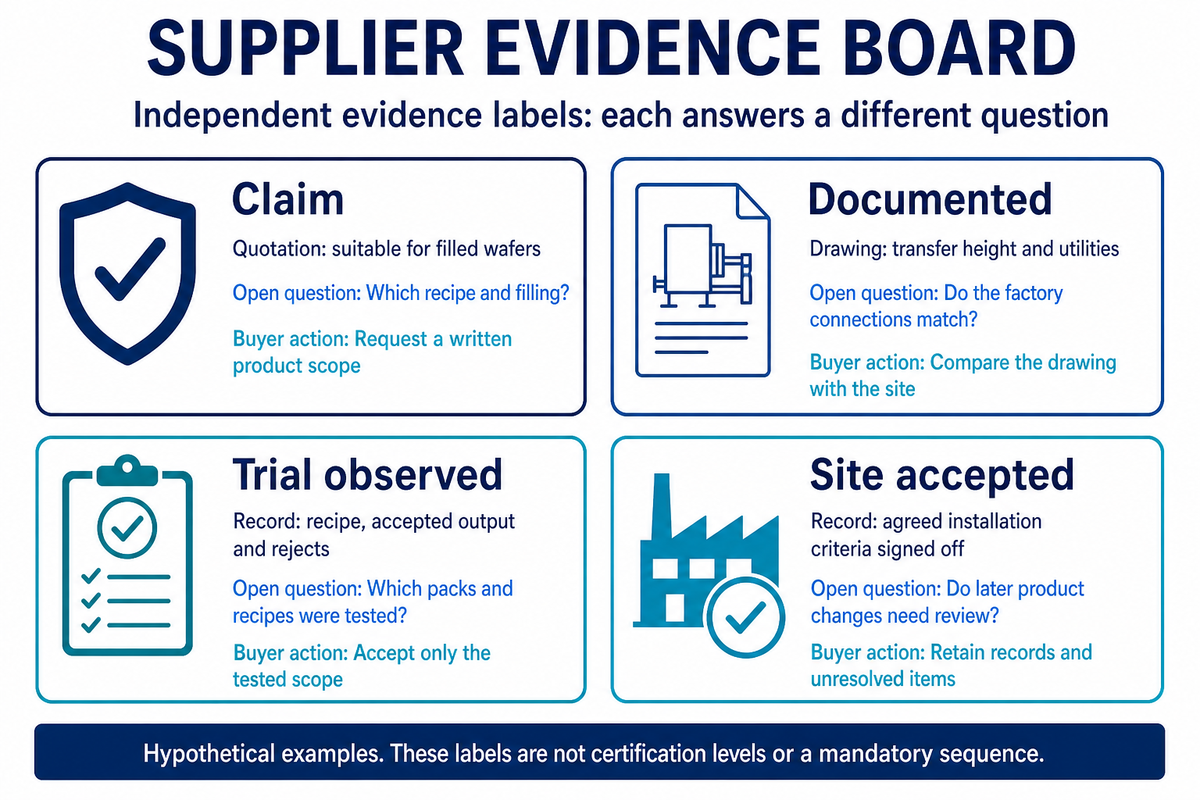
Supplier evidence becomes valuable where its supporting documentation is able to answer the question you require resolved. Establish the product, machinery build, conditions and acceptance criterion supporting it. Drawings can resolve dimensional questions, while throughput estimates may require specified product tests. Differing questions call for differing proof documents.
4-State Supplier Evidence Board
Use the four labels below separately. They aren’t a registration scheme or mandatory sequence. An adequate documentary record doesn’t have to turn into a production trial simply to cross the table. On the other hand, a trial video can’t answer every question about the machine’s construction.
| Evidence label | Example record | What remains open | Buyer decision |
|---|---|---|---|
| Claim | Quotation says “suitable for filled wafers” | No recipe or filling has been identified | Procurement requests a written product scope |
| Documented | Drawing identifies transfer height and utilities | Factory connection points have not been checked | Plant engineer compares the drawing with the site |
| Trial observed | Agreed recipe runs with output and rejects recorded | Different packs and recipes remain outside the test | Quality and production accept only the tested scope |
| Site accepted | Signed record closes the agreed installation criteria | Later product changes may need further evaluation | Owner retains the record and unresolved-item list |
Record who reviewed each item and what would change the decision. That traceability matters when a high-precision or high-quality claim refers to an earlier machine build. The board turns “send more information” into a specific request: a missing drawing, a different product sample or a test of a disputed transfer. Tom Egan’s 2025 production-line article supports agreeing factory and site acceptance measures early. The four labels themselves are this guide’s editorial method.
Compare Quotes on the Same Supply Boundary
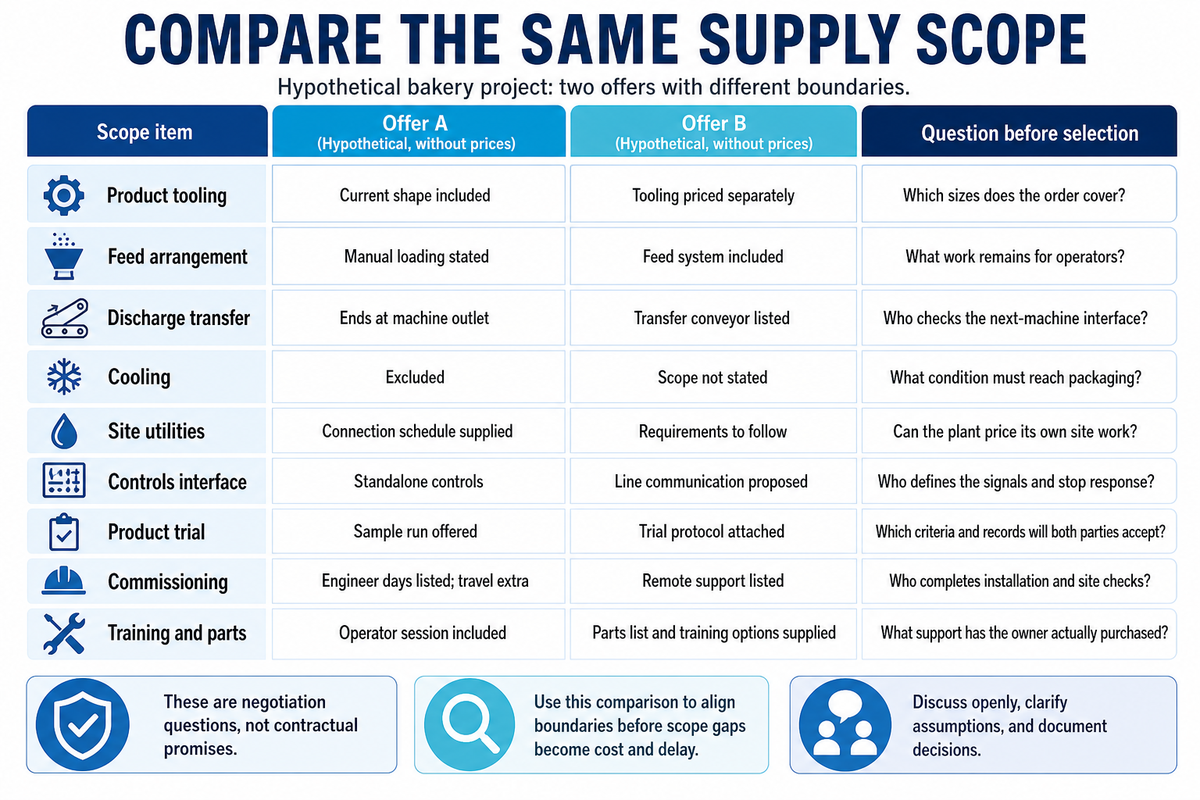
Compare quotes after you’ve separated included machinery, options and client-supplied work, and put identical product profile and transfer point descriptions in each offer. An apparently lower-price package could still be correct, but finance requires a clear report of remaining work and expenditure at the factory. Scalable solutions should show subsequent steps and their interfaces along the machinery lifecycle. An undefined installation scope can leave hidden costs for the buyer.
Quote Boundary Sheet
The packaging and processing layout below uses constructed quote descriptions without invented prices. It demonstrates how procurement can render unlike offers comparable. Replace these lines with actual quotes to obtain written responses to unresolved points. The responsibilities listed here are issues for negotiation, not a supplier obligation.
| Scope item | Offer A | Offer B | Question before selection |
|---|---|---|---|
| Product tooling | Current shape included | Tooling priced separately | Which sizes does the order cover? |
| Feed arrangement | Manual loading stated | Feed system included | What work remains for operators? |
| Discharge transfer | Ends at machine outlet | Transfer conveyor listed | Who checks the next-machine interface? |
| Cooling | Excluded | Scope not stated | What condition must reach packaging? |
| Site utilities | Connection schedule supplied | Requirements to follow | Can the plant price its own site work? |
| Controls interface | Standalone controls | Line communication proposed | Who defines the signals and stop response? |
| Product trial | Sample run offered | Trial protocol attached | Which criteria and records will both parties accept? |
| Commissioning | Engineer days listed; travel extra | Remote support listed | Who completes installation and site checks? |
| Training and parts | Operator session included | Parts list and training options supplied | What support has the owner actually purchased? |
Installation staffing and travel are part of the purchasing-specification scope in the university guide. Allocate other cost enquiries to finance; allocate interface checks to the factory head. The factory needs the plant’s measurements before the sales person can resolve an unknown site condition.
Product-to-Pack Bottleneck Map: hypothetical bakery line
Food preparation → forming → cooling → transfer → packaging of batches into containers. Review the complete food production journey before purchasing advanced machinery for one stage. Plant utilities, cleaning access and operating personnel support the whole journey.
At each transfer point specify the desired product state, accepted output and accountable party. If packaging needs a cooler or differently oriented product, a faster former may leave that constraint unresolved. Measure the transfer point before finance approves added machine capacity for high-volume production. Efficient processing depends on the agreed route, not just the former’s quoted speed.
Janna Hamlett’s used-equipment purchasing article highlights upstream and downstream constraints, utilities and maintenance capability. The map extends those questions to this hypothetical new-line enquiry; it isn’t a measured factory layout.
Specify Food Safety and Hygiene Evidence
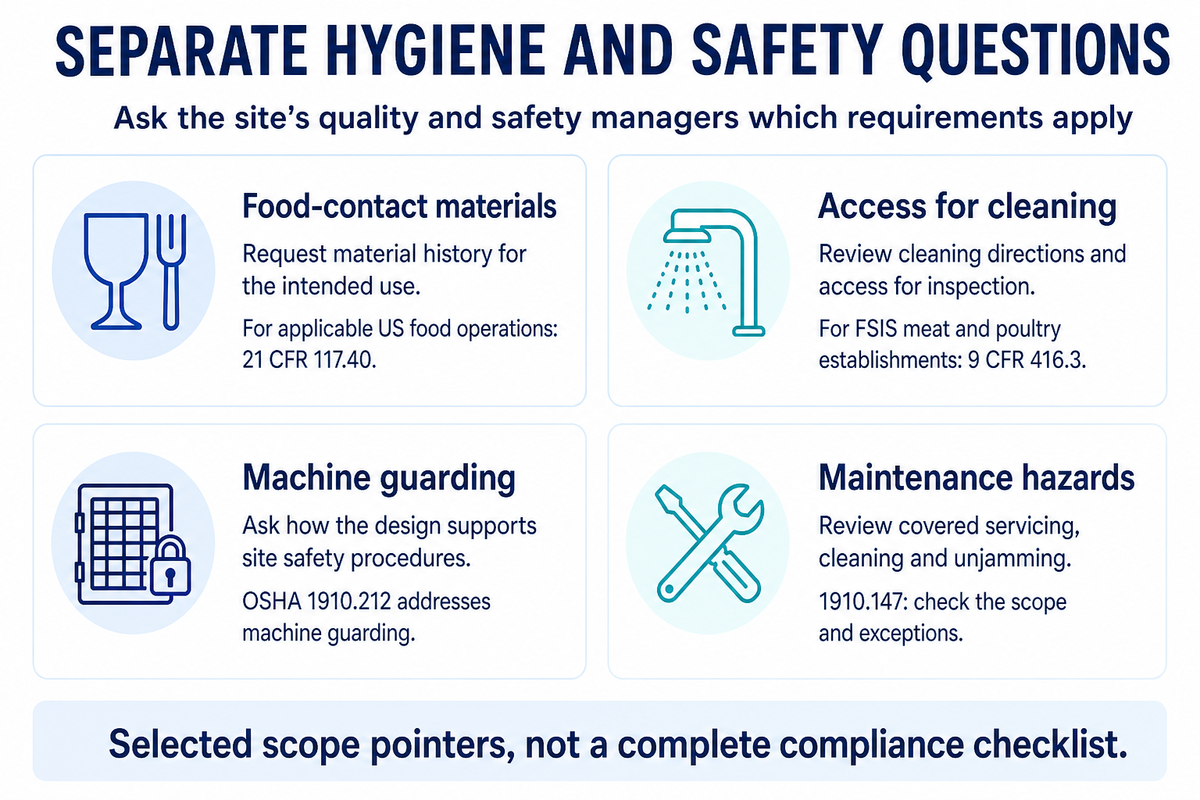
Consult your quality and safety managers on which standards are applicable to the product, premises and planned machine operation, then request evidence according to that scope. Food-contact materials, access for cleaning, machine guarding and maintenance hazards require separate treatment. Certification labels and the phrase “food-grade” don’t constitute full purchasing requirements.
For applicable US food operations, 21 CFR 117.40 addresses cleanable equipment, materials suited to their intended use and access for cleaning and maintenance. Meat and poultry establishments under FSIS have a separate equipment provision in 9 CFR 416.3, including sanitary condition and access for inspection. These are selected scope pointers for food safety standards, not a complete compliance checklist.
Bring the cleaning task into the machinery review. OSHA 1910.212 addresses machine guarding. 1910.147 on hazardous energy addresses covered servicing and maintenance where unexpected start-up or stored energy could injure workers; its definitions include cleaning and unjamming, subject to its scope and exceptions. Ask the supplier how its design supports the site’s safety procedures.
The EHEDG GL 8 catalogue lists a fourth edition dated December 2025. Its public description concerns hygienic design for intended use; the full guideline wasn’t reviewed for this article. A catalogue reference is also different from evidence that a particular machine is certified.
Quality should request supporting material history and cleaning directions to support any sanitation claim. The factory team should verify whether the proposal makes such operations feasible. Responsibility for ensuring food safety and quality includes the factory’s food safety or HACCP plan; evidence from the supplier can support it, but purchasing industrial food equipment doesn’t finalize it.
Plan Product Trials and Acceptance
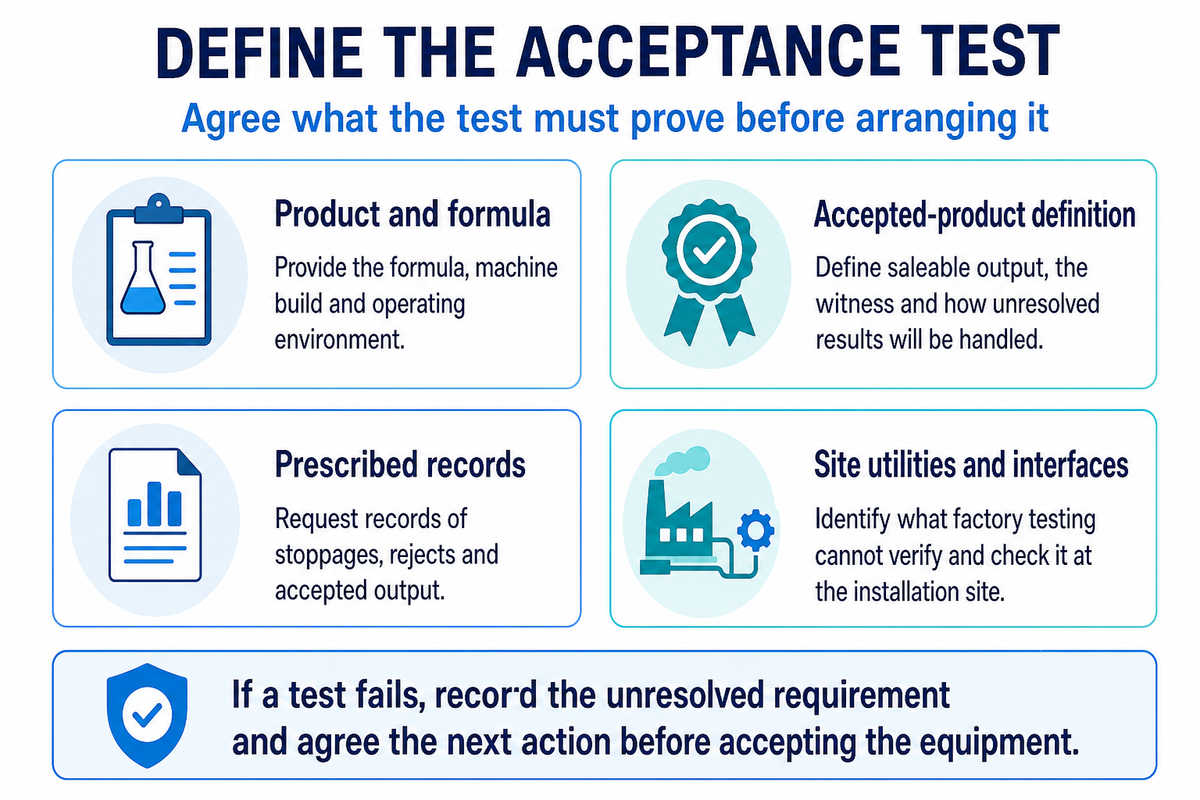
Define what product testing must prove before arranging it. Provide the formula, machine build, operating environment, accepted-product definition and prescribed records. Factory testing can resolve issues prior to shipment, and site acceptance can then verify the install scope, including utilities or interfaces not available in the previous test.
Short clips can show a forming action without showing stoppages, rejects or the next operation. Ask for the relevant record rather than a longer promotional video. In an equipment commissioning discussion, practitioners described factory and site checks and the need for several departments to agree the requirements. Those are reported experiences, not a universal test duration or acceptance standard.
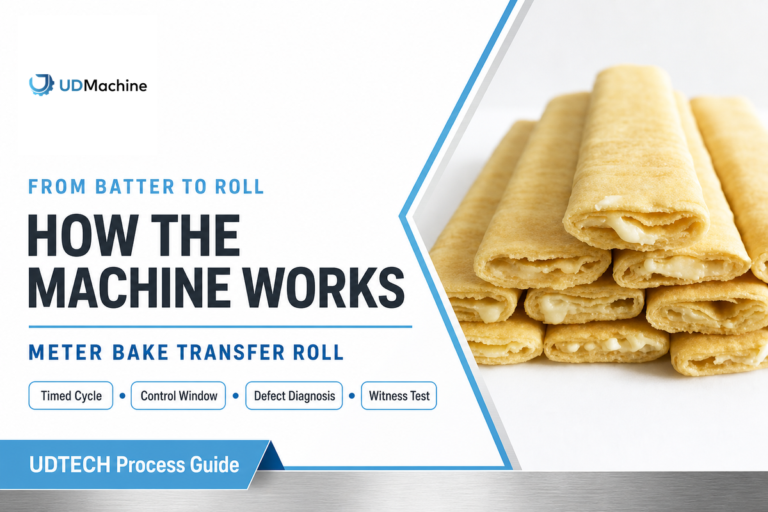
When purchasing a rolled-wafer project, send the nominated supplier the intended product, filling details and the rolled-wafer equipment options you are considering. Define the condition that counts as saleable output, who witnesses the test and how an unresolved result will be handled. The rotary egg roll machine guide offers a more detailed next step for that equipment family.
The buyer can accept a drawing of an interface dimension and also keep a separate trial requirement for product handling. Keep the two in view. Neither a successful test on another recipe nor an empty-machine run ends the question you include in the purchase specification. If acceptance tests fail, record the unresolved requirement and agree the next action before accepting the equipment.
Confirm Installation, Training and Parts Availability
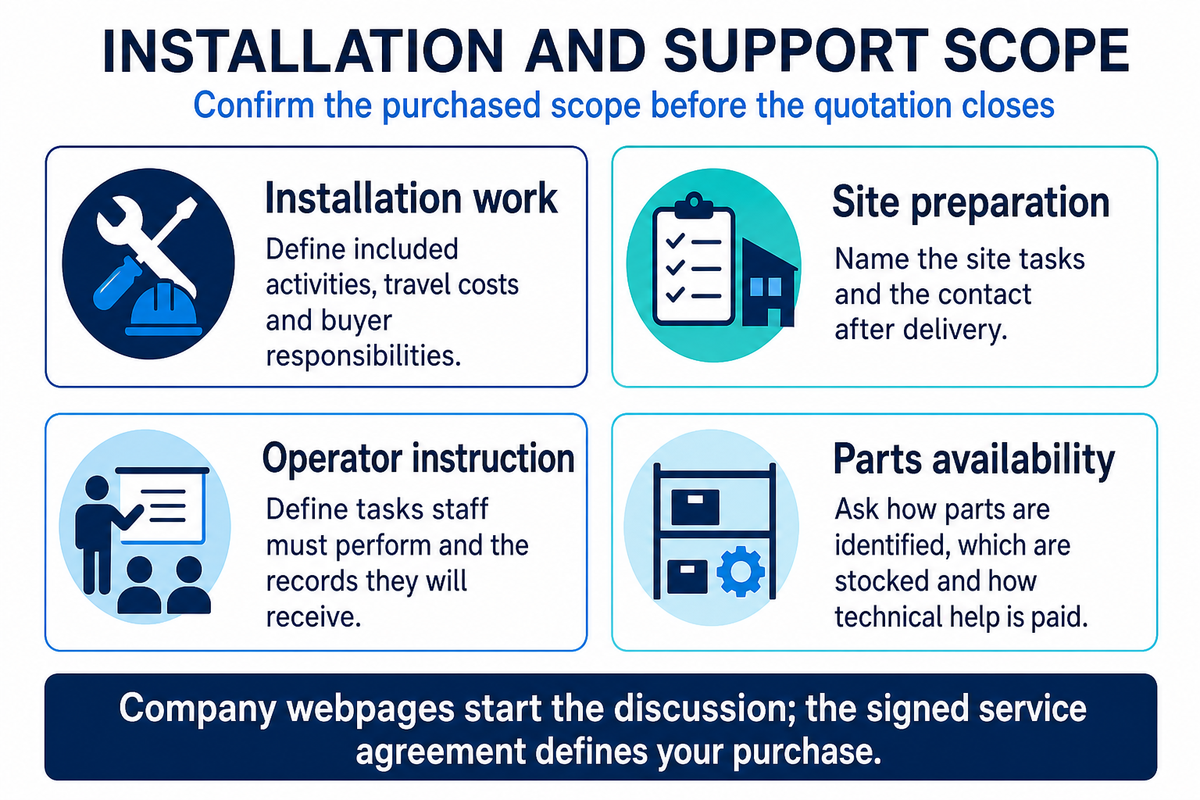
Confirm installation, operator instruction and parts availability before the quotation closes. Identify the included work, site preparation and contact person after delivery. An owner needs to know how the machine enters service and how to obtain assistance after the sales discussion closes. Modern food production may leave maintenance staff working on unfamiliar sensors and control systems.
UDTECH’s public project description includes recording criteria before build, running the customer’s product before shipment, commissioning at the customer’s factory and training operators. Ask for those activities to be defined for your order, with any travel costs and buyer responsibilities stated. Company webpages start the discussion; the signed service agreement defines your purchase.
Training also needs an observable result. Egan’s production-line article distinguishes operator proficiency from attendance. Have the plant manager identify the tasks staff must perform and the records they’ll receive. Maintenance may need a parts list and fault information that an operator session doesn’t cover.
Ask how replacement parts are identified, which are stock parts and how technical help is paid. Don’t buy into a time-to-response expectation that can’t be budgeted. If predictive maintenance is offered, clarify the data, skills and ongoing service it needs. Where the supplier cannot confirm a service arrangement, the owner can price local capability or keep that item open before committing.
What Automation Trends Change for Buyers in 2026
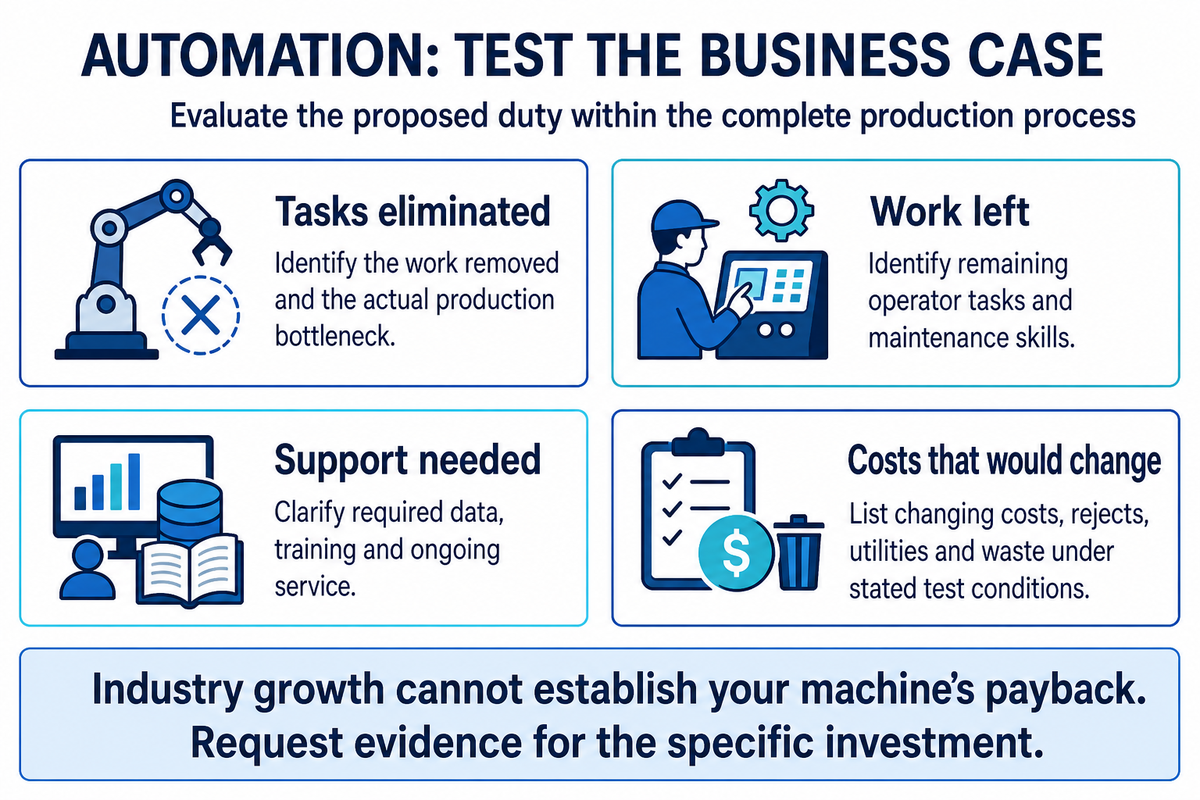
Automation can change both the number of operators required and the skills a factory needs to maintain production. Evaluate those impacts separately. A supplier’s labor-savings claim should identify the tasks eliminated, the work left and the support needed. Growth in the food processing industry helps make the case but it can’t establish your machine’s payback.
PMMI and FPSA’s May 2026 announcement reports $6.2 billion in US food and beverage processing machinery shipment value for 2025. It identifies workforce shortages as a reason for automation investment. The announcement concerns the US food and beverage industry. Its shipment figure isn’t the global food processing equipment market or an individual supplier’s sales.
The Bureau of Labor Statistics’ June 2026 analysis expects mixed employment effects across food manufacturing industries. Some automated processes may need fewer workers even as output grows. That doesn’t conflict with an individual plant needing stronger maintenance skills.
“The most costly and elaborate solution is not always the best for any given application”
For the investment meeting, have production describe the bottleneck and finance list the costs that would actually change. Quality should identify any effect on rejects or inspection work. To improve efficiency, agree which tasks or losses the purchase should change. Production efficiency and operational efficiency claims need that same measured basis. Compare the proposed duty with the complete process, then request the evidence needed to resolve the largest uncertainty. An automation label alone is too little to buy on.
For sustainability-driven purchases, ask how energy-efficient or high-yield claims account for utilities, rejected product and waste management. Modern food plants need the actual test conditions behind those labels, not an assumed saving.
Frequently Asked Questions
How do I choose the right food processing machine?
Start with the product, required operation and accepted output. Give suppliers the recipe conditions, utilities and interfaces they need to propose equipment. Compare written supply boundaries, relevant evidence and support provisions before price. For a food processing machine that must handle a difficult product, agree how a sample trial will address the uncertainty rather than accepting a generic demonstration.
Are commercial food processing machines easy to clean?
Cleaning access depends on the machine design, product residue and cleaning method. Ask the supplier to show the parts that must be opened or removed, the tools needed and the cleaning instructions. Your food safety team should review whether the proposed procedure fits your operation. Stainless steel construction alone doesn’t answer these questions or establish that every area can be cleaned effectively.
Who are the largest food equipment manufacturers in the USA?
Company revenue, installed base and the size of a product division measure different things. Start with manufacturers that document relevant equipment and support in your location. Searches for top food processing equipment manufacturers or the best food processing equipment can return company lists, distributors and market reports. Check what each list measures before using it to choose a supplier. The food processing equipment sector includes firms with quite different duties. This guide doesn’t rank companies by size.
What is the difference between a commercial food processor and a residential model?
Check the stated workload, application limits and service provisions for the exact model. A larger motor alone doesn’t establish that household equipment is suitable for factory production.
How to find manufacturers for food products?
Separate food producers and co-packers from machinery builders. The food processing equipment industry supplies various food businesses with different process needs. For equipment, search by process and product, then check the supplier’s relevant scope and trial arrangements.
Prepare your equipment enquiry. Bring your product sample or specification, target accepted output, current bottleneck and open scope questions to UDTECH. The evidence board and quote sheet will help your factory and the supplier decide what can be specified now and what needs a trial. A shortlist of leading food processing equipment suppliers still needs those project-specific answers.
Research basis: public official, university, industry and supplier sources. The worksheets are editorial synthesis; no private factory tests or supplier performance rankings were used.
References & Sources
- Oklahoma State University: Selecting and Purchasing Food Process Equipment
- US20240308099A1: published slicing and conveyor-system disclosure
- Food Engineering: Tom Egan on production-line acceptance and training
- Food Safety Magazine: Janna Hamlett on buying used processing equipment
- Electronic Code of Federal Regulations: 21 CFR 117.40
- Electronic Code of Federal Regulations: 9 CFR 416.3
- Occupational Safety and Health Administration: 1910.212
- Electronic Code of Federal Regulations: 29 CFR 1910.147
- European Hygienic Engineering and Design Group: GL 8 public catalogue
- PMMI and FPSA: 2026 processing-industry report announcement
- US Bureau of Labor Statistics: food-manufacturing employment projections
- Food Engineering: Wayne Labs on automation and labor