Get in touch with UDTECH Company


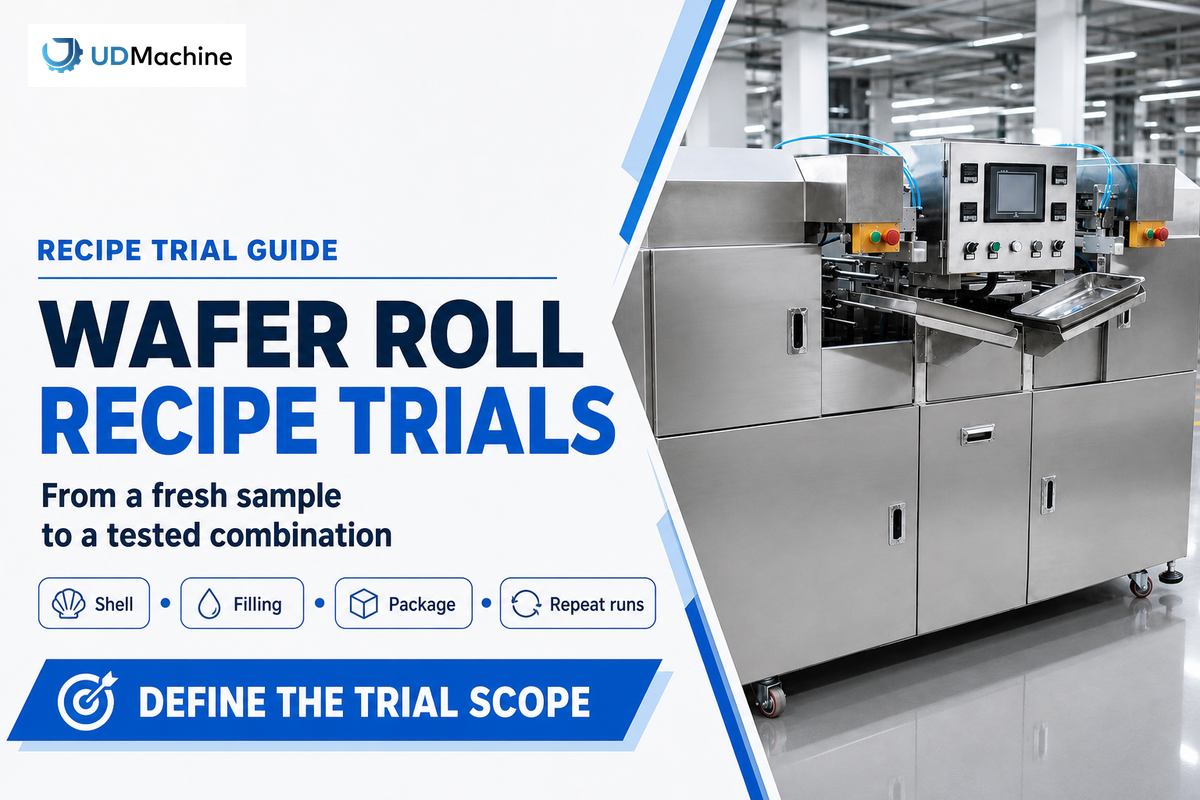
A wafer roll making machine bakes a thin batter strip and winds it into a crisp tube. To test a recipe, compare shell and filling combinations under recorded conditions, then assess intactness and crispness after cooling, packing and storage.
Trial brief
- Product: a baked wafer tube, hollow or filled.
- Comparison: two shell recipes and two fillings, plus unfilled controls.
- Record: independent runs, sample identity, handling and measurement conditions.
- Decision: whether the recipe, filling route and intended package need further work.
When assessing wafer roll making machine manufacturers, begin with a recorded product trial. A demonstration can show a neat roll, but it doesn’t answer what happens to your formulation on the same equipment. Thin filling, altered flour lots, or extending the time before wrapping can modify the outcome of a trial. Agree what you will measure before the manufacturer begins. Keep the selection of machine configurations separate from recipe qualification: UDTECH’s wafer roll machine configurations page covers the commercial equipment; this guide covers the evidence to be requested.
Identify the wafer roll and its filling route
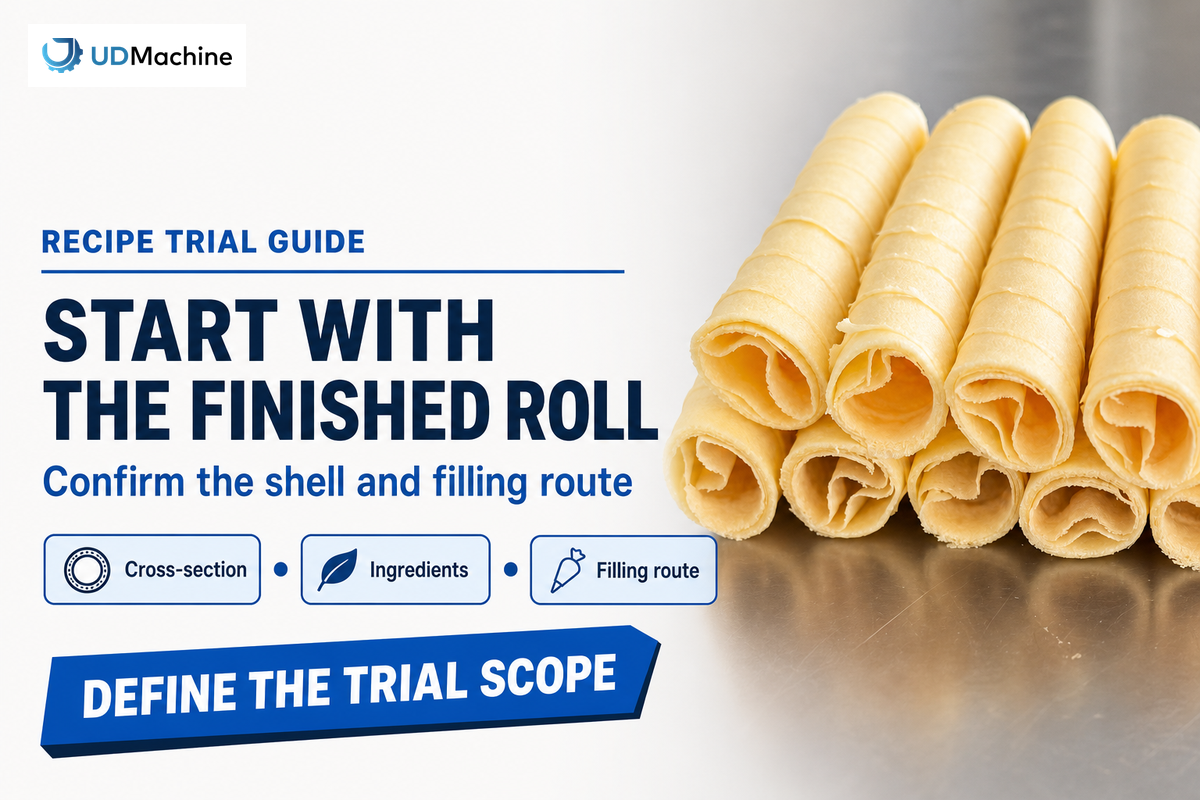
Start with the finished product and the point where filling enters the process. Hollow wafer rolls, internally coated tubes and fully filled wafer sticks expose the shell to different materials and handling. Ask the supplier to demonstrate your intended form, including the filling equipment and its functioning. That consideration is important when defining an automatic wafer stick machine.
How are wafer rolls made?
To make wafer rolls, a thin batter is baked, and then rolled while it’s still formable. The roll is cut and cooled. The type of filling or coating is dependent on the product. Document the actual process and the sequence on the product in question. A general demonstration doesn’t answer where filling can be introduced.
The academic chapter Technology of wafer biscuits addresses rolled wafer sticks differently from flat layered wafers and molded cones. The objective of an automatic wafer stick roll machine trial is to demonstrate the required shell and filling route. “Egg roll” can describe a different snack, so a picture, cross-section and ingredient list would be more helpful than the name. See the egg roll and wafer process guide for other format variations.
Common mistake: Approving a hollow sample when the intended product is cream filled is a common error. The shell may form correctly while the proposed filling still requires a different pump, nozzle or temperature-control arrangement. Confirm those details with the equipment supplier before the trial.
Set a repeatable batter and shell reference
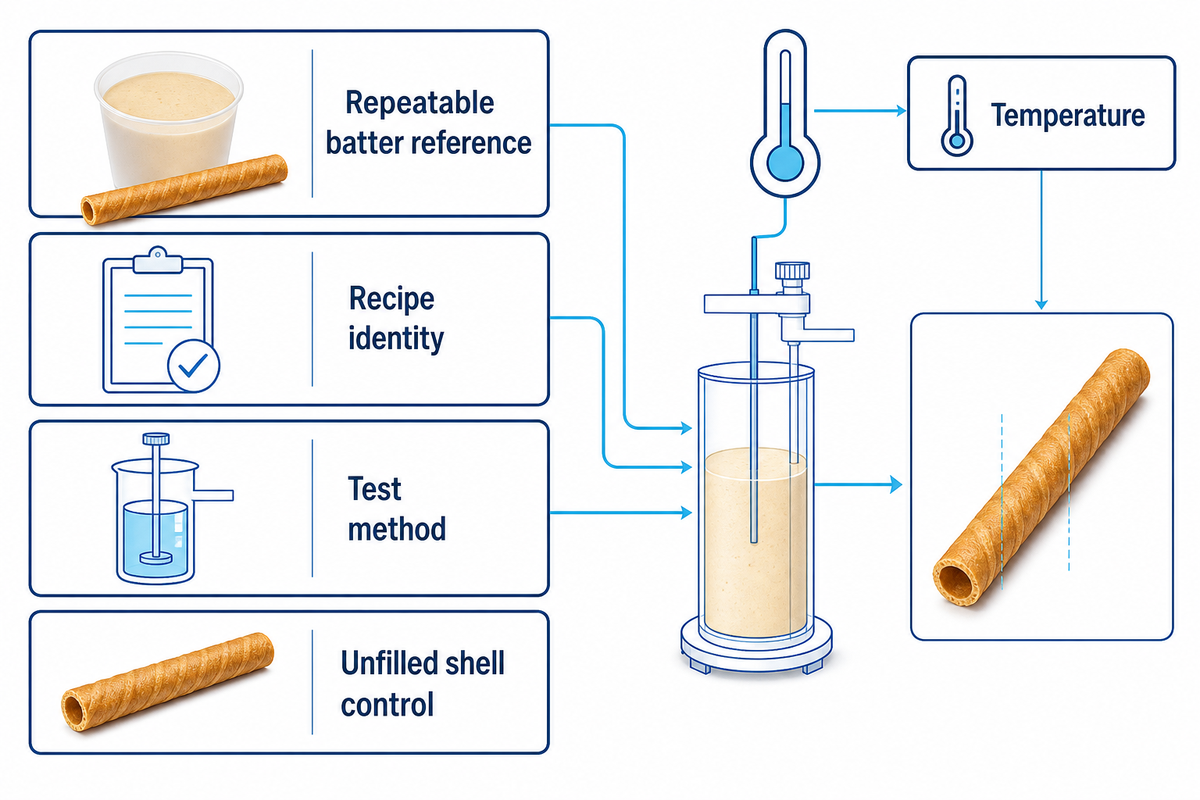
Use a reference wafer batter recipe and document how it’s handled and kept. As in other food processing trials, keep the identity of the recipe unchanged during manufacture. A result of viscosity without its test method and temperature is difficult to compare against the next result. Keep an unfilled sample of each shell condition to see if the filling obscures a change in the baked shell.
A published fresh-egg-waffle experiment kept preparation constant while measuring batter temperature, density, acidity and flow-cup time. Its recipes and limits belong to waffles and not your wafer processing line. The useful lesson here is measurement discipline: record the instrument or cup, procedure, sample temperature and elapsed time. Don’t compare a cup-drain time with a rotational viscosity reading and draw conclusions as if they were the same measurement.
Describe mixing in practical terms. If a food machinery quotation calls the mixer “material beating” equipment, ask for the mixing sequence, batch size and the arrangement behind that label. Record actual settings for the feed of the batter, bake cycle and temperature control, and where each temperature is measured. A set point on a control panel and a product measurement answer different questions.
Consider a hypothetical bakery changing its flour supplier. The operator adjusts the consistency by adding water until it pours like the batch from the day before, while the product developer changes the flavor powder. The first rolls look good, but the second batch breaks during collection. This trial can’t determine what effect changing the flour has compared to the water and flavor adjustments. Go back to the reference recipe, and label the changes being made. Compare the unfilled shells before adding another filling variable. The existing food product scale-up process guide covers version control and wider production transfer; here, the immediate task is to preserve a usable shell comparison.
Compare hollow and filled wafer sticks on the same line
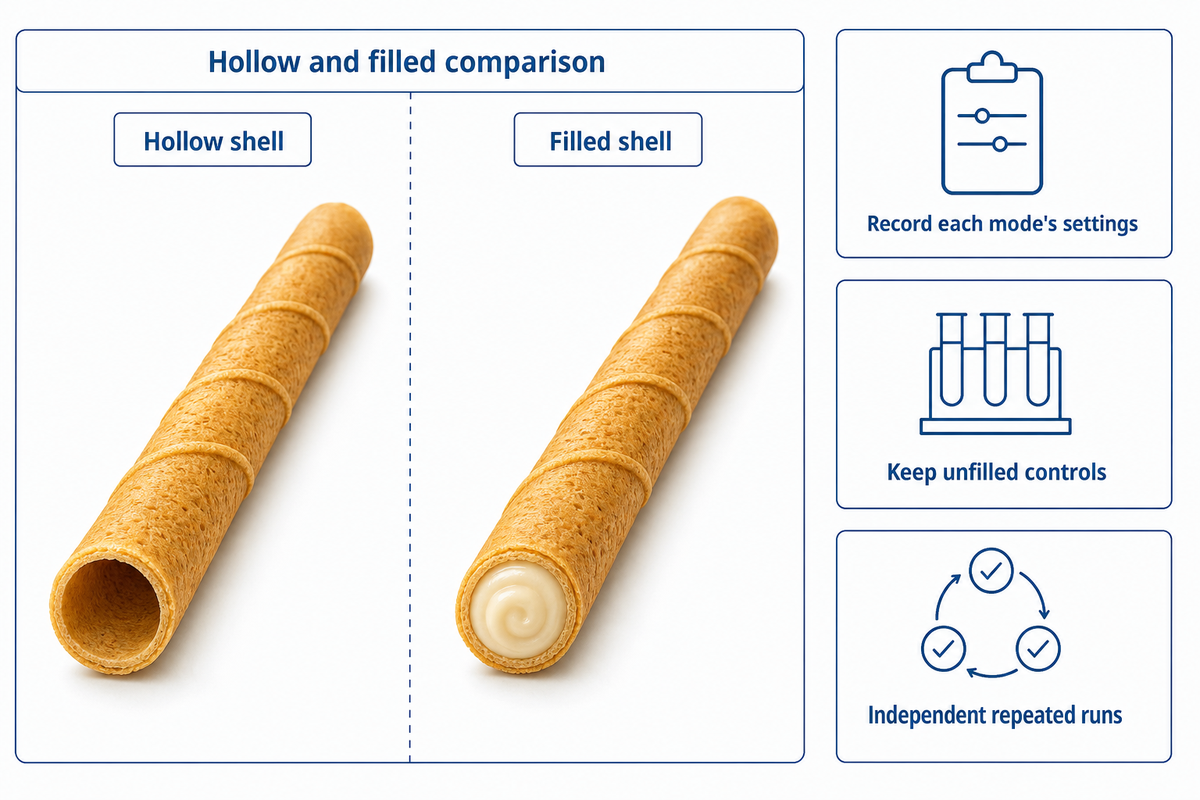
Consider accepted samples of output and assess piece condition as well as finished mass. A filled wafer is heavier due to the presence of filling; greater kilograms per hour don’t, by themselves, indicate faster shell production. Use the same period of time and explain which kind of rejects, interruptions and handling losses have been incorporated in the result under study.
The UDTECH UD05 series publically shows both hollow and centre-filled formats. This allows for a request for both demonstrations, but doesn’t guarantee identical performance for your recipe. An automatic wafer stick production line may also use different settings between modes. Document the settings rather than say the runs are equivalent. Leave overall line sizing to the separate egg roll capacity-planning guide.
Can a wafer stick production line produce different flavors?
A wafer stick production line can create various flavors, depending on the configured equipment and recipes. Verify if flavor changes affect the batter or the filling, or if they affect both. Then compare forming, filling consistency, breakage and stored texture under the new conditions. The ability to make various flavors doesn’t guarantee each formulation will perform as intended without adjusting the process.
To evaluate an automatic wafer roll trial, keep the unfilled controls of both shell recipes. For the study, a fragile shell can be distinguished from one that changes after contact with filling. These controls don’t replace the need for independent repeated runs. Variation between runs should be checked, as is the case with producing wafer sticks. Define reliable performance based on agreed measurements, rather than the appearance of a single sample.
Run the 2 × 2 Shell, Filling Trial
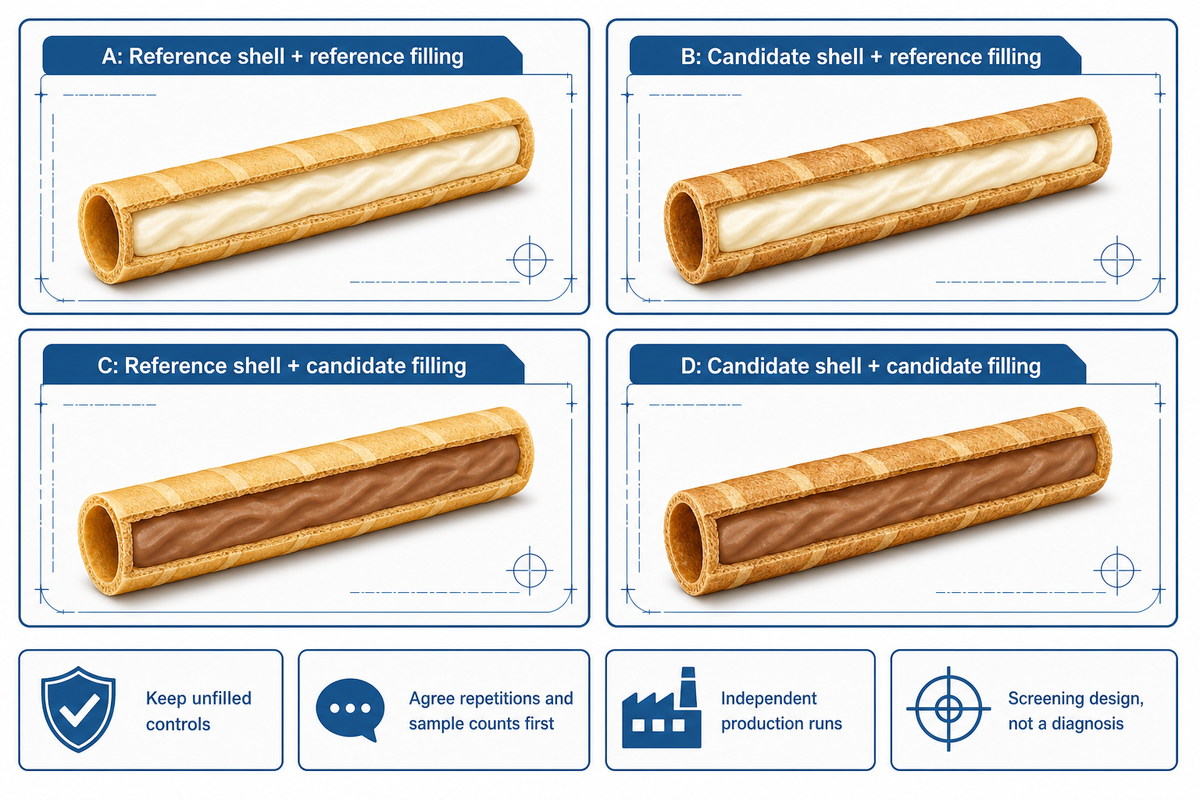
The 2 × 2 Shell, Filling Trial is a proposed screening design: combine a reference and candidate shell with a reference and candidate filling. This design arranges comparisons, and isn’t a validated diagnostic design. Product development and quality staff should choose the run repetitions, sample counts and acceptance criteria before interpreting differences. Negotiate measurable terms for defining high-quality wafer sticks based on product (including intactness, texture) rather than the appearance of a single sample.
Why separate these factors? Ergun, Lietha and Hartel’s review of moisture in confections describes how the movement of moisture in systems is driven by differences in water activity, while the rate of movement is determined by the resistance of the system. Water activity describes water’s availability relative to pure water under defined conditions; it is not the percentage of water in a recipe. Measure the components as designed rather than speculating about the direction of moisture transfer based on percentages.
| Condition | Shell | Filling | Comparison purpose |
|---|---|---|---|
| A | Reference recipe | Reference filling | Check the starting combination |
| B | Candidate recipe | Reference filling | Compare shells with filling held constant |
| C | Reference recipe | Candidate filling | Compare fillings with shell held constant |
| D | Candidate recipe | Candidate filling | Observe the proposed finished combination |
Use a production run independently prepared and operated as the experimental unit. A few sticks collected from that run represent variation within the run and aren’t a few independent trials. Repeat the design as agreed with the quality lead. Randomize run order as feasible. If the order of runs is constrained due to cleanings or changeovers, document the constraint and group runs by batch or day to represent sequence effects.
“Replication provides information on variability”
NIST’s example pertains to a polishing process, so the example presents general principles of experimental design, not a wafer recipe. In this screening exercise, hold the intended package and storage conditions fixed, first. A film comparison can follow as a separate test. Changing the shell, filling, and wrapper together creates an observed difference that’s difficult to interpret.
| Measurement or record | Unit or format | Comparison requirement | Responsible role |
|---|---|---|---|
| Shell and filling identities | Recipe revision and ingredient lot | Preserve the reference/candidate pairing | Product development |
| Independent run identity | Run code, date and sequence | Separate repeats from within-run samples | Production |
| Batter holding and temperature | Minutes and °C | Use the same sampling point | Production |
| Batter flow measurement | Seconds or method-specific viscosity units | Record instrument, procedure and temperature | Quality |
| Shell dimensions and mass | mm and g | Use the agreed method and sample count | Quality |
| Filling dose and condition | g per piece and °C | Record leakage, distribution and dose changes | Production |
| Accepted and broken pieces | Counts over a recorded time | Keep defect definitions constant | Quality |
| Component water activity | Dimensionless value and test temperature | Use a consistent validated measurement method | Quality |
| Package and storage identity | Film/seal record, elapsed time, °C and relative humidity | Trace every stored sample to its run | Quality and procurement |
Consider testing chocolate filled wafer sticks: a candidate cocoa filling appears to be acceptable in condition C but softens the candidate shell in D. Repeat the comparison before blaming the automatic production line. Check if D used a different filling temperature, dosage or wait time before sealing. If the pattern is observed across independent runs and the controls remain stable, the interaction warrants further consideration. It doesn’t identify a single cause. The product developer can evaluate formulation compatibility, while the production staff can evaluate the filling route. Procurement can then request the required adjustment without treating a single attractive demonstration as approval of the complete roll product.
Track crispness after cooling and packaging
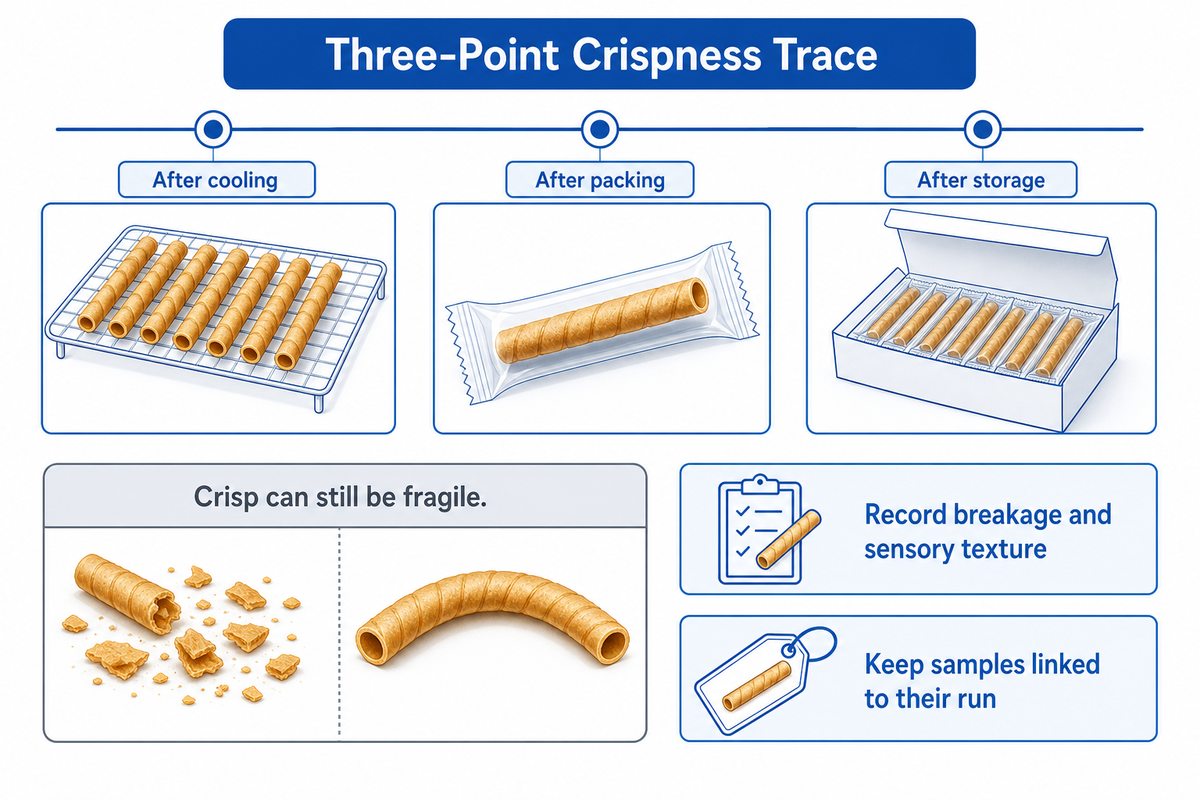
The Three-Point Crispness Trace evaluates samples following cooling, packing and storage as defined, to assess the adequacy of wafer roll packaging and handling. Record breakage of shells along with sensory texture. Product can feel crisp but may be too breakable to handle. Keep samples traceable to their independent runs, and reach an agreement on the package, environment and assessment method prior to conducting the study.
A study by the University of Bologna/Babbi researched chocolate-covered layered vanilla wafers, left at 18°C and 50% relative humidity, for eight months. They found that packaging affected retained sensory acceptability. While the alternative package used a vacuum with an added material layer, the study didn’t isolate a film only effect. So based on this information, the shelf life of your rolled wafer sticks can’t be determined.
The opposing issue of texture is also of importance. A 2004 wafer water-sorption study reported fragile behavior below its studied moisture window and rubbery behavior above it. Don’t implement the window in your specification. Define acceptance against your product and include the damage it suffers during normal handling.
| Observation type | Stage | Useful comparison | Next check |
|---|---|---|---|
| Unfilled shell is already soft | After cooling | Reference versus candidate shell | Review baking, recipe and exposure records |
| Shell is crisp but breaks easily | After cooling | Intact samples versus transfer rejects | Check fragility and handling separately |
| Filled sample differs from its unfilled control | After cooling | Matched shell with and without filling | Review contact time, dose and filling condition |
| Breakage rises after transfer | After packing | Before-transfer versus packed samples | Observe drops, guides and product spacing |
| Filling reaches the seal area | After packing | Clean-seal versus contaminated-seal samples | Check dose, leakage and sealing conditions |
| Visible package defects appear | After packing | Defect classes within the same run | Inspect film handling and seals |
| Only filled samples soften | After storage | Filled versus unfilled controls | Investigate internal migration without assuming it |
| Both filled and unfilled samples soften | After storage | Matched packages and exposure history | Check external moisture routes and initial condition |
| Results vary between runs | Any stage | Independent repeats and run sequence | Resolve process variation before accepting a recipe effect |
Sensory evaluation should be conducted using a defined and agreed upon procedure, along with instrumental data where available. Water activity shouldn’t be the sole criterion for determining quality. Accelerated storage should be justified and demonstrated to relate to real storage conditions. Harsher conditions can introduce a different deterioration mechanism.
Suppose a buyer’s samples leave the factory crisp, then arrive softer after a packaging-film change. In a hypothetical situation, the investigation would keep the same shell and filling, and compare the packages under controlled conditions, and check the seal, along with the film specification, rather than blaming the wafer stick roll machine immediately. Meanwhile, finance would distinguish the cheaper film’s purported saving from the cost of damaged or rejected product. No saving is established until the finished pack performs acceptably. This trace points out where evidence is lacking; it can’t transform one delivery or one storage result into a shelf-life guarantee.
Keep the trial valid through stops and changeovers
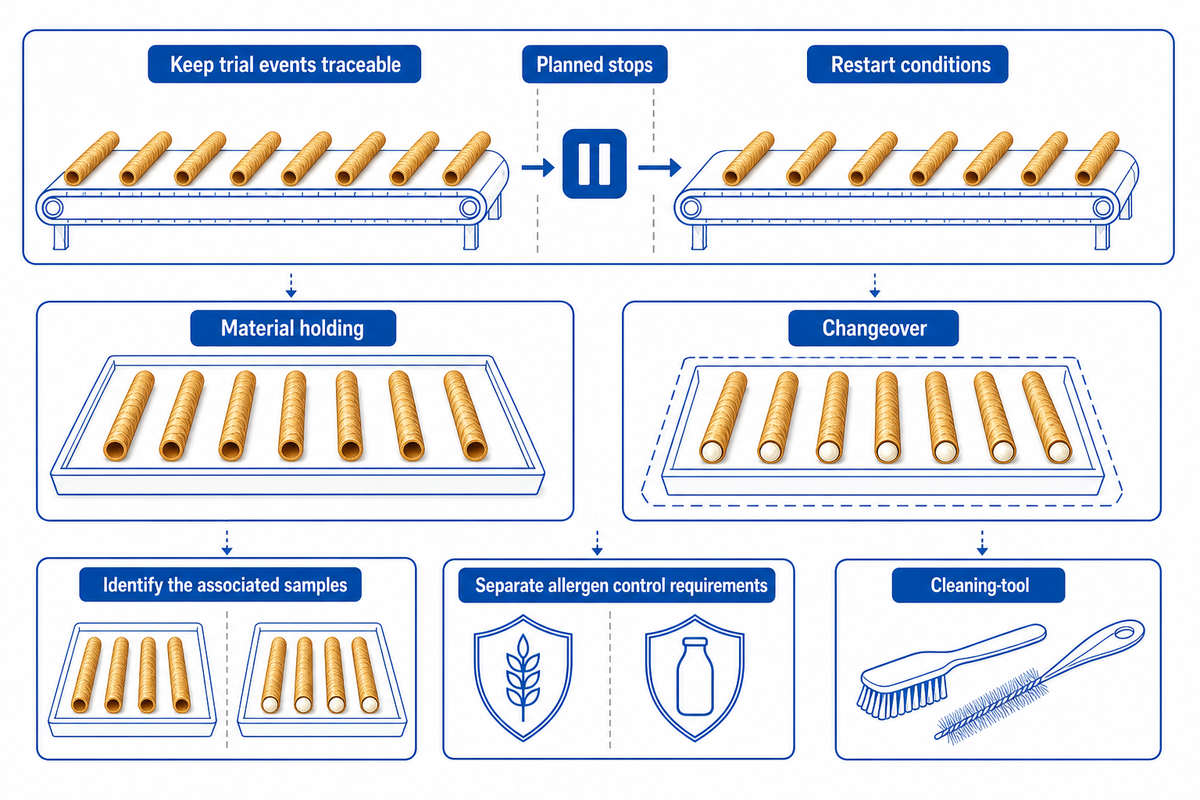
Wafer roll sample testing should include operating events as they may impact the samples used for comparison. Document planned stops, restart conditions, material holding and changeover, and identify the samples associated with each. For the product textural assessment, ensure that allergen control requirements of the facility and destination market are also kept separate.
Ask the operator to illustrate the way the automated wafer stick line resumes after an agreed stop. If automatic ignition is also included, follow the approved restart procedure for that configuration. Record the condition of the batter and filling before taking the restart samples. Don’t mix those samples with the background or continuous samples. If a change occurs to the bake, feed, filling, or cooling conditions, start a new comparison rather than treating the change as the background.
The FDA’s 2025 draft guidance on low-moisture ready-to-eat foods addresses sanitation and environmental monitoring. It is draft guidance, not new regulation, and a dry crispy shell does not mean safe production. A nice looking sample does not validate an allergen changeover.
Do
- Identify restart samples separately.
- Record cleaning and changeover conditions.
- Use the facility’s approved food-safety procedures.
Don’t
- Mix steady-run and restart results without labels.
- Treat food-grade stainless steel alone as sanitation proof.
- Invent a universal cleaning time from a demonstration.
For routine access and inspection questions, use the egg roll machine maintenance guide. Obtain the configured machine’s instructions before operating or cleaning it. A short recipe trial doesn’t ensure long-term component durability.
Put recipe trials and repeat tests into the machine quotation
Include the trial scope in the quotes and acceptance documents. This should include recipes, supplied materials, configured modules, measurements, repeat runs, and the response to a failed test. The procurement team needs to understand exactly what has been included. Procurement needs to know what is included, while finance needs to know who pays for ingredients, packaging, additional testing and any agreed equipment adjustment.
The food-equipment purchasing guidance by Oklahoma State specifically names the documentation of acceptance-test requirements, timing and failure consequences. Applying this to recipe trials ensures that an adequate explanation of what has been included is documented. A wafer roll machine price without these terms leaves the buyer unable to evaluate what has been included in an offer.
UDTECH’s published project process states that the buyer’s own product runs against criteria recorded before the build. Ensure the repeat runs defined in your contract are documented. Determine which parts the supplier can customize and which motor and electrical components are documented, as well as how spare parts, warranty and technical support are defined. A promise of “lifetime technical support” needs a defined service scope.
When assessing machine manufacturers, explain the production needs in product terms. Food industry buyers should differentiate measured trial results from service commitments. “Full automatic” or “fully automatic” doesn’t define the labor involved in mixing, refilling, inspection and packing. Ascertain the duties an operator still performs on a fully automatic wafer stick line. Prior to claiming automation will reduce labor costs, ask the supplier to show the tasks that remain to be done during your trial.
Match cooling and packaging to the tested production line
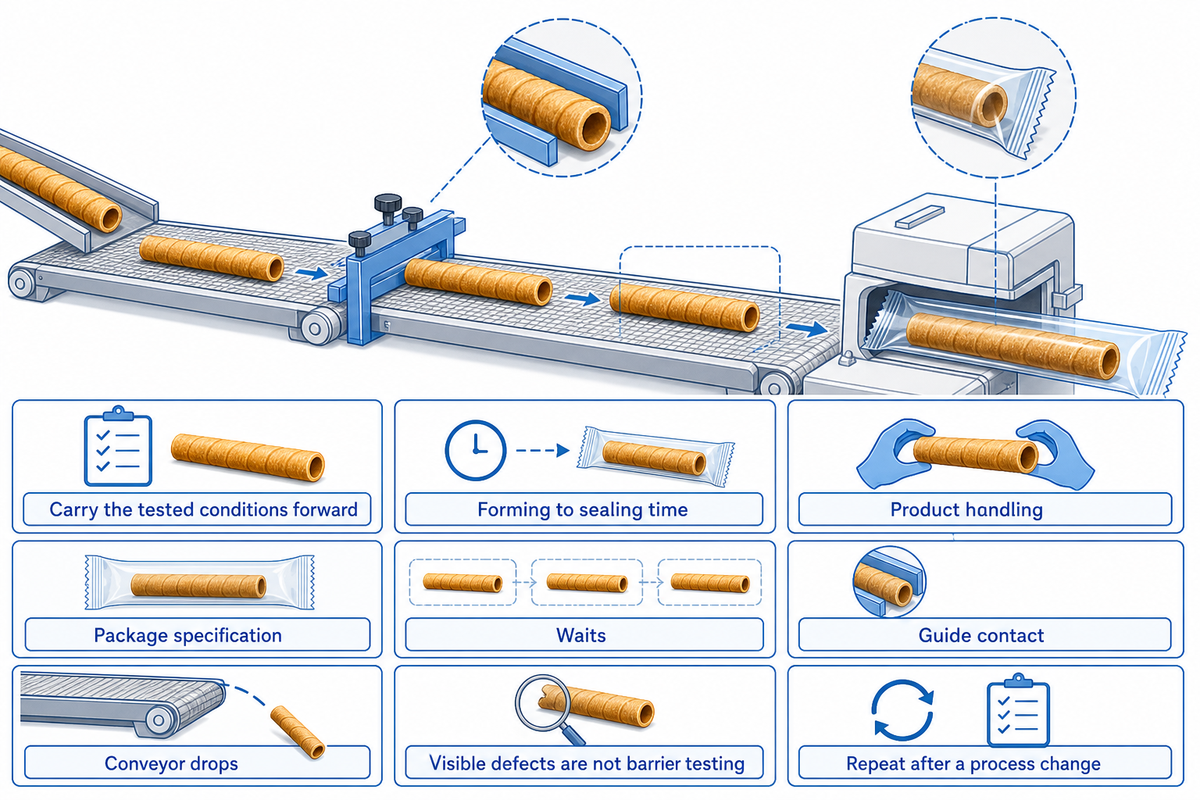
Carry the successful trial conditions into the cooling and packing arrangement. Record the time between forming and sealing, product handling and the package specification. Wafer production on a wafer roll production line is only a part of the finished-pack result; downstream transport and storage can adversely affect the product and change what the customer receives.
A Food Engineering report on wafer packaging inspection describes a plant inspecting visible package defects and label alignment. While the example provides useful operational context, vision inspection shouldn’t be confused with moisture barrier or seal-tight testing. Clarify what each check is intended to address.
On your proposed automatic production line, watch where the product waits, touches a guide or drops between conveyors. Those locations may explain breakage or extra exposure even when automatic wafer stick making itself appears stable. Don’t blindly copy settings from a biscuit production line. If a new wrapper, cooling route or filling is introduced later, repeat the comparison. Keep the successful production process linked to packaging conditions rather than approving the machine and forgetting the rest.
Key takeaway
Approve a traceable recipe, filling and package combination. A fresh sample shows what happened at the machine; independent repeats and stored samples show how reliably that result survives.
Preparing a recipe trial? Send UDTECH a finished-product sample description, shell and filling details, intended package and the comparisons you need. Use those inputs to discuss the configured equipment and written trial scope before ordering.
Frequently asked questions
These questions focus on the limits of a demonstration of a recipe and the evidence to request next. Keep answers limited to equipment, ingredients, and package used in the demonstration. General food science principles may be used as a guide in a trial, but principles can’t substitute for the specific measurements and tests required to approve a commercial production process.
What is a wafer roll?
A wafer roll is a crisp baked tube, which may be hollow, coated or filled.
The term describes the product’s form, not a single recipe or filling method. Check a cross-section to identify the shell, any inner coating and the filling distribution. Flat cream wafers, rolled cones and savoury egg rolls can involve different processes. Give the supplier a physical sample or clear photographs so both sides are discussing the same finished product and texture.
Can I use a homemade wafer roll recipe on an industrial machine?
Treat a home recipe as a development starting point that needs a controlled trial.
A recipe that works with manual production may behave differently when mixed, held, deposited and baked continuously. Preserve its ingredient weights and preparation sequence, then document adjustments on the proposed wafer stick making machine. Compare forming and unfilled-shell quality before introducing filling changes. Don’t assume that a larger batch, longer holding time or different mixing action leaves the product unchanged.
Does a crisp sample prove that a filled wafer roll will stay crisp?
No. Fresh crispness does not establish texture through the intended shelf life.
Assess the finished product in its intended package under a defined storage plan. Track unfilled controls and matched filled samples, keeping independent runs identifiable. Internal moisture migration, external exposure and handling damage can produce different problems. A water-activity result or an accelerated test needs an appropriate interpretation; neither provides a universal shelf-life number for every shell, filling and packaging combination.
How much does a wafer roll making machine cost with recipe testing?
Request a configured quotation that separates equipment and trial scope.
Ask whether ingredients, packaging, repeat runs, adjustments, travel and stored-sample testing are included. A public machine price seldom answers all of those questions. Compare equivalent deliverables before comparing totals.
Where can I buy a machine for my filled wafer product?
Approach a manufacturer that can demonstrate the required product and filling route.
Use a supplier’s product page to identify the relevant equipment, then request a recipe-specific demonstration and written acceptance terms. Establish who supplies the materials, which measurements will be taken and what happens if the trial fails. Ask for traceable samples from independent runs and the intended package. The evidence should connect the offered configuration to your product, rather than relying on another customer’s recipe or a promotional video.
References & Sources
- Technology of wafer biscuits
- published fresh-egg-waffle experiment
- Ergun, Lietha and Hartel’s review of moisture in confections
- NIST/SEMATECH, Full factorial example
- University of Bologna/Babbi study
- 2004 wafer water-sorption study
- FDA’s 2025 draft guidance on low-moisture ready-to-eat foods
- Oklahoma State’s food-equipment purchasing guidance
- Food Engineering report on wafer packaging inspection
The linked academic studies address specific wafer, waffle or confectionery systems; their numerical settings are not universal machine instructions. NIST supplies general experimental-design principles, Oklahoma State covers equipment purchasing, and FDA covers sanitation guidance. Supplier statements are identified separately. The trial tables are proposed working aids, not records of tests performed by UDTECH or guarantees of product performance.