Get in touch with UDTECH Company



It takes five coordinated plant streams to connect feuilletine line utilities before machine shipment. Those streams include 3-phase power, gas or electric heat, dry compressed air, makeup air, and wet-zone water.
Base baking drive power is small, such as 3 kW on a 60-mold unit. Full-line thermal ovens, chillers, air dryers, room dehumidifiers, and so on are the major facility loads.
Planning feuilletine line utilities requirements covers five plant streams: three-phase electrical feeders, regulated gas or electric baking heat, and ISO 8573-1 Class 1.2.1 compressed air at 6 to 8 bar. Plants also need balanced oven exhaust with makeup air and dehumidified packing rooms below 35% to 40% RH (≤0.30 aw).
Key points
- A 60-mold baking unit uses 3 kW for drive motors and controls across a 9.8 m length × 1.6 m width × 1.9 m height footprint. Full-line heating, air, and downstream modules are sized per quotation.
- Evaporating ~110 kg/h of water for 100 kg/h of finished flakes requires ~75 kWth of net heat. Electric ovens cut point-of-use energy losses by up to 40% versus gas but shift high kVA demand onto plant transformers.
- Direct food-contact air should meet voluntary ISO 8573-1:2010 Class 1.2.1 benchmarks (-40 °C pressure dew point, ≤0.01 mg/m³ oil) at 6–8 bar with point-of-use sterile filtration.
- Building negative pressure above 4.9 Pa (0.02 in. w.c.) cuts exhaust fan flow by up to 30% and pulls humid outdoor air across cooling flakes.
Updated October 2026.
Quick Specs: feuilletine line utilities requirements
| Base baking unit reference (UDTECH YT-10) | 60 molds; 3 kW drive/control electrical power; 9.8 × 1.6 × 1.9 m (full line per quotation) |
| Baking surface temperature window | 141.7–163.2 °C (wafer plates) / 150–230 °C (rotating drum, ~90 s cycle) |
| Electrical supply & cabinet ambient limit | 3-phase ±10% voltage stability; 5 °C to 40 °C ambient rating per IEC 60204-1 / NFPA 79 |
| Compressed air header & purity class | 6–8 bar; ISO 8573-1 Class 1.2.1 (-40 °C PDP) direct contact; Class 2.4.2 (+3 °C PDP) cylinders |
| Exhaust & cooling/packing room climate | Building negative pressure ≤ 4.9 Pa; packing room ≤ 35%–40% RH (+10 to +15 Pa positive) |
| Finished flake moisture & water activity | Residual moisture ≤ 2.5%–3.0%; water activity aw ≤ 0.30 (softening band 0.35–0.50 aw) |
What Utilities a Feuilletine Line Consumes When Scaling a Batter Recipe
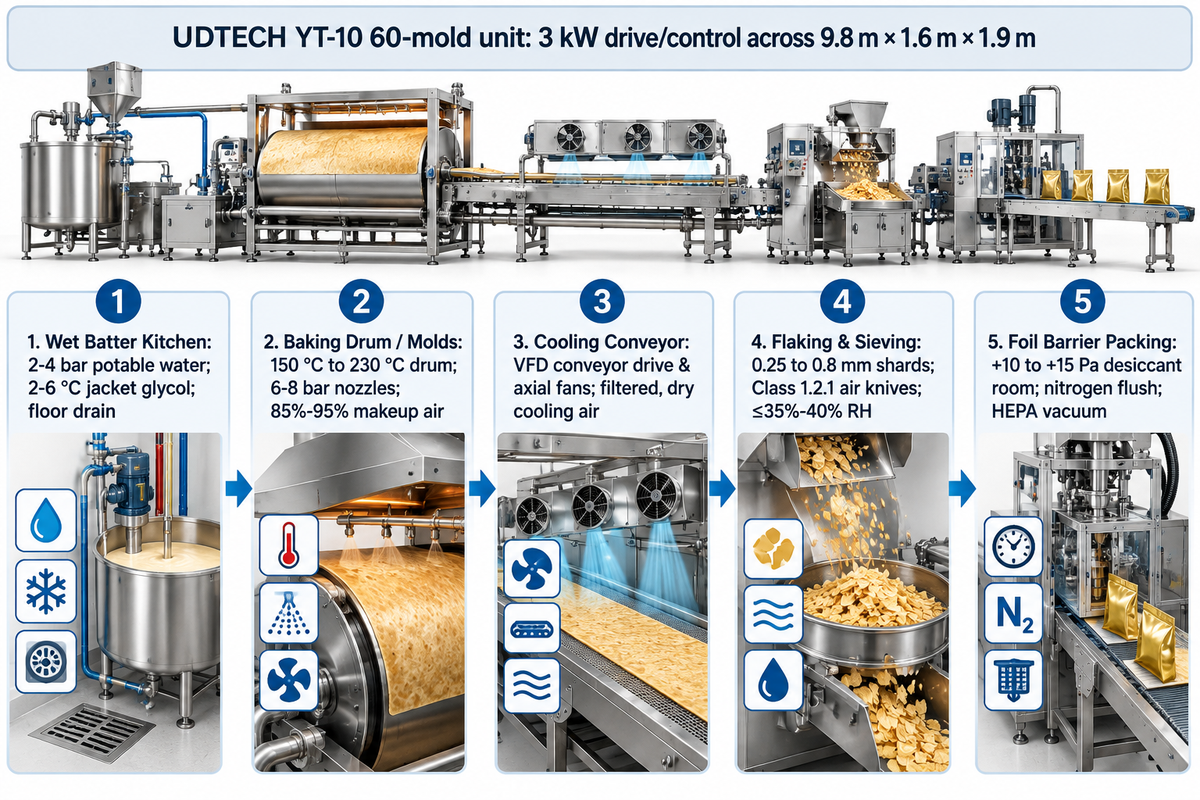
Five different plant utility headers are required to integrate a feuilletine line to an industrial line. Each step of the process from batter preparation to foil packing draws a different combination of power, heat, air, and water.
The UDTECH YT-10 60-mold baking unit has a drive and control system rated at 3 kW and measures 9.8 m × 1.6 m × 1.9 m. It’s a common mistake in engineering to base the size of the main plant breaker on the drive motor rating of the unit alone. Heating, compressed air, cooling, conveyor and dehumidifier systems are engineered separately per the project quotation.
Continuous drum lines follow the mechanical layout described in patent JP2005124452A. Liquid batter is dosed onto a 1,160 mm heated drum at 150 °C to 230 °C for about 90 seconds. Doctor blades lift the baked sheet onto a fan-cooled belt before 15 mm toothed rollers crush it into 0.25 to 0.8 mm shards. For the mechanical sequence across those modules, see our guide on the continuous drum baking and crushing workflow.
| Process Module | 3-Phase Power | Thermal Energy | Compressed Air | HVAC / Exhaust / Water |
|---|---|---|---|---|
| 1. Wet Batter Kitchen | High-shear mixer, transfer pump | Butter melting kettle jacket | Diaphragm pump & valve actuators | 2–4 bar potable water; 2–6 °C jacket glycol; floor drain |
| 2. Baking Drum / Molds | Drum/chain drive (e.g., 3 kW on YT-10), combustion blower | Gas premix burners or electric SSR heating zones | Pneumatic depositor nozzles & scraper cylinders (6–8 bar) | Canopy steam hood + flue stack; 85%–95% makeup air |
| 3. Cooling Conveyor | VFD conveyor drive & axial fans | None (heat rejection zone) | Belt tracking tensioners | Filtered, dry cooling air; zero wet drains |
| 4. Flaking & Sieving | Toothed crusher rolls & vibratory sifter motors | None | ISO 8573-1 Class 1.2.1 air knives & screen cleaning | Dry dust extraction (separate from wet oven steam); ≤35%–40% RH |
| 5. Foil Barrier Packing | Multi-head weigher & heat sealer | Sealing jaw heaters | Bagging actuators & nitrogen flush valves | Positive pressure (+10 to +15 Pa) desiccant room; HEPA vacuum |
How Do Industrial Feuilletine Lines Differ From a Homemade Tray-Baked Recipe in Utility Demand?
A homemade feuilletine recipe uses a manual process and a single deck oven. In contrast, an industrial line runs continuous synchronized motors, high-volume steam extraction, and dehumidified rooms.
In small batches, stir egg whites, icing sugar, flour, melted butter, and vanilla, to create a smooth mixture, as detailed in pastry blog posts, “Paris chez Sharon’s homemade pailleté feuilletine guide” and “The Furious Pear Pie’s bench test.” Spread a super thin film using an offset spatula and bake it before peeling the warm sheet from the parchment.
Continuous systems like the SDTN automated batter strip cooking line or a multi-mold carousel, replace batch systems. This creates a number of challenges, including the need for uninterrupted electricity or gas, and controlled climate (air conditioning).
Gas Burners vs Electric Heating: Thermal Utility Sizing for Pailleté Feuilletine
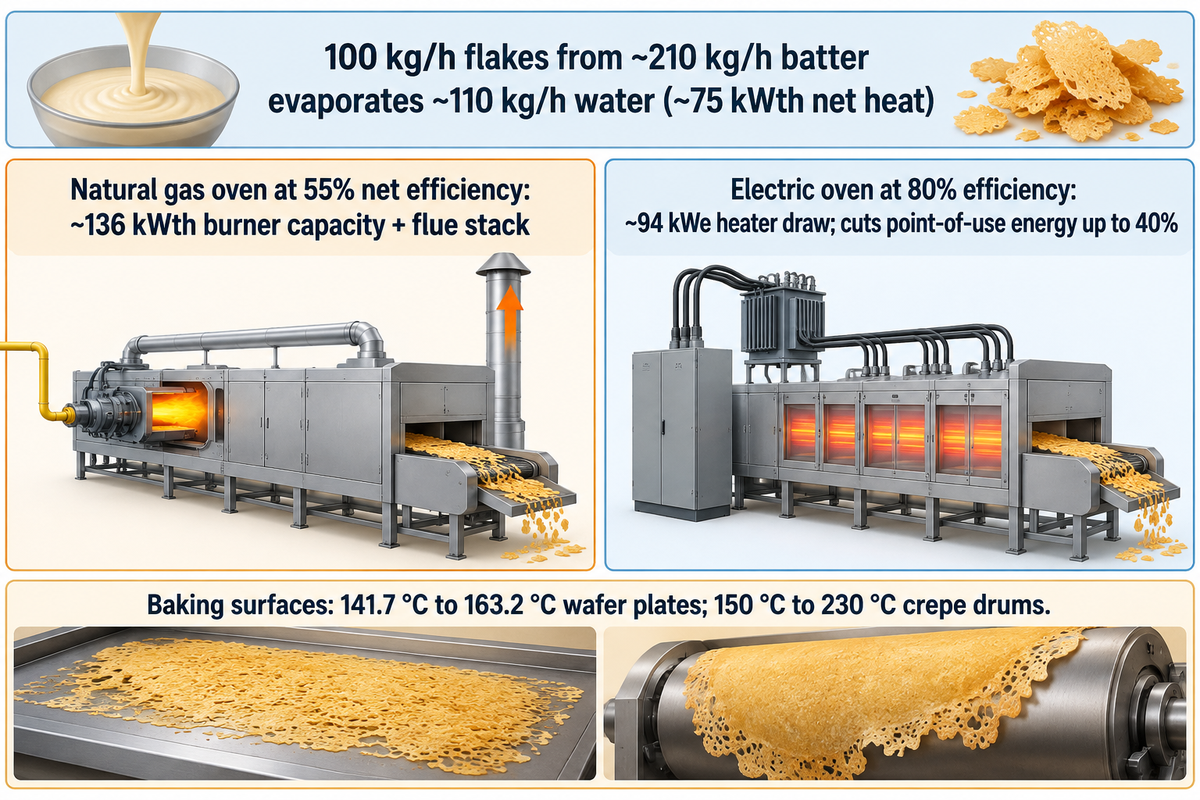
Your choice between natural gas or electric heating sets your primary utility infrastructure. Both options must deliver stable baking surface temperatures to turn wet batter into caramelized, golden pailleté feuilletine.
A 2025 industrial wafer study (Applied Sciences / PMC12523659) recorded baking plate temperatures of 141.7 °C to 163.2 °C on a 385 kW commercial oven. Rotating crepe drums run between 150 °C and 230 °C. Thermal analysis of biscuit baking in PMC9666246 and the LBNL Baking Guide shows modest dough sensible heat (1,875 to 1,942.7 J/(kg·K)). Latent water evaporation (~2,260 kJ/kg, or 0.628 kWh per kg of water) dominates the thermal budget.
Electric ovens cut point-of-use energy consumption by up to 40% by eliminating flue gas losses, according to 2025–2026 oven efficiency benchmarks. Avoiding gas piping and flue stacks leads many managers to assume electric heating is always simpler to install. However, plant transformer capacity often blocks electric retrofits, as reported in BakingBusiness on switching to electric heat and electric oven technology.
Take a worked thermal calculation for a 100 kg/h finished flake line. Producing 100 kg/h of finished flakes from ~210 kg/h of liquid batter at ~50% water down to <3% flake moisture evaporates ~110 kg/h of water. Evaporating 110 kg/h requires 110 × 0.628 = 69.1 kWh/h of latent heat, plus ~6.0 kWh/h of sensible heating from 20 °C to 160 °C (~75 kWth net thermal load). At 80% electric thermal transfer efficiency, the oven heater bank draws ~94 kWe, whereas a gas oven at 55% net efficiency requires ~136 kWth of burner firing capacity.
| Utility Parameter | Natural Gas / LPG Heated Line | Electrically Heated Line |
|---|---|---|
| Base Drive & Control Electrical Load | Low (e.g., 3 kW on YT-10 60-mold unit + combustion fan) | Low for drive, plus full heater kWe on main feeder |
| 100 kg/h Heating Input Basis | ~130–145 kWth burner input (~50%–58% net efficiency) | ~90–100 kWe heater bank (up to 40% lower point-of-use energy) |
| Supply Stability Requirement | Dedicated low-pressure regulator; zero sag on boiler startup | Substation transformer headroom; ±10% voltage stability |
| Exhaust & Flue Infrastructure | Separate combustion flue stack + canopy steam hood | Canopy steam hood only (no products of combustion) |
| Control Panel Heat Dissipation | Standard VFD/PLC heat load | High SCR/SSR solid-state relay heat load inside cabinet |
Why Does Gas Supply Pressure Fluctuation Cause Pale or Burnt Patches on a Thin Crêpe Sheet?
A thin crêpe sheet is under 0.5 mm thick and carries almost no thermal mass.
As cited in Reading Bakery Systems notes on gas vs electric ovens, premix ribbon burners depend on an even fuel-to-air ratio across the baking width. If a plant boiler that shares the same gas header as the ovens fires up, the gas pressure sags, resulting in pale, pliable wet stripes. A dedicated slam-shut regulator and pressure transducer on the oven drop ensure that the biscuit sheet is crisp and uniform.
Three-Phase Electrical Power, VFD Harmonics, and Control Panel Cooling
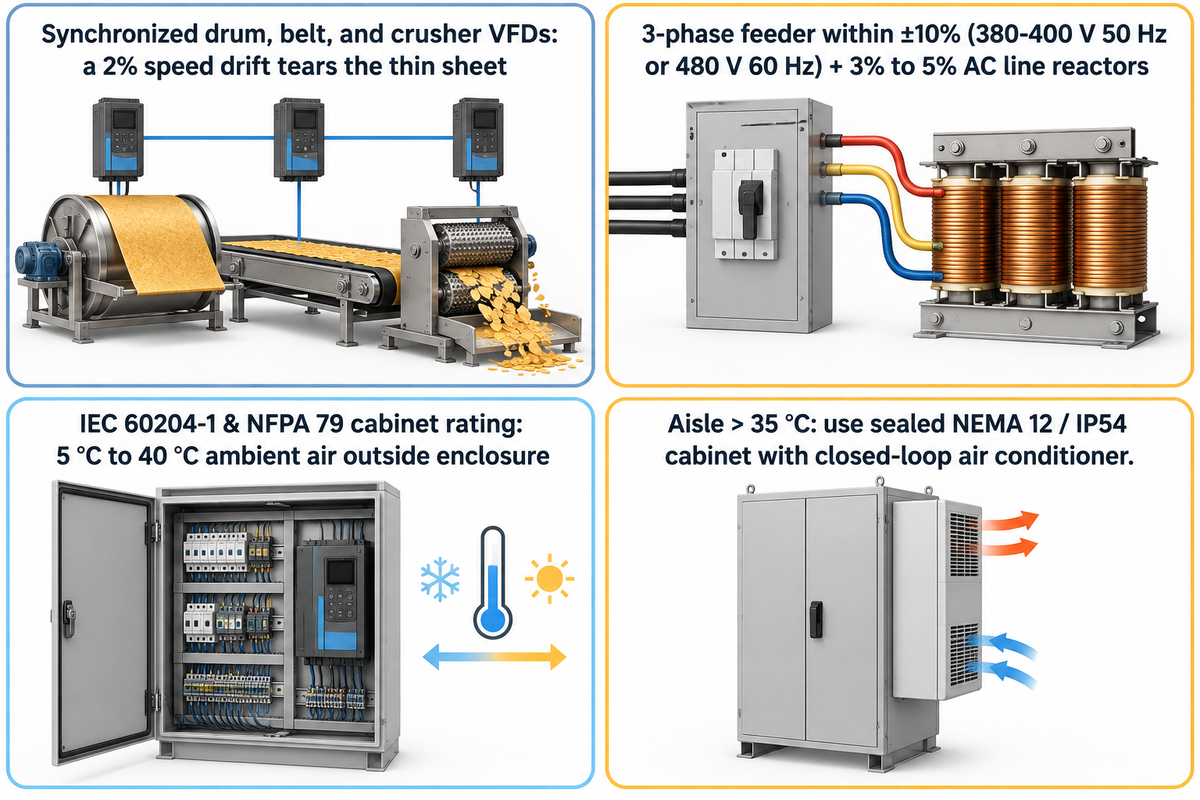
In feuilletine industrial lines, variable frequency drives (VFDs) on the baking drum, cooling belt, and crusher roll are synchronized. A 2% speed drift can tear the thin sheet or jam the flaking nip.
Industrial control panels require steady-state voltage within ±10% of nominal (380–400 V 50 Hz or 480 V 60 Hz). They are also rated for ambient air temperatures between 5 °C and 40 °C outside the enclosure. Both IEC 60204-1 safety of machinery rules and the NFPA 79 Electrical Standard set strict feeder tolerances.
Next to a radiant baking hood, aisle temperatures above the oven often climb past 40 °C. As maintenance technicians report in industrial high-temperature troubleshooting threads, uncooled cabinets trip VFDs on over-temperature faults during summer shifts. Engineers should install 3% to 5% AC line reactors on VFD feeders and provide 4-wire Wye neutral grounding for 24 VDC PLC supplies. Mount closed-loop cabinet air conditioners whenever ambient aisle air exceeds 35 °C.
⚠️ Common Mistake
Cooling a VFD cabinet next to a feuilletine line with an open louver fan. Flour, sugar dust, and butter aerosols coat heat sinks and trigger short circuits; use a sealed NEMA 12 / IP54 enclosure with a closed-loop panel cooler.
Compressed Air Purity and Pressure Dew Point for Crispy Feuilletine Flake Handling
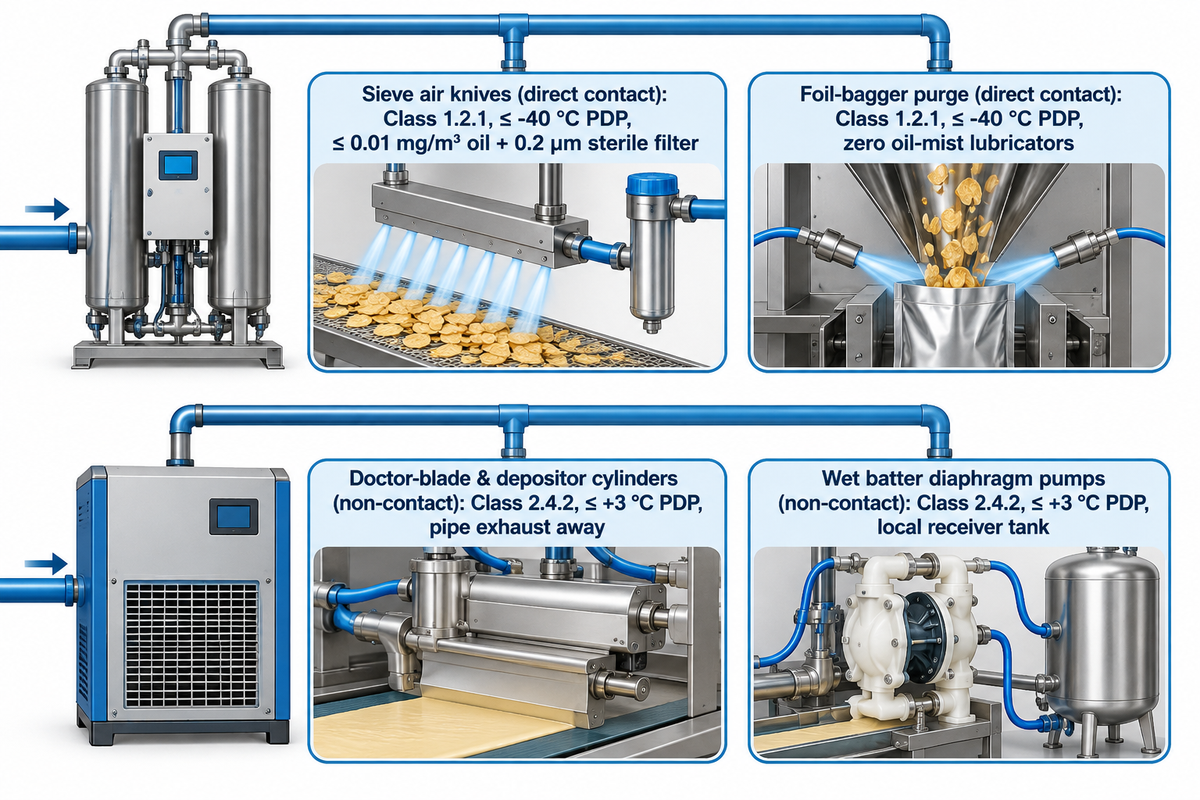
Pneumatic depositors, doctor-blade tensioners, and sieve air knives are typically run with a 6 to 8 bar (87 to 116 psi) compressed air header. The air, however, needs to be dried and filtered much more than typical shop air, before it comes in contact with whisper-thin flakes.
In the United States, 21 CFR 117.40(g) mandates that compressed air contacting food be treated to prevent contamination. Plant engineers pair that rule with voluntary benchmarks from the BCAS Food Grade Code 102 and the CAGI ISO 8573-1 purity guide.
“Class 1 oil allows up to 0.01 mg/m³ of total oil. Class 2 water requires a -40 °C pressure dew point.”
Both Nordic Filtration’s ISO 8573-1:2010 guide and Kaeser’s food compressed air guide specify Class 1.2.1 for direct food contact. Under ISO 8573-1:2010 Table 1, Class 1 particulate limits particles per m³ to ≤20,000 (0.1–0.5 µm), ≤400 (0.5–1.0 µm), and ≤10 (1.0–5.0 µm), paired with a ≤ -40 °C pressure dew point and ≤0.01 mg/m³ total oil. Still, the 3-digit ISO 8573-1 code does not by itself verify microbiological sterility. Food Engineering’s compressed air testing guide therefore recommends a 0.2 µm point-of-use sterile filter and periodic microbial sampling.
| Pneumatic Branch | Target Purity Class | Pressure Dew Point | Total Oil & Filtration Rule |
|---|---|---|---|
| Sieve air knives & flake blow-off (direct contact) | Class 1.2.1 + point-of-use sterile filter | ≤ -40 °C (-40 °F) desiccant dryer | ≤ 0.01 mg/m³; 0.01 µm coalescing + activated carbon + 0.2 µm sterile |
| Foil-bagger nitrogen/air purge | Class 1.2.1 | ≤ -40 °C (-40 °F) | ≤ 0.01 mg/m³; zero oil-mist lubricators permitted |
| Doctor-blade & depositor cylinders (non-contact) | Class 2.4.2 | ≤ +3 °C (+37.4 °F) refrigerated dryer | ≤ 0.1 mg/m³; pipe cylinder exhaust away from open product |
| Wet batter room diaphragm pumps | Class 2.4.2 | ≤ +3 °C (+37.4 °F) | ≤ 0.1 mg/m³; local receiver tank to stop pressure drops |
Can Wet or Oily Compressed Air Make Feuilletine Lose Its Crunch on the Line?
Yes, standard shop air dried only to +3 °C (Class 4) releases water vapor and oil mist directly onto warm flakes. That moisture plasticizes the glassy wafer matrix before the flakes ever reach an airtight container.
Never use inline oil-mist lubricators (FRLs) for food zone air. Use pre-lubricated food-grade cylinders, pipe valve exhaust ports outside the product hood, and dry direct-contact air to a -40 °C pressure dew point.
Oven Exhaust Extraction, Makeup Air, and Dehumidification Before Chocolate and Hazelnut Coating
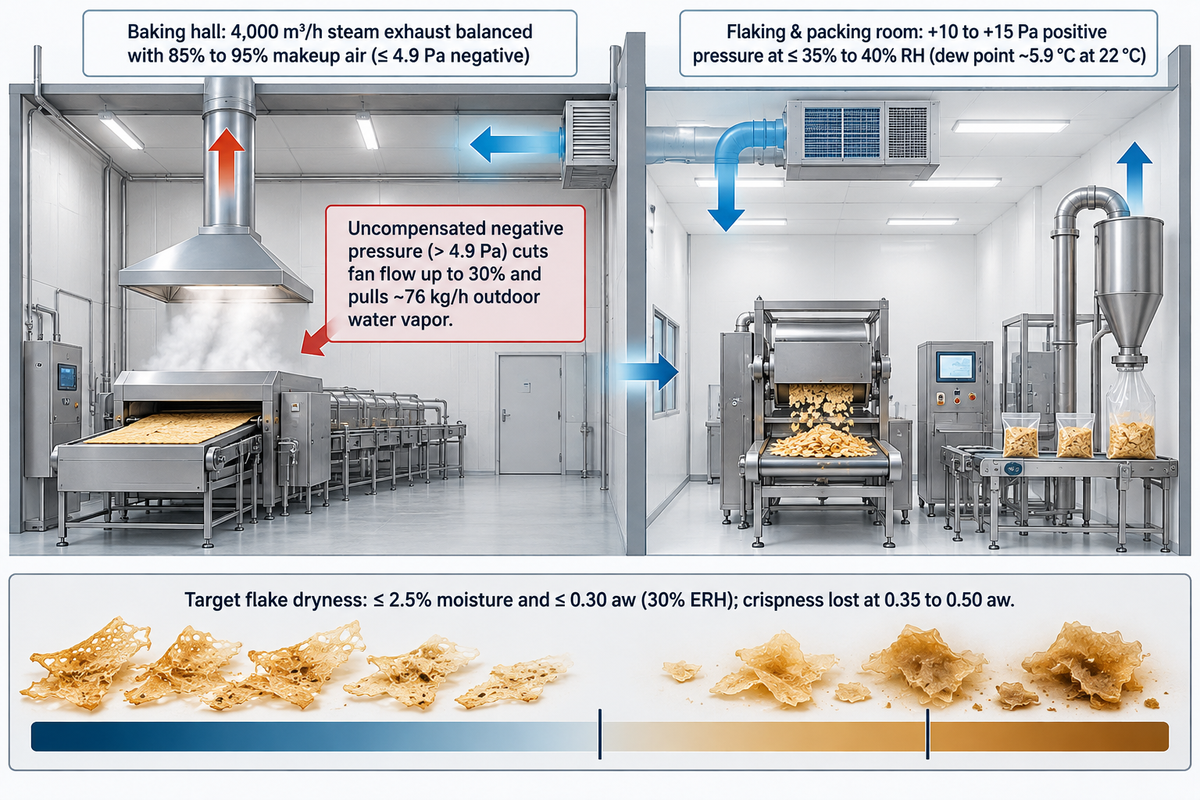
Rapid exhaust of crispy flakes without supply of conditioned air makes them unusable on a summer afternoon. Exhaust fans create a negative pressure that pulls warm, wet air from outdoors. That air crosses through the cooling conveyor and through the crusher.
As stated in Accurex’s engineering white paper on commercial makeup air, the negative pressure in a baking space shouldn’t exceed 0.02 in. w.c. (4.9 Pa). Without the supply of makeup air, the negative pressure in a building increases, and the exhaust fan capacity decreases by up to 30%, as noted in CCC Engineering’s bakery ventilation memo and MEP air-balancing discussions.
Commercial feuilletine specifications, such as Cacao Barry’s Pailleté Feuilletine BIG-PF-1BO-401, require residual moisture ≤ 2.5% and water activity ≤ 0.30 aw. Per FDA Inspection Technical Guide No. 39, 0.30 aw corresponds to an equilibrium relative humidity (ERH) of 30%. Low-moisture snack studies by Katz and Labuza (1981) and wafer plasticization research explain the risk. Baked starch matrices lose crispness once moisture pushes water activity into the 0.35 to 0.50 aw band. Worse, if cooling air or conveyor metal drops near the ambient dew point (US National Weather Service dew point standard), water condenses rapidly.
For a baking hall exhausting 4,000 m³/h of oven steam, supply 85% to 95% tempered makeup air at the oven hood to stop infiltration drafts. Without makeup air, uncompensated negative pressure pulls ~76 kg/h of outdoor water vapor into the baking hall when outdoor air is at 30 °C and 70% RH (~19 g/m³). Isolating the flaking and packing room under +10 to +15 Pa positive pressure and ≤35% to 40% RH (dew point ~5.9 °C at 22 °C packing room air) protects the product.
That dry climate keeps every flake ready for downstream pastry and patisserie lines. Bakeries fold the shards into melted chocolate, hazelnut praline, white chocolate, or almond paste for a cake, tart, dessert, macarons, or mousses. Traditionally, pâtisserie chefs add chocolate and praliné to a glossy praline feuilletine crunchy layer. They fold it gently and refrigerate or hold the slab at room temperature. For upstream texture control, check out our resources on the sheet cooling temperature window before crushing, five post-baking moisture pickup points, and formulating feuilletine for chocolate and praline fillings.
💡 Pro Tip
Never tie dry crusher and sifter dust extraction into the wet baking-hood steam duct. Fine wheat flour and sugar dust from crushing cookies and crêpes will cake inside damp ductwork and create hygiene and combustible-dust hazards; route crusher extraction to a dedicated dry dust collector.
Why Does a High Oven Exhaust Rate Without Makeup Air Soften Crispy Flakes Before Chocolate Coating?
An oversized exhaust fan without makeup air depressurizes the room to 4.9 Pa or below. That vacuum pulls humid outside air across the cooling belt and raises flake water activity above 0.30 aw before packing.
Balance each oven canopy hood with 85% to 95% dedicated makeup air near the baking zone. The post-bake cooling and flaking room should be slightly positive (10 to 15 Pa). This room can also be dehumidified with desiccants.
Potable Water, Batter Jacket Chilling, and the Wet-to-Dry Sanitation Boundary
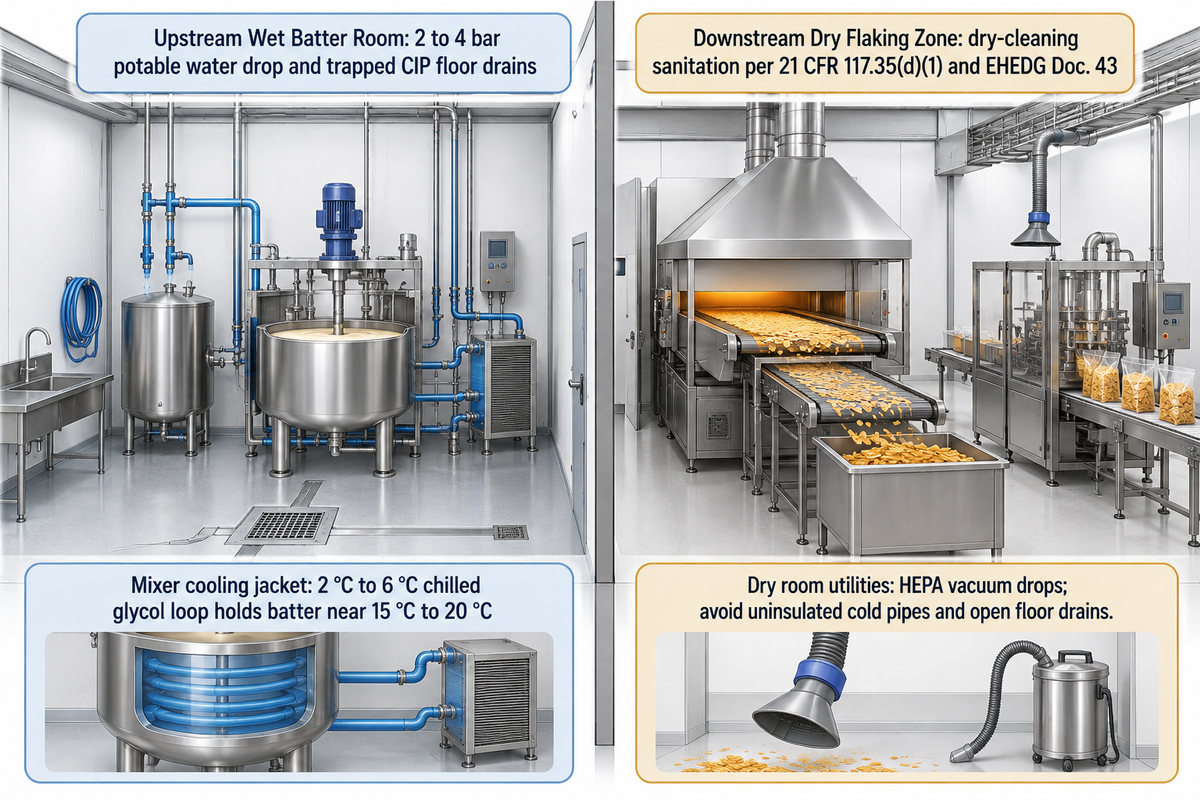
Water utilities should only be in the upstream batter preparation room. The line downstream from the baked sheet should be in a dry-cleaning sanitation zone.
In the wet batter room, install a 2 to 4 bar potable water drop for batch mixing and hose stations. Add a 2 °C to 6 °C chilled glycol loop for mixer jackets (holding batter near 15 °C to 20 °C) and trapped CIP floor drains. Under US regulation 21 CFR 117.35(d)(1), food-contact surfaces for low-moisture foods must be dry and sanitary before use. When surfaces are wet-cleaned, plants must dry them completely before production resumes. Likewise, EHEDG Guideline Doc. 43 covers belt conveyors where wet cleaning is mandatory, whereas dry-handling zones follow dry-sanitation design principles (Commercial Food Sanitation conveyor guidance).
Dry processing environments are discussed in various guides from Solenis and Quality Assurance Magazine. Routine water washdowns in dry biscuit and flake rooms trap water inside bearings and hollow frames. That water increases the relative humidity in the room and provides an environment for pathogenic harborage. Provide central or portable HEPA filter vacuum drops, and avoid uninsulated cold water pipes and open floor drains in flaking rooms.
The Utility-to-Defect Diagnostic Matrix: Trace Flake Commissioning Faults to Hookup Errors
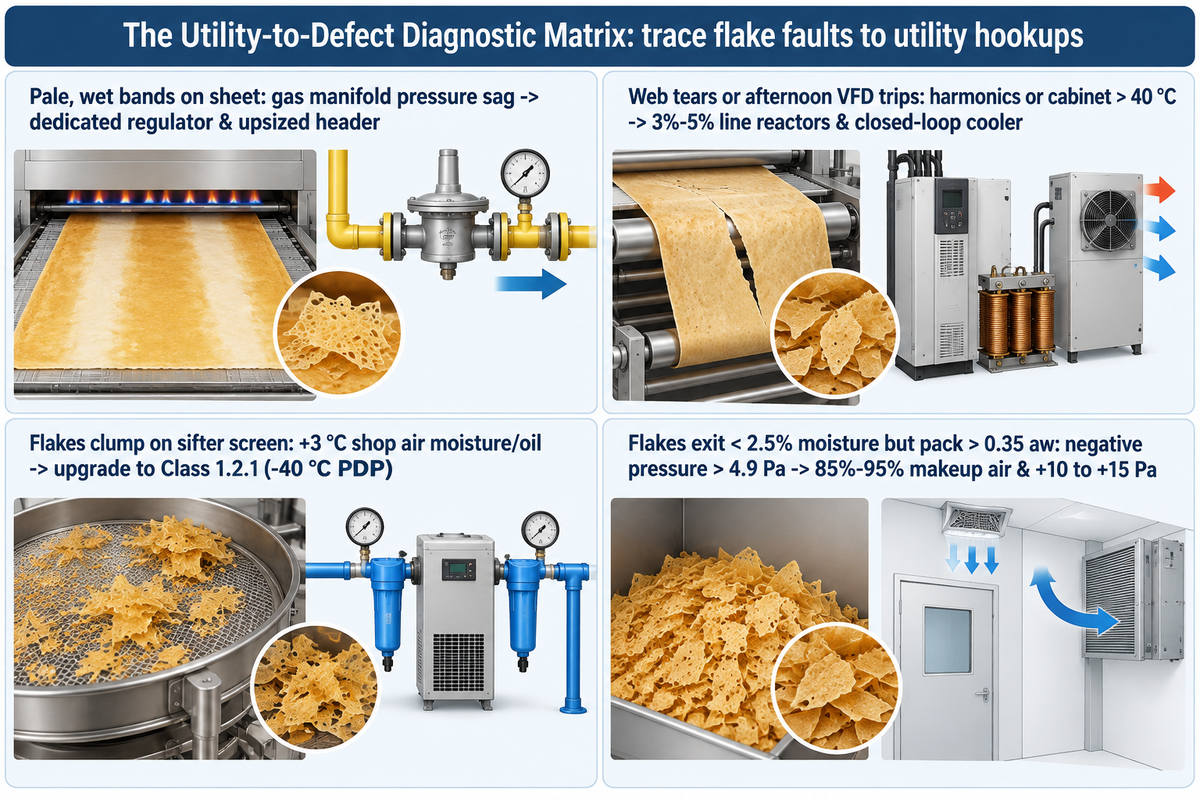
Operators tend to blame recipe when sheets bake unevenly (i.e. come out lumpy) or flakes turn leathery during commissioning. In reality, unstable plant utility hookups can cause defects that resemble recipe problems even if the ingredients are the same.
Use the Utility-to-Defect Diagnostic Matrix to determine if a commissioning defect is caused by gas pressure sag, electrical harmonics, wet compressed air, or negative room pressure and humidity.
| Commissioning Symptom | Utility Mismatch Root Cause | Drop-Point Instrument Check | Permanent Engineering Fix |
|---|---|---|---|
| Pale, wet bands alternate with dark edges during shift | Dynamic gas manifold pressure sag when plant boilers fire | Log inlet gas pressure at burner train under full factory load | Install dedicated line regulator and upsize gas header pipe |
| Electric baking zones lag in recovery after cold batter dosing | Feeder voltage drop >10% or undersized plant transformer | Measure 3-phase voltage under 100% SSR heater duty | Upgrade feeder cable cross-section and verify kVA tap |
| Crêpe web tears or bunches between drum and cooling belt | VFD speed drift from line harmonics or missing neutral reference | Check THD and 24 VDC encoder signal noise with power analyzer | Add 3%–5% AC line reactors and shielded motor cables |
| VFD or PLC trips randomly during afternoon baking runs | Control cabinet internal temperature exceeding 40 °C rating | Log internal enclosure temperature next to baking hood | Replace open louver fan with closed-loop cabinet cooler |
| Flakes clump on sifter screen or carry off-odor | Shop air at +3 °C PDP condensing water or carrying compressor oil | Check inline dew-point sensor and oil aerosol test tube at air knife | Upgrade food-contact branch to Class 1.2.1 (-40 °C PDP) |
| Doctor blade chatters and leaves uneven sheet thickness | Pneumatic header pressure dropping below 6 bar on depositor pulse | Monitor dynamic pressure at blade cylinder during dosing stroke | Install local 50–100 L buffer receiver tank at baking unit |
| Flakes exit oven at <2.5% moisture but pack out above 0.35 aw | Negative room pressure (>4.9 Pa) pulling humid air across crusher | Differential pressure gauge across flaking room doors | Add 85%–95% oven makeup air and +10 to +15 Pa dry room HVAC |
| First shift after sanitation produces soft, leathery flakes | Wet hose washdown or sweating cold water pipes in flaking zone | Pre-start room RH audit and pipe surface temperature vs dew point | Enforce dry HEPA vacuum cleaning and insulate/reroute cold pipes |
Pre-Installation Utility Verification Protocol and Feuilletine Line Supplier Quotation Checklist
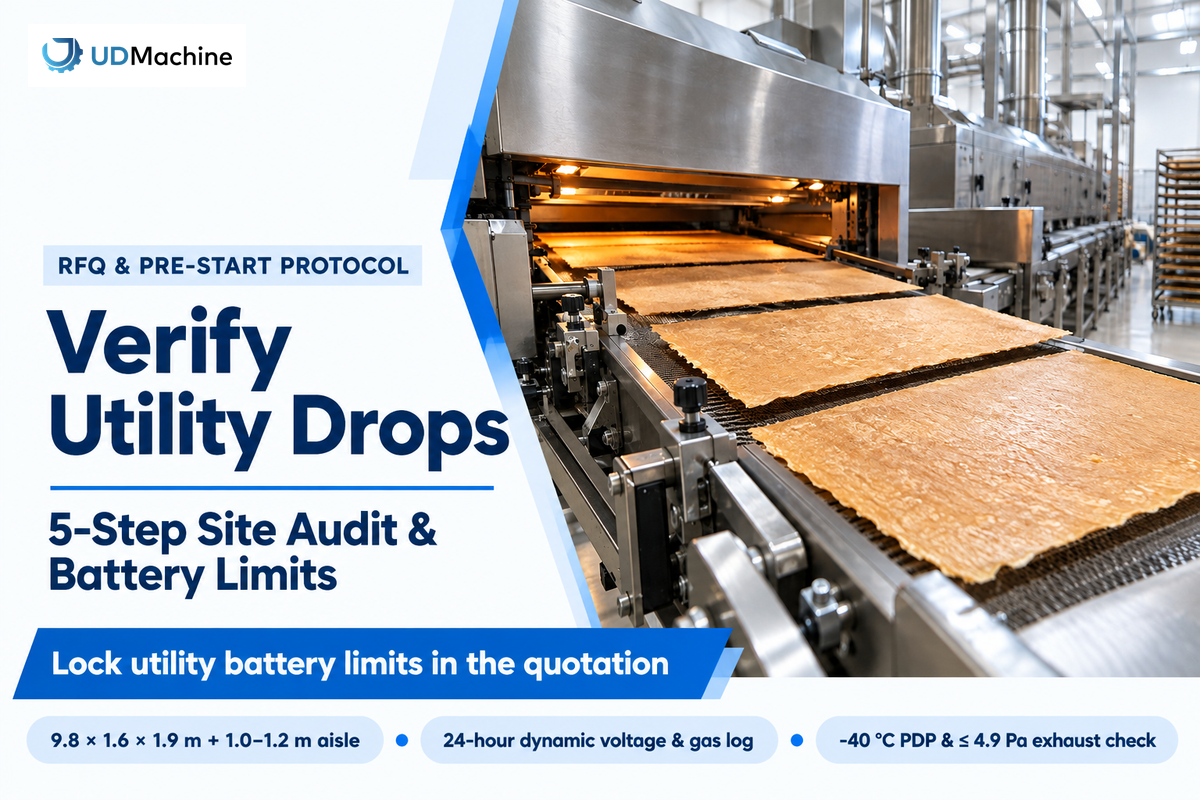
Prior to engineering teams routing a new utility drop to the bakery floor, all existing drops should be tested for utility under dynamic load. Locking in battery-limit responsibilities in the quotation prevents delays during startup.
The YT-10 base baking unit has 60 molds, measures 9.8×1.6×1.9 m, and consumes 3 kW (commercial feuilletine baking and flaking equipment). Full-line heating loads, compressed air flow (Nm³/min) and exhaust static pressure are sized to your hourly output in the quotation. To avoid facility constraints, use our feuilletine line throughput and utility sizing planner to analyze your batch output, and ensure it aligns to facility constraints prior to signing off.
- Itemize the module-by-module utility schedule with the line supplier so drive kW, heating kW, and blower loads are listed separately.
- Log dynamic 3-phase voltage and fuel pressure at the proposed machine drop for 24 hours while neighboring ovens and boilers run at peak load.
- Certify compressed air dew point and oil content at the flaking drop against ISO 8573-1:2010 Class 1.2.1 (-40 °C PDP, ≤0.01 mg/m³ oil) before connecting food-contact air knives.
- Balance oven exhaust and packing-room pressure so baking hall negative pressure stays below 4.9 Pa and the flaking room holds +10 to +15 Pa at ≤35%–40% RH.
- Measure floor flatness and service clearances across the 9.8 × 1.6 × 1.9 m footprint, keeping 1.0 to 1.2 m of clear aisle around hoods and panels.
Supplier Quotation & Utility Battery-Limit Schedule Checklist:
| Utility Interface | Target Engineering Specification | Battery-Limit Boundary | Pre-Start Verification Test |
|---|---|---|---|
| Base drive vs total electrical load | Itemize base drive (e.g., 3 kW on YT-10) separately from electric heater bank and blowers | Buyer main breaker to machine main disconnect lug | 3-phase load & ±10% voltage stability check under full heat |
| Control cabinet thermal rating | 5 °C to 40 °C ambient rating per IEC 60204-1 / NFPA 79; closed-loop cooler if aisle >35 °C | Supplier panel enclosure & internal VFD cooling | Thermal camera scan of VFDs and SSRs during 4-hour heat test |
| Gas burner train or SSR heater bank | Regulated gas pressure (kPa/mbar) + shutoff train, or zoned SSR kWe load schedule | Buyer shutoff valve / feeder cable to OEM inlet flange | Manifold pressure drop test at 100% cold-start firing |
| Direct food-contact compressed air | 6–8 bar; ISO 8573-1 Class 1.2.1 (-40 °C PDP, ≤0.01 mg/m³ oil) + 0.2 µm sterile filter | Buyer desiccant dryer header to machine FRL manifold | Portable dew-point meter & oil aerosol check at air knife |
| Non-contact cylinder compressed air | 6–8 bar; ISO 8573-1 Class 2.4.2 (+3 °C PDP, ≤0.1 mg/m³ oil); exhaust piped away | Buyer shop air drop to machine pneumatic island | Dynamic pressure log during rapid depositor cycling |
| Oven canopy & flue exhaust | Separated flue stack and steam hood m³/h; 85%–95% tempered makeup air | OEM hood spigot to buyer roof duct & makeup air unit | Micromanometer check confirming hall negative pressure ≤4.9 Pa |
| Flaking & packing room climate | ≤35%–40% RH at 20–22 °C; +10 to +15 Pa positive pressure; separate dry dust collector | Buyer HVAC / desiccant unit and room partition envelope | Calibrated hygrometer + flake water activity check (≤0.30 aw) |
| Wet batter vs dry flaking water boundary | 2–4 bar potable water & 2–6 °C glycol in batter room only; 0 open drains in flaking room | Buyer water/glycol drops to mixer jacket; dry HEPA drops in flaking | Sanitation zoning audit per 21 CFR 117.35(d)(1) before startup |
Frequently Asked Questions
What utilities are needed to make feuilletine on an industrial baking line versus a home recipe?
An industrial feuilletine line requires five dedicated plant utilities: three-phase electrical power, regulated gas or electric baking heat, and dry oil-free compressed air at 6 to 8 bar.
It also needs balanced oven exhaust with 85% to 95% conditioned makeup air and a dehumidified flaking room below 35% to 40% RH. Potable water and floor drains stay isolated inside the wet batter kitchen. By contrast, a small homemade recipe uses only a standard kitchen oven, parchment paper, and manual baking trays without continuous pneumatic or HVAC headers.
Why does exhausting baking steam without conditioned makeup air soften feuilletine flakes in the packing room?
Exhausting baking steam without conditioned makeup air creates negative building pressure above 4.9 Pa and pulls warm, humid outdoor air across the cooling conveyor and crusher.
Hygroscopic flakes exit the baking zone below 2.5% moisture and absorb ambient humidity within minutes. That moisture pickup pushes flake water activity above the 0.30 aw target into the 0.35 to 0.50 aw softening band before foil packing. Supplying 85% to 95% tempered makeup air and holding the packing room at +10 to +15 Pa positive pressure blocks outdoor air infiltration.
What compressed air quality class is required for a commercial pailleté feuilletine line?
Compressed air that directly touches pailleté feuilletine flakes should meet voluntary ISO 8573-1:2010 Class 1.2.1 benchmarks at 6 to 8 bar.
Under ISO 8573-1:2010 Table 1, Class 1.2.1 specifies Class 1 particulate limits (≤20,000 particles/m³ at 0.1–0.5 µm), a -40 °C desiccant pressure dew point, and ≤0.01 mg/m³ total oil. Plant engineers should also add a 0.2 µm point-of-use sterile filter on sieve air knives and ban inline oil-mist lubricators. Non-contact pneumatic cylinders can run on Class 2.4.2 air (+3 °C dew point) if exhaust ports are piped away.
Can an industrial feuilletine oven run on electric power instead of natural gas?
Yes, industrial feuilletine ovens use either premix gas burners or electric heaters.
Electric ovens eliminate flue stacks and cut point-of-use energy losses by up to 40%, provided the plant substation has sufficient kVA headroom.
Where can bakeries buy commercial feuilletine flakes or industrial feuilletine baking lines?
Pastry kitchens buy ready-made pailleté feuilletine in 2.5 kg foil-barrier cartons from confectionery distributors carrying brands such as Cacao Barry or Callebaut.
Food manufacturers scaling to continuous in-house production source automated batter dosing, heated drum or 60-mold baking units (such as the UDTECH YT-10), and cooling conveyors directly from industrial bakery machinery manufacturers. Full-line flaking modules and utility schedules are defined in the project quotation.
How much floor space and ceiling clearance does a feuilletine production line require?
A 60-mold UDTECH YT-10 baking unit measures 9.8 × 1.6 × 1.9 m alone.
Engineers should add 1.0 to 1.2 m of aisle clearance on all sides plus space for downstream cooling and packing.
Planning facility utilities for a commercial feuilletine line? Send your available 3-phase voltage, gas or electric heating preference, and target hourly flake output. The UDTECH engineering team will prepare a module-by-module quotation and utility schedule.
About This Analysis
Prepared by the Suzhou UDTECH Technology Co., Ltd. engineering team from YT-10 specifications, peer-reviewed baking thermal studies, and IEC 60204-1 / NFPA 79 electrical standards. Compressed air and humidity targets follow ISO 8573-1, BCAS Code 102, and FDA water activity criteria. The 100 kg/h evaporative heat load and 4,000 m³/h exhaust balance are worked engineering calculations; site-specific full-line utility ratings are defined per project quotation.
Related Articles
References & Sources
- JP2005124452A, Method and Apparatus for Producing Crepe Flakes, Google Patents
- Industrial Wafer Baking Plate Temperature and Moisture Analysis (2025), PubMed Central (PMC12523659)
- Thermal Properties and Specific Heat Capacity in Biscuit Baking, PubMed Central (PMC9666246)
- Energy Efficiency Improvement and Cost Saving Opportunities for the Baking Industry, Lawrence Berkeley National Laboratory
- Energy Efficiency Heats Up at the Oven (2025), BakingBusiness
- Making the Leap to Electric Heat in Commercial Bakeries, BakingBusiness
- Shining a New Light on Electric Oven Technology, BakingBusiness
- Gas vs. Electric Industrial Ovens for Commercial Bakeries, Reading Bakery Systems
- IEC 60204-1 Safety of Machinery, Electrical Equipment of Machines, IDEC Technical Reference
- NFPA 79: Electrical Standard for Industrial Machinery, National Fire Protection Association
- Food and Beverage Grade Compressed Air Best Practice Code 102, British Compressed Air Society (BCAS)
- ISO 8573-1 Compressed Air Purity Guide, Compressed Air and Gas Institute (CAGI)
- Understanding ISO 8573-1 Classes for Compressed Air Quality, Atlas Copco
- Compressed Air Standard ISO 8573-1:2010 Specification, Nordic Filtration
- Compressed Air Resources for Food and Beverage Applications, Kaeser Compressors
- Testing for Microorganisms in Food-Grade Compressed Air, Food Engineering
- When Make-Up Air Is Required for Commercial Kitchens and Bakeries, Accurex
- Bakery Ventilation and Make-Up Air Design Memo, CCC Engineering
- Pailleté Feuilletine BIG-PF-1BO-401 Technical Data Sheet, Cacao Barry
- Inspection Technical Guide No. 39: Water Activity (aw) in Foods, US Food and Drug Administration
- Katz and Labuza, Effect of Water Activity on the Sensory Crispness and Mechanical Deformation of Snack Food Products (1981), University of Minnesota
- Water Plasticization and Crispness Loss in Low-Moisture Wafer Systems, PubMed (15384182)
- Dew Point vs. Relative Humidity Psychrometric Guidance, US National Weather Service
- EHEDG Guideline Catalogue (Doc. 43 & Dry Material Handling), European Hygienic Engineering & Design Group
- EHEDG Conveyor Systems Working Group Guidance, Commercial Food Sanitation
- Food Safety and Moisture Control in Dry Processing Environments, Solenis
- Dry-Cleaning Sanitation Best Practices for Low-Moisture Bakeries, Quality Assurance & Food Safety