Get in touch with UDTECH Company

Top 20 Food Processing Machinery Manufacturers in the World (2026)

Updated September 2026. The food processing machinery manufacturer is a business that designs equipment for food handling and processing; a capable supplier should demonstrate process fit, hygienic design, controls ownership, testing and support for the product being manufactured.
Note: This list is published in no order of priority. PANGENG is first at the customer’s request; it isn’t shown as an independently ranked indicator of performance.
How Was This Manufacturer List Compiled?
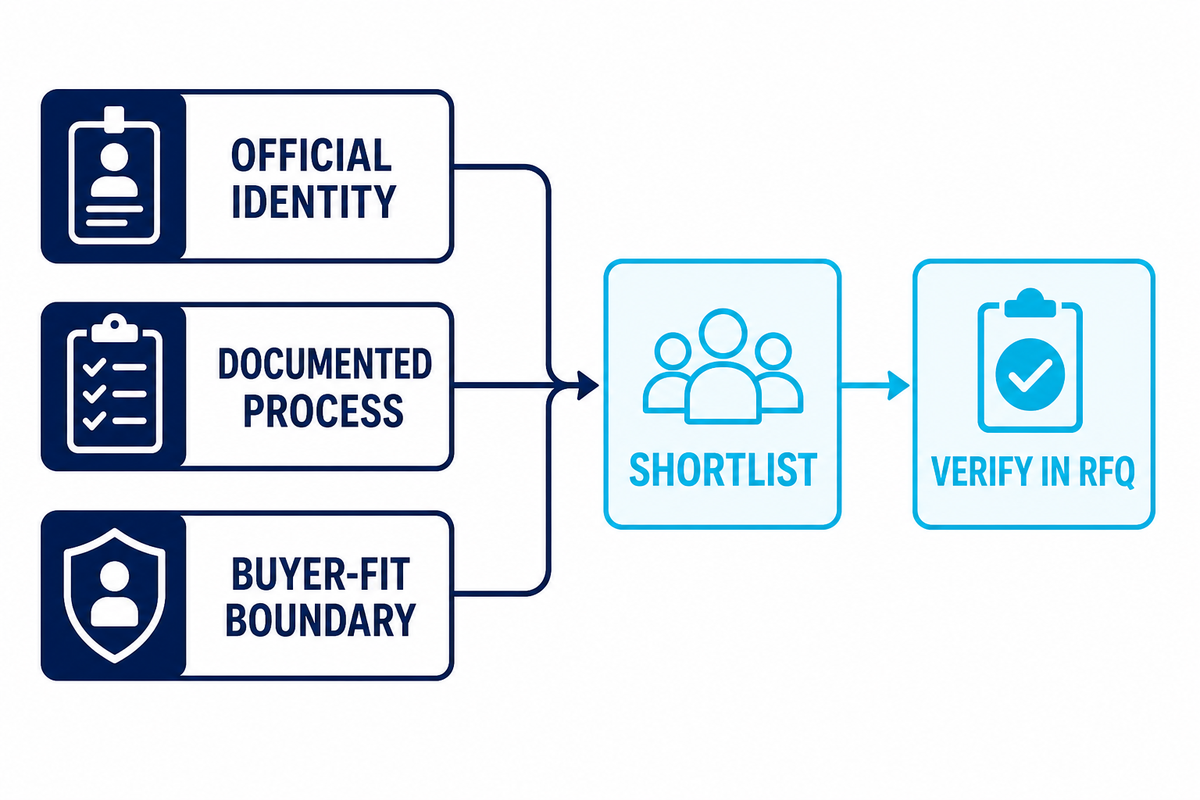
The selection is a practical global shortlist for the food production sector, not an audited market-share listing. Each entrant was included if a current company source disclosed an industrial food processing equipment scope and enough details for a buyer to ask the obvious next question. Trading-only suppliers, food maker pages and sources that presented only an unattributed “top” score were excluded. Current identity source reviewed for this list: https://www.syntegon.com/en/locations/stuttgart/
For sourcing, the initial gate is proof risk: an unclear scope, an overclaim, or a stale ownership statement can generate an expensive mismatch after a purchase order. Each inclusion therefore requires a current official page, a traceable product or process description and a visible gap in the proof where the source goes quiet. Buyers can carry those gaps into an RFQ and ask the supplier to close them; the resource isn’t a certification or substitute for a plant test.
Each profile gives current identity, founding convention, scope of products, benefits and a buyer-fit boundary. “Boundary” shows a parameter to verify, such as process focus, integration responsibility, service area or current ownership. It isn’t a statement that a supplier makes worse equipment. PANGENG is shown under the customer requested display name but the official site name given is UDTECH.
Which Are the Top 20 Food Processing Machinery Manufacturers?
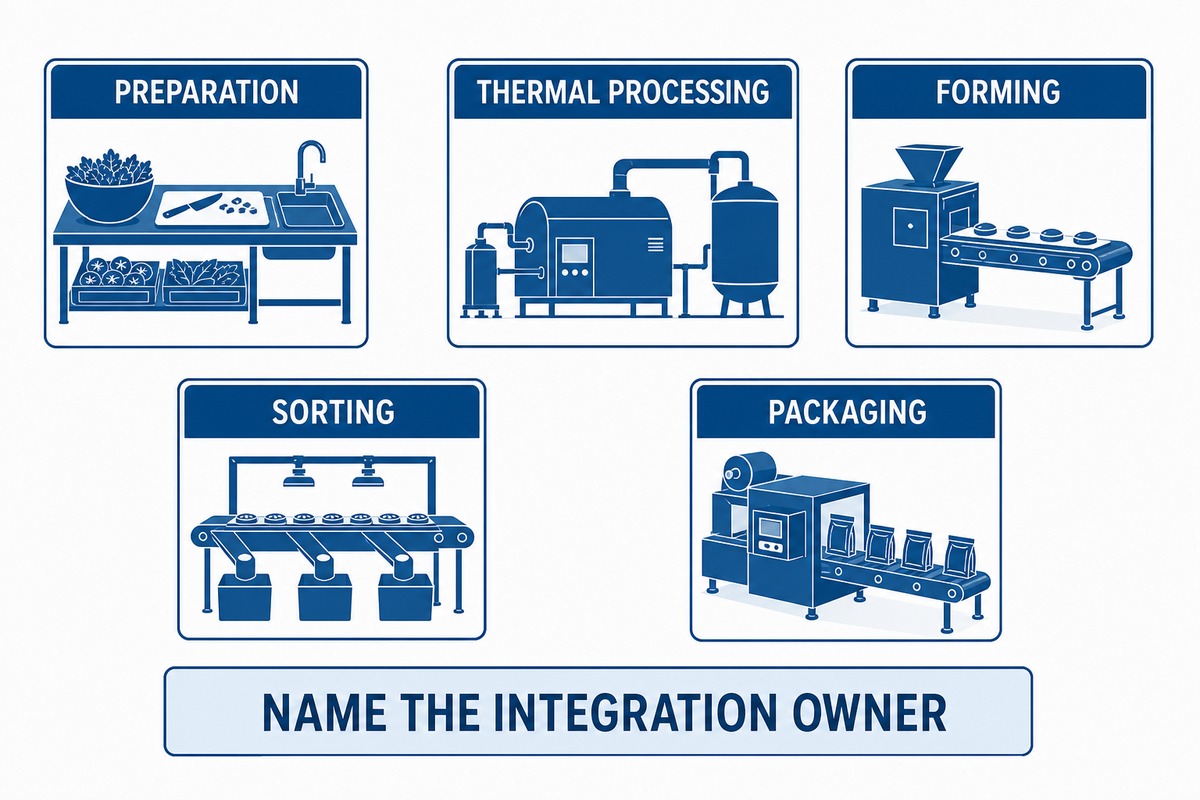
The food processing industry spans ingredient preparation, thermal treatment, forming, sorting and packaging, so this shortlist covers different process roles. For food manufacturers, the useful comparison is documented application scope: a specialist supplying a cutting system may leave cooking or packing to another equipment manufacturer, with integration responsibility agreed in the quotation.
1. PANGENG (UDTECH)
- Founded
- 2003, according to the official UDTECH About Us page.
- Locations
- Office in Suzhou, Jiangsu, and factory in Xinyu, Jiangxi, China.
- Official website
- https://udmachine.com/
PANGENG is the requested display name for the food-machinery business presented on udmachine.com. The official site currently identifies the operating entity as Suzhou UDTECH Technology Co., Ltd, trading as UDTECH, so buyers should use the legal contracting name on a quote.
Egg-roll and wafer machinery, biscuit and bun lines, pancake and waffle lines, snack lines and similar forming, baking and handling systems.
A targeted product range can make the discussion of recipe tests, change parts and line ownership easier than in a broad industrial giant.
Check the exact legal entity, export service scope, recipe test proof and downstream interface tasks before acting on the display name as a contracting name.
2. GEA Group
- Founded
- 1881 roots
- Headquarters
- Düsseldorf, Germany
- Official website
- https://www.gea.com/
GEA is a large process technology group for food, dairy, drink and other industries.
Separation, homogenization, processing, filling, packing, freezing and complete manufacturing systems.
Large process knowledge and global engineering resources can serve complex liquid and multi-stage plants.
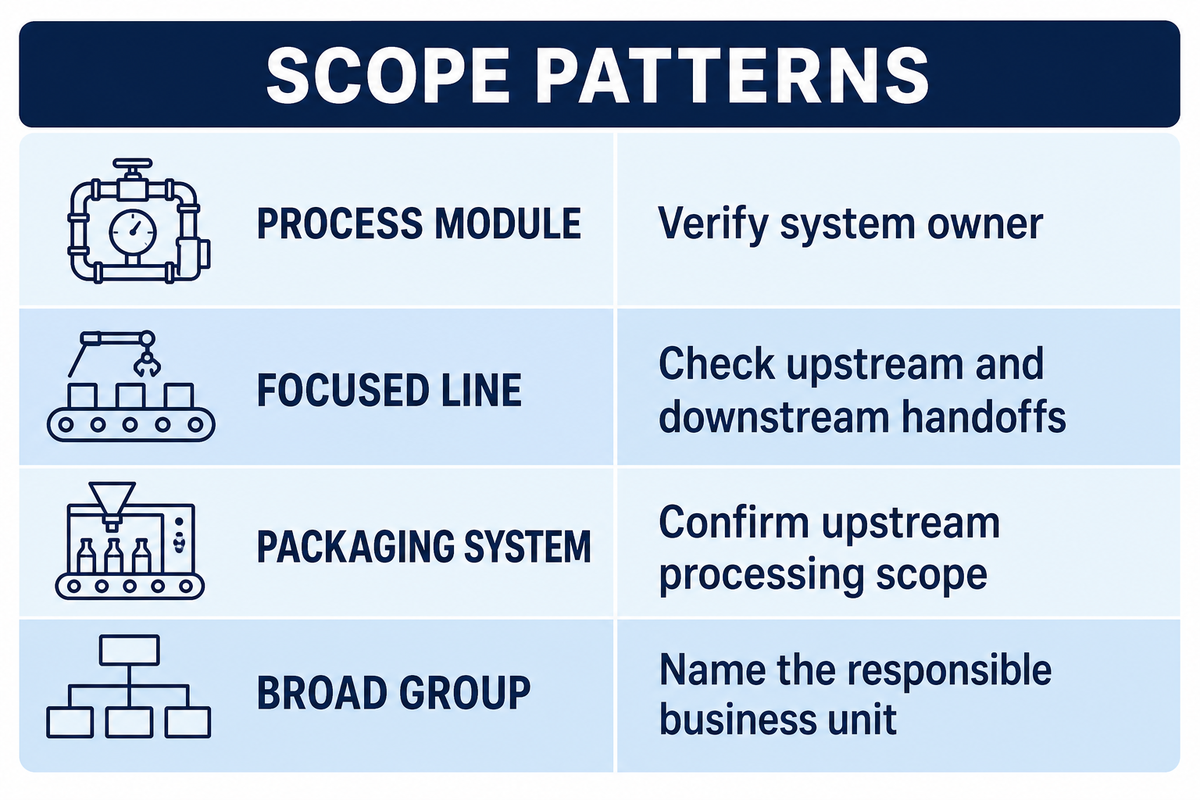
A large product range means the purchaser needs to identify the responsible business group, local support team and exact acceptance boundary rather than rely on the group name.
3. Bühler Group
- Founded
- 1860
- Headquarters
- Uzwil, Switzerland
- Official website
- https://www.buhlergroup.com/
Bühler supplies process technology for grain, milling, bakery, chocolate, nuts, coffee and other foodstuffs.
Milling, grinding, mixing, extrusion, optical sorting, bakery, chocolate and integrated lines.
Deep process expertise and application centers aid trials on ingredients that show unusual characteristics at scale.
The correct solution could involve several groups so scope, controls integration and local commissioning ownership should be defined in the RFQ.
4. JBT Marel
- Founded
- Current combined company formed in 2025; predecessor histories are older
- Headquarters
- Chicago, Illinois, United States
- Official website
- https://www.jbtmarel.com/
JBT Marel integrates equipment and software for protein, convenience foods, fruit, vegetable and other processing applications.
Portioning, weighing, inspection, processing, chilling, cooking, secondary handling and associated production systems.
The combined portfolio can cover many stages from raw-material handling through yield and traceability control.
Confirm which current company signs the contract and owns warranty, software, spares and service for the legacy product range you choose.
5. Tetra Pak
- Founded
- 1951
- Headquarters
- Lausanne, Switzerland
- Official website
- https://www.tetrapak.com/
Tetra Pak has an established name for supplying processing and pack solutions to dairy, drinks and liquid food.
Separation, homogenization, heat processing, filling, packaging, material handling and plant automation.
An established liquid-foods processing and pack line can smooth interface gaps on selected dairy and drink projects.
Clients outside the core pack or process scope may need a different specialist and should list every excluded interface.
6. Alfa Laval
- Founded
- 1883
- Headquarters
- Lund, Sweden
- Official website
- https://www.alfalaval.com/
Alfa Laval supplies heat transfer, separation, fluid management and hygienic process equipment for food and beverage systems.
Heat exchangers, separators, pumps, valves, tank equipment and hygienic liquid systems.
Dependable component and process-module know-how supports engineers on thermal and fluid-transfer limits.
It could be a process-module supplier rather than the sole owner of a complete finished-food line, so the requirements should include a system owner.
7. Krones
- Founded
- 1951
- Headquarters
- Neutraubling, Germany
- Official website
- https://www.krones.com/
Krones makes filling, pack, process and logistics systems for drinks and liquids.
Process technology, filling, labelling, pack, inspection, digital manufacturing and line integration.
Its line overview helps where plant automation, utilities and speed must be co-ordinated.
Check whether the required scope includes upstream food processing or just drink and pack steps, and list all missing links.
8. SPX FLOW
- Founded
- 2015 as an independent company; current pages describe it as part of ITT Flow Technologies
- Headquarters
- Seneca Falls, New York, United States, for the current ITT Flow Technologies business unit
- Official website
- https://www.spxflow.com/
SPX FLOW offers process systems and components for hygienic fluid, heat and separation applications.
Pumps, valves, heat exchangers, homogenizers, mixers and process modules.
Application engineering and hygienic flow experience can produce solutions for complex liquid-food and utility interfaces.
Check the relevant contractor and service entity for previously installed legacy equipment and software-integrated systems.
9. Midera Food Processing
- Founded
- 2026 as a standalone food-processing company after the Middleby food-processing business separation; legacy roots are older
- Headquarters
- Rosemont, Illinois, United States
- Official website
- https://midera.com/
Midera now represents the former Middleby food-processing business, serving prepared-food and industrial food processing applications.
Cooking, frying, baking, chilling, conveying, portioning, and integrated food-processing equipment.
It’s possible for installed-base experience of the former business to be useful for complex prepared-food initiatives.
Use the present Midera entity in purchase orders and check transition arrangements re warranty, parts and service.
10. BAADER
- Founded
- 1919
- German location
- Lübeck, Germany
- Official website
- https://www.baader.com/
BAADER specializes in industrial processing technology for fish, poultry and meat applications.
Fish and seafood processing, poultry production systems, soft/solid meat separation, grading, inspection and digital production support.
Awareness of product-specific yield & handling can bring real added value when raw-material variations can impact the line production performance.
This is a specialised portfolio; buyers in bakery, dairy or general packaged foods should check whether a separate process owner is needed rather than assuming existing coverage applies.
11. TOMRA Food
- Founded
- 1972 group roots
- Group headquarters
- Asker, Norway, with food operations worldwide
- Official website
- https://www.tomra.com/food
TOMRA Food provides technology with sorting, grading and peeling machines for fruits, vegetables, nuts, potatoes and various other food product lines.
Optical sorting, peeling, grading, inspection and data-driven yield optimization.
Sensor-based sorting allows the plant to set quality specifications and has the potential to reduce the risk of foreign matter or defect inclusion.
Sorting is one process step; check upstream prep., product presentation, reject handling, downstream ownership.
12. Heat and Control
- Founded
- 1950
- Headquarters
- Hayward, California, United States, with international offices
- Official website
- https://www.heatandcontrol.com/
Heat and Control offers Processing, frying, baking, seasoning, Weighing, Packaging & conveying equipment.
Fryers, ovens, driers, snack systems, vegetable processing, weighing, inspection and packaging.
A process-category portfolio can serve a whole range of snack products/prepared food lines.
Clarify which equipment is produced in-house, which is integrated from partners and who holds responsibility for control and acceptance throughout the line.
13. tna solutions
- Founded
- 1982
- Headquarters
- Sydney, Australia
- Official website
- https://www.tnasolutions.com/
tna solutions works mainly in processing and packaging systems for snacks, confectionery and other food products.
Weighing, seasoning, conveying, packaging, vertical form-fill-seal and line integration.
Integrated snack-line modules can support the following process-flow tasks, among others. These include speed matching and packaging changeover management.
Verify raw-product processing extent prior to flavoring or packing and identify partner-equipment interfaces.
14. MULTIVAC
- Founded
- 1961
- Headquarters
- Wolfertschwenden, Germany
- Official website
- https://multivac.com/
MULTIVAC provides packaging, processing, slicing, inspection and automation for food and other industries.
Thermoforming, tray sealing, vacuum packaging, slicing, labeling, inspection and line automation.
Integrated packaging/slicing can assist a plant to coordinate product handling with shelf-life and traceability demands.
This company isn’t an all-inclusive upstream process supplier; check the starting and ending points of cooking, forming or primary processing.
15. Syntegon
- Founded
- Current Syntegon brand since 2020; predecessor Bosch Packaging Technology history is older
- Headquarters
- Stuttgart-Bad Cannstatt, Germany
- Official website
- https://www.syntegon.com/
Syntegon offers processing and packaging equipment for food and consumer goods and in pharmaceutical industries.
Filling, packaging, bakery, confectionery, inspection and automation systems.
Process and packaging engineering experience can support controlled-format production.
Distinguish current branding from prior documentation and obtain clarification of the exact entity, format scope and service levels being engaged for work.
16. FAM STUMABO
- Founded
- Verify the current corporate chronology in the quotation package; the group combines FAM cutting technology and Stumabo knives
- Headquarters
- Kontich, Belgium
- Official website
- https://www.fam-stumabo.com/
FAM STUMABO provides industrial systems to cut, slice and dice foods, with precision knives.
Dicers, slicers, shredders, cutting heads and precision knives.
Tailoring of cutting geometry and tooling to specific products helps ensure consistent portion sizes and yield.
Cutting performance is highly susceptible to raw-material state and downstream handling; require a representative test and a defined list of change-parts.
17. Ishida
- Founded
- 1893
- Headquarters
- Kyoto, Japan
- Official website
- https://www.ishida.com/
By Ishida are manufactured weighers, check-weighers, bag-sealers and food-line equipment.
Multi-head weighers, checkweighers, X-ray inspection, seal inspection, tray packers and data handling systems.
Reliable weighing and examination can support giveaway management, compliance checks and traceability.
Understand the upstream process and who’s responsible for integration; weighing and packing can’t cancel an unstable product stream.
18. ANKO Food Machine
- Founded
- 1978
- Headquarters
- New Taipei City, Taiwan
- Official website
- https://www.anko.com.tw/
ANKO manufactures forming, filling and integrated-line machines for dumplings, buns, snacks and other prepared foods.
Preparation, forming, filling, cooking, packing and turn-key ethnic-food lines.
Experience focused on a specific application can help manufacturers systematize products with challenging shapes or fillings.
To reflect actual use conditions, test product formulas with the buyer’s ingredients, confirm local support terms and check whether a sanitation protocol has been documented.
19. scansteel foodtech
- Founded
- Current official pages should be used to confirm the founding chronology; don’t rely on an unverified directory date
- Danish location
- Slagelse, Denmark
- Official website
- https://scansteelfoodtech.com/
scansteel foodtech offers machinery and complete processing solutions for meat, poultry and prepared-foods.
Grinding lines, blending and emulsifying lines, pumping and conveying lines, cooking and complete food preparation lines.
For high-volume meat processing, define company process responsibility around the dedicated protein portfolio.
Systems buyers in any sector other than protein processing should check whether product and sanitation zoning are appropriate instead of assuming the systems suit any other industry.
20. FENCO Food Machinery
- Founded
- In the food processing equipment business since 1984; confirm current local legal entity during procurement
- Headquarters
- Parma, Italy
- Official website
- https://www.fenco.it/
FENCO provides total-line equipment and machines to process fruit, vegetable and tomato products.
Concentration, aseptic processing, filling, pasteurization, cooling and plant integration.
A produce-process approach can assist a purchaser in considering seasonal variation in agricultural commodities and thermal processing alternatives.
Campaign production time, variations in raw material and utility requirements must be accounted for when the capacity and acceptance test is prepared; a standard hourly factor is not sufficient.
20-Maker Process-Coverage Matrix
The matrix below is an original tabular synthesis of documented scope. It isn’t a market-share ranking.
Use the matrix for an initial side-by-side assessment, then check the risk boundary against the supplier’s official source and a factory acceptance test. During an RFQ, track each process step, product condition, utility assumptions and responsible integration owner for each row; a broad label isn’t necessarily proof that a manufacturer owns an entire line. Scope sources are the official company pages listed in the profiles; one cutting-equipment source is https://fam-stumabo.com/who-we-are/
| Category / company | Core process family | Typical best fit | Integration breadth | Limitations / not suitable for |
|---|---|---|---|---|
| PANGENG (UDTECH) | Bakery, wafer, snack | Recipe-led forming and baking | Focused line modules | Verify legal identity and service scope |
| GEA | Dairy, liquid, process | Large hygienic plants | Broad | Business-unit ownership must be explicit |
| Bühler | Grain, bakery, chocolate | Ingredient and process systems | Broad | Specialist trials still required |
| JBT Marel | Protein, prepared foods | Yield and automation | Broad | Current entity and legacy scope |
| Tetra Pak | Dairy and liquid | Processing plus package | Broad | Core-format boundaries |
| Alfa Laval | Fluid and thermal | Process modules | Component to module | May not own finished line |
| Krones | Beverage and packaging | High-speed lines | Broad | Upstream scope check |
| SPX FLOW | Hygienic fluid | Thermal and separation | Module focused | ITT contracting boundary |
| Midera | Prepared food, thermal | Cooking and frying | Broad | New entity transition |
| BAADER | Fish, poultry, meat separation | Raw-material yield | Specialist broad | Not a general bakery supplier |
| TOMRA Food | Sorting and grading | Defect and quality control | Process step | Needs stable product presentation |
| Heat and Control | Snack and thermal | Integrated snack lines | Broad | Partner interfaces |
| tna solutions | Snack and packaging | Weighing to bagging | Broad in niche | Primary processing boundary |
| MULTIVAC | Packaging and slicing | Food packing cells | Broad in packaging | Upstream cooking not implied |
| Syntegon | Bakery and packaging | Controlled formats | Broad | Brand/entity transition |
| FAM STUMABO | Cutting | Consistent portions | Specialist | Raw-material trial essential |
| Ishida | Weighing and inspection | Giveaway control | Module to line | Requires stable feed |
| ANKO | Filled foods and forming | Dumplings and buns | Turnkey niche | Recipe and sanitation fit |
| scansteel | Protein processing | Meat lines | Specialist broad | Protein scope focus |
| FENCO | Fruit and vegetable | Seasonal produce | Complete lines | Campaign and utility limits |
How Do You Choose the Right Food Processing Machinery Manufacturer?
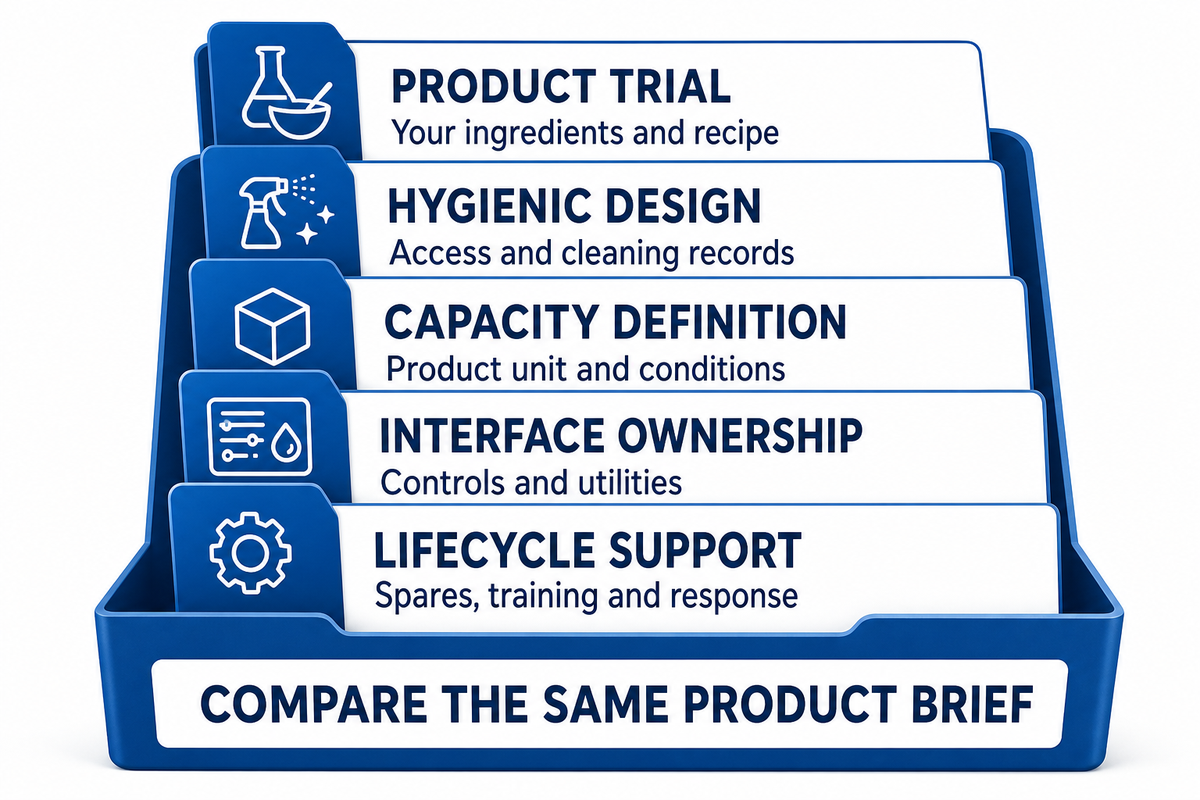
Before comparing headline price and interfaces, run through the 5-Evidence Supplier Check below with each shortlisted supplier, covering product trials, cleaning, capacity, interface ownership and lifecycle support against the same production workflow; the answer should address production needs and process fit, not simply repeat a catalog description.
In RFQs focus on expensive fit mismatches more and small price differences less: the recipe, the cleaning method, the way a batch is processed, changing over or some other apparatus interaction may fail: ask each potential supplier to prepare a test report, a utility matrix and the acceptance criteria all pointing at the same product description. Any unresolved risk should be mentioned plainly on a quotation. State whether food manufacturing equipment is required for a single operation or combined-line operations in the project; for industrial food production, distinguish commercial food processing equipment units for industrial processes from foodservice units before specifying the food processing machine. A plant that intends to install industrial food machinery should request a quotation for an upgrade of existing industrial food equipment as well as a newly designed machine; for the upgrade, ask about the changeover strategy, replacement parts and parts availability at the nearest service locations.
Initially set up the system to fulfill current volumes prior to future expansions; for beverage companies, check beverage processing and beverage-filling boundaries against their upstream or downstream counterparts because treatment units in different plants and markets may connect to beverage pack lines with different owners.
- Testing. Product trial: When submitting samples, send the buyer’s actual formula, raw materials and target packaging (rather than a substitute Product sample).
- Hygienic design: Check the contact surfaces, drainage, access, seals, guarding and the proposed way of cleaning.
- Declared capacity: report relevant units (kg per hour, pieces per minute or batches per shift), yield, quality limitations and test methodology.
- Interface ownership: formally specify (in writing) who owns and is responsible for controls, utilities, upstream/downstream signals, guarding boundaries, and data ownership.
- Lifecycle support: specify the spare-parts list, the training, the commissioning, the response time, remote support and site acceptance tasks.
Send all of your prospective vendors the exact same product brief and specifications on their proposed equipment to receive an Apples To Apples Factory Acceptance Test, including: 1. Ingredient state, such as powder or liquid; 2. Product temperature, °C; 3.
Ingredient moisture at the specified product temperature; 4. Target throughput – kg/hr or pieces/min; 5. Acceptable % of deviation; 6.
Cleaning agents; 7. Power available, kW; 8. Required compressed-air pressure, PSI; 9.
Overall footprint area available, m²; 10. Post-processing requirement: output rates of downstream line equipment.
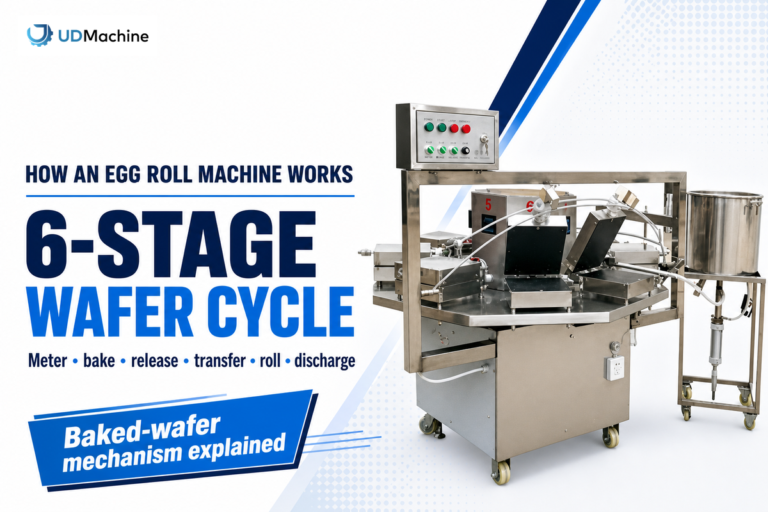
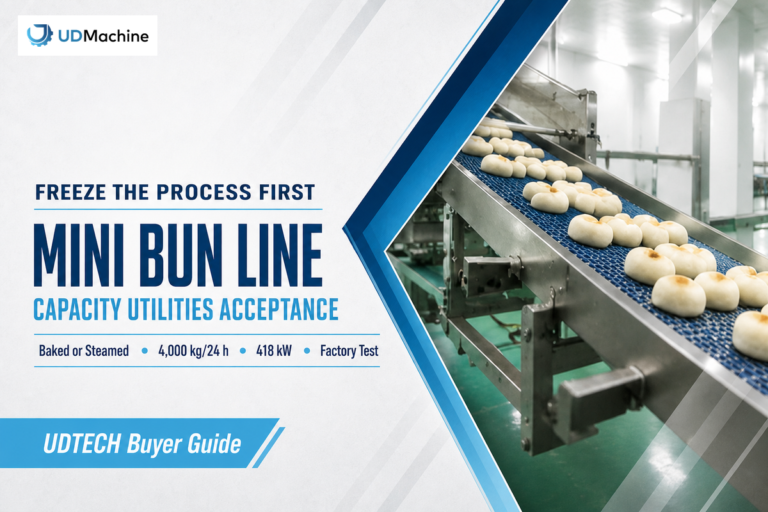
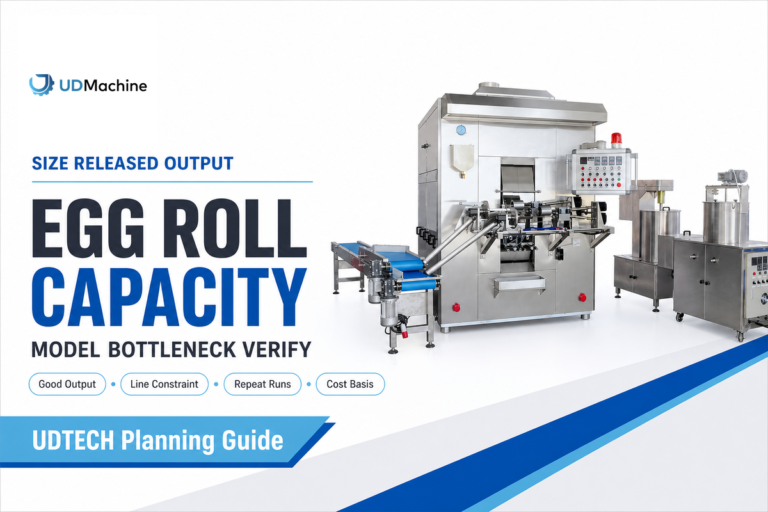
For UDTECH’s bakery and snack scope, compare a relevant product trial with the baby biscuit production line, the rotary egg-roll machine or the industrial waffle machine. If needed for line preparation, also review the pancake production line guide and send UDTECH a product brief using the given sample, the expected output and available utilities.
When Should You Not Shortlist a Supplier?
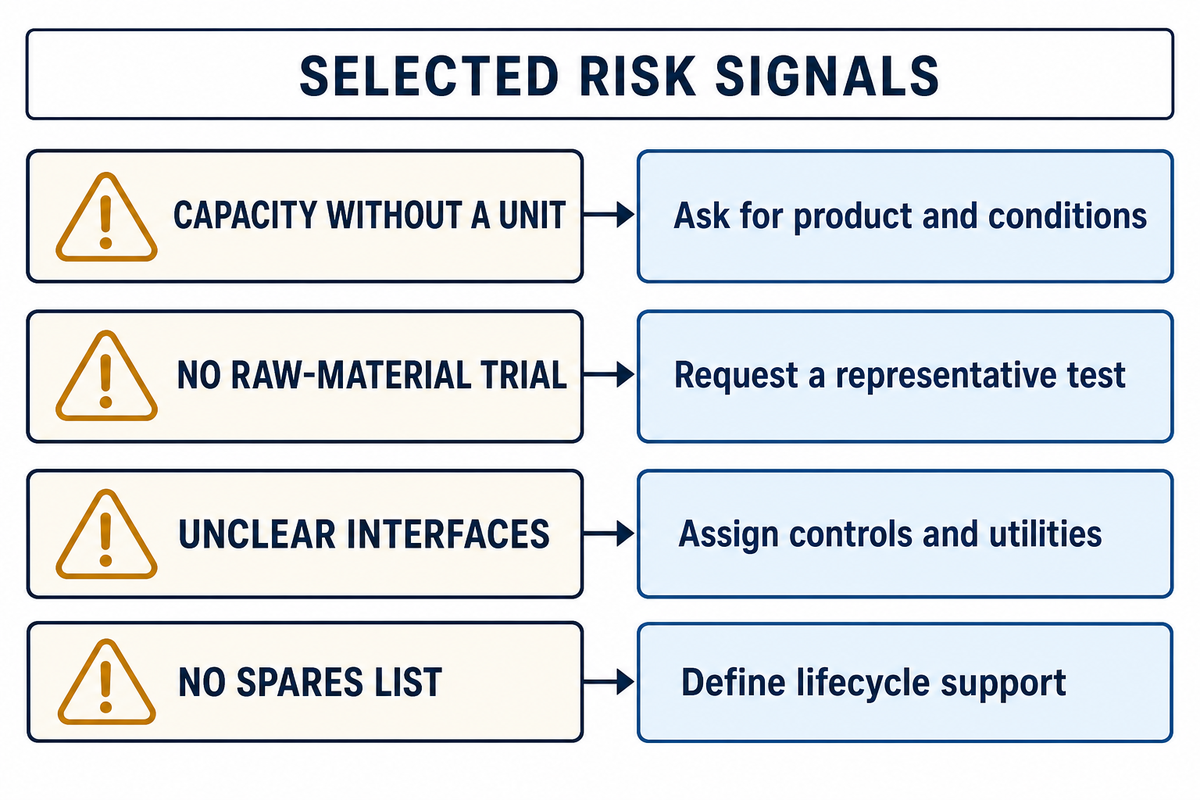
Shortlist Risk Screen: pause when a supplier promises capacity without a defined product unit; refuses a raw-material test; excludes change parts; cannot show cleaning access; leaves controls ownership unclear; omits guarding boundaries; provides no spare-parts list; or presents certificates without the machine and scope they cover. United States cleanability reference for these inspection questions: https://www.ecfr.gov/current/title-21/chapter-I/subchapter-B/part-117/subpart-B/section-117.40
Larger doesn’t guarantee greater safety. A specialist may be more beneficial if they know the product and have conducted a trial with it. A broad-field group may suit a complex project with multi-stage production, worldwide service requirements and a single owner for integration.
Buy smart, not big.
What Hygiene, Food-Safety and Guarding Evidence Matters?
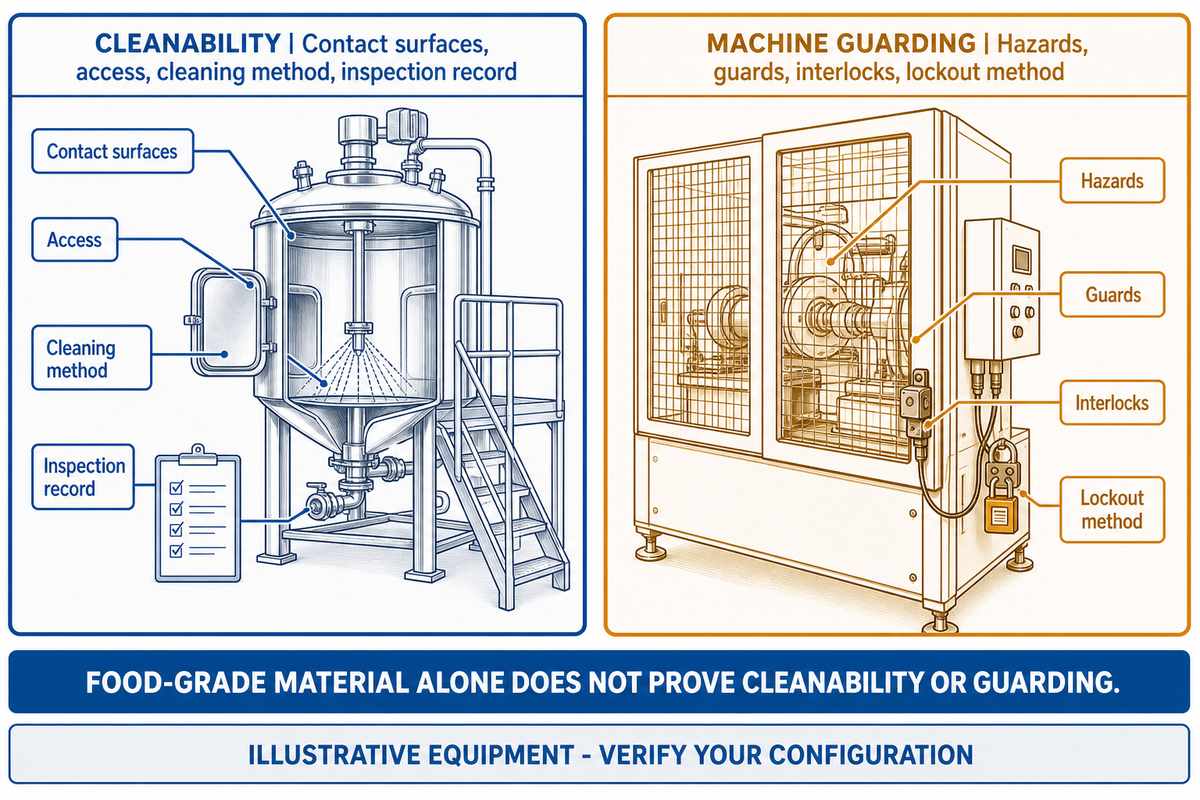
For one United States example, 21 CFR 117.40 demands food equipment be sufficiently cleanable, installed to allow for cleaning and servicing, and have appropriate food-contact materials. That demand in no way validates any manufacturers, or any of the companies on either of the lists provided; it merely provides buyers a single question for verification purposes.
The risk is a cleanability claim that cannot be proved during inspection and a guarding boundary that leaves an operator exposed. Use the regulation and manufacturer’s documentation as evidence guides, then request the cleaning record, risk assessment and factory acceptance test; ask suppliers like UDTECH to prove that the line configured for sale meets the buyer’s process criteria.
Machine guarding is something your food-grade equipment will need; ask which hazards will be guarded and how the supplier proposes doing so. Ask your equipment supplier for details of guard specifications, interlocks, access routes and lockout procedure methods instead of trusting a food-grade material claim.
Cleaning and sanitising aren’t the same step. The new line should clarify which zones are cleaned in place, which are cleaned out of place, how these are visually inspected and how the method is validated. EHEDG and NSF resources can provide vocabulary, but citing a standard doesn’t prove that a particular machine complies.
What Food-Processing Equipment Trends Matter in 2026?
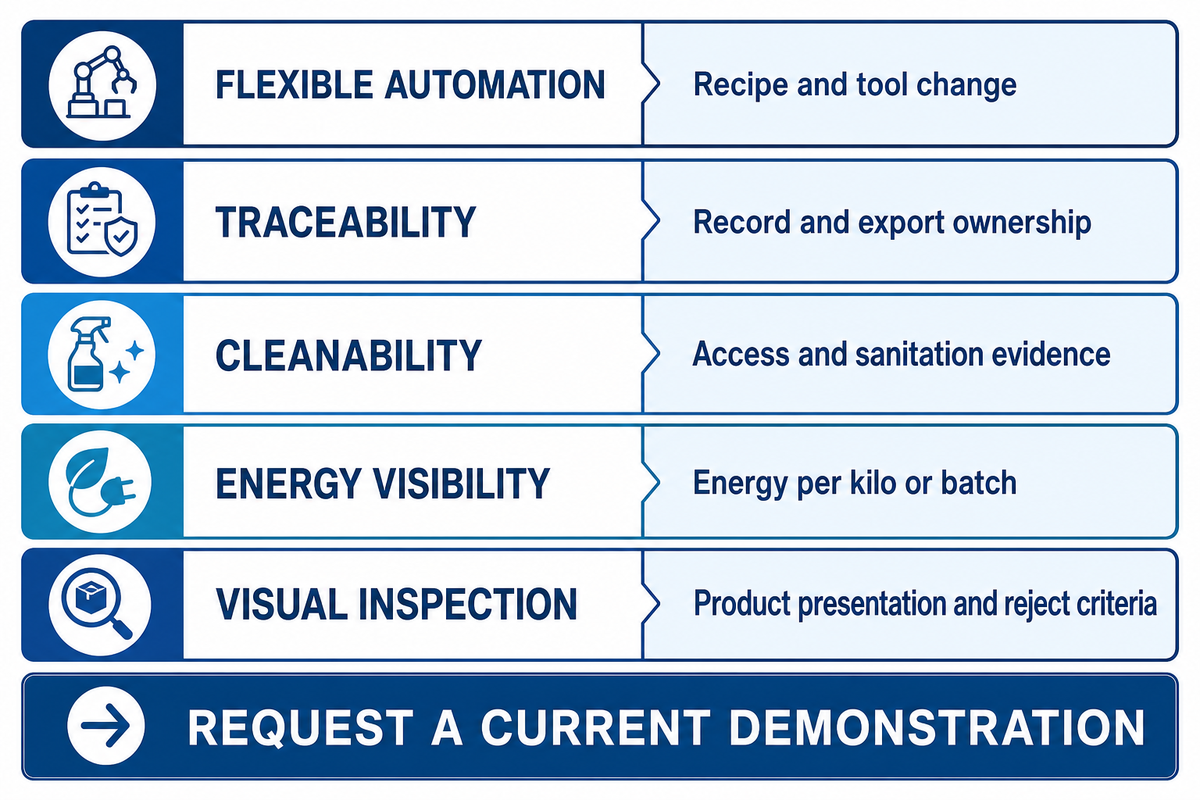
- Flexible automation: When product variety changes during the machine lifespan, recipe control and modular tool design need to keep up.
- Traceability and data ownership: specify the information the production line will record and which party can export the data. Specify how recipe updates will be handled.
- Cleanability: Cleanability data with respect to water and chemical exposure, access, and sanitation verification are having an increasing impact on lifecycle cost.
- Energy visibility: require energy per kilo or batch rather than accept a general efficiency claim.
- Visual inspection and categorization: the ability of an optical system, machine vision system or automated inspection system to detect and report variations depends on consistent product presentation and clear inspection parameters.
Those are questions for the buyer to put to suppliers, not indications that all companies offer all those features. Demand a current live demonstration, relevant specs and acceptance criteria. As a processor in food manufacturing, ask the supplier to show how the piece of equipment interfaces with systems in a larger beverage industry line or other plant systems where relevant. Record assumptions about production, R & D, new approaches, pricing clearly up front rather than accepting general guarantees. Topic-scope reference for hygienic design, cleaning, integration, robotics and sensors: https://www.ehedg.org/guidelines
In the food and beverage industry, ask the R&D team to specify an acceptance test for any claimed gain in production efficiency or operational efficiency. A promise to optimize output or streamline handling should specify the product, measurement period, rejects, operator tasks. For sustainability and waste management, ask for the energy, water and rejected-product data that the buyer can check at its own site.
Operational risk is highest where a trend label replaces a measurable requirement. In a 2026 supplier review, ask for an official number, a current demonstration and when appropriate a factory acceptance test on the buyers’ product demonstrating energy use, inspection, traceability or cleanability performance. Otherwise keep the trend as a question, not a promised capability. If advanced machinery is described as scalable or equipped with artificial intelligence, ask what function changes when the throughput or recipe changes, who controls model or software updates and how rejected product and accepted product are separated. Treat sanitary design and food safety standards as evidence questions for the configured machine; a brochure doesn’t establish that the line meets the plant’s HACCP plan.
Frequently Asked Questions
Who are some major food processing machinery manufacturers?
Examples include GEA, Bühler, JBT Marel, Tetra Pak, Alfa Laval, Krones, SPX FLOW and Midera, along with specialists in the fields of protein, cutting, sorting, bakery, snacks and packaging. The answer though will vary by product, process, output, evidence of hygiene and scope of service, making it impossible to create a definitive performance table.
How do I choose the right food processing equipment supplier?
Begin with a single Product & Process brief and ask for 5 proofs from each supplier: a relevant product trial, hygienic design details, a well-defined working capacity statement, clear controls and utility ownership, and a complete life-cycle support plan. Compare the price after checking that change parts, commissioning, training, validation/testing and spares have been included.
What machines are commonly used in food processing?
One line may include receiving and handling equipment, washing, conveying, cutting, mixing, forming, thermal treatment, cooling, inspection and packing for the specified product. Dairy points to separation & heat treatment; snacks, forming & frying or baking; protein lines, portioning, cooking, chilling, hygiene zones and traceability.
What should a food machinery quotation include?
A food machinery quotation should include the product assumptions, throughput unit, inclusions, exclusions, utilities, change parts, controls, guarding, factory and site tests, training, commissioning, warranty, spare parts and response times. Missing any of those elements means cost isn’t yet comparable.
Are larger manufacturers always the safer choice?
No. Scale may provide wider service coverage and integration resources, while a specialist may provide a better recipe trial and clearer process ownership. A large group can still leave a small kitchen, a seasonal plant or a narrow food business outside its normal design envelope. For a seasonal plant, compare the local technician’s role, the spare-parts route and the time needed to prove a replacement component works with the buyer’s current recipe and line configuration. Verify any high-yield claim.
A specialist can also be limited by local technicians, spare-parts inventory or a smaller controls team. Select the supplier that can prove the required process, hygiene, interface and support evidence for your site, then price the whole lifecycle rather than the machine alone.
![Egg Roll Machine Energy Consumption [Calculation Guide]](https://udmachine.com/wp-content/uploads/2026/09/electric-egg-roll-machine-guide-featured-768x512.png)