Get in touch with UDTECH Company

Sachima Production Line Troubleshooting: Texture, Sanitation and FAT Records

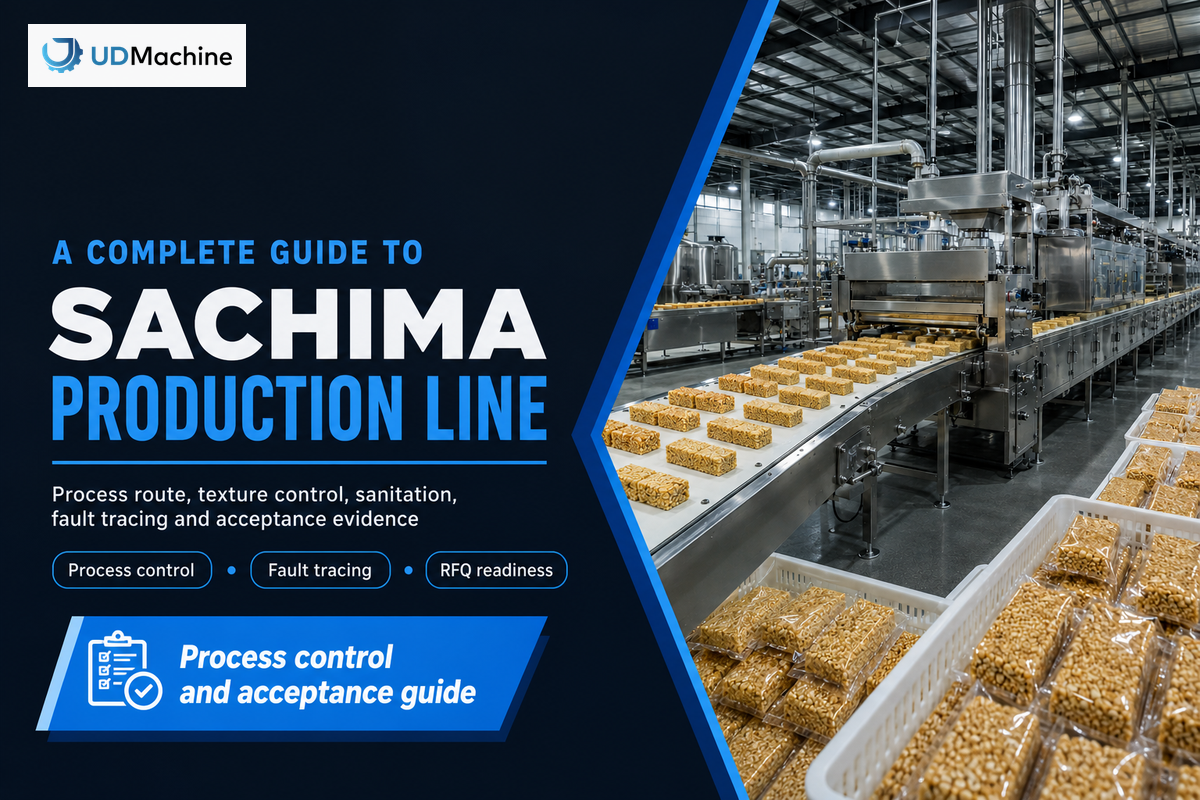
Short answer. A Sachima Production Line is an integrated food-processing route whose stable operation depends on finding the first changed condition, documenting one controlled response and checking the next identified sample. This guide focuses on that operating task: tracing strand, frying, syrup, forming and packaging defects; verifying sanitation-to-start readiness; and building usable factory-acceptance records. It does not compare machine configurations or quotations.
This is a level-two operating guide for foodmakers, quality teams and project engineers who have already selected the sachima route. The commercial Sachima Production Line page owns equipment configuration, specifications, quotation and order decisions. The level-one snack-lines guide owns product-family and route comparison. This page stays with Sachima-specific control signals, defect isolation, sanitation release and evidence capture.
The existing Sachima and specialty snack lines guide is the level-one overview for comparing product families and production routes. The Sachima snack-lines hub remains the parent commercial category for that wider route family. This level-two guide assumes that the buyer is evaluating a sachima route and goes deeper into its control points, defect tracing, sanitation release and acceptance records. For company context, see the UDTECH company background.
Scope note: Sachima varies by flour system, inclusions, syrup, bite, shape, market and packaging format. These sequence and checklist items are planning frames. Confirm the recipe, facility, target jurisdiction and contract limits during a product trial.
Method boundary: The named ledgers, decision trees and procurement sequences are editorial planning frameworks created for this guide. The buyer’s safety, quality and engineering teams must adapt them to the actual plant; they are not regulatory instructions or universal operating procedures.
Key terminology: Search terms sometimes blend a typo “shachima production line” with further equipment focus processing machinery, sesame candy, potato chips, peanut brittle, a large-scale or multi-functional snack route, central kitchens or a sesame candy production line. These terms aren’t interchangeable with a sachima route. And “high-quality”, “fluffy”, “golden color”, “efficiency and quality”, “modern food”, “product specifications”, “hot air”, “sprayer”, “impurity” and “mouthfeel of sachima” are descriptions to specify and assess, not automatic outcomes of a supplier’s machine.
An industrial sachima study describes mixing and forming dough, frying it, blending the fried pieces with heated syrup, moulding the mass and cutting it. That process description is still useful during a new trial: maintain the target texture and colour while documenting any recipe change. A “traditional” label should describe the product brief, not serve as a substitute for a measured acceptance criterion.
Related research paths include the sachima production process, an automatic sachima line, a sachima snack line, a sachima forming machine and a sachima packaging line. In this guide, those terms are treated as stages or adjacent scopes within one recipe-bound acceptance problem, not as interchangeable product promises.
Terminology also matters at the equipment boundary: a mixer prepares dough for a broader food production route, while a frying machine handles a thermal step. Large-scale briefs may mention traditional sachima, texture of sachima, sugar cooking and product requirements; a multi-functional label still needs a recipe-bound trial. Related snack searches may also use caramel treats, crispy bars or a bar machine, but those labels don’t define the sachima process. Likewise, sachima machine, automatic fryer, oil heating, temperature control and snack production are equipment-scope phrases; none defines an accepted product or proves a particular control response. These terms describe scope and questions, not guaranteed results.
What an Automatic Sachima Production Line Actually Controls
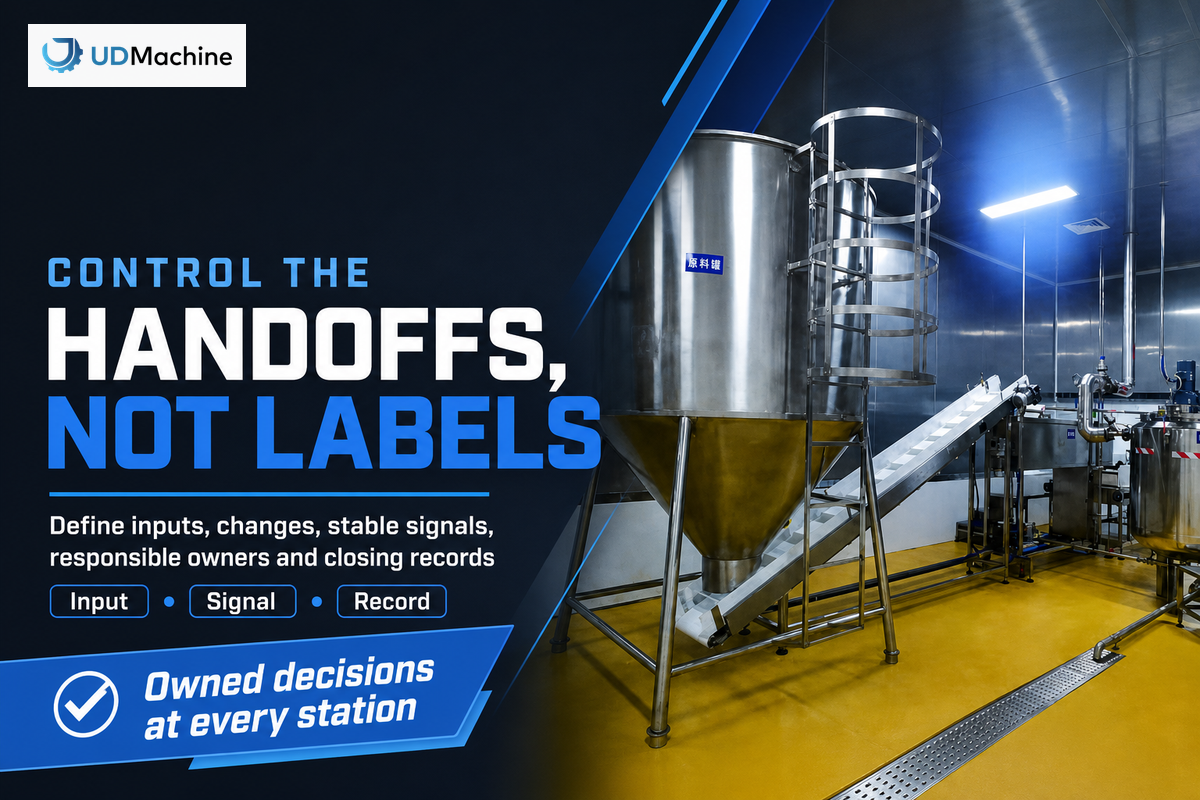
Each line links an input with an acceptable output. Inputs include the recipe, ingredient condition, oil, syrup, packaging material and utilities. Outputs include strand structure, syrup bond, slab set, cut quality, pack integrity and traceability. If a team only compares station names or a single piece of food-making machinery, it can miss the interfaces where quality is lost. The risk persists because an undocumented hand-off can hide the first condition that changed.
The Canadian Food Inspection Agency’s preventive-control templates illustrate why a process flow, hazard review, control procedure and verification record belong together. That structure supports the documentation method here; it does not certify a particular machine.
When a buyer compares offers, this control map also prevents an apparently complete equipment list from hiding an unowned interface, because the team can trace every ingredient, utility, sample, alarm, hold decision and release record to the person responsible for the next action before a factory trial begins.
Define five control questions for every hand-off:
- What goes in? Log recipe revision, ingredient lot, moisture or temperature state and inclusion identity.
- What changes? Record each physical step: sheeting, frying, syrup binding, compression, cooling, cutting or packaging.
- What signal proves stability? Select a visible parameter or inspection result, not a vague adjective like “good.”
- Who reacts? Name the handler, quality supervisor, maintenance supervisor or packaging responsible before the test begins.
- Which record closes the feedback loop? Maintain the production report, deviation, quality disposition and retest decision with the sample ID.
This arrangement is intentionally separated from food product marketing. One machine SKU may be attached to a quotation; a checkpoint establishes a decision point. These principles hold whether a bakery uses a staged route or a fully automated process.
The Process-Window Control Loop
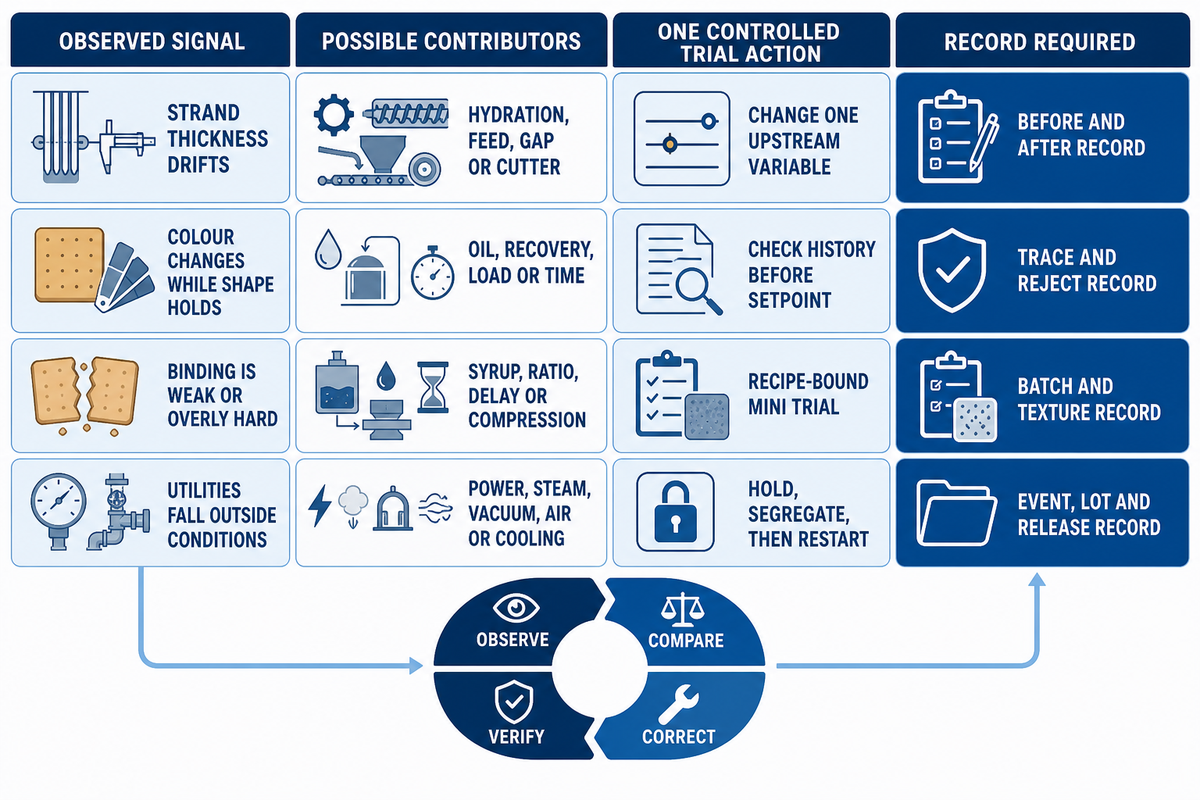
A process window is a bounded range in which the ingredients, product and machine behave acceptably. This control loop observes a signal, compares it with that window, makes one traceable correction and checks the next sample. In a factory trial, this loop doesn’t mean the control system can automatically recover from every disruption.
| Observed signal | Possible contributors | Controlled adjustment to trial | Record required |
|---|---|---|---|
| Strand thickness drifts | Dough hydration, feed pressure, roller gap or cutter condition. | Change one upstream variable; keep recipe and sample point fixed. | Before/after measurement, operator, time and sample identity. |
| Colour changes while shape holds | Oil condition, thermal recovery, loading or residence time. | Check oil and loading history before changing the nominal setpoint. | Oil lot/age, load, temperature trace and reject count. |
| Binding is weak or overly hard | Syrup endpoint, coating ratio, transfer delay or slab compression. | Run a recipe-bound mini trial and compare cohesion after the defined hold time. | Syrup batch, endpoint method, mix time, hold time and texture result. |
| Utilities fall outside conditions | Loss of electricity, steam, vacuum, air pressure or cooling capacity. | Trigger interlock or hold-and-release; segregate affected product before restart. | Alarm/event time, affected lots, disposition and restart authorisation. |
A 1996–2000 project record hosted in the U.S. Department of Agriculture National Agricultural Library database reports that researchers at the National Center for Food Safety & Technology warned that utility losses could push processing conditions beyond critical limits and normal control-response speed. The center is a cooperative research organization involving Illinois Tech, the U.S. Food and Drug Administration and food-industry members. The record is not a current regulation and does not show that every production line behaves the same way. For a sachima line, use it only as a prompt to define a disturbance response: stop or divert affected product, identify the lots, decide their disposition and verify stable conditions before normal operation resumes. For facilities covered by the U.S. rule, the Food Safety Modernization Act text also calls for all affected food to be evaluated for safety.
Design rule: Do not use “the system will catch it” as an acceptance criterion. Ask what happens to the product if power or another utility is lost, which automatic hold or diversion occurs, who can authorize release, and what record proves the line is stable before restart.
The 3-Checkpoint Texture Ledger
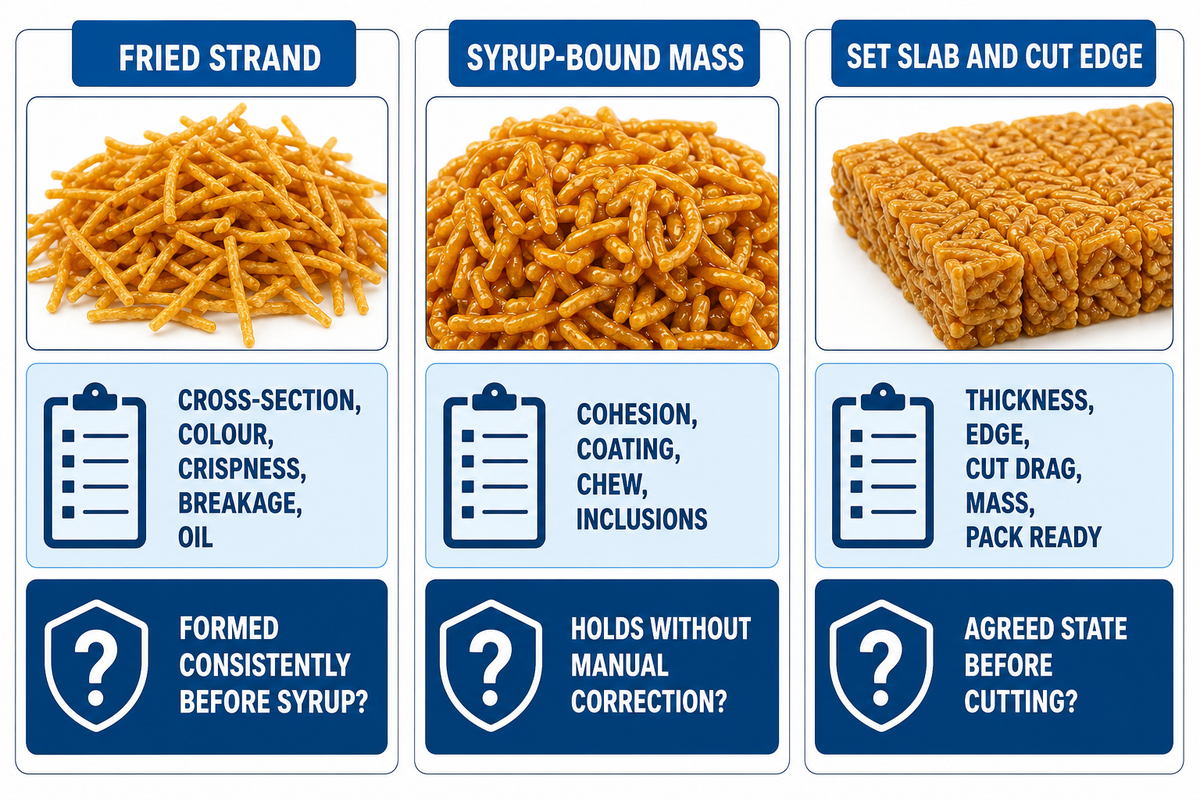
Texture should be followed through the route, not judged only after packaging. Use the Three-Checkpoint Texture Ledger below as a practical sampling frame. It becomes a real acceptance method only after the buyer and supplier define the sampling location, product state, instrument or sensory method, sample size and tolerance.
| Checkpoint | Inspect | Questions to answer |
|---|---|---|
| 1. Fried strand | Cross-section, colour, crispness, breakage and visible oil. | Is the strand formed consistently before syrup can mask the defect? Is the sample taken after thermal recovery? |
| 2. Syrup-bound mass | Cohesion, coating uniformity, chew and inclusion distribution. | Does the mass hold together without requiring an undocumented manual correction? What is the defined hold time before scoring? |
| 3. Set slab and cut edge | Thickness, edge integrity, cut drag, piece mass and pack-ready condition. | Has the slab reached the agreed state? Are rejects linked to cooling, compression, cutter timing or packaging speed? |
Use one ledger row per sample: recipe revision, time, station, measurement method, result, operator, decision and photo reference. Records may show a 2 mm thickness reading, a 165 °C oil observation or a 15 min hold, but those figures are illustrative record formats, not recommended sachima setpoints. Avoid turning convenient adjectives into universal limits. The Food Chemistry study indexed by PubMed shows that formulation changes can alter several dough and fried-product attributes at once, so the contract should state which physical characteristic defines success for that buyer. If crispness is critical, stipulate how the customer wants it quantified.
Example record format (not a setpoint): a trial sheet might reserve fields for a 1 hour observation, a 30 min hold, a 2 mm thickness check, a 1 bar air check, a 4 kW load note and a 0.5% reject entry. A blank form may also show a 3 mm cut-check field and a 6 kW peak-load field; these are documentation placeholders, not recommended sachima values. These placeholders show how to make evidence measurable; the actual values, sample count and tolerances remain recipe-, facility- and contract-specific.
Additional blank-form fields: a template can reserve a 20 s transfer-delay entry, a 5 min inspection entry, a 40 mm piece-width entry, a 12 g piece-mass entry, a 2 m conveyor-clearance entry, a 500 mm sampling-interval entry, an 8 mm gap entry, a 90 s recovery entry, a 75 s verification-delay entry, a 250 g sample entry, a 22 °C ambient entry, a 5 bar utility entry, a 12 rpm mixer-log entry, a 50 kPa pressure-check entry and a 100 mL sample-volume entry. These are empty documentation prompts, not recommended values or equipment specifications.
For teams building a first acceptance form, the following expanded examples show how a unit can be tied to a decision without pretending that the number is universal.
| Record field | Illustrative placeholder pair | How the buyer uses it |
|---|---|---|
| Strand thickness | 2 mm and ±0.2 mm | Define the measurement method and the disposition when the sample falls outside the agreed band. |
| Oil recovery observation | 165 °C and 10 min | Link a temperature reading to the recovery observation and sample identity. |
| Syrup-bound hold | 15 min and 1 hr | State when cohesion is scored and when a delayed texture change is reviewed. |
| Utility check | 1 bar and 2 bar | Record the observed air condition and the alarm or hold rule agreed with the plant. |
| Heater load note | 4 kW and 5 kW | Capture the trial load and the escalation point for an engineering review. |
| Reject review | Sample reject entry and agreed investigation trigger | Show the counting basis and trigger a documented investigation rather than a silent adjustment. |
| Cooling release | 25 °C and 30 min | Connect slab condition to the cutting and packaging handoff decision. |
| Trial window | 10 kg/h and 2 hr | Describe the run scope, not a promised commercial capacity, and attach the raw log. |
Qualification: every pair above is a documentation example only. Replace it with the buyer’s recipe, instrument, sampling plan, plant utilities and contract tolerance before a factory acceptance test; a 3 hr observation may be appropriate for a long trial, but only if the parties agree that duration in advance. Use the qualified output definition worksheet to turn those blank fields into project-specific acceptance definitions.
Sanitation-to-Start Verification
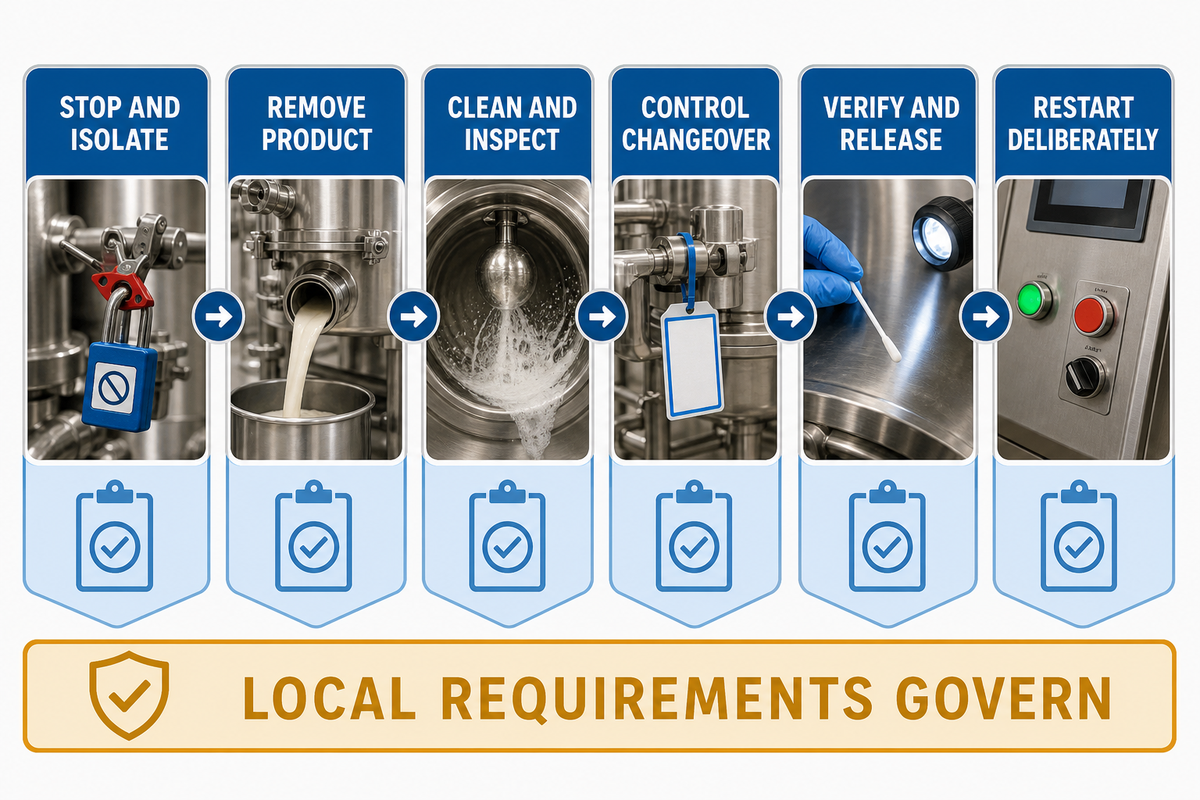
After the texture record is defined, sanitation release is a sequence of evidence, not a badge. Treat the Sanitation-to-Start Verification Path as a facility-specific route: start with the target market and product-risk classification, then map the equipment surfaces and movement paths that matter for that facility. The United States Food and Drug Administration’s current preventive-controls overview explains that covered facilities are required to have and implement a written food-safety plan. It also states that preventive controls can be tailored to hazards in the products they manufacture.
Food-contact access, guards, drains and clean-down questions should be written into the design review. Where stainless steel or other food-grade materials are proposed, ask the manufacturer which surfaces are actually food-contact and how they are inspected. If the buyer wants to customize a machine route, record the change as a controlled design decision rather than an informal promise. In this guide, hygiene is treated as a buyer-defined release condition, not a marketing adjective.
- Stop and isolate: identify stored energy, hot surfaces and moving parts; for U.S. workplaces, apply the employer’s hazardous-energy procedure consistent with OSHA’s lockout/tagout requirements, while other markets must follow applicable local rules.
- Remove product: record the last good lot, unfinished material and any product held at the interface.
- Clean and inspect: verify food-contact access, removable parts, drains, guards, dead spots and cleaning-tool compatibility.
- Control changeover: identify allergens, flavours, inclusions and packaging materials; complete line clearance before the next recipe. For U.S. facilities, FDA’s allergen overview describes written controls to prevent allergen cross-contact in manufacturing and packaging.
- Verify and release: use the facility’s approved inspection, swab or other method, record findings and obtain pre-op sign-off.
- Restart deliberately: confirm utilities, guards, sensors, recipe revision and packaging material before releasing the first sample.
FDA’s draft industry guidance describes written allergen-cleaning procedures, monitoring, verification and corrective-action records. It is nonbinding guidance for its stated U.S. context, so the facility still has to determine the applicable controls and validation method.
Canadian Food Inspection Agency templates are deliberately generic and modifiable. They include product description, process-flow mapping, hazard analysis, critical-control procedures and verification records. That is useful as a design prompt, but it is not a substitute for the buyer’s own plan. China’s official standards platform lists GB/T 22475-2025 General quality for sachima, published on 2025-08-29 and scheduled for implementation on 2027-03-01. A quotation or acceptance document should therefore name the market and applicable edition instead of saying simply “compliant.”
Failure-Fingerprint Decision Tree
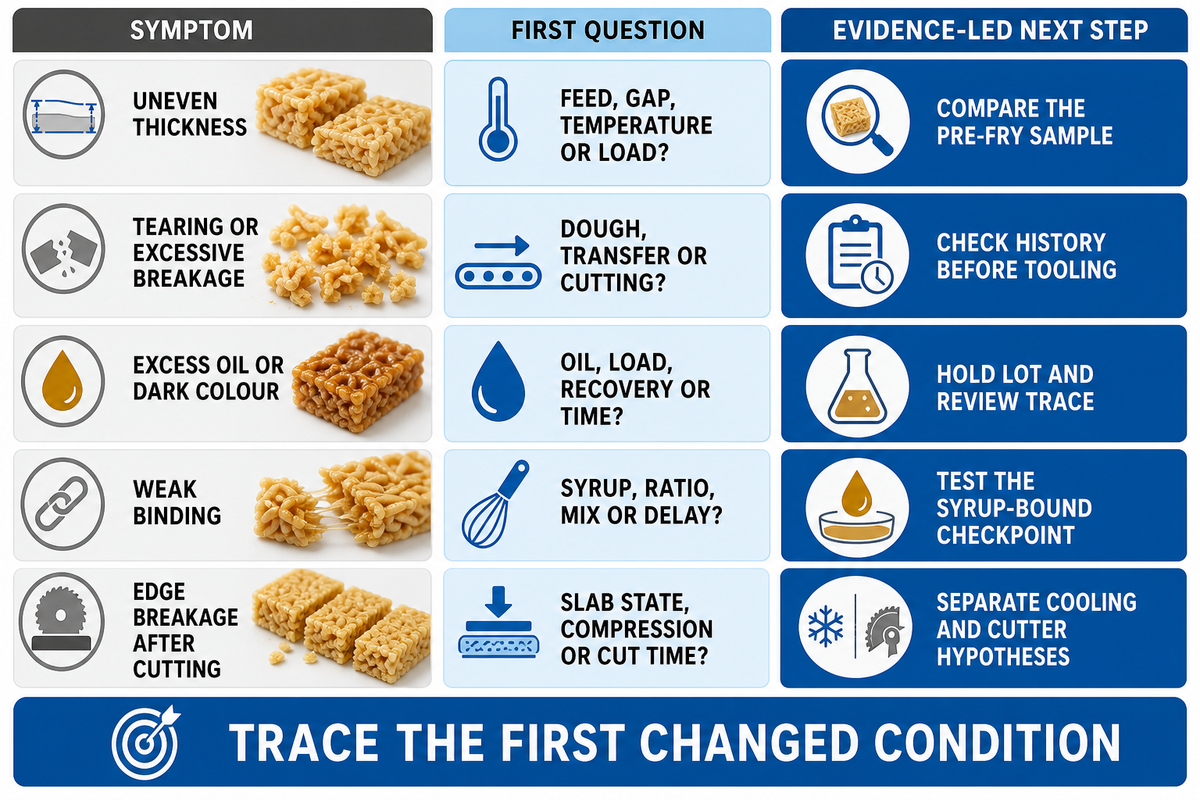
Once sanitation is released, a defect should be traced to its first changed condition before a component is replaced. One visible symptom can have several interacting causes; a formulation change, for example, may alter both dough behaviour and fried texture. In a factory investigation, the first sample point upstream of the defect can be more useful than the loudest alarm.
The published sachima formulation study is a useful caution here: changing one flour variable affected multiple product attributes. It supports a multi-variable investigation, not a universal fault code or machine-setting recommendation.
| Symptom | First questions | Evidence-led next step |
|---|---|---|
| Uneven thickness | Did feed condition, roller gap, dough temperature or cutter loading change? | Compare a pre-fry strand sample with the last accepted sample; adjust one upstream cause and log it. |
| Tearing or excessive breakage | Is the dough extensibility different? Is the transfer or cutting interface pulling the strand? | Check recipe and moisture history, then observe the hand-off before changing tooling. |
| Excess oil or dark colour | Was oil condition, loading, recovery or residence time different? | Hold the affected lot, review the thermal trace and oil record, and verify a controlled restart sample. |
| Weak binding | Was syrup endpoint, ratio, mix time or transfer delay different? | Test the syrup-bound checkpoint and compare cohesion after the agreed hold time. |
| Edge breakage after cutting | Was the slab too warm, too cold, over-compressed or cut before set? | Record slab condition and cut timing; separate cooling and cutter hypotheses. |
This avoids a common diagnostic failure: replacing a component because the visible symptom is easier to see than the upstream condition that changed. A short “first changed condition” field lets the next technician continue the investigation instead of starting from square one.
The 5-Field FAT Evidence Pack Builder
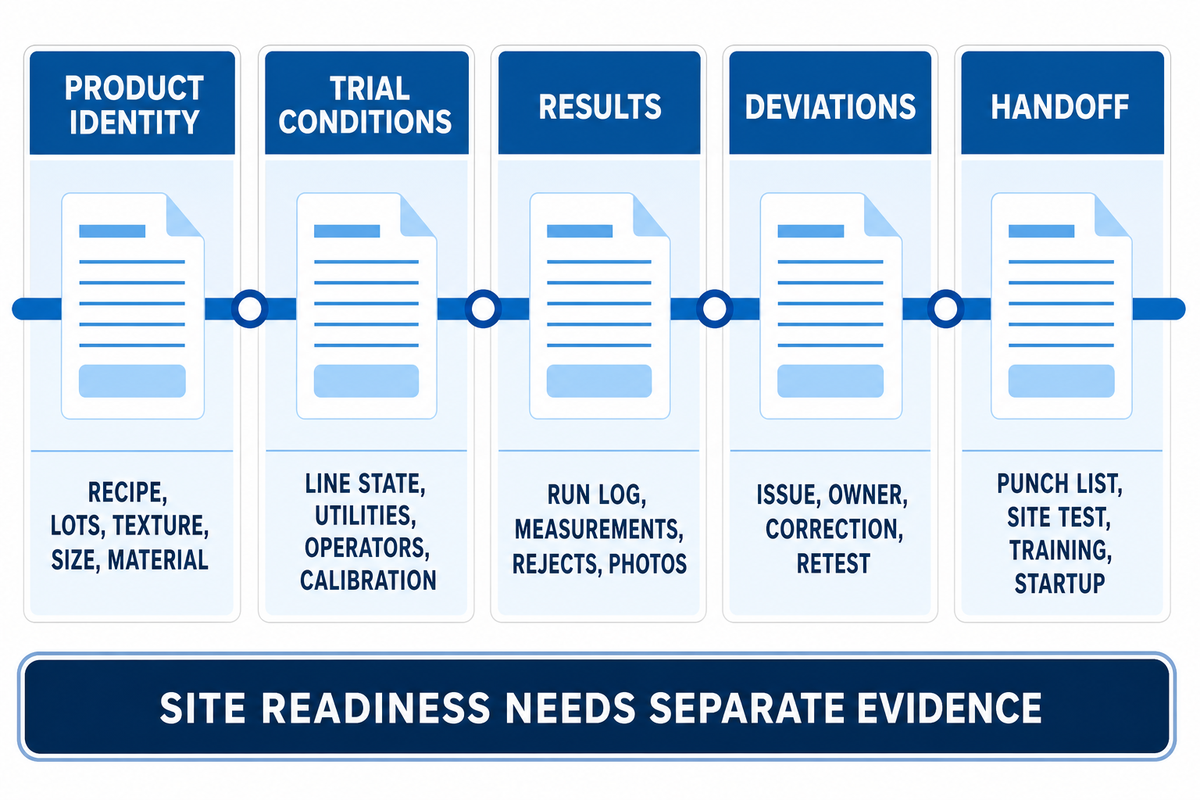
Factory acceptance testing is a witnessed test against agreed conditions. It is not, by itself, proof that a line is ready for production in the buyer’s plant. ISA-105 guidance distinguishes factory acceptance, site acceptance, site integration, loop checks and commissioning. Incomplete handoffs remain risky because a factory test cannot reproduce every site utility, operator and interface. Efficiency claims are meaningful only when the same evidence shows stable product quality and an accepted handoff.
Factory acceptance closes the agreed factory test; site readiness still needs its own utilities, loop checks, sanitation release, training and commissioning evidence.
Build the pack before the test
| Pack section | Minimum fields |
|---|---|
| Product identity | Recipe revision, ingredient and inclusion lots, target texture, piece size, packaging material and sample photographs. |
| Trial conditions | Batch size, line state, operating window, utilities, operator names, calibration status and sampling points. |
| Results | Run log, strand/slab/pack measurements, good-piece basis, reject count, photos and traceability record. |
| Deviations | Observed issue, containment, owner, agreed correction, retest condition and signed disposition. |
| Handoff | Open punch list, site acceptance items, loop checks, operator training, sanitation release and startup authority. |
The United Kingdom workplace-safety authority’s plant-design guidance separately names design, construction, proof testing and commissioning. That distinction is another reason not to treat a “FAT passed” mark as the whole release. A defensible acceptance statement identifies what was tested, under which recipe and conditions, when and where it was tested, who accepted it and which deviations remain open.
Downstream Packaging and Handoff Checks
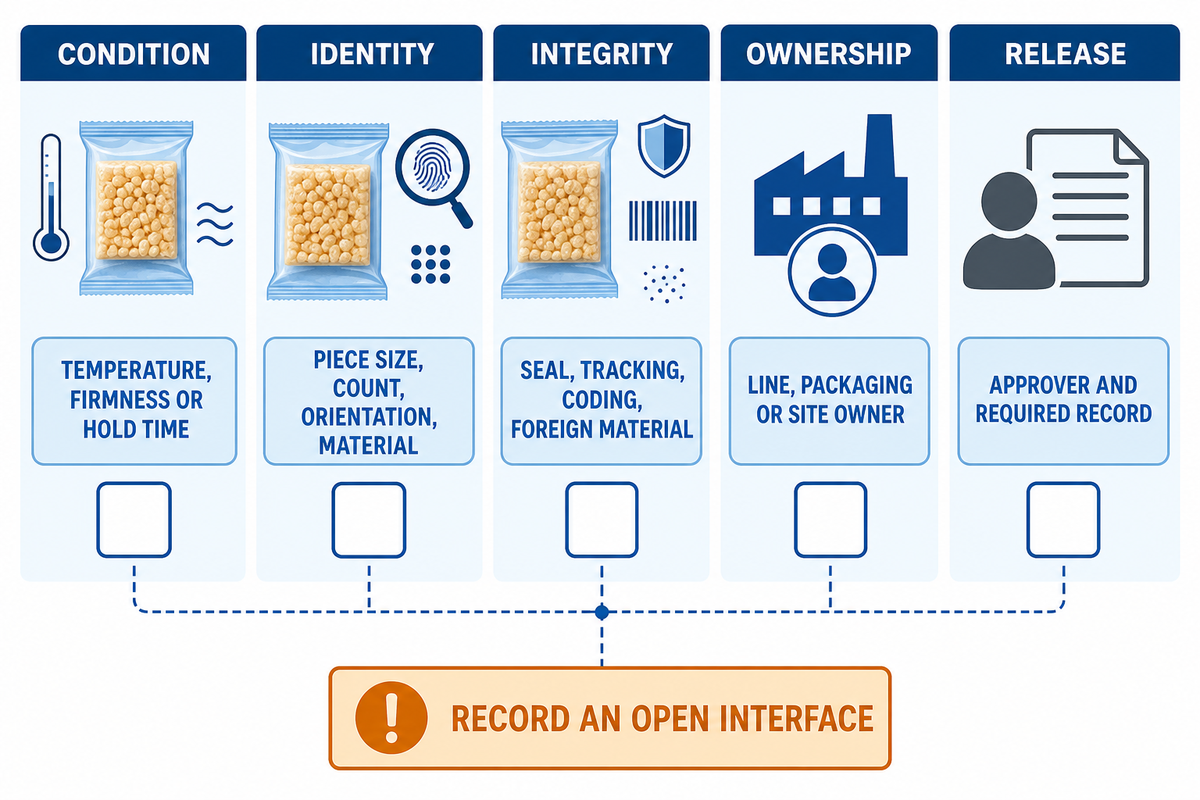
After the FAT handoff is recorded, cooling and packaging can expose problems not discoverable at the slab-cutting station. Define the interface in the same language as the previous section:
- Condition: What temperature, firmness or hold time is required before cutting and packing?
- Identity: Which piece size, count, orientation and packaging material were actually tested?
- Integrity: How were seal quality, tracking, lot coding and foreign-material controls checked?
- Ownership: Who owns each line, packaging or site-interface problem?
- Release: Who has authority to approve the first product and what record is required?
Put these questions in the interface checklist, including any responsibility that sits outside the purchase order. A sample can look acceptable while cooling, tracking, counting or seal evidence remains incomplete. The Canadian Food Inspection Agency’s modifiable planning templates reinforce the need to connect process steps, controls, records and verification; they do not replace the buyer’s packaging validation.
If the supplier demonstrates an acceptable cut piece but the buyer has not supplied the intended film, coding format, cooling condition or pack count, both parties should record the packaging result as an open interface test instead of allowing a visually good sample to become evidence for an untested commercial handoff.
Commercial handoff: This guide deliberately stops before machine selection, rated capacity, configuration, quotation and order terms. Use the commercial Sachima production line page for those decisions after the control and test evidence has been defined.
Discuss Your Sachima Trial Brief
Frequently Asked Questions
Can product size and texture be adjusted?
Adjustability depends on the recipe, forming method, cutter arrangement and the control windows agreed during testing. Put the desired texture, thickness, inclusion and pack format in the product brief. Then record which adjustments are allowed, how each sample is measured and how a change affects both upstream and downstream stations.
How do you clean and change over a sachima line?
Use a documented stop, isolate, remove-product, clean, inspect, verify and restart sequence. Include allergen controls, line clearance, food-contact access, guards and a pre-op release record. Plant sanitation teams must confirm it against the target market, product risk and local requirements.
What should a buyer check before accepting a sachima line?
Agree recipe revision, sample identity, raw-material equivalence, run conditions, utilities, measurable quality criteria, record format, deviation process, retest rules and signatories before the factory test. At site, repeat those checks with plant utilities, operators, sanitation procedure and packaging interface. Keep readings, photos, sample identities and disposition notes with signed record. If conditions differ, mark the run as a deviation and schedule the site check needed before release. Factory acceptance is one stage, not the whole startup release. Then obtain sign-off.
References & Sources
- PubMed: Effect of whole wheat flour on the quality of traditional Chinese Sachima formulation-sensitive dough and fried-product findings.
- United States Food and Drug Administration: Final Rule for Preventive Controls for Human Food covered-facility food-safety planning and preventive-control context.
- United States Department of Agriculture National Agricultural Library database record for a National Center for Food Safety & Technology project utility-loss and sensor-monitoring research context.
- Canadian Food Inspection Agency: Preventive control plan templates for domestic food businesses modifiable process, hazard and verification templates.
- China National Standard Information Public Service Platform: GB/T 22475-2025 sachima standard publication and implementation dates.
- International Society of Automation: ISA-105 Series of Standards factory/site testing, loop checks and commissioning boundaries.
- United Kingdom workplace-safety authority: Design Codes – Plant design, construction and commissioning verification context.
- United States Occupational Safety and Health Administration: Control of Hazardous Energy employer hazardous-energy and lockout/tagout responsibilities during servicing and maintenance.
- United States Food and Drug Administration: Food Allergies written controls for allergen cross-contact in manufacturing and packaging.
- United States Food and Drug Administration: Full Text of the Food Safety Modernization Act affected-food evaluation and preventive-control context for covered facilities.
- Food Science and Technology Research: Antioxidative Maillard Reaction Products in Sachima industrial mixing, frying, syrup-blending, moulding and cutting process description.
- United States Food and Drug Administration: Draft Guidance for Industry, Hazard Analysis and Risk-Based Preventive Controls for Human Food nonbinding allergen cleaning, monitoring, verification and corrective-action record context.
Editorial boundary: This guide doesn’t certify a supplier, promise a universal output, confirm a patent or replace the buyer’s local food-safety, occupational-safety or standards review. Those decisions belong in the project’s technical and commercial records.