Get in touch with UDTECH Company

Seaweed Egg Roll Machine: A 9-Step Guide to Process Design, Quality, and Acceptance


Short answer: Evaluate a seaweed egg roll machine as a recipe-and-line system, not as a single speed figure. Start with the finished wafer format, then test batter deposit, seaweed registration, adhesion, cooling, yield, hygiene and acceptance evidence. The commercial solution page for Seaweed Egg Roll Machine handles configuration and quotation; this guide is the practical layer for production, quality, engineering and procurement teams.
A Seaweed Egg Roll Machine is a line that forms a thin baked wrapper, places or incorporates seaweed and rolls the product for cooling, inspection and packaging; the exact route depends on the approved product brief.
A machine rate is comparable only when the recipe, piece definition, run window and reject rules are stated beside it.
For adjacent equipment options, review the egg roll wafer machine range after the process brief is fixed; use this guide to prepare the evidence questions first.
“Seaweed egg roll” is an ambiguous search term. It can describe a home recipe, a Korean egg roll with seaweed, a Korean omelette wrapped in nori, a fried filled roll or a thin baked wafer with a seaweed layer. Those products do not share the same forming route or acceptance test. Define the food before comparing equipment. The nine steps below are a buying and commissioning sequence, while the extra sections supply the detail needed to make each step auditable.
Related searches include “Seaweed egg roll machine recipes,” “Seaweed egg roll machine for sale,” “Seaweed egg roll machine commercial” and “Seaweed egg roll snack.” They point to different buyer questions, so this guide separates recipe language from production evidence and leaves configuration and pricing to the solution route.
Terminology note: searchers may use making machine, roll machine, egg roll making machine, egg roll machine, automatic egg line, spring roll equipment, automatic egg roll system, seaweed egg snack, egg roll with seaweed, forming machine, automatic egg roll machine, Korean egg dish, egg mixture, high quality egg rolls and rolled egg. In a procurement brief, translate those labels into one product drawing and one egg roll production solution. The same discipline applies when a supplier discusses customization, food machinery, after-sales support or integrated solutions: ask which tested process and deliverable each phrase represents.
The finished snack may be described as crispy, pastry-like or omelette-style. Those adjectives are sensory targets, not machine specifications. If the recipe uses dried seaweed, record its sheet condition and storage history because it can affect registration and adhesion.
For a food production project, keep the production process map beside the quotation so every station, control point and evidence request remains visible.
What Does a Seaweed Egg Roll Machine Actually Make?
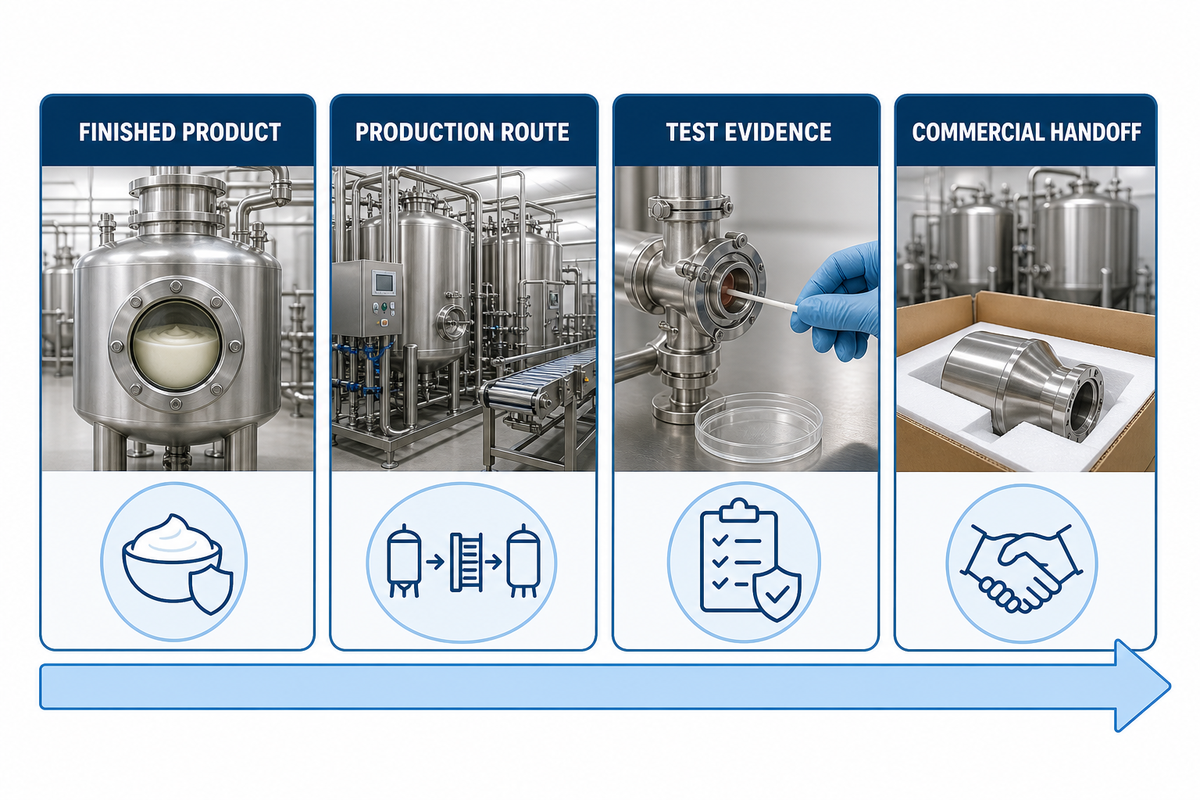
For this article, the target is a thin baked wafer or egg-roll shell that receives a seaweed sheet, seaweed inclusion or seaweed-flavoured layer while the sheet is still formable, then becomes a rolled snack that must survive cooling and packaging. A recipe page may use the same words for a pan-cooked egg dish. A supplier may use “egg roll” for a filled, fried product. Neither label is enough for an industrial request.
The U.S. equipment rule becomes useful after the product format is defined; it cannot resolve that format for the buyer.
Write a one-page product brief with a cross-section sketch, wrapper thickness, roll diameter and length, seaweed format, filling or seasoning, target piece mass, texture at pack-out and the markets where it will be sold. Include the acceptable seam, cosmetic tolerance and whether pieces are sold loose, in trays or in a barrier pouch. This brief prevents a recipe demo from being mistaken for a production-fit trial.
An expensive format mismatch is the main risk. Ask UDTECH engineers to review the product drawing and demonstrate the defined wrapper and seaweed on a factory trial or production line before you approve the route.
Three-gate decision card:
- Format fit: does the route make your wrapper, seaweed layer and seam?
- Controllable quality window: can operators hold the required texture while recipe and ambient conditions move?
- Evidence-ready acceptance: can both parties measure good pieces, rejects, utilities, cleaning and restart behaviour?
Seaweed Egg Roll Format: From Batter Deposit to Rolled Wafer
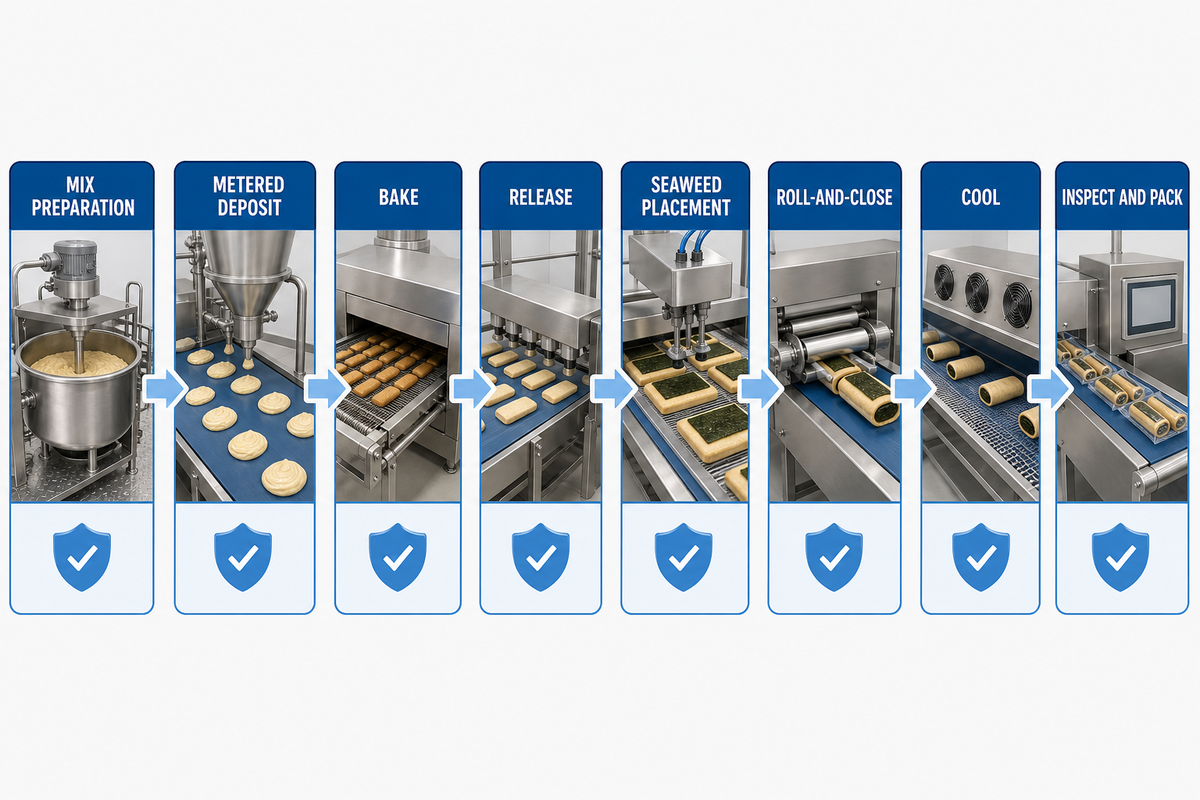
In practice, map the line as a sequence of hand-offs. A useful eight-stage route is mix preparation, metered deposit, spread or plate distribution, bake, release, seaweed placement, roll-and-close, then cool, inspect and pack. Some machines combine stations, but the control questions remain separate. If the batter is inconsistent, a faster roller only produces inconsistent cracks more quickly.
- Prepare: record ingredient lot, solids, fat, water, temperature and the mixing endpoint.
- Deposit: check dose mass and edge-to-edge distribution at the actual line speed.
- Heat: define the bake endpoint by colour, flexibility and break behaviour, not by a copied temperature.
- Release: observe sticking, tearing and sheet curl before adding seaweed.
- Place: register the seaweed to the sheet datum and record overlap or edge clearance.
- Roll: inspect seam closure, filling position and roll geometry.
- Cool: allow the structure to set without trapping heat in the pack.
- Inspect and pack: classify cracks, open seams, misplaced seaweed and underweight pieces.
Wafer process-control guidance is a useful reminder that variables interact. It does not supply a universal recipe for your product. Keep recipe version, operator, ambient conditions and machine settings together in the run record.
For high-temperature processing context, the FDA acrylamide questions and answers explains why bake conditions must be treated as a process decision rather than copied as a universal setting.
How Seaweed Sheets Enter the Process Without Shifting
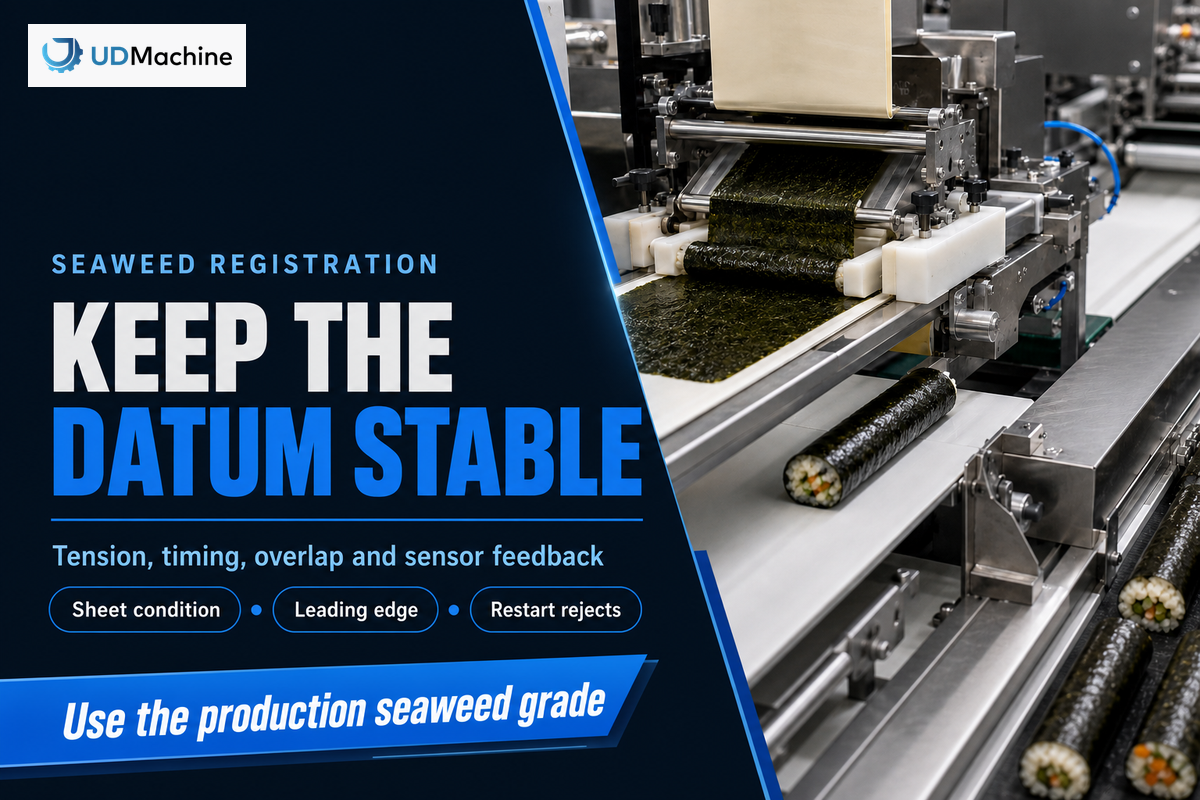
In turn, seaweed behaves like a registration problem as much as an ingredient problem. Sheet tension, curl, moisture, cut accuracy and static can move the datum. Timing matters too: if the wafer is too hot, the sheet can wrinkle or migrate; if it is too cool, adhesion may be incomplete. Ask the supplier to show the reference edge, sensor or mechanical guide used to align the sheet and what happens when a sheet is short, skewed or missing.
Use a registration record
- Seaweed lot, sheet dimensions and storage condition.
- Leading-edge offset and side-to-side registration at start, middle and end of the run.
- Overlap, seam location and percentage of pieces outside the agreed visual band.
- Sensor response, splice or replenishment event and restart rejects.
Do not accept a water-only or empty-sheet demo as proof of production fit. Use your seaweed grade and the wrapper state that will be used in production. A buyer can then compare repeatability rather than a best-looking sample.
For a production line, ask UDTECH engineers to document the registration method in the factory trial record, including the guide, sensor response and restart checks.
One seaweed-processing patent record can show that placement and handling deserve a defined mechanism, but it does not prove UD Company ownership or this machine’s repeatability.
Seaweed Adhesion and Crispness: Finding the Quality Window
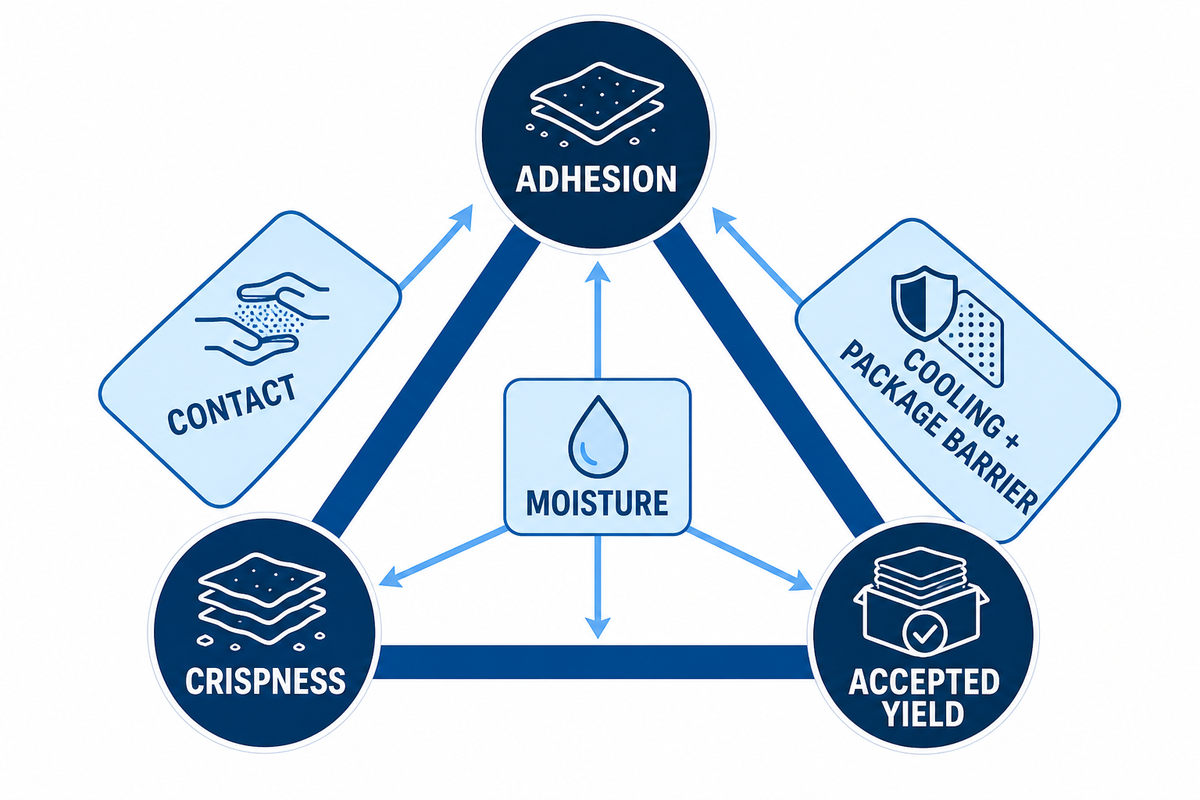
By contrast, adhesion and crispness pull in different directions. More contact or moisture may improve attachment while reducing crispness. Longer exposure to heat may improve browning but can create a brittle wrapper or process-contaminant concern. Government guidance on high-temperature food processing and cleanable equipment provides a safety frame; it does not set your temperature, moisture or residence time.
Build a Seaweed Registration–Crispness–Yield (RCY) triangle for trials. Every change should be logged against all three corners: registration rejects, texture observations after cooling, and accepted-piece yield. Use a simple 1–5 sensory or instrument scale only after defining what each score means. Record pack-out time and a later shelf check if the product promise depends on crispness.
Quality-window worksheet: recipe version → seaweed lot → sheet condition → bake endpoint → contact/roll observation → cooling time → package seal → retained sample. Keep the worksheet jurisdiction-neutral and have your food-safety team map it to the rules for the destination market.
Choosing a setting that looks crisp at release but fails after cooling is the main risk. Because FDA guidance and 21 CFR 117.40 provide a safety frame, have UDTECH engineers tie each factory trial observation to a retained sample and a documented acceptance check.
Pieces per Hour Planning: Build a Yield Model Before Buying
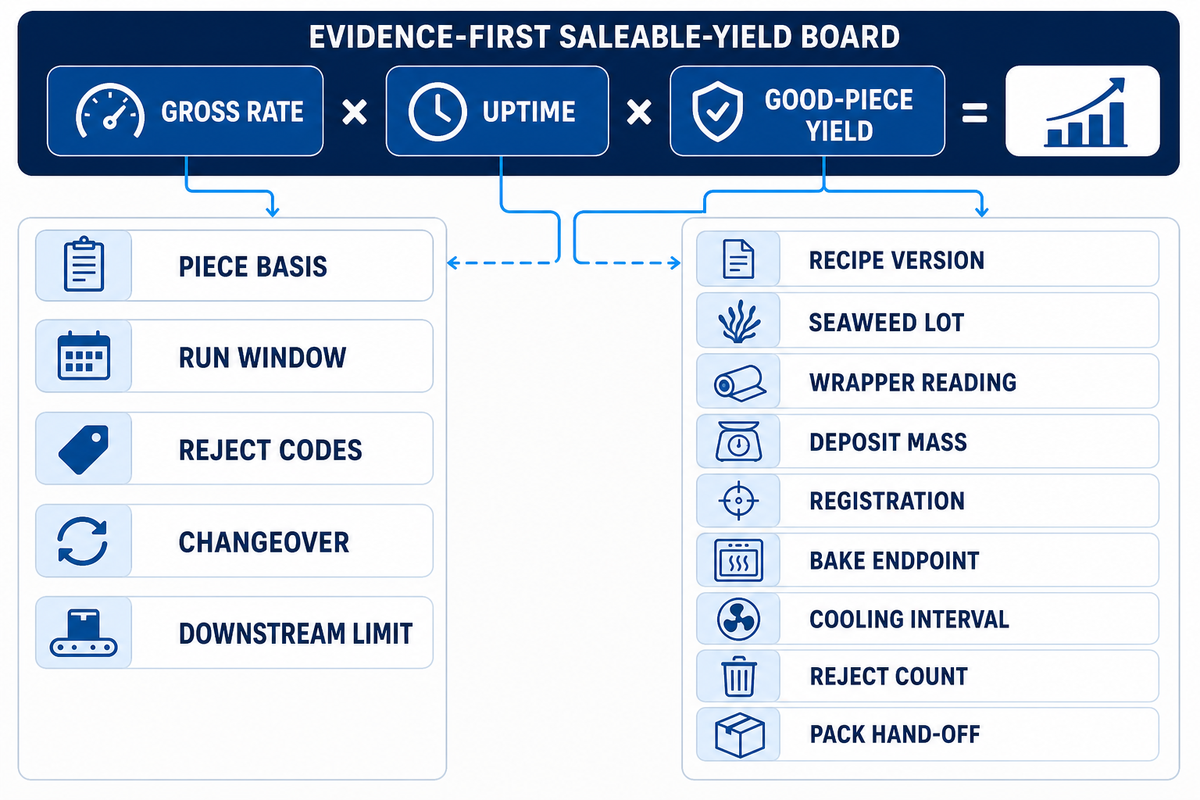
For this reason, a rate is meaningful only when its basis is visible. Published machine pages may show an example such as 2400 pieces per hour under a stated piece condition, while other listings show a price field such as 5000 USD. Those figures are not comparable and are not a UDTECH promise. Use them as prompts to ask what recipe, size, run window and reject definition was used.
Use this transparent model:
NIST sampling guidance supports defining the sampling unit before interpreting a run; here that means keeping the product basis, time window and accepted-piece rule together.
Saleable pieces per hour = gross pieces per hour × uptime × good-piece yield. In a worksheet, separate planned cleaning, changeover, restart loss and downstream packing limits from mechanical cycle rate.
Illustrative record fields, not machine specifications— could include a 10 min sample interval, a 0.8 hr productive window, an estimated 5% reject-rate placeholder, and utility or clearance readings recorded in kW, PSI and mm where those units apply to your approved plant plan. Replace every placeholder with witnessed values.
| Field | What to write down | Why it changes the decision |
|---|---|---|
| Piece basis | Mass, dimensions, seaweed format and filling | A different product is a different rate test. |
| Run window | Start/middle/end samples and stop events | Short demos hide drift and restart rejects. |
| Good-piece yield | Cracks, open seams, misplaced sheets, underweight pieces | Scrap can erase a headline speed advantage. |
| Uptime and changeover | Stops, cleaning minutes and restart loss | Labour and schedule capacity depend on usable time. |
| Downstream limit | Cooling, inspection and packing rate | The slowest stable hand-off sets saleable output. |
| Evidence field | Source context | Value to capture |
|---|---|---|
| Recipe version | Internal recipe sheet | Revision identifier |
| Seaweed lot | Supplier batch label | Lot code and storage note |
| Wrapper reading | Gauge log | Measured value and time |
| Deposit mass | Scale log | Sample average and spread |
| Registration | Camera check | Leading-edge offset |
| Bake endpoint | Retained sample | Colour, flexibility and break result |
| Cooling interval | Timer record | Minutes before inspection |
| Reject count | Run sheet | Accepted count and reason code |
| Pack hand-off | Line log | Start condition and sample ID |
For an illustrative worksheet, assume 100 gross pieces in a short trial, 92 accepted pieces, and 0.8 productive hours after planned stops. The saleable rate is 115 accepted pieces per productive hour. Replace every value with witnessed data; the arithmetic is the point, not the example result.
Cooling, Inspection and Packaging Handoffs
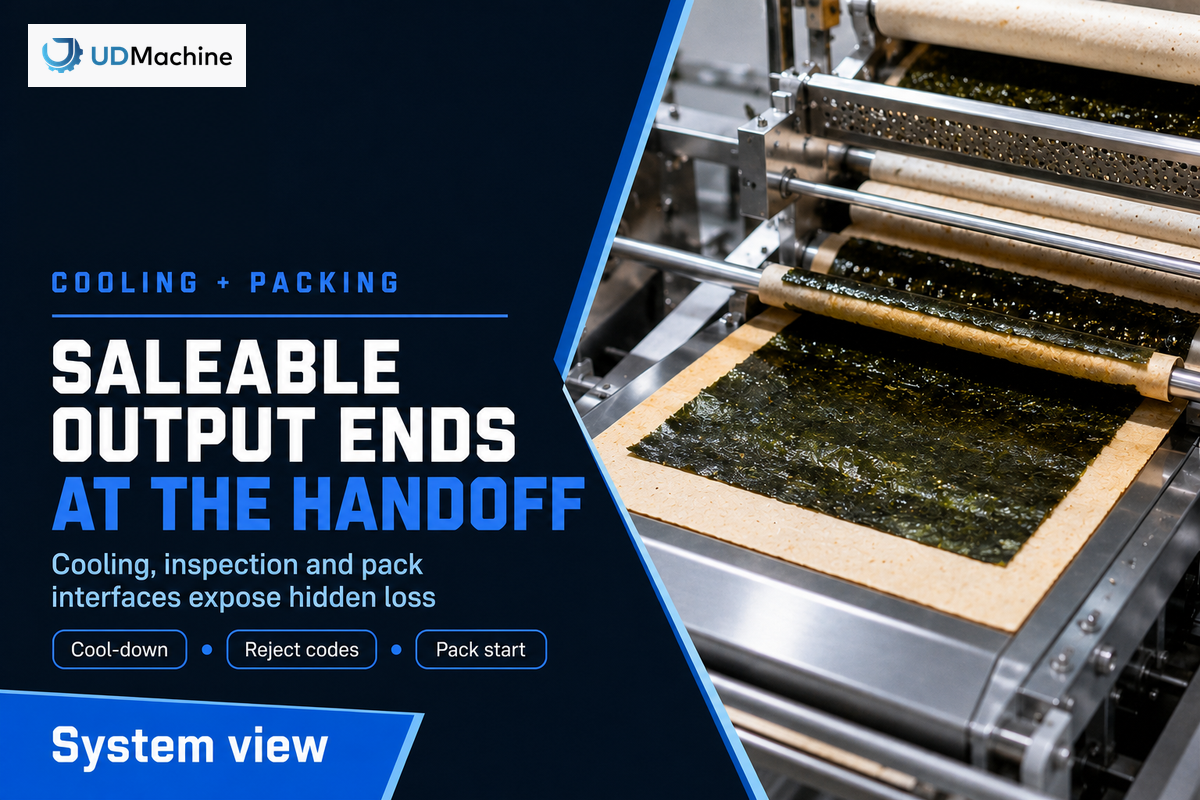
After the rate is known, the roll station is not the finish line. Cooling changes rigidity and seam strength. Inspection is where misplaced seaweed, cracks and open ends become visible. Packaging can add compression, heat retention or seal stress. Define a hand-off condition: product temperature or time basis, acceptable geometry, inspection sample, reject code and pack start.
Use separate bins or digital codes for wrapper crack, seaweed skew, open seam, fill migration and pack damage. A single “reject” bucket cannot tell an engineer which variable to change. Trade-press case material on sanitary conveyors and overall equipment effectiveness supports this systems view, but only your trial can establish the actual bottleneck.
On a production line, record the measured cooling interval, inspection sample and packaging hand-off as evidence. Factory trials that omit those downstream checks can hide the real capacity constraint.
Because a production line can hide risk at the hand-off, compare the measured cooling interval with an ISO 22000-style record and retain the sample.
Cleaning, Allergen Changeover and Seaweed Dust Control
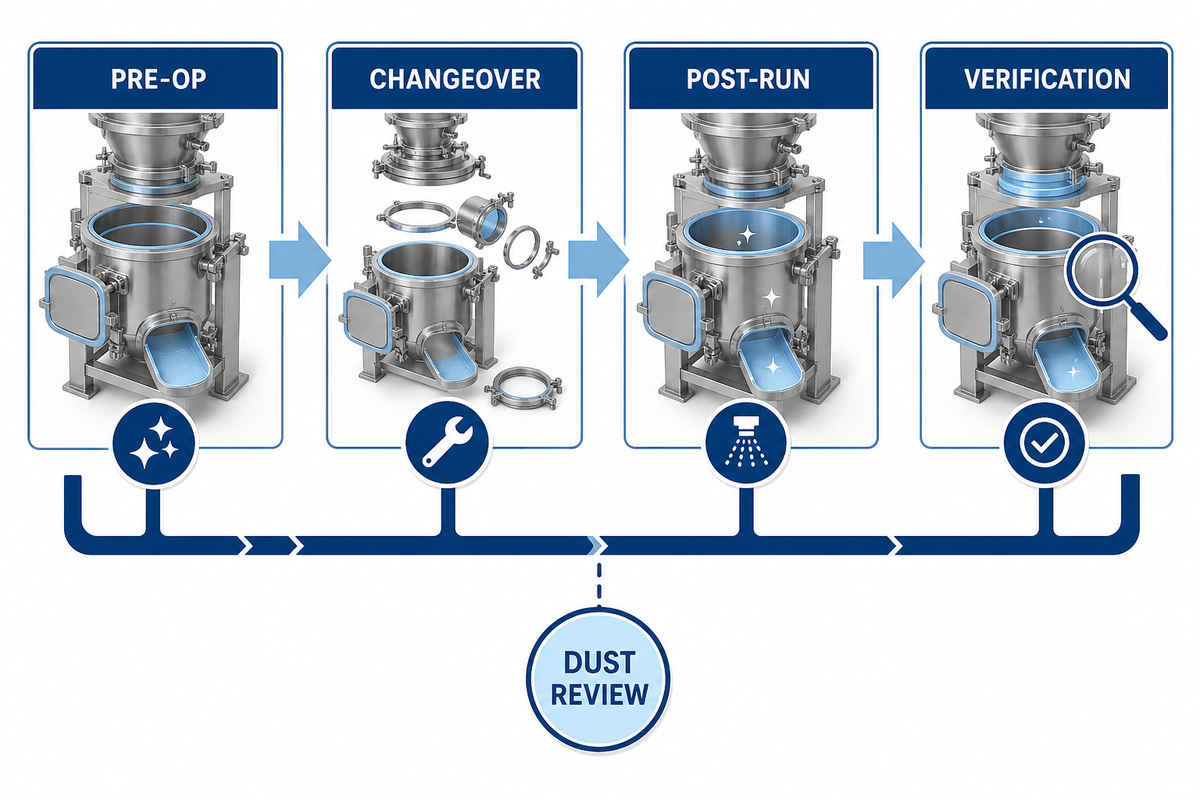
Dry seaweed is still a food-contact and housekeeping question. List all contact surfaces, removable guides, crumb or dust collection points, lubricant boundaries and inspection access. The U.S. equipment rule in 21 CFR 117.40 is a planning reference for suitable, cleanable equipment; it is not a blanket certification of any machine. OSHA combustible-dust guidance is a reminder to review fine-particle accumulation with the facility safety owner.
- Pre-op: verify clean surfaces, guards, tools, labels and line clearance.
- Changeover: record the previous product, allergen status, dry removal method, wet-cleaning decision and inspection sign-off.
- Post-run: inspect hidden ledges, sheet guides, conveyors and packaging contact points; retain the record with the lot.
- Verification: agree who owns swabs, visual checks, allergen validation and local regulatory interpretation.
FDA and USDA allergen guidance has been updated in 2025, but requirements vary by market and product claim. Ask the supplier for access and disassembly information; ask your food-safety team to approve the procedure.
Because cleanable equipment and traceable procedures reduce contamination risk, compare the supplier’s factory documentation with 21 CFR 117.40 and ISO 22000 requirements for your market.
Factory Acceptance Test and Commissioning Checklist
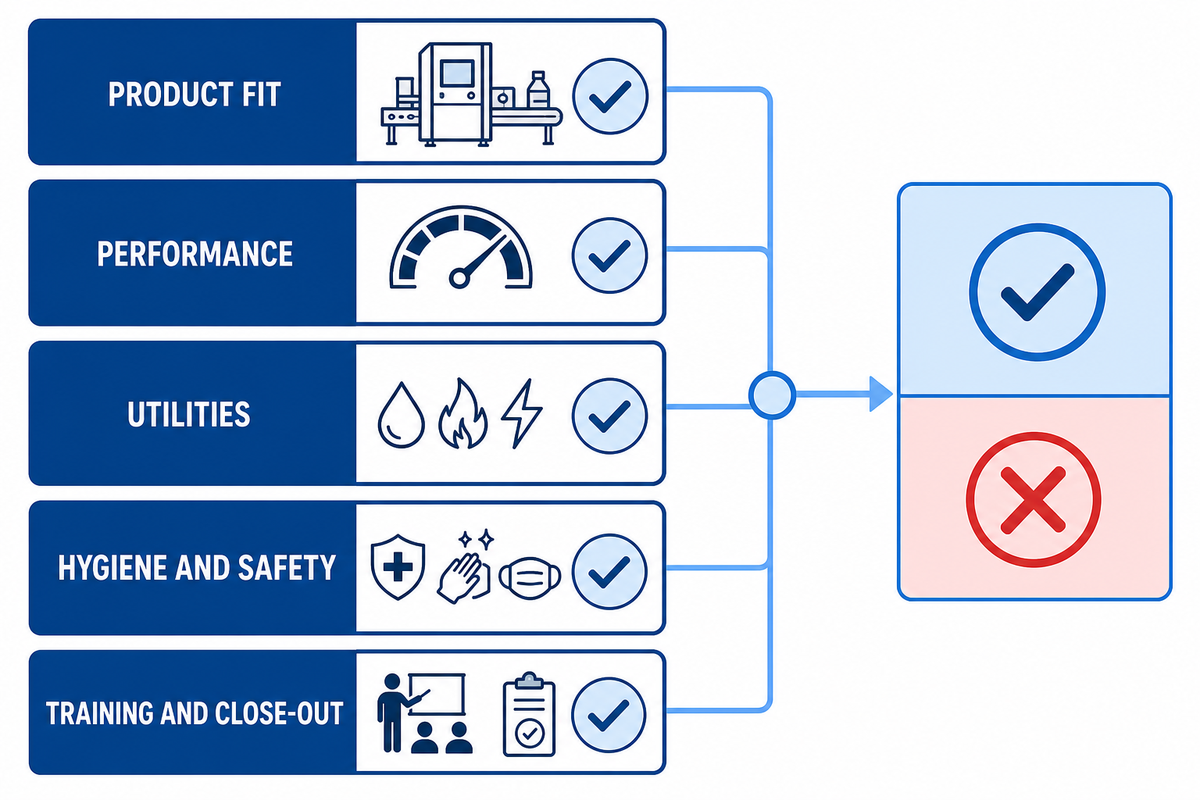
For the same reason, a factory acceptance test should prove a defined product under defined conditions, not merely show that motors run. Before the trial, freeze the recipe version, seaweed lot, wrapper dimensions, utilities, tooling, run duration, sampling plan and defect definitions. During the run, record operator interventions, stops, speed changes, alarms, cleaning events and retained samples from the beginning, middle and end; a 5 min restart sample and a 1 hour verification window can expose warm-up rejects.
| FAT block | Evidence to retain | Owner at sign-off |
|---|---|---|
| Product fit | Approved drawing, recipe and seaweed identification | Buyer quality and supplier process lead |
| Performance | Gross and accepted counts, reject codes and run log | Joint witness team |
| Utilities | Actual electrical, air and exhaust conditions | Buyer engineering |
| Hygiene and safety | Access, guarding, line clearance and cleaning review | Buyer safety/food-safety owners |
| Training and close-out | Training attendance, punch list and open actions | Named commissioning owner |
Use a signed disposition for each failed point: corrected and retested, accepted with a dated action, or rejected. A patent document or a supplier brochure cannot replace this evidence. The user-supplied UD Company history describes independent development and invention patents; those statements are kept as company background, not treated as proof that this specific configuration passes your FAT.
Egg Roll Wrapper Cracking and Uneven Seaweed Placement: Troubleshooting
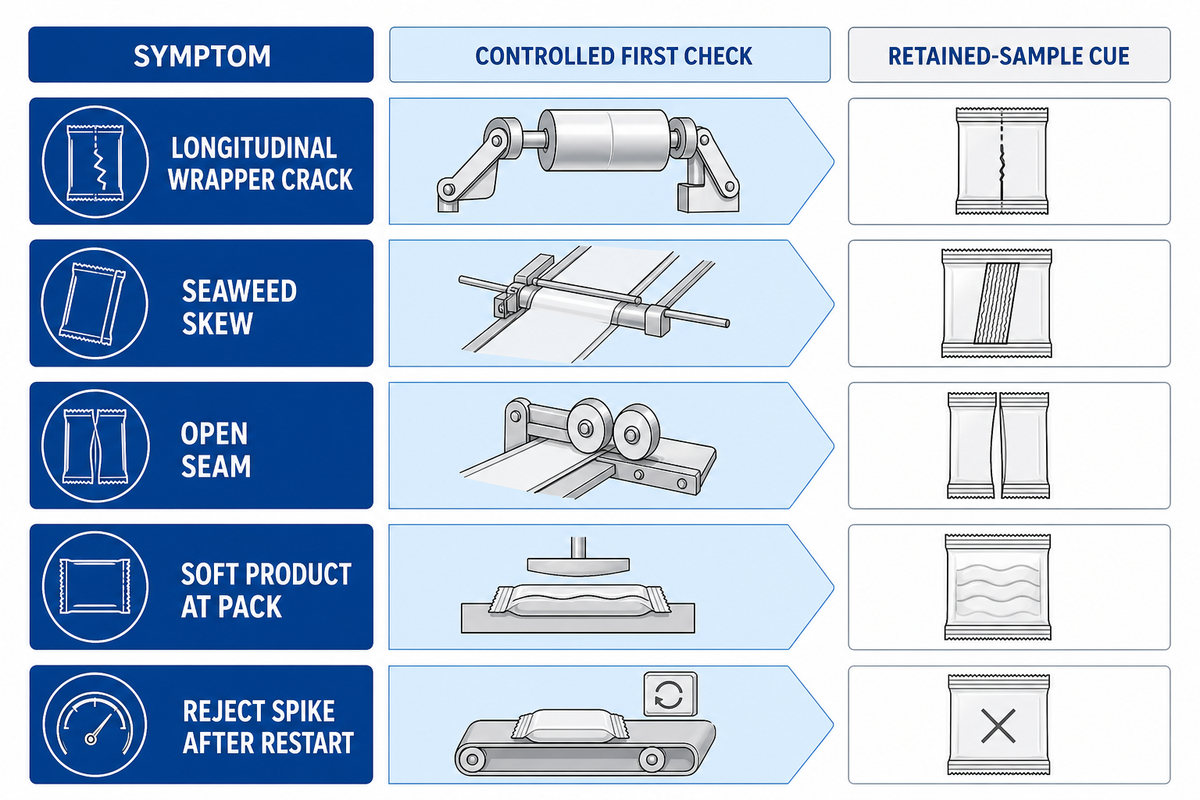
Start with the symptom, then isolate one variable. Changing speed, bake and seaweed tension at the same time destroys the evidence trail.
NIST process-monitoring guidance cautions that chronological measurements are not automatically independent, which supports changing one variable while retaining the same sampling basis.
| Symptom | Likely variable family | First controlled check |
|---|---|---|
| Longitudinal wrapper crack | Sheet thickness, release, roll force or cooling | Compare start/middle/end thickness and release marks before changing speed. |
| Seaweed skew | Sheet datum, curl, tension or sensor timing | Mark the leading edge and measure offset over a fixed sample. |
| Open seam | Contact, wrapper flexibility or filling position | Inspect warm and cooled pieces separately; hold the recipe constant. |
| Soft product at pack | Cooling time, moisture migration or seal heat | Retain samples before and after packing and compare the same interval. |
| Reject spike after restart | Warm-up, replenishment or operator reset | Log the first minutes after restart and classify the first-cause code. |
Community discussions are useful for naming symptoms such as breaking or watery dough, but they are not industrial failure-rate evidence. If the first check does not move the result, restore the previous setting, document the observation and test the next variable with the same sampling basis.
Supplier RFQ Checklist for a Seaweed Roll Line
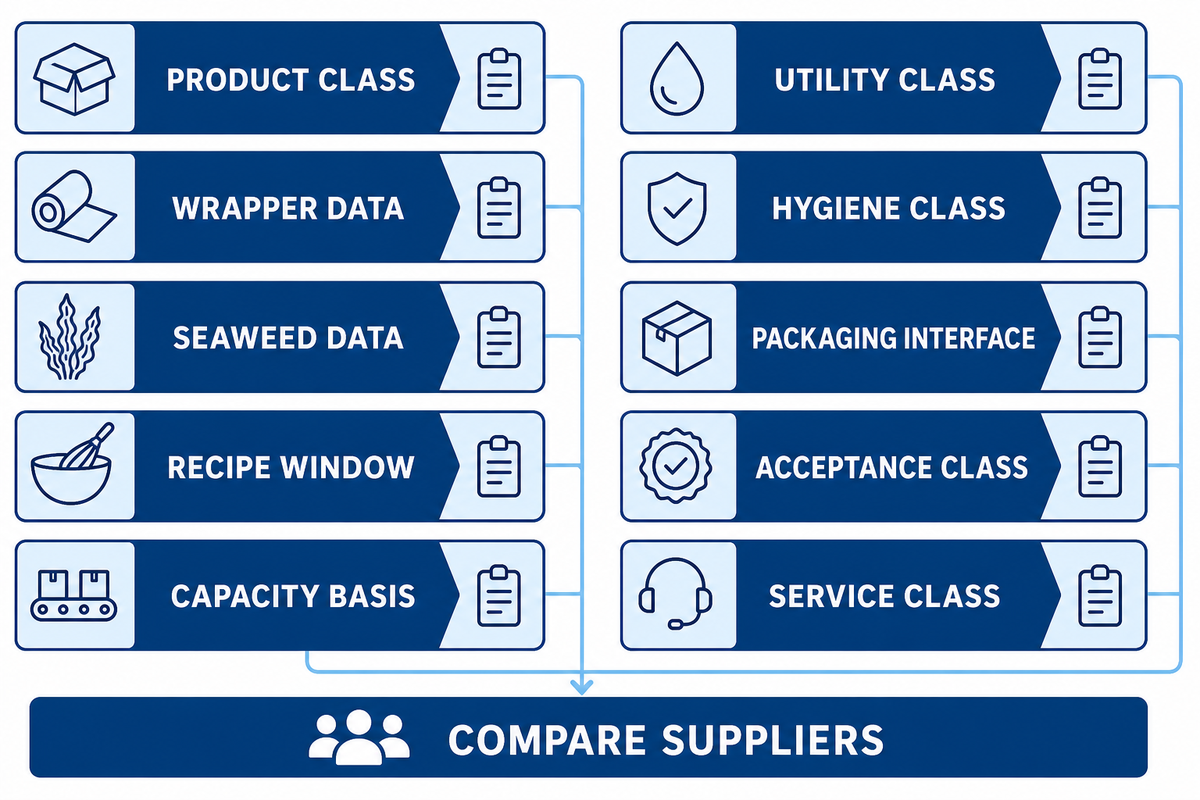
After troubleshooting, a quoteable RFQ describes the product and the evidence required, not just a model name and pieces-per-hour target. Include:
Anchor hygiene and access fields to 21 CFR 117.40 or the applicable rule for the destination market, without turning that reference into a machine-certification claim.
- Product drawing, wrapper and seaweed specification, filling or seasoning and target piece mass.
- Recipe states at deposit, bake, seaweed placement and roll closure.
- Required registration band, seam acceptance, crispness definition and shelf-life hand-off.
- Utilities, room constraints, operator skill, cleaning method, allergen programme and dust review.
- Cooling, inspection, reject handling, packaging interface and data fields.
- FAT/SAT run length, sample plan, good-piece definition, retest rule and training deliverables.
- Service scope, spare parts list, change-control process and named response contacts.
| RFQ field type | Minimum detail to request | Evidence returned with the quote |
|---|---|---|
| Product class | Baked wafer, filled roll or another defined format | Annotated product drawing and route statement |
| Wrapper data | Thickness, flexibility and break criterion | Sample photos and measurement method |
| Seaweed data | Sheet or inclusion, lot condition and cut size | Registration record and handling notes |
| Recipe window | Ingredient states and permitted variation | Trial recipe sheet and change log |
| Capacity basis | Gross rate, good-piece yield and run duration | Time-stamped run report with reject codes |
| Utility class | Electrical, air, exhaust and room constraints | Utility schedule and installation drawing |
| Hygiene class | Contact surfaces, access and changeover method | Cleaning and inspection checklist |
| Packaging interface | Cooling condition, seal hand-off and buffer need | Downstream compatibility note |
| Acceptance class | FAT/SAT samples, defect limits and retest rule | Signed protocol and punch list |
| Service class | Training, spares, response and change control | Named contacts and deliverable list |
Ask each supplier to return the same evidence table. That makes a lower nominal speed with stronger yield and changeover records comparable to a faster but unproven headline. Keep commercial configuration and pricing questions on the solution route after the process brief is agreed.
2025–2026 Trend: Why Traceable Process Evidence Beats Speed Claims
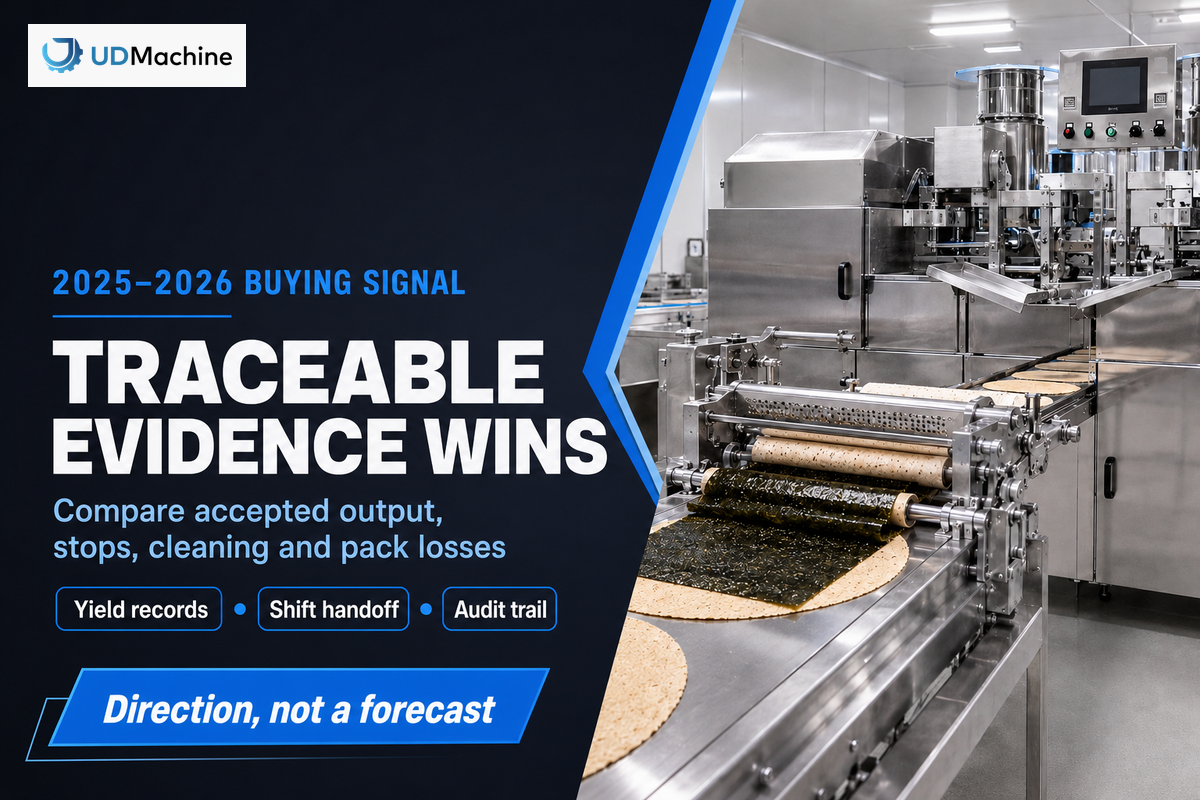
In turn, market reports describe continuing interest in seaweed snacks, while food-manufacturing coverage points toward monitoring, robotics and traceability. These are directional signals, not a forecast of your demand. They do change the buying conversation: labour variation, allergen accountability and repeatable quality make a traceable trial more useful than an isolated maximum-rate video.
Build the business case from records: accepted kilograms or pieces, cleaning minutes, restart rejects, labour hours, utility readings and packaging losses. If a supplier cannot state the conditions behind a number, label it as an example and keep it out of the return-on-investment model. The practical trend is evidence that can be audited by the next shift, not a larger brochure number.
An attractive headline with no repeatable basis is a risk. Ask UDTECH for a factory trial report that records the production line conditions and lets the next shift audit the same evidence under an ISO 22000-style management approach.
FAQ: Practical Questions Buyers Ask Before Trials
How much does a seaweed egg roll machine cost?
There is no responsible universal price. Listings mix domestic appliances, recipe equipment, shaping modules and complete industrial lines, often with different tooling, utilities, installation and acceptance scope. Request a configuration-based quotation after freezing the product brief, then compare total delivered scope, good-piece trial evidence, cleaning access, training and changeover—not only the equipment line item. Ask whether the quotation includes tooling, seaweed handling, cooling, inspection, packing interfaces, commissioning travel, operator training, spare parts and a defined acceptance retest. A low entry figure can become expensive if those interfaces are excluded, while a higher figure may include evidence and support that protect saleable yield. Keep the comparison on one product basis and one delivery scope.
What is the name for the machine that rolls egg rolls?
Suppliers may call it an egg roll machine, wafer roll machine, phoenix roll machine, seaweed roll shaping machine or an automatic production line. The name does not prove the route. Confirm whether the equipment deposits and bakes a thin sheet, feeds seaweed, fills a shell, rolls while warm, cools and hands off to inspection. Use the process stages and finished-product drawing in the RFQ to avoid a naming mismatch.
Do egg and seaweed go together?
They can be paired in several foods, from a hand-made omelette to a baked wafer snack. Compatibility depends on moisture, heat exposure, adhesion, flavour and the intended texture. A recipe result does not prove an industrial line will place seaweed accurately or keep a crisp shell. Trial the actual seaweed grade and wrapper, then retain samples through cooling and packaging before making a scale decision.
What should a supplier trial include?
Provide your recipe version, seaweed lot, product drawing, utilities and acceptance definitions. Ask for start/middle/end samples, gross and accepted counts, reject reasons, registration measurements, cleaning notes, restart behaviour and a signed punch list. If the trial uses a surrogate ingredient or a short demonstration, label it mechanical feasibility only and schedule a recipe-bound retest. Also request the raw run sheet, operator interventions, alarm history, cleaning time, restart sample and disposition of every failed point. Those details let a second shift reproduce the observation and stop a polished demonstration from becoming an untraceable production assumption.
How should a buyer compare two capacity claims?
Put both claims on the same basis: piece mass and dimensions, recipe and seaweed, run duration, utility conditions, operator interventions, accepted-piece yield, planned stops and downstream packing rate. A condition-bound example can be useful, but it is not a guarantee for another recipe. Calculate saleable pieces per productive hour and keep the assumptions beside the result.
Ready for a process-fit discussion?
Bring the product brief, RCY trial sheet, yield model and FAT checklist to the configuration conversation. Open the UDTECH enquiry form.
Bring the product brief, RCY trial sheet, yield model and FAT checklist to the configuration conversation. Open the UDTECH enquiry form.
References & Sources
- U.S. Food and Drug Administration: Acrylamide questions and answers high-temperature processing context.
- Electronic Code of Federal Regulations, 21 CFR 117.40 equipment and utensil hygiene planning.
- NSF food-equipment certification overview sanitary-design context.
- ISO 22000 food-safety management standard system-level food-safety context.
- BiscuitPeople: Process control on wafer secondary process-control guidance.
- Food Engineering: Sanitary conveyor and overall equipment effectiveness integration context.
- OSHA: Combustible dust facility housekeeping and hazard-review context.
- FDA: Food allergies and USDA FSIS Directive 7230.1 jurisdiction-aware allergen-update context.
- Fact.MR seaweed-snacks market coverage and Grand View Research seaweed-snacks market coverage directional trend context.
- ANKO Egg Roll Machine and Automatic Production Line condition-bound commercial example; not a UDTECH specification.
- NIST sampling plan guidance and NIST process monitoring for autocorrelated data measurement-planning context.