Get in touch with UDTECH Company

Wafer Roll Machine
Automatic Wafer Roll and Wafer Stick Production Line — Two-Line and Three-Line Configurations
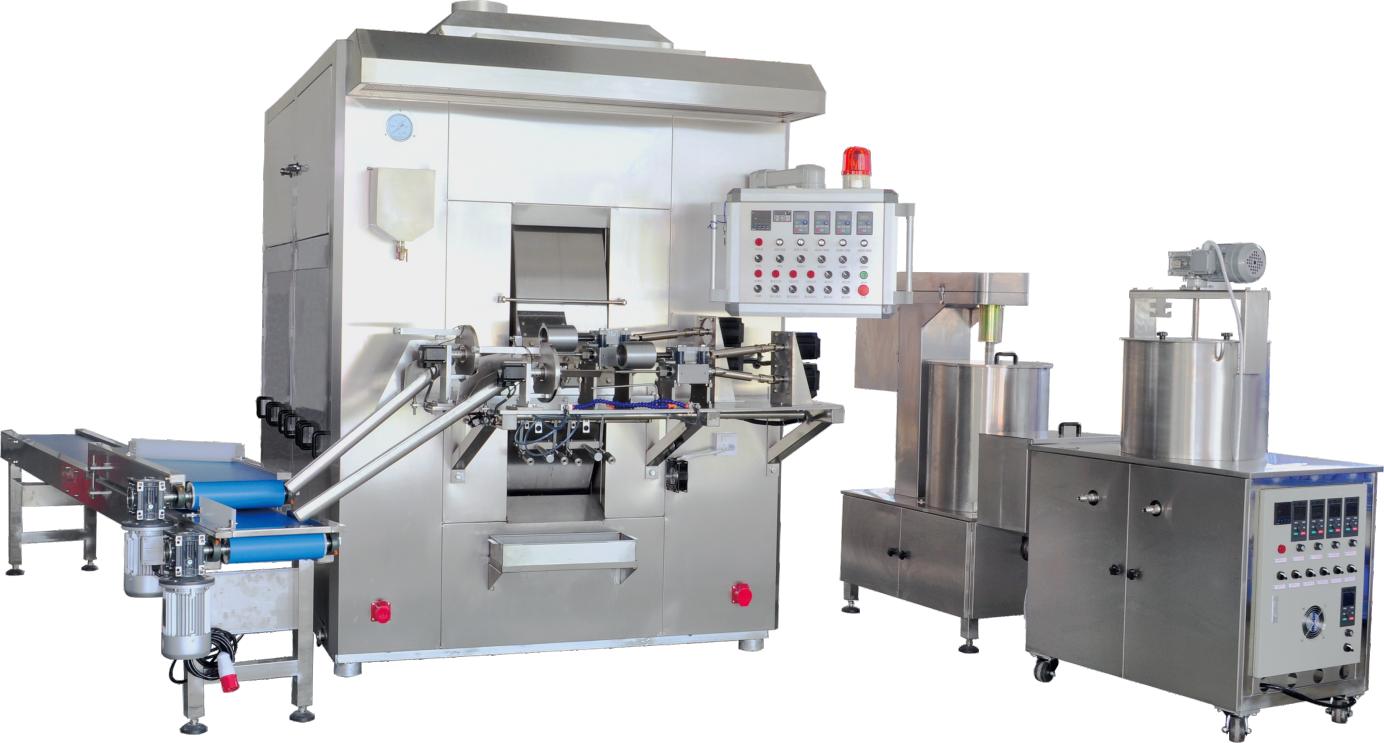
This wafer roll machine bakes the sheet, injects the core and forms the roll in one continuous pass, in either a two-line or a three-line configuration. Send us the finished piece you want and the daily output you are sizing for, and we will tell you which of the two fits. We return the quotation within one business day.
Quotation in 1 business day
9–13 weeks to factory acceptance
220 or 330 pieces per minute
Published envelope 4.2 × 3.7 m
-
Output rate
220 pieces/min on the UD05-2;
330 pieces/min on the UD05-3 -
Rated shift output
600 kg on the UD05-2;
900 kg on the UD05-3, per 8-hour shift -
Connected load
9.7 kW on the UD05-2;
12 kW on the UD05-3 - Published envelope 4.2 × 3.7 m for either configuration
- Lead time 9–13 weeks from signed contract to factory acceptance
- Quotation Returned within 1 business day
Three answers alter the configuration more than anything else: the roll length you sell, whether you require a centre filling and the gas supply you already have at your plant.
Wafer roll line capabilities: baking, core injection and roll forming
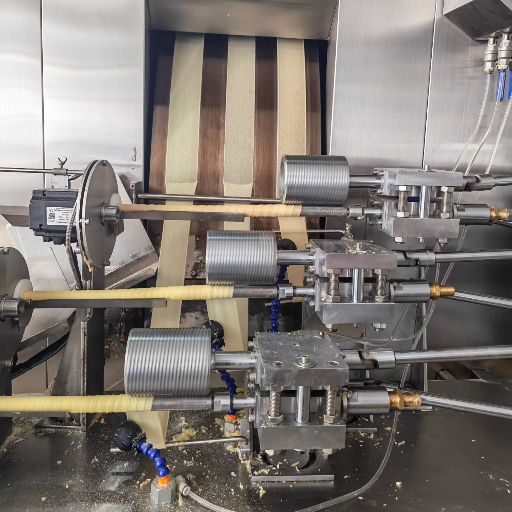
The line runs three operations in sequence without an operator moving product between them. Batter is deposited and baked into a continuous sheet, filling is injected into that sheet while it is still hot enough to form, and the roll is wound and cut to the length you set.
What each stage does, and what you control
-
BakingBatter is deposited onto heated plates and baked to a continuous sheet at a held plate temperature.Recipe, sheet thickness, plate temperature
-
Core injectionFilling is pumped into the sheet while it is still pliable, immediately before winding.Whether filling runs at all, and the dose per piece
-
Roll formingThe sheet is wound into a tube and cut to length, then discharged to the take-away conveyor.Roll length, from 70 mm to 140 mm
Because the three stages sit on one frame and one control system, changing roll length becomes an operator setting rather than a mechanical rebuild.
Why the winding step decides crispness
A granted third-party patent on rolled wafer production, US 5,795,607 held by Franz Haas Waffelmaschinen, states the mechanism plainly: a baked wafer wall is porous, absorbs moisture and loses its crispness, and compacting the strip as it is pressed and rolled closes those pores and leaves a surface that resists moisture. Wall structure is therefore set at the forming station, not in the bag the product ends up in.
Ask what a supplier’s forming station does to the wall, not only what length it winds.
Ask for every shelf-life figure to be quoted with the packaging and the storage conditions it was measured under, because one quoted without them cannot be compared against anyone else’s.
Two lines or three lines on the same frame
- UD05-2 runs two parallel baking and forming lines: 220 pieces per minute, 600 kg per 8-hour shift.
- UD05-3 runs three: 330 pieces per minute, 900 kg per 8-hour shift.
Both configurations share the same published envelope of 4.2 × 3.7 m.
The third line adds 2.3 kW of connected load and 2 kg/h of LPG demand.
The hygiene and cleanability checks a buyer runs
European buyers check food processing machinery against EN 1672-2, the current basic-concepts standard covering hygiene and cleanability. It sets out how food, splash and non-food zones are separated, and how surfaces in each zone must be finished so they can actually be cleaned.
Ask any supplier to walk you through the line zone by zone against it, rather than accepting a general assurance.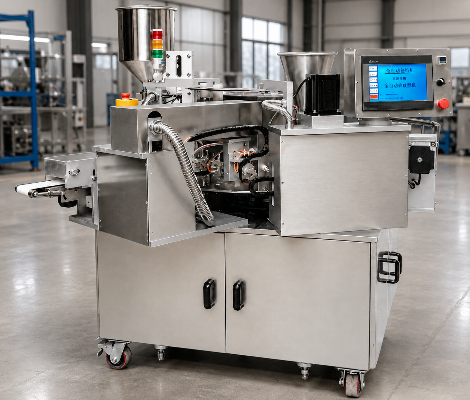
Output Formats: Hollow Wafer Rolls and Centre-Filled Wafer Sticks
One automatic wafer stick line makes both formats. What differs between them is the injection stage, the piece weight and the raw material you have to buy for a shift.
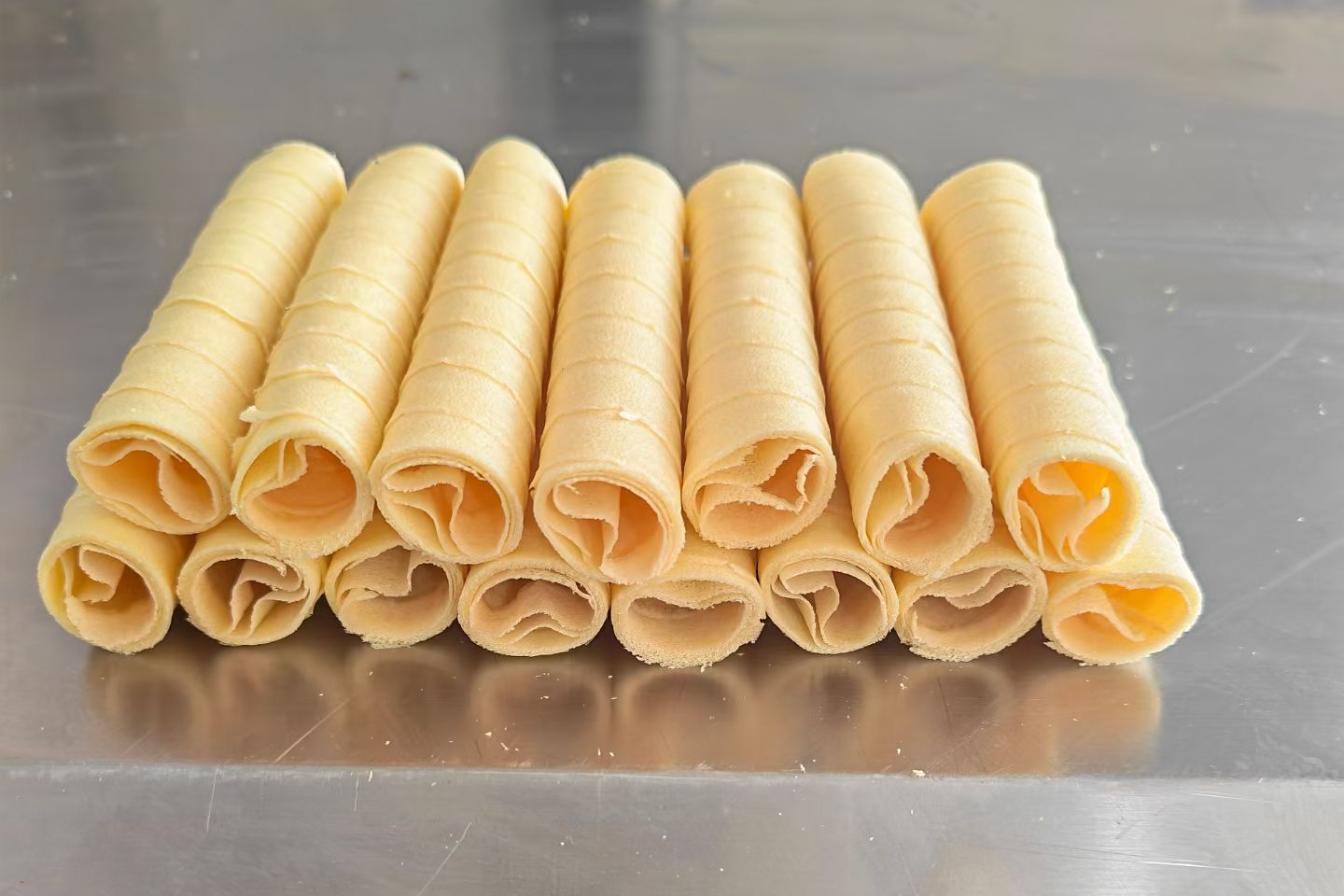
Hollow wafer rolls
- Product
- A wound, unfilled wafer tube, crisp through the wall.
- Machine function needed
- Baking and forming; the injection stage stays idle.
- Effect on output
- Piece weight is the wafer alone, so a shift consumes less material for the same piece count.
- Give us at quotation
- Roll length, wall thickness target, pieces per pack.
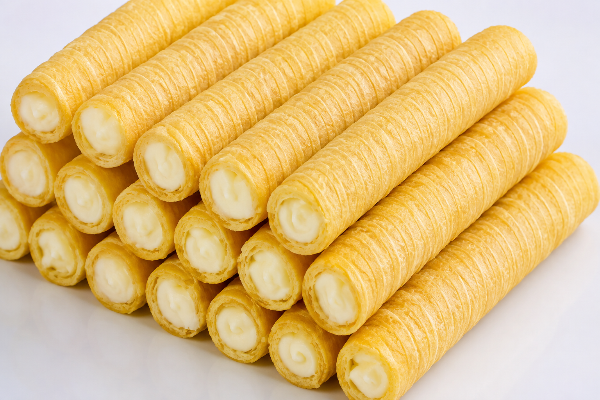
Centre-filled wafer sticks
- Product
- The same tube with a cream or chocolate core injected before winding.
- Machine function needed
- Baking, forming and the core injection stage running together.
- Effect on output
- Piece count is unchanged; kilograms per shift rise with the dose you set.
- Give us at quotation
- Filling type, target dose per piece, filling viscosity at the injection temperature.
Filling viscosity is the input most buyers leave until last, and it is the one that decides whether a dose is repeatable at 330 pieces per minute. A core that pumps cleanly at 40 °C and stiffens at 25 °C behaves like two different products on the same line.
Geometry we build to
| Parameter | Range | Set by |
|---|---|---|
| Roll length | 70–140 mm (7–14 cm, 2.76–5.51 in) | Operator, from the control panel |
| Wall thickness | 0.8–1.4 mm (0.031–0.055 in) | Recipe and baking gap |
| Piece basis | 5.68 g | The figure implied by our own published pairing of 220 pieces per minute with 600 kg per 8-hour shift |
The Three-Number Yardstick
Three numbers turn a piece rate into a raw-material purchase plan: the rate, the minutes you really run, and your own batter-to-finished yield.
| Step | UD05-2 | UD05-3 | Your figure |
|---|---|---|---|
| Rated rate | 220 pieces/min | 330 pieces/min | — |
| Effective running minutes per shift | 480 at the full rated shift | 480 at the full rated shift | Your input |
| Pieces per shift | 105,600 | 158,400 | Rate × minutes |
| Finished weight at the 5.68 g basis | 600 kg | 900 kg | Pieces × your piece weight |
| Batter to buy per shift | Finished ÷ your yield | Finished ÷ your yield | Your input |
The 480-minute row is where most sizing errors start. Warm-up, changeover and cleaning come out of that number before any of the rest applies, so put your own running minutes in rather than assuming a full shift at rate.
Heating, Temperature Control and Site Utilities
The line is gas fired. It runs on piped natural gas or on bottled liquefied petroleum gas, and the burner system holds plate temperature automatically through the bake.
How temperature control works on the line
Plate temperature is held by an automatic burner control system with safety interlocks on the gas train. The operator sets the target from the panel and the system modulates to hold it through the bake rather than cycling the burner against a wide band.
What the line draws
| Utility | UD05-2 | UD05-3 |
|---|---|---|
| Electrical load | 9.7 kW | 12 kW |
| Liquefied petroleum gas | 6 kg/h | 8 kg/h |
| Natural gas | 8 m³/h | 10 m³/h |
| Supply | 380 V / 50 Hz standard; 220 V / 60 Hz on request | 380 V / 50 Hz standard; 220 V / 60 Hz on request |
The combustion safety checks a buyer runs
European market
Gas-fired thermoprocessing equipment is checked against EN ISO 13577-2, the current standard, which replaced the older EN 746-2 that many supplier pages still name. Asking which of the two a supplier builds to is a fast way to find out how current their engineering documentation is.
United States market
Bakery equipment falls under 29 C.F.R. § 1910.263. Its oven provisions require direct-fired ovens to be safeguarded against failure of fuel, air or ignition, and require any direct-fired oven above 150,000 BTU per hour of heating capacity to be preventilated with at least four complete changes of the baking chamber atmosphere before ignition.
Direct-fired ovens shall be safeguarded against failure of fuel, air, or ignition. To prevent the possible accumulation of explosive gases from being ignited after a shutdown, all direct-fired ovens with a heating capacity over 150,000 B.t.u. per hour shall be ventilated before the ignition system, combustion air blower, and the fuel can be turned on.
The per-shift energy ledger
Multiply each rated figure by the hours you run. These are connected loads rather than metered demand, so the quantities below are a ceiling for a full 8-hour shift at rate: the figure to size a gas train and an electrical supply against, not the figure your meter reads once burners cycle and the line idles through changeovers.
| Per 8-hour shift | UD05-2 | UD05-3 |
|---|---|---|
| Electricity | 77.6 kWh | 96 kWh |
| Liquefied petroleum gas, if LPG fired | 48 kg | 64 kg |
| Natural gas, if NG fired | 64 m³ | 80 m³ |
Apply your own local tariff to those quantities. We do not publish an operating cost figure because we do not know what you pay for gas or electricity, and a cost per shift calculated at somebody else’s tariff is not a number you can plan against.
Read those two rows together before comparing suppliers on electrical load alone. Gas carries most of the heat on this line, so a machine that looks efficient on kilowatts can still be the expensive one to run.
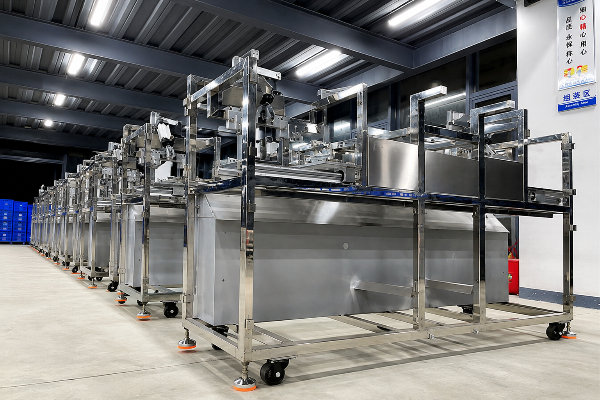
CFG // 150K BTU
Ask us for the burner heat input
Whether a given configuration sits above or below that 150,000 BTU per hour threshold depends on the burner set we build into your line. Request it with your quotation and check it against the threshold yourself. Put your own gas and electricity tariffs against these quantities.
Wafer Roll Machine Specifications: Two-Line UD05-2 and Three-Line UD05-3
Every figure below is a rated value from our own specification sheet, revision May 2025. The two derived rows are marked as such, because they are arithmetic on the rated values rather than measured performance.
The two derived rows are nameplate ratios: rated power divided by rated output. They exclude warm-up, changeover, downtime and rejects, so treat them as a comparison basis rather than as an energy bill. Both fall on the UD05-3 because the third line adds 24% more connected load and 33% more gas demand for 50% more output.
The Same-Basis Spec Readout
Published specifications in this category are not written on one basis, which makes side-by-side comparison misleading unless you restate them.
| Basis | UD05-2 | UD05-3 | Supplier 1 | Supplier 2 | Supplier 3 |
|---|---|---|---|---|---|
| Pieces per minute | 220 | 330 | 220–300 at 100 × 10 mm | Not published | Not published |
| Output in kg/h | 75 | 112.5 | Not published | 50 hollow / 100 filled | 25–30 hollow / 50–60 filled |
| Electrical load | 9.7 kW | 12 kW | 9.5 kW | 10 kW | 8 kW |
| Liquefied petroleum gas | 6 kg/h | 8 kg/h | 3.5–4.5 kg/h | 5 kg/h | 5 kg/h |
| Published envelope | 4.2 × 3.7 m, scope not stated | 4.2 × 3.7 m, scope not stated | 2.1 × 3.0 m, main machine | 3.45 × 1.7 m, main machine | 3.4 × 1.7 m, main machine |
| Piece-weight basis declared | Yes, 5.68 g implied | Yes, 5.68 g implied | Yes, 100 × 10 mm piece | No | No |
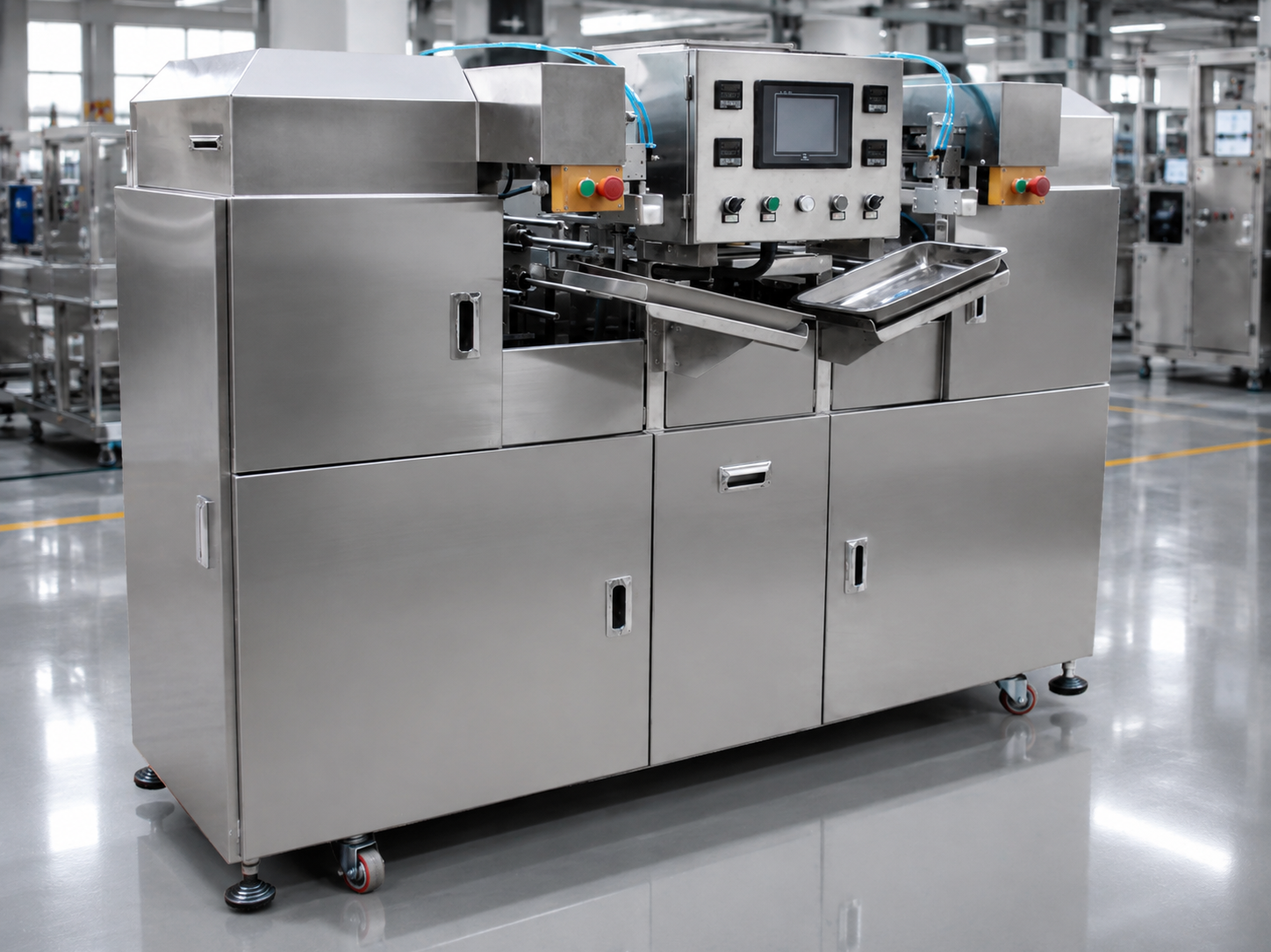
The envelope row is the one that misleads most often. Every published figure in that row, ours included, is an envelope rather than an installed footprint with operator and maintenance access, and none of the four suppliers publishes the installed figure. Three of the four state that their figure covers the main machine; our own sheet does not say whether it covers the machine or the line, so treat that cell as undeclared until the installation drawing settles it.
What to ask every supplier on the shortlist
Ask each of them for an installation drawing showing the machine inside its access aisles, and for the piece weight behind their kilogram-per-hour figure. A kg/h rate at an undeclared piece weight cannot be compared with anyone else’s, and a floor area without aisles is not the area you have to rent. Factories may overstate capacity on a published sheet, ours included, which is why the acceptance tests further down measure four of these numbers with an instrument rather than asking you to take them on trust.
Get a Quotation for Your Configuration
Not sure which of the two fits your target output? Work it through with the our model decision helper.
Pricing Basis and Lead Time
Price follows the number of lines, whether core injection is fitted, the heat source and the range of auxiliary equipment in scope. We do not publish a list price for a wafer stick machine because those four variables move the figure more than any headline number would suggest.
The four variables that move a quotation
-
01
Line count
Two lines or three, which sets both the piece rate and the connected load
-
02
Core injection
Fitted or not, which decides whether the filling system is in scope at all
-
03
Heat source
Piped natural gas or bottled liquefied petroleum gas, which changes the gas train
-
04
Auxiliary scope
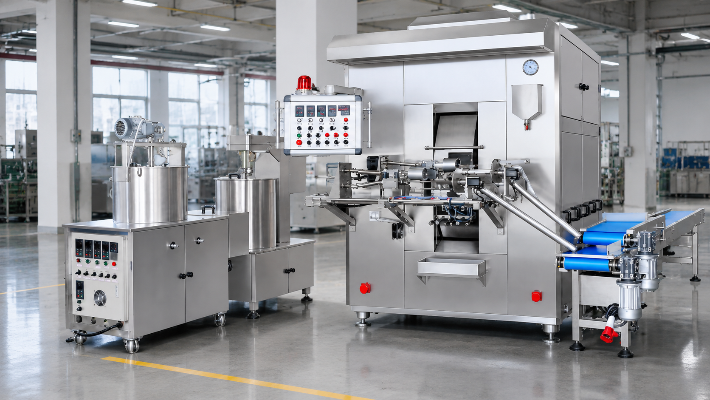
Mixing, cooling and downstream packaging interfaces, each priced separately
Budget the project, not the machine
The purchase cost of the equipment is not the cost of the project. One consultancy that budgets food plant builds puts equipment purchase at 40 to 50% of total fixed capital investment, and documents a case budgeted at $3 million that landed above $7.4 million once installation, utilities and the rest of the build were counted.
What a published price usually covers
Published prices in this category almost always describe a bare baking machine rather than a line. One open marketplace listing for a comparable gas-heated machine at 60 kg/h sits at US$28,000 for a single unit, and consumer countertop appliances sold under similar search terms sit two orders of magnitude below that.
Commercial terms
Quotation turnaround
Returned within 1 business day
Lead time
9–13 weeks from signed contract to the factory acceptance test
Payment
40% by T/T (telegraphic transfer) on order confirmation; 60% against the bill of lading copy before shipment; letter of credit at sight accepted
Delivery
FOB China by default; CFR and CIF quoted on request
Order size
One production line per order; multi-line orders share spares and training
Read a cheap quotation carefully
A low figure is usually a machine-only quote with mixing, cooling and packaging interfaces left out of scope.
Inspection at Factory Acceptance, Commissioning and Warranty Cover
Every line is run and witnessed before it ships. Acceptance testing before shipment is standard purchasing practice for food process equipment, and published guidance on specifying such equipment advises buyers to define the test, its timing and the consequences of failure in the contract itself rather than leaving them to be settled later.
Four things you can measure yourself at factory acceptance
Nothing on that list requires our word for it. Each row checks a number already published on this page against an instrument you or your inspector brings to the factory.
Bring a structured checklist, not a walk-through
Industry bodies in packaging and processing publish acceptance-test material for exactly this purpose, including a buyer-and-manufacturer checklist developed jointly by equipment purchasers and original equipment manufacturers.
Commissioning and cover
By the time a line is crated and the container is sealed, the money is largely committed and you have nothing left to hold back. That is the argument for testing before shipment rather than after arrival, and it is why the 60% balance falls due against the bill of lading rather than at the factory gate.
Check where every warranty clock starts
A warranty period can be written to begin at delivery, at acceptance or at the in-service date, and those are materially different lengths of protection for the same stated number of months.
How We Work: From Product Spec to Commissioned Line
The clock in the lead-time figure starts at step three.
01
You send the product spec: roll length, hollow or filled, target output per day, and the gas supply available at your site.
02
We quote within 1 business day, naming the configuration, the scope of supply and the delivery terms.
03
Contract and deposit: 40% by T/T on order confirmation starts the 9–13 week build.
04
The line is assembled, run and witnessed at factory acceptance against the figures written into your contract.
05
At shipment the 60% balance falls due against the bill of lading copy, so you hold shipping documentation before the balance is paid.
06
Our engineers install and commission over 5–7 days, including 2–3 days of operator and maintenance training.
07
Commissioning is done by our own engineers, and the 12-month cover on core components starts at factory acceptance rather than at shipment.
Ten parameters we need before we can quote
| Parameter | Why it changes the configuration or the cost |
|---|---|
| Roll length | Sets the cutting and winding setup within the 70–140 mm range. |
| Hollow or centre-filled | Decides whether the core injection system is in scope. |
| Target kilograms per day | Selects two lines or three before anything else is priced. |
| Effective running minutes per shift and shifts per day | Converts a rated rate into your actual daily output; without it a rated figure oversizes the line. |
| Filling type and viscosity | Determines the pump and dosing setup, and whether the dose repeats at full rate. |
| Gas type available | Natural gas and liquefied petroleum gas need different gas trains. |
| Gas supply pressure and burner interface | Sets the burner selection and the heat input figure you check against local rules. |
| Voltage and frequency | 380 V / 50 Hz is standard; 220 V / 60 Hz changes the electrical build. |
| Ceiling height and door width | Determines how the line is crated, shipped and moved into position. |
| Installation drawing confirmation | Confirms the real installed area including access aisles, which the published envelope does not cover. |
When a UD05 Line Is Not the Right Machine
Four situations where this line is the wrong purchase, with what to buy instead.
This line winds a sheet into a tube. It is not a substitute for a wafer biscuit making machine, which bakes flat sheets in moulds for cut-and-stack products, or for a wafer cone making machine, whose forming mandrel is conical rather than cylindrical.
Those are wrapped rather than baked and wound, so the two are not interchangeable and they run on a different class of former altogether. Those products are made on a pastry-sheet machine feeding a separate wrapping or folding station.
The line is gas fired on natural gas or liquefied petroleum gas. A bottled gas bank covers sites without a piped supply, but there is no electric heating option, and that is a trade-off worth settling before you specify anything else.
A full rated shift on the UD05-2 produces 600 kg. If your break-even volume sits well below that, a small wafer roll making machine in the 125–350 kg per day class fits better, and at pilot or artisan volumes a manual wafer stick making machine costs you far less capital than automation buys you in labour.
Work out your own cut-off
Break-even volume is fixed costs divided by selling price minus variable cost per unit. A worked example in University of Missouri Extension publication G648, revised August 2026, shows how far price alone moves that number for one value-added product.
Four dollars of selling price swings the required volume by 72% in that example, with no change to the equipment. Run the calculation on your own figures before you size any line, ours included, and if your break-even sits far below a rated shift, buy the smaller machine.
- Selling price per unit Break-even volume per year
- $14 2,281 units
- $16 1,678 units
- $18 1,327 units
The Rows-or-Moulds Rulebook
Three product families get conflated in search results, and each one is measured in a different unit. Knowing which unit a supplier quotes tells you immediately which family their machine belongs to.
| Family | Counted in | Product | What it cannot make |
|---|---|---|---|
| Rolled wafer lines | Rows, ribbons or lanes | Hollow wafer rolls and centre-filled wafer sticks | Flat sheet wafers; savoury wrapped rolls |
| Flat wafer plants | Baking moulds or plates | Sheet wafers for cut-and-stack and book products | Wound tubes with an injected core |
| Savoury roll formers | Pieces per hour | Spring rolls, Chinese egg rolls, wrapped snacks | Baked wafer sheet of any kind |
Wafer Roll Production Tools
-
01
per shift energy ledger
Calculate energy consumption and operational costs per shift. Optimize utility usage to enhance factory sustainability.
-
02
shift output planner
Accurately forecast wafer roll production yield. Plan daily schedules efficiently to meet distribution demands.
-
03
two line vs three line
Compare throughput and ROI between two-line and three-line configurations. Make data-driven decisions for equipment upgrades.
Wafer Roll Machine FAQs
What is a wafer roll machine, and how does it differ from a wafer biscuit line?
A wafer roll machine bakes a continuous wafer sheet and winds it into a tube, counted in rows or lanes. A wafer biscuit line bakes flat sheets in moulds for cutting and stacking, counted in baking plates.
How many pieces per minute does each configuration produce?
The two-line UD05-2 is rated at 220 pieces per minute and the three-line UD05-3 at 330. Over a full 8-hour shift at rate, that is 600 kg and 900 kg respectively.
What does 600 kg per 8-hour shift mean in raw material?
Start from pieces: 220 per minute over 480 minutes is 105,600 pieces, which at our implied 5.68 g piece basis gives the 600 kg figure. Batter to buy is that finished weight divided by your own yield. As a starting point before you measure your own, one competing supplier publishes a yield in which 50 kg of batter gives 35 kg of hollow product.
Which wafer roll lengths can the line produce?
Roll length is operator settable from 70 mm to 140 mm, roughly 2.76 to 5.51 inches. Changing it is a panel setting rather than a mechanical changeover.
Can the same line make hollow rolls and centre-filled sticks?
Yes. Running the core injection stage produces centre-filled wafer sticks; leaving it idle produces hollow rolls on the same line.
How is baking temperature held steady?
An automatic burner control system holds plate temperature against the setpoint entered at the panel, with safety interlocks on the gas train.
What gas, power and voltage does the line need?
The UD05-2 draws 9.7 kW and the UD05-3 draws 12 kW. Gas demand is 6 or 8 kg/h of liquefied petroleum gas, or 8 or 10 m³/h of natural gas. Standard supply is 380 V / 50 Hz, with 220 V / 60 Hz available on request.
How much floor space is needed, and on what basis is that figure quoted?
Our published envelope is 4.2 × 3.7 m for either configuration. That is an envelope figure, not an installed footprint including operator and maintenance access. Ask us for the installation drawing to confirm the real area for your building.
Is the difference between two lines and three lines only throughput?
Throughput is the main difference, and it is a 50% increase in piece rate. The third line adds 2.3 kW of connected load and 2 kg/h of liquefied petroleum gas demand within the same published envelope.
What drives wafer roll machine price and wafer stick machine price?
We quote per configuration rather than publishing a list price, because line count, core injection, heat source and auxiliary scope move the figure substantially. Open marketplace listings for comparable gas-heated machines start around US$28,000 for a single unit at 60 kg/h, but those are usually machine-only prices rather than a line.
What does a quotation include, and how fast is it returned?
The quotation names the configuration, the scope of supply and the delivery terms, and it is returned within 1 business day. Delivery is quoted FOB China by default, with CFR and CIF on request.
Which items are included in the scope of supply?
An order covers one production line, with multi-line orders configured to share spares and training. The operator handbook is supplied in English and Chinese, with other languages on request.
What is the lead time from contract to factory acceptance?
9 to 13 weeks from signed contract to the factory acceptance test. The clock starts when the 40% deposit is received against the order confirmation.
What happens during installation and training?
Our engineers commission the line on site over 5 to 7 days. Two to three days of that period is operator and maintenance training for your team.
What is covered on the UD05 line, and for how long?
Core components carry 12 months of cover starting at the factory acceptance test, followed by lifetime remote engineering support.