Get in touch with UDTECH Company


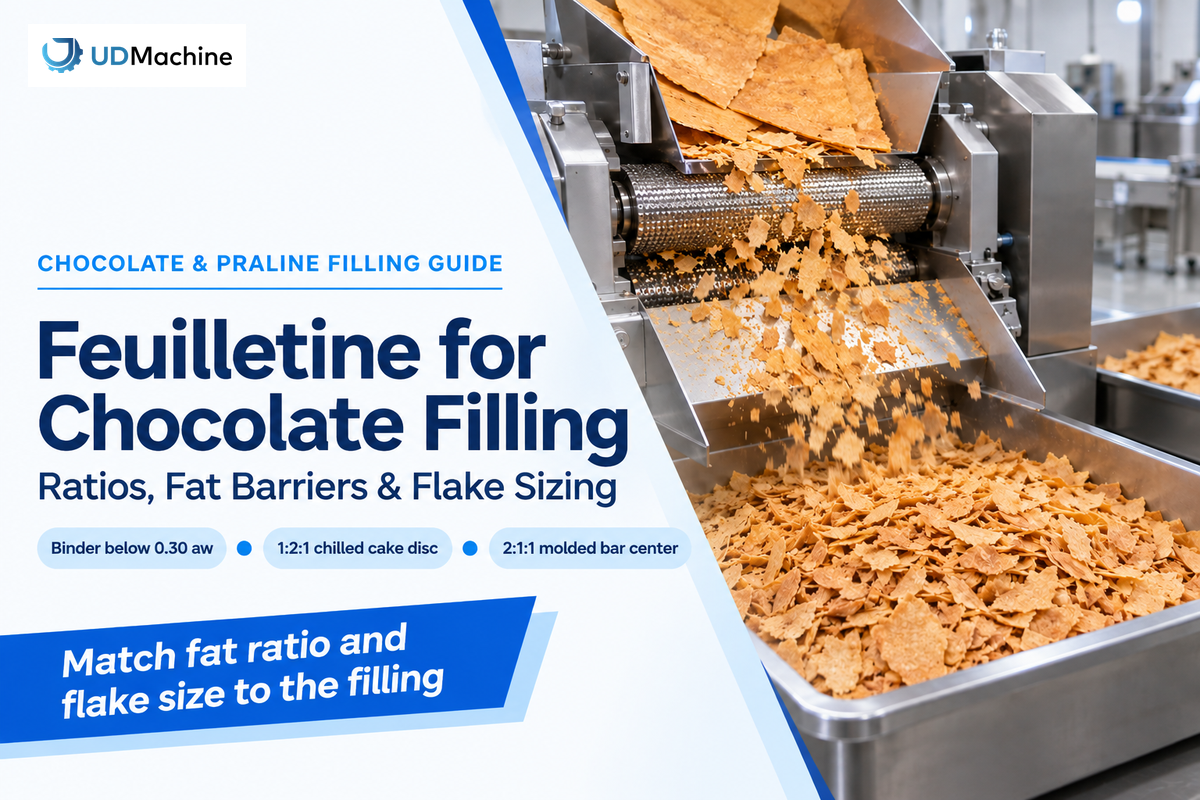
Choosing feuilletine for chocolate filling requires holding the binder below water activity 0.30, because dry wafer pieces lose their snap at 0.35 to 0.50. Hazelnut praline and tempered couverture protect that crunch because they’re fat-continuous systems. Cream ganache and dairy butter, when melted, carry free water that softens thin flakes within hours.
In a kitchen or confectionery plant, two rules govern the final bite. The first rule states that each shard should be coated in a fat phase before it touches mousse or sponge. The second rule states that solid cocoa butter should be balanced against liquid nut oil to enable clean slicing.
Feuilletine for chocolate filling stays crisp only inside fat-continuous binders below water activity 0.30. Hazelnut praline, gianduja, and melted couverture protect the wafer. For a chilled cake insert that slices cleanly, mix 1 part chocolate, 2 parts praline, and 1 part feuilletine by weight.
Key points
- Standard wafers start losing perceived crispness above water activity 0.30. Dry crisp snacks fail sensory panels at 0.35 to 0.50.
- Dairy butter holds 16% to 18% water by weight. Coating flakes in melted butter adds water instead of blocking it.
- A 1:2:1 ratio of dark chocolate, praline, and flakes slices cleanly when cold. A 2:1:1 ratio suits firm bars.
- Piston depositors need a nozzle orifice 3 to 5 times the largest flake. Keep fines below 1.0 mm under 5%.
Updated October 2026.
Quick Specs: feuilletine for chocolate filling
| Target flake water activity at dosing | Below 0.30 aw (moisture ≤ 2.5%–3.0%) |
| Sensory crispness rejection band | 0.35–0.50 aw (Katz and Labuza, 1981) |
| Chilled cake croustillant ratio | 1:2:1 chocolate : praline : flakes (20%–25% chocolate) |
| Molded chocolate bar center ratio | 2:1:1 milk or dark couverture : praline : flakes |
| Screened flake size by line equipment | 1–3 mm for depositors; 2–6 mm for slabs and bars |
| Commercial barrier pack benchmark | 2.5 kg foil bag, 4 × 2.5 kg case, 12-month shelf life |
Why Feuilletine Crunch Stays Crisp in Praline Paste Yet Softens in Chocolate Ganache
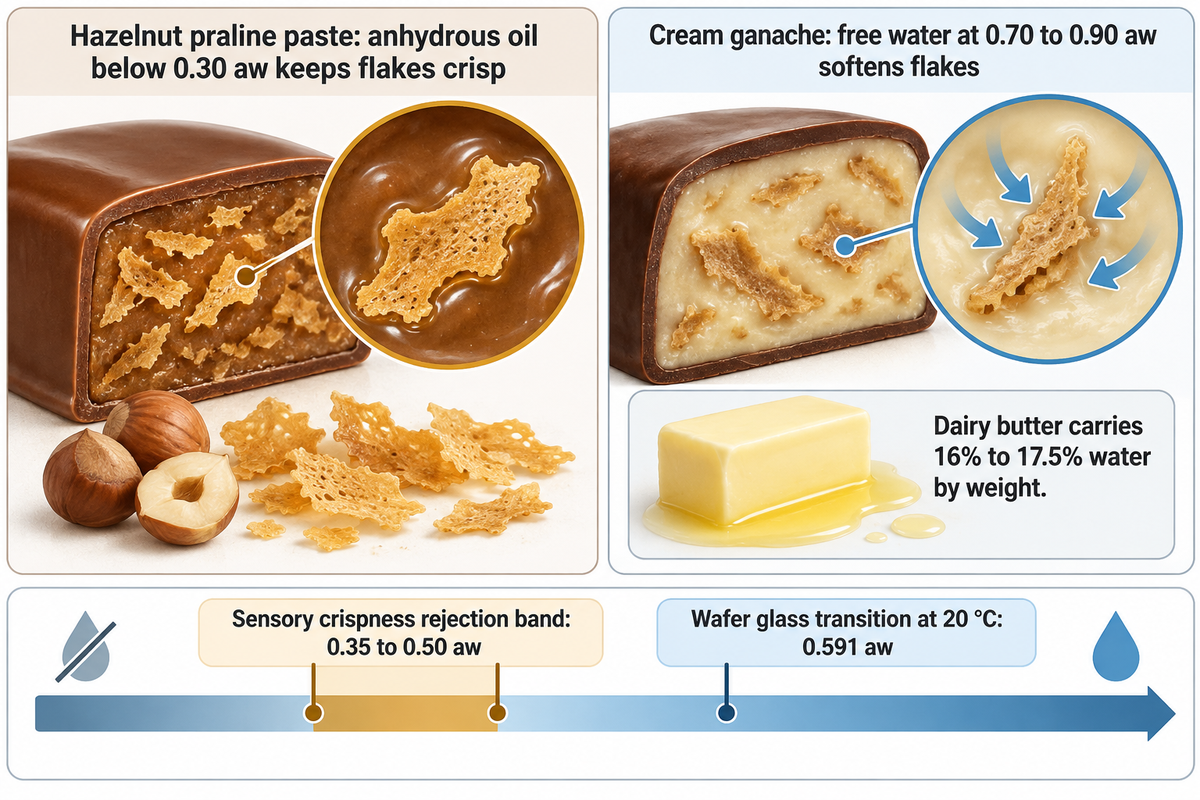
Feuilletine crunch is crisp in hazelnut praline paste because the oil is anhydrous and its water activity is less than 0.30. Inside chocolate ganache, dairy cream adds free water at water activity 0.70 to 0.90. The vapor pressure gap pushes water into the glassy wafer.
Dry crisp snacks lost their sensory crispness at water activity 0.35 to 0.50 in a 1981 tasting study. Katz and Labuza measured this rejection band in their 1981 University of Minnesota snack study which was published in the Journal of Food Science. Thin wafer sheets lose their crispness even before water activity reaches 0.35. A Nestlé patent on moisture-resistant wafers (US20100092612A1) notes that the perceived crispness of a standard wafer is lost above water activity 0.30.
Structural collapse happens much later than sensory rejection. Commercial wafers undergo glass transition at 20 °C only at a water activity of 0.591 (0.118 g water/g dry solids), and in a 2004 study, cited by food glass-transition studies, a three-point bend test showed mechanical changes in a wafer. Every baker must therefore hold the binder below 0.30 to 0.35 aw. If you’ve never used feuilletine before, then you should test your binder’s water activity first.
“A portion of the total water content present in food is strongly bound to specific sites and does not act as a solvent.”
Dairy butter contains 16% to 17.5% water by weight, whereas chocolate and nut pastes carry very little water, as shown in USDA FoodData Central. Some kitchen blogs recommend tossing delicate brown flakes in melted dairy butter, but that water softens the wafer. A 2025 Journal of Food Science study of low-cost water activity meters judged devices against the 0.005 maximum error used in ISO 18787 water activity determination. The cheaper meters claimed accuracies of ±0.03 to ±0.05, too coarse for that window.
The wafer can be soft before mixing because of humid conditions. Our guide on why feuilletine loses crunch covers bag seals and humid packing rooms, as well as dock condensation. These upstream leaks spoil the light and crispy texture before the bag is even opened.
Why Isn’t My Feuilletine Crispy Inside a Cream Ganache Center?
The reason your feuilletine isn’t crispy inside a cream ganache center is because dairy cream has unbound water. That water can dissolve sugar and soften the wafer walls. An average ganache sits at 0.70 to 0.85 aw, and flake sits at 0.30 aw, so there’s a huge difference.
Suppliers clearly state this rule on their data sheets. Callebaut’s Pailleté Feuilletine application sheet states not to mix shards in a cream or liquid base. To pair ganache with a crisp confection center, the shards should first be coated in cocoa butter. You can also place the shards in a praline disc to preserve textural contrast.
Chocolate to Praline Ratios: How to Make Feuilletine Crunch Fillings Slice Cleanly
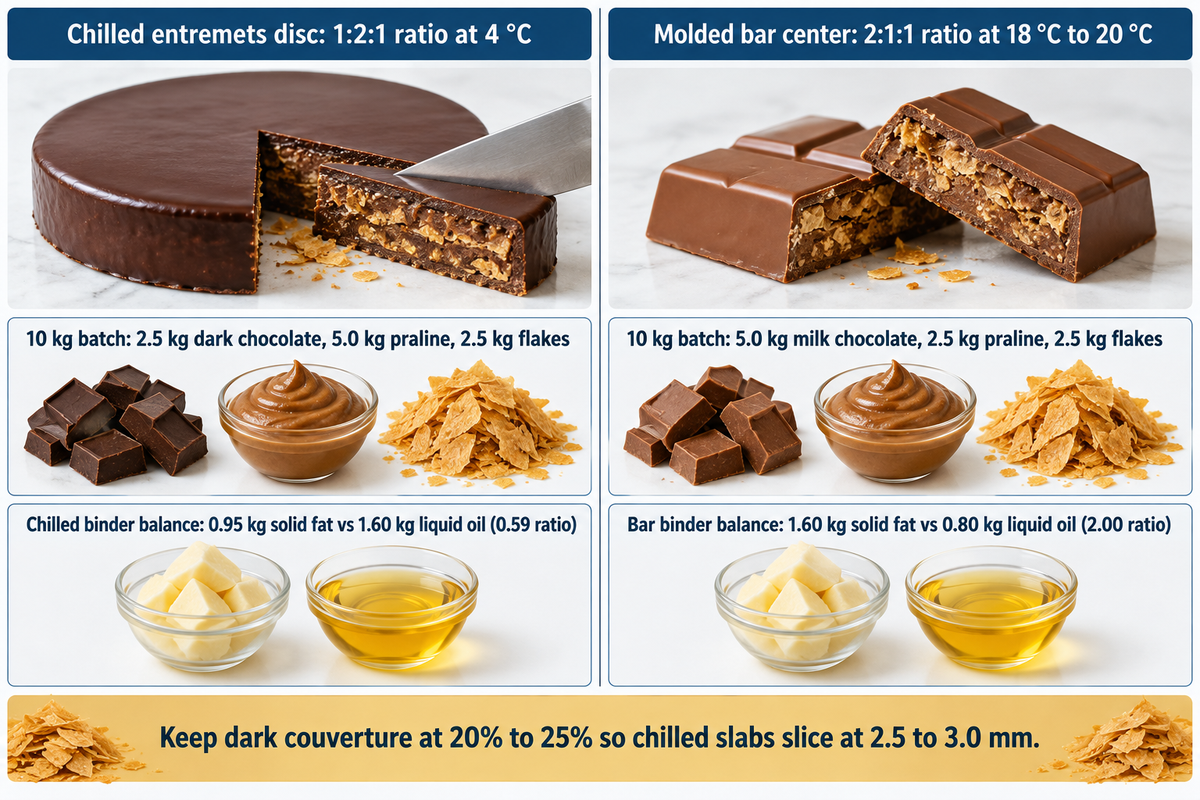
For a chilled cake insert that slices cleanly, mix 1 part chocolate, 2 parts praline and 1 part feuilletine. For firmer molded chocolate bars held at 18 °C to 20 °C, mix 2 parts chocolate, 1 part praline and 1 part flake.
Liquid nut oils in praline disrupt and soften the rigid cocoa butter crystal network. That plasticizing effect lets chilled croustillant layers slice cleanly without shattering. Hazelnut paste holds 30% to 36% liquid oil at fridge temperatures. Dark couverture holds 35% to 42% cocoa butter, which sets hard at 4 °C. Jess Wang shows in her bench analysis of feuilletine ratios that chocolate-heavy inserts crack under a knife. The broken slab then squeezes mousse out of layered desserts.
A classic patisserie benchmark uses 40 g milk chocolate, 100 g hazelnut praline, and 60 g feuilletine: 20% couverture, 50% praline, and 30% flakes by weight, rolled to 2–4 mm. In a baking thread on praline crunch in layer cakes, bakers found that 70% dark chocolate made cold discs far too hard. The rigid insert crushed the soft sponge underneath.
Customers expect a crunchy inclusion in creamy desserts. The Puratos Taste Tomorrow chocolate report highlights this demand for a crunchy texture. Below is a worked 10 kg batch comparison across two binder architectures. We compare a sliceable chilled entremets croustillant (1:2:1 dark couverture : hazelnut praline : feuilletine flakes) against a firmer molded bar center (2:1:1 milk couverture : praline : flakes). The numbers show exact ingredient weights and the cocoa-butter-to-liquid-oil balance.
In the 10 kg chilled entremets batch (1:2:1), weigh 2.5 kg dark couverture, 5.0 kg hazelnut praline, and 2.5 kg flakes. With 38% cocoa butter in dark couverture and 32% nut oil in praline, the 7.5 kg binder holds 0.95 kg solid fat and 1.60 kg liquid oil. That gives a 0.59 solid-to-liquid fat ratio. In the 10 kg molded bar batch (2:1:1), weigh 5.0 kg milk couverture, 2.5 kg praline, and 2.5 kg flakes. At 32% cocoa butter in milk couverture, the binder holds 1.60 kg solid fat and 0.80 kg liquid oil (a 2.00 ratio). A three-drop dark couverture (36% to 38% cocoa butter) paired with 50%-nut hazelnut praline slices cleanly at 4 °C in a 3.0 mm slab.
| Filling Category / System Type | Chocolate : Praline : Flake Ratio | 10 kg Batch Weights (kg) | Serving Temp | Target Thickness & Bite |
|---|---|---|---|---|
| Type 1: Chilled Dark Entremets Disc | 1 : 2 : 1 (25% : 50% : 25%) | 2.5 / 5.0 / 2.5 kg | 4 °C–6 °C | 2.5–3.0 mm; clean knife cut under mousse |
| Type 2: Classic Milk Patisserie Base | 2 : 5 : 3 (20% : 50% : 30%) | 2.0 / 5.0 / 3.0 kg | 4 °C–8 °C | 2.0–3.5 mm; high crunch density, soft cut |
| Type 3: Balanced All-Purpose Insert | 3 : 5 : 2 (30% : 50% : 20%) | 3.0 / 5.0 / 2.0 kg | 6 °C–12 °C | 3.0–4.0 mm; cohesive slab for guitar wire |
| Type 4: Molded Bonbon Praline Center | 1.5 : 6.5 : 2 (15% : 65% : 20%) | 1.5 / 6.5 / 2.0 kg | 16 °C–20 °C | Deposited shell; fluid enough for 1–3 mm flakes |
| Type 5: Ambient Milk Chocolate Bar Center | 2 : 1 : 1 (50% : 25% : 25%) | 5.0 / 2.5 / 2.5 kg | 18 °C–20 °C | 4.0–6.0 mm; firm snap inside molded tablet |
| Type 6: White Chocolate Pistachio Insert | 2.2 : 1 : 1 (52% : 24% : 24%) | 5.2 / 2.4 / 2.4 kg | 4 °C–10 °C | 3.0 mm; extra cocoa butter offsets milk fat |
| Type 7: Pure Couverture Rocher Cluster | 7 : 0 : 3 (70% : 0% : 30%) | 7.0 / 0.0 / 3.0 kg | 18 °C–20 °C | Molded bite; brittle snap, not for cold slicing |
| Type 8: Freezer Ice-Cream Gateau Layer | 1 : 3 : 1 (20% : 60% : 20%) | 2.0 / 6.0 / 2.0 kg | -18 °C to -12 °C | 2.0 mm; high nut oil resists sub-zero cracking |
Will a Praline Feuilletine Filling Turn Soggy or Too Hard When Chilled?
A praline feuilletine filling becomes hard when chilled if dark chocolate is over 35% in the mixture. It becomes soft when water comes from dairy butter, cream, or condensation. Praline is anhydrous and protects the low water activity and unique texture of the wafer.
To prevent a hard slab in a chilled chocolate cake, keep dark couverture at 20% to 25% of total weight. Let hazelnut or almond praline supply 50% of the mix. Roll the warm sheet to 2.5 to 3.0 mm between parchment sheets so a knife glides through cleanly.
Cocoa Butter Chablonnage vs Dark, Milk, and White Chocolate as Moisture Barriers
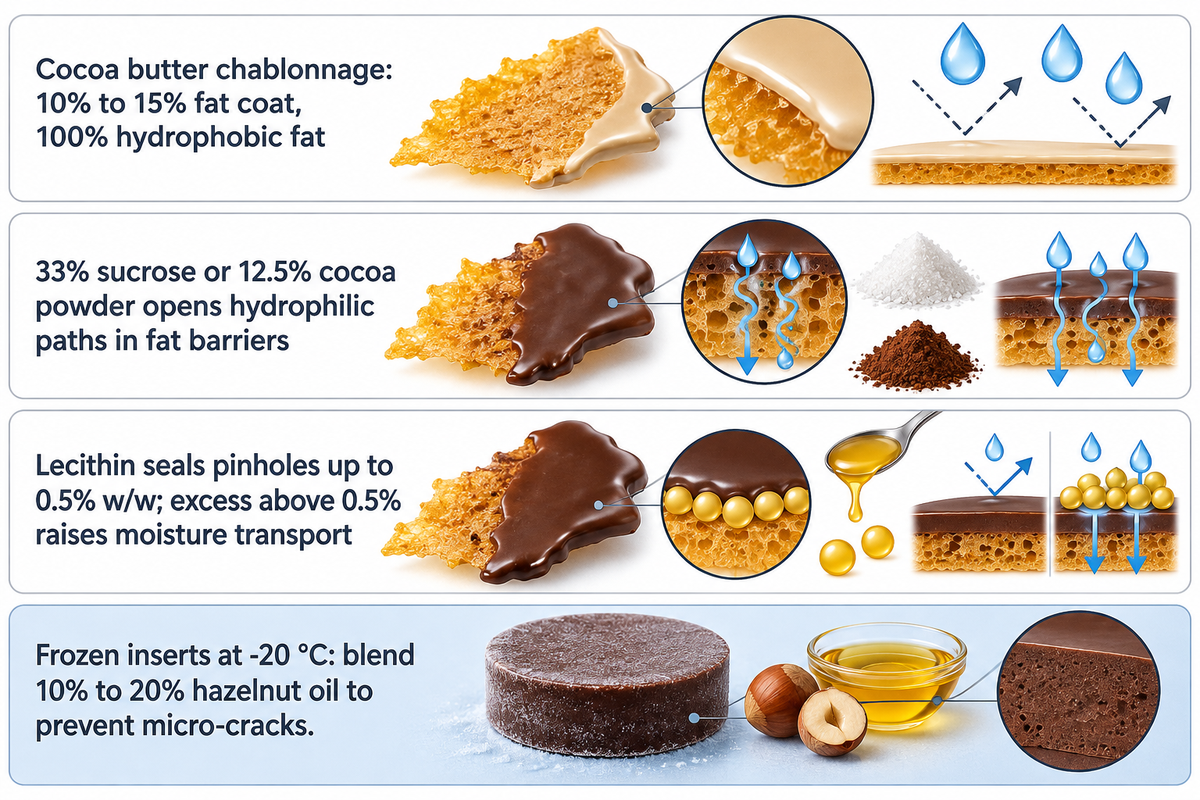
Cocoa butter blocks water better than dark, milk, and white chocolate, by weight. It contains 100% hydrophobic fat and zero hygroscopic sugar or cocoa solids. However, pure cocoa butter turns brittle below 0 °C and cracks if frozen without liquid oil.
In fat barriers, cocoa powder raises effective moisture diffusivity due to its hygroscopic nature. Lecithin lowers permeability at concentrations up to about 0.5%, after which excess hydrophilic groups reverse the effect. This was shown by Ghosh, Ziegler, and Anantheswaran in their Penn State study on chocolate coatings (also on Research Gate) and in a study of hydrophobic fat barrier films. Adding 33% sucrose or 12.5% cocoa powder opened hydrophilic paths through the fat barrier.
Lecithin thins chocolate at concentrations up to 0.5% w/w, as shown in guides on soy lecithin in chocolate, helping the chocolate seal pinholes over rough delicate shards. Beyond 0.5%, lecithin’s water-loving head groups bind to water and aid in transporting water vapor. In modern pastry, brushing or tumbling with melted cocoa butter is called cocoa butter chablonnage. A 10% to 15% fat coat seals the pores prior to the flakes entering the filling.
At sub-zero storage (-20 °C), brittle high-solid-fat coatings develop micro-cracks. Those cracks speed up moisture migration into the wafer core. In the Penn State tests, swelling cocoa powder cracked rigid coats below 0 °C. When pastry chefs build frozen mousses or white chocolate inserts, as seen in white chocolate feuilletine threads, they blend 10% to 20% hazelnut oil into the coat. That liquid oil keeps the film flexible during freezing.
⚠️ Common Mistake
Assuming thicker dark cocoa coatings always protect frozen inserts better. High-cocoa films with low liquid oil crack at -20 °C and let thaw water rush into the wafer.
Do We Need to Temper the Chocolate or Cocoa Butter Before Coating Feuilletine?
Yes, temper the chocolate or cocoa butter when making loose clusters, molded bars, or pre-coated flakes left at room temperature. If you immediately mix the coating with a high oil praline for a cold cake insert, full tempering isn’t necessary.
In a cake insert held at 4 °C, liquid hazelnut oil softens the crystal lattice anyway. Melted couverture cooled to 31 °C to 32 °C sets fast on cold parchment and protects the delicate texture. For ambient bonbons or bars held at 18 °C to 20 °C, untempered fat causes gray bloom.
Layer Design for Pastry Entremets, Molded Bonbons, and Filled Chocolate Bars
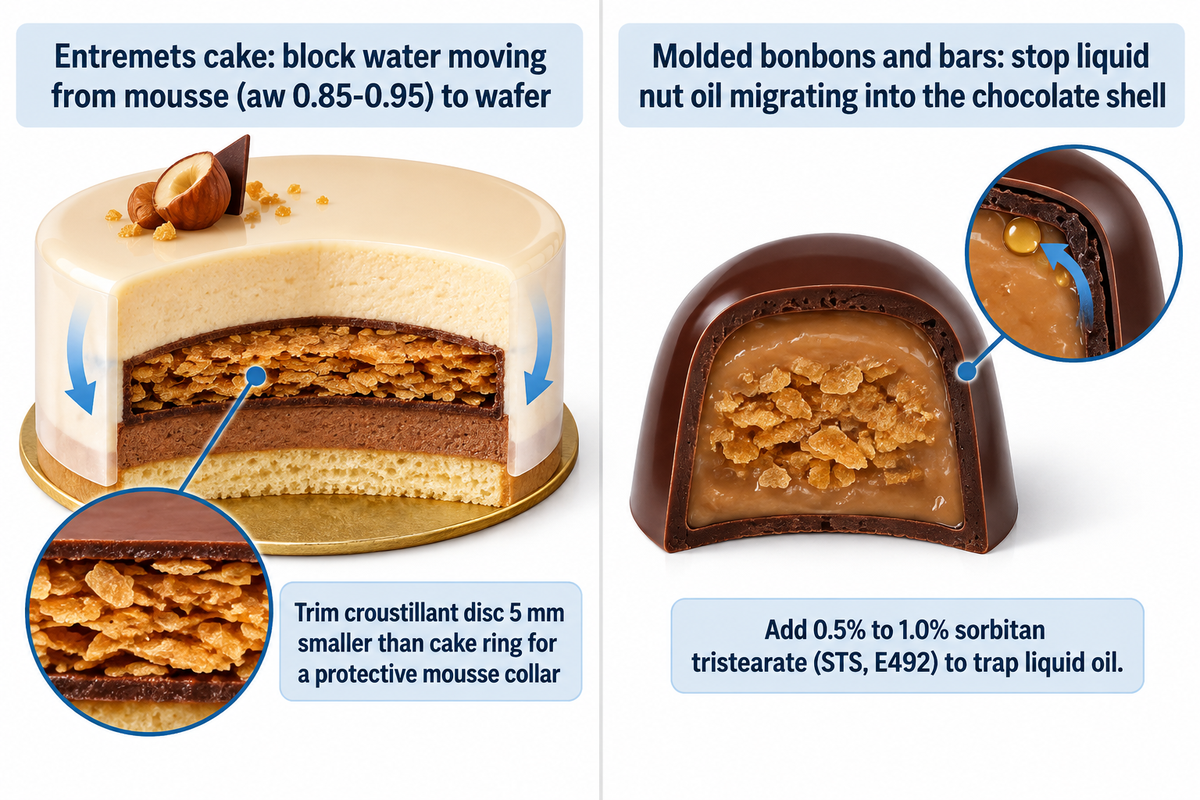
Layer design must obstruct water and oil migration in wet pastry entremets, bonbons and bars. Inside a cake, water moves from mousse to wafer. In a bonbon, nut oil moves from praline to chocolate shell.
In a cake, water moves from mousse or a sponge soaked in fruit puree to a dry biscuit inclusion, unless a continuous fat film separates them. The 2024 study on chocolate and the rheology of fat fillings shows that the migration happens rapidly. The speed of the diffusion depends on the contact area and temperature. When a layer of feuilletine touches fruit mousse or dairy mousse (aw 0.85-0.95), the bare edge of the flake pulls water into itself within hours.
Generally, in ambient pralines and bars, the most significant risk is oil migration rather than water. Liquid oils from hazelnut or almond paste can migrate into the shell and dissolve beta-V cocoa butter crystals and cause a dull beta-VI fat bloom. Food technologists slow this in two ways. First, this is discussed in European patent EP2148571A1 and in ConfectioneryNews processing reports. They describe fat-phase structuring and controlled shell cooling. Second, adding 0.5% to 1.0% sorbitan tristearate (STS, E492) traps liquid oil, a key step as textured fillings grow in 2026 . This is also an important development as textured fillings are expected to grow in 2026.
Can We Use Chocolate Feuilletine Crunch as a Cake Filling Under Mousse or Ganache?
Yes, chocolate feuilletine crunch can be used as a cake filling with mousse or ganache once each shard is fat-coated. Press the mix on top of a sponge base and seal the top with melted chocolate. Never scatter bare delicate flakes on top of wet cream.
As suggested by bakers in layer-cake placement threads and tiered cake discussions, trim the disc 5 mm smaller than the cake ring. The outer mousse collar blocks fridge condensation and prevents buttercream from wicking.
Flake Particle Size, Low-Shear Folding, and Depositor Clearances on Confectionery Lines
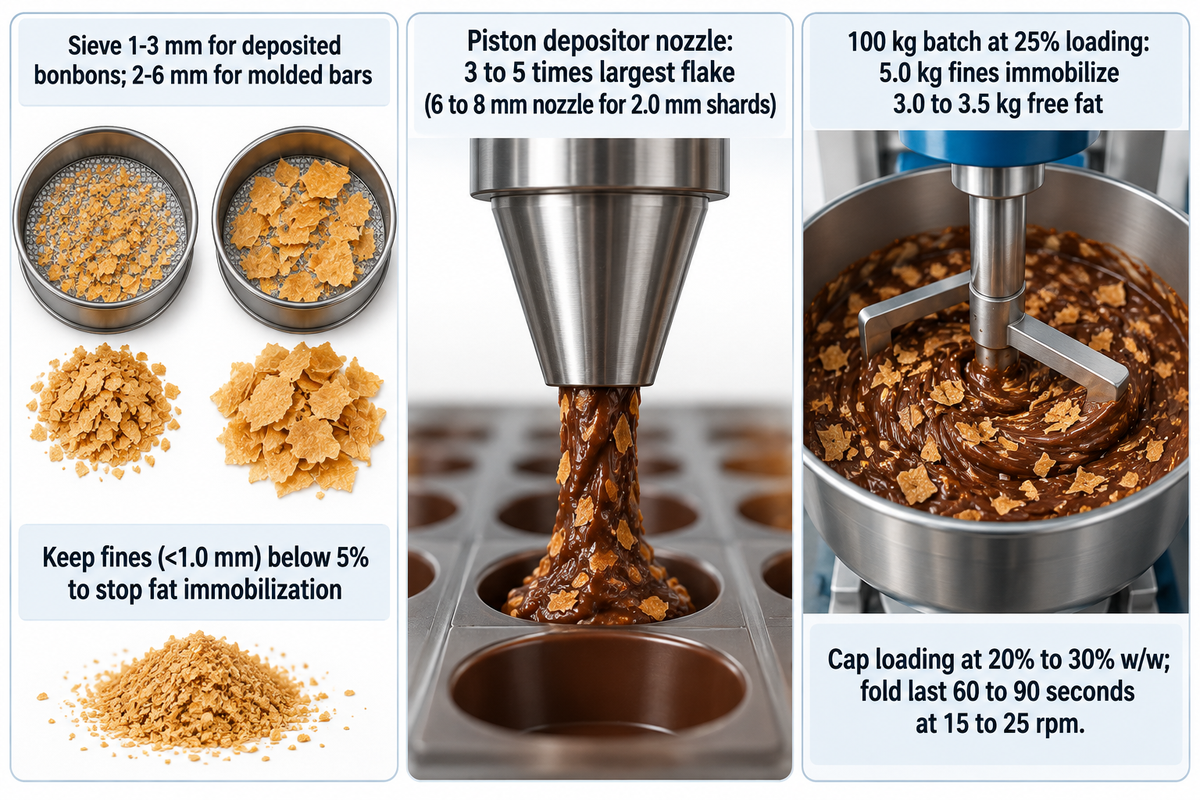
Deposited bonbon centers require finer screened flakes (1–3 mm) than molded bars (2–6 mm). Finer flakes under 1 mm need a loading cap because their high surface area absorbs free cocoa butter and increases viscosity. A piston depositor also needs a nozzle that’s 3 to 5 times the largest flake.
Cap flake loading at 20% to 30% w/w in fat, following Premier Forrester on inclusion depositing and patent EP4021195A1 on fragile wafer depositing. Fragile crêpe dentelle pieces act like flat plates in a hopper and lock into arches at tapered nozzles. Fold gently to avoid cracking fat barriers, as emphasized in BakeryAndSnacks on coated inclusions.
Keep fines (<1.0 mm) below 5% to prevent free-fat absorption and piston depositor bridging. In this worked 100 kg gianduja-feuilletine example at 25% loading, 75 kg gianduja at 34% fat supplies 25.5 kg of binder fat for 25 kg crisp flakes. High-shear mixing that crushes 20% of the wafer into dust below 1.0 mm produces 5.0 kg of fines and increases surface area fourfold. Those fines immobilize 3.0 to 3.5 kg of free fat, cutting mobile fat by over 12% and jamming a 6 mm nozzle.
When fines (<1.0 mm) remain below 5% (or under 1.25 kg) and shard length does not exceed 2.0 mm, a 3x to 4x clearance ratio is maintained with a 6 to 8 mm nozzle. Upstream shard size is controlled on the baking line. Our guides on how feuilletine is made industrially and cooling of feuilletine describe how roll gap control and sheet cooling limit fines before sifting.
💡 Pro Tip
Fold screened feuilletine during the last 60 to 90 seconds of mixing at 15 to 25 rpm. Never pump flake-loaded praline through high-shear gear pumps.
The Binder-to-Flake Ratio Dial: Match the Filling Defect to the Formulation Fix
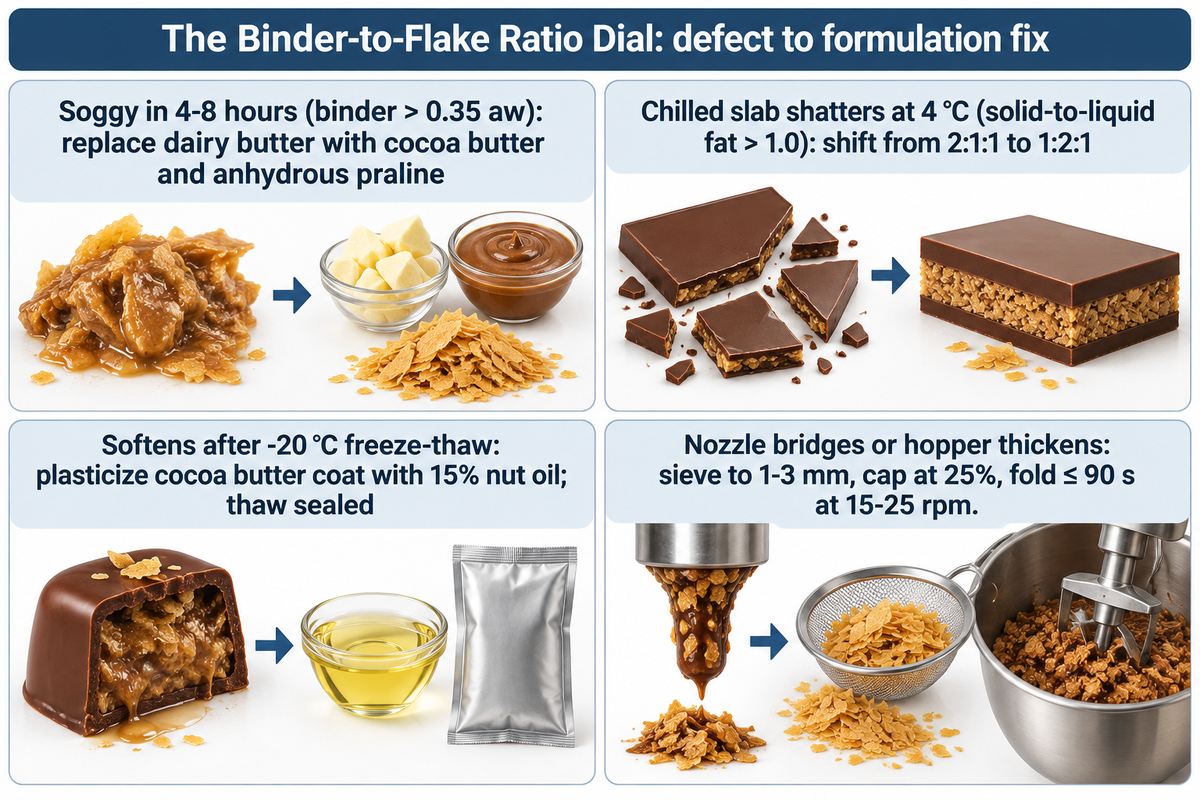
The Binder-to-Flake Ratio Dial maps eight production defects to their exact water activity or fat ratio. It helps to pinpoint the variable that drifted during a bench trial and identifies soggy mousses and poor guitar-wire cuts. It also explains clogged nozzles.
Don’t speculate whether the flake supplier or the kitchen caused a batch failure. Check what defect appeared first and how a slab fractured. The Binder-to-Flake Ratio Dial separates food water activity pickup from fat-crystal and shear mistakes.
| Observed Filling Defect | Primary Root Cause | Target Metric to Check | Formulation or Process Fix |
|---|---|---|---|
| Flakes turn soggy within 4–8 hours inside filling | Wet binder (cream ganache or dairy butter at 16%–18% water) | Binder water activity > 0.35 aw | Replace dairy butter with cocoa butter; switch to anhydrous praline |
| Chilled cake insert shatters and crushes sponge when sliced | Excess solid cocoa butter from dark couverture at 4 °C | Solid-to-liquid fat ratio > 1.0 in cold slab | Shift from 2:1:1 to 1:2:1 (25% chocolate : 50% praline : 25% flakes) |
| Slab crumbles apart on guitar wire or ultrasonic cutter | Flake loading too high or binder starved of fat | Flake mass fraction > 35% w/w | Cap flakes at 25%–30% w/w and screen out dust below 1.0 mm |
| White chocolate layer stays soft and smears at room temperature | Low cocoa butter solids and soft milk fat plus nut oil | Total solid fat content at 20 °C | Raise white couverture to 50%–55% or add 5%–8% cocoa butter |
| Flakes soften after -20 °C freeze and refrigerator thaw | Brittle fat barrier cracked at sub-zero storage or condensation | Coating cocoa powder > 10% or cold unwrap | Plasticize cocoa butter coat with 15% nut oil; thaw sealed |
| Piston depositor nozzle bridges or drips on bonbon line | Oversized shards interlocking at nozzle orifice | Orifice-to-flake ratio < 3× | Sieve flakes to 1–3 mm for 8–10 mm nozzles; cap loading at 25% |
| Filling thickens rapidly in heated hopper during run | High-shear agitator crushing flakes into fines, or lecithin > 0.5% | Fines (<1.0 mm) > 5% w/w; mixer speed | Fold flakes ≤ 90 s at 15–25 rpm; hold lecithin at 0.3%–0.5% |
| Gray streaks and fat bloom appear on bar shell in weeks | Liquid nut oil migrating from praline center into shell | Storage temp > 20 °C; untempered center | Temper filling at 28 °C–29 °C, add 0.5%–1.0% STS, store at 16 °C–18 °C |
How to Run a 3-Ratio Bench Calibration Before Scaling a Production Batch
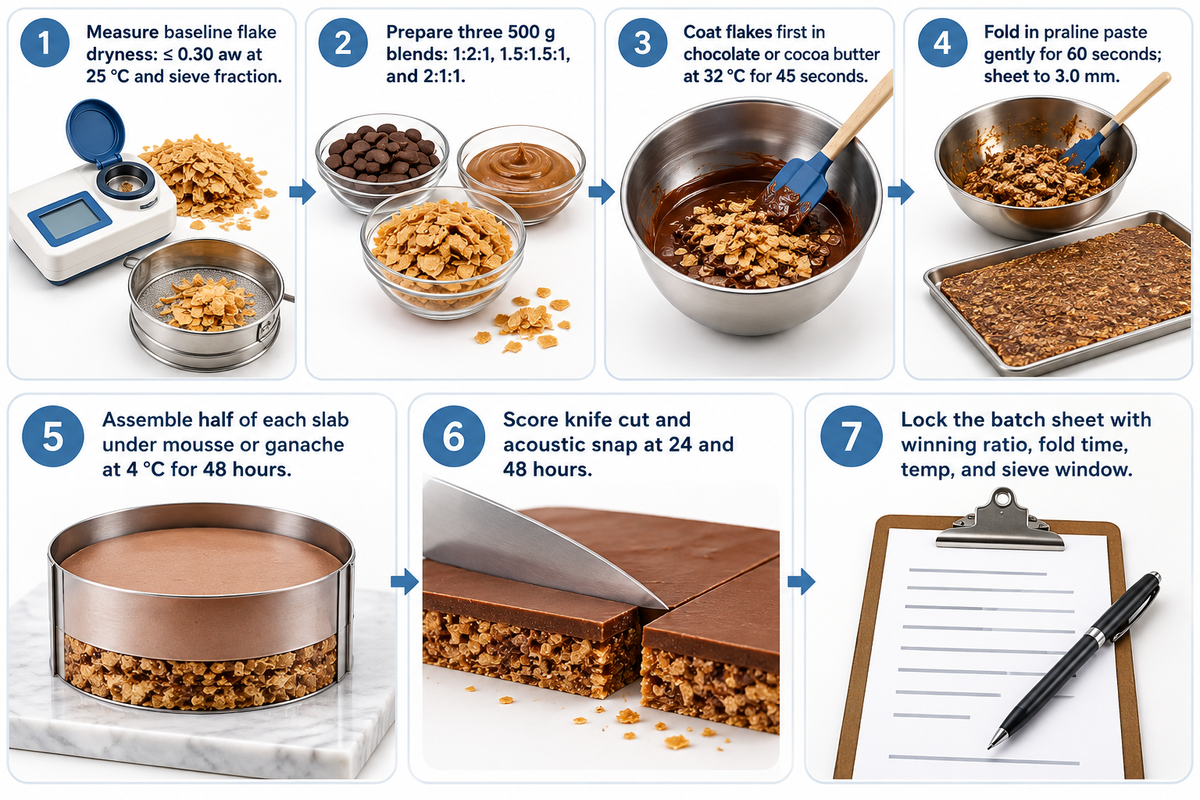
A 3-Ratio Bench Calibration consists of testing three 500 g slabs over 48 hours at 4 °C and 18 °C to determine slicing force and crunch retention prior to a plant run. Run 1:2:1, 1.5:1.5:1 and 2:1:1 ratios of chocolate, praline, and flake using your exact production couverture and nut paste.
- Measure baseline flake dryness by checking incoming water activity (≤ 0.30 aw at 25 °C) and sieve fraction before mixing.
- Prepare three 500 g binder blends at 1:2:1 (125 g : 250 g : 125 g), 1.5:1.5:1 (187.5 g : 187.5 g : 125 g), and 2:1:1 (250 g : 125 g : 125 g).
- Coat the flakes first by tumbling them in melted chocolate or cocoa butter at 32 °C for 45 seconds before adding praline.
- Fold in the praline paste gently with a spatula for 60 seconds, then sheet to 3.0 mm on a level baking pan.
- Assemble under real wet layers by placing half of each slab under mousse or ganache at 4 °C for 48 hours.
- Score knife cut and acoustic snap at 24 and 48 hours by slicing with a warm knife and checking extracted flakes for crisp texture.
- Lock the batch sheet by writing the winning ratio, mixing time, deposit temperature, and sieve window into your master spec.
Treat this calibration as a formal water activity gate in your food product scale-up process. When increasing from a 500 g bowl to a 200 kg mixer, keep tip speed and fold time the same.
What to Write Into a Feuilletine Purchase Specification (and When to Make Feuilletine In-House)
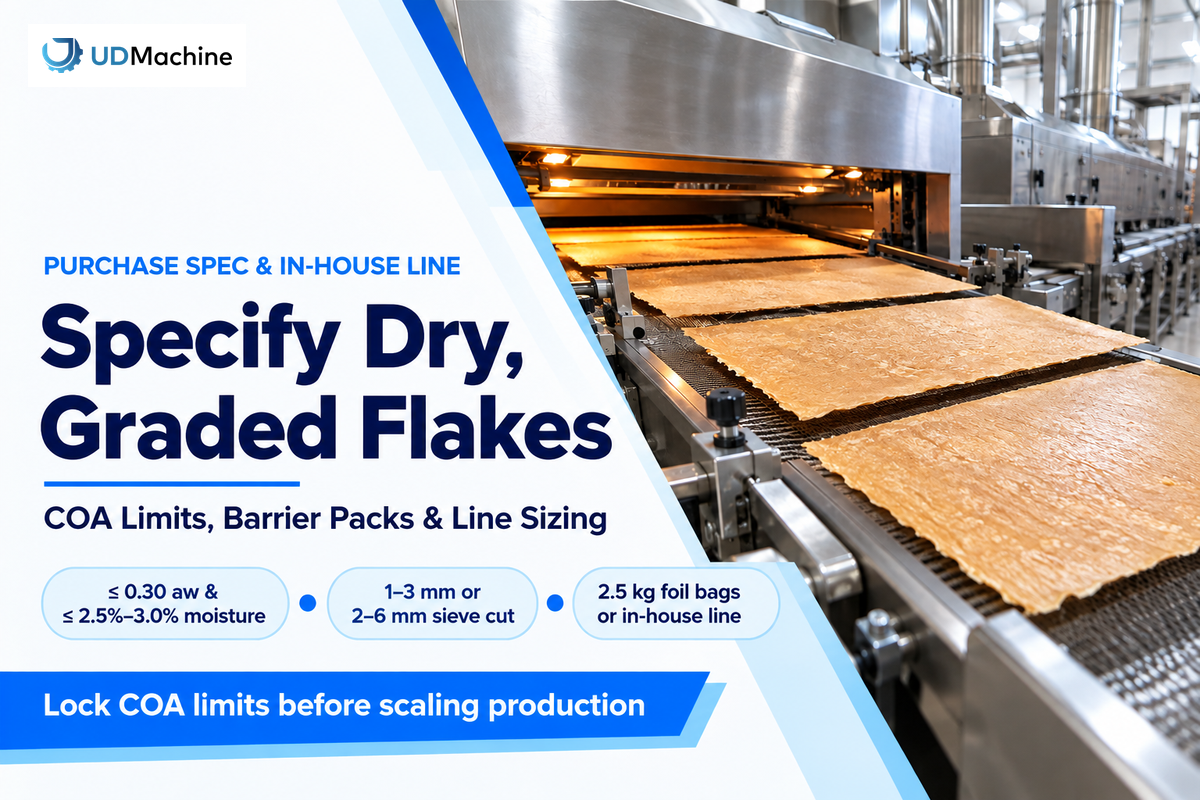
An industrial feuilletine purchase order specification would lock in residual moisture at or below 2.5% to 3.0% and water activity at or below 0.30 aw at 25 °C. It would also require particle sieve limits, foil-laminated inner bags, and a lot-specific Salmonella-negative certificate of analysis prior to release.
According to the manufacturer specification, Cacao Barry Pailleté Feuilletine (code BIG-PF-1BO-401) is packed in 2.5 kg foil bags (4 × 2.5 kg cases) with a 12-month unopened shelf life. See the Cacao Barry BIG-PF-1BO-401 specification and Callebaut packaging data for standard pack formats. Small shops buy feuilletine from specialty baking stores, where invoices sometimes spell it feulletine. Once a plant uses several pallets a month, opening dozens of 2.5 kg bags per shift adds labor and humidity exposure. As noted in the Royal Society of Chemistry monograph on confectionery shelf life, low-moisture ready-to-eat (LMRTE) inclusions also need strict pathogen control because fat protects Salmonella during storage.
An in-house line bakes thin crêpes to ≤ 2.5% moisture, cools them in a dry tunnel, and crushes directly to 1–3 mm or 2–6 mm. When monthly volumes justify baking on site to make feuilletine in-house, UDTECH’s public industrial feuilletine production line and feuilletine capacity planner scope cover verifiable equipment stages: batter dosing, a heated baking drum, a cooling conveyor, adjustable crushing/flaking, and sieving.
RFQ checklist for purchasing feuilletine or specifying an in-house flaking line:
| Parameter | Target Specification | Why It Matters in Chocolate Fillings | Verification Method |
|---|---|---|---|
| Water activity at release | ≤ 0.25–0.30 aw at 25 °C | Keeps flakes below the 0.35 aw sensory softening point | Dew-point meter per ISO 18787 on every lot COA |
| Residual moisture content | ≤ 2.5%–3.0% w/w | Prevents glassy starch-sugar softening in storage | Halogen moisture balance or oven drying on COA |
| Particle size distribution | 1–3 mm (bonbons) or 2–6 mm (bars); fines <1.0 mm below 5% | Stops piston depositor bridging and free-fat absorption | Ro-Tap sieve shaker audit per shift or incoming lot |
| Barrier pack structure | 2.5 kg or 5 kg foil-laminated bag, nitrogen-flushed, heat-sealed | Blocks warehouse water vapor during 12-month shelf life | Supplier WVTR data sheet and seal integrity check |
| Microbiological LMRTE safety | Salmonella negative per 25 g (or 375 g composite); Enterobacteriaceae ≤ 10 CFU/g | Flakes enter ready-to-eat chocolate with no further kill step | Accredited lab COA required prior to lot release |
| Allergen declaration | Wheat gluten, milk/butter, soy lecithin, and barley malt status stated | Prevents undeclared allergen cross-contact on molding lines | Signed allergen matrix and label specification |
| Bulk density & intact flake yield | Stated g/L bulk density; ≥ 95% on-spec shard yield | Maintains consistent volumetric pocket fill in chocolate bars | Graduated cylinder check at incoming receiving |
| In-house line crusher & sifter | Adjustable roll gap with inline twin-deck sifter for 1–3 mm and 2–6 mm cuts | Lets plant switch between bonbon centers and bar slabs without retooling | Factory acceptance test on UDTECH flaking and sieving stage |
Frequently Asked Questions
What is a good substitute for feuilletine in a chocolate crunch filling?
Crushed crêpes dentelles (Gavottes), toasted cornflakes, crisped rice, or baked filo shards are the closest substitutes for feuilletine in a chocolate filling.
None of these swaps match the 0.5 mm delicate crunch of true pailleté feuilletine right out of the box. Crush cornflakes or crisped rice to 2 to 5 mm and toast them at 110 °C for 8 minutes to drive off moisture. Tumble the warm pieces in 15% melted cocoa butter before folding them into praline.
Can I use store-bought feuilletine or crushed tuile wafers in bonbon fillings?
Yes, you can use store-bought feuilletine or crushed tuile wafers in bonbon fillings once you sieve the shards to 1 to 3 mm and remove dust.
Store-bought flakes arrive below 3% moisture, whereas homemade tuile cookies often hold 4% to 6% moisture and uneven thick edges. Bake homemade tuiles at 110 °C until water activity drops below 0.30 aw. Cool them in a dry room, sieve out dust below 1.0 mm, and coat the shards in cocoa butter before depositing.
Does feuilletine for chocolate filling contain gluten and dairy?
Yes, standard commercial feuilletine contains wheat flour, concentrated butter, skim milk powder, and barley malt, so it carries both gluten and dairy allergens.
For gluten-free or plant-based confections, specify certified rice-flour or chickpea-flour wafer shards baked with deodorized cocoa butter or coconut oil instead of dairy butter. Check the supplier certificate of analysis for a gluten limit below 20 ppm and verify that incoming water activity stays below 0.30 aw before blending into dark couverture.
Why does white chocolate feuilletine crunch set softer than dark chocolate crunch?
White chocolate contains milk fat and zero non-fat cocoa solids, so its crystal network sets softer than dark chocolate when mixed with nut oil.
Raise white chocolate to 50% of the mix or add 5% cocoa butter for a firmer snap.
What causes fat bloom on chocolate bars filled with praline and feuilletine?
Fat bloom on praline-filled chocolate bars occurs when liquid nut oils migrate from the praline center into the outer shell and turn cocoa butter into dull beta-VI crystals.
Warm storage above 20 °C and untempered centers speed up that oil transport. To stop bloom, temper both the shell and the binder. Add 0.5% to 1.0% sorbitan tristearate (E492) to trap liquid oil, and store finished bars at 16 °C to 18 °C.
How thin should a chocolate feuilletine crunch layer be rolled for an entremet cake?
Roll a chocolate feuilletine crunch layer to 2.5 to 3.5 mm thick for a chilled entremet cake so a knife slices cleanly without crushing the mousse.
Cut the disk 5 mm narrower than the ring mold so outer glaze hides the edge.
Scaling up wafer flake or chocolate inclusion production? Send your target hourly output, flake size window, and recipe specs. The UDTECH engineering team will map the batter dosing, drum baking, cooling, and flaking stages into a line proposal.
About This Analysis
Prepared by Suzhou UDTECH Technology Co., Ltd. from peer-reviewed food-engineering studies, patent filings, USDA composition tables, and commercial couverture technical sheets. The 10 kg binder comparison and the 100 kg fines calculation are worked engineering examples.
Related Articles
References & Sources
- Katz and Labuza, Effect of Water Activity on the Sensory Crispness and Mechanical Deformation of Snack Food Products (1981), University of Minnesota
- Katz and Labuza, Effect of Water Activity on the Sensory Crispness and Mechanical Deformation of Snack Food Products, Journal of Food Science (Wiley)
- US20100092612A1, Moisture resistant wafer, Nestec S.A. patent application
- Moisture sorption and glass transition behavior in crispy cereal and wafer systems, PubMed Central
- Inspection Technical Guide No. 39: Water Activity (aw) in Foods, US Food and Drug Administration
- FoodData Central: Butter moisture and lipid composition, US Department of Agriculture
- ISO 18787:2017 Foodstuffs, Determination of water activity, International Organization for Standardization
- Use of Low-Cost Devices for Water Activity Determination by Cottage Food Producers (2025), Journal of Food Science, via PubMed Central
- Cacao Barry Pailleté Feuilletine BIG-PF-1BO-401 US product data, Barry Callebaut
- Feuilletine Crunch: Ratios and Texture Mechanics, Jess Wang Pastry
- Taste Tomorrow: Hottest Chocolate and Texture Trends, Puratos
- Ghosh, Ziegler, and Anantheswaran, Moisture migration through chocolate-flavored confectionery coatings (2005), Penn State University
- Moisture migration through chocolate-flavored confectionery coatings, Journal of Food Engineering record
- Moisture permeability and structure of fat-based edible barrier films, PubMed
- Soy Lecithin in Chocolate: Function and Dosing Limits, The Chocolate Journalist
- How Cocoa Butter Chablonnage Protects Pastry Shells From Moisture, Tasting Table
- Multi-domain stability, lipid migration, and bloom in filled chocolates (2024), PubMed Central
- Rheological and crystallization behavior of confectionery fat fillings (2024), PubMed Central
- EP2148571A1, Method for controlling oil migration and bloom in filled confectionery, European Patent Office
- Kraft develops quality-preserving chocolate structuring method, ConfectioneryNews
- Taste and texture still rule confectionery as reformulation and innovation accelerate (2026), ConfectioneryNews
- Inclusion Depositing Processes and Nozzle Engineering, Premier Forrester
- EP4021195A1, Confectionery product with crispy wafer inclusions and depositing method, European Patent Office
- Barrier-coated bakery inclusions for high-moisture desserts, BakeryAndSnacks
- Pailleté Feuilletine BIG-PF-1BO-401 Technical Specification, Cacao Barry
- Callebaut Pailleté Feuilletine M-7PAIL-E0-401 Packaging and Storage Specification, Barry Callebaut
- Legislation, Shelf-Life and Packaging of Confectionery Products, Royal Society of Chemistry