Get in touch with UDTECH Company


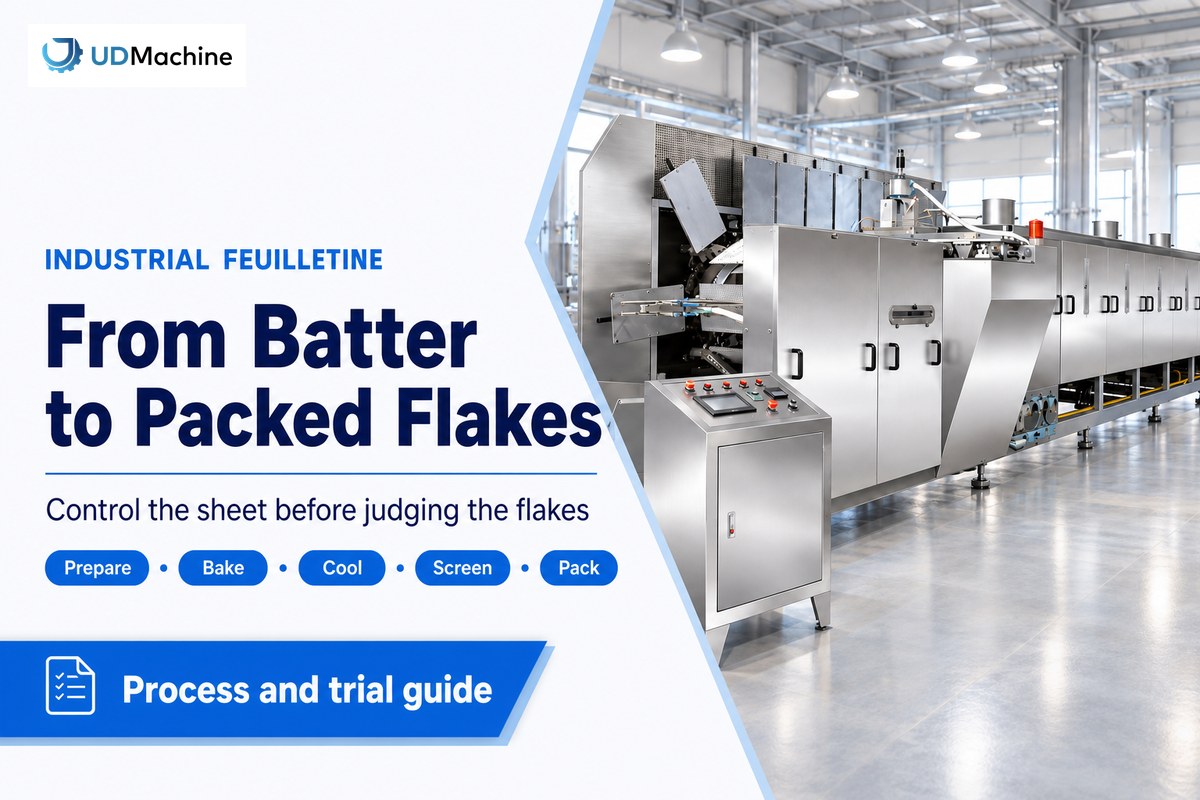
Six steps are required for industrial feuilletine production: prepare batter, deposit a thin layer, bake and release it, cool the sheet, crush and screen it, and pack accepted flakes. Control the sheet before judging the finished flakes.
Feuilletine, or pailleté feuilletine, is a crisp crepe-like wafer that’s broken into small flakes. This component adds crunch to confections. For a manufacturing facility, the challenge is repeating that texture while maintaining an agreed flake size and keeping the pickup of moisture to a minimum. A good sample starts the discussion; measured pack-out completes it.
Updated October 2026. This guide uses publicly available equipment and food-science literature. The suggested quality methods in the trials tables aren’t a food-safety release procedure nor are they a representation of completed UDTECH customer trials.
The industrial feuilletine process at a glance
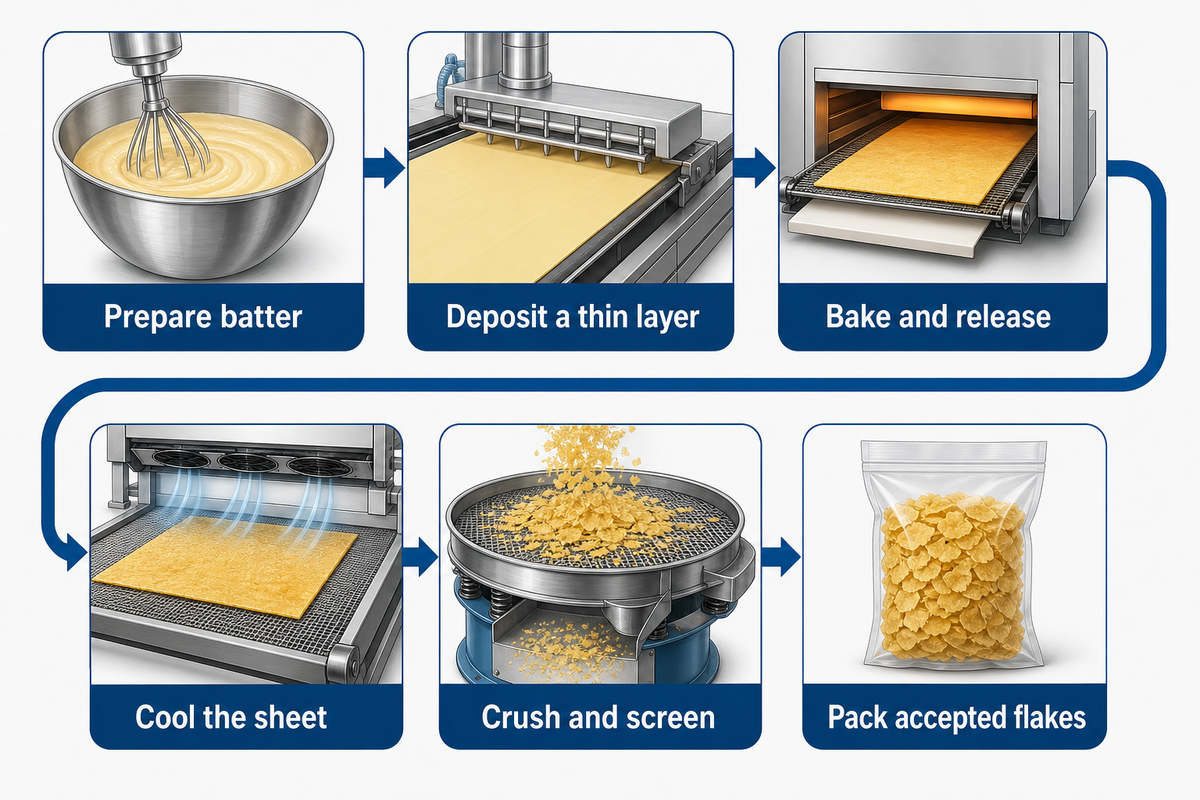
Making a thin, even baked sheet is the first process, followed by a loose flake. Breaking the process into these six steps helps identify problems in baking versus problems caused by mishandling. The same purchasing distinction is made by the UDTECH feuilletine production line: baking equipment versus equipment for handling.
| Stage | What changes | Check before the next stage |
|---|---|---|
| Batter preparation | Ingredients become a depositable mixture | Recipe revision and consistent flow |
| Thin-layer depositing | Batter spreads over the baking surface | Coverage and deposited amount |
| Baking and release | The layer sets, dries and separates | Color, sheet condition and sticking |
| Cooling | The released sheet reaches the agreed handling condition | Texture before crushing |
| Crushing and screening | The sheet becomes a specified flake fraction | Accepted size, fines and oversize |
| Packing | Accepted flakes enter the selected package | Seal, lot identity and stored-product performance |
Not all quotations contain the six steps. One biscuit baking unit may be only one step of the overall process. Also differentiate loose flakes from rolled products: a different shaping process after baking is followed in our wafer forming and baking guide.
Batter preparation and thin-layer depositing
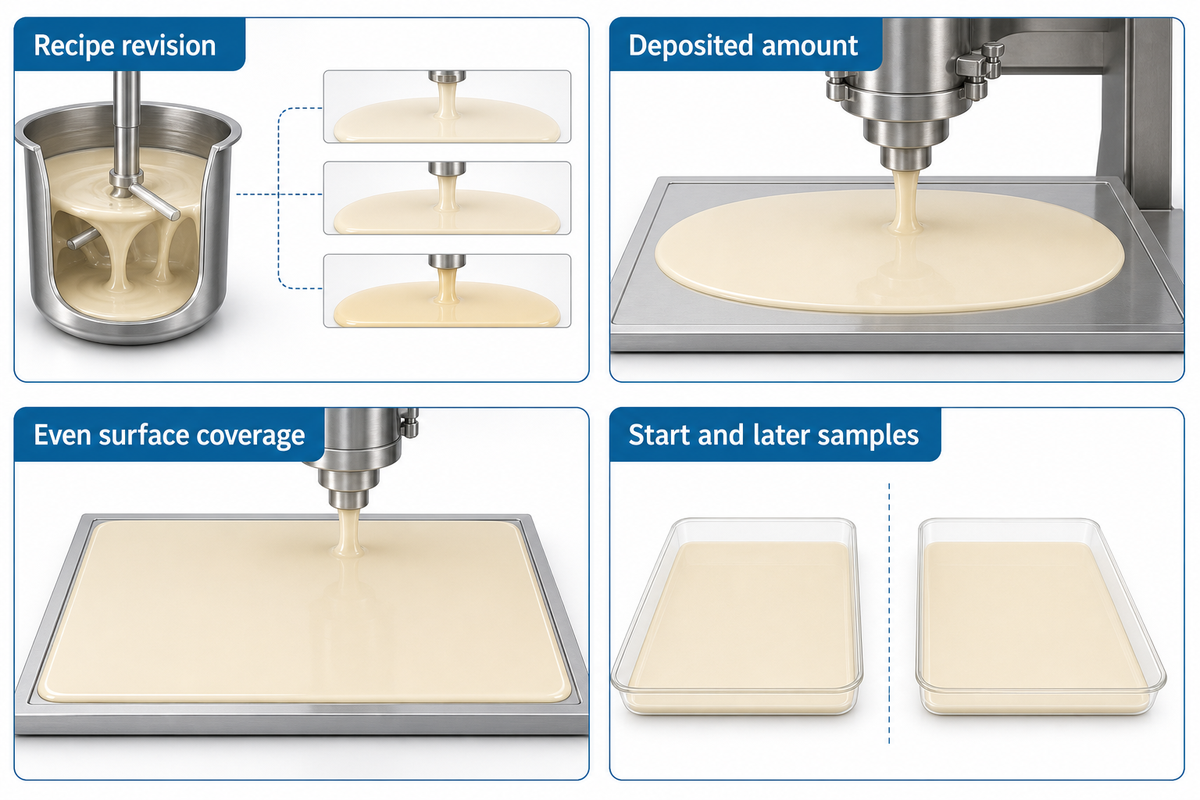
Control feuilletine ingredients and deposition to give the oven a repeatable starting point. Control recipe and mixing sequence, and fix deposited amount before altering baking conditions. A homemade feuilletine recipe can establish a desired flavour, but spreading batter thinly with a spatula doesn’t dictate how a factory will reproduce that layer throughout a run.
A tray lined with baking paper or parchment paper, or a silicone mat, allows a developer to examine a small batch in a laboratory. Instructions to spread batter as thin as possible need a measurable factory equivalent: record the deposit setting and how evenly the baking surface is covered. An even layer matters more than a photograph of the best sheet.
Köklü and colleagues’ 2025 wafer baking study examines the relationship between process conditions and sheet properties. It concerns plate-baked wafers, so its dimensions and operating settings aren’t a feuilletine recipe guide. Use that distinction when transferring a kitchen formula.
- Record ingredient lots and the formula revision, including whether icing sugar or another sugar is specified.
- Keep a deposit reference from the start and later part of the run.
- Treat a switch to brown sugar as a recipe change, not an informal color adjustment.
A common error is to change batter consistency and oven settings concurrently. If the sheet improves, the team can’t tell which change helped.
Baking and release: control the sheet before crushing
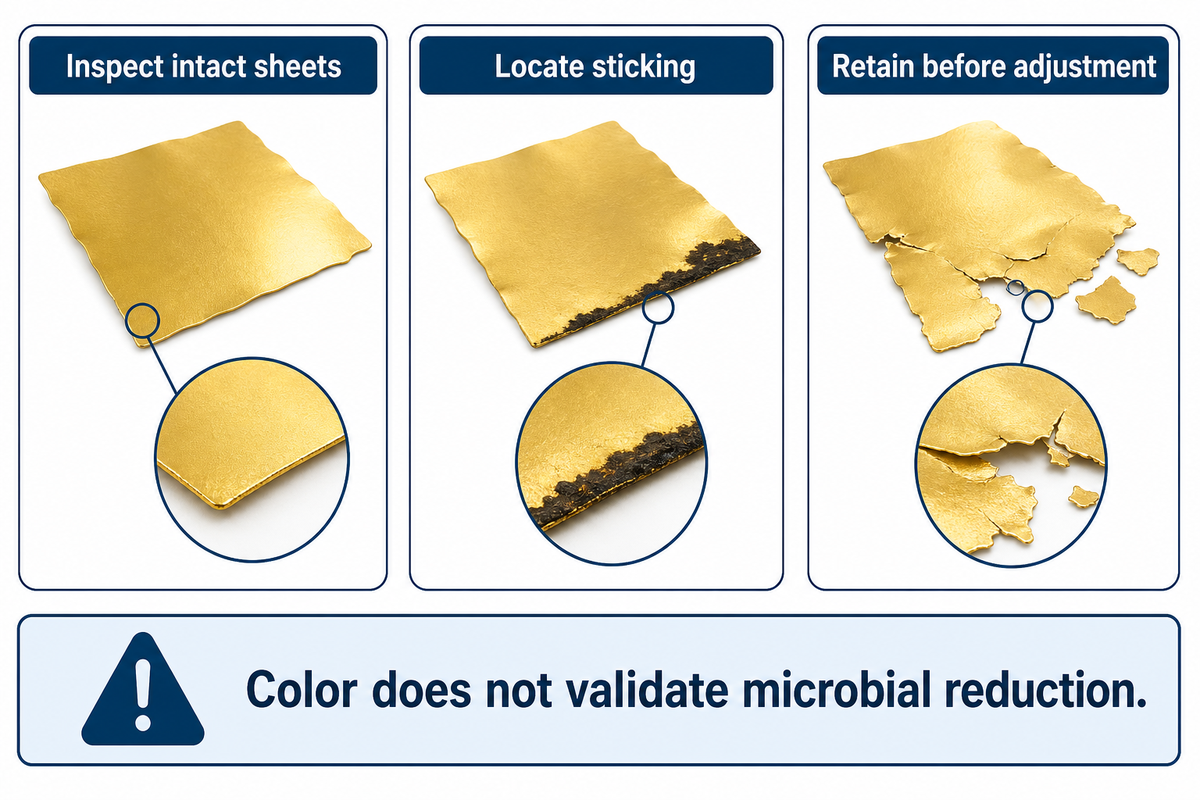
The goal of baking is to obtain the thin, brittle sheet as agreed and release it without excessive sticking and/or tearing. Golden brown color is a good visual aid, but isn’t the complete end point. Inspect sheets across the baking surface and throughout the run before crushing makes pale and dark fragments harder to trace.
The 2025 plate-material study covers color and wafer thickness, in addition to temperature distribution. The study doesn’t, however, define an absolute temperature or bake time for crispy feuilletine. What works for a recipe for one baking surface may not work for another.
- Compare the intact sheet with the approved appearance reference.
- Note where sticking begins: the same location repeatedly, or scattered areas.
- Retain a sheet before changing a setting, then compare the next agreed sample.
For instance, if dark edges occur before the crusher, modifying the crusher isn’t going to correct the bake. If sheets leave cleanly but fragments are scorched in only one of the collected samples, verify the identity of the sample and the time it was collected, and don’t automatically blame the entire run.
Process Boundary: Color and crispness don’t prove a validated microbial reduction. The food-safety team at the plant must establish the required baking validation and post-bake controls for its product.
Cooling: prepare a brittle sheet without moisture pickup
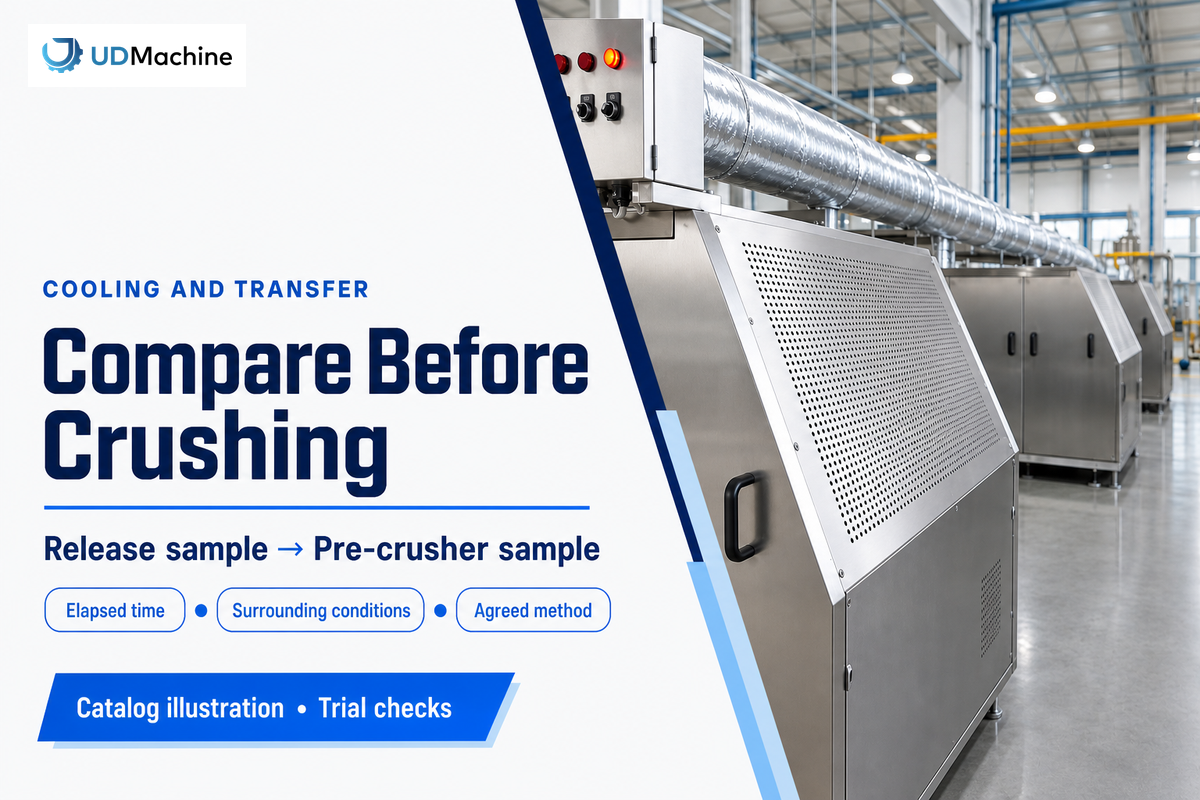
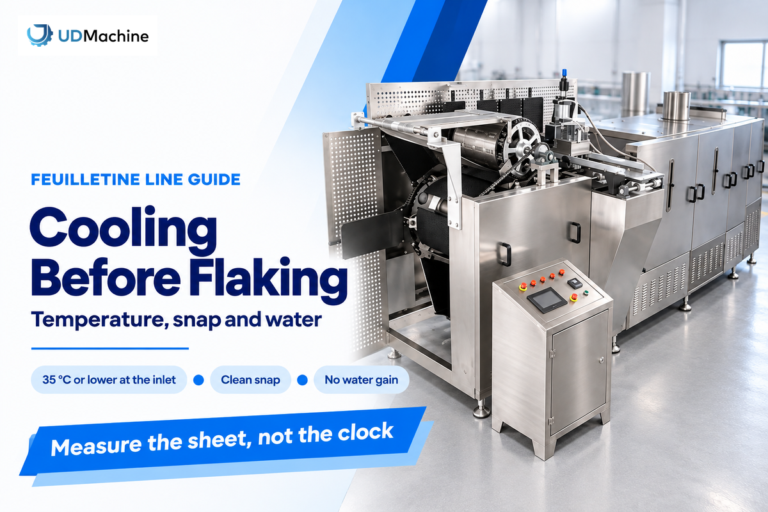
Feuilletine cooling prepares the sheet for consistent breaking. The transfer, however, exposes the sheet to the surrounding environment. There needs to be a sample of the uncrushed sheet to show a change in texture. The objective is for handling conditions to be agreed upon, not to copy an arbitrary waiting time from a home baking recipe.
The FDA’s definition of water activity distinguishes available water from total moisture. Record whatever is specified in the product specification, using the methods indicated. A dry looking sheet is not a measurement.
- Compare the sheet at release with the sample collected before crushing.
- Record the elapsed transfer time and surrounding conditions during the trial.
- Use the agreed sampling and handling method so the comparison itself doesn’t change the sample.
If the uncrushed sheet is already soft, examine that prior step before increasing crushing force. Extending exposed cooling without testing can add additional variables.
Crushing and screening: separate flakes from fines
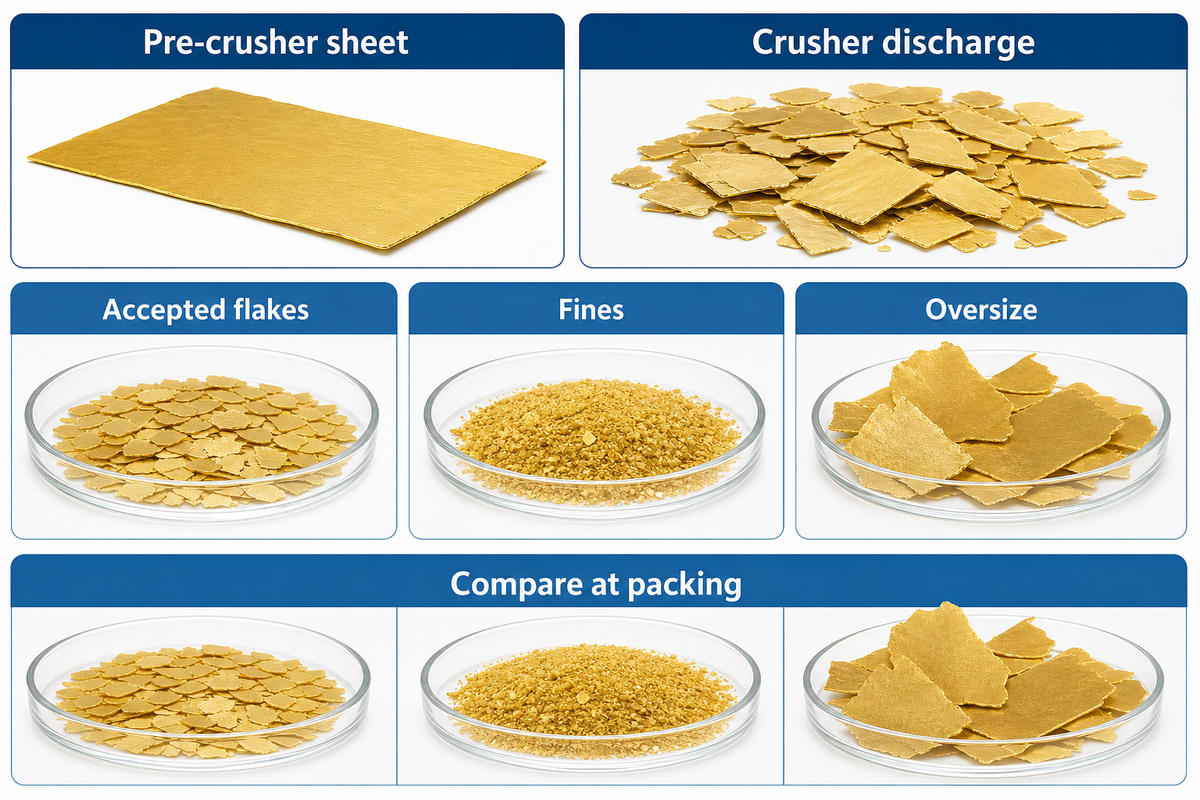
Crushing transforms the cooled sheet into flakes; screening separates the size fractions that the buyer accepts. Gross material leaving the crusher isn’t automatically saleable output. Agree the particle-size method and treatment of fines prior to the trial, and weigh the accepted flakes separately from oversize and rejected fractions.
According to NC State’s food-production guidance available online, in settling specifications, there are considerations of piece size, texture, and rejection conditions. In this context, a reference bag, by itself, isn’t adequate. The supplier and buyer must agree upon a common standard to judge flakes.
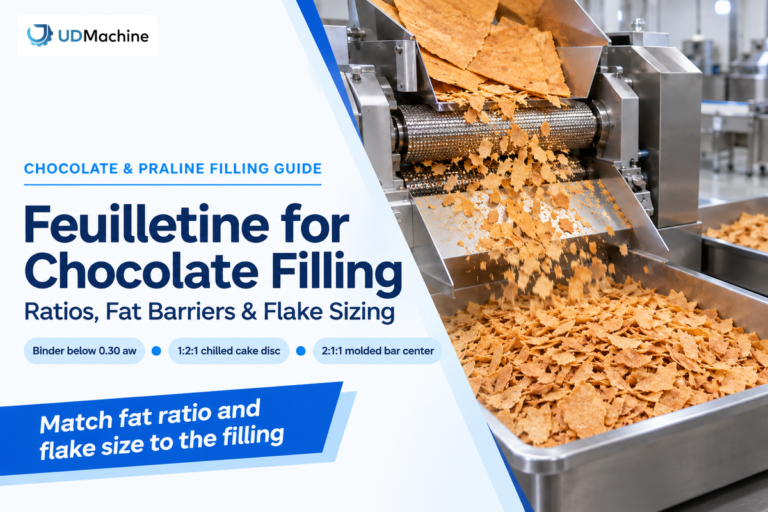
Crispy flakes may be desired by a chocolate bar producer. A small particle may suit another application but disappear visually in the bar. A large particle may prevent a thin, even, smooth layer. Before accepting any fraction, state the intended application.
- Retain separate pre-crusher, post-crusher and screened samples.
- Record accepted mass and each excluded fraction.
- Repeat the comparison at the packing point to detect damage after screening.
Fines shouldn’t be counted as accepted flakes unless stated in the purchase specification.
Packing and storage: test crispness in the final application
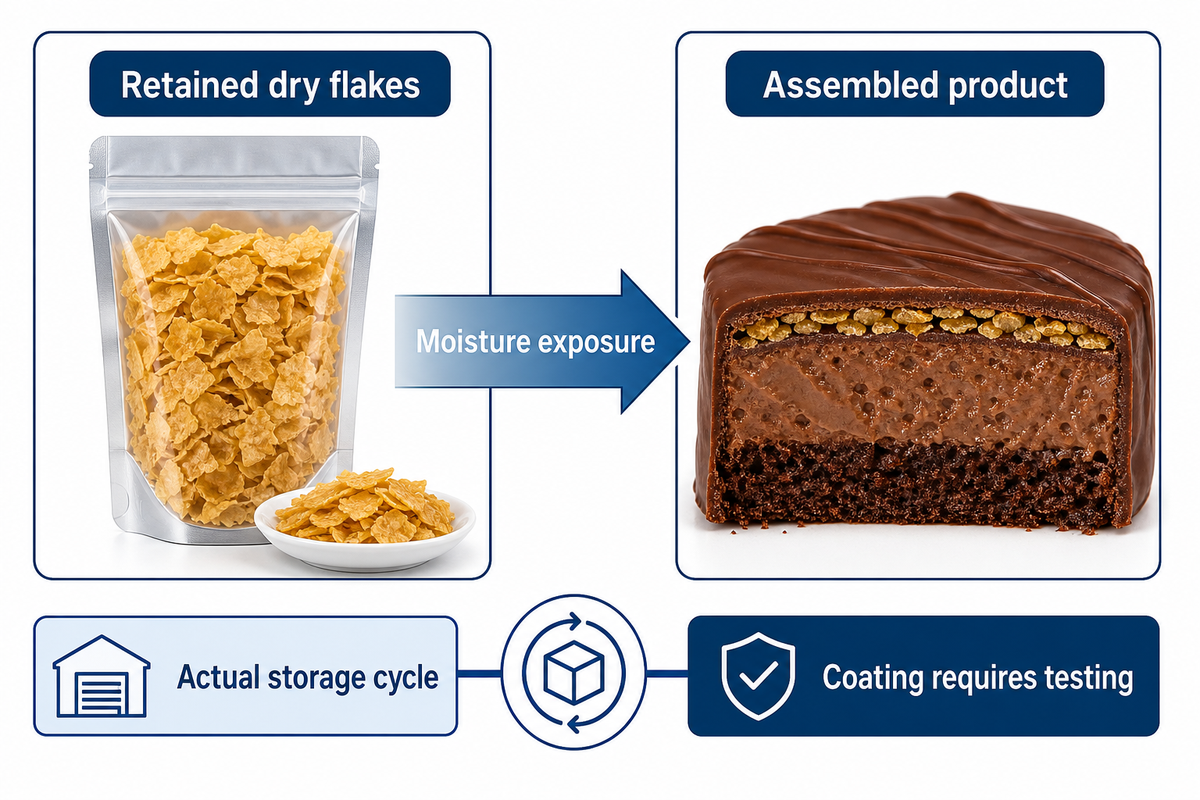
Feuilletine storage and packing protect accepted flakes, but the final recipe determines the fate of crunch. Analyze dry ingredients and completed food separately. Retain samples of both, with the actual package and storage conditions, and the quality team will be able to tell if there’s a production problem with flakes or if moisture movement is occurring after the mixing.
How does feuilletine stay crunchy?
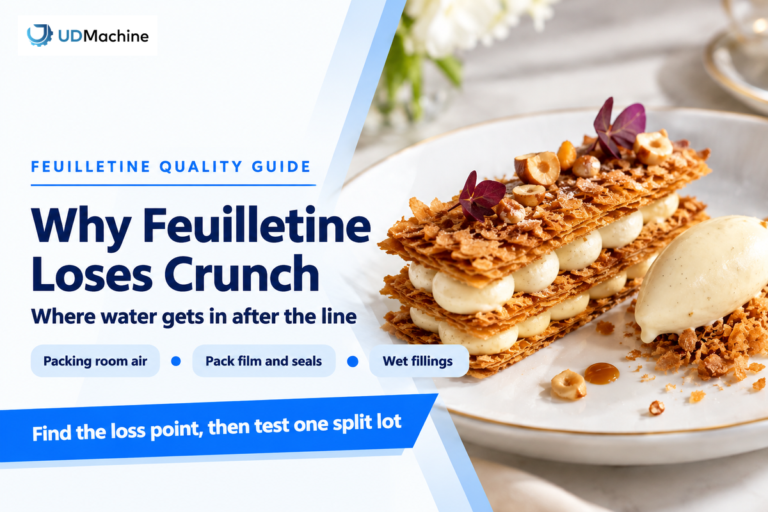
Control moisture exposure and test the intended application. Callebaut’s Pailleté Feuilletine guidance describes using it with chocolate, praline and gianduja, but warns against incorporating its flakes into cream, dairy or liquid bases, as they absorb moisture. That product guidance isn’t a shelf-life guarantee for the fillings.
A 2008 model bread-crust study found that both moisture content and water activity affected perceived crispness. Its results explain why the measurements should stay separate; they don’t provide a feuilletine pass limit. Keep the sensory check alongside the selected instrumental measurements.
What can I make with feuilletine?
Praline-and-feuilletine bases can add crunchy layers to entremets. Chocolate hazelnut fillings can supply contrasting bites. For tarts, cheesecakes, or tortes, test the assembled product rather than just the dry topping. A buttery biscuit note that works with dark chocolate may not be as suitable with another flavour profile.
A further boundary comes from Ghosh and colleagues’ coating research: composition and storage conditions affect the moisture barrier. A chocolate-and-hazelnut coating is therefore a formulation to test, not automatic protection. If you refrigerate the finished product during distribution, include that intended storage cycle in the trial.
Common mistake: approving dry flakes because they crunch, then thinking the same texture would make it through mousse or a wet filling.
Sheet-to-Flake Defect Trace
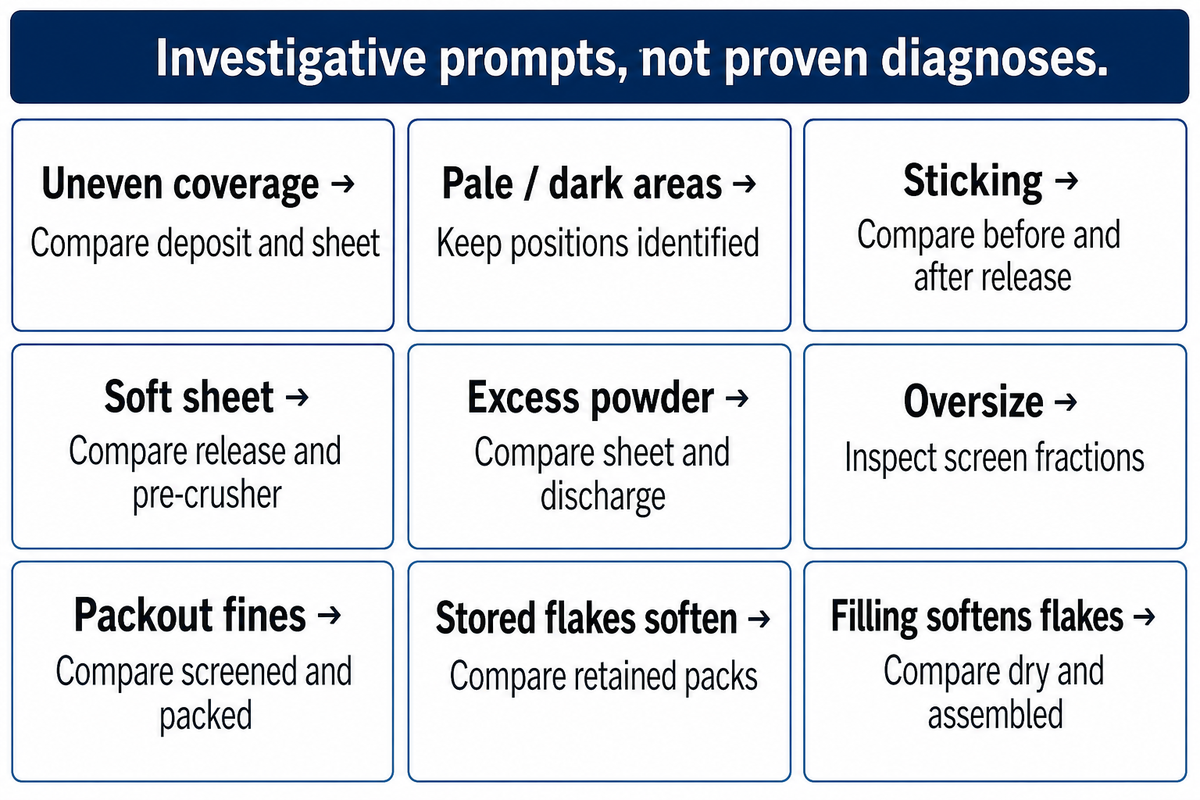
Sheet-to-Flake Defect Trace locates where a defect first appears in the feuilletine manufacturing process.
Use the table to select a sample pair before adjusting a setting. It develops the product-specification approach in NC State’s trial guidance into a feuilletine quality tool. These are just investigative prompts, not proven diagnoses. Start with the first abnormal sample and keep all other conditions of the trial constant.
| Observed defect | Compare these samples | Next decision | Owner |
|---|---|---|---|
| Uneven sheet coverage | Deposit reference and first baked sheet | Check spreading before changing the bake | Production |
| Pale and dark areas | Intact sheets from identified positions | Locate the pattern; do not hide it in a mixed bag | Production and quality |
| Sticking at release | Sheet before and after release | Separate release damage from later breakage | Production |
| Soft sheet before crushing | Release and pre-crusher samples | Review bake and cooling conditions first | Quality |
| Excess powder after crushing | Pre-crusher sheet and crusher discharge | Check brittleness and crusher conditions together | Production |
| Oversize in the accepted fraction | Crusher discharge and screen fractions | Review the agreed separation method | Quality and supplier |
| More fines at packout | Screened flakes and packed flakes | Inspect intervening transfers | Plant manager |
| Stored dry flakes lose crunch | Initial pack and retained stored pack | Review seal, package and storage conditions | Quality and procurement |
| Only the filling softens the flakes | Unused flakes and assembled product | Review formulation and application storage | Product development |
If screened flakes match the reference but packaged samples contain more dust, that comparison draws attention to the transfer and filling path. It doesn’t warrant a recipe change immediately. Confirm the pattern by taking a sufficient amount of representative samples and then assign a reason for the difference.
Trial sampling and accepted output
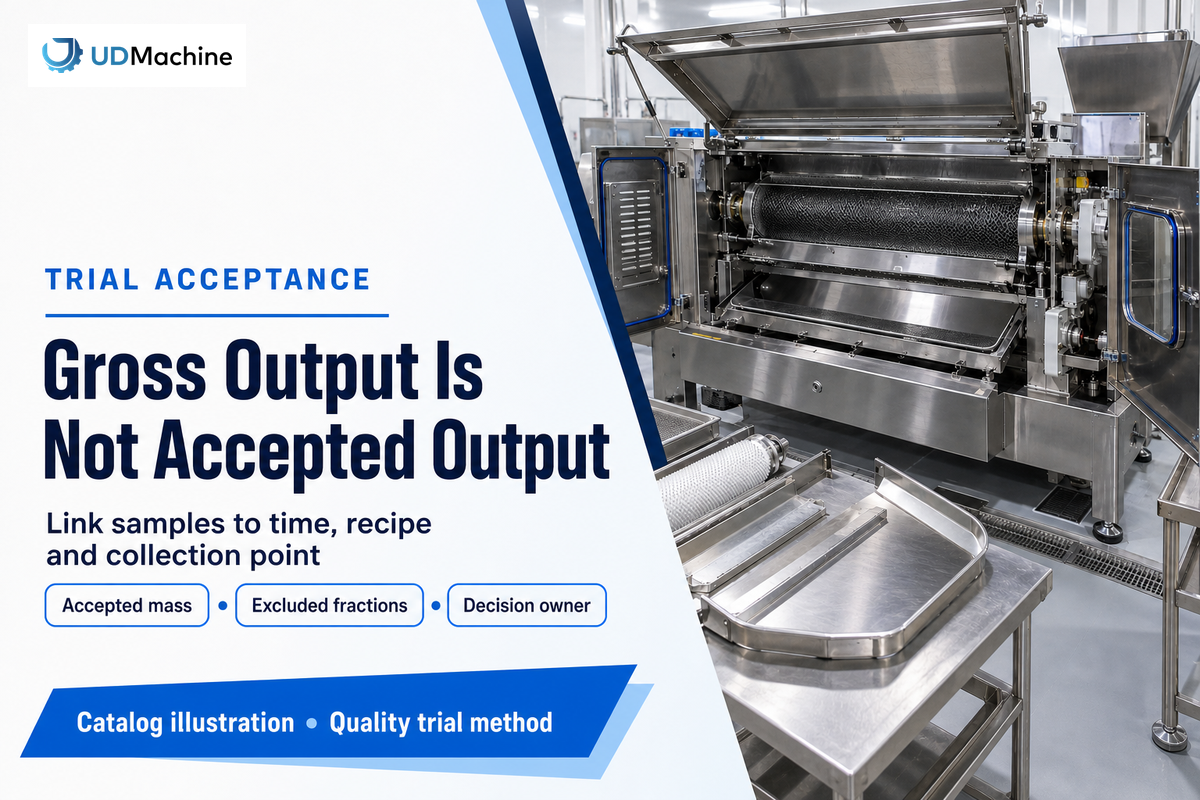
A useful trial connects samples to the recipe, collection point, elapsed time and an acceptance decision. Decide on those record fields before operating the equipment. Two linked samples may help identify damage, but one pair can’t show long term stability or assure that all components are within spec and that the process is in control. Likewise, one pair can’t determine the production line’s guaranteed output.
“the first plant trial may produce unsaleable or unusable product”
Paired Sample Acceptance Record
The Paired Sample Acceptance Record connects a before-and-after sample pair to quality criteria, the time boundary and the person responsible for the decision.
| Record field | What to enter | Decision it supports |
|---|---|---|
| Recipe identity | Revision and ingredient lot references | Whether runs are comparable |
| Sample pair | Named upstream and downstream collection points | Where a change first appears |
| Timing | Start, finish and planned collection times in minutes | Which production period the result represents |
| Size acceptance | Agreed size method, units and accepted fraction | Which flakes count as acceptable |
| Mass balance | Accepted, fines, oversize and other rejected mass in kg | Gross output versus accepted output |
| Texture | Reference sample and agreed sensory comparison | Whether the desired bite is reproduced |
| Water measurements | Moisture content and water activity, each with its method | Whether separate specification limits are met |
| Application retention | Actual filling, package, storage cycle and test dates | Whether texture survives intended use |
| Disposition | Decision owner, accepted lot and rejected-material route | Who authorizes the quality decision |
Worked example, hypothetical: a 90-minute run produces 75 kg after screening. The agreed quality specification accepts 66 kg; 9 kg is excluded. Accepted output is 66 ÷ (90 ÷ 60) = 44 kg/h, while gross screened output is 50 kg/h. These teaching numbers aren’t a UDTECH machine rating. State whether start-up and interruptions are included before comparing another run.
Use the daily output planner with measured inputs. For the wider handoff, you can use the food product scale-up guide to transfer recipes and samples.
Quality acceptance has its own boundary. These records are separate from food safety release. For facilities subject to the applicable U.S. preventive controls, 21 CFR 117.130 (c)(1)(ii) describes the evaluation of environmental pathogens of exposed ready-to-eat foods under certain conditions. The plant must identify its applicable controls for cooling, crushing, and packing.
Make the flakes or buy them?
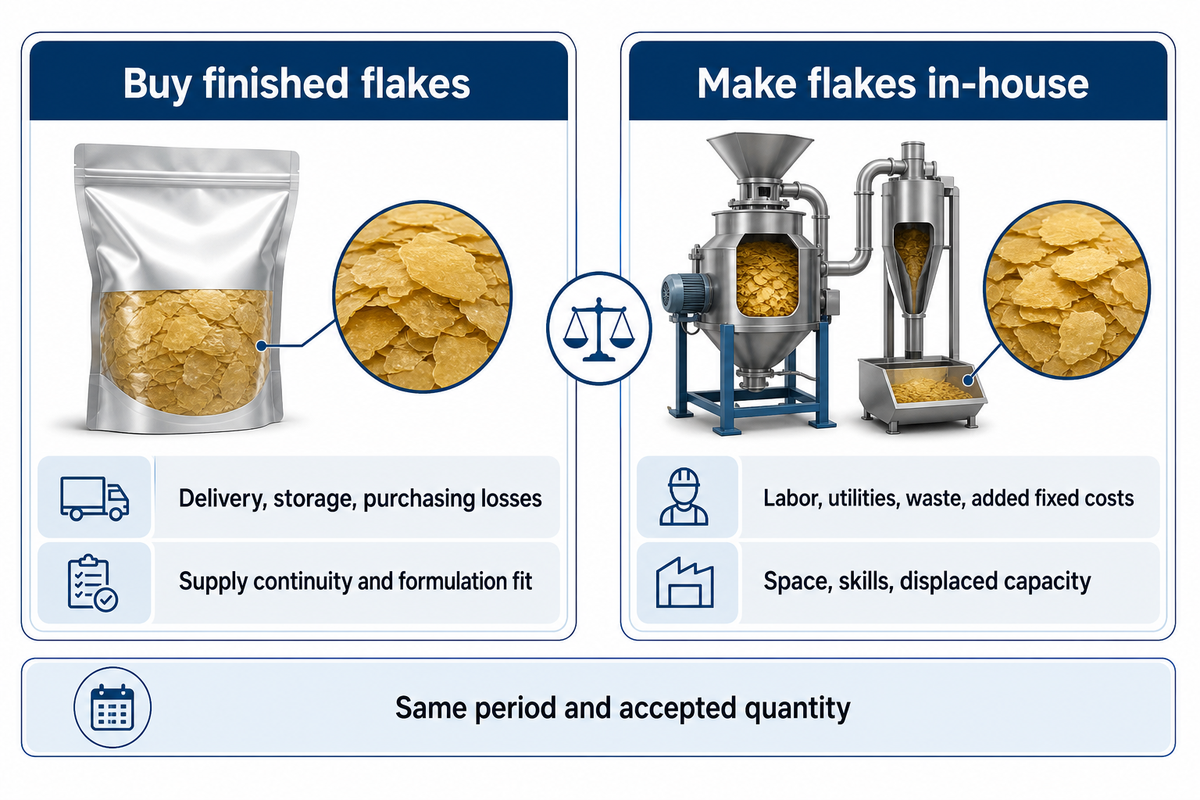
Buy complete flakes when demand or the formulation is still uncertain; look at producing in-house when process control and measured economics warrant the additional process. Compare both options over the same period and accepted quantity. The OpenStax make-or-buy framework separates costs which can vary with the choice from fixed costs that continue the same.
Buy finished flakes
- Test the supplied grade in the final recipe.
- Include delivery, storage and purchasing losses.
- Check supply continuity and formulation fit.
Make flakes in-house
- Validate the recipe and accepted packout.
- Include labor, utilities, waste and added fixed costs.
- Check space, skills and capacity displaced elsewhere.
What situations warrant postponing a line purchase? A new crunchy chocolate product may have only tentative orders, and purchasing ingredient batches may preserve flexibility while the recipe is being tested. Buying batches of ingredients is preferable since we may not be certain of demand. A machine doesn’t resolve uncertainty of how much will sell. It adds work like mixing, handling, packing, and quality work which may be omitted by a baking-unit quote.
For finance, what seems like a cheap gross kilogram can still be an expensive accepted kilogram. In a separate hypothetical comparison, an incremental batch cost of $330 for 66 kg of accepted flakes equals $5.00/kg. A delivered purchase price of $4.80/kg would be lower on those assumptions. Neither of these prices reflects a market quote. Add decision-specific capital and capacity costs before deciding which route is better.
Don’t assume all existing rent as savings from outsourcing if the rent will remain. Also, don’t consider available floor space as “free” if making flakes displaces a more valuable product. Use the make-or-buy comparison tool only after these boundaries are agreed.
Equipment scope and utility requirements
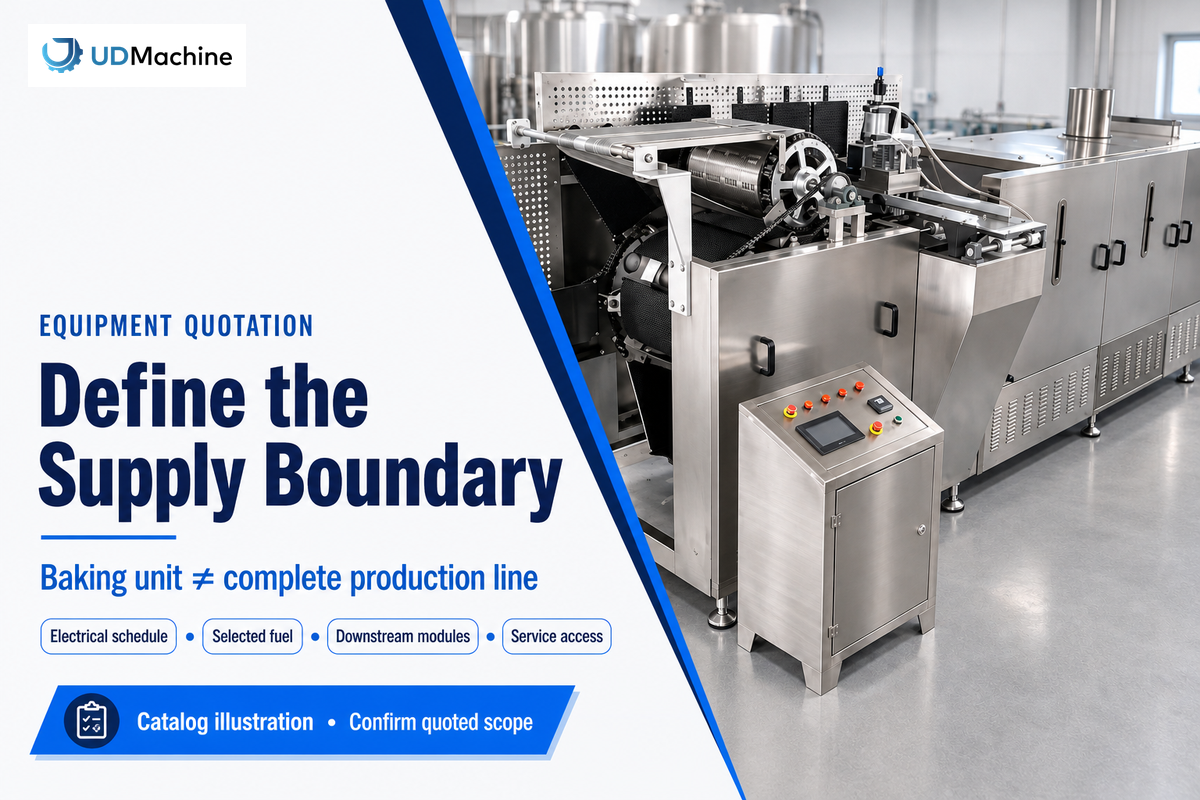
For a feuilletine machine quotation, request separate equipment, electrical and fuel schedules. UDTECH’s public YT-10 page describes a baking unit. Its listed electrical power doesn’t cover all downstream loads and fuel demand isn’t included. Compare the quoted supply boundary before considering price and determine who supplies the cooling, crushing, screening and packing.
Quick specs: published YT-10 baking-unit reference
- UDTECH lists 60 baking molds.
- Published unit dimensions are 9.8 m long, 1.6 m wide and 1.9 m high.
- Listed electrical power is 3 kW for the baking unit.
- Published fuel figures are 14.5 m³/h natural gas or 8 kg/h LPG, as alternative fuel choices.
Source: manufacturer’s product page, checked October 2026. These figures aren’t a turnkey footprint or an accepted kg/h guarantee.
Engineering note: The unit envelope doesn’t cover the entire installation layout. Obtain service clearances and accessways for the proposed arrangement and determine the dimensions of all downstream modules. Use the electricity and fuel estimator with the selected fuel and actual local tariffs; do not add both alternative fuels to one operating case.
Which supplier evidence makes two lines comparable?
Request the same recipe trial and accepted flake definition, collection time and equipment boundary. A video of a lacy sheet leaving an oven doesn’t show what was accepted at packing. Provide your accepted flakes and your application to the supplier and require a trial to answer the same questions.
Industry outlook: texture demand and production trials
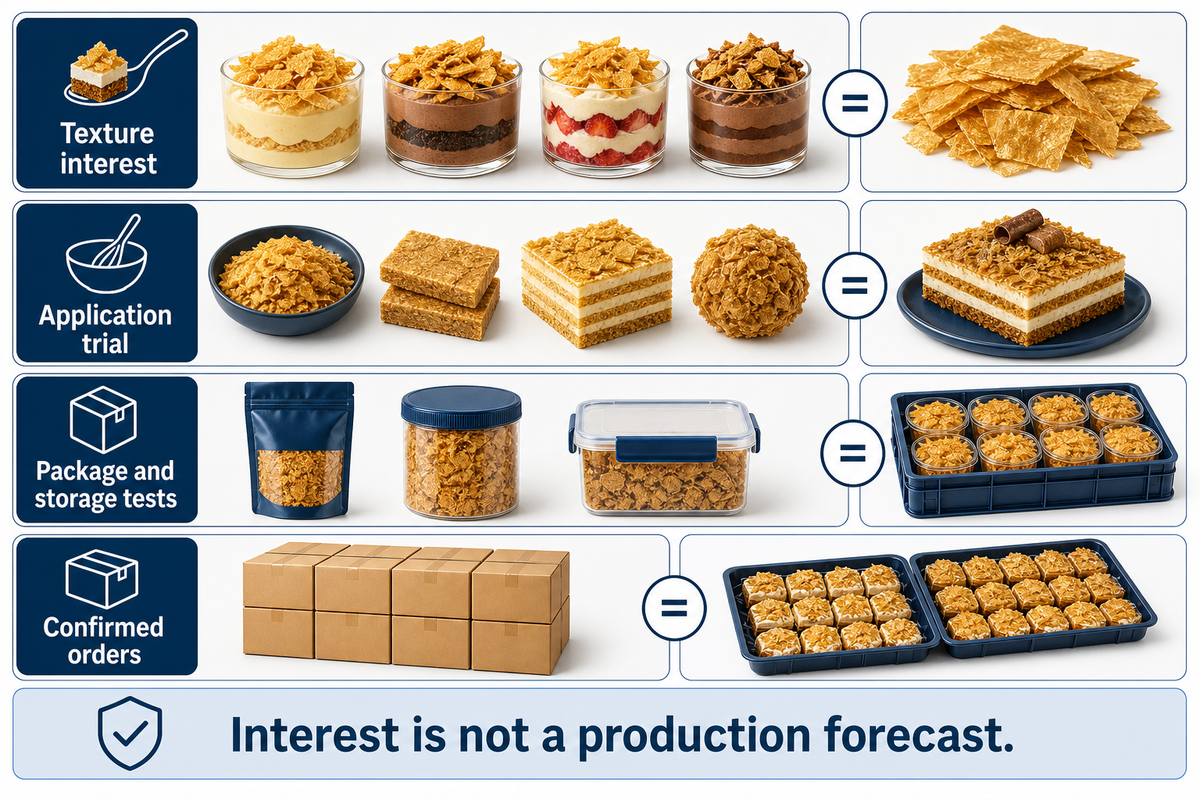
Product developers test new ingredients in response to a shifting consumer preference. However, these trends don’t guarantee a demand for that machine. Puratos’ 2026 outlook describes broad bakery preferences and online conversations. Treat this as an application signal and evaluate the expected orders, product and accepted output prior to making a commitment to that equipment.
In its October 2025 Taste Tomorrow bakery outlook, Puratos describes research involving 23,000 consumers in 56 countries and reports that 71% view texture as central to enjoyment. It predicts a 19% growth in online conversations related to crunchy or crusty textures in 2026. That prediction isn’t a measured increase in sales of feuilletine.
For development teams, the big opportunity is contrast. A chocolate feuilletine base can provide a crisp bite to a softer dessert. A chocolate and feuilletine inclusion added to a filling can act differently from one pressed into a base or added at the time of serving. A perfect layer may not pass the test of stored product for texture; define the required bite and thickness in the product brief.
Process research indicates a different direction. The 2025 baking plate study is focused on how sheet properties respond to plate material and temperature distribution. It isn’t evidence that a new plate material is already standard for this product. Making a recipe work with a new piece of equipment still requires a demonstration.
- For the next product trial, compare a dry ingredient reference with the assembled dessert.
- Before purchase, settle the desired flake fraction and repeat the trial over an agreed production window.
- Before commercial rollout, complete the planned package and application storage tests.
Keep consumer desire and process research separate from the factory order forecast. Prior to scheduling production, verify which applications remain development samples and which have confirmed orders. An exciting textural idea is worthwhile to explore; it isn’t a production forecast on its own.
Frequently asked questions
What is feuilletine in English?
Feuilletine means thin, crisp crêpe-style pastry flakes.
Suppliers may describe them as crispy crêpe flakes made by breaking baked crêpes dentelles. The name identifies an ingredient, not a fixed industrial machine or formula. For a factory purchase, add the intended application, a reference sample and an agreed flake-size method. Those details make a supplied bag easier to compare with the trial output.
What is a good substitute for feuilletine?
Crushed wafers or other crisp inclusions can substitute for crunch, but need application testing.
Their flavour, thickness, breakage and response to moisture can differ from feuilletine flakes. Compare a substitute using the intended inclusion rate and finished recipe, then evaluate the stored product. A replacement that tastes acceptable immediately may change the bite later. Keep the original reference sample until the new ingredient and its production route have been accepted.
Where can I buy feuilletine?
Pastry ingredient suppliers and distributors sell finished feuilletine.
Compare the supplied grade, ingredient declaration, packaging, minimum order and storage instructions before testing it in your own product. Buying ready-made flakes is a separate decision from buying equipment to make feuilletine. For an equipment quotation, prepare a recipe trial and a defined scope so the supplier can address the required finished product and handling stages.
Is feuilletine the same as puff pastry?
Feuilletine and puff pastry use different structures and production methods.
The brittle flakes come from a thin baked crêpe-style sheet. Puff pastry has layers formed through dough-and-fat lamination. A flaky appearance does not make their recipes or machines interchangeable. Confirm the actual product sample before choosing forming and baking equipment.
What is feuilletine made of?
Feuilletine formulations vary; flour, sugar and fat are common starting ingredients.
Liquids and other ingredients depend on the approved recipe. Read the supplied product’s ingredient and allergen declaration instead of assigning a single formula to every brand. For an industrial trial, identify the recipe revision and ingredient lots, then retain the finished reference sample. Substitutions can change depositing, release, color and the way the sheet breaks. A change made to improve taste may therefore require another process trial before the factory can accept the new recipe for routine production.
Is feuilletine gluten-free?
Feuilletine should not be assumed gluten-free.
Check the exact product’s ingredient and allergen declaration; many versions use wheat. Replacing wheat with another flour also changes the recipe. Validate the resulting batter and baked sheet rather than treating an ingredient substitution as an unchanged manufacturing process.
Does feuilletine get soggy in ganache?
Feuilletine can soften in a wet ganache as moisture moves into the flakes.
A coating may slow that change, but it does not establish the shelf life of every filling. Test the actual chocolate ganache formulation, inclusion amount, assembly order and intended storage period. Keep unused flakes as a comparison sample so the team can separate application-related softening from a texture problem already present in the ingredient. A croustillant base and a topping added just before serving face different exposure conditions; judge each in the finished food rather than assuming the same dry-flake test answers both questions.
Key takeaway
Approve the sheet, the accepted flake fraction and the finished application separately. Measure output at the agreed packing boundary before using it to compare production costs.
Prepare a feuilletine equipment enquiry
Send UDTECH your recipe, reference flakes, required accepted quantity and factory layout. Include the intended filling or dry application, available utilities and which downstream stages you need quoted. Use the trial record above to make the proposal comparable.
Related articles
- Food product scale-up: from sample to factory trial
- Egg roll and wafer roll process stages
- Checks for choosing a food machinery manufacturer
- Cleaning and maintenance questions for wafer equipment
References & Sources
- 2025 study of wafer baking-plate materials and sheet properties Köklü and colleagues, Applied Sciences.
- Water Activity (aw) in Foods U.S. Food and Drug Administration, 1984 technical guide; used for the measurement definition.
- Choosing and Using a Copacker North Carolina State University Extension, John Rushing, 2022.
- Water content or water activity: what rules crispy behavior in bread crust? Van Nieuwenhuijzen and colleagues, 2008; original study abstract.
- Moisture migration through chocolate-flavored confectionery coatings Ghosh, Ziegler and Anantheswaran, 2005; Penn State research record.
- 21 CFR 117.130: Hazard analysis Electronic Code of Federal Regulations.
- Evaluate and Determine Whether to Make or Buy a Component OpenStax, Rice University.