Get in touch with UDTECH Company


UD Machine Solution Technology Co., Ltd. | Buyer Guide | Technical team review
In this buyer’s guide, we present recommendations from UD Machine Solution Technology Co., Ltd. The team members have years of experience in technology services, operations, and quality assurance.
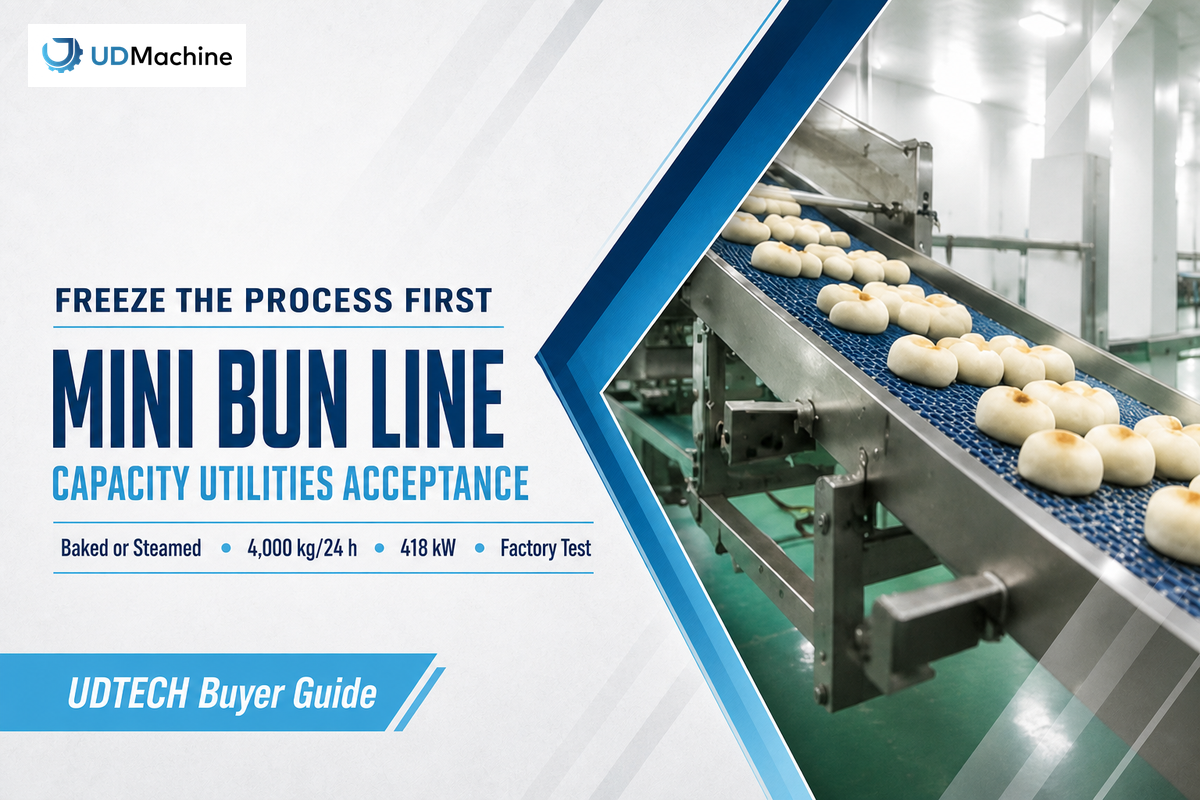
A Mini Steamed Bun Production Line is a linked dough-forming and thermal-processing system whose required modules depend on the finished product and cooking method. The YT-XMT800 described on UDTECH’s product page is an electrically heated tunnel-oven line for unfilled mini buns, not a typical proof-and-steam bao line.
The decision in one minute
Consider the YT-XMT800 only if you expect your final product to share the same dough-forming and electric-baking process. Need proofing? Need steam cooking? Need filling? Need encrusting? Specify a different machine family in the request for quotation. Every capacity claim should be treated as a witnessed acceptance test with an agreed mass point, runtime, reject rule, and cooling endpoint.
What Does “Mini Steamed Bun Production Line” Mean?
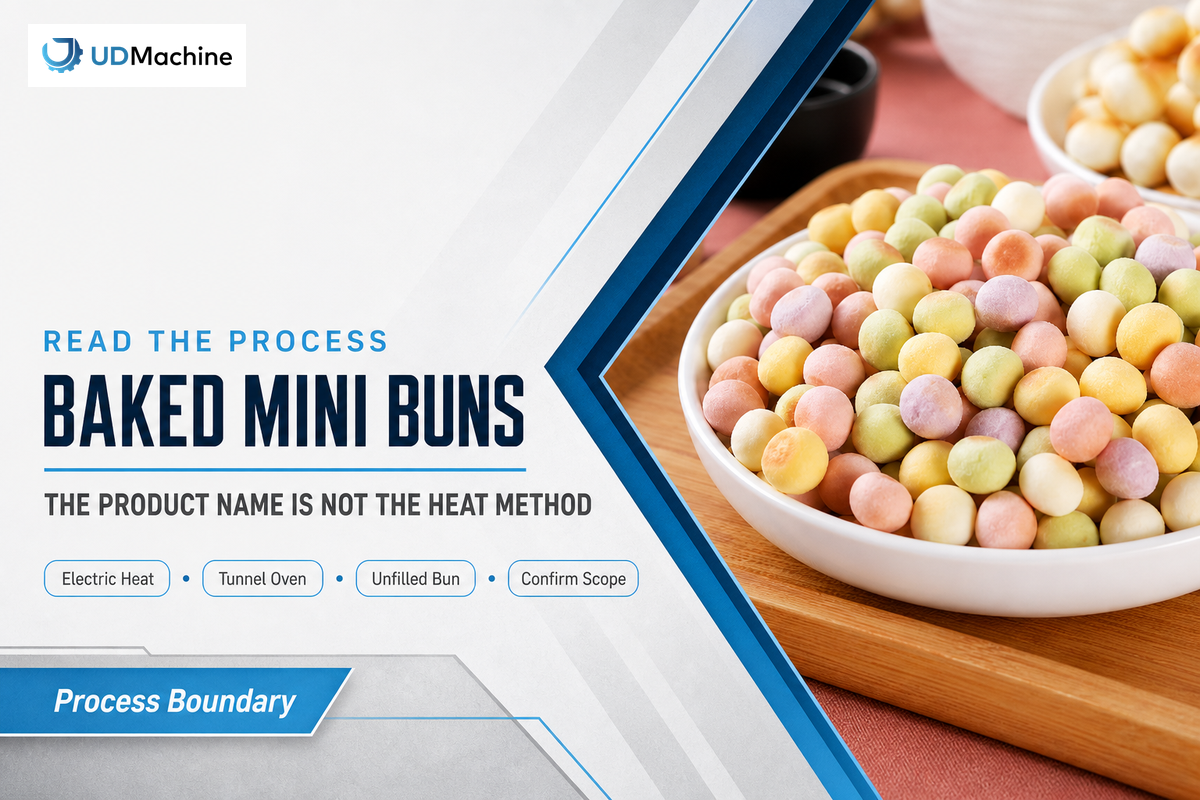
“Mini Steamed Bun Production Line” refers here to a category for mini-bun products, not a line that cooks with steam. For the YT-XMT800 listing we captured, the configuration shown uses electric heating and a tunnel oven with a steel belt. The published module list doesn’t include a steamer, proofer, filling unit, encrusting unit, or packaging machine. Confirm that the quotation specifies the scope.
That distinction is more than terminology. Baking generates crust formation and moisture loss and results in different coloring and cooling behavior than steaming. For example, a 2026 peer-reviewed study on stuffed buns treats steaming time and internal temperature as important process parameters. The results of that study don’t apply to the baked line throughput because of differences in formulation, size, filling, and heating method.
| Question | YT-XMT800 public description | Conventional steamed or filled-bun route |
|---|---|---|
| Final heat process | Electric tunnel baking | Steam cooking |
| Product structure | Unfilled, formed mini bun | May be unfilled mantou or filled bao/baozi |
| Modules to verify | Mixing, sheeting, cutting, rounding, arranging, baking, screening, cooling | Dough dividing or sheeting, filling/encrusting if needed, forming, proofing, steaming, cooling |
Send the supplier your product photo, ingredient formula, target piece weight, dimensions, internal texture, surface color, and final cooking method. This is the fastest way to see whether both parties are using the same product name for different foods.
Baked or Steamed? Freeze the Process Boundary First
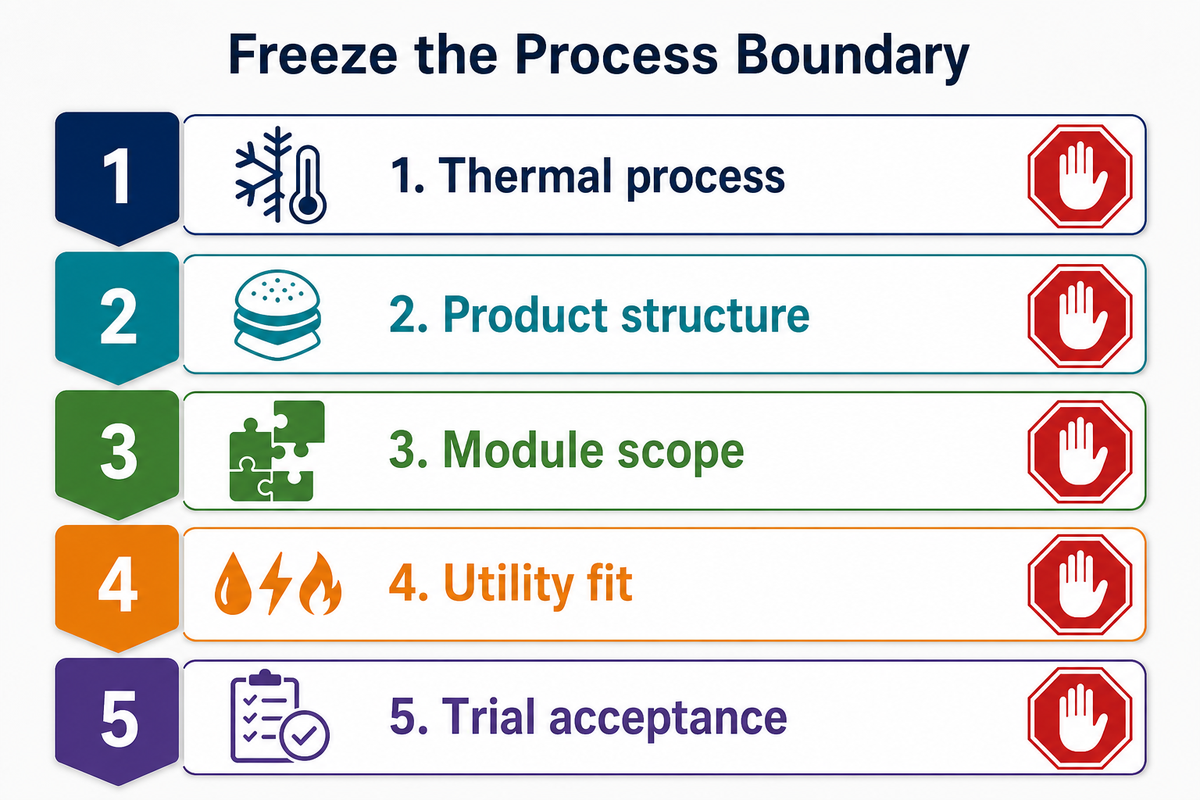
Is a mini steamed bun line steamed or baked?
A mini steamed bun line can be steamed or baked; the process modules decide, not the label. This YT-XMT800 listing describes a baked route. Your request for quotation should hold the thermal process, product structure, modules, utility limits, and trial conditions constant before any models or prices are compared.
5-Gate Mini-Bun Line Selector
| Gate | Decision to freeze | Stop condition |
|---|---|---|
| 1. Thermal process | Bake, steam, fry, or combination | Do not quote a tunnel oven for a steam-cooked target |
| 2. Product structure | Unfilled or filled; piece weight and shape | Filling requires a confirmed depositor or encruster |
| 3. Module scope | From ingredient feeding to packaging handoff | List every excluded upstream and downstream machine |
| 4. Utility fit | Voltage, frequency, installed load, air, water, extraction | No purchase before a site engineer approves the load schedule |
| 5. Trial acceptance | Recipe, runtime, mass point, quality limits, rejects | A brochure rating without a test method is not an acceptance criterion |
Buyer action: Clear all five gates before comparing total project prices. This selector combines the current product scope with the process variables described in the stuffed-bun research; it is a procurement method, not a manufacturer performance claim.
The YT-XMT800 Line at a Glance
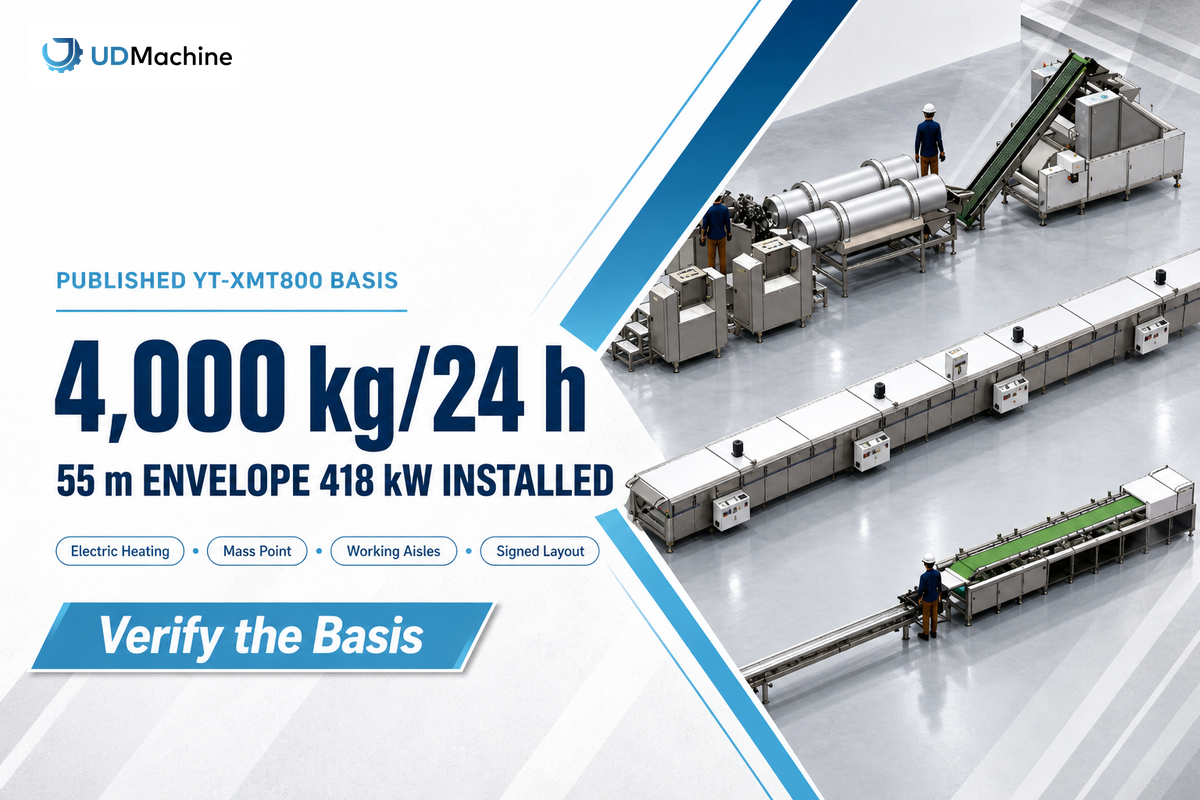
The first-party commercial specifications are shown below. With the thermal process fixed, these figures can support an initial screening. However, partially complete performance or energy-use specifications don’t ensure regulatory compliance. Confirm the final configuration in the signed technical agreement and final layout.
| Published item | YT-XMT800 value | How a buyer should read it |
|---|---|---|
| Capacity | 4,000 kg/24 h | A supplier rating; mass point, runtime, recipe, rejects, and acceptable product must be defined |
| Overall dimensions | 55,000 × 1,900 × 3,000 mm | Equipment envelope only; it excludes working aisles, panels, maintenance pull space, and packaging |
| Installed power | 418 kW | Connected/installed load, not a statement of actual kilowatt-hours consumed |
| Heating | Electric | Requires destination voltage, frequency, distribution, protection, and demand review |
The dimensions in the list result in a 104.5 m² nominal equipment rectangle (55 m × 1.9 m). This is a preliminary calculation for layout screening. It shouldn’t be treated as a suggested room area. The working area will increase after the addition of operator access, electrical cabinets, ingredient staging, sanitation, fire and egress clearances, cooling discharge, inspection, and packaging.
For broader context, compare the biscuit and mini bun line family with the dough-route to accepted-output guide. The final choice still needs to reflect your sample and plant data.
How the Dough-to-Cooling Route Works
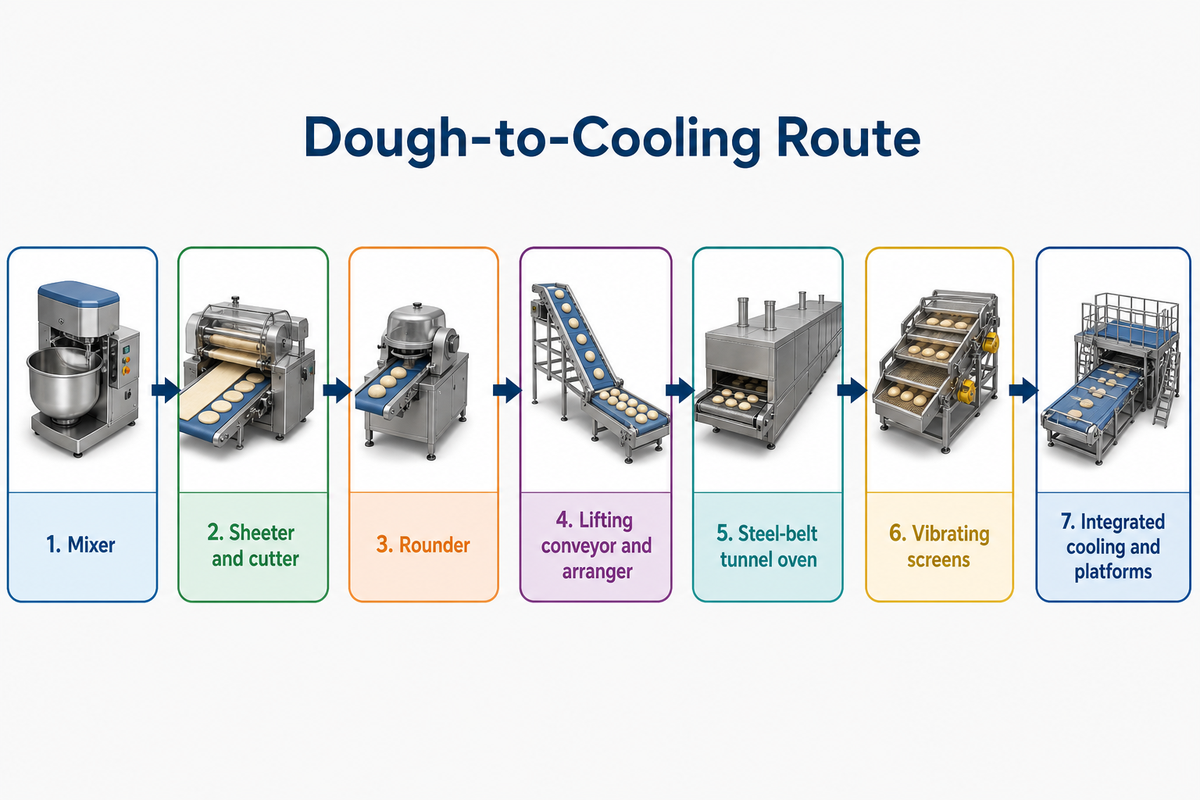
The public configuration describes continuous dough mixing, sheeting, cutting and rolling, rounding, lifting, and arranging before tunnel baking, screening, and cooling. Read alongside the earlier equipment envelope, product fit, sample, and plant data, these forming steps can change piece shape, surface condition, and breakage risk, so test the line as one system rather than as separate machines.
- Mixer: creates a dough condition suitable for sheeting.
- Sheeter and cutter: establish the portion geometry before rounding.
- Rounder: turns cut dough into the target mini-bun form.
- Lifting conveyor and arranger: transfers and spaces pieces for the oven.
- Steel-belt tunnel oven: applies the electric-baking step.
- Vibrating screens: can separate and convey baked products as needed.
- Integrated cooling and platforms: move products toward inspection or the buyer’s downstream equipment.
The words “production line” shouldn’t be interpreted to mean that every transfer is automatic. A 2021 Chinese patent publication for a YT-XMT800-named system describes a baked-product line using a tunnel furnace, a 402 kW furnace, manual dough transfer, operator actions, and a 10 m cooling conveyor running at 7 m/min. It was filed by Guangzhou Yitong Food Machinery Equipment Co., Ltd., rather than the brand identity shown on the current UDTECH site. Use the historical disclosure for context only; it does not substantiate the present supplier, ownership, 418 kW configuration, automation boundary, or 4,000 kg/24 h rating. Ask the supplier to clarify these points when requesting a new quotation.
Send these trial inputs:
- ingredient formula, flour specification, hydration, dough temperature, and processing aids allowed;
- target weight and dimensions, finished and raw; moisture content, color, internal texture, and overall condition of the piece;
- the defects that are acceptable and how those defects will be counted or weighted;
- required cooling-exit product temperature or packaging condition;
- allergen profile and the intended product-change sequence.
These inputs help the supplier determine the recipe on the machine instead of using a generic dough. They also help define the automation boundary in the quotation: where people load, inspect, clear jams, clean, remove waste, restart, and hand the finished product to the packer.
Capacity: Read 4,000 kg/24 h Without Overpromising
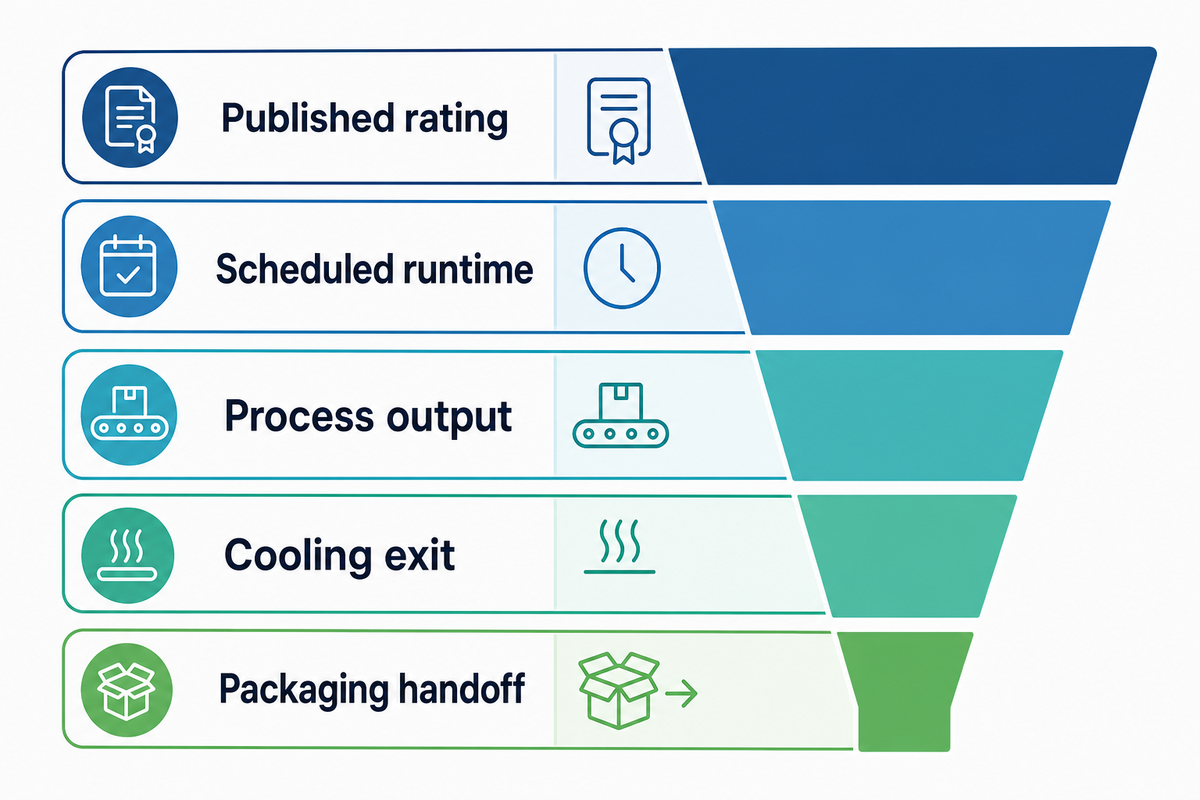
4,000 kg/24 h is a current supplier rating, NOT a public guarantee of packaged saleable output. The product mass measurement point must be stated before comparing it with another line. We need to know whether the mass is measured as dough, oven infeed, hot oven discharge, cooled product, accepted product, or packed product. Moisture loss can cause the same physical throughput to have different measured mass at different points.
A precise contract definition can be: accepted output = gross product measured at the agreed mass point – rejected product measured at the same boundary. The test sheet should capture the scheduled time, warm-up time, planned stops, unplanned stops, cleaning time, recipe used, measurement tolerance, and quality limit.
Rated-to-Saleable Output Hidden Bottleneck Map
| Boundary | Hidden loss or ambiguity | Evidence to record |
|---|---|---|
| Published rating | No public recipe, mass point, or quality definition | Signed test recipe and measurement location |
| Scheduled runtime | Warm-up, sanitation, changeover, and breaks | Timestamped run log by stop reason |
| Process output | Weight variation, breakage, color or texture defects | Gross mass, reject mass, defect counts, samples |
| Cooling exit | Product may reach the end but remain unfit to pack | Agreed exit temperature/condition and dwell record |
| Packaging handoff | Packer speed, accumulation, inspection, and rework | Accepted mass delivered continuously to interface |
Why this matters: the slowest accepted-output boundary, not the fastest individual machine, sets commercially useful capacity.
The piece weight also affects capacity. A kilogram-per-day figure can’t be converted to pieces per hour until the finished piece-weight range and measurement point are agreed. It’s NOT appropriate to guess yield and state a figure. A trial should be conducted to measure gross and rejected product and to keep a defect record.
When a Steamed or Filled-Bun Line Is the Better Choice
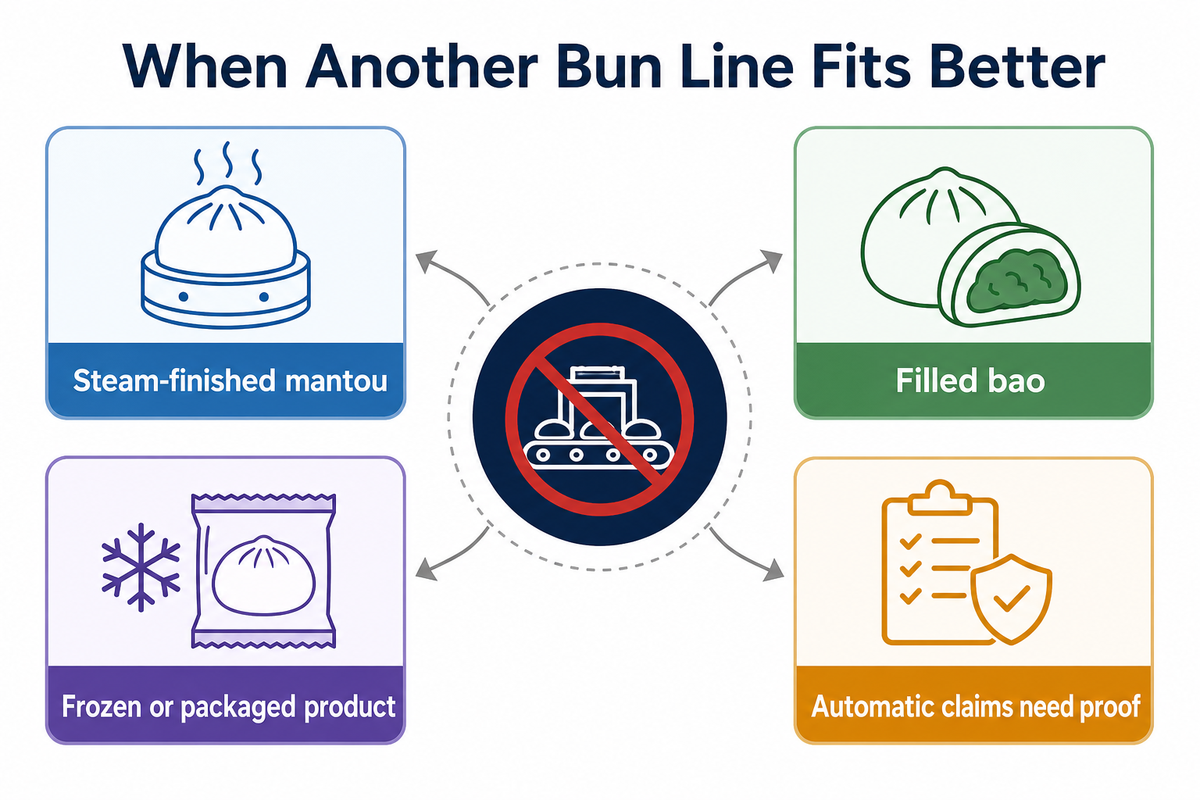
Move to a different machine family if the product specification calls for steam cooking, controlled proofing, or a deposited/encrusted filling. These functions affect food safety, dough behavior, seal quality, line balance, and allergen control. They’re NOT minor accessories to a baked, unfilled product line.
Catalogs may label an alternative a bun machine, steamed bun machine, automatic steamed bun making machine, fully automatic steamed bun line, baozi machine, bread production line, or automated steamed bun production line, but none of those tags defines the real scope. Ask the production line manufacturer to map every food-production or pastry-production module and manual handoff, then turn claims about high-quality materials, Internet of Things controls, dough elasticity, reduced manual work, or process efficiency and automation into testable specifications.
| Target product | Likely process route | What must be in scope |
|---|---|---|
| Baked, unfilled mini bun matching the trial sample | Form, arrange, electric bake, cool | Confirm current YT-XMT800 configuration and acceptance test |
| Plain mantou or steam-finished bun | Divide/form, proof if recipe requires, steam, cool | Proofer and steamer sized to forming output |
| Meat, vegetable, bean-paste, or other filled bao | Dose/encrust, seal/form, proof as required, steam, cool | Filling handling, weight control, seal integrity, food-safety and allergen plan |
| Frozen or packaged product | Core route plus controlled cooling/freezing and packaging | Exit condition, accumulation, inspection, freezing and packer interface |
| Chinese steamed bun, steamed bread, or flower rolls | Knead, make a dough sheet, portion, and use a steamed bun forming or bun forming machine | Kneading machine, forming machine, proofer, and steamer; verify size and shape |
| Bean paste bun, red bean paste bun, or custard baozi | Prepare the wrapper and bun filling, then use a filling and forming machine | Filling machine or encrusting machine, pleat control, seal integrity, and product quality |
| Meat bun or stuffing bun | Dose meat stuffing with a stuffing machine or multi-head stuffing unit, then encrust and close | Hopper temperature, food safety standards, quality control, and cleaning validation |
| Frozen food for central kitchens | Complete production through cooking, controlled cooling or freezing, and packing | Food processing hygiene, production capacity, and packaging interface |
| Automatic bun or automated pastry claims | Compare automatic production, automated production, and manual operations at each transfer | Quantify production efficiency, labor costs, and whether the food machine is easy to operate |
Can a baked mini-bun line make filled bao or meat buns?
No, not based on the public YT-XMT800 module list. This list doesn’t include filling/encrusting, proofing, or steaming equipment. Treat any supplier-built alternative as a new line design, not an add-on, and agree on trials, sanitation, thermal-process validation, and commercial terms.
Factory Fit: Utilities, Floor Space, and Packaging Handoff
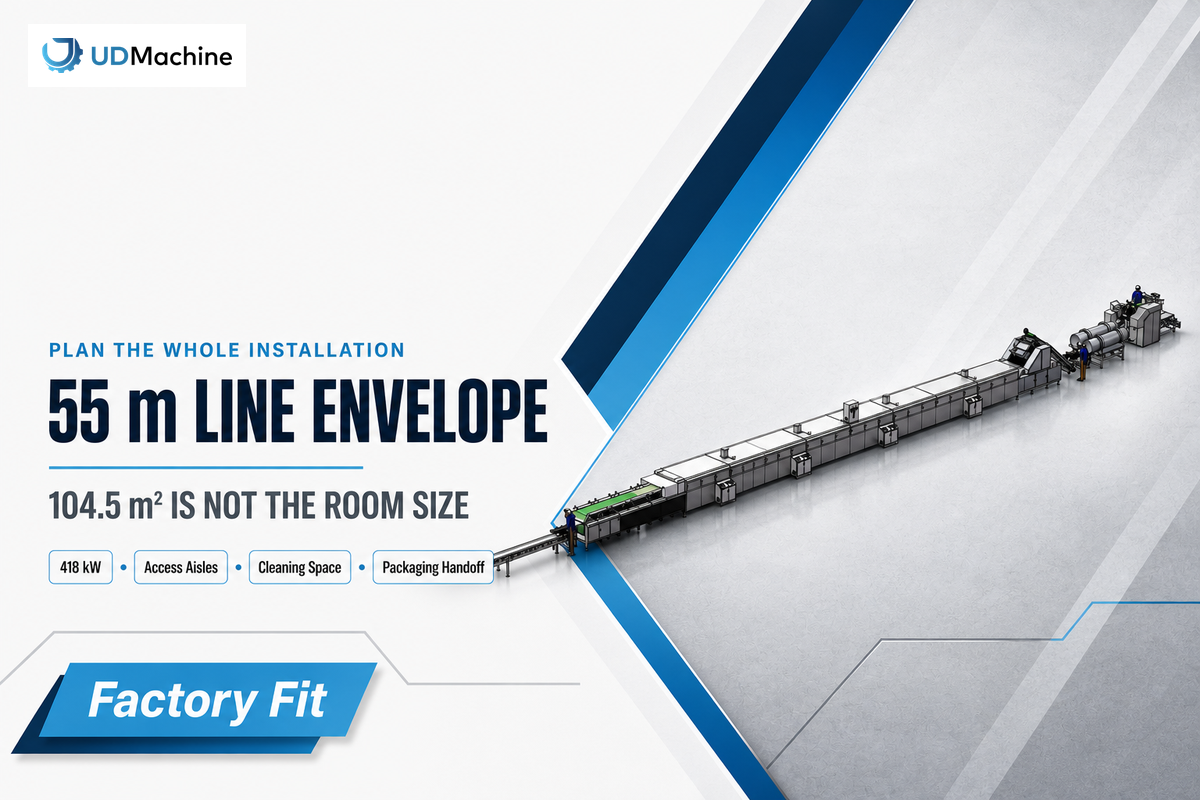
Begin the layout with the 55,000 × 1,900 × 3,000 mm equipment envelope and the 418 kW installed load. Add all other interface components the product page doesn’t define. An electrical engineer should evaluate supply voltage and frequency, power distribution, protective devices, cable routing, local demand limits, and a realistic load schedule. Installed power isn’t a surrogate for energy consumption.
Equipment rectangle
104.5 m² nominal only; derived from 55 m × 1.9 m.
Electrical basis
418 kW installed load; confirm destination power design and operating profile.
Packaging handoff
Define temperature, orientation, spacing, accumulation, and accepted flow at the interface.
Ensure adequate clearance for cleaning and inspection, belt and bearing servicing, overhead maintenance, safe egress, and waste removal. Confirm whether the 3,000 mm height includes the required access space and whether overhead extraction and cable trays require more clearance.
Flour handling also warrants its own analysis. Map bag opening, dust capture, grounding and bonding, dust-accumulation controls, the local combustible-dust assessment, and any dust-control systems included in the design. Don’t assume that the main specifications of the design describe a dust-control system.
Cooling is complete when the product has reached the agreed packaging condition. The phrase “cooling conveyor included” says little about the cooling-system design. It sets no exit temperature, design condition, residence time, or packer-readiness criterion for condensation, deformation, or accumulation. These should be documented in the interface control document and verified in a witnessed run.
Acceptance, Hygiene, and Safety Evidence to Put in Writing
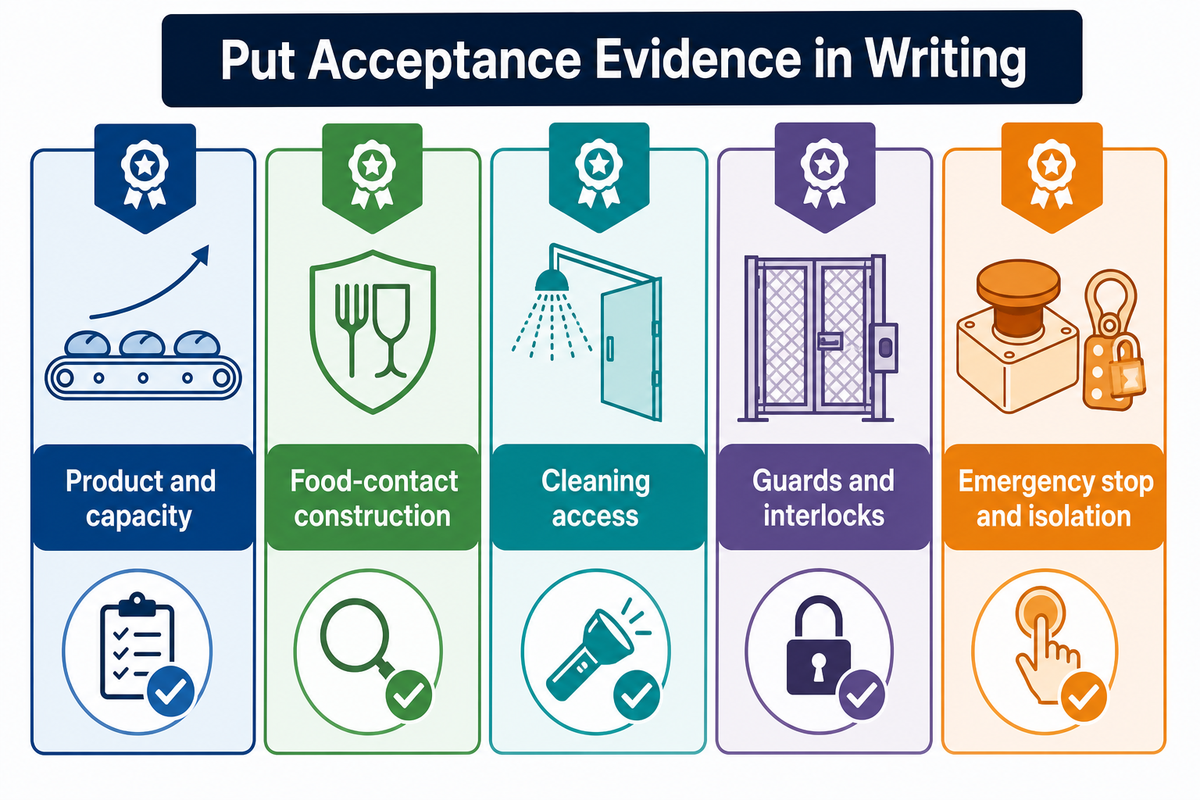
A useful purchase specification separates supplier statements from buyer acceptance evidence. ISO 14159:2002 provides hygienic-design principles for machinery and is still marked current on the ISO record after its 2018 confirmation. A replacement Draft International Standard is under development, but it is not yet the published replacement. Neither record proves that a particular YT-XMT800 conforms or settles destination-specific certification obligations.
For a U.S. installation, 21 CFR 117.40 addresses adequately cleanable equipment, suitable food-contact materials, cleanable seams, contamination prevention, and the accuracy and maintenance of instruments used to control or prevent undesirable microorganism growth. OSHA 1910.263 is applicable to general guarding, individual mixer controls and safety devices, safety controls and interlocks for certain bakery equipment categories, emergency stop, and conveyors. For design reviews, use the applicable clauses. Contact local advisors for requirements that are specific to the destination.
“must be so designed and of such material and workmanship as to be adequately cleanable”
Mini-Bun Line RFQ and Acceptance Matrix
| Evidence type | Evidence requested | Acceptance method | Owner |
|---|---|---|---|
| Product and capacity | Approved sample, recipe, mass point, runtime, tolerances | Witnessed continuous run; gross and rejected mass recorded | Operations + quality |
| Automation boundary | Process diagram naming manual actions and recovery tasks | Observe normal run, stop, restart, and changeover | Engineering |
| Food-contact construction | Material declarations, surface/seam details, lubricant list | Document review and physical inspection | Quality |
| Cleaning access | Cleaning procedure, access/removal map, tools and time | Witness complete clean, inspection, and restart | Sanitation + operations |
| Allergen cross-contact | Changeover sequence and validation plan | Buyer-defined visual/analytical verification | Food safety |
| Flour dust | Dust-source inventory, extraction/housekeeping interfaces | Site risk review under local requirements | Safety + facilities |
| Guards and interlocks | Guarding drawing, safety-device list, circuit information | Functional test of access points and safe restart | Safety + engineering |
| Emergency stop and isolation | Stop locations, energy-source list, isolation procedure | Functional stop and verified isolation demonstration | Safety + maintenance |
| Cooling and packaging | Exit condition, line speed, orientation, accumulation logic | Measure accepted flow at the agreed interface | Packaging + quality |
| Destination documents | Manuals, drawings, declarations, training and spare-parts list | Document register closed before shipment | Procurement + engineering |
Specify pass criteria for each row. Statements such as “food grade,” “easy to clean,” or “safe design” aren’t accepted as test methods. The same applies to allergen changeovers. Name the soils and allergens, define the cleaning sequence and sampling sites, set sampling and analysis criteria, and state the approving authority rather than assuming the equipment is clean based on visual assessment.
Evidence Is Moving Toward Measurable Acceptance
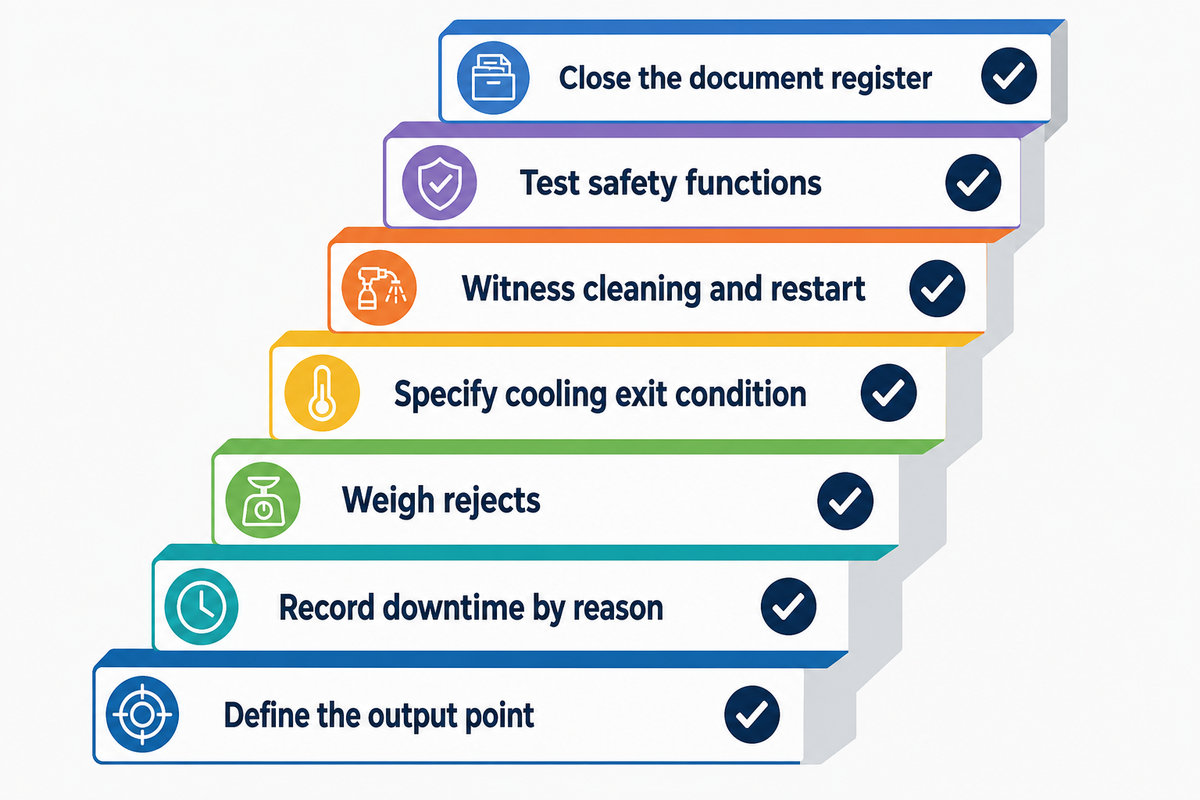
Stronger documentation on hygienic design and measurable factory acceptance in 2026 is more verifiable than a claimed universal market-growth percentage. Bake-off challenges in trade reporting show inconsistent hygienic design across bakeries, and ISO is extending its machinery hygiene standard. These sources show active industry discussion, not settled criteria or universal adoption.
For a buyer, the response is simple: replace adjectives with records. Define output at a measurement point. Record downtime by reason. Weigh rejects. Specify the cooling-exit condition. Witness cleaning and restart. Test guards, interlocks, emergency stops, and isolation. Close the document register before shipment.
This evidence also supports fair comparisons among suppliers. Two quotations that contain the same nominal kg/day may have different boundaries of modules, operator work, cleaning time, or packing restrictions. After installation, a lower machine price could signal a higher project price if these restrictions are later discovered.
Request a sample-based YT-XMT800 review
Send a product photo, formula, target weight and dimensions, required thermal treatment, hourly or shift demand, utility and room drawings, and packaging-interface requirements. UDTECH can then confirm whether this mini-bun baking route fits or redirect the project for a quotation.
Frequently Asked Questions
Is YT-XMT800 a steaming line or a baking line?
The current UDTECH product page describes YT-XMT800 as an electrically heated line with a steel-belt tunnel oven. It doesn’t list a steamer. Treat “mini steamed bun” as the product-category name used on this page, then confirm the target sample and cooking method in the quotation. Require the supplier to name that method in writing.
What output basis does 4,000 kg/24 h use?
The public page states the rating but doesn’t define the recipe, operating-time basis, mass measurement point, reject treatment, or saleable yield. Put those definitions into a witnessed test protocol. Measure gross and rejected product at the same agreed boundary. Also state whether the rating covers warm-up, cleaning, changeover, and planned maintenance time.
How much floor space and electrical capacity should be reserved?
The published equipment envelope is 55,000 × 1,900 × 3,000 mm, and installed power is 418 kW. The 104.5 m² rectangle is only an early equipment-area calculation, not a room-size recommendation. Add operator and sanitation aisles, panels, door swings, service pull space, extraction, ingredient staging, waste routes, cooling discharge, inspection, accumulation, and packaging. Then have qualified local engineers approve the final layout, egress, electrical distribution, protective devices, and expected load profile for the destination site.
Can buyers send raw materials or product samples for a factory trial?
Yes. UDTECH’s current commercial information says the buyer supplies trial materials. Confirm quantities, customs or shipping constraints, storage conditions, trial protocol, sample disposition, and who approves the finished sample before dispatching ingredients.
What information is needed for a layout and quotation?
Provide product and formula data, target piece weight and output, final heat process, destination power supply, room drawing, upstream feeding scope, cooling and packaging interfaces, food-safety requirements, test conditions, and destination documentation needs.
What are the production lead time and minimum order?
Current first-party commercial terms state one line as the minimum order and an estimated 120-day lead time after deposit and layout approval. The stated payment basis is 30% deposit and 70% before shipment, with EXW, FOB, or CIF terms available. Treat all terms as quotation-dependent and confirm them in the contract.
About UD Company
The company states that UD Company was established in 2003 and invested approximately 200 million RMB in the High-tech Development Zone of Xinyu City, Jiangxi Province. Its approximately 130-acre operation includes two automated food-production bases. These operational statements are provided for background and haven’t been independently verified.
Next step: review the YT-XMT800 product page, then contact UDTECH with your sample, utilities, and room drawing. Public specifications are subject to the final signed quotation and acceptance protocol.
References and Sources
- ISO 14159:2002, Safety of machinery, hygiene requirements for machinery design (current published edition record)
- ISO/DIS 14159 (work in progress; not treated as a current requirement)
- OSHA 1910.263, Bakery equipment
- 21 CFR 117.40, Equipment and utensils
- Foods (2026), stuffed-bun steaming study (process context only; not used for line throughput)
- Baking Business (2026), hygienic equipment design gaps (trade context)
- CN113598206A, 2021 YT-XMT800-named public technical disclosure (historical context only; applicant and figures differ from the current commercial page)
Editorial review: UD Machine Solution Technology Co., Ltd. technical team. This guide supports equipment screening and doesn’t replace a signed technical agreement, witnessed factory acceptance test, or destination-specific engineering and legal review.
![Egg Roll Machine Energy Consumption [Calculation Guide]](https://udmachine.com/wp-content/uploads/2026/09/electric-egg-roll-machine-guide-featured-768x512.png)
![Egg Roll Machine Energy Consumption [Calculation Guide]](https://udmachine.com/wp-content/uploads/2026/09/electric-egg-roll-machine-guide-featured-150x150.png)