Get in touch with UDTECH Company

Industrial Soft Waffle Machine
Industrial Waffle Machine for Soft-Waffle Production
UD supplies an industrial waffle machine range for soft-waffle production, beginning with an 8-mold rotary machine rated at 1,100 pieces/h and extending to 32-, 60- and 80-mold continuous lines. This is production equipment for a bakery or food factory that can provide three-phase power, compressed air, suitable floor space and, for the continuous lines, a confirmed fuel supply.
- We answer machine enquiries within 24 hours on business days
- 30–90-day build windows by project scope
- Factory batter trial before shipment
- Installation, commissioning and operator training available
If that starting capacity is already beyond your demand, use the fit criteria below before requesting a line quotation. Provide target product, unit weight, capacity, operating hours, and space constraints including any recipe requirements and site services available to your process. We use these factors as your inputs for selecting your layout; don’t simply look at a mold count and consider this to be the solution.
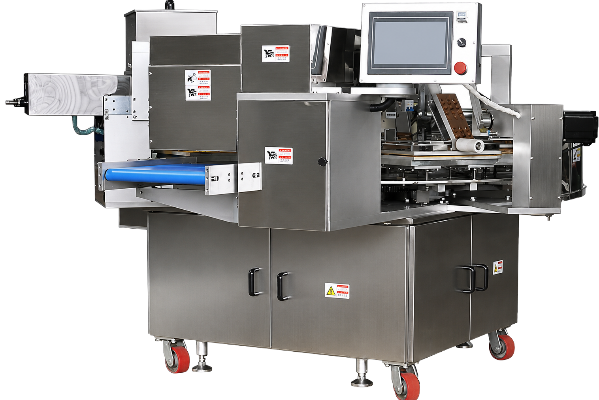
8-mold rotary machine
1,100 pieces/h · 17.5 kW
three-phase 380 V
8-mold machine envelope
2,100 × 2,300 × 1,400 mm
1,000 kg net
8-mold compressed air
0.2 m³/min
at >0.6 MPa
32-mold continuous line
About 1,800 kg/24 h
6.0 × 1.6 × 1.9 m
60-mold continuous line
About 3,500 kg/24 h
9.8 × 1.6 × 1.9 m
80-mold continuous line
About 5,000 kg/24 h
12.0 × 1.6 × 1.9 m
Industrial Waffle Machine Configurations for Rotary and Continuous Production
Search labels such as waffle iron, Belgian waffle maker, bubble waffle maker, double waffle, single Belgian and single waffle describe countertop appliance layouts, not the industrial models in this range. A hotel or dessert counter serving ice cream may require much less output. This page covers an industrial waffle production line built to manufacture soft waffles; the quotation must define oven and conveyor scope along with the components responsible for the accepted product.
Industrial customers may land on countertop listings when they search for a commercial waffle machine, industrial waffle machine for sale, large commercial waffle maker or small industrial waffle machine. Unlike a countertop listing, this page keeps each industrial output unit intact rather than comparing plate design or unit count as appliance listings do. The categories are not substitutes for each other, and a larger nameplate does not necessarily mean a better line.
[ SYSTEM CONFIGURATIONS ]
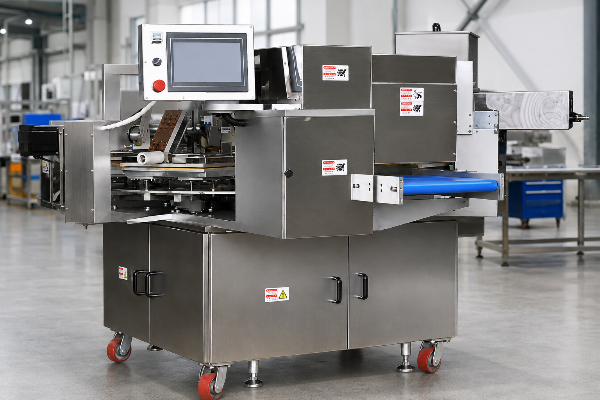
8-Mold Rotary Soft-Waffle Machine
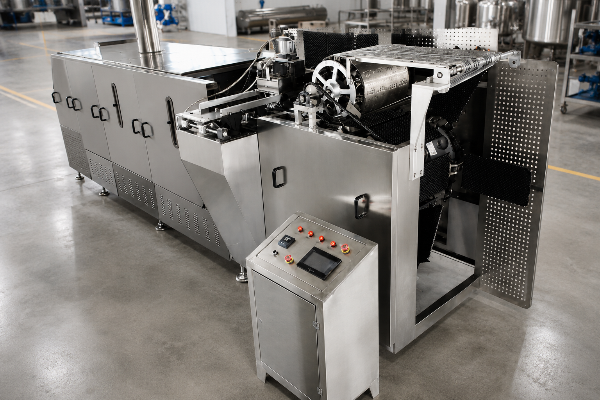
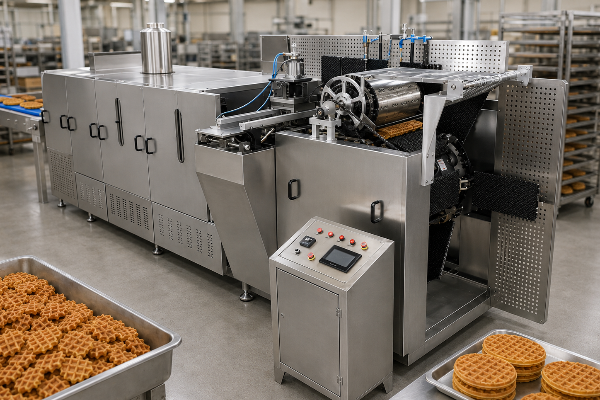
The YT-02H brings batter depositing, baking, mold opening and discharge into an automatic rotary sequence. Its declared output is 1,100 pieces/h, so it gives a direct piece-rate reference when product dimensions and unit weight have already been frozen.
The machine uses 17.5 kW at three-phase 380 V and requires compressed air at 0.2 m³/min above 0.6 MPa. Its 2,100 × 2,300 × 1,400 mm envelope and 1,000 kg net weight must be checked against access doors, floor loading, operator clearance and service space.
- Output 1,100 pieces/h
- Power 17.5 kW (380V)
- Air Demand 0.2 m³/min
- Dimensions 2,100×2,300×1,400 mm
- Weight 1,000 kg
32-Mold Continuous Line
The 32-mold line is declared at about 1,800 kg/24 h and occupies 6.0 × 1.6 × 1.9 m. The line electrical load is 3 kW, while process heat requires either natural gas at 8 m³/h or LPG at 4 kg/h; compressed-air demand is 0.6 m³/min.
This configuration is a candidate when the buyer manages production by finished mass rather than individual pieces. It still needs a recipe-specific trial.
- Output 1,800 kg/24 h
- Power 3 kW
- Gas / LPG 8 m³ / 4 kg
- Air Demand 0.6 m³/min
- Dimensions 6.0×1.6×1.9 m
60-Mold Continuous Line
The 60-mold line is declared at about 3,500 kg/24 h, with a 9.8 × 1.6 × 1.9 m footprint and a 3 kW electrical load. Its fuel input is natural gas at 14.5 m³/h or LPG at 8 kg/h, plus compressed air at 0.6 m³/min.
The additional line length changes more than capacity. Plant layout must provide safe product flow, cleaning access, and burner planning.
- Output 3,500 kg/24 h
- Power 3 kW
- Gas / LPG 14.5 m³ / 8 kg
- Air Demand 0.6 m³/min
- Dimensions 9.8×1.6×1.9 m
80-Mold Continuous Line
The 80-mold line is declared at about 5,000 kg/24 h and measures 12.0 × 1.6 × 1.9 m. It uses 5 kW of electrical power, natural gas at 19 m³/h or LPG at 14 kg/h, and compressed air at 0.6 m³/min.
This model should be evaluated as a line project rather than a stand-alone waffle baker. Utility availability and accepted criteria are key.
- Output 5,000 kg/24 h
- Power 5 kW
- Gas / LPG 19 m³ / 14 kg
- Air Demand 0.6 m³/min
- Dimensions 12.0×1.6×1.9 m
Waffle Capacity Translation Worksheet
Pieces per hour and kilograms per 24 hours cannot be compared until the buyer supplies the conversion inputs. The worksheet keeps declared output separate from normalized daily output, then shows the headroom needed for cleaning, changeovers, startup losses and rejects.
Calculation lane
Buyer inputs
Calculation Formula
Decision use
Declared output
Supplier specification and its time basis
Keep pieces/h and kg/24 h original
Prevents unlike figures from being ranked as equivalents
Piece-rate conversion
Pieces/hour, unit weight in grams, net operating hours
kg/day = pcs/h × unit_g × net_hrs ÷ 1000
Places the rotary model in the buyer’s daily mass plan
Saleable good output
Nominal output, availability, performance factor, first-pass yield
Saleable = nominal output × availability × performance factor × first-pass yield
Connects production planning with quality and downtime
Required nameplate output
Saleable demand plus the same three loss factors
Required output = saleable demand ÷ availability ÷ performance factor ÷ first-pass yield
Shows capacity headroom without inventing a default allowance
Availability
Cleaning, changeover, planned stops and unplanned stops
Net available time ÷ scheduled time
Exposes downtime hidden by a continuous-day label
First-pass yield
Startup scrap, sticking, under-bake, over-bake and appearance rejects
Accepted output ÷ total output
Aligns the machine trial with finance and packing
[ CAUTION ]
Do not borrow a default efficiency factor
Availability, performance and first-pass yield depend on the buyer’s recipe, cleaning plan, staff, acceptance standard and connected equipment. Enter measured trial data or a deliberately conservative internal planning assumption, keep the assumption visible, and compare the result with required saleable demand.
Soft-Waffle Product Inputs and Recipe Trial Requirements
The confirmed equipment scope is soft-waffle production. A product name doesn’t fix batter behaviour, deposit volume, release or bake time, so we do not expect Belgian waffle, Liège waffle, bubble waffle, waffle cone, biscuit, pancake or crêpe recipes to be automatically compatible.
Product Brief Required Before Configuration
- Target waffle shape, diameter, thickness and cavity pattern
- Target unit weight and acceptable weight band
- Daily saleable demand and working hours per day
- Batter or dough formula, with sugar, fat and leavening details
- Viscosity, temperature and holding-time constraints
- Target color, crust, texture and final moisture
- Release agent and cleaning method now used
- Cooling and packaging temperature target
- Changeover frequency and allergen-control requirements
- Rejected-product definitions used by quality staff
NOTICE: Liège-style products with pearl sugar, thick Belgian formats, multicolor batter and filled products need separate confirmation of the forming tool, depositor and bake profile. Dense dough, high sugar, inclusions and non-stick requirements can change depositing, caramelization, release and cleaning.
Why the Actual Batter Belongs in the Factory Trial
A nominal recipe match does not establish clean release or stable saleable output. Industrial-scale research has shown that ingredients, process conditions, plate material, release agent and cleaning work together; changing only machine size or coating does not guarantee the result.
We run your batter on our machine before packing and send photos and videos; you are welcome to witness the run at our factory. Rather than relying on a short demonstration chosen for appearance, we use a formal approval report.
“A useful trial does not ask whether the line can make one acceptable waffle. It asks whether the agreed recipe can repeat the accepted weight, color, release and texture while the team records startup loss, interruptions and cleaning.”
Trial Sample and Acceptance Inputs
CTRL-01 Recipe Control
Identify flour, water, eggs, oil or fat, sugar, leavening, inclusions, batter temperature and the permitted preparation window. Record substitutions because a packet mix and a scratch recipe may deposit and release differently.
CTRL-02 Product Control
Freeze mold drawing, cavity count, deposit mass, target dimensions, appearance, texture and acceptable weight band. Use the same definitions for the trial, purchase agreement and receiving inspection.
CTRL-03 Process Control
Record preheat, startup pieces, stable-run duration, interruptions, sticking events, rejected output and cleaning time. These observations provide inputs for a real capacity model instead of a brochure-only estimate.
If you expect frequent menu changes, list the recipe families and mold changes in the request for quotation. We can then identify which variants share hardware, which need a separate forming tool or depositor review, and which require another trial.
Get Instant Quote →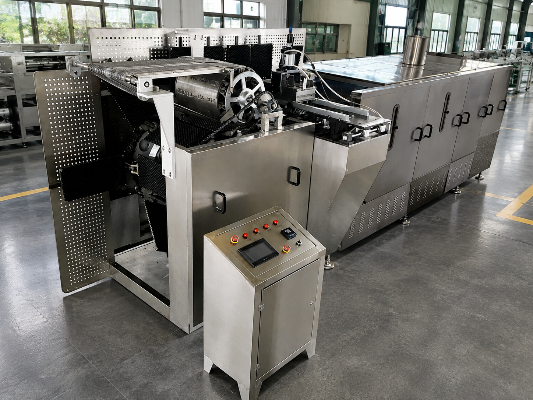
Machine Construction, Baking Plates and Control Architecture
The 8-mold rotary machine uses a stainless-steel enclosure with aluminium-alloy structural members, PLC control, multi-axis servo linkage and fibre-optic photoelectric sensing. Its rotary stations handle batter depositing, baking, mold opening and discharge automatically. That confirmed architecture does not by itself establish cleanability, food-contact suitability or destination-market conformity.
Area
Confirmed on the 8-mold rotary machine
Quotation-stage verification
Outer construction
Stainless-steel enclosure
Request the material declaration and identify actual food-contact surfaces
Structural members
Aluminium-alloy structural members
Review joints, exposed interfaces and cleaning access for the proposed layout
Sequence control
PLC control
Freeze recipe set points, user levels, alarm handling and changeover procedure
Motion
Multi-axis servo linkage
Review guarded zones, maintenance access and recovery after a stop
Sensing
Fibre-optic photoelectric sensing
Confirm each detection point, reject response and cleaning protection
Rotary functions
Automatic deposit, bake, mold opening and discharge
Define the buyer’s batter, mold, release and accepted-product criteria
Document or design question
Requested
Verified
Gap owner
Food-contact material declarations and product-contact map
Buyer marks at RFQ
Record document ID
Supplier engineering
Cleaning, access, disassembly and drainage description
Buyer marks at RFQ
Review against sanitation plan
Buyer quality and supplier engineering
Guarding, interlocks and emergency isolation
Buyer marks at RFQ
Review circuit and test evidence
Buyer safety and supplier controls
Burner supervision, fuel shutoff and flame-failure response
For gas or LPG line
Review components and test method
Buyer utilities and supplier engineering
Electrical drawings, supply compatibility and panel documentation
Buyer marks at RFQ
Compare with plant standard
Buyer electrical engineer
Destination-country conformity and local inspection path
Buyer defines market
Record responsible party and evidence
Buyer procurement
Baking plate and product-contact questions
The project record today does not define a baking-plate alloy, coating grade, surface roughness or cleaning-validation result. Place those topics into the engineering review whenever product chemistry, abrasion, allergen control, regional food-contact legislation or a non-stick requirement makes them material to the purchase decision.
- Plate base material, coating system and supplier declaration
- Food-contact material list for the product and batter path
- Plate removal, cleaning access and inspection method
- Permitted cleaning chemicals, tools, temperature and contact time
- Wear criteria and replacement procedure for plates and seals
- Drainage, niches, hollow sections and product-trap review
Destination-market evidence lane
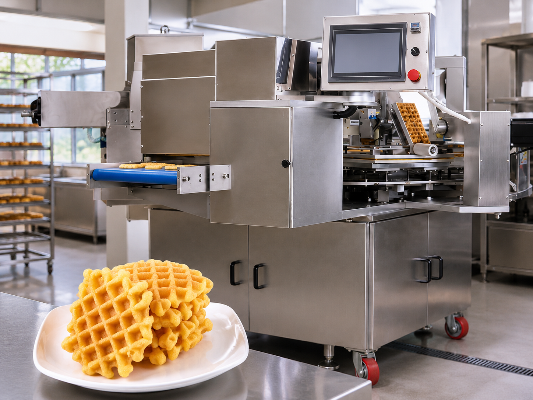
Government guidance on hygienic design covers cleanability, access, compatible materials, drainage and niches where debris can accumulate. For a U.S. bakery installation, OSHA 1910.263 makes emergency stops, fuel shutoff, electrical isolation and burner flame-failure behavior relevant review topics.
Use document status, not assumptions
A stainless-steel description is not a substitute for a product-contact map, cleanability review or conformity file. Keep each line as requested, verified or open, and make closure ownership part of the quotation review.
Execute ReviewModel Specifications, Utilities and Plant Fit
Machine selection fails late when a capacity choice is made before the plant verifies power, fuel, compressed air, access and line length. The specification matrix keeps the original output units visible and provides practical conversions solely for site planning.
For a U.S. bakery project, use OSHA 1910.263 as a separate installation-safety review lane; it does not validate the machine ratings below.
Check Your Plant Against Published Utility Values
| Specification | 8-mold rotary | 32-mold line | 60-mold line | 80-mold line |
|---|---|---|---|---|
| Declared output | 1,100 pieces/h | About 1,800 kg/24 h | About 3,500 kg/24 h | About 5,000 kg/24 h |
| Output basis | Piece rate | Finished mass per continuous day | Finished mass per continuous day | Finished mass per continuous day |
| Mold count | 8 molds | 32 molds | 60 molds | 80 molds |
| Electrical power | 17.5 kW | 3 kW | 3 kW | 5 kW |
| Voltage | Three-phase 380 V | Confirm for project | Confirm for project | Confirm for project |
| Compressed air | 0.2 m³/min (7.1 cfm) | 0.6 m³/min (21.2 cfm) | 0.6 m³/min (21.2 cfm) | 0.6 m³/min (21.2 cfm) |
| Air pressure | >0.6 MPa (>87 psi) | Confirm for project | Confirm for project | Confirm for project |
| Natural gas | Not listed for this model | 8 m³/h (282.5 ft³/h) | 14.5 m³/h (512.1 ft³/h) | 19 m³/h (671.0 ft³/h) |
| LPG alternative | Not listed for this model | 4 kg/h (8.8 lb/h) | 8 kg/h (17.6 lb/h) | 14 kg/h (30.9 lb/h) |
| Machine or line dimensions | 2,100 × 2,300 × 1,400 mm | 6.0 × 1.6 × 1.9 m | 9.8 × 1.6 × 1.9 m | 12.0 × 1.6 × 1.9 m |
| Net weight | 1,000 kg (2,205 lb) | Confirm for project | Confirm for project | Confirm for project |
| Heat source planning | Electrical load is listed | Natural gas or LPG | Natural gas or LPG | Natural gas or LPG |
| Installation services | Quoted separately | Quoted separately | Quoted separately | Quoted separately |
| Factory batter trial | Before shipment | Before shipment | Before shipment | Before shipment |
Hidden bottleneck map
| Potential constraint | Evidence to collect | Decision before order |
|---|---|---|
| Batter preparation | Batch size, mixing cycle, hold time and transfer method | Confirm the depositor never waits for batter |
| Recipe stability | Trial yield, sticking events and process window | Use accepted good output in the capacity model |
| Utilities | Measured capacity and connection specification | Assign plant upgrades and commissioning tests |
| Cleaning and changeover | Required access, steps and elapsed time | Deduct planned downtime from scheduled hours |
| Cooling and packing | Maximum downstream rate and temperature window | Avoid buying baking output that cannot be packed |
| Maintenance access | Service zones, removal paths and lifting needs | Reserve more than the published machine envelope |
Model-to-Utility Gate Matrix
Engineering gate
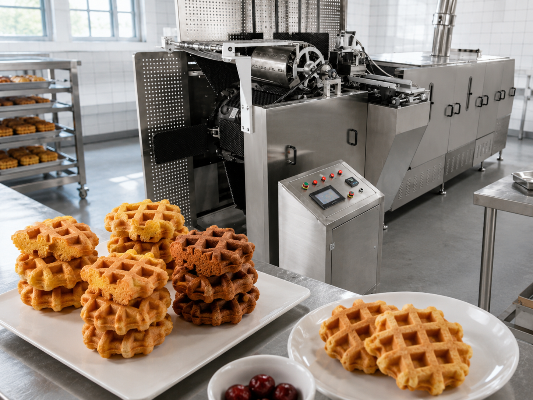
Check incoming electrical supply, transformer capacity, gas or LPG pressure and quality, compressed-air capacity at the point of use, exhaust route, floor loading, access doors and maintenance clearance.
Operations gate
Map batter preparation, ingredient staging, operator movement, product discharge, cooling, inspection, packing, waste removal and sanitation. A clear machine footprint is not the same as an operable line footprint.
Procurement gate
Freeze what is included in machine scope, molds, burner train, controls, spare parts, shipping, installation, commissioning, training and destination-market documentation. Put each exclusion next to its cost owner.
Submit a Utility Fit Brief
Quotation Basis, Lead Time and Payment Terms
There is no responsible fixed price for an unconfigured waffle line. Quotation depends on the selected model and mold count, product dimensions, batter handling, forming tool, heat source, control scope, line interfaces, spare-parts package, destination and on-site service.
Quote-Normalization Scorecard
-
Quote lineNormalize this detailHidden-cost question
-
Machine and moldsModel, mold count, cavity drawing, included forming tools and change partsDoes a second product require another mold or depositor?
-
Rated outputUnit, recipe, product mass, operating hours and accepted-good definitionIs the figure theoretical, nominal or saleable?
-
Heating systemElectric, natural gas or LPG; burner and control scopeWho supplies regulators, train components, exhaust and site approval?
-
UtilitiesConnection values, quality requirements and point-of-use conditionsDoes the plant need a transformer, compressor or fuel upgrade?
-
Line boundaryBatter preparation, feeding, baking, discharge, cooling and packing interfacesWhich upstream or downstream machines are excluded?
-
Factory acceptanceRecipe, stable-run period, output, quality limits and evidence packageWho supplies batter and who approves the result?
-
Delivery and site workFreight basis, unloading, installation, commissioning and trainingWhich travel, labor, utilities and local permits remain with the buyer?
-
Lifecycle supportWarranty boundary, wear parts, recommended spares and response routeWhich items should be stocked before production starts?
A lifecycle-cost comparison requires installed cost, energy, operation and maintenance, replacements, residual value and the time value of money. This Bronze-level scorecard does not promise a payback period; it creates a common scope so finance can calculate one after receiving project-specific costs and operating assumptions.
Quotation response and build windows
We answer machine enquiries within 24 hours on business days once the product and capacity brief is usable. The first response can identify missing technical inputs; the final written quotation follows the frozen model, product, utility, line-boundary and service scope.
-
Project classBuild windowStart point
-
Single machine30–60 daysA single machine ships in 30–60 days once the technical confirmation sheet is signed.
-
Mid-size line45–60 daysA mid-size line ships in 45–60 days once layout and utilities are frozen.
-
Full production line60–90 daysA full production line ships in 60–90 days from signed layout drawings.
These windows are build commitments, not transit or local commissioning schedules. Shipping route, customs, site readiness, installation and acceptance timing belong in the project schedule as separate workstreams.
Payment and optional site services
Payment is a 30% T/T deposit to start the build, followed by a 70% balance before shipment; an irrevocable L/C at sight is also accepted. We send engineers for installation, commissioning and operator training on your site, quoted separately from the machine.
Compare total installed scope, not the headline machine figure
Ask every supplier to complete the same scorecard and name each exclusion. A lower machine price can become the more expensive project when molds, utilities, freight, commissioning, spares or downstream capacity remain outside the comparison.
Factory Trial, Shipment Evidence and Warranty Support
A useful factory trial transfers product risk into written acceptance criteria before shipment because a peer-reviewed industrial-scale waffle study found that product and process variables interact. The acceptance risk remains because a short highlight can hide startup scrap and interruptions. UD Company links shipment release to the agreed trial record, while the 12-month warranty and parts route define post-shipment support.
-
Freeze the product brief by recording recipe version, batter temperature and holding time, mold drawing, deposit mass, dimensions, color, texture and release criteria.
-
Define the run method through an agreed preheat, startup period, stable-run duration, sampling points, planned stops and recovery procedure.
-
Record nominal and saleable output. Count total production, accepted product, startup scrap, sticking, under-bake, over-bake and appearance rejects without combining the categories.
-
Check repeatability. Compare unit weight, appearance and release behavior across the agreed sampling window rather than approving one selected sample.
-
Capture downtime and cleaning. Record stops, reasons, recovery time, cleaning steps and the time needed to return to accepted product.
-
Close the evidence package. Both sides sign the result, open items, corrective actions, retest conditions and shipment release decision.
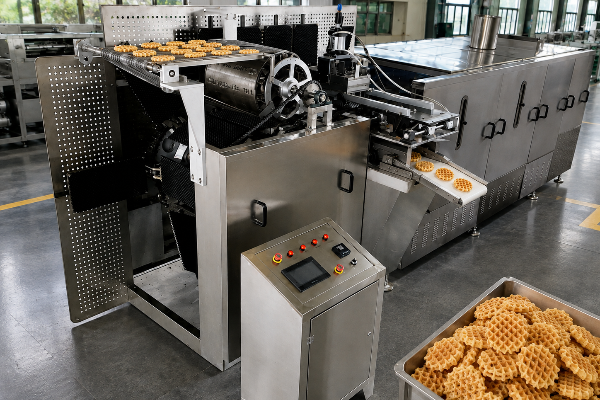
We do not ship free machine samples. Instead, we run your batter on the machine before shipment and send the trial photos and video; you are welcome to witness the run at our factory.
Trial record
- Signed recipe and product acceptance sheet
- Run conditions and stable-run duration
- Nominal output and accepted good output
- Reject categories, stops and cleaning observations
- Open-item and retest log
Visual evidence
- Machine and control sequence photos
- Trial video covering deposit through discharge
- Representative accepted product and reject examples
- Nameplate, packed-machine and shipment-release views
- Buyer witness record when attendance is used
Every machine carries a 12-month warranty on parts and workmanship. Wear parts leave our warehouse in 3–7 days of a confirmed request, so the recommended-spares list should be reviewed before production starts rather than after the first interruption.
We send engineers for installation, commissioning and operator training on your site, quoted separately from the machine. The quotation should name buyer responsibilities for utilities, foundations, lifting, permits, local labor, ingredients and production staff so the arrival date does not become a readiness date by assumption.
Approval should follow evidence, not a demonstration highlight
Connect the trial sheet to the capacity worksheet, payment milestone and shipment release. If a result is outside the agreed boundary, record the open item and retest method before approving dispatch.
From Production Target To Commissioned Waffle Line
The project path keeps product fit, plant fit and commercial scope moving together. It also provides engineering, procurement and operations a shared record of what has been confirmed and what still needs an owner.
Project Phases
Phase 01
Distribute The Production Brief.
Provide target product, unit weight, dimensions, recipe constraints, saleable output, working hours, power, fuel, compressed air and available floor space.
Phase 02
Map The Configuration.
We map the brief to an 8-mold, 32-mold, 60-mold or 80-mold configuration and list the inputs that remain open.
Phase 03
Freeze Product And Scope.
Both sides approve the mold and product targets, output basis, heat source, utilities, line boundary, trial criteria, documentation and commercial terms.
Phase 04
Start The Build.
We begin after the agreed 30% T/T deposit and the technical confirmation package is signed.
Phase 05
Conduct The Factory Trial.
We use the agreed batter and acceptance protocol, share the evidence and close any agreed retest actions before shipment release.
Phase 06
Ship And Commission.
The 70% balance is due before shipment; optional on-site installation, commissioning and operator training follow the written quotation scope.
Buyer Input Checklist
-
Product And Quality
Recipe version, unit weight, dimensions, mold pattern, appearance, texture, moisture target, release criteria, acceptable weight band and rejection rules.
-
Capacity And Operations
Saleable pieces or kilograms per day, shift pattern, scheduled hours, cleaning plan, changeovers, staffing, upstream batter capacity, downstream cooling and packing rate.
-
Site And Commercial
Country, voltage, power, fuel, compressed air, floor plan, access, required documentation, freight responsibility, commissioning location and target start date.
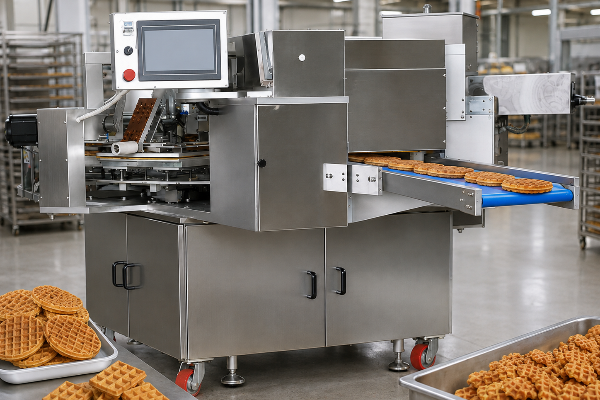
Responsibility Split Before Shipment
| Workstream | UD Responsibility | Buyer Responsibility | Shared Acceptance Point |
|---|---|---|---|
| Product Definition | Review machine and mold fit | Supply accurate recipe and product requirements | Signed product brief |
| Machine Configuration | Propose equipment and declared utilities | Confirm plant capacity and access | Signed technical sheet and layout |
| Factory Trial | Run the agreed method and provide evidence | Supply batter or agreed ingredients and approve criteria | Signed trial record |
| Destination Readiness | Provide quoted machine documents | Complete local conformity, permits, exhaust, utilities and safety review; for U.S. bakery equipment, include OSHA 1910.263 in that review lane | Site-readiness checklist |
| Commissioning | Provide quoted engineer services | Provide ready site, staff, materials and local support | Commissioning record |
| Production Ramp | Provide warranty and parts route | Run preventive maintenance and process control | Handover and spares plan |
When an Industrial Waffle Machine Is More Capacity Than You Need
An industrial machine is a poor fit if the plant cannot support its output, supply its utilities or freeze product assumptions for a meaningful trial. Capacity ratings expressed in different units are not interchangeable, and machine selection is not a substitute for a recipe-specific trial. That trade-off matters because the wrong choice costs you in idle capacity, corrective plant work or saleable-output loss, so confirm fit before comparing price.
1,100 pieces/h already exceeds realistic demand
Why it works against you
The starting 8-mold configuration adds power, air, floor-space and staffing obligations without enough saleable volume to absorb them.
What to do instead
Compare smaller equipment or multiple countertop units using labor, cleaning, redundancy and peak-demand scenarios.
The recipe, product mass or mold geometry is still changing
Why it works against you
A nominal output comparison cannot predict deposit behavior, sticking, bake profile, first-pass yield or packing rate for an undefined product.
What to do instead
Freeze a reference recipe and sample, then complete a mold and batter trial before selecting capacity.
The chosen line exceeds available fuel, air or floor flow
Why it works against you
Utility upgrades, exhaust, access and downstream changes can dominate schedule and installed cost after the purchase order.
What to do instead
Run the utility gate first, price the plant work and compare a smaller configuration or revised layout.
Daily demand is seasonal or highly uncertain
Why it works against you
A single high-output line can leave unused capacity while creating a fixed cleaning and maintenance burden.
What to do instead
Model base, peak and downside demand with explicit availability and yield assumptions before choosing headroom.
Local documentation and inspection responsibilities are unclear
Why it works against you
Machine completion does not close destination-specific electrical, fuel, guarding, installation or inspection obligations.
What to do instead
Assign every document and approval to the supplier, buyer or local specialist before quotation acceptance.
Industrial Soft Waffle Machine: Production Planning Tools
waffle capacity translator
Determine exact line configurations, throughput metrics, and footprint requirements to hit your daily soft waffle production targets.
waffle utility fit checker
Cross-reference your factory’s power supply, compressed air, and water utility capacities with our industrial machine specifications.
factory trial rfq readiness scorecard
Systematically evaluate your project scope, raw materials, and technical parameters to ensure successful machine testing and quotation.
01
SEC.01 // Specifications
Product file
Include a product photo or drawing, mold pattern, unit weight, dimensions, batter or dough formula, target color, texture, moisture, release behavior and accepted weight band.
02
SEC.02 // Capacity
Production target
State saleable pieces/day or kg/day, shifts, hours/day, cleaning and changeover plan, reject allowance, upstream batter capacity and downstream cooling and packing limits.
03
SEC.03 // Infrastructure
Plant data
Provide country, voltage, available electrical load, natural gas or LPG data, compressed-air capacity, floor plan, access restrictions, exhaust plan and target installation date. Use sanitary-design guidance to frame cleanability and access questions; it does not certify the proposed machine.
04
SEC.04 // Delivery
Commercial boundary
List required molds, line interfaces, documentation, freight term, trial witness plan, installation, commissioning, operator training and recommended spare-parts package.
The distinction here is practical rather than a universal legal definition. The range starts with an integrated 8-mold rotary sequence at 1,100 pieces/h and extends to continuous lines with dedicated footprints, compressed air and fuel requirements, so the buying decision includes production flow, utilities, cleaning, maintenance and line interfaces rather than only plate size and timer controls.
The 8-mold YT-02H is stated in pieces/h, at 1,100 pieces/h. The 32-, 60- and 80-mold lines are stated in kg/24 h, at about 1,800, 3,500 and 5,000 kg/24 h respectively; retain those original units until unit weight and net operating time are supplied.
Convert the piece rate with your actual unit weight and net operating hours: kg/day = pieces/hour × unit weight in grams × net operating hours ÷ 1,000. Then apply your own availability, performance and first-pass-yield factors so the result reflects cleaning, changeover, recipe loss and rejected product.
The 8-mold machine lists 17.5 kW, three-phase 380 V and 0.2 m³/min compressed air above 0.6 MPa. The continuous lines list 0.6 m³/min air; their electrical loads are 3 kW, 3 kW and 5 kW, while natural-gas demand is 8, 14.5 and 19 m³/h or LPG demand is 4, 8 and 14 kg/h for the 32-, 60- and 80-mold lines.
Published machine dimensions are 2,100 × 2,300 × 1,400 mm for the 8-mold model and 6.0 × 1.6 × 1.9 m, 9.8 × 1.6 × 1.9 m and 12.0 × 1.6 × 1.9 m for the three continuous lines. Add receiving access, operator movement, service clearance, burner and exhaust work, batter supply, discharge, cooling, inspection, packing and sanitation zones to create the plant layout.
That requires a defined product brief and factory trial. Send the formula, batter temperature and hold time, deposit mass, dimensions, mold drawing, target color and texture, release method and accepted weight band; we run your batter before shipment and record the agreed results.
No automatic compatibility should be assumed. Industrial-scale sticking research supports checking interacting recipe, process and plate variables; thick Belgian formats, Liège dough with pearl sugar, high-sugar batter, bubble waffle, filled products and different cavity patterns still need a defined mold, forming method and trial plan.
Both sides freeze the recipe, product, run method and acceptance sheet before testing. We record startup, stable-run output, accepted good output, sticking and reject categories, interruptions, cleaning and evidence; we send photos and video, and the buyer may witness the run at our factory.
The quotation follows model and mold count, product dimensions, recipe and batter handling, heat source, controls, line interfaces, requested documents, spare parts, destination, freight boundary and site-service scope. We answer a usable enquiry within 24 hours on business days and identify any missing inputs before freezing the final offer.
A single machine ships in 30–60 days, a mid-size line in 45–60 days and a full production line in 60–90 days from the stated technical start point. Payment is 30% T/T deposit to start the build and 70% before shipment; an irrevocable L/C at sight is also accepted.
Installation, commissioning and operator training on your site are quoted separately from the machine. Define the destination, plant readiness, utilities, lifting, local labor, ingredients, travel boundary and required production support so the written quotation can assign the work clearly.
Send your country, target product, unit weight, dimensions, recipe constraints, saleable pieces/day or kg/day, working hours/day, power, gas or LPG, compressed air, floor plan, cooling and packing rate, required documentation, target schedule and preferred trial arrangement. Those inputs let us check model, utilities and project boundary before price is compared.