Get in touch with UDTECH Company

How to Evaluate an Automatic Egg Roll Machine for a Real Production Line

Industrial food-equipment guide · Updated September 2026
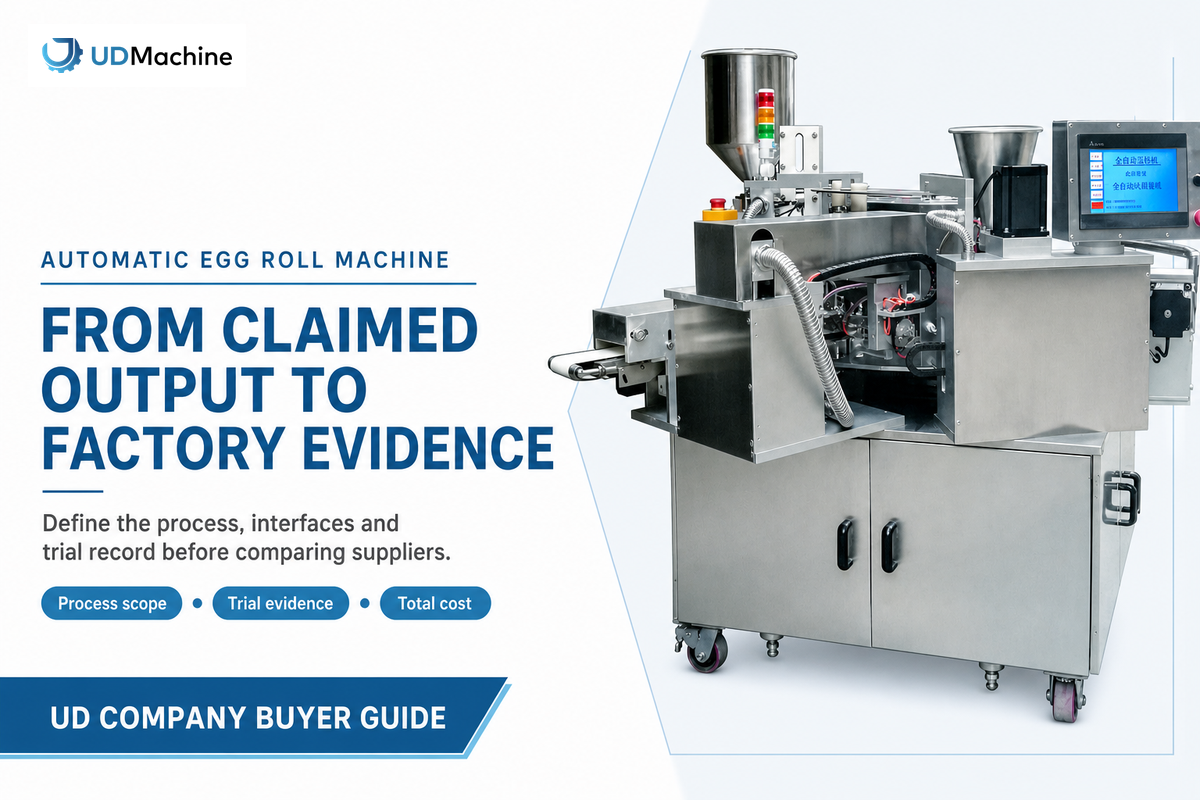
Automatic Egg Roll Machine is a connected production system that coordinates batter or wrapper feed, filling, forming, heat, cooling and discharge; its accepted output depends on the complete line, not a headline speed. Its functions range from metering batter, to creating and feeding an egg roll wrapper, depositing filling, forming a roll, applying heat, cooling the item and feeding it out for packing. As such, the purchase process begins by defining your product sample, its expected accepted rate, utility and changeover requirements. This guide for teams evaluating an egg roll production line, or anticipating a factory trial, is written separately from commercial offering detail.
Search labels such as “fully automatic egg roll roller machine,” “automatic egg roll making machine,” “automatic egg roll maker,” “commercial egg roll machine,” “small automatic egg roll machine” and “Chinese egg roll machine” describe buyer language, not guaranteed specifications.
A rated speed is a starting point; accepted output must be measured with representative samples in a documented trial.
What an automatic egg roll machine actually automates
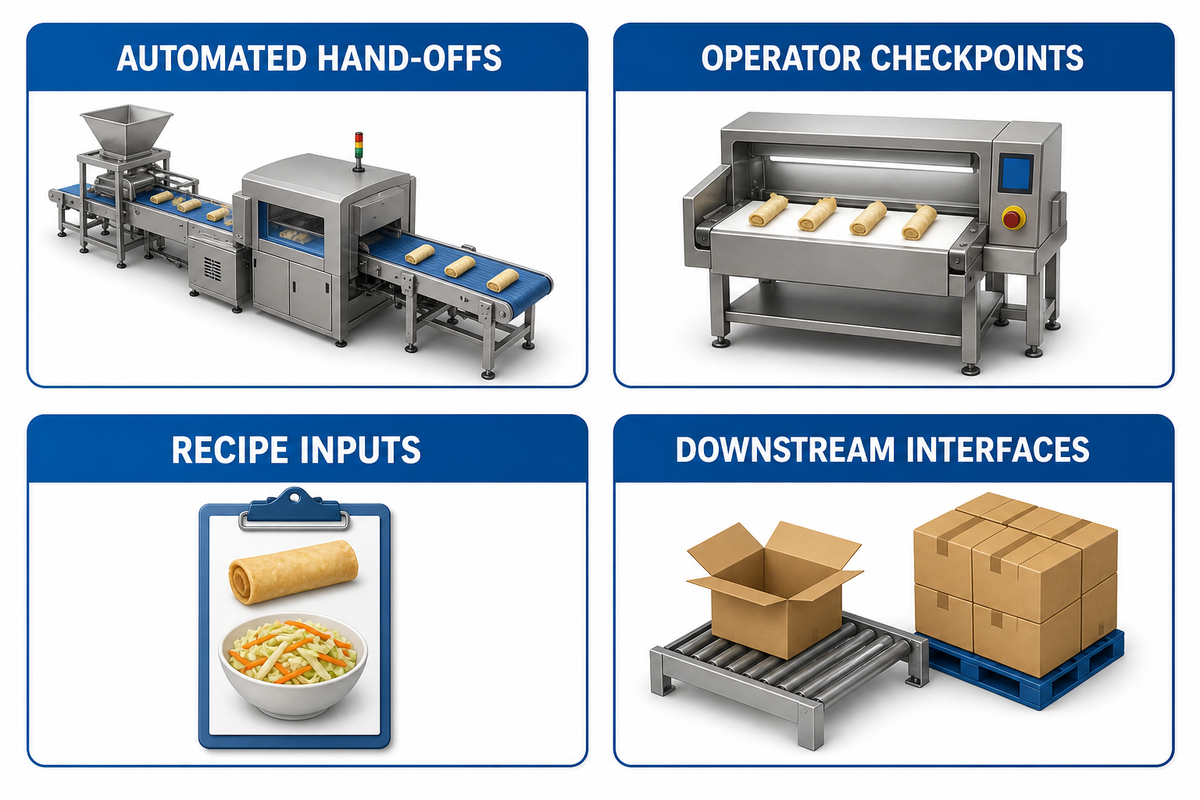
Buyer risk is an incomplete automation boundary. Use documented trial evidence from the factory scenario to show which step removes a measured production problem. The boundary may cover batter, wrapper feed, filling, rolling, heat, cooling and packing, or only selected stations; list each included function before comparing suppliers.
An automatic line joins several controlled actions. Depending on the product, the line can prepare a batter sheet or receive a wrapper, portion filling, form the roll with a forming machine, seal the seam, transfer the piece, heat or fry it, cool it and present it for inspection. Some lines automate only forming and rolling; others add frying, seasoning, cooling and packing interfaces. Ask the machine manufacturer to draw the exact boundary rather than assuming that the phrase “fully automatic” includes every station. This machinery is best evaluated as a food machine system, not a standalone roller machine or rolling machine.
| Stage | What to confirm | Why it changes the decision |
|---|---|---|
| Wrapper or sheet feed | Width, thickness, moisture and roll orientation | Small changes can create seams, tears or skew |
| Filling | Viscosity, particle size, temperature and portion tolerance | A former cannot correct a filling stream that is unstable |
| Rolling and sealing | Diameter, length, overlap and seam closure | Geometry affects frying, cooling and the pack format |
| Heat and transfer | Residence time, oil or oven interface, cooling path | Downstream bottlenecks can erase a forming-speed gain |
For an accurate description, locate each point where an operator still engages the product and define it clearly. This inventory becomes the starting point for your Request for Quotation (RFQ) and supports the purchase case by identifying the labor, quality and interface issues the equipment is meant to address.
From batter and wrapper to rolled product: the process flow
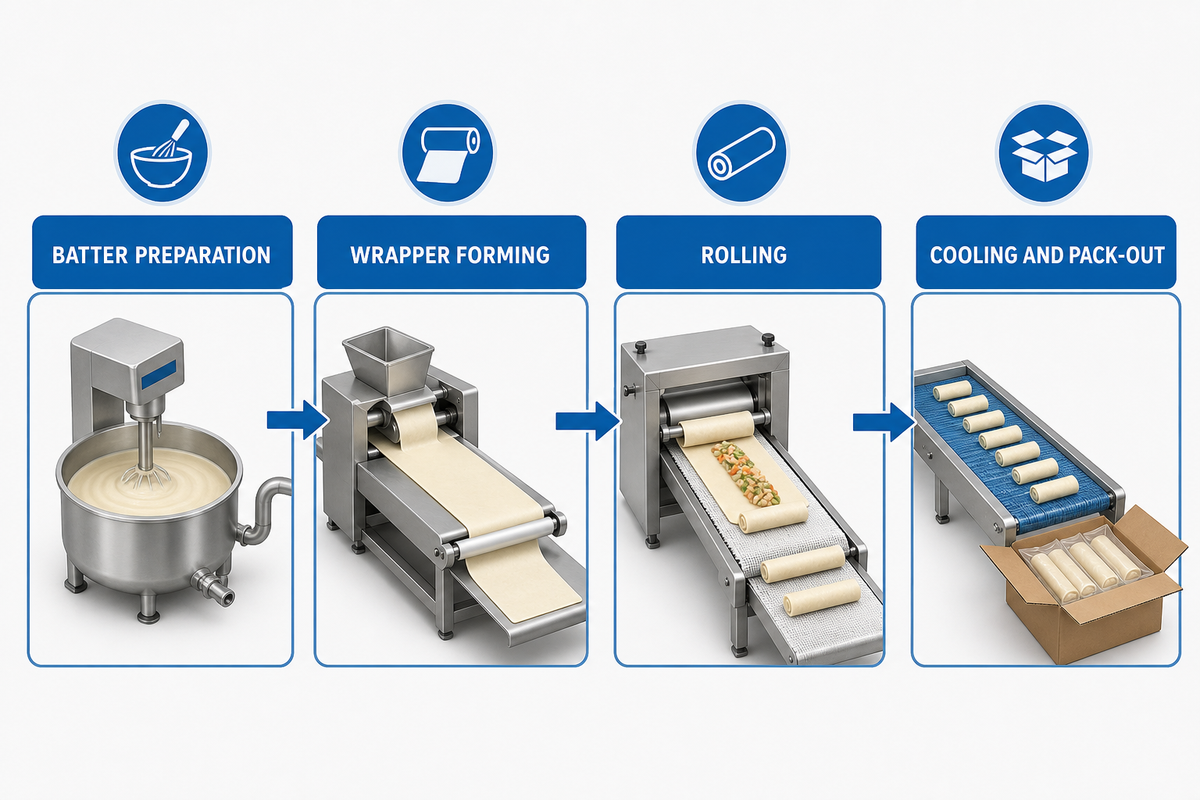
In a plant scenario, a process gap or hand-off failure can create rejects. Record the evidence at each station before approving the production line.
- Prepare your ingredients and materials. Ensure recipe, temperature, hold times for batter and/or wrapper are established and consistent.
- Loading and alignment. Specify how wrappers are detected, whether centering will occur automatically, and how it will compensate for roll drift.
- Dispense and fill. Specify the allowed variance in filling weight or volume per roll, maximum particle size of filling and areas that could cause filling to smear or bind.
- Form and seal. Confirm acceptable percentage of wrapper overlap, the applied pressure across the seam, and describe roll shape after transfer.
- Heat, cool, and inspect. Detail acceptable standards for size (diameter), color, completeness of seal, and acceptable number/severity of package breaks.
- Product handover to packing. Match acceptable production, not merely total, speed to accommodate either hand-loading or automated feed from the packing system.
Is there a machine to roll egg rolls?
Yes. Commercial egg-roll and spring-roll lines can feed a wrapper or sheet, portion filling and form a repeatable roll. The key question is whether the machine can make your roll within the wrapper, filling, seam and downstream constraints. A demonstration with a different wrapper or dry filling proves only movement; send representative samples and record setup, run duration, accepted pieces, rejects and cleaning.
For those operations that handle products intended for short seasons, very small runs or frequent recipe changes, having a manual fill step may still be a practical necessity. An automatic egg roll machine has value for the plant only when it will run steadily, with a well-defined product window and enough labor support for sanitation and preventive maintenance. View “automatic” as one aspect of process automation, rather than as a stand-in for guaranteed ROI.
Product-family boundary check
Search results often mix an egg roll production solution with adjacent equipment. Use this boundary map before comparing quotes: it keeps a buyer from treating a consumer appliance or a different forming family as an industrial egg roll line.
| Search terms surfaced | How to classify them in an RFQ |
|---|---|
| egg roll production solution; automatic encrusting and forming machine; anko er-24 automatic egg roll; er-24 automatic egg roll machine; produce egg rolls; making egg rolls; egg rolls made; food production; food processing; food machinery; production equipment; food manufacturing; automated food; entire production line; actual production; production capacity; pieces per hour; production needs; food preparation | Confirm the complete route, measured output and hand-offs. Ask whether the proposed automatic production line includes the wrapper, filling, forming, heat, cooling and packing interfaces. |
| dough belt; dough belt making machine; inspection machine; wrapper machine; folding and rolling; spring roll and egg roll; size egg roll; high quality egg rolls; crispy; look and taste | These describe input preparation, inspection or acceptance criteria. Record the wrapper and filling window instead of assuming that a similar phrase means the same roll geometry. |
| pastry; pastry machine; samosa; samosa machine; dumpling machine; shumai; shumai machine; lumpia; cone; ice cream cones; ice cream cone maker; waffle cone maker; egg roll maker pan; egg roll baker; non stick egg roll; non-stick double-sided waffle; tapioca pearl machine | Treat these as adjacent product families or consumer equipment. They may share a forming or heating principle, but they do not prove an egg-roll line’s sanitation, changeover or acceptance performance. |
| frozen food manufacturers; american chinese restaurants; food business; manual production; manual to automated; labor costs; reducing labor costs; after-sales; technical support; anko provides | Use these as buyer-context questions. Ask the machine manufacturer to state service coverage, labor assumptions and the transition from manual production; do not turn a supplier phrase into a guaranteed saving. |
Capacity planning without trusting a headline number
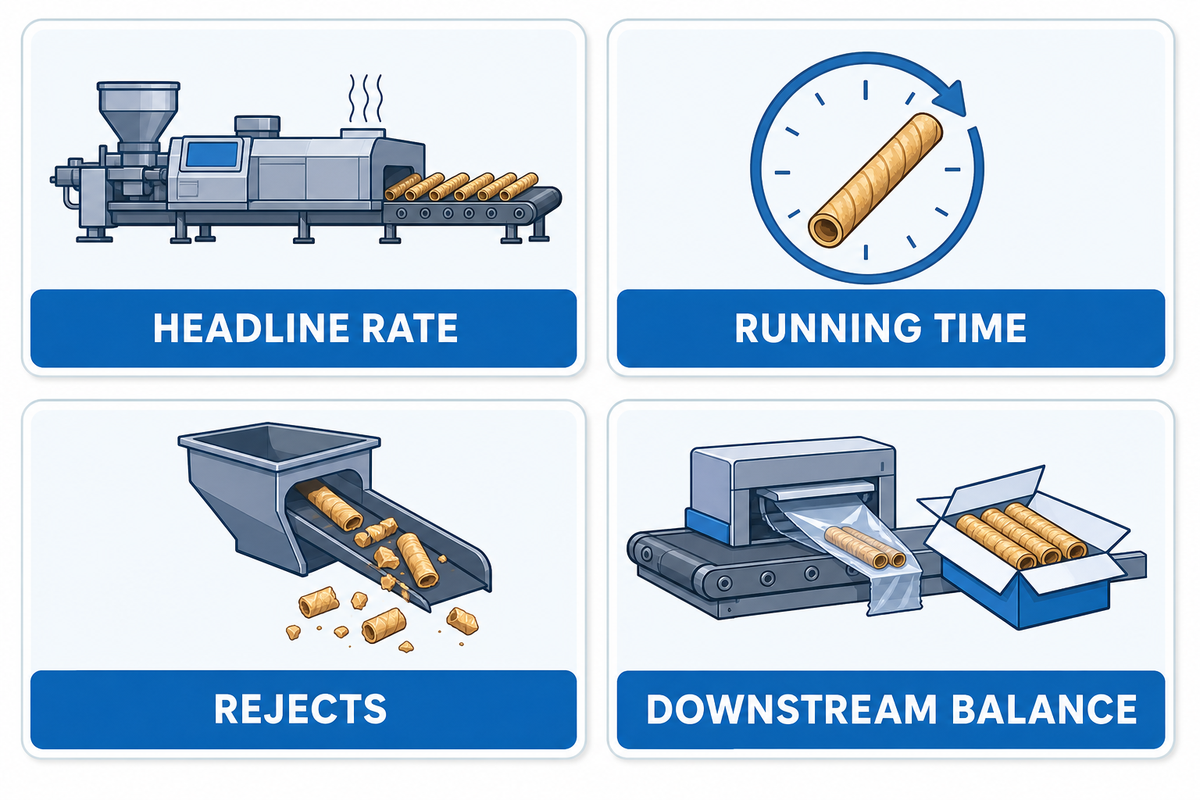
Start with accepted output per elapsed hour. Use this planning expression:
Accepted pieces/hour = gross pieces/hour × uptime × (1 − reject rate) × downstream availability
Those factors are site inputs, not universal machine specifications. Suppose a trial records a gross 2,400 pieces/hour, 0.82 uptime, a 0.04 reject rate and 0.90 packing availability. This illustrative accepted rate is 2,400 × 0.82 × 0.96 × 0.90 = 1,700 accepted pieces/hour, rounded. This arithmetic is a planning example only; your line must measure its own values. Compare the result with the egg roll capacity comparator before accepting a nameplate number.
3-Checkpoint Roll-Path Decision Framework
Capture the values in the units used by the project team: wrapper thickness in mm, batter temperature in °C, connected load in kW, compressed air in PSI, uptime in % and trial duration in min. Your worksheet might ask for 3 trials, 30 min per run, 10 sample pieces every 15 min, 2–3 changeovers, 1–2 operators, a 5 mm tolerance check, a 20 °C ingredient record, a 15 kW load entry, 6 PSI air, 95% uptime, a 12-month spare-parts horizon, 4 reject codes, 2 sanitation checks, 1 shift and an 8-hour production window. If a site uses other fields, the same form can accept 2 kg, 3 hours, 4 sec, 5 cm, 6 bar, 7 Hz, 8 RPM, 9 months, 10 days, 11 years, 12 kWh or 13 oz. These are recording examples, not specifications supplied by UD Company.
For a second worksheet, log 12 V control voltage, 8 A current, 1 m access clearance, 2 bar air pressure and a 30 min cooling observation. These are illustrative fields for a factory trial, not UD Company model specifications.
| Input | Evidence to request | Question it answers |
|---|---|---|
| Gross rate | Setpoint and sample count | What did the machine physically produce? |
| Uptime | Stopped-time log with causes | How often did feed, filling or transfer interrupt? |
| Reject rate | Reject code and sample photos | Which defects consume material and labor? |
| Downstream availability | Packer and cooling-line run log | Can accepted pieces leave the forming cell? |
A line can still fail a trial when a demonstration uses a thin wrapper, omits changeovers or ends at an empty downstream conveyor. Apply the Roll-Path Decision Ladder: stable geometry and constant demand support an integrated line; multiple recipes require quick, verified changeovers; and a constrained packer must be balanced before a faster upstream former is specified.
Wrapper, filling and roll-geometry checkpoints
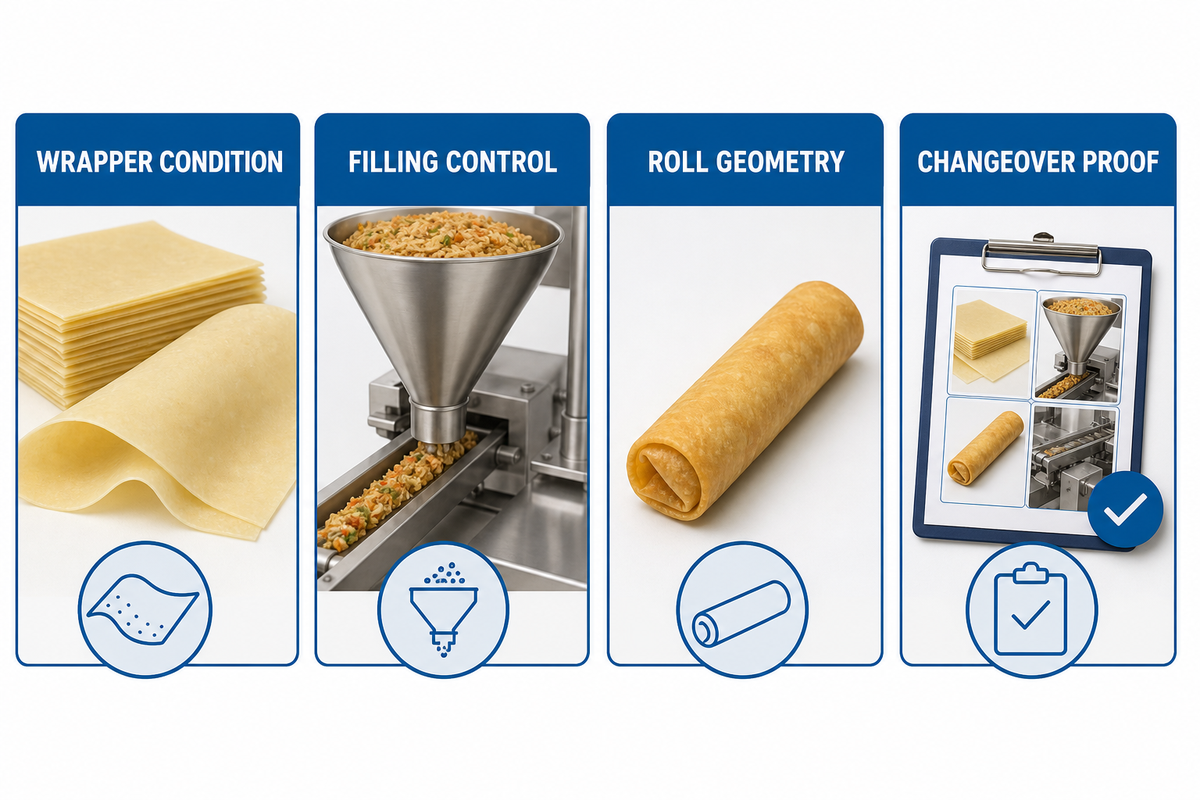
The risk is an inconsistent wrapper or filling window. Documented factory-trial samples provide evidence before a tooling decision is made.
Product inputs determine the operating envelope. Document wrapper thickness and moisture content, the temperature and particle size of your topping or fill (if applicable), your target portion or dosage rate, final diameter, length, lap and the strength of your seam or seal. Your supplier needs to specify where the change is recipe-based versus requiring a tooling adjustment.
If the same setting is intended to address multiple products, request a matrix showing the anticipated change range instead of the supplier’s best-guess compromise.
How does an egg roll machine handle filling and rolling?
Filling equipment meters a portion onto a wrapper or sheet and directs it through formers that fold and roll it. Sensors help alignment, but they cannot remove variation from lumpy filling, a dried wrapper edge or an out-of-window temperature. During a trial, weigh samples before and after forming, inspect seam fullness and categorize stoppages by fault. Those counts isolate the dispenser, wrapper feed or rolling machine.
Preserve a handful of your trial “edge cases”: longest and shortest approved wrapper, largest filling particle size and the very first pieces after a restart. Lines that focus only on the center of the window can look excellent for 10 minutes and be difficult to operate on a production run.
Utilities, hygiene zoning and line layout
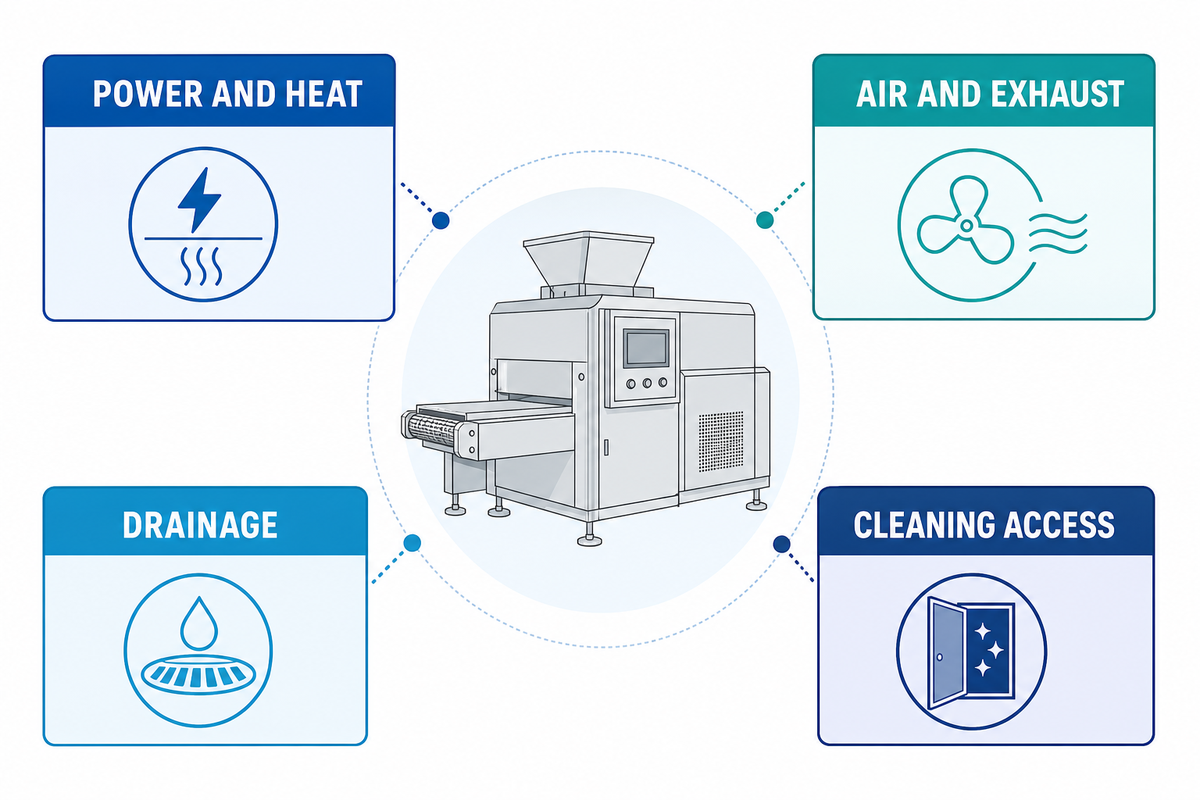
A layout problem can delay commissioning or create a sanitation risk. The factory acceptance record should document utilities, food-contact paths and the plant scenario.
Before delivery, issue a utilities sheet with voltage and phase, connected load, compressed-air pressure and quality, heat exhaust, drainage, water, floor loading, access width and headroom. Confirm where operators stand and where sanitation tools, guards and removable contact parts travel. Layout should separate raw-material handling, cooked product and waste paths according to the buyer’s food-safety plan.
- Access for inspection and for cleaning (not merely for installation).
- Delineate cable routes, air, and drain locations, in the layout drawing.
- Confirm restart behavior after a sensor fault or power interruption.
- Find out which surfaces are food-contact surfaces and how they can be removed.
- Confirm safe guarding and lockout protocols with the responsible individual for site safety.
USDA sanitation guide lines and food-equipment standards may serve as references, but a generic citation doesn’t trump local regulatory review. The final process is dictated by your buy’s jurisdiction, recipe, allergen plan and cleaning chemicals.
Quality controls, scrap and yield
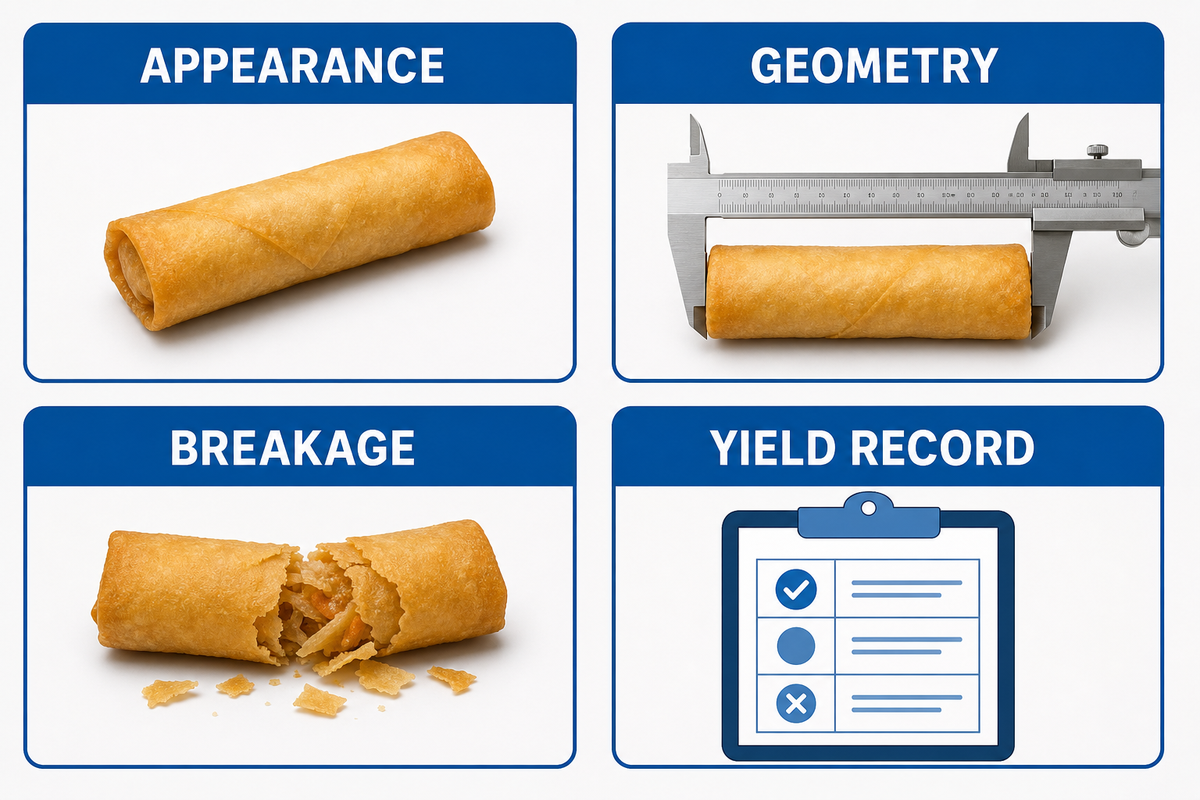
Quality risk is hidden scrap. Use evidence from a measured shift scenario and a documented factory control record to connect defects to an action.
During a real production shift scenario, inspect at least 10 pieces after startup and after any stop; keep the sample record beside the reject code so the next operator can repeat the check.
Define “good” before you discuss speed. A practical acceptance sheet can include piece length and diameter, wrapper overlap, seam integrity, filling mass, fried or baked color, moisture target, breakage and foreign-material controls. Add a reject code for every observed failure. A single yield percentage hides whether the loss came from startup, wrapper tears, overfill or a downstream jam.
| Control | Sample record | Escalation trigger |
|---|---|---|
| Geometry | Ten-piece length and diameter readings | Drift after a speed or recipe change |
| Seal | Visual and destructive seam check | Open seam or filling exposure |
| Weight | Portion mass by time block | Trend outside the agreed window |
| Appearance | Color reference and breakage count | Dark spots, cracks or collapsed roll |
Use a short control run at the start and end of a trial. If the line is stable only at the beginning, the apparent speed boundary may be drift, not capacity. Keep gross pieces, accepted pieces and elapsed time visible in the same record so a later reviewer can reproduce the conclusion.
Changeover, sanitation and preventive maintenance
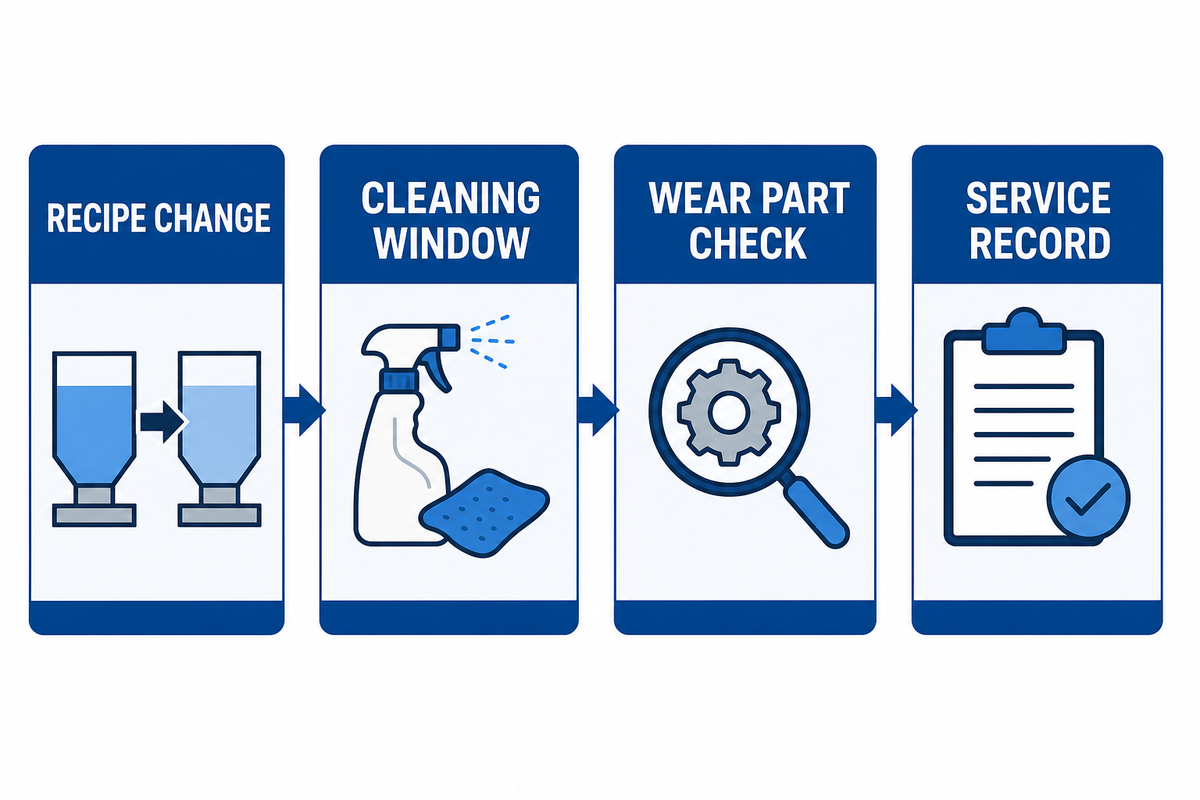
Changeover risk appears as downtime, rework or an unsafe cleaning step. Document the factory evidence and the operator scenario before accepting the maintenance plan.
Changeover is production work. Time the last accepted piece of recipe A to the first accepted piece of recipe B, including emptying, cleaning, tooling, sensor checks and restart waste. Note which steps need a technician. A line with a lower headline speed can win if it returns to an accepted recipe quickly and predictably.
| Cadence | Record |
|---|---|
| Every shift | Contact-surface inspection, guards, sensors, leaks and reject-bin check |
| Every changeover | Recipe, tools used, sanitation sign-off and first-piece approval |
| Weekly or per supplier manual | Lubrication points, belts, bearings, fasteners and alignment |
| Planned service | Wear parts, calibration, software backup and spare-parts forecast |
Changeover Evidence Map: record the last accepted piece, every sanitation and tooling step, the first accepted piece, lost pieces and the person who signed the restart check.
Do not let an operator reach into a guarded or hazardous area to “save” a trial. Site lockout and guarding procedure governs servicing and fault recovery. Ask the supplier for a safe cleaning sequence and a list of parts that can be changed without disturbing alignment.
Supplier questions and factory-trial evidence
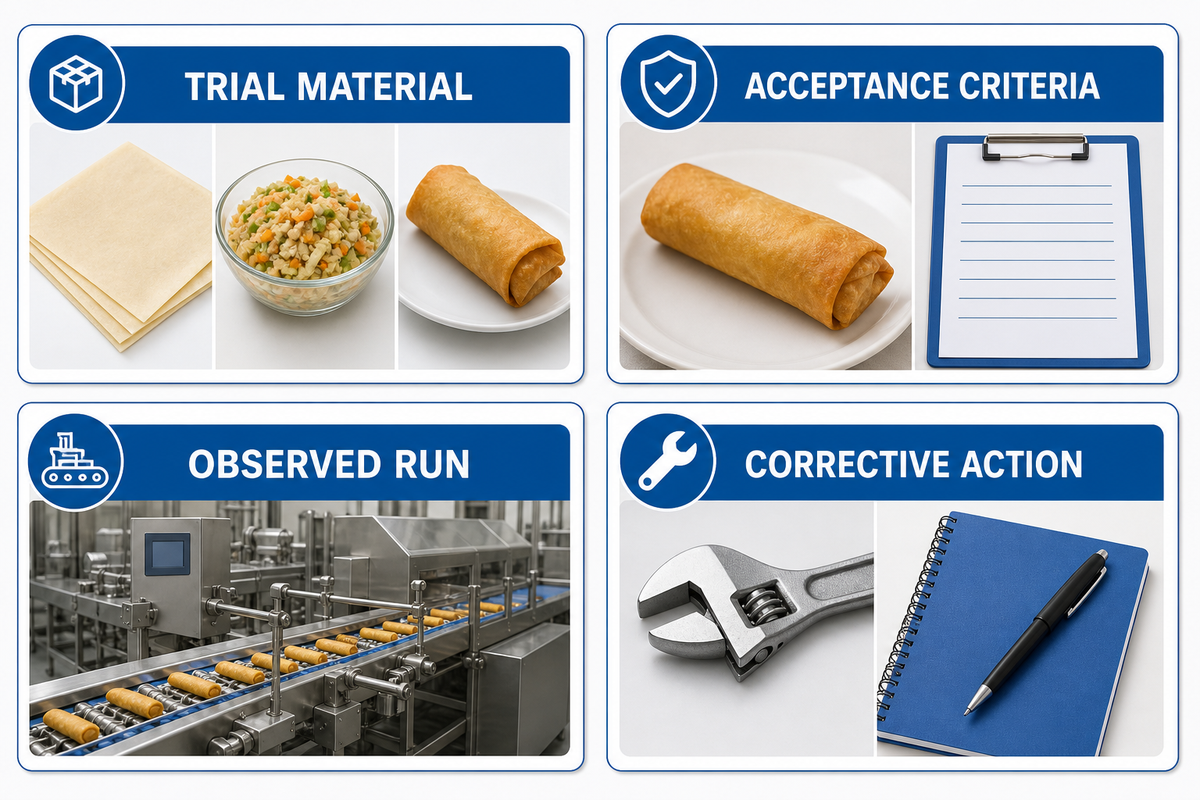
A supplier gap is a procurement risk. Ask for documented evidence from a reproducible factory trial rather than accepting an unsupported promise.
Send an RFQ that describes the product rather than only the focus keyword. Include wrapper samples, filling recipe, target dimensions, accepted rate, shift pattern, utilities, cleaning chemicals, packing interface, destination regulations and service expectations. Ask the supplier to mark every value as measured, rated, estimated or to be confirmed.
Quote-to-Trial Scorecard
- Sample identity and recipe version are frozen.
- Trial duration and warm-up are recorded.
- Gross, accepted and rejected pieces are separated.
- Stop causes, changeover minutes and sanitation steps are logged.
- Utilities and operator count match the proposed installation.
- Acceptance signatures identify what happens if a criterion is missed.
This scorecard turns a demonstration into evidence. It also exposes a common objection: trial conditions may not be reproducible at the buyer’s plant. If you are evaluating UD Company, its supplied company profile states that it has been building egg roll and phoenix tail roll machines since 2003 from two production bases, in Guangzhou and in the Xinyu Hi-Tech Development Zone in Jiangxi. Those are first-party company statements; request current documentation for any specific model, patent, certification or performance value. Before sending an RFQ, use the automatic egg roll machine scope selector to state which stations are actually in scope.
For the entirely commercial summary, see the automatic egg roll machine solution. To keep the solution and the guide separate: the guide outlines your assessment criteria, and the solution could describe the systems offered by the seller and the inquiry procedures.
What drives total cost of ownership
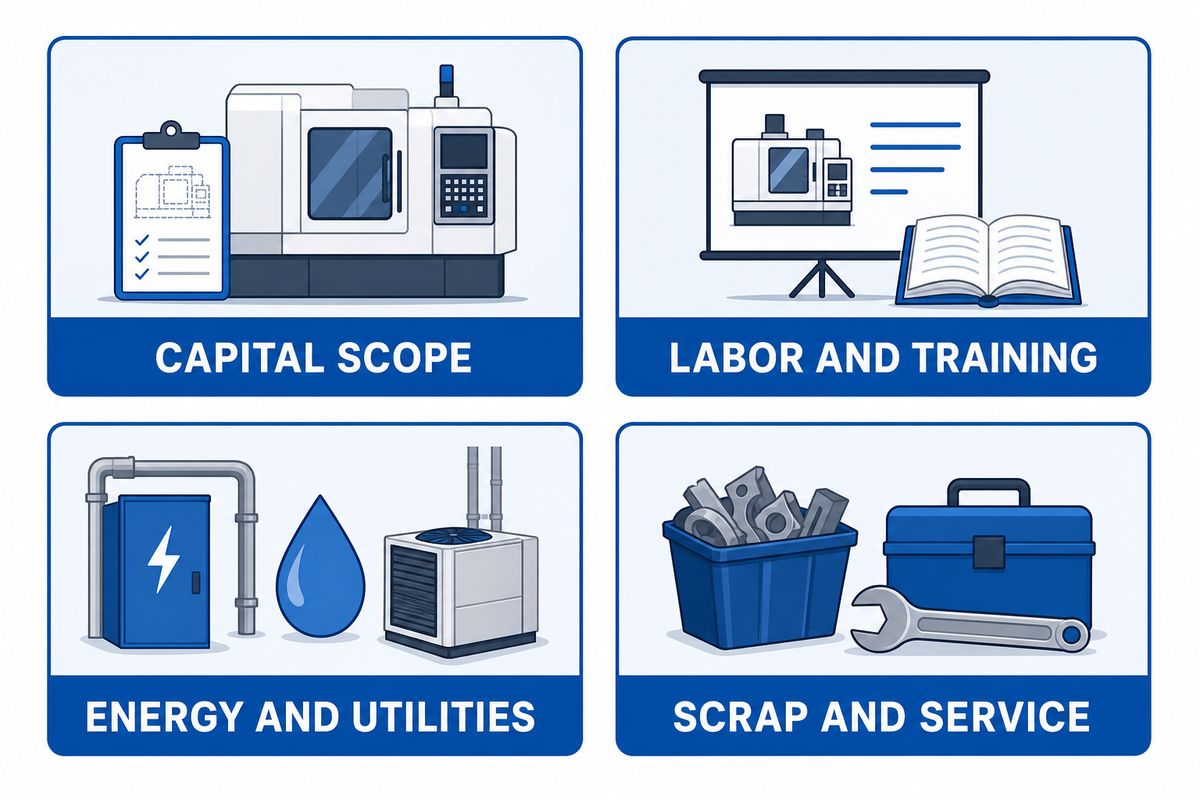
Cost risk grows when a quote hides downtime, labor or service. Use a documented plant scenario and evidence from the factory trial to expose those items. Include purchase, tooling, utilities, labor, sanitation, spares, service, rejects and downtime so a five-year comparison reflects the delivered line. For a first-pass utility view, use the egg roll machine energy cost calculator and replace its assumptions with your measured load.
Two quotes with similar purchase prices can have different five-year costs. Build a comparison sheet with purchase and tooling, freight and duties, installation, commissioning, utilities, labor, sanitation time, spare parts, planned service, rejects, changeover waste and the cost of downtime. Mark unknown values as “to be quoted” rather than filling the gap with an industry average.
| Cost category | Site question |
|---|---|
| Capital | What tooling, sensors, guarding and options are included? |
| Run cost | What are connected load, air, heat, oil and labor requirements? |
| Quality loss | How much wrapper, filling and product is rejected during startup? |
| Service | Where are technicians and critical spares located? |
| Changeover | How many accepted pieces are lost between recipes? |
| Utilities | What kW, PSI, water and exhaust loads must the site provide? |
| Labor | How many operators and sanitation hours are planned per shift? |
| Downtime | What response time and spare-parts inventory protect uptime? |
| End of life | What upgrade, resale or disposal assumptions are documented? |
Public listings and competitor pages can provide orientation, but they do not establish a delivered price for your recipe and country. A credible supplier should be comfortable separating a rated value from a site-specific commitment.
Industry outlook: automation with evidence, not hype
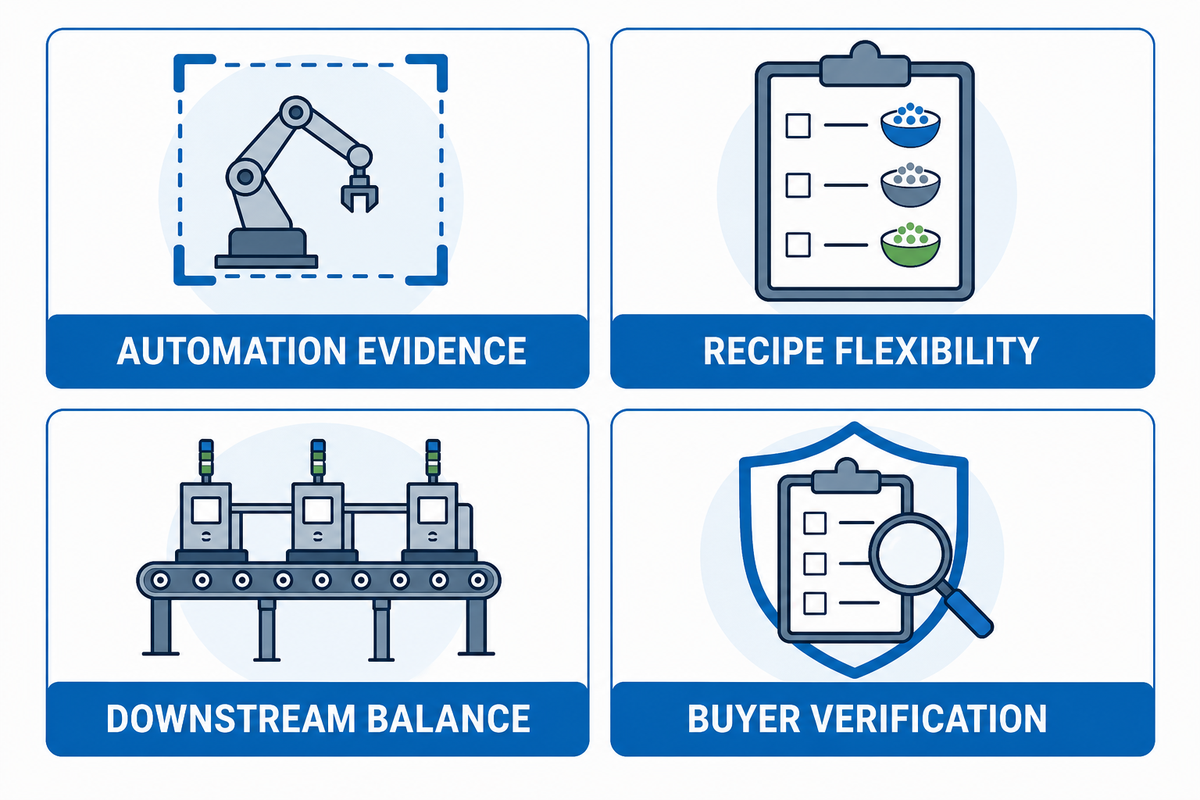
The practical risk is buying automation without a measured constraint. A factory scenario and documented production evidence keep the outlook decision grounded.
The useful 2025–2026 automation signal is a shift toward connected food lines that make labor, traceability, sanitation and changeover visible. A trade search result reported that thousands of new food-production lines in 2025 included automation as part of their design; treat that as an industry context signal, not a promise that every egg-roll project needs the same level of automation. Buyer implication is practical: choose the data you want the line to record before choosing the fastest mechanism.
Ask whether the control system can expose recipe versions, stop causes, reject codes and maintenance events to the people who own quality and production. If the answer is no, a faster machine may create a faster mystery. The right outlook decision is therefore staged: prove the product window, prove accepted output, then add automation that removes a measured constraint.
Frequently Asked Questions
Is there a machine to roll egg rolls?
Yes. Commercial egg-roll and spring-roll equipment can feed wrappers, portion filling and form a consistent roll. The decision depends on your wrapper, filling, geometry, accepted rate, hygiene plan and downstream packer. A supplier demonstration is meaningful only when it uses representative samples and records setup, gross pieces, accepted pieces, rejects, stops and cleaning. For variable recipes or very small batches, a manual or semi-automatic cell may still be the better fit.
How much does an egg roll making machine cost?
There’s no responsible single price for an egg roll making machine without the recipe, capacity, automation boundary, destination and utilities. The total can include forming equipment, filling, frying or heating, cooling, packing interfaces, tooling, freight, duties, installation, commissioning, training and spares. Request an itemized quote and compare five-year ownership cost. Treat marketplace listings as orientation only, not as a delivered project price or a payback guarantee.
How much does it cost to make homemade egg rolls?
Homemade cost is a consumer calculation and shouldn’t be mixed with an industrial line quotation. Add wrapper and filling ingredients, oil or energy, packaging and your time, then divide by the number of accepted pieces. A factory evaluation instead adds equipment, labor, sanitation, utilities, rejects, changeovers, service and downtime. Keeping the two scopes separate prevents a low home-kitchen ingredient cost from being used as an invalid industrial benchmark.
What is the best brand of egg rolls?
“Best” depends on recipe, wrapper, filling, texture, market and quality criteria. For equipment, compare the supplier’s trial evidence, changeover method, service radius, spare-parts plan and documentation rather than relying on a brand label alone.
What is the difference between an egg roll machine and a spring roll machine?
The names can describe different wrappers, fillings, thicknesses, shapes and cooking steps by market. Confirm the actual product sample and forming path. Some equipment can handle related formats with tooling changes; some can’t. The trial should show both products if you intend to sell both.
What should I include in an egg roll machine RFQ?
Include product samples and recipe, wrapper dimensions, filling properties, target geometry, accepted pieces/hour, shift pattern, utility data, floor plan, sanitation requirements, packing interface, destination standards, service expectations, spare parts and a proposed factory-trial scorecard. Ask suppliers to label rated, measured and guaranteed values separately.
References & Sources
- USDA FSIS sanitation performance standards compliance guidance — food-process hygiene context.
- ANSI notice on NSF/ANSI 2-2025 food equipment — dated standards context.
- ANKO egg-roll machine and automatic production line — supplier example, used as a directional benchmark only.
- ANKO ER-24 solution example — supplier-reported output and wrapper options, not a universal promise.
- Food Engineering automated spring-roll machine article — trade context.
- PMMI 2025 food-safety and sanitation trends — industry operating context.
Prepared with product information supplied by UD Company. Company facts in this guide are attributed first-party statements supplied for this article. Patent numbers, certifications, capacities and prices are not inferred where no source was provided.