Get in touch with UDTECH Company


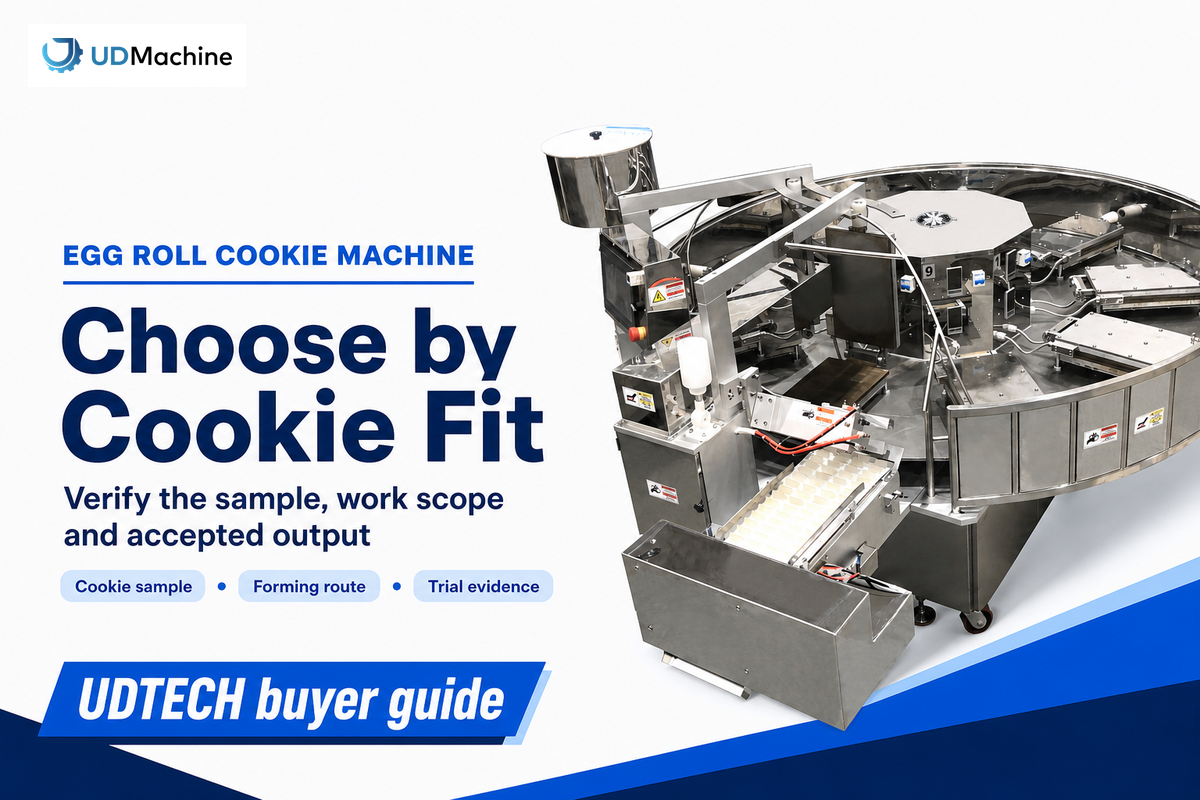
An egg roll cookie machine makes a thin, crisp roll.
A thin, crisp wafer is rolled into a cylinder to make this product. The finished cookie is studied for shape, recipe and filling. Next, the equipment is assessed for handoffs and what’s done manually, and the cooled product is evaluated to see if it meets specifications.
Updated October 2026. This buying guide separates published machine ratings from trial results and provides two worksheets to compare a complete production cell.
Define the cookie before comparing machines
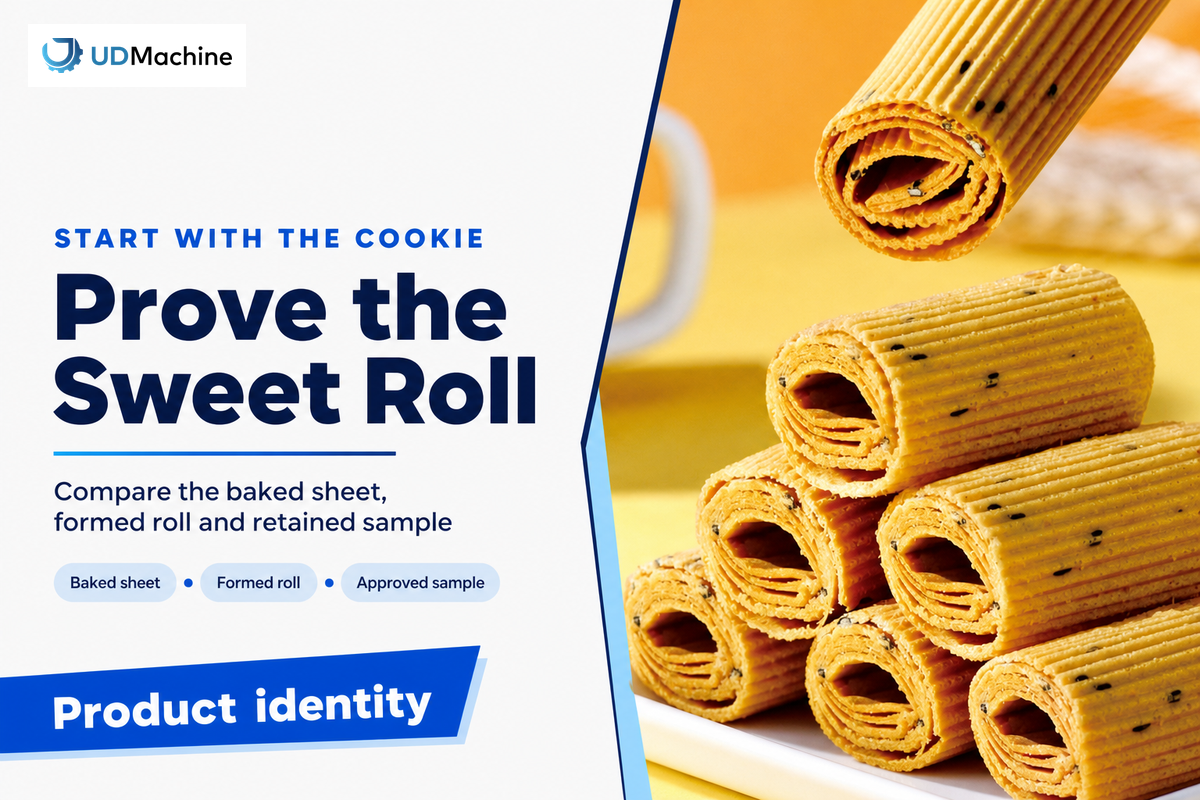
Sweet egg roll cookies are a crisp snack that needs a baking and forming process suited to their thin, brittle structure. Savory rolls use a different route involving wrappers and filling. Providing a whole sample, a cut section and a photo of the output is required before a discussion. A supplier can’t settle on the routes or the end product from the equipment name alone.
| Finished product | Process to demonstrate | Exclusion test |
|---|---|---|
| Sweet rolled wafer cookie | Bake batter into a thin sheet, then form the warm sheet | Reject a demonstration that only wraps a ready-made pastry sheet. |
| Continuous wafer stick | Bake a ribbon, wind the tube and cut it; filling may be added | Check that the resulting wall, seam and bite match your sample. |
| Folded wafer or cone | Bake a sheet and fold or form the required geometry | A round mandrel alone does not establish a folding or cone capability. |
| Savory spring roll or lumpia | Handle a wrapper, dose filling, fold and seal | Do not substitute this route for baking a sweet wafer. |
The table is a method for product identification, not a ranking for capacity. Flour blends, inclusions and filling change what the forming trial needs to prove. For an egg roll waffle with a patterned surface, show both sides of the baked sheet and the final seam.
What kind of machine can I use to make egg rolls?
A thin, crisp wafer is rolled into a cylinder to make a sweet rolled cookie. One product may require a thin wafer baking and rolling system, while another may require wrapping, filling and folding equipment to make a savory filled roll. A breakfast egg cooker makes yet another product. Decide on the product and process shown in a trial and compare production rates.
A restaurant making a few cookies beside other kitchen work has different handling needs from a dedicated bakery. A cookie depositor forms dough for an oven; it does not establish thin-sheet rolling capability. Ask the supplier to identify the batter feed, heating plate, release and forming steps on the offered model. Keep a copy of the approved sample so later changes can be checked against it.
What does automatic actually include?
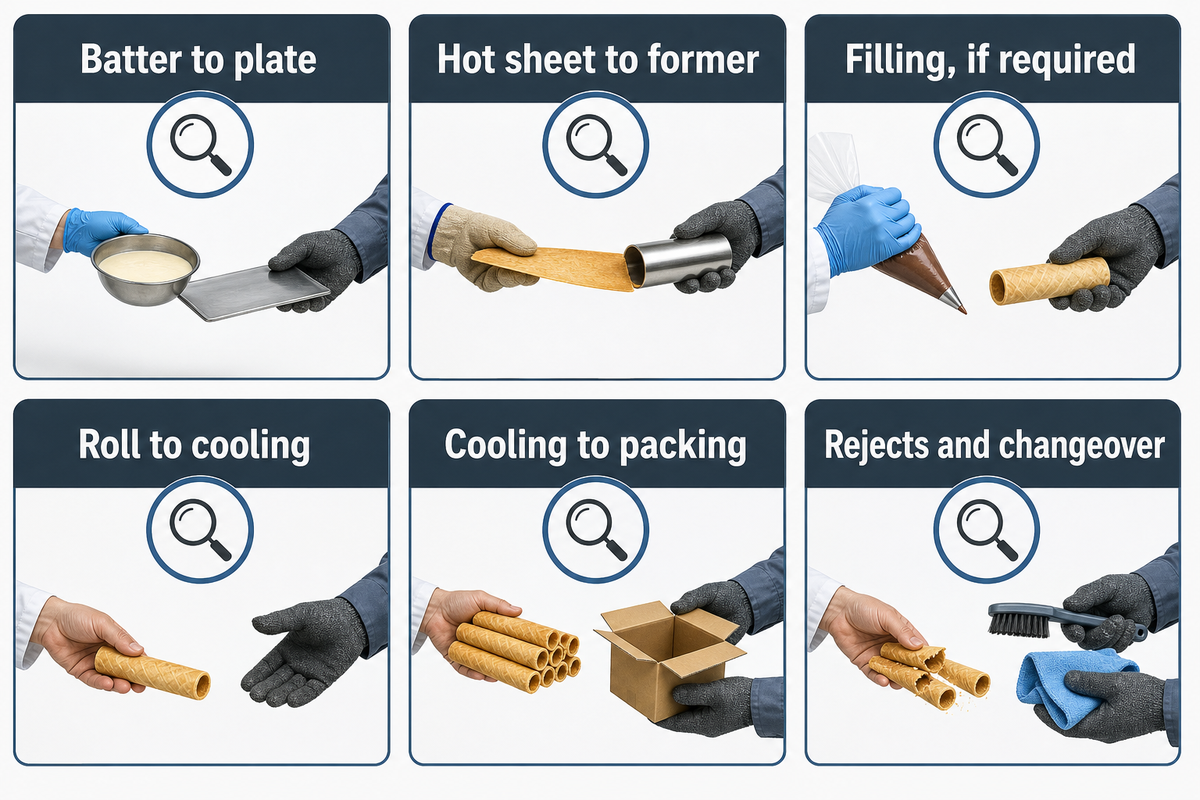
Automatic operation describes specific food processing actions, not an entire factory. Baking plates may move and open automatically while a person still rolls each hot sheet. Unshown steps remain to be verified.
Six-Transfer Staffing Map
The Six-Transfer Staffing Map assigns a work owner and a proof requirement to each handoff between batter, baking, forming, cooling and packing.
| Transfer | Record during the run | Owner to name | Proof needed |
|---|---|---|---|
| Batter to plate | Automatic dose, manual pour or unverified; spills and refills | Operator or dosing system | Uncut view of feeding and replenishment |
| Hot sheet to former | Automatic pickup, hand rolling or unverified; missed releases | Former operator or transfer mechanism | Hands and forming station visible together |
| Filling to roll | Automatic feed, manual topping or absent; filling interruptions | Filling operator or pump | Cut samples and recorded filling condition |
| Roll to cooling | Conveyor, trays or unverified; collisions and tray changes | Transfer operator or conveyor | Discharge and cooling entry in one view |
| Cooling to packing | Automatic loading, manual loading or unverified; queues | Packing operator or loading unit | Cooled pieces entering the actual pack format |
| Rejects and changeover | Removal, cleaning and restart tasks; stoppage duration | Named shift and maintenance staff | Observed recovery and changeover procedure |
Supplier completion fields: Offered model: __________; automatic transfers: __________; manual transfers and assigned operators: __________; unresolved scope: __________; demonstration date: __________. For each row, add the observed failure, its duration and who resolves it. The plant manager can then assign work, procurement can check whether the quoted hardware covers it, and quality staff can identify where the accepted product is counted. A blank row does not mean zero labor.
Imagine a trial in which the plates open automatically, but an operator removes and rolls each sheet. Your staffing map still shows rolling manually. Observe what happens when rolling and carrying cooling trays are combined. A clean demonstration of baking can’t resolve that overlap. A line may already automate those transfers; record the mechanism instead of assuming that every small machine needs the same crew.
To decide if an egg roll making machine will be efficient for your operation, name the work removed and the work retained. Some systems automate cleaning functions. Assess cleaning efficiency separately from production speed: routine operation, sanitation and maintenance are separate scopes.
Match the baking and forming route
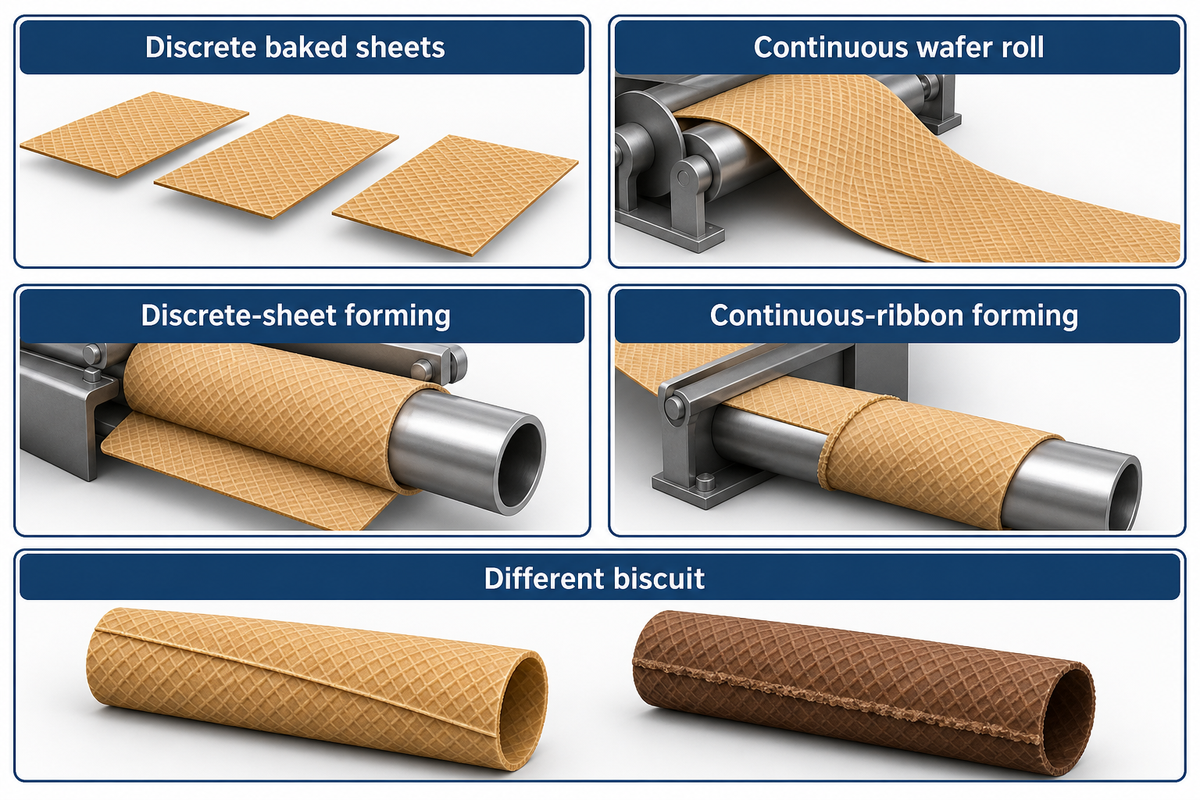
The baking route must reproduce the cookie’s geometry before its rated speed becomes useful. Rotary systems and plate machines are suited for discrete baked sheets. A continuous wafer roll machine forms a ribbon into tubes for high-volume production. Review the former, filling method and recipe together, since a faster route may result in a different biscuit.
| Product or model case | Published reference or route | Buyer check | Limitations / Not suitable for |
|---|---|---|---|
| YT-06 plate machine | 300 pieces/h; 5 kW heat + 0.8 kW drive | Prove the sheet, roll and retained handwork | Rating alone does not establish your recipe’s accepted output. |
| YT-12 plate machine | About 600 pieces/h; 10 kW heat + 1.1 kW drive | Check all loading and forming tasks | Do not assume twice the plate capacity halves staffing. |
| YT-02DJ rotary machine | 500–600 pieces/h; 9 molds | Witness release and forming with your sample | A compact rotary platform is not a continuous wafer-stick line. |
| UD05-2 continuous line | 220 pieces/min; 600 kg/8 h | Match product mass and filling basis | The two ratings do not prove your cookie weighs the implied amount. |
| UD05-3 continuous line | 330 pieces/min; 900 kg/8 h | Confirm the required tube geometry and downstream rate | A higher rate does not establish demand or packing capacity. |
| UD-02 phoenix roll route | 720 pieces/h; 12 kW | Demonstrate the specified topping and folded form | A specialty folded product is not interchangeable with every hollow roll. |
| YT-02G specialty route | Product trial and project-specific specifications | Request the exact model sheet and filling method | Do not borrow another manufacturer’s model data. |
| Hand-rolled thin wafer | Plate bake followed by manual forming | Time hot-sheet handling and tray movement | An automatic opening feature does not prove automatic rolling. |
| Savory filled wrapper | Separate wrapping and folding route | Identify the wrapper and filling process | Not a substitute for baking sweet wafer cookies. |
Source basis: The information is from UDTECH’s publicly available product pages, checked in October 2026. These are manufacturer-listed values with different product and time bases, not a matched comparative test. The Continuous Wafer Roll Line page provides the UD05 specific details. Be sure to retain those model numbers when requesting a quotation.
Cases that justify postponing a machine choice
Postpone model selection if a supplier is unable to reproduce the required wall thickness or seam. A machine offered at 330 pieces/min isn’t necessarily better than one at 600 pieces/h when it makes a different product. A hollow sample doesn’t qualify a cream-filled sample. The filling method, cut section and final pack need to be part of the trial.
Postpone the comparison if a supplier names a model without providing a technical sheet. The YT-02G route needs to be taken on a project basis; a visually similar machine doesn’t address this gap. Also postpone the purchase decision when the proposed equipment cannot be placed with access for operators and cleaning. A drawing of the bare frame isn’t sufficient for this.
The next useful action is a sample trial or revised layout, not a larger motor or higher catalog speed. A versatile machine still needs to demonstrate each agreed product. Keep exclusions in the written offer so a later change in filling or geometry doesn’t alter the project without notice.
Compare output on your cookie and your shift
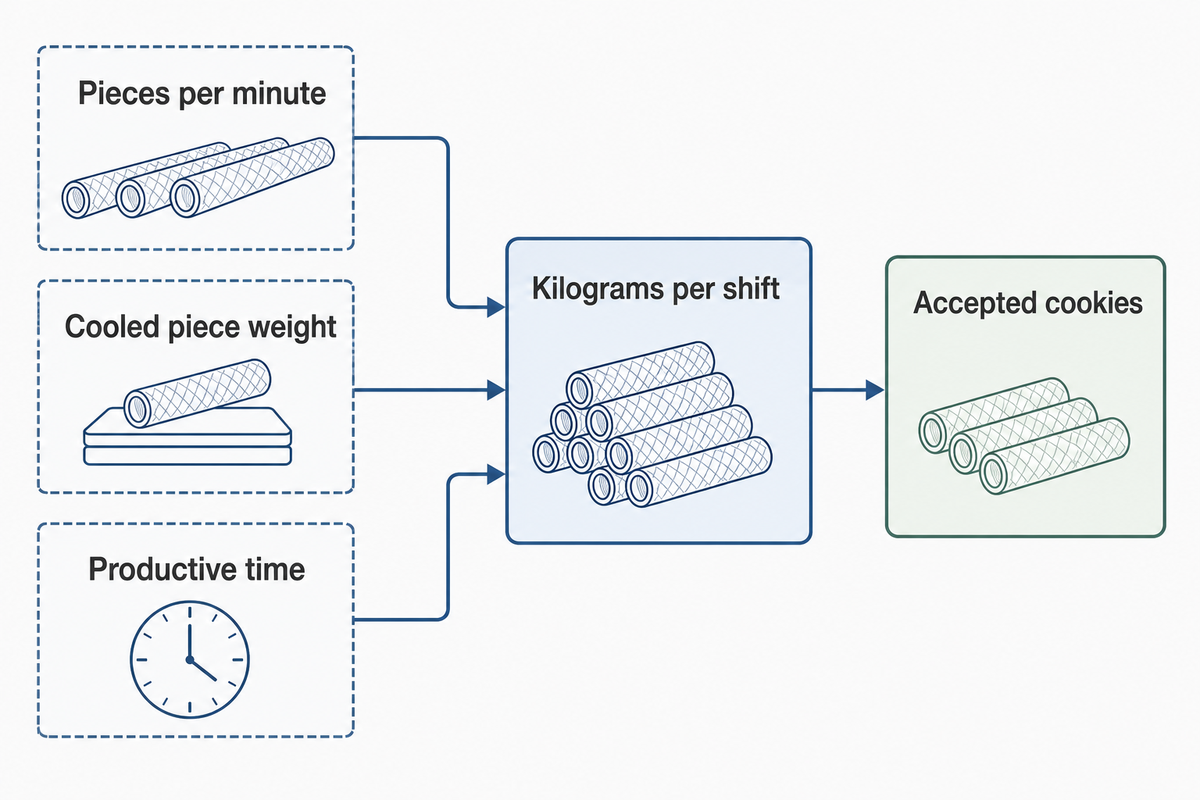
Similar output data should have the same cooled piece weight, filling condition, and time basis. Pieces per minute is a count rate; kilograms per shift also depend on mass of product and time of production. State whether each piece of data is based on all product discharged or only accepted cookies before conversion or applying a yield factor.
UDTECH publishes 220 pieces/minute and 600 kg per 8-hour shift for UD05-2. If both figures relate to the same product and continuous 480-minute production, 600,000 ÷ (220 × 480) equals approximately 5.68 g/piece. That is catalog arithmetic, not a measured cookie weight or proof of sustained output with your batter.
Take a hypothetical plan for a bakery aiming for 600 pieces/hour, 20 g finished cookie, and a productive time of six hours. Gross output = 600 × 20 × 6 ÷ 1,000 = 72 kg. If 95% of the output meets the acceptance criteria, the net output is 68.4 kg. If the planning figure of 600 pieces/hour already refers to accepted output, then considering the loss again in multiplying by 95% would account for the loss twice.
Matched-product run record: Recipe/sample ID: __________; cooled piece mass: __________ g; filling condition: __________; elapsed run: __________ min; accepted pieces: __________; rejects: __________; stop time: __________ min; people attending: __________. Be sure to describe the counting boundary with these values.
The arithmetic establishes a relationship for planning purposes. It does not show that a particular machine can bake a 20 g piece, maintain stable output at that rate, or achieve the assumed acceptance. Representative cooled samples should be weighed during the trial, and the fill mass should be held constant. More filling can increase kilograms per hour without increasing the number of wafers baked.
Use the existing guide to plan a shift around saleable output for detailed sizing, and trace output losses through the line when the bottleneck is after baking. This comparison needs one shared counting boundary, not another headline capacity number.
Approve the cookie before the production rate
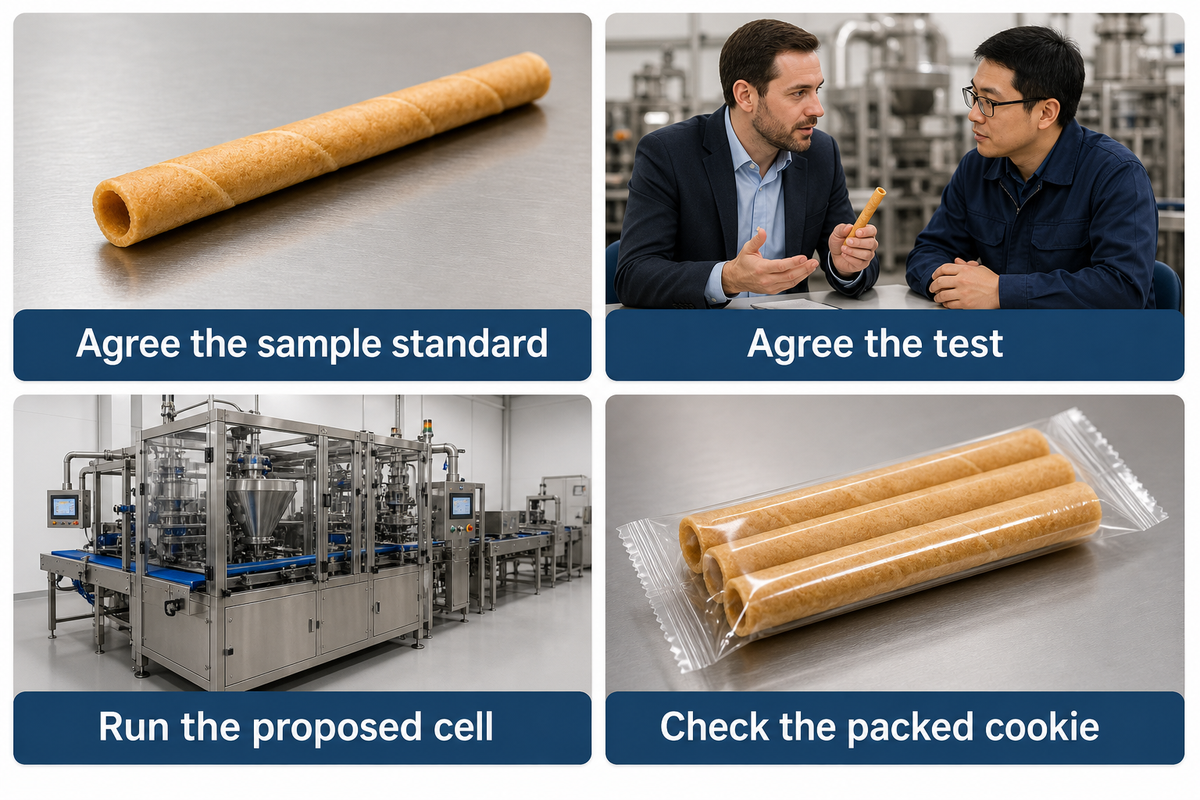
A useful acceptance trial defines the sample and the point at which it’s judged. Agree on dimensions, color, filling and breakage criteria before timing output, then examine the cooled cookie in its intended package. Separate those product-quality checks from food-safety process validation and from storage-life testing.
NIST’s measurement traceability guidance explains why traceability alone doesn’t show fitness for a measurement task. Be sure to determine the instrument and method as well as the tolerances. For example, decide where to check for uniform thickness and whether piece mass includes filling; a scale reading without those definitions cannot resolve a disagreement.
A 2025 flat-wafer baking-plate study has shown differences in thermal distribution and wafer uniformity under its stated test conditions. It supports checking that the sheet bakes evenly at the intended rate. Its results do not establish a material upgrade, operating temperature or improvement percentage for UDTECH rolled-cookie equipment.
- Freeze the sample — identify the formula, flour blend, geometry and filling condition.
- Agree the test — define productive time, measurements, acceptance limits and who observes.
- Run the proposed cell — record stops, interventions, gross pieces and accepted pieces.
- Check the packed cookie — compare retained cooled samples and record the pack used.
Hygiene also relies on access and appropriateness of each contact part. A 304 stainless steel enclosure does not identify every food-contact component. Request the part specific material specification, the intended use of the non-stick coating, and an appropriate cleaning method. Heat-resistant parts still require a stated service limit.
“adequately cleanable”
The FDA food manufacturing practice framework covers more than the equipment surface. Under applicable US requirements, 21 CFR 117.160 addresses validation of preventive controls and lists exceptions. Have the responsible food-safety lead assess the process; a crisp, attractive sample does not establish its microbiological suitability.
Store samples for separate recipe-and-packaging storage work. A successful run on the purchase date can’t prove the cookie’s quality throughout the claimed shelf life. Discuss cleaning and maintenance planning to show access and restart tasks prior to equipment arrival.
Build a quote that includes the missing work
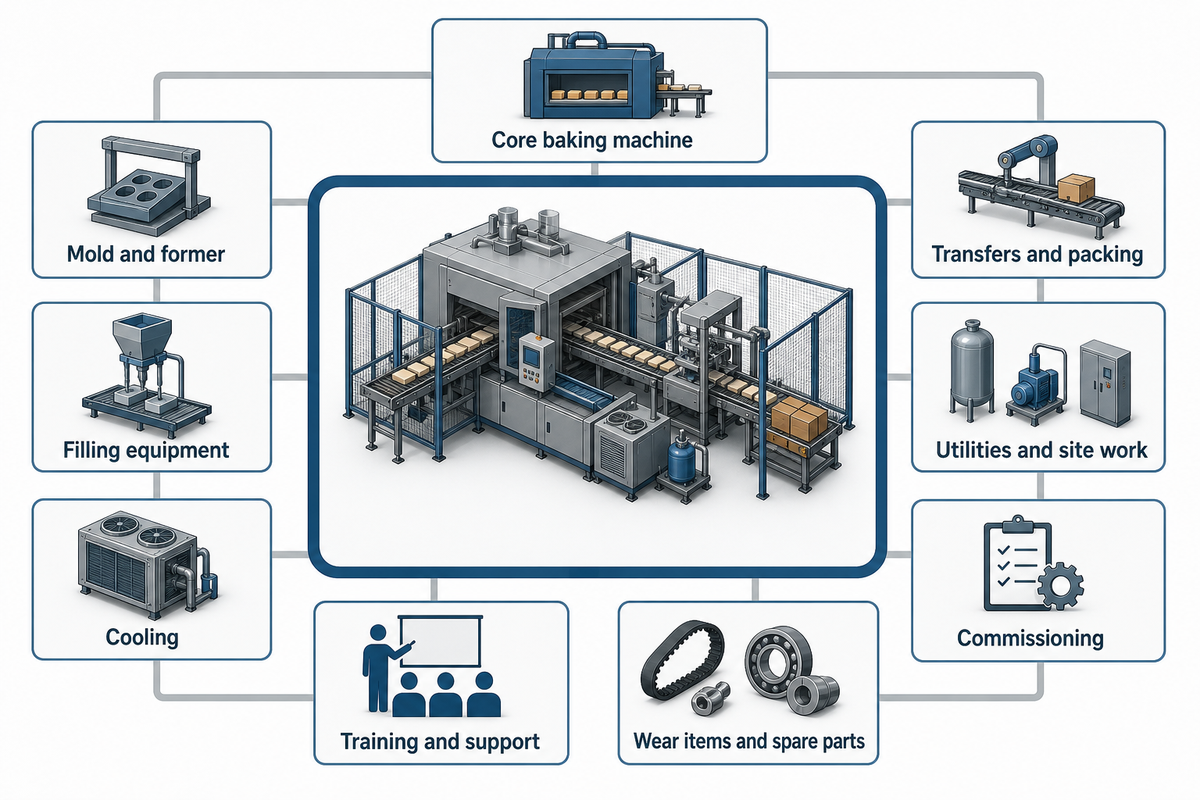
A complete quotation outlines the conditions used to price the project and the work to be performed by the buyer and equipment to be supplied by the seller. Cooling, transfer, and commissioning may be bundled together or performed separately. Request an explicit scope against the same cookie, output basis, and equipment to be supplied, before comparing the totals.
How much does a cookie machine cost?
The right price for an industrial egg roll cookie machine is a quotation for a specific product and scope. It isn’t a price band for generic cookie-cutter equipment. Indicate the forming route, required output and included handling, and request the machine price and installation items separately. This guide doesn’t set a current market price range.
A household maker, dough depositor, and wafer production line all do different jobs and therefore have different prices. A price for one can’t be substituted for another. A quotation, dated with the model, delivery terms, currency and validity, should be provided. Compare what’s included before comparing the headline price. Ask the supplier to provide a price for any work that isn’t included.
Same-Cookie Quote Split
The Same-Cookie Quote Split separates the core machine and product handling and site work so competing offers can be compared against one approved cookie.
| Scope line | Supplier entry to request | Buyer decision | Limitations / exclusions to record |
|---|---|---|---|
| Core baking machine | Model, rated basis and price | Does the trial match the product? | Different recipes are not a matched price comparison. |
| Mold and former | Included sizes and change parts | Can the specified thickness and seam be made? | A sample size does not prove every requested size. |
| Filling equipment | Pump, contact parts and adjustment range | Who proves the filled sample? | Hollow output alone does not qualify a filled cookie. |
| Cooling | Conveyor or trays and handoff | Can the cooled product reach packing? | Bare machine output excludes unproved cooling capacity. |
| Transfers and packing | Loading method and pack format | Which tasks remain assigned to people? | Unquoted downstream equipment is not included. |
| Utilities and site work | Connection loads, fuel, air and layout | Which installer owns each connection? | Nameplate load is not an energy-use measurement. |
| Commissioning | Trial scope, travel and acceptance record | What evidence closes the installation? | Product quality is not all safety or regulatory review. |
| Training and support | Language, tasks and response arrangement | Can the shift operate and recover faults? | Do not assume unlimited on-site support. |
| Wear items and spare parts | Initial kit, part codes and lead times | Which items must be stocked locally? | Consumables and replacement labor may be separate. |
For the budget owner, the US Department of Energy’s acquisition-cost method separates equipment and installation from energy, maintenance, repair, replacement and disposal. Those categories are useful here; the training’s federal purchasing rules and lighting examples aren’t bakery price evidence.
Suppose one proposed arrangement needs two additional operators for six hours, at an assumed total hourly cost of $20 per person. The additional shift labor would cost 2 × 6 × $20 = $240. That isn’t a local wage estimate or anticipated cost-savings. For support in determining whether a higher cost handling option would be warranted, consider your staffing observations and actual employment costs.
Choose a supplier that can prove product fit
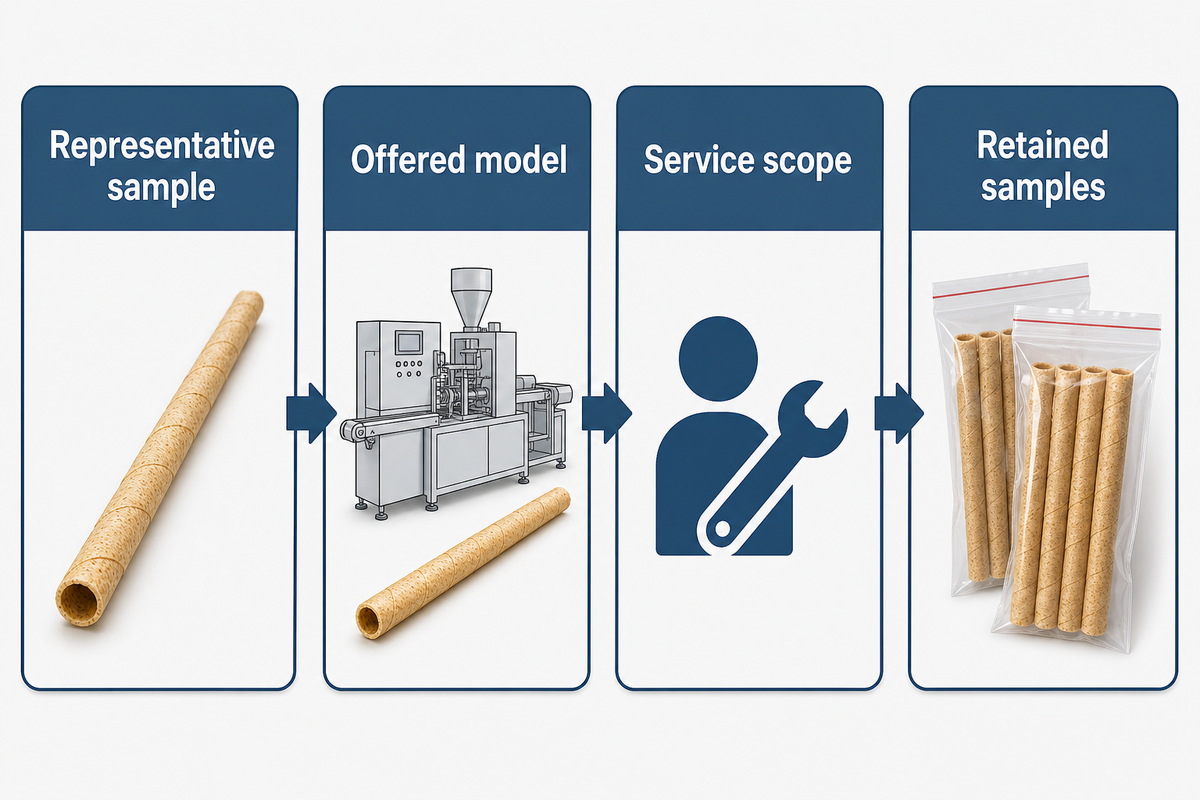
A short-listed supplier should provide a representative sample trial of the offered model and define the written scope of the service offered. Factory photographs, a marketplace listing or an automatic label cannot establish that connection. Confirm who supplies the machine, who supports it at your location and which exact build the demonstration represents.
Where can I buy an egg roll machine?
You can source a commercial egg roll machine from a machinery manufacturer or a distributor that can demonstrate the correct food process. Start with your cookie sample and required handling scope, then compare written offers. Marketplace listings can introduce suppliers, but the listing itself does not verify product fit or installation support.
For a UDTECH enquiry, review the automatic egg roll machine configurations and send the sample with your proposed shift and pack format. Verify the UDTECH company details against the legal entity on the quotation. Request the supplier to identify the tested model rather than showing a video of some other production line.
A recorded demonstration is most useful if the identity of the equipment, time and manual work remain part of the evidence. Retain samples from that run. If you request the supplier to customize the former or filling system, agree how that changed build will be checked before it’s sent; a test of the standard machine doesn’t settle the customized scope.
“This testing process also provides an opportunity to learn from the data generated.”
Howard’s observations regarding workcell planning and testing from an automation supplier’s perspective justify the request for useful evidence from a trial rather than support a specific cookie machine.
Connect the machine to cooling and packing
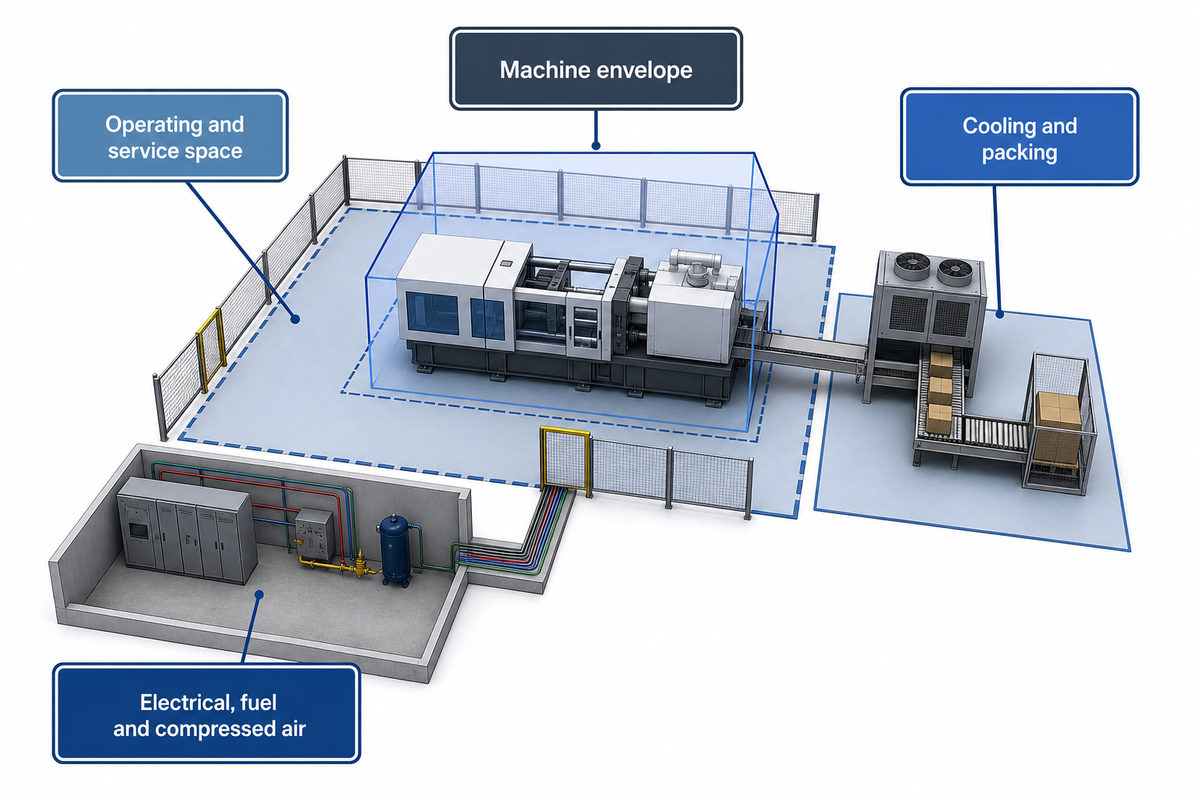
The machine, its utilities and the space needed to operate, clean and service it form part of the installed automation cell. Match cooling and packing to the agreed, accepted output rate, and draw the actual handoff points. Electrical, fuel and compressed air should be shown separately in the requirements definition and layout reviews.
The YT-02DJ rotary specifications list 22.5 kW heating, 1.5 kW transmission, three-phase 380 V and 0.4–0.7 MPa compressed air. The listed 2700 × 2100 × 1500 mm dimensions describe the machine envelope. Allow additional space for operating and servicing in the project drawing; those dimensions do not define the complete installed footprint.
On the separate UD05 line, the published 9.7/12 kW electrical figures sit alongside LPG consumption of 6/8 kg/h or natural gas of 8/10 m³/h. Treat LPG and natural gas as alternative fuel specifications and don’t add the two together. The site’s competent installer needs the connection schedule, air flow and burner details for the model selected.
According to the 2025 Carolina Foods automation report, packing and cooling are sequential activities. Its honey-bun and donut plant is not an egg-roll case, but the handoff question transfers: what reaches the packer, in what condition, and who responds if packing stops? Test the actual cookie and pack instead of borrowing that plant’s results.
For US projects, OSHA’s bakery-equipment requirements cover installation and safeguards for fuel, air and ignition failure protection for direct-fired ovens. Have qualified project personnel assess the combustion, emergency stop and guarding arrangements. This guide doesn’t assess that a listed model meets all the destination requirements.
Key takeaway
Approve the cookie, map the six handoffs, and compare written scope before choosing the rated speed. A machine becomes a workable purchase when the product and the surrounding cell are both demonstrated.
The fields requested for your enquiry are given below. Numeric examples in the table are published YT-02DJ references and aren’t suggested limitations for every cookie line.
| Parameter | Recommended range | Why it matters | How to verify |
|---|---|---|---|
| Cookie size and mass | Buyer-defined mm and g limits | Makes quotations refer to the same product | Measure retained cooled samples |
| Accepted output | Buyer-defined pieces/h or kg/h | Sets the counting and time boundary | Record gross and accepted pieces |
| Electrical supply | YT-02DJ reference: 380 V, three-phase | Checks site compatibility | Obtain selected-build connection drawing |
| Connected loads | YT-02DJ reference: 22.5 kW heat + 1.5 kW drive | Separates loads from energy consumption | Installer reviews the load schedule |
| Compressed air | YT-02DJ reference: 0.4–0.7 MPa; flow to confirm | Pressure alone does not size the supply | Request required flow and air treatment |
| Operating space | YT-02DJ envelope: 2.7 × 2.1 × 1.5 m, plus project clearances | Preserves access around the frame | Review the installed cell drawing |
Egg roll cookie machine FAQs
Is an egg roll cookie machine worth it?
A machine can be worthwhile when it makes the approved cookie and removes a measured production constraint.
Compare the installed cost with retained labor, breakage, cleaning time and usable output from a representative trial. A faster baking cycle alone may leave rolling, cooling or packing unchanged. Use observed tasks and your own shift costs to assess the purchase. Include demand and available service support, because a high rating does not guarantee enough saleable orders to use it.
Which egg roll cookie machine is best?
The best fit is the machine that proves your cookie and required handling scope under agreed trial conditions.
Start with a sample rather than a universal model ranking. Compare the forming method, dimensions, recipe and amount of manual work. Ask shortlisted suppliers to demonstrate the same product and record the same acceptance boundary. A compact model may fit a small batch better; a continuous line needs a product and downstream arrangement suited to its forming route.
Is an egg roll cookie machine safe?
An automatic label or stainless enclosure cannot establish that an installed cookie machine is safe.
Ask for the electrical drawings, guarding information, operating instructions and cleaning procedures for the exact build. Have responsible specialists assess hot surfaces, moving mechanisms, stored energy and the installation requirements at your destination. Keep product-quality acceptance separate from this assessment. A sales video or an unrelated certificate does not replace the required review of the machine and its actual use.
What if we do not know how to use the machine?
Put operator training and supervised startup in the quotation.
Confirm the training language, adjustments, cleaning tasks and fault-recovery procedures. Name who provides ongoing support and what response arrangement the offer includes.
How can I visit your factory?
Arrange the visit with the supplier and confirm the address and machine before booking travel.
Send the cookie sample and trial requirements in advance so the visit includes a useful demonstration. Ask which offered model will be available, who will run it and whether you can retain samples. If travel is impractical, request an uninterrupted remote trial with identifiable equipment, elapsed time and visible manual handling. A tour establishes what you observed that day; it does not verify an untested build or every promise in a quotation.
Where will the machine be shipped from?
The quotation should state the shipping origin and delivery terms.
Factory location, export port and final delivery point can differ. Agree who arranges transport, unloading and installation, and where each party’s responsibility begins.
What is the best home cookies making machine?
Choose a domestic appliance for the particular cookie and the handwork you expect.
A cookie press shapes dough for a separate oven, while a thin-wafer iron bakes a sheet that may need immediate hand rolling. A small maker is not automatically a miniature industrial line. Follow the appliance manufacturer’s intended-use instructions and supply requirements. This guide concerns commercial sweet-roll production; household ratings do not establish repeated bakery-shift capacity, and an ice-cream cone accessory does not prove the required rolled-cookie geometry.
How this cookie-machine guide was prepared
UDTECH supplies egg roll and wafer equipment, so this guide takes a supplier’s perspective on product fit and quotation scope. Published catalog ratings were checked against the relevant product pages; the staffing and cost examples are proposed buyer methods, not private factory trials. Measurement guidance and the cited studies inform the questions to ask, without certifying a particular build.
References & Sources
- NIST, Metrological Traceability
- eCFR, 21 CFR 117.40, equipment and utensils
- FDA, Food current good manufacturing practices
- eCFR, 21 CFR 117.160, validation
- Applied Sciences 15(1), 466, flat-wafer baking-plate research, 2025
- US Department of Energy, Life Cycle Costs for Acquisition, 2024
- Food Engineering, Modularity in production lines, 2020
- Food Engineering, Carolina Foods automation case, 2025
- OSHA, 29 CFR 1910.263, bakery equipment