Get in touch with UDTECH Company


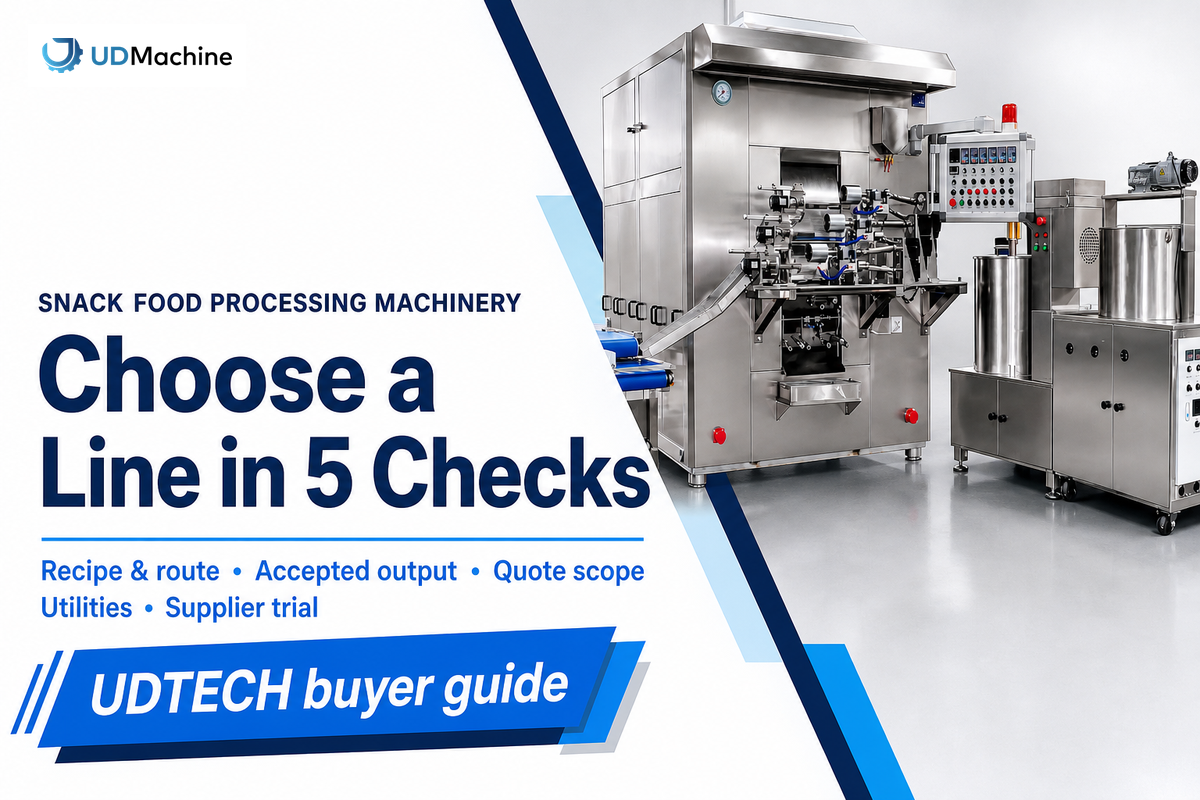
Snack food processing machinery converts ingredients to a finished product through preparation, forming, heating and further processing. First select a process route and then check the accepted outputs, utilities and quotation’s scope of supply. A machine that shapes ingredients to the right size may still leave packing as the limiting step.
Start with a finished sample and outline the packed quantity per shift. This guide uses UDTECH’s published catalog figures as selection inputs and provides a worked example you can replace with your own trial measurements. Product information was checked in October 2026.
What machinery does your snack product actually need?
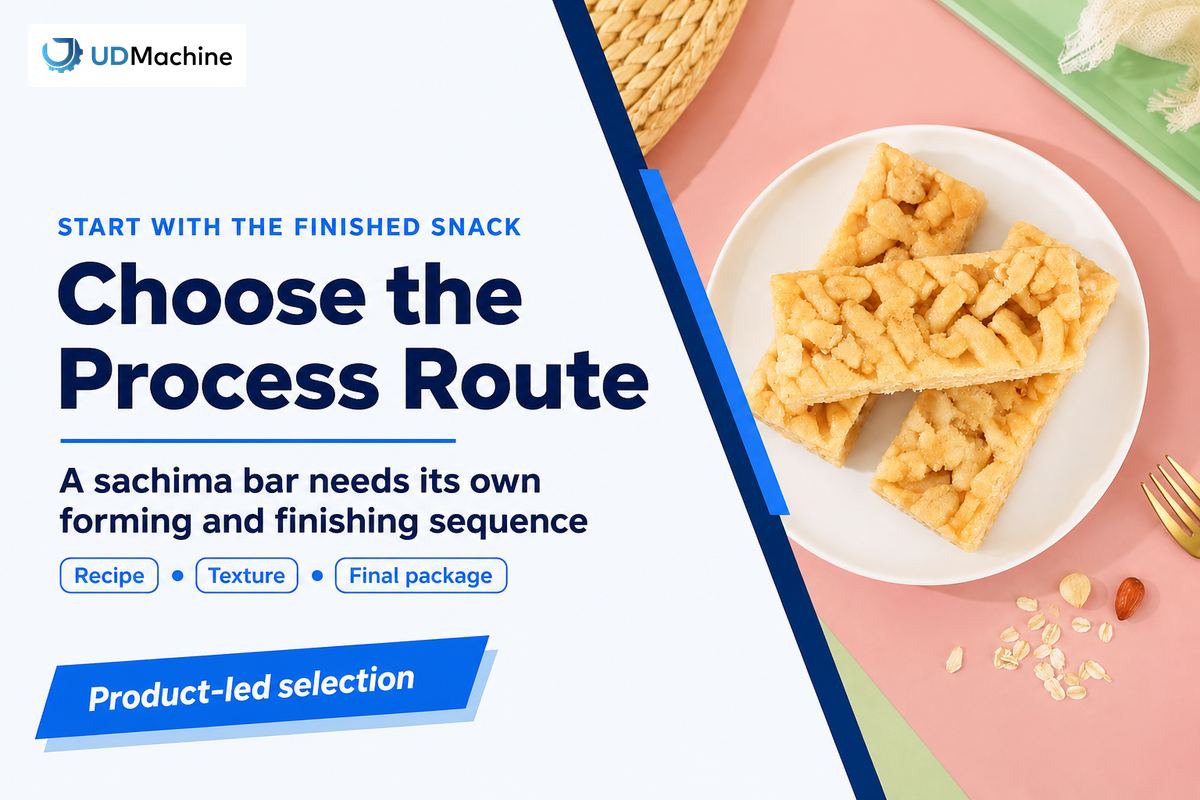
A snack food production line requires machinery matched to the forming method and the heat treatment of the food. Different routes can be used to prepare a finished product made of the same ingredients based on the method of forming. Define the desired finished texture and moisture and the packaging before choosing a process.
Five-Route Snack Selector
Five-Route Snack Selector is a list of products grouped under expanded extrusion, baking, dough frying, fresh slice frying or pellet finishing.
| Product target | Process to demonstrate | Downstream check |
|---|---|---|
| Corn puff snack | Mix and cook-expand a flour blend through a snack extruder | Recipe-specific drying, coating and packing |
| Filled puff snack | Extrude the shell with a filling module and form it | Filling distribution, closure and breakage |
| Wafer roll | Bake a thin sheet and roll it while formable | Cooling and fragile-product transfer |
| Folded wafer | Bake the sheet and fold to the agreed geometry | Fold integrity and package fit |
| Soft waffle | Dose batter into heated molds and release the baked product | Cooling, stacking and package condition |
| Biscuit or mini bun | Deposit or form dough and bake | Piece consistency and oven discharge |
| Sachima bar | Form dough strips, fry, bind with syrup and cut | Cooling before wrapping |
| Fresh potato chips | Prepare and slice potatoes, then fry | Oil handling, seasoning and bag filling |
| Pellet-based fried snack | Finish purchased or separately produced pellets | Expansion, oil removal and coating |
The matrix compares various types of snacks rather than ranking interchangeable machines. These different types of snacks require a type of machine matched to the forming route. Check baked wafer and egg-roll equipment, waffle and pancake lines or biscuits and mini-buns equipment against the product sample. A chips machine with a slicer takes care of a different raw material from a flour-fed extruder machine. Vegetable processing at a potato production line’s inlet doesn’t prove flour-extrusion capability.
Common mistake: A processing machine should be judged on more than just its name. Both a potato chips production line and a cereal-flour snack food machine can make a crispy bite, but one may have the preparation or forming capability that the other lacks. Reject a trial that substitutes another product for the one in your specification. Trials for snacks like banana chips should use the intended raw material and the cut geometry.
Which snack making machine matches your recipe?
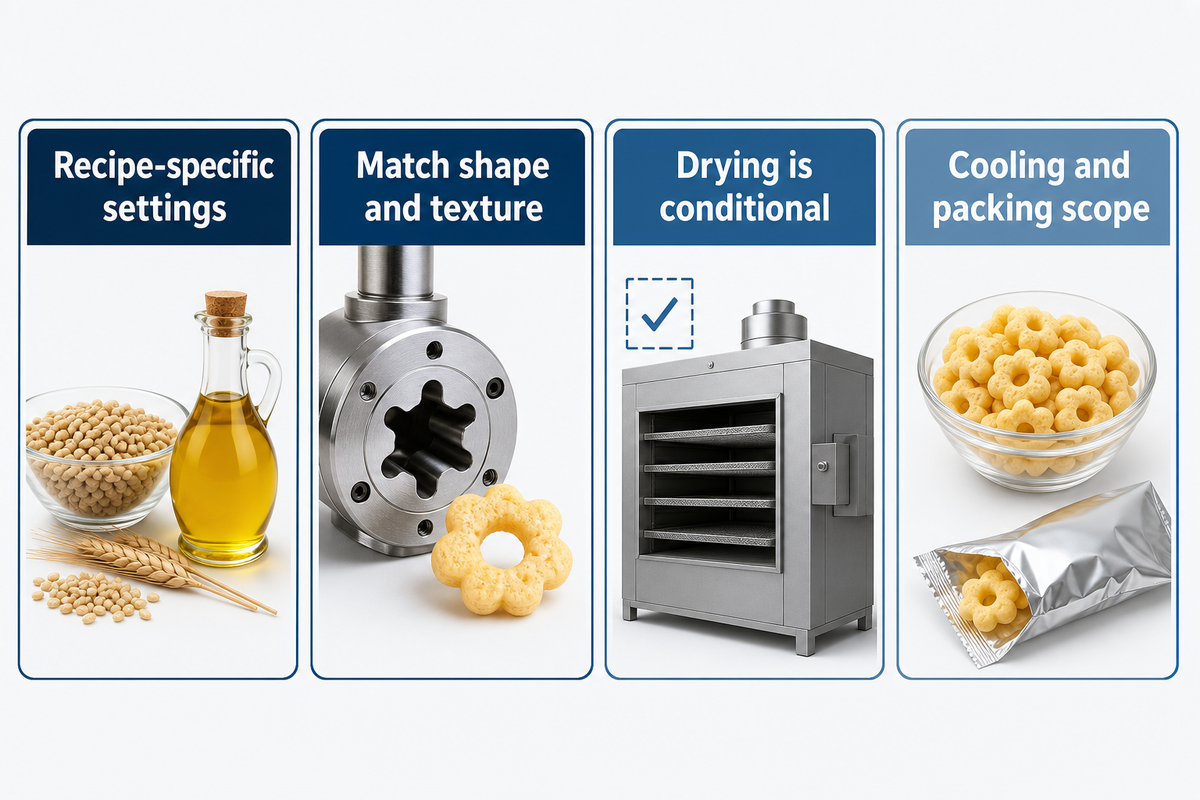
A snack making machine works with your ingredients to make the product that you want. Evaluate the flour blend, inclusions, fillings, and finish geometry. Replacing a die or mold can produce different shapes, but it doesn’t prove the recipe will act the same on equipment as the previous recipe.
An offered rice machine for grain preparation isn’t sufficient evidence of puffing capability. For a pretzel trial, the forming and baking modules should be specified and evidence of the product should be shown.
Does a food extruder make the finished snack?
A food extruder can form and cook a material through a die, but the finished product may still need frying, coating, cooling, and/or packing. Expanded and filled products also need different downstream arrangements. An extruder manufacturer should show the equipment for each stage of the entire process for a recipe, and a puffs machine trial should evaluate the offered drying and coating stages.
A screw extruder designed to produce puffed food requires recipe-specific adjustments. Maize flour, oil additions and barrel temperature affect expansion and texture; a published 2025 corn-snack extrusion experiment illustrates that relationship under its own test conditions. Specific mechanical energy isn’t total energy consumption of the factory.
Drying is conditional. A trehalose-based direct-expanded formulation without oven drying is described in the EP2744350A2 patent publication. That example does not establish your recipe’s suitability, commercial throughput or UDTECH patent ownership. The route you propose must be evaluated for reaching the agreed moisture and texture levels.
UDTECH’s YT-30 sachima page lists eight core stations: dough cutting, pressing/forming, secondary proofing, frying, buffering, sugar boiling, sugar mixing and shaping/cutting. Packing follows the core process; include upstream dough preparation, cooling and the food packaging machine only when the quotation names them.
Let’s consider the case of the buyer of a fried snack bar who approves the forming sample, but wishes for individual flow wrapping. Warm bars that look correct at cutting may still need cooling before the wrapper. The trial must follow the product through that hand-off. An offered snacks making machine remains incomplete until the buyer’s requirement is met, if the agreed package can’t be made at the required rate.
Snack production line capacity: compare the same boundary
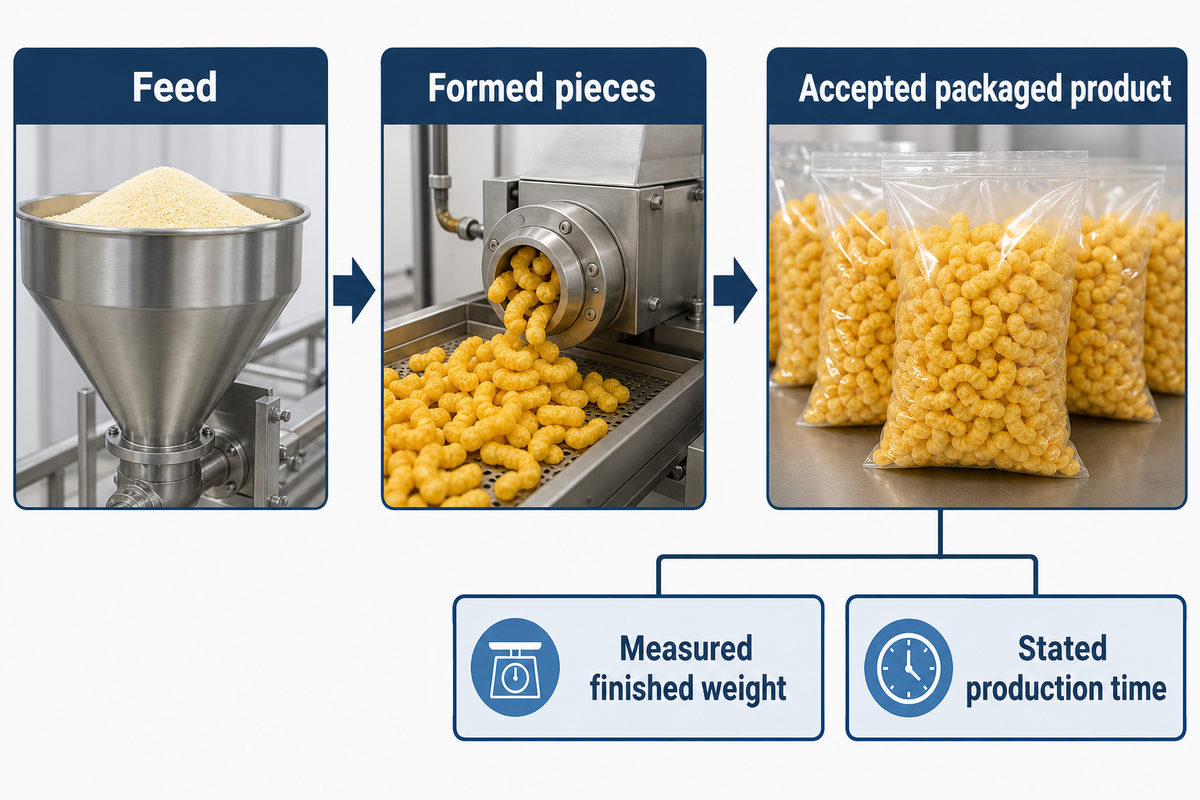
Compare snack production line capacity at the same output point, in the same units and over the same period. Indicate the rating means feed, formed pieces or accepted packaged product. Piece counts need a measured finished weight before conversion to kilograms; daily figures need a stated production-time basis.
NIST’s manufacturing indicator research separates throughput, availability, and quality metrics and their connections. Measuring machine utilization can’t show whole-line packout. If a measured rate already counts accepted pieces, don’t apply the same reject allowance again.
Three-Boundary Output Worksheet
Three-Boundary Output Worksheet: A comparison of the catalog rating, measured finished output and accepted packaged output using one declared time basis.
| Catalog model | Published output | Listed electrical load | Separately listed natural gas |
|---|---|---|---|
| YT-12HT | About 500 pieces/h | 11.1 kW | Not stated in this overview row |
| YT-02 | 780 pieces/h | 12 kW | Not stated in this overview row |
| YT-02D | 720 pieces/h | 12 kW | Not stated in this overview row |
| YT-02DJ | 500–600 pieces/h; 18 kg/h also listed | 24 kW | Not stated in this overview row |
| YT-02H | 1,100 pieces/h | 17.5 kW | Not stated in this overview row |
| YT-10-32M | About 1,800 kg/24h | 3 kW | 8 m³/h |
| YT-10-60M | About 3,500 kg/24h | 3 kW | 14.5 m³/h |
| YT-XMT800 | 4,000 kg/24h | 418 kW, all-electric entry | Not applicable to the listed heating route |
| YT-30 | 1,000 kg/h | 88 kW | 30 m³/h |
These are published catalog entries, not a matched performance test. The YT-30 core-line specifications outline a different product and scope from the other rows. The table doesn’t make inferences about a piece weight from separately listed units, or rank gas and electric lines by efficiency.
Frying changes the material itself. Oklahoma State University’s Industrial Deep Fat Frying Guide explains water loss as steam and oil absorption. Thus, the finished fried product and the raw, wet dough that’s fed into the fryer, have different mass boundaries. This is true even before taking into account the rejected product.
Worked example, hypothetical: A trial counts 600 finished pieces/h before rejection. Each cooled piece weighs 0.020 kg. Six net productive hours and a 95% accepted share give 600 × 0.020 × 6 × 0.95 = 68.4 kg/shift. Measure final packed acceptance separately if later handling adds loss. Replace every input with your own observed value.
A 24-hour catalog figure does not establish the same result in a shorter shift with cleaning and changeovers. Use the line-capacity worksheet after the supplier agrees to the time and output boundary.
What changes the price of a snack food processing line?
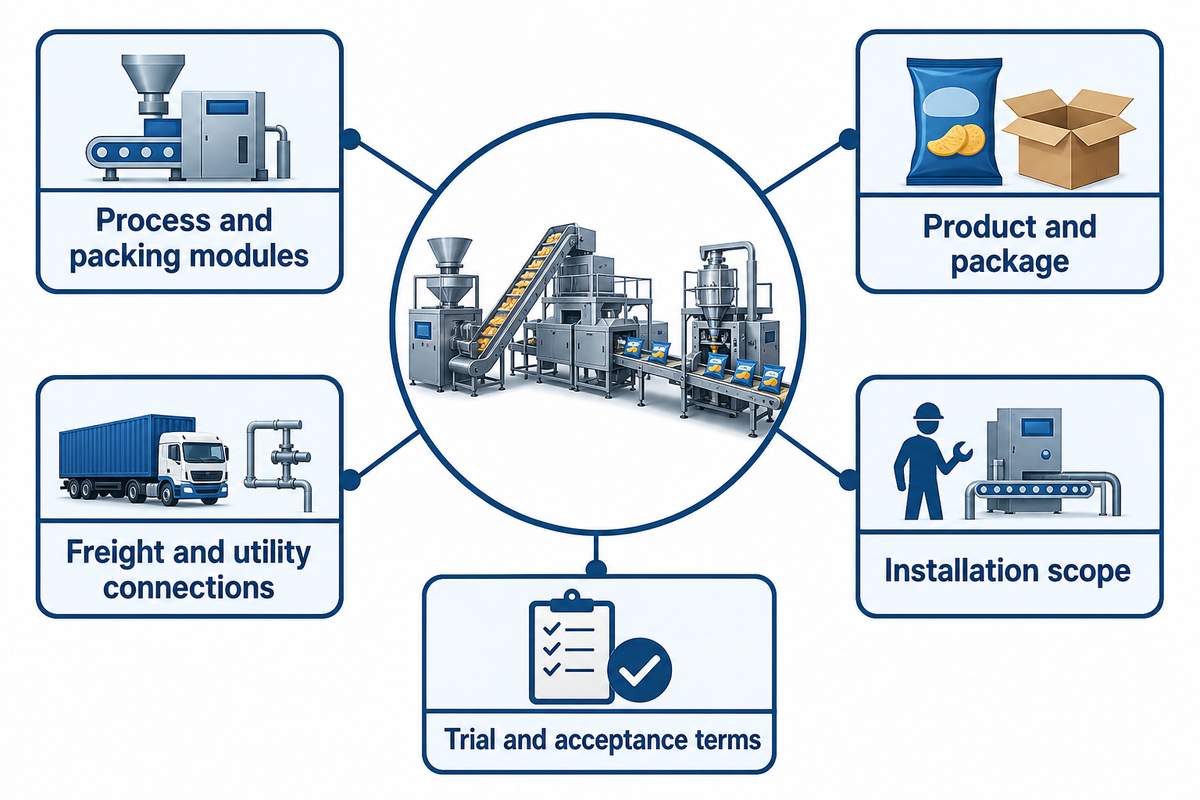
The price changes with the product route, required output, included modules and installation scope. A stand-alone unit, a process line, and a project are all different purchases. Compare suppliers and check that the same supply boundary is given before assessing prices. A low machine price may not include essential downstream equipment.
Oklahoma State University’s food-equipment purchasing guide asks for product requirements and specs, package types, interfaces and utilities, acceptance, delivery and installation, rates and travel costs for installers. Carry all these in the quote. Don’t use a uniform installation multiplier. Be sure to list the machinery and equipment at all interfaces, giving the name of the supplier for each.
How much does a food packaging machine cost?
A useful packaging-machine price requires a defined product, package format, accepted rate and delivery scope. Weighing, feeding and bag forming may be separate items. A fragile product like wafer rolls requires different product handling from a free-flowing product like puffs. Obtain a current, itemized offer and compare.
Do
- Name the recipe, finished size and package.
- List each included process and packing module.
- Assign freight, utility connections and installation.
- Write the trial and acceptance terms.
Don’t
- Compare a machine with an installed project.
- Treat a vending-machine price as a processing quote.
- Assume packing or upstream mixing is included.
- Infer payback from a nominal speed alone.
Suppose a small snack producer assigns a hypothetical $240 of shift costs to the 68.4 kg accepted-output example. The allocation is $240 ÷ 68.4 = $3.51/kg. This is a calculation method, not a machinery quote, predicted saving or selling price. Add only the cost categories you intend to compare and use the same categories for both offers.
A pending purchase shouldn’t be made if a missing module means the offer can’t meet the end point. A machine for sale with a high rating isn’t sufficient if responsibility for cooling and packing is still undefined.
How should you inspect cleaning, utilities and automation?
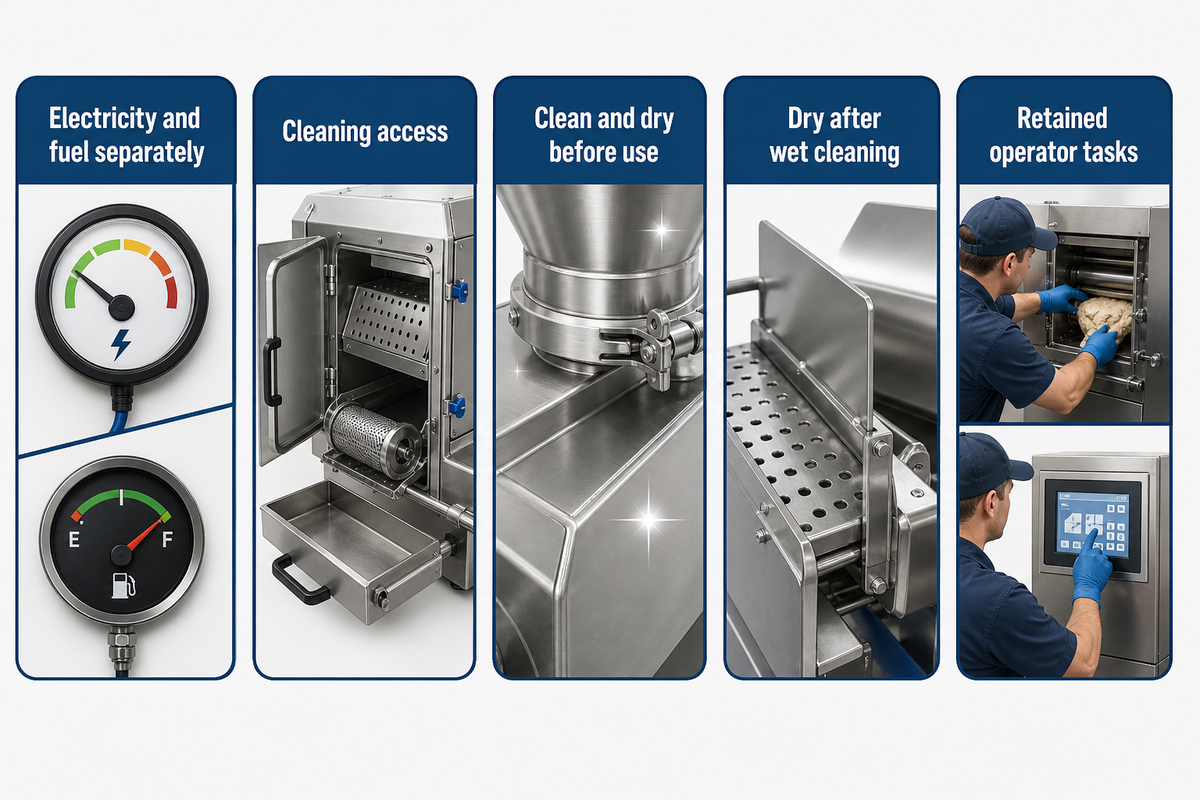
You may inspect equipment in its intended production environment and determine access for cleaning, utilities, etc. Separate electric load from fuel usage and analyze tasks left to operators. A Stainless Steel or touch screen exterior doesn’t mean that the equipment is easy to clean, easy to operate or ready for your installation.
How much energy does a snack processing machine need?
Energy demand requires the exact model and heating route. Electrical ratings define installed loads; fuel-heated machines may define gas separately. Measure electricity and fuel over a defined period and relate to an accepted output. Keep startup, idle operation and ancillary equipment within the declared boundary instead of treating a nameplate kW value as kWh/kg.
For example, the YT-30 catalog lists 88 kW plus 30 m³/h of natural gas at 4 kPa. Its air entry is 0.2 m³/min at at least 0.6 MPa. Confirm the supply at the machine connection under load. A 418 kW all-electric YT-XMT800 entry can’t be judged against a 3 kW gas-heated line without fuel, product and output measurements.
Use separate electricity and fuel cost inputs with relevant rates. The estimate isn’t complete without measured running conditions; research on food extrusion doesn’t establish a food production line’s utility bill.
US 21 CFR 117.40 equipment requirements address cleanability and food-contact construction. Ask to see seams, product traps, removable parts and cleaning access.
“Food-contact surfaces must be corrosion-resistant when in contact with food.”
For low-moisture production, 21 CFR 117.35 (d)(1) requires clean, dry, sanitary food-contact surfaces before use. Wet-cleaned surfaces must be sanitized when necessary and thoroughly dried before reuse. Plan for the dry-out time as part of your changeover. Also plan for allergen cross-contact.
Automation should describe tasks: feeding, temperature control, transfer, recipe change, jam recovery and packing. For a fully automatic potato chips line, document manual tasks at preparation and bagging during the trial. Rebecca Marquez’s July 2025 packaging article discusses format changes and equipment modularity. The buying implication is to demonstrate the package changes with the need for manual intervention, rather than focusing on control-screen features.
A bakery alternating an egg-containing wafer with another product should time cleaning and inspection and ensure drying before resuming production. Faster baking still requires this changeover. For covered U.S. servicing, assess energy isolation under OSHA’s control-of-hazardous-energy standard; normal production and minor-servicing exceptions need a separate scope check.
What should a supplier recipe trial prove before you order?
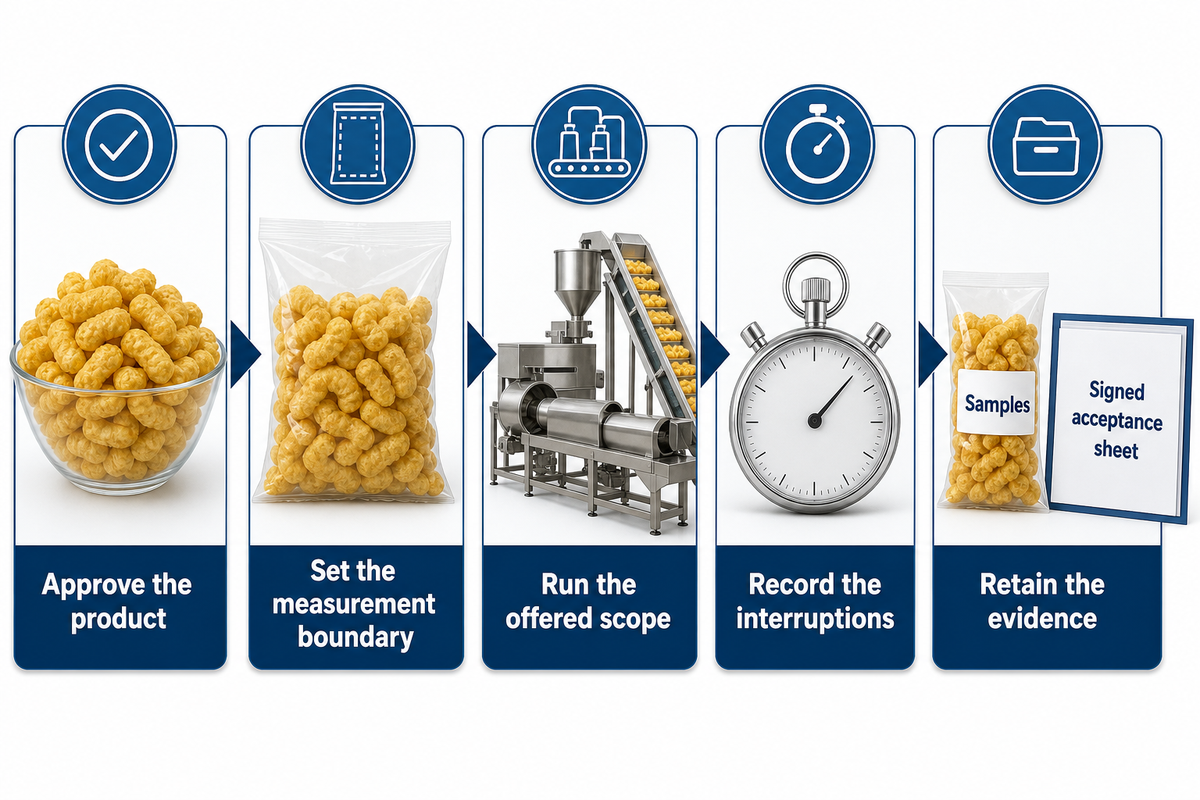
A trial should demonstrate the agreed-upon final product and the accepted output at the quotation end point. Representative ingredients, package material and operating conditions should be used. Record all manual work, interruptions and changeovers and evaluate product quality. Collect any crumb loss at fragile product transfers; don’t assume that every formed piece reaches the pack. An uninterrupted demonstration of a food processing line can’t alone be proof of a complete functioning system.
Trial-to-Packout Bottleneck Map
Trial-to-Packout Bottleneck Map: A trial record that follows the final product from the cooling to the transfer and pack operations to identify the limiting handoff.
- Approve the product: Record recipe, dimensions, texture and agreed acceptance checks.
- Set the measurement boundary: Name the machine outlet, cooled product or accepted final package.
- Run the offered scope: Observe each included module and retained operator task.
- Record the interruptions: Separate changeovers, rejects, cleaning and downstream waiting.
- Retain the evidence: Keep samples, elapsed-time records, utility readings and the signed acceptance sheet.
Mechanical acceptance and food safety validation should be kept separate. For applicable US preventive controls, 21 CFR 117.160 requires appropriate scientific and technical evidence. That section exempts listed sanitation and allergen controls from the validation requirement. A supplier’s successful recipe run alone doesn’t prove the facility’s applicable process controls are effective.
Verify the layout as well. The YT-30 page lists an equipment envelope of 70 × 1.3 × 3.5 m. Service access and packing aisles are site requirements as well. Use the production-line footprint planner with an approved supplier layout, not a photograph’s apparent size.
When discussing [sachima snack lines] with UDTECH, provide the finished sample, recipe, accepted kg/shift, utilities, and packaging info. Request an itemized scope and trial to meet your requirement. Exclude unsupported lifespan, saving and certification estimates from acceptance criteria.
Snack food processing machinery FAQs
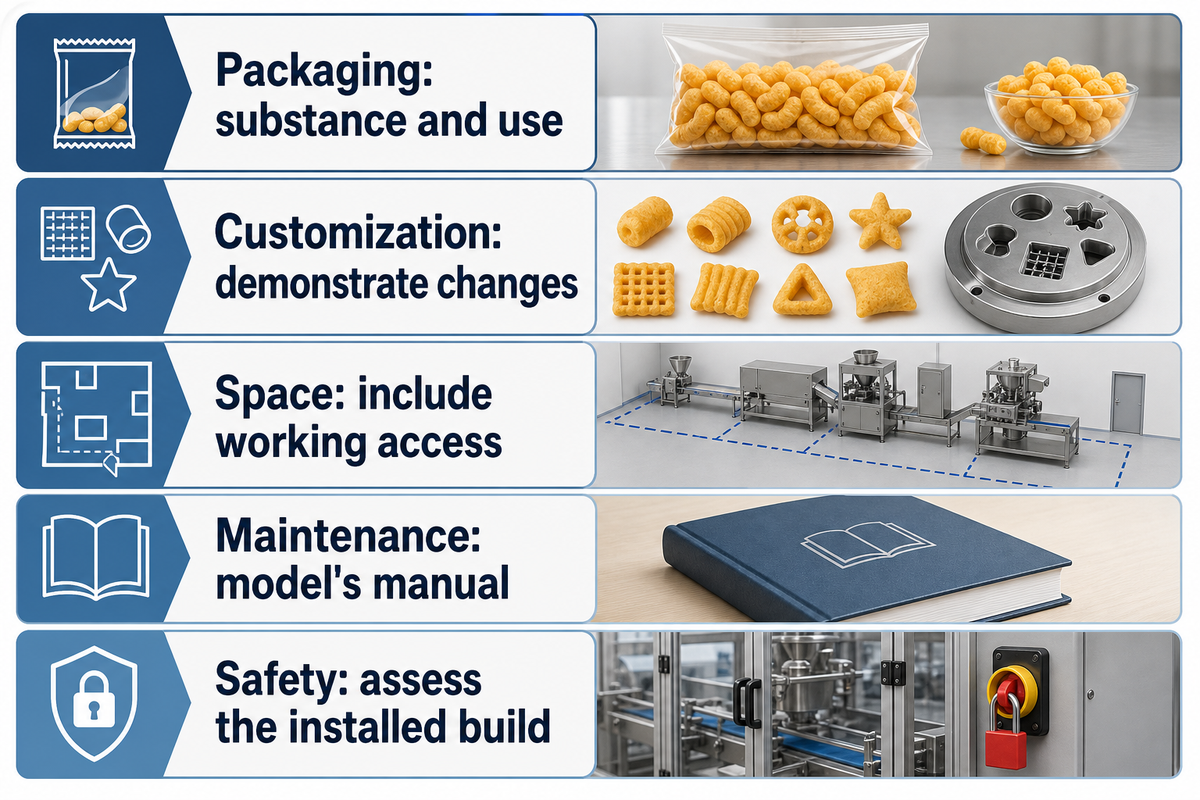
What material is used for snack packaging?
Choose packaging for the food’s barrier, sealing and contact-use requirements.
Films and laminates must suit the required moisture and oxygen protection, pack shape and sealing conditions. Confirm the specification with the packaging supplier and test it on the offered wrapper. The FDA’s food-contact component guidance evaluates the substance and intended use; an effective notification can be manufacturer-specific. A familiar film name does not establish authorization for every food or temperature.
What are the downsides of food extrusion?
Extrusion requires recipe and process control, and may leave downstream operations to other equipment.
Ingredient moisture, oil content and operating settings can change expansion, density and texture. A snack food extruder that makes one approved product has not proved every formulation. Establish the acceptable result through representative trials and identify any drying, coating or packing still required. Extruder equipment also needs appropriate cleaning and product-contact access. Compare complete process scope before treating a compact machine as the whole factory.
Can a snacks processing machine be customized to different production needs?
Customization is useful when the proposed changes are specified and demonstrated.
List the recipe, piece geometry, output, control language and downstream interfaces that must change. A different mold or die may produce different shapes without proving another texture or filling. Ask the snacks making machine manufacturer to identify changed parts, operator adjustments and trial acceptance. Confirm which changes are included in the offer and which require separate tooling, engineering or additional modules before placing the order.
How much space is required to install a snacks processing machine?
Use an installation layout that includes working access and downstream equipment.
Food machinery dimensions alone omit ingredient handling, cooling, packing, service and cleaning space. Confirm doorway access, utility connection points and the complete production footprint with the supplier.
What are the maintenance requirements for a snacks processing machine?
Maintenance requirements come from the exact model’s manual and operating duty.
Request schedules for inspection, lubrication, wear-part replacement and cleaning, with the required tools and isolation procedures. Review seals, belts, drives, heating parts and food-contact components relevant to the offered build. Ask for spare-part identifiers, service access and support arrangements. High temperature, abrasive ingredients or frequent changeovers may alter the tasks the supplier specifies. Record maintenance interruptions separately from production runtime so the output calculation does not silently assume continuous operation. A generic annual allowance cannot replace the model’s instructions.
What is the lifespan of a snacks processing machine?
There is no supported universal lifespan for every snack machine.
Assess the offered build, duty, maintenance, parts availability and service terms. A warranty period is not the machine’s operating life.
What are the safety measures to consider when operating a snacks processing machine?
Assess guarding, hot surfaces, electrical systems and energy isolation for the installed build.
Obtain operating instructions and drawings, then have responsible specialists evaluate access to moving mechanisms, cleaning and jam recovery. Confirm emergency controls, operator training and utility connections. Servicing may involve electrical, pneumatic, mechanical or thermal stored energy even after a stop command. Keep this machinery assessment separate from food-contact suitability and the facility’s food-safety controls. A stainless enclosure, automatic label or sales video cannot establish that the offered equipment meets every destination requirement.
Related production guides
- Plan wafer-machine output at a defined shift boundary
- Understand the nori-wrapping handoff
- Compare phoenix-roll forming requirements
- Review soft-waffle production modules
Prepared from published UDTECH model info and other sources. Catalog specs are sourced. Hypothetical worked example of production and cost is included. No customer trial or manufacturer certification is claimed.
References & Sources
- Corn-flour snack extrusion study, 2025, abstract — PubMed, National Library of Medicine.
- EP2744350A2, published patent document, 2014 — European patent publication via Google Patents.
- A Hierarchical Structure of Key Performance Indicators for Operation Improvement in Production Systems — National Institute of Standards and Technology, 2016.
- Industrial Deep Fat Frying — Oklahoma State University, 2012.
- Selecting and Purchasing Food Process Equipment — Oklahoma State University, 2017.
- 21 CFR 117.40: Equipment and utensils — U.S. Food and Drug Administration.
- 21 CFR 117.35: Sanitary operations — U.S. Food and Drug Administration.
- Snack Makers Seek Innovation in Throughput, Automation, and Equipment Modularity — Packaging Technology Today, Rebecca Marquez, July 2025.
- 29 CFR 1910.147: The control of hazardous energy — Occupational Safety and Health Administration.
- 21 CFR 117.160: Validation — U.S. Food and Drug Administration.
- Determining the Regulatory Status of Components of a Food Contact Material — U.S. Food and Drug Administration.