Get in touch with UDTECH Company


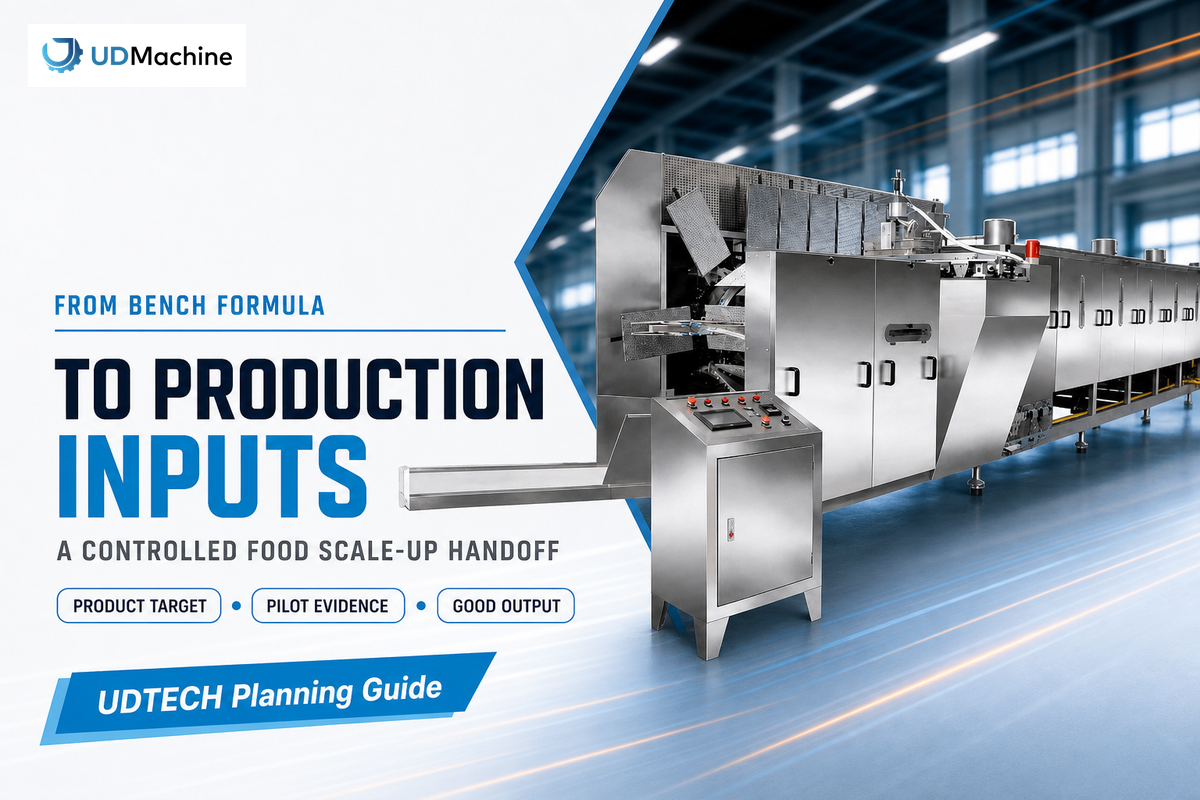
A sample on the bench isn’t, on its own, enough to generate large-scale production directives. Scaling up food production begins with a defined product and package target. The food product scale up process transforms samples into controlled planning inputs, which comprise a trial version of the formula, a target product and its package, a process flow, a measurable trial, and a brief that an equipment or service provider can answer. Deficiency in any of these may lead to incorrect product specifications and a production line quote based on unsuitable assumptions.
This document concerns the hand-off of a product development activity to large-scale product generation. It includes examples pertaining to the production of baked and formed snack foods such as waffles, wafers and biscuits, but this remains a planning aid rather than a validated recipe or food-safety program. However, this document shouldn’t be misconstrued as a food safety or product definition framework. The food product development process remains iterative until the production route and package are supported by evidence. The complete definition of the product and the requirements of the market should be established by the manufacturer’s qualified team. This document provides a development-to-manufacturing handoff for a trial product specification. The suggested planning documents in this guide are the 12-Field Scale-Up Handoff Sheet, a pilot-trial record, and a good-output bottleneck map illustrating constraints for the production line.
Define the accepted product and run window before comparing line speeds
Before asking for a line quote: record what the finished food must be, which formula version will be trialled, how many conforming pieces or kilograms are required over a stated run, and who will decide whether the result is acceptable. Leave unknown fields marked “to be validated” rather than filling them with a supplier’s rated speed.
What the food product scale up process must deliver
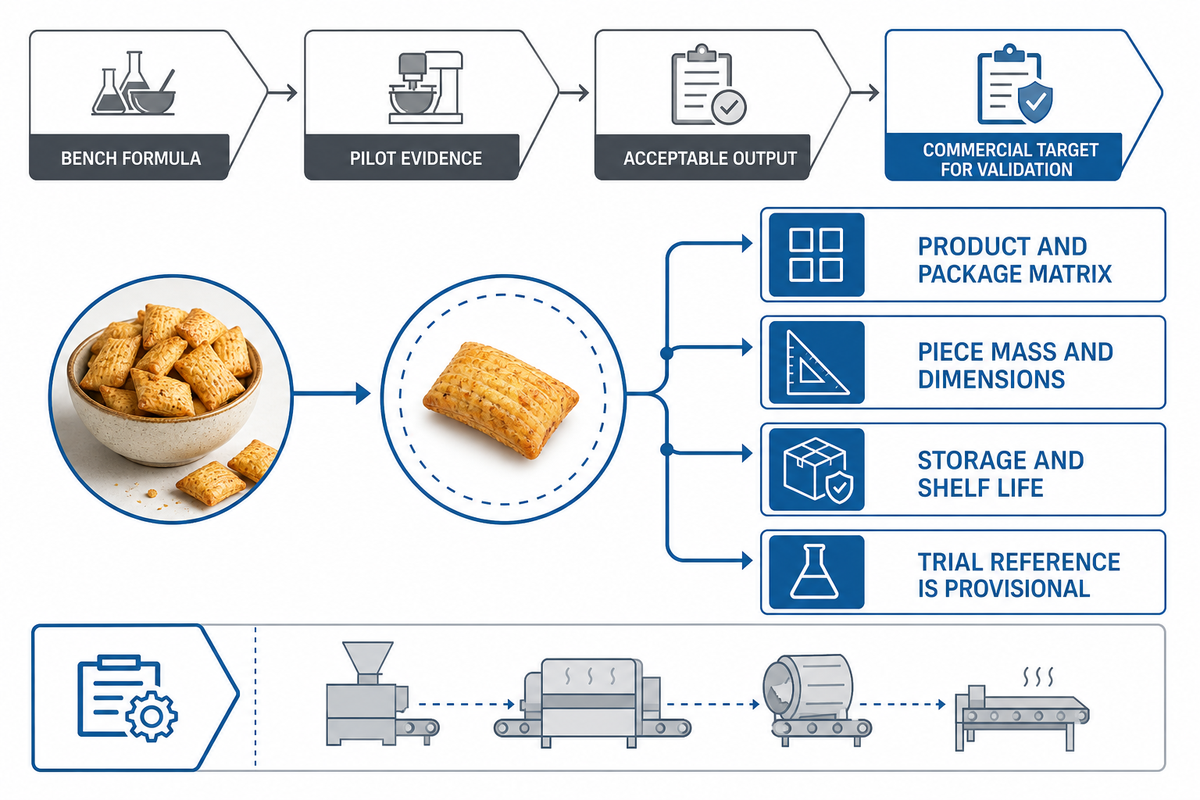
The first output is a measurable product-and-package target. Oklahoma State University Extension calls the product and package matrix the first step in process and equipment scale-up. Its questions include the product definition, package size and type, and intended rate. That’s a useful order of operations: an approved kitchen sample is a reference, while the commercial specification is still a hypothesis to test.
Write down the attributes a buyer will notice and the plant can measure: piece mass and dimensions, moisture or texture target where appropriate, appearance, packaging format, storage conditions and intended shelf life. For a waffle, “golden and crisp” may be a consumer description, but engineering needs the agreed color range, dimensions, breakage rule and sample method. The food team sets those limits; this article doesn’t supply universal thresholds. Oregon State University cautions that a fresh sample can change across its shelf life, so release evidence must look beyond the day of production.
Keep the trial reference clearly identified as provisional until product, package, safety and shelf-life evidence supports approval for commercial release. There may be changes in the formula, package or process before the final release.
Version the trial formula and ingredient specifications by weight
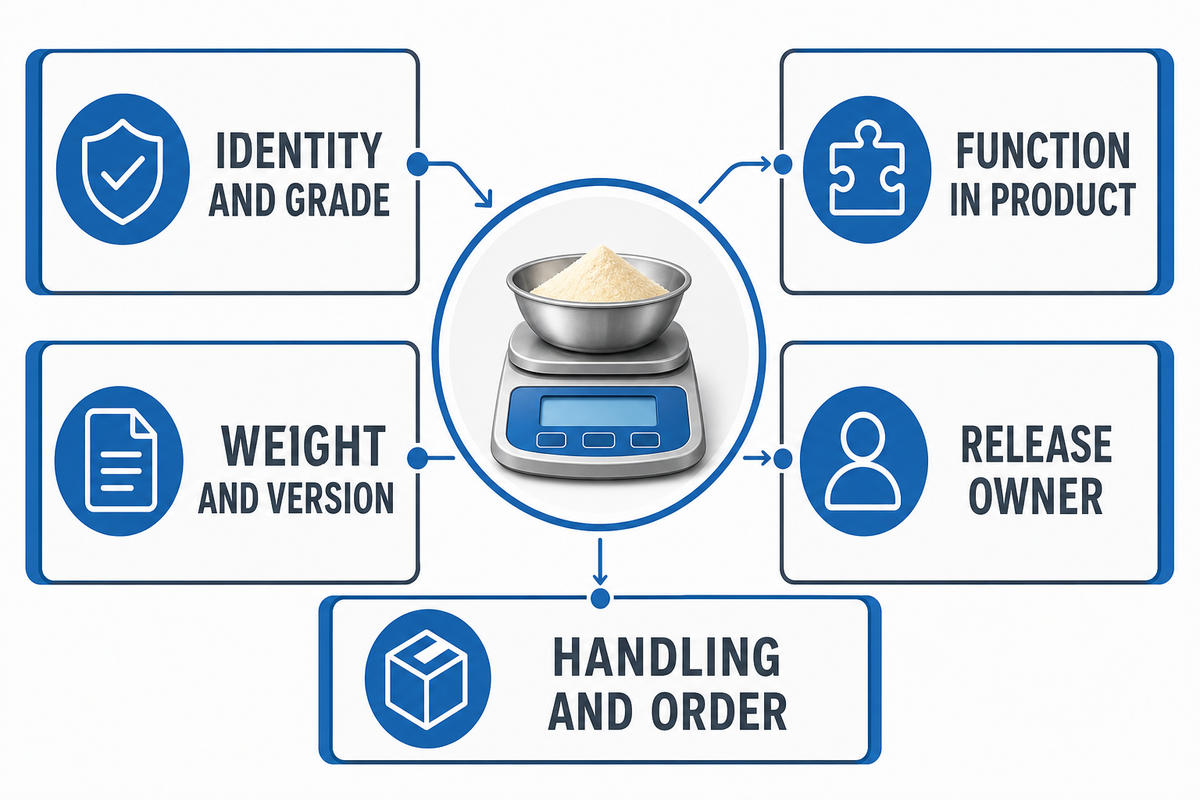
Weighing a formulation gives the team a repeatable baseline. For teams asking how to scale up a recipe for production, that weighed version is a trial baseline rather than a commercial release specification. It doesn’t prove that a larger batch can use the same proportions. University of Maryland Extension notes that ingredient amounts may not change proportionately as a recipe moves into commercial processing. Oklahoma State likewise describes changes in ingredient behavior, flavor, texture and appearance. Record the bench version, its batch mass, the ingredient grade and its functional role before altering anything.
| Field | Record for each material | Why it matters |
|---|---|---|
| Identity and grade | Supplier, specification and approved alternative | A bulk grade can behave differently. |
| Mass basis | Weight per trial batch and formula version | Volume measures can obscure density differences. |
| Function | Structure, binding, sweetness, leavening or flavor | A substitute must preserve the required function. |
| Handling | Storage, addition order and preparation | A material may enter differently on the line. |
| Release owner | Food development and quality approval status | Trial material is not automatically approved for sale. |
What variability exists between lots, and how much can the ingredient supplier deliver at the planned cadence? A change in flour, oil, or other filling affects the assessment, so repeat relevant product checks. As with other product checks, assessments of the finished product should depend on agreed trial measurements and acceptance criteria rather than contract assumptions. The assessments should consider the process to generate the final commercial formula, which typically includes the commercial preparation of the product, and not a “frozen” version of the process prior to the pilot run.
Map bench actions to a real process route
“Mix, cook and pack” hides the transfers that become important at scale. Draw the route from ingredient receiving through preparation, mixing, depositing or forming, heating, cooling, inspection and packing, deleting stages that don’t apply to your product. At every handoff, record whether the product is pumped, conveyed, held, touched or reworked, and who owns the loss. Oklahoma State’s scale-up guide specifically calls out batch versus continuous processing, product transfers, waste, storage, packaging and sanitation as equipment decisions.
When assessing equipment for a waffle or pancake line, first analyze batter preparation, depositing, cooking, releasing, cooling, and pack-out before comparing machines. See the site’s waffle and pancake line layout guide for more information. For egg rolls or wafers, product formation and/or process discharge create transfer risk. Visit the egg roll and wafer process stages for more information.
Boundaries between modules define decision points. A mixer that feeds batter more quickly than a depositor can discharge it creates a holding time. An oven that exits faster than packaging can receive creates product accumulation. Identify and balance minimum and maximum operating speeds of processing equipment on the same flow diagram. Indicate transfer methods and conditions, and identify which process variables require verification through analysis of actual or representative samples.
Test heat, mixing and hold time before scaling the batch
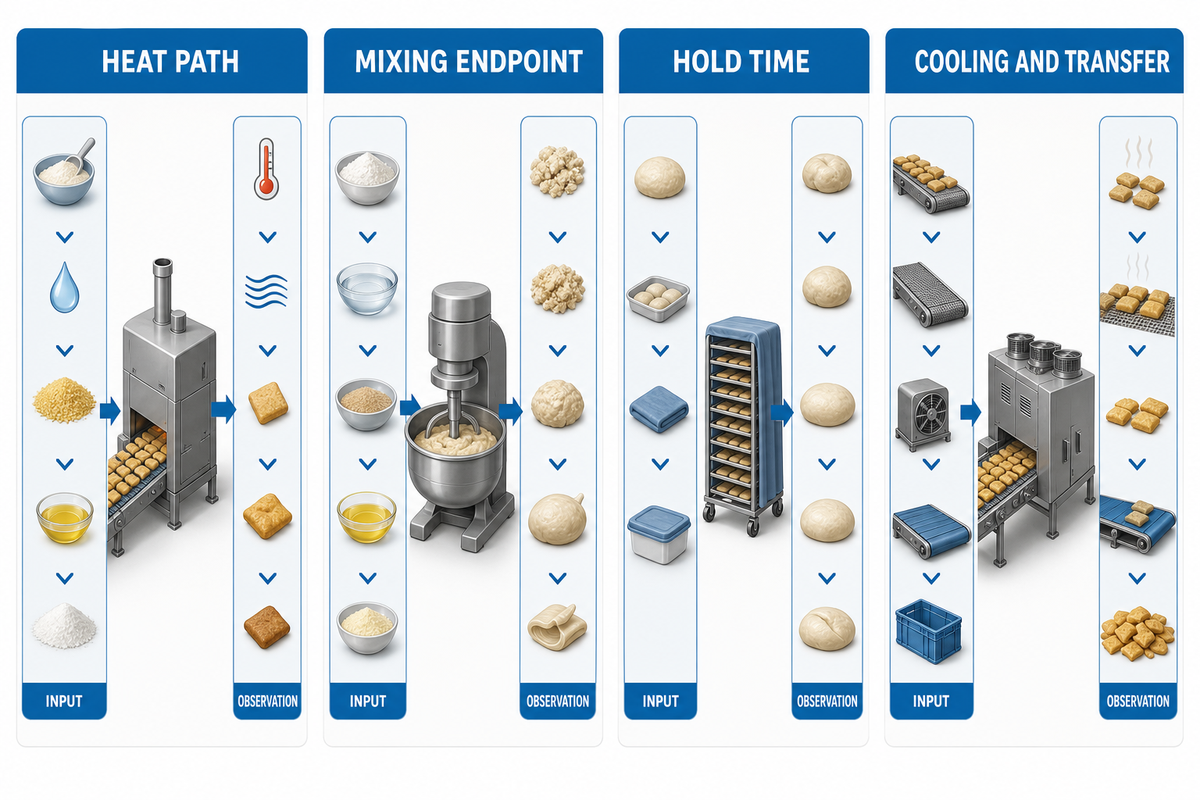
Multiplying ingredient weights is arithmetic; reproducing the finished food is an experiment. The relationship between product volume and heat-transfer area changes with equipment geometry. Mixing and time spent waiting for the next stage can also alter texture or consistency. The Institute of Food Technologists describes batch-size changes as a risk to ingredient behavior, processing conditions and final quality. None of these sources gives one temperature, mixing speed or hold-time rule for every recipe.
| Variable | Bench note | Pilot measurement | Possible consequence |
|---|---|---|---|
| Heat path | Pan or small oven | Product profile and heating zone settings | Different color or moisture |
| Mixing | Tool, sequence and duration | Addition order, batch size and endpoint | Texture or deposit change |
| Hold time | Time before cooking | Maximum and typical wait at line conditions | Viscosity or structure drift |
| Cooling and transfer | Manual removal | Product temperature and breakage at pack-out | Rejects or package defects |
If shear is significant for this specific formulation, ask the process engineer to define and assess the condition for mixing or transferring. Don’t assume there’s a general limit for scale-up. Analyze pilot samples and the reference, and describe and record any observable changes. Avoid attributing an improvement to a variable other than the one being studied.
Is it possible to directly scale a lab recipe for commercial production?
Use the lab recipe as a weighed trial baseline, then test the production route. A direct multiplication may fail because mixing, heat transfer, ingredient grade, holding and product transfer differ. University of Maryland Extension explicitly warns that ingredient proportions may need adjustment in a larger cookie batch. Keep the target product attributes stable, change a controlled set of variables, and record the result. If the pilot can’t meet the target, revise the formula or equipment route before promising output.
Translate the output target into an equipment and utility brief

Give every prospective supplier the same basis: product dimensions and piece weight, target conforming units over a stated run, expected operating hours, packaging format, available floor area, power, compressed air, sanitation needs and interfaces to upstream and downstream equipment. Oklahoma State’s equipment-purchasing guide places product, package, system interface, performance and utilities in the specification; those fields make bids more comparable and expose hidden installation costs.
Ask for a trial plan and rate measurement basis, not only a catalogue figure. UDTECH’s public range includes waffle and pancake lines, egg roll and wafer, biscuit and mini bun, and a separate sachima and specialty snack family. This article uses the first three as examples. The biscuit line equipment stages provide a third product-family route. They don’t establish that one model can process all three formulas or that every quoted line includes packaging.
Own-line purchase is only one route. A co-manufacturer’s available process and package formats may influence formulation, while the co-manufacturer may ask for a finished formula and process requirements before accepting a project. Oregon State University describes those decisions as intertwined. Keep a co-manufacturer path in the brief until facility fit is known; record where trial data was generated and whether it transfers to the proposed site.
Illustrative Waffle Trial: picture a customer permitting a 6-hour run, but planning on a 5.25-hour run, with a 5% reject allowance. The inputs stated are examples of planning inputs, not measured line performance of UDTECH. The supplier must identify which rate it can demonstrate with the buyer’s product and package.
Run a pilot trial that can actually fail
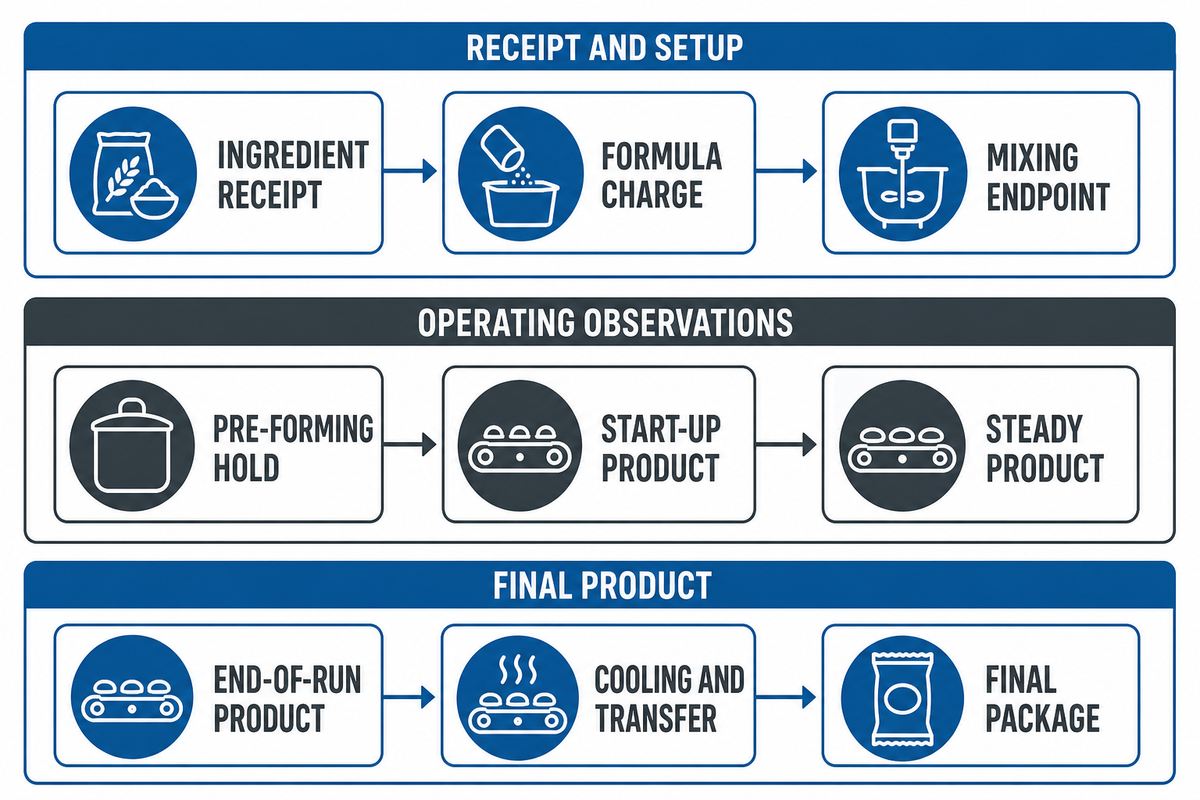
A demonstration is useful only if the team agrees beforehand what would count as a failure. In pilot plant food production, record actual operating conditions against the proposed commercial route. Set the tested formula version, equipment configuration, package, operating conditions, sampling positions, measured attributes and decision owner before the run. IFT advises that plant trials should reflect commercial conditions closely enough to surface scale-dependent issues, followed by review of new risks before first production. One good sample pulled at a favorable moment is weaker evidence than a documented run covering start-up, stable operation and the end of the batch where relevant.
| Record | Before the run | After the run |
|---|---|---|
| Trial identity | Formula, lot, machine setup, package | Deviations and actual settings |
| Samples | Positions and sample count set by quality team | Labelled samples and test results |
| Product criteria | Approved attributes and limits | Pass, fail or inconclusive with evidence |
| Line behavior | Rate, stoppage and transfer questions | Measured good output and loss log |
| Next decision | Owner and sign-off rule | Release, revise or repeat with reason |
When settings change within a run, note the time and settings used to make the change. Merging samples from different settings into the same “pass” can be very misleading.
The following checkpoints are a sample of what a plan may look like. The food team will use these to develop a sample plan and limits for a given product; a blank result remains open, not a pass.
| Checkpoint | Evidence to retain | Decision affected |
|---|---|---|
| Ingredient receipt | Supplier, grade, lot and storage condition | Whether the tested material matches the buying specification |
| Formula charge | Weighed inputs, sequence and version | Whether the product can be reproduced |
| Mixing endpoint | Observed condition and recorded setting | Whether the feed remains consistent |
| Pre-forming hold | Elapsed time and product condition | Whether waiting changes the feed |
| Start-up product | Samples and reject reasons during stabilization | How much start-up loss to allow |
| Steady product | Timed accepted and rejected counts | What sustainable good output means |
| End-of-run product | Late-run samples and settings | Whether quality drifts during the run |
| Cooling and transfer | Breakage, temperature and handling observations | Whether downstream losses constrain capacity |
| Final package | Pack integrity and retained study samples | Whether package and shelf-life work remain open |
How significant are pilot trials in food formulation?
Pilot trials test the interaction of formulation and equipment under conditions a bench test can’t reproduce. A pilot is most valuable when failure would change a buying or formulation decision: for example, if heating profile, mixing endpoint or transfer breakage could alter the finished food. IFT recommends assessing scale risk before a plant trial and using its observations to update the assessment. A trial doesn’t automatically settle shelf life, food safety or the fit of a different co-manufacturer’s line.
Connect equipment evidence to product safety without confusing approvals
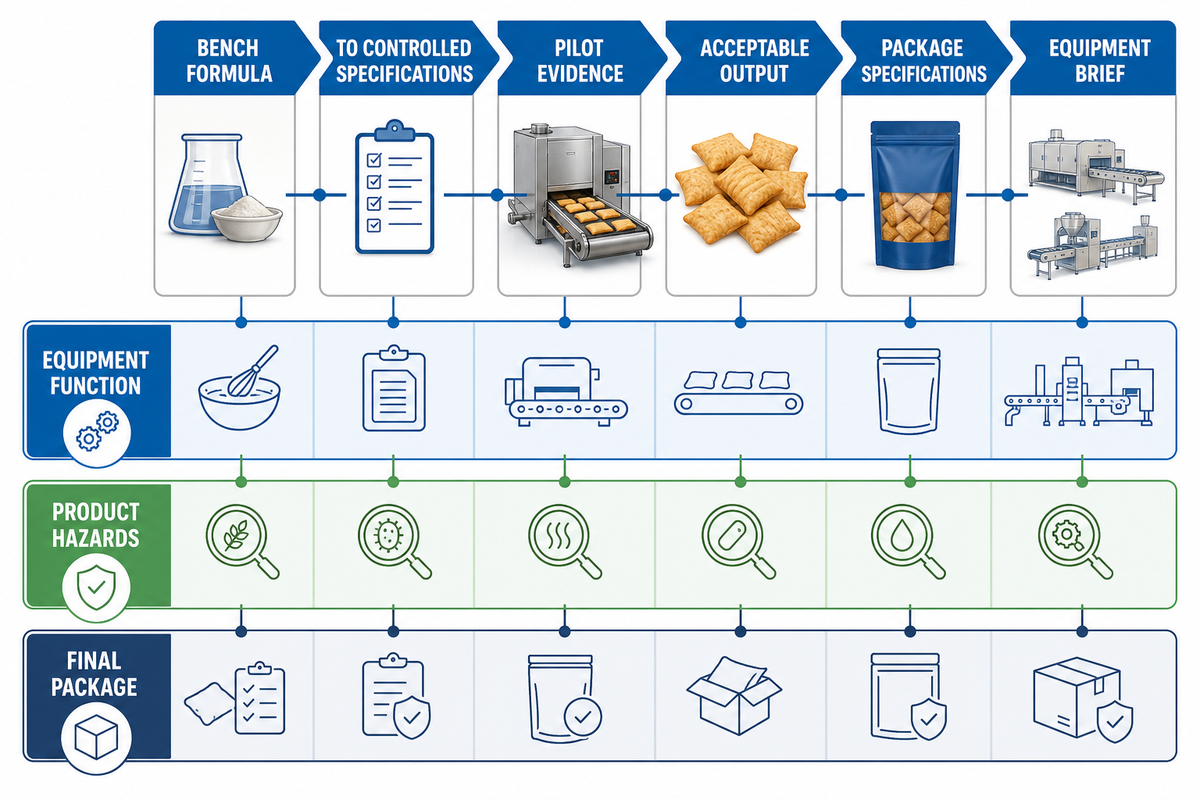
A supplier’s factory acceptance test can show that a machine performs agreed functions with specified material and settings. Its records may help the food business assess process capability, but they do not approve a recipe, establish shelf life or replace a facility’s hazard analysis. For generally covered US facilities, the FDA’s Preventive Controls for Human Food rule calls for a written food safety plan with hazard analysis and controls tailored to identified risks; exemptions and product-specific rules can change applicability. The food business and its qualified specialists decide what validation, monitoring, sanitation and records are required.
| Question | Evidence to collect | Decision owner |
|---|---|---|
| Does the equipment operate as specified? | Configuration, functional checks, rate basis, sample results | Buyer and equipment supplier under the acceptance contract |
| Does the process control the relevant product hazards? | Facility hazard analysis, process evidence, monitoring plan | Food business and qualified food safety team |
| Will the packaged food remain acceptable? | Final-pack shelf-life and storage evidence | Food development and quality team |
Some low-moisture, ready-to-eat snack products need special attention to post-process contamination and environmental sanitation. A 2025 FDA draft guidance discusses these issues for covered foods including crackers and other snack products, and states that guidance recommendations are generally nonbinding unless a statute or regulation is cited. Do not copy its conditions onto every waffle, biscuit or snack without checking the actual product and facility.
Compare good-product output, not rated line speed
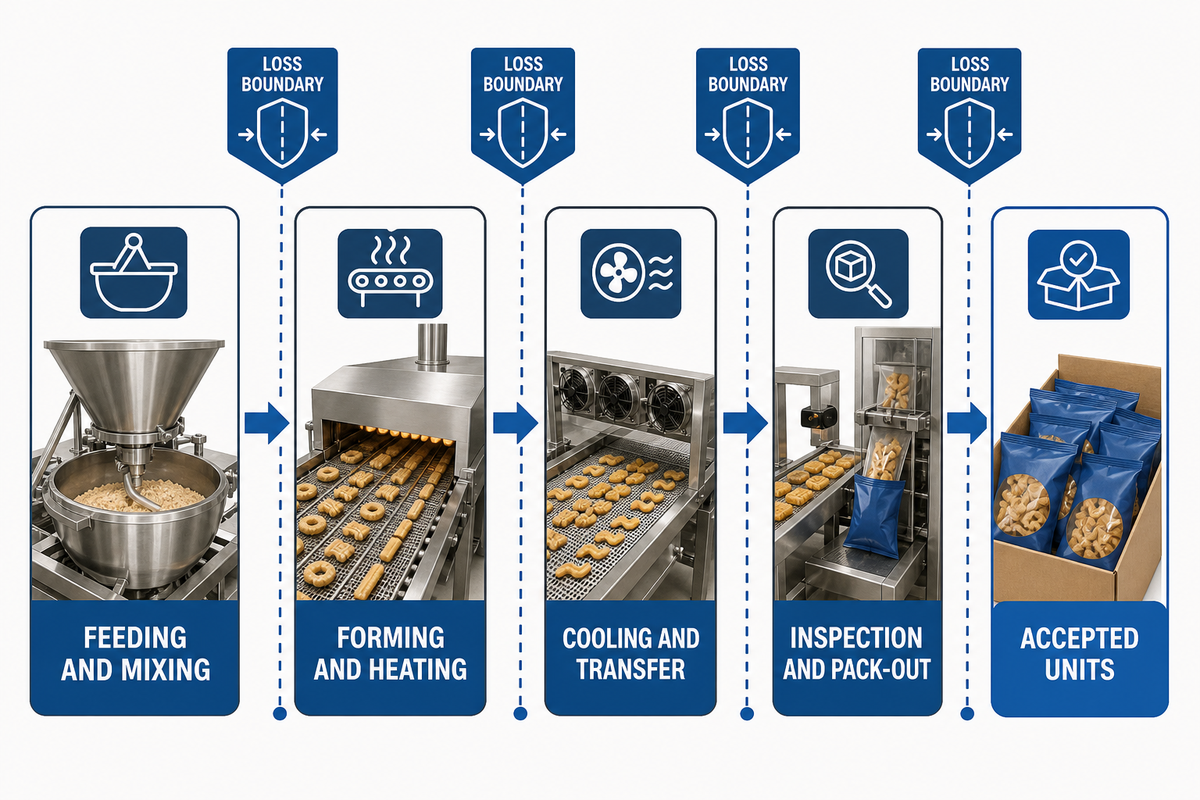
Rated speed is one of several ways to describe a piece of equipment. For a buyer, capacity means conforming product leaving a defined run in a defined package after stops and rejects. If equipment is described in units per hour and another is described in mass per day, first determine the mass of each piece and the actual operating time. Ask whether the number given is the maximum possible throughput of the equipment or module, a tested line throughput, or the accepted-product throughput.
Oklahoma State University’s scale-up guide puts the required production rate in the initial product-and-package matrix and warns that process waste can be overlooked in scale-up plans. That’s why the trial record should show both attempted output and the quantity accepted under the buyer’s product criteria.
Illustrative Waffle Trial: the earlier hypothetical 6-hour schedule, 5.25 hours of operation and 5% reject allowance give a common basis for comparing bids.
| Boundary | What to measure | Who needs the answer |
|---|---|---|
| Feeding and mixing | Feed availability, recipe change and waiting time | Plant manager |
| Forming and heating | Sustainable operating rate at the approved product target | Engineering |
| Cooling and transfer | Breakage, jams and waiting time | Operations and quality |
| Inspection and pack-out | Accepted units, reject reasons and package losses | Quality and finance |
Worked illustration, not UDTECH performance data: suppose a quoted line runs at 1,200 pieces per operating hour, actually runs for 5.25 hours in a six-hour scheduled window, and 5% of its output fails the agreed product criteria. Attempted pieces are 1,200 × 5.25 = 6,300; conforming pieces are 6,300 × 0.95 = 5,985. That’s 997.5 conforming pieces per scheduled hour, not 1,200. If the run has a hypothetical fixed cost of $900 and $0.08 variable cost per attempted piece, total run cost is $1,404 and cost per 1,000 conforming pieces is about $234.59. Replace every assumed input with your own trial data before using the result for a purchase decision.
The loss and cost measures shown in this example are illustrative only.
Build the 12-Field Scale-Up Handoff Sheet
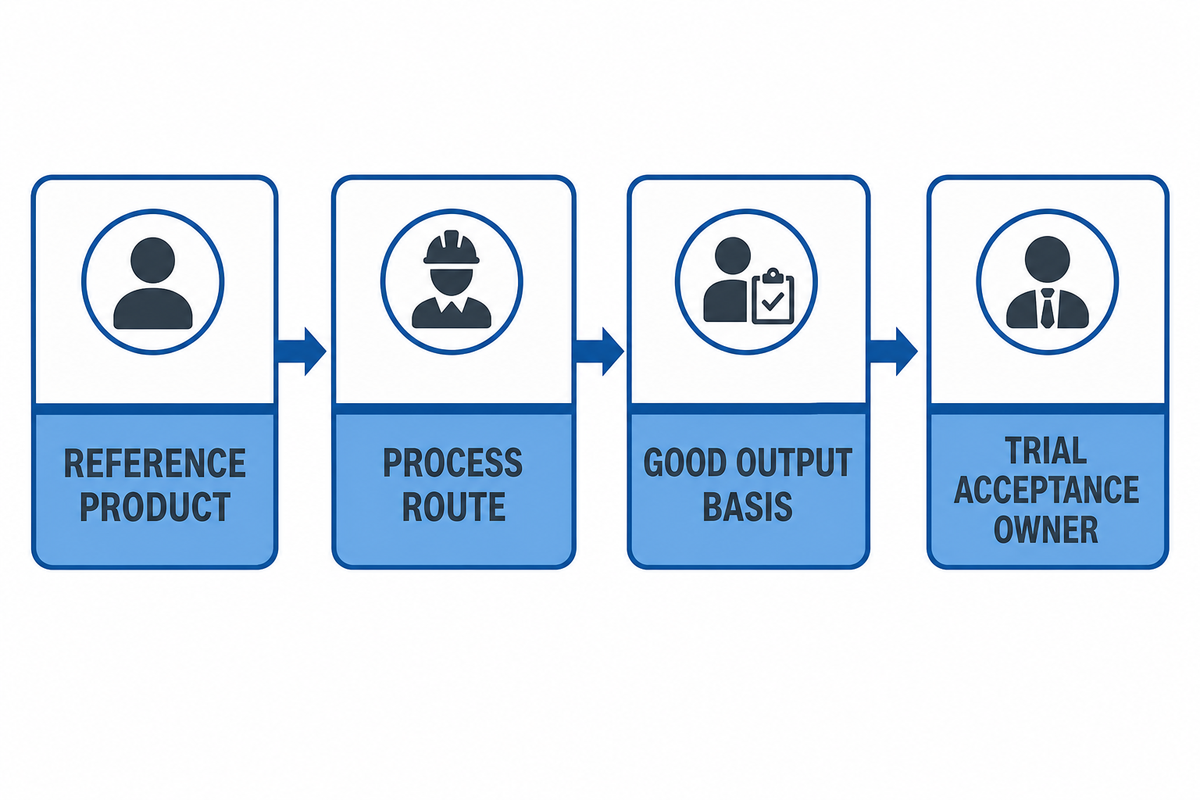
Copy this sheet into the project brief and put a name, document version and evidence status beside every row. These food product scale up process steps remain open wherever the sheet lacks a measured result or a decision owner. “Unknown” is a useful answer before a pilot; it tells bidders which assumptions they must price or test. The fields synthesize the product-package matrix in Oklahoma State’s scale-up guide, its equipment specification guidance, and the shelf-life and co-manufacturer constraints noted by Oregon State University. The 12-field structure is an editorial decision aid, not an industry standard.
| No. | Input to document | Evidence or owner |
|---|---|---|
| 1 | Reference product and measured attributes | Development / approved sample |
| 2 | Trial formula version and ingredient grades | Development and purchasing |
| 3 | Ingredient supply and substitution rules | Purchasing and quality |
| 4 | Process route and transfer points | Process engineer |
| 5 | Scale-sensitive settings to trial | Process engineer / trial plan |
| 6 | Target conforming output and run basis | Operations and finance |
| 7 | Piece weight, dimensions and tolerances | Development and quality |
| 8 | Final package and pack-out route | Packaging lead |
| 9 | Utilities, floor space and interfaces | Plant engineer |
| 10 | Sanitation, allergen and hazard-analysis status | Qualified food safety team |
| 11 | Final-pack shelf-life and storage evidence | Quality / study status |
| 12 | Pilot acceptance method and decision owner | Cross-functional approval |
Use the same worksheet to make requests for equipment suppliers and flag relevant sections depending on the capabilities of the co-manufacturer. More information on UDTECH’s product lines can be found in UDTECH Food Processing Machinery.
RFQ checklist — copy these buyer-defined fields into a quote request:
| Parameter | Recommended range or basis | Why it matters | How to verify |
|---|---|---|---|
| Good output | Buyer target in pieces/h or kg/h | Avoids nameplate ambiguity | Timed trial and quality count |
| Product size | Buyer tolerance in mm and g | Determines forming and pack fit | Sample measurement |
| Recipe feed | Buyer-defined batch or flow window | Exposes mixer/depositor mismatch | Documented production trial |
| Utilities | Site limits in kW, air pressure and water | Prevents installation surprises | Supplier load schedule and site check |
| Footprint | Available mm × mm plus service access | Protects layout and maintenance | Approved layout drawing |
| Acceptance | Buyer-set sampling and product limits | Defines what “pass” means | Signed trial record |
Release, revise or repeat the trial: a go/no-go table
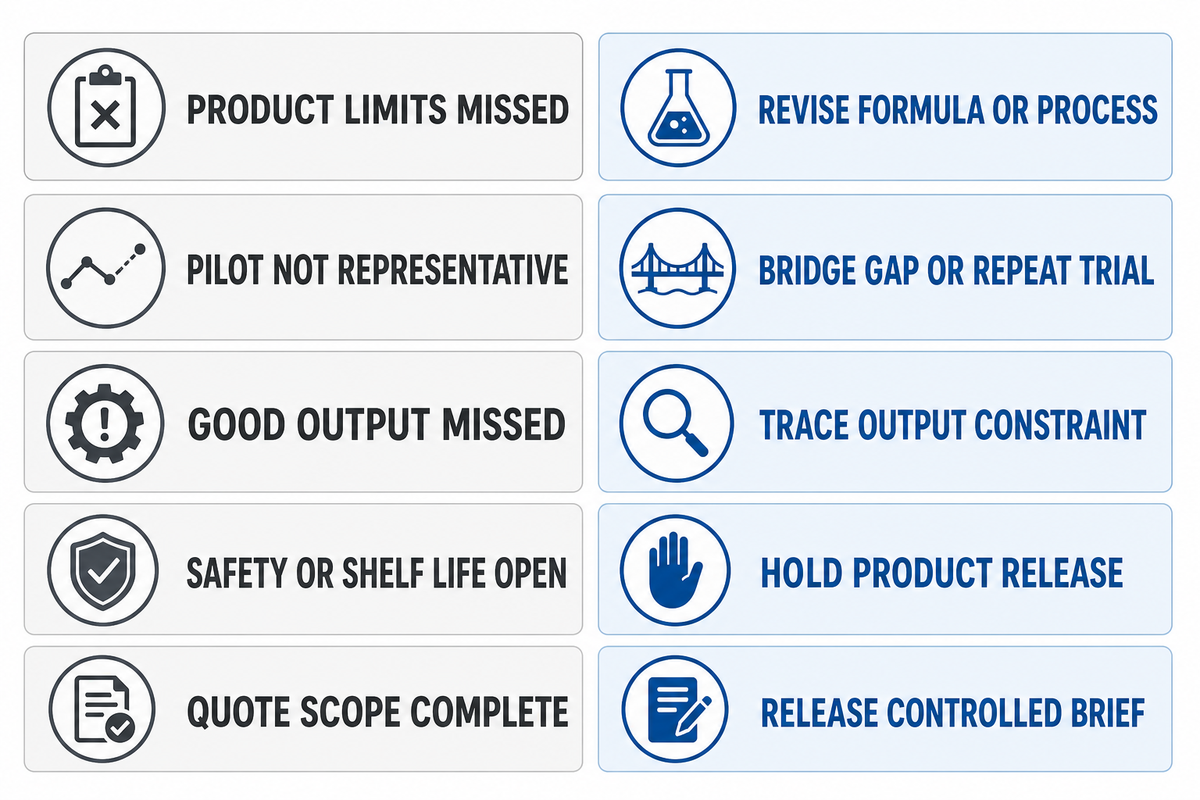
The handoff occurs once the decisions for each product and process element are documented and owned. It doesn’t mean that answers are known for all questions. The table helps discern when an equipment question is, in fact, a question concerning a package, formula, or food safety. Once that’s determined, unnecessary and costly speculation regarding food product development can be avoided.
| Observed state | Next action | Owner |
|---|---|---|
| Product attributes miss agreed limits | Revise formula or process; preserve the failed trial record | Development and quality |
| Pilot conditions differ from intended production | Bridge the gap or repeat a production-like trial | Process engineer |
| Rated speed passes, good output does not | Locate feeding, heating, transfer or pack-out constraint | Operations and supplier |
| Food safety or shelf-life evidence is open | Hold the product-release claim; continue qualified assessment | Food safety and quality |
| Evidence and responsibilities are complete for the quote scope | Release the controlled brief for comparable bids | Project owner |
A supplier can help propose feasible equipment conditions and product acceptance criteria; the buyer and food team should approve the final product limits. If your brief is ready to test, send UDTECH the product and trial inputs and ask which of its listed equipment families fits the route. Ask the same evidence questions of any alternative supplier or co-manufacturer.
Illustrative Waffle Trial: Assumptions have been made for the waffle trial, including 6 hours scheduled, 5.25 hours of operation and 5% defective output; these are planning inputs until a signed trial record supports them. The assumptions must be documented and a signed trial record must be produced to verify the assumptions. If the assumptions change, the equipment brief must be revised, and the good and rejected outputs and cost must be recalculated before release.
Frequently Asked Questions
Q: What is the scale up process for a food product?
Food scale-up turns a bench sample into a tested formula, process route and production brief.
Begin with a measurable product and package target, then version the weighed trial formula and map the intended operations. Measure variables that may change at scale, run a production-like pilot, and record good output and losses against agreed product limits. The food business separately completes applicable safety and shelf-life work. The final brief states equipment, utility, package and acceptance requirements with an owner for each open item; it is revised when trial evidence changes the product.
Q: Can I multiply a kitchen recipe to make a commercial batch?
Multiplying weights creates a trial starting point, but it does not establish a commercial formula.
A bigger batch can change mixing, heat transfer, hold time and ingredient behavior. Convert the recipe to weights and identify the exact ingredient grades, then compare pilot samples with the approved reference. Change proportions or process settings only with a recorded reason and retest the affected product attributes. University of Maryland Extension specifically notes that ingredient amounts may not change proportionately when a small recipe is moved into commercial processing. The final formula is approved after, not before, those checks.
Q: What information should I send an equipment supplier?
Send a controlled product, process and acceptance brief with every unknown marked.
Include product dimensions and weight, the trial formula version, ingredient handling, process route, package format, target conforming output over a stated run, utility and footprint limits, sanitation needs, and the proposed acceptance method. Attach the trial results and say whether shelf-life and safety work is complete or pending. Specify whether you are buying your own line or evaluating a co-manufacturer. Ask each bidder to explain the basis of any capacity number and what equipment or packaging is excluded.
Q: Does a successful factory acceptance test prove the food is safe?
No. Equipment acceptance can provide useful process data, but it does not replace the food business’s hazard and product work.
The qualified food safety team must determine applicable controls and evidence for the actual facility and market. A machine run does not by itself establish shelf life or regulatory compliance.
Q: When should a pilot trial be repeated?
Repeat or extend a pilot when its evidence no longer represents the proposed commercial product and line.
Triggers include a changed ingredient or supplier grade, formula proportions, package, critical process setting, equipment configuration or manufacturing site. A repeat is also warranted when samples miss agreed attributes or when the run did not cover the conditions that matter: start-up, stable operation, shutdown, or a full batch where applicable. Record which question the next trial must answer, hold all other variables as steady as practical, and retain the previous failure record. The food team decides whether a change also requires new safety or shelf-life evidence; a supplier demonstration alone cannot make that judgment.
How this handoff guide was prepared
UDTECH lists machinery for baked and formed food families, so this guide focuses on buyer information before discussing a production line. The transfer sheet and capacity illustration are editorial tools assembled from public university, professional and regulator guidance; the numbers in the illustration are hypothetical. We haven’t used private factory trial data or claimed that a supplier’s machine test validates a finished food. Prepared for Suzhou UDTECH Technology Co., Ltd. from the public sources linked below; buyer-specific values require trial verification.
References & Sources
- Scaling Up Your Food Process Oklahoma State University Extension.
- Selecting and Purchasing Food Process Equipment Oklahoma State University Extension.
- Product Development, Part 2: Scaling University of Maryland Extension.
- Formulating for New Product Scale-Up Institute of Food Technologists, March 2026.
- Working With Us: Product Development Oregon State University Food Innovation Center.
- FSMA Final Rule for Preventive Controls for Human Food US Food and Drug Administration.
- Draft Guidance for Low-Moisture Ready-to-Eat Foods US Food and Drug Administration, 2025; nonbinding draft guidance.