Get in touch with UDTECH Company

Soft vs Belgian Waffle Lines: Which Process Fits?

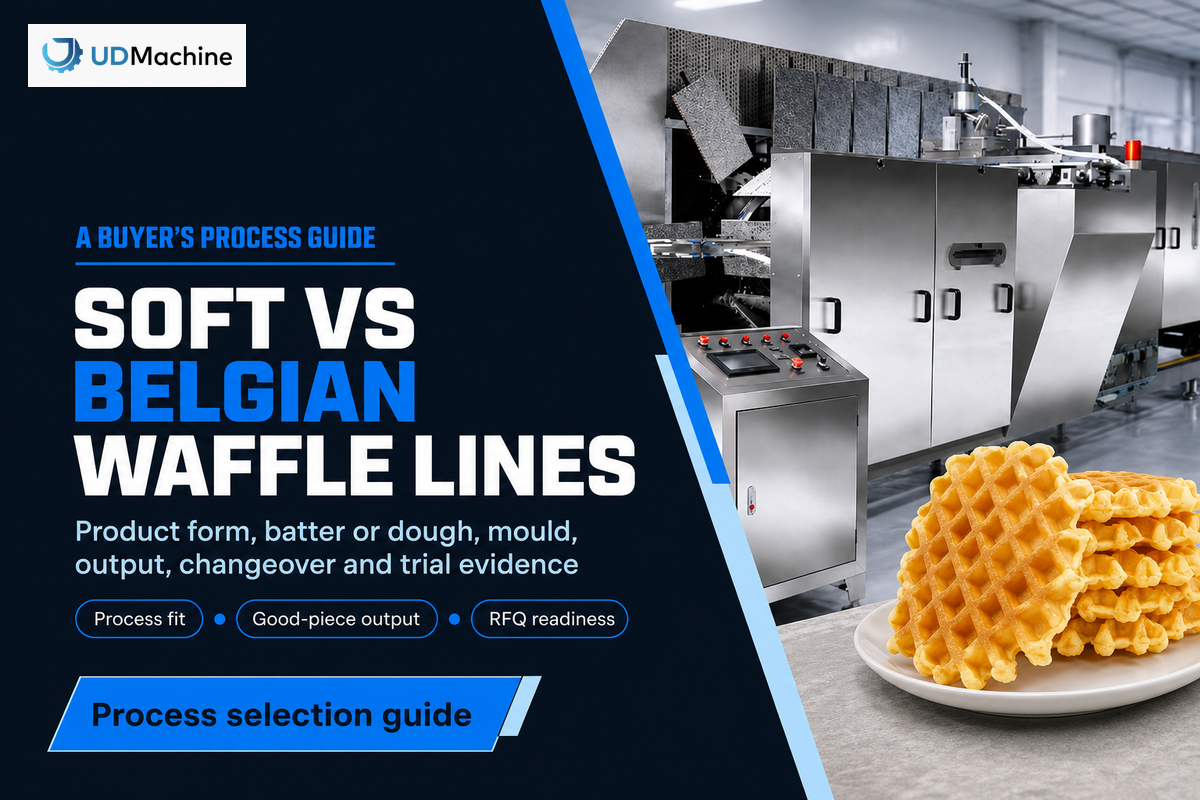
Soft vs Belgian waffle lines are industrial production routes selected by the finished product and its process behaviour, not by the product name alone. Soft batter products may suit metered depositing into shallow moulds. Brussels-style waffles may use a fluid, yeast-leavened batter and deeper pockets. Liege waffles can require portioning structured dough containing pearl sugar. The supplier should prove the chosen route with your formula, target piece and acceptance method.
Soft vs Belgian Waffle Lines at a Glance
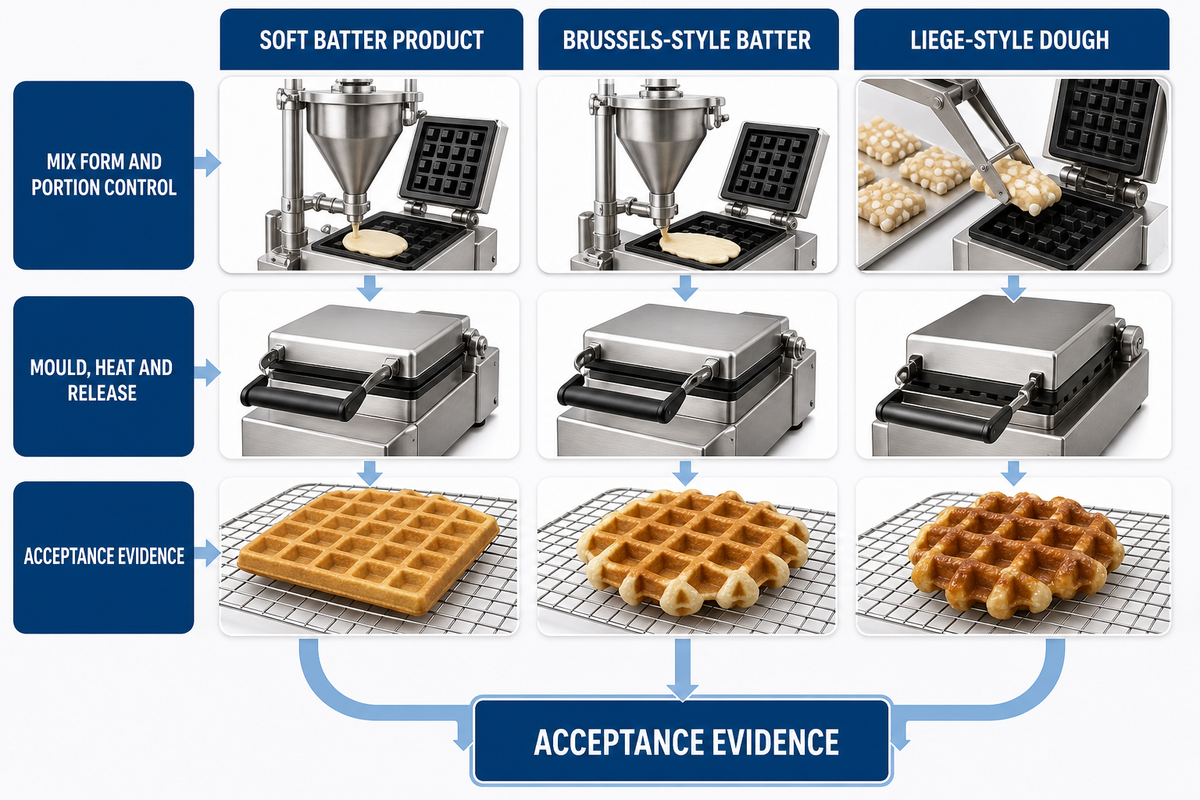
Soft vs Belgian waffle lines differ most at the product-to-machine boundary: how the mix reaches the plate, how the mould shapes it, how heat reaches the centre, and how the baked piece releases. Belgian does not mean one process. Define Brussels or Liege style before comparing equipment.
10-Part Product-to-Process Boundary Map
| Product type in the 10-Part Boundary Map | Soft waffle line question | Belgian waffle line question | Evidence to request |
|---|---|---|---|
| 1. Finished bite | How soft and flexible must the crumb remain after cooling? | Is the target light and crisp outside, or denser and chewier? | Approved sensory sample at packing time and after storage. |
| 2. Mix form | Can the batter be pumped and deposited without damaging aeration? | Is it fluid batter, yeast-leavened batter, or brioche-like dough? | Formula revision, density or viscosity method, and temperature. |
| 3. Portion control | What deposited mass fills each cavity without flash? | Does the line meter liquid or place a divided dough piece? | Start, middle, and end weights from a witnessed run. |
| 4. Pocket geometry | What shallow grid pattern supports the required softness? | How deep are the pockets, and can the product release intact? | Product drawing and approved mould drawing. |
| 5. Leavening | Does the recipe tend to use baking powder or another system? | Is it leavened with yeast, chemically leavened, or hybrid? | Proof or hold-time window tied to the actual recipe. |
| 6. Sugar behaviour | How does sugar in the batter affect colour and plate release? | Is pearl sugar folded into the batter or placed in dough? | Residue photographs and cleaning record after the trial. |
| 7. Bake and release | Can the soft piece leave the plate without tearing or compression? | Can the deeper product release without broken corners or stuck sugar? | Reject counts by failure mode, not a selected photo. |
| 8. Cooling and handling | Will the piece deform, sweat, or stick before packing? | Will the crust or caramelised surface change in the cooling path? | Temperature and condition at oven exit, cooling exit, and pack. |
| 9. Changeover | Which wet batter zones must drain and clean? | Which dough, yeast, crumb, or sugar zones need separate access? | Timed changeover with inspection and release decision. |
| 10. Acceptance | Which softness, dimensions, and defect limits define a good piece? | Which style, pocket, crust, and internal texture define acceptance? | One signed specification used by every bidder. |
The map prevents a common purchasing error. Regular waffles, American waffle products, Brussels waffles, and Liege waffles may share a grid, yet their mix and handling requirements can lead to different feeding, mould, take-off, cooling, and cleaning choices. Domestic waffle iron comparisons cannot answer those factory questions.
Decision capsule: compare at least 10 boundary fields on one worksheet. If 3 or more remain undefined, quotations will probably describe different products. Resolve the mix form, piece mass, mould drawing, packing condition, and acceptance sample before treating a price or pieces-per-hour figure as comparable.
Start With the Product, Not the Machine Label
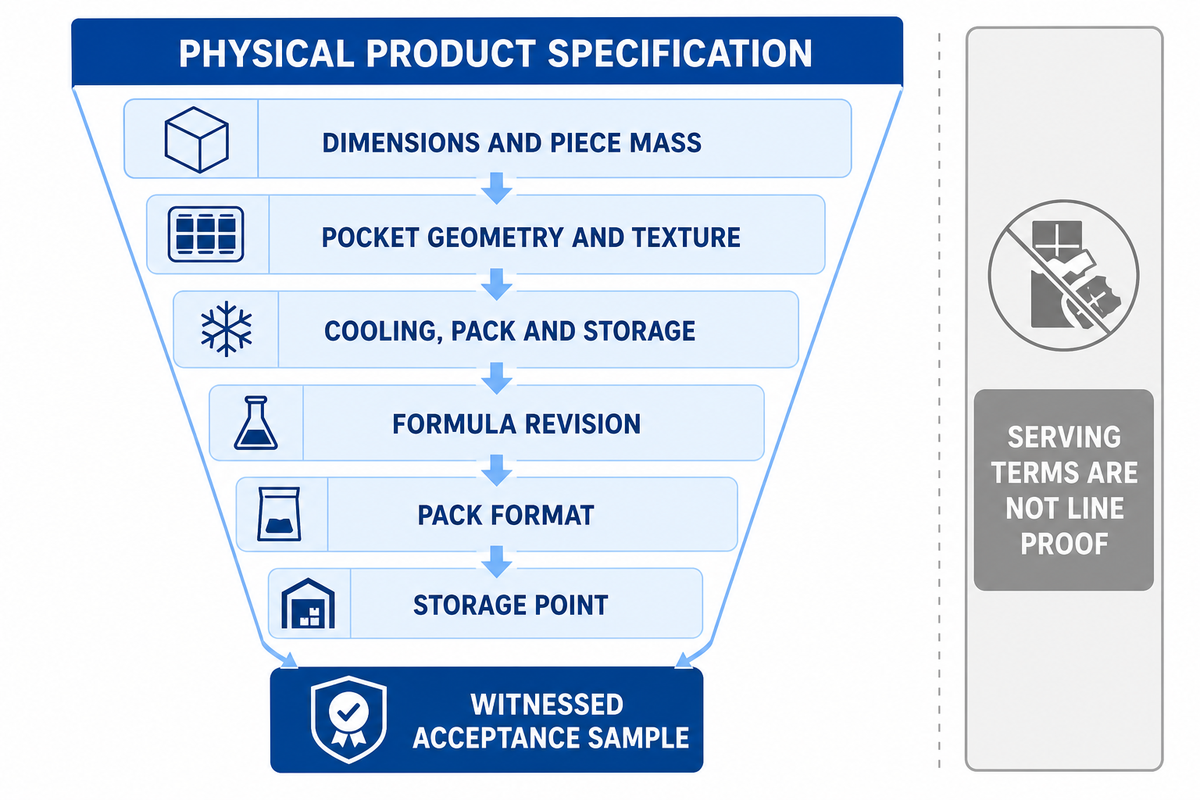
Machine labels are useful for routing an enquiry, but they cannot freeze the process. Start with a physical product specification: dimensions, piece mass, pocket geometry, bite, colour, moisture or texture target, inclusions, toppings, filling, cooling condition, pack format, storage conditions, and expected shelf life.
Consumer descriptions add noise. Belgian waffles may be served with toppings such as whipped cream, fresh fruit, powdered sugar, or maple syrup, but those serving choices do not define the production line. “Soft inside” also needs a test method. One buyer may accept a fluffy centre with a crisp on the outside; another may want a flexible snack that stays soft throughout distribution.
Search terminology boundary: Searches such as “What makes a Belgian waffle different from a regular waffle?”, “Belgian waffle vs Liege waffle,” and “Can I make Belgian waffles in a regular waffle maker?” usually seek recipes or domestic appliance advice. Other queries ask for the difference between Belgian waffles, the real difference among types of waffles, or a Brussels waffle vs regular waffles. Searches for “Belgium waffles” and “waffles in Belgium” can also mix product names with culinary geography. Pages about waffle varieties and popular waffle varieties may group a stroopwafel, stroopwafels, yeast waffles, savory waffles, other savory items, and savoury snacks together. Those consumer categories do not prove that one industrial line can make each product.
Serving language creates a second boundary. Someone may ask how to eat waffles, eat a Belgian waffle, or choose products eaten plain, eaten warm, or served with cream and strawberries. Recipe pages may say Belgian waffles are usually thicker, that aeration makes them lighter, or that pearl sugar caramelises on the iron. Procurement still needs the formula. Brussels and Liège waffles can follow different routes: one may use batter, while a Liège waffle can be made with a dough closer to brioche dough. The difference between Belgian product names becomes useful only after each phrase is tied to mix form, mould, heat, release, and packing.
The first useful distinction is therefore product form. Brussels-style products are commonly discussed as batter waffles, while an authentic Liège waffle from Belgium is associated with yeast dough and pearl sugar. Even that split is only a starting point. One peer-reviewed fresh egg waffle study found strong formulation effects within one batter-based product class, so starch and sugar choices can change release, stability, and texture. The study does not compare every soft, Brussels, or Liege line and does not select equipment; it supports only the narrower conclusion that a recipe label is too coarse for acceptance. Retail waffles must also be judged after their intended cooling and packaging cycle.
Write a one-page product brief with a cross-section photograph or drawing. Add the formula revision, target weight tolerance, acceptable colour range, maximum broken-piece rate, permitted surface marks, packaging entry condition, and the point at which the product will be judged. Buyers can then inspect the industrial waffle equipment category for commercial configuration discussions without asking a product page to make the decision for them.
Common mistake: approving a line from one attractive hot sample. Hot waffles can change during a 20-minute cooling path, after sealing, and through a 30-day storage programme. The acceptance sample should represent the product at the point of sale, not only at oven discharge.
Specification capsule: retain 3 sample sets from the start, middle, and end of the witnessed run. Record at least 1 piece-mass tolerance, 1 dimensional tolerance, 1 texture method, and the pack-entry condition. Those four measured fields answer more than a soft, regular, or Belgian label alone.
How Batter or Dough Changes Feeding and Baking
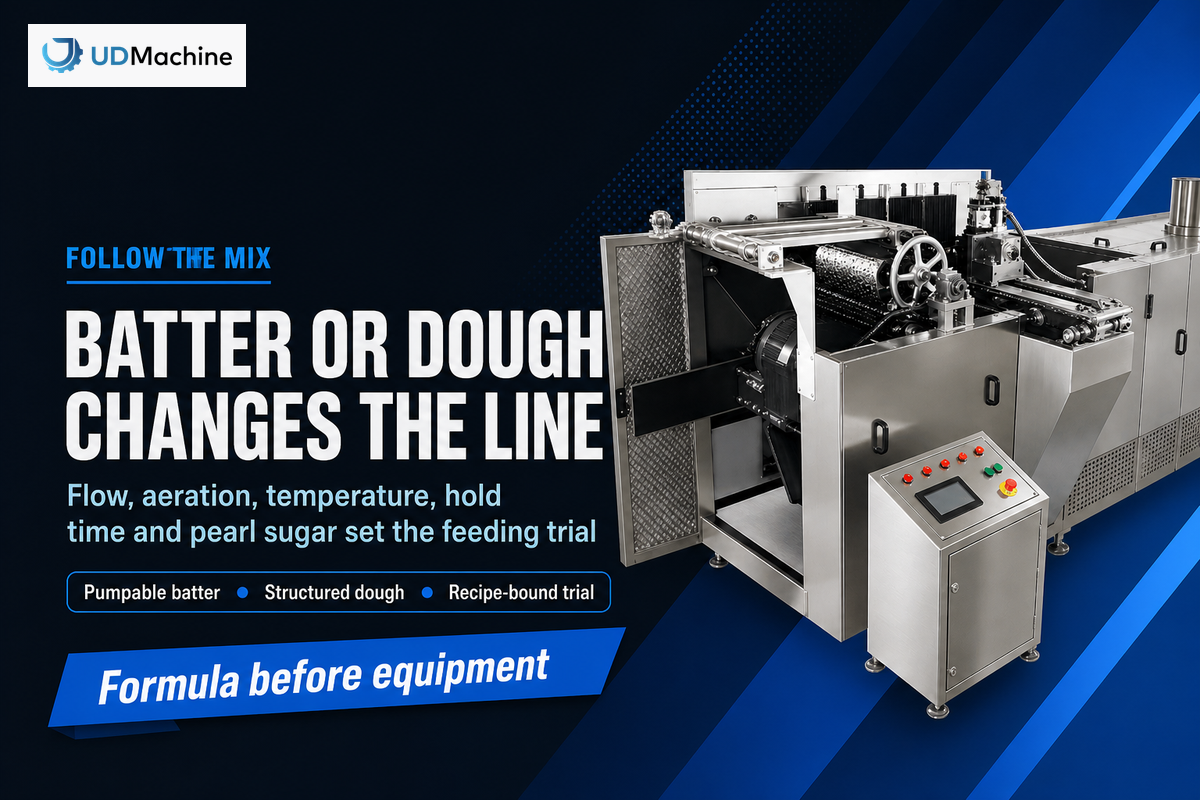
Feed system choice follows flow behaviour. Those measured specification fields now become the input to feed-system design. Pumpable batter can move through a hopper, pump, manifold, or depositor, while structured dough may need dividing, placing, and proof-time control. Yeast, egg white aeration, fat, flour, sugar, temperature, and hold time can all move the operating window.
The process risk is loss of dose and texture control because the same hopper setting can behave differently after hold time changes.
Liquid and aerated batter routes
Soft and Brussels-style products may both begin with batter, but the resemblance ends quickly. Density, viscosity, pH, solids, leavening, and aeration affect how the dose spreads and how much gas remains during baking. Even a depositor that repeats volume can miss piece mass if batter density drifts. Record both the setting and the resulting weight.
Aeration creates another boundary. If a recipe makes the waffle lighter through whipped egg white or mechanical aeration, pumping and waiting can change the bubble structure. Ask how long the prepared batter may remain in the hopper, whether recirculation changes it, and whether the last 10 minutes of a batch still meet the approved sample.
Structured dough and pearl sugar routes
Liege-style production can move the question from depositing to dough portioning and placement. Dough containing pearl sugar has particles, fermentation history, and surface tack that a smooth batter does not. The buyer should witness piece division, placement in the hot iron, spread, caramelisation, release, crumbs, and residue. The phrase “containing pearl sugar that caramelises” describes a product mechanism, not proof that any line can run every sugar grade.
Are Belgian waffles supposed to be soft?
There is no single Belgian texture. Brussels and Liege are two main styles, and each producer may define a different crust and interior. Brussels waffles may be lighter and crispier outside with an airy centre; Liege waffles are denser and often chewier. Freeze a physical reference and measurable limits instead of approving the word “Belgian.”
Trial capsule: test the actual formula at 3 planned points: low, nominal, and high feed or hold condition. At each point, collect 10 consecutive pieces and record dose mass, spread, release, and breakage. That 30-piece record can expose drift that one presentation sample will hide.
Mould Geometry, Heat and Release Work as One System

Waffle moulds do more than create a grid pattern. Those formula and release observations lead directly to mould geometry. Plate material, pocket depth, surface condition, deposit spread, baking temperature, baking time, release treatment, and recipe interact. A deeper Belgian profile is not automatically better; it must transfer heat and release the specified product without damage or excess residue.
10-Check Batter-to-Mould Fit Test
The Batter-to-Mould Fit Test is a buyer-side trial method. Freeze the mould drawing and recipe, then record how the dose fills corners, whether flash forms at the edge, how colour develops across lanes, what force or intervention is needed at take-off, and where the first damage appears. Use the same inspection sheet after every change.
| Observed result | First variables to check | Do not assume |
|---|---|---|
| 1. Incomplete corners | Dose mass, batter spread, viscosity, plate level, pocket fill. | A larger pump alone will solve the shape. |
| 2. Edge flash | Overfill, spread rate, closure timing, dough placement. | Every excess edge can be trimmed economically. |
| 3. One pale lane | Heat distribution, plate contact, deposit temperature, timing. | One global temperature increase is the safest correction. |
| 4. Dark ridges | Local heat flux, sugar contact, residue, pocket geometry. | Colour comes only from total bake time. |
| 5. Sticking at release | Plate condition, recipe, release agent, temperature, time. | Sticking has a single universal cause. |
| 6. Broken corners | Take-off path, pocket depth, texture, cooling delay. | The mould must be redesigned before the recipe is checked. |
| 7. Crumbly take-off | Starch system, moisture, structure, removal timing. | More release agent will restore structural strength. |
| 8. Surface tearing | Adhesion, opening timing, plate finish, product flexibility. | Higher line speed reduces contact damage. |
| 9. Sugar residue | Sugar form, contact point, plate temperature, cleaning interval. | A dry brush reaches every food-contact shadow. |
| 10. Compression marks | Take-off tool, transfer height, belt pressure, hot-piece strength. | The oven caused damage seen after transfer. |
Peer-reviewed waffle work supports the multivariable approach. Plate material, temperature, time, release treatment, starch, sugar, and other ingredients can influence sticking and take-off. That evidence does not supply a universal setting for your product. It tells the trial team which variables must stay visible in the record.
For more detail on soft-waffle defects and control points, use the existing soft-waffle process guide for defect-control detail. For the commercial equipment path, buyers can compare the mould, batter and baking controls used for a soft waffle line. This comparison article keeps the cross-format decision boundary.
Release capsule: inspect 30 consecutive cavities after a stable 20-minute window, then classify every defect by lane and location. A 2% total reject figure hides whether failures cluster in 1 lane, 1 pocket corner, or the first 5 minutes after a stop.
Compare Output as Good Pieces, Not Brochure Speed
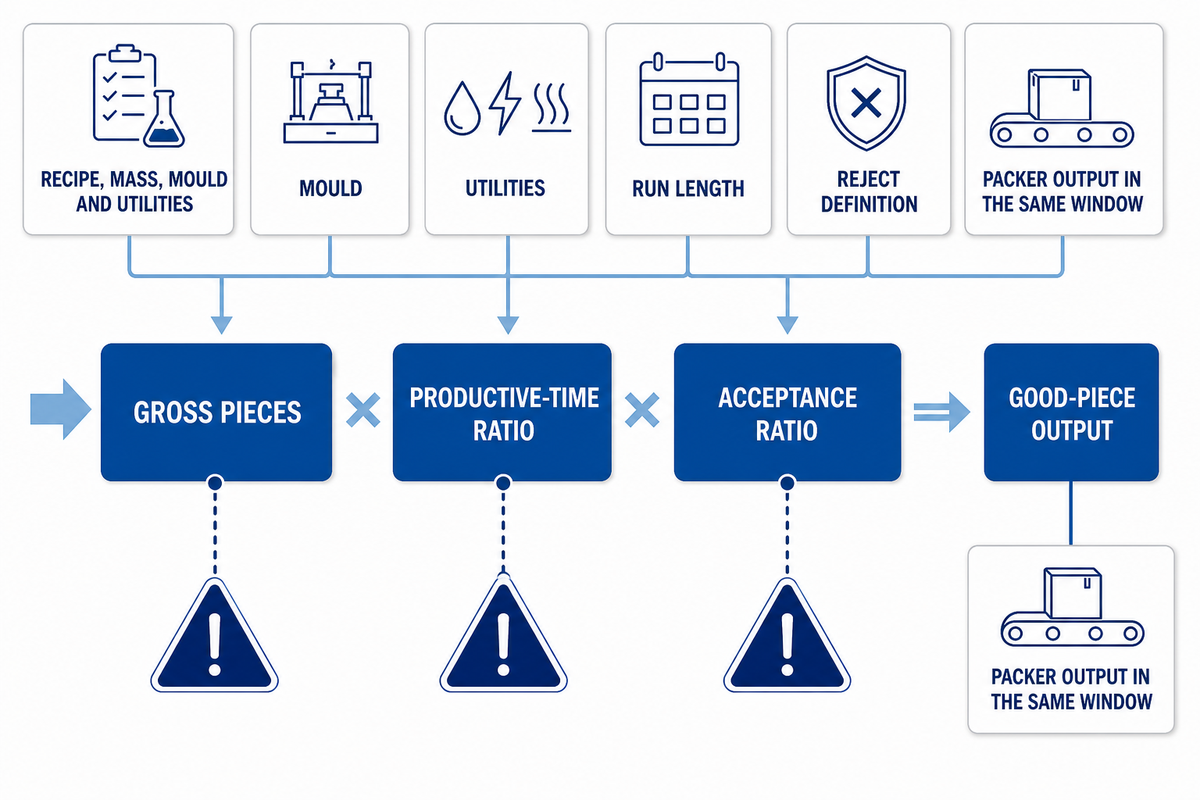
Brochure speed is useful only when suppliers use the same basis. Compare good pieces per productive hour under a stated recipe, piece mass, mould, utilities, run length, planned stop rule, and reject definition. Gross cycles can overstate usable output when sticking, breakage, cooling, or packing limits the connected line.
Good-piece output per hour = gross pieces × productive-time ratio × acceptance ratio
Consider an illustrative line rated at 12,000 pieces per hour. If the observed productive-time ratio is 92% and 96% of pieces meet the agreed specification, the calculated output is 10,598 good pieces per hour: 12,000 × 0.92 × 0.96. This is a method example, not a UDTECH capacity statement or a purchase guarantee.
Now change the product. If a deeper pocket raises gross pieces but breakage reaches 9%, or a pearl-sugar dough adds a 35-minute cleaning loss, the higher headline rate may deliver fewer accepted cartons per shift. Apply the same formula to both formats. Keep startup waste, restart waste, sampling holds, and downstream stoppages visible instead of averaging them out.
The witnessed window also matters. A 5-minute run can miss batter ageing, plate fouling, yeast timing, sugar residue, and packer accumulation. Agree a stable-run definition before the factory acceptance test. For example, require 60 continuous minutes after warm-up, record every 10 minutes, and retain 3 sample groups. The exact duration belongs to the buyer’s risk and production plan.
What most teams get wrong: they ask, “How many pieces per hour?” Ask four questions instead: What piece? Which formula? How many accepted pieces? Over what productive window? A supplier that cannot state those four inputs has not provided a comparable output figure.
Output capsule: retain gross rate, productive minutes, accepted pieces, and packer output for the same 60-minute window. If the oven reports 12,000 pieces per hour but packing accepts 10,200, the lower number sets the immediate line plan until the bottleneck is resolved.
Cleaning, Changeover and Utilities Can Reverse the Choice
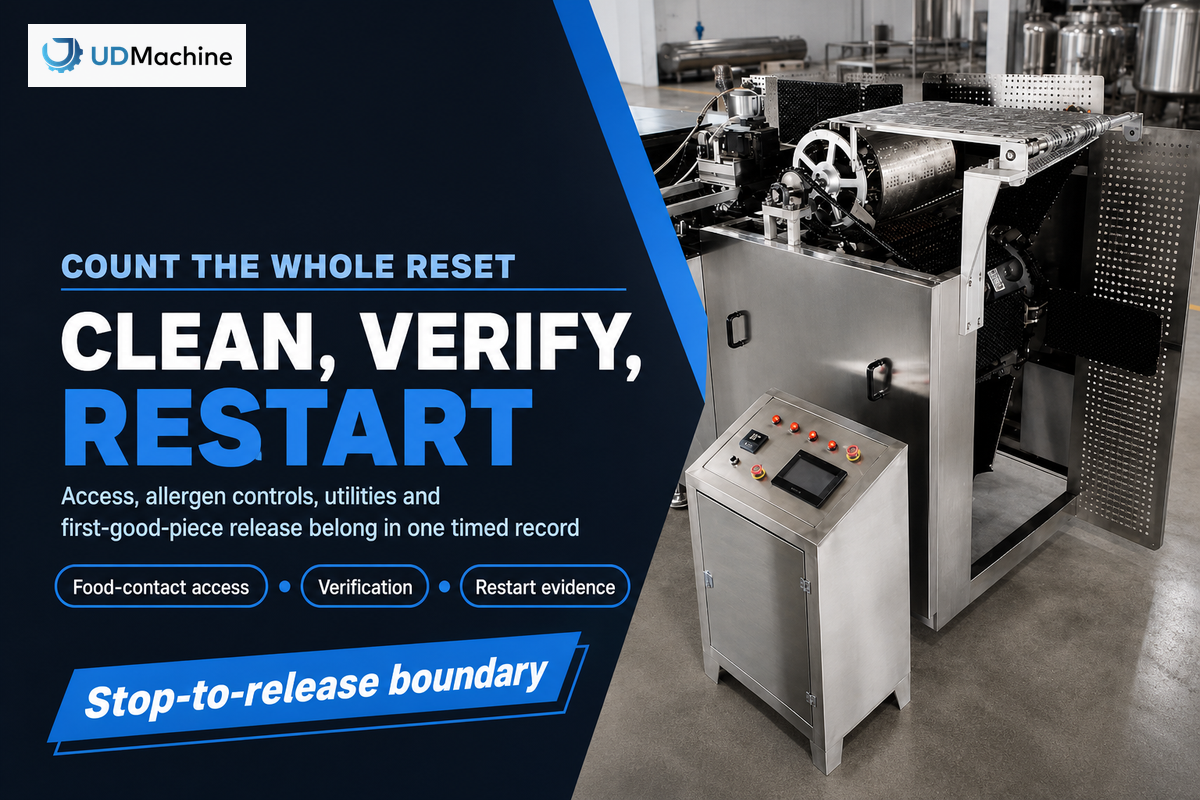
The main risk is that cleaning and utility demands can reverse an apparent capacity advantage. Wet batter circuits, dough contact parts, yeast residues, pearl sugar, crumbs, release agents, deep pockets, and cooling belts create different access needs. Compare productive minutes lost, inspection steps, allergen controls, restart waste, energy, air, ventilation, and floor space.
Which line is easier to change over?
The easier line is the one whose actual food-contact path can be accessed, cleaned, inspected, released, reassembled, and restarted inside the buyer’s allowed window. Count tools and parts. Time drain-down, scraping, dry or wet cleaning, inspection, swabbing where required, recipe loading, first-good-piece approval, and disposal of startup waste.
Allergen changeover deserves its own record. Where applicable, a covered facility may need written procedures that control allergen cross-contact and support correct labels. A generic “sanitation complete” box does not show which allergen was removed, which contact zones were inspected, what method verified the result, or who released the line.
“The lethality and microbial destruction kinetics should not be extrapolated to other bakery products without further research.”
The 2016 paper tested hamburger buns, not waffles. It supplies no waffle lethality value, bake schedule, or safety guarantee. Its role here is limited to the authors’ no-extrapolation warning and the resulting need for product-specific validation where the buyer’s hazard analysis requires it.
The same caution applies to process acceptance. A line can pass mechanical checks while the buyer’s product-specific hazard analysis, thermal validation, cooling, packaging, water activity, or shelf-life programme remains open. Equipment suppliers can provide settings and test access. The food manufacturer and its qualified specialists must decide which safety controls and legal duties apply.
Utilities should share the same basis too. Record voltage, phase, frequency, connected load, compressed-air pressure and flow, gas if used, exhaust, cooling demand, ambient range, drainage, wash-water rules, and maintenance clearance. A line that fits the product but not the factory is not an acceptable configuration.
Changeover capsule: time 8 events separately: stop, empty, disassemble, clean, verify, reassemble, restart, and first-good-piece release. A quoted 25-minute “clean” can become a 70-minute production loss when the other 7 events are omitted from the comparison.
Use the 10-Signal Texture-to-Line Decision Grid
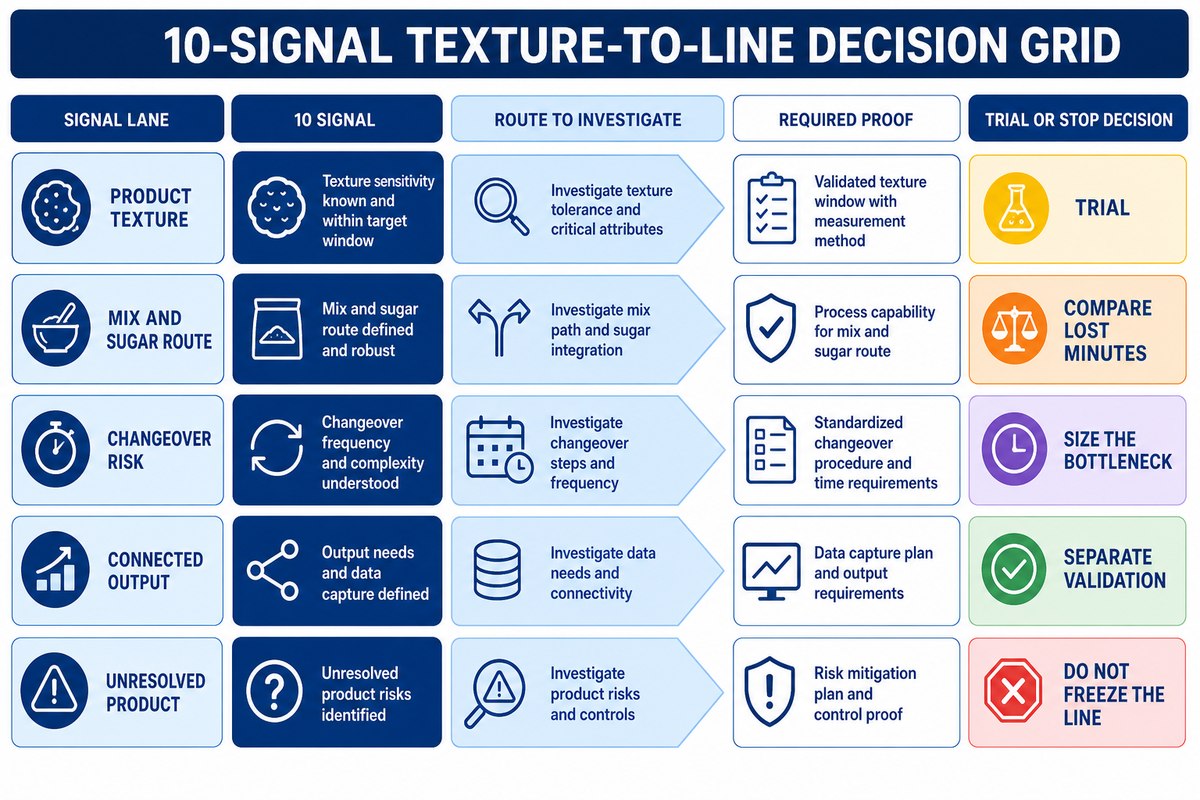
Once changeover and cleaning limits are visible, the Texture-to-Line Decision Grid converts sensory language into an engineering route. It does not select a machine automatically. The procurement risk is freezing a guess as a purchase specification because sensory terms alone do not prove product-line fit.
The grid shows which input remains unknown, which trial must be run, and when a buyer should stop quotation work until the product and acceptance boundary are clear enough to test.
| Buyer signal | Likely route to investigate | Required proof | Decision |
|---|---|---|---|
| 1. Flexible soft snack after packing | Soft-waffle batter, shallow mould, controlled cooling. | Packed texture at target storage age. | Trial required. |
| 2. Airy Brussels-style centre | Fluid or aerated yeast-leavened batter and deeper pocket. | Density, hold time, pocket fill, crust and centre sample. | Trial required. |
| 3. Denser, chewier Liege profile | Portioned dough and placement route. | Dough-piece repeatability, proof state, spread and release. | Trial required. |
| 4. Made with pearl sugar | Particle-tolerant dough handling and residue plan. | Sugar grade, distribution, caramelised residue, cleaning record. | Trial required. |
| 5. Frequent flavour changes | Accessible product path and recipe-control plan. | Timed changeover plus first-good-piece release. | Compare lost minutes. |
| 6. Different allergen profiles | Segregation or validated allergen-changeover route. | Written procedure, label check, verification and release. | Quality review required. |
| 7. Fragile deep pockets | Gentle opening, take-off, transfer, and cooling. | 30-piece breakage map by cavity and lane. | Trial required. |
| 8. High output with small cartons | Line balance through inspection and packing. | Same-window oven, conveyor, and packer counts. | Size the bottleneck. |
| 9. Long ambient shelf life | Product-specific cooling, packaging, and shelf-life programme. | Buyer-approved storage and safety evidence. | Separate validation required. |
| 10. Product still changing | Pilot work or flexible test platform. | Frozen prototype and unresolved-variable register. | Do not freeze the line yet. |
A “trial required” result is useful. It prevents a guess from becoming a purchase specification. If both soft and Belgian routes remain possible, ask each bidder to state which product assumption drives the proposed depositor, mould, bake system, removal method, and cooling path. The answer makes commercial proposals easier to compare.
Grid capsule: score all 10 signals as defined, unknown, or disputed. More than 2 unknown process inputs or 1 disputed food-safety boundary should keep the project in trial planning. Quotation can continue for budget context, but technical acceptance should stay open.
What to Witness During a Sample Trial
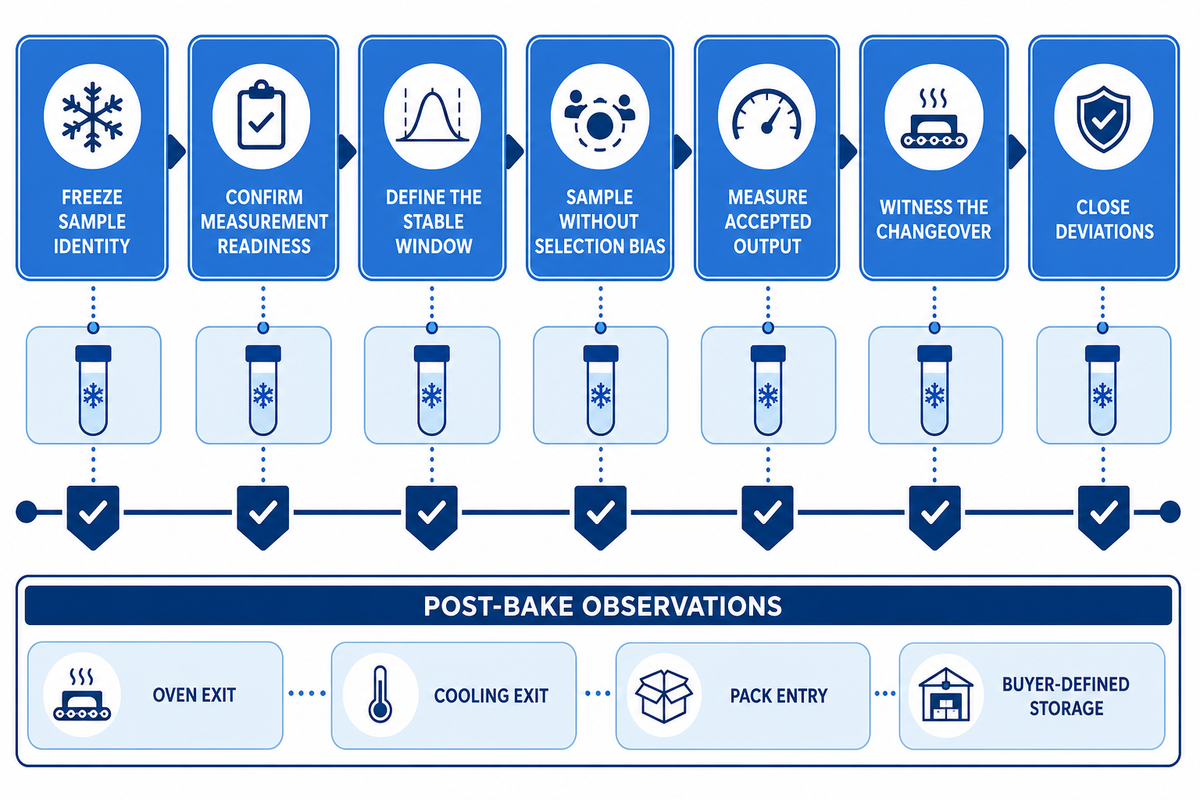
A sample trial should test the specified product over a defined window and preserve enough evidence to explain a pass or failure. Witness recipe identity, raw-material state, feed behaviour, plate conditions, stable output, stops, changeover, cooling, packaging, defects, and deviations. Do not record only selected good pieces.
- Freeze the sample identity. Record formula revision, ingredient lots, batter or dough preparation, temperature, density or viscosity method, yeast or leavening state, pearl-sugar grade, piece target, and approved reference.
- Confirm measurement readiness. List calibrated scales, thermometers, timers, gauges, inspection templates, data tags, and the person responsible for each reading.
- Define the stable window. Agree when warm-up ends, how long the witnessed period lasts, which interruptions stop the clock, and whether restart pieces enter the acceptance sample.
- Sample without selection bias. Take consecutive pieces from every lane at fixed intervals. Keep failures with the matching time, cavity, setting, and operator note.
- Measure accepted output. Count gross pieces, rejects by cause, productive minutes, accepted cartons, and the downstream constraint during one common time window.
- Witness the changeover. Time access, cleaning, inspection, allergen verification where applicable, reassembly, recipe loading, restart, and first-good-piece approval.
- Close deviations. Give each open item an owner, due date, retest method, evidence requirement, and acceptance authority.
Keep equipment acceptance separate from food-safety validation. The trial can demonstrate control access, repeatable settings, sample collection, and mechanical performance. It should not silently certify thermal lethality, shelf life, local legal compliance, or allergen control for a product that the competent team has not validated.
Post-bake observations belong in the protocol. Record product condition at oven exit, after the cooling conveyor, at pack entry, and after the buyer-defined storage period. If a soft product sweats inside the package or a crisp product softens after sealing, an attractive oven-exit sample did not meet the commercial objective.
Illustrative Trial Data Sheet
The values below are placeholders that show how to bind a number to a unit and observation point. They are not UDTECH specifications, safe processing limits, or recommended waffle settings. Replace every value with the approved product trial plan before a supplier run.
| Measured category | Illustrative entry | Required context |
|---|---|---|
| 1. Batter condition | 20 °C at start; 25 °C at end | Recipe revision, mixing completion, and calibrated probe. |
| 2. Product envelope | 120 mm × 90 mm × 18 mm | Drawing revision, tolerance, and measurement method. |
| 3. Pocket check | 15 mm depth at 6 locations | Mould drawing, gauge, and cavity identity. |
| 4. Plate observations | 160 °C, 180 °C, and 200 °C display points | Sensor location, calibration, and actual approved test range. |
| 5. Contact time | 90 sec, 110 sec, and 130 sec trials | Closure event, opening event, and stop-clock rule. |
| 6. Stable run | 60 min after a 20 min warm-up | Definition of stable, pauses, and excluded minutes. |
| 7. Sampling | Every 10 min across 3 time points | Lane coverage, consecutive pieces, and sample retention. |
| 8. Acceptance rate | 97% accepted; 3% classified rejects | Approved defect codes and inspection authority. |
| 9. Electrical | 380 V, 50 Hz, 80 kW connected entry | Quoted configuration and plant utility verification. |
| 10. Compressed air | 0.6 MPa and 0.2 m³/min entry | Pressure at use, air quality, and simultaneous demand. |
| 11. Line envelope | 25 m × 3 m working area | Layout revision, access, guarding, and maintenance clearance. |
| 12. Cooling | 15 min to a 35 °C pack-entry check | Ambient conditions, belt loading, and product condition. |
| 13. Changeover | 45 min maximum lost-time target | Full stop-to-first-good-piece event list. |
| 14. Storage review | 1 day, 7 days, and 30 days | Pack, storage condition, safety plan, and texture method. |
| 15. Weight control | ±2% illustrative tolerance | Target piece mass, scale resolution, and sampling rule. |
Witness capsule: a practical record may use a 60-minute stable window, readings every 10 minutes, and 10 consecutive pieces from each lane at 3 time points. Those numbers are planning examples. Replace them with the sample size and duration justified by the buyer’s risk assessment.
Build an RFQ That Suppliers Can Answer on the Same Basis
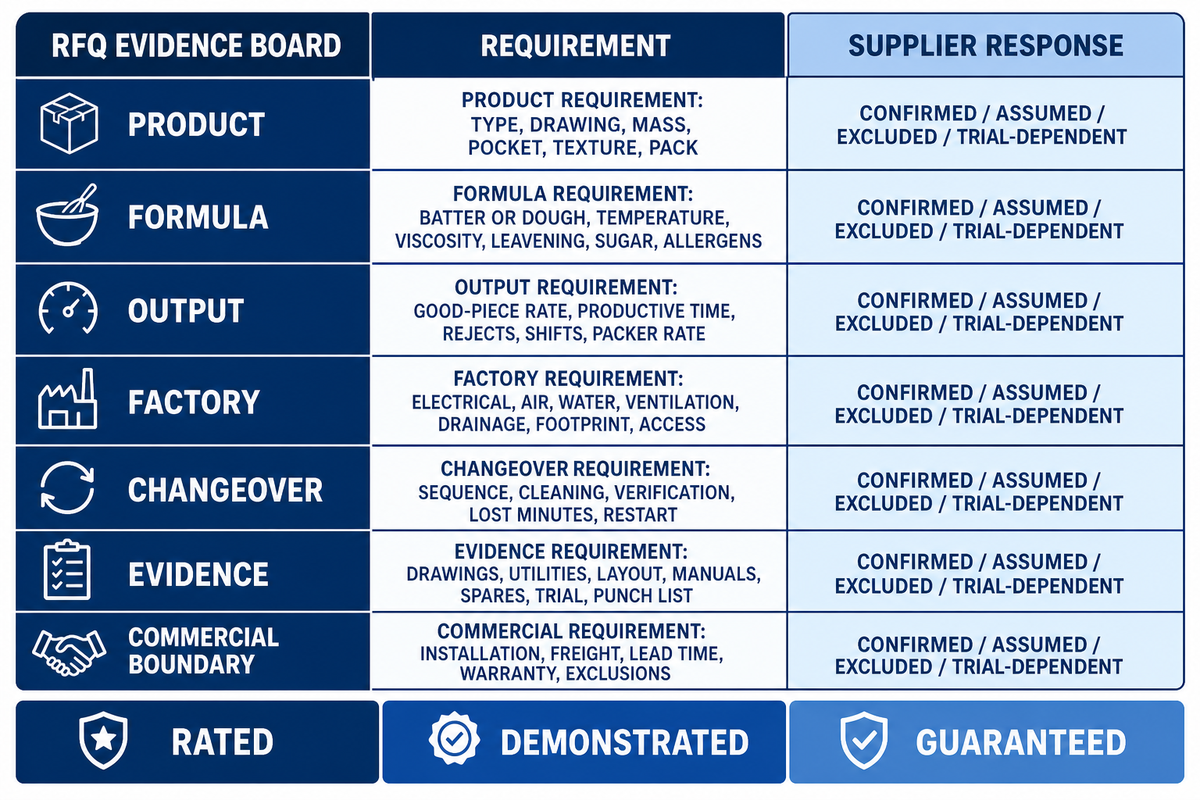
A useful RFQ fixes the comparison basis before suppliers choose equipment. That witnessed sample record becomes the evidence attached to the RFQ. Send the same product file, output definition, utilities, cleaning boundary, site limits, documentation list, trial protocol, and acceptance method to every bidder. Ask each supplier to identify assumptions, exclusions, untested conditions, and values that remain provisional.
- Product: waffle type, drawing, piece mass, pocket geometry, texture, colour, toppings or filling, pack format, storage, and shelf-life target.
- Formula: batter or dough, temperature, density or viscosity method, yeast or baking powder, egg, fat, flour, sugar form, pearl-sugar grade, inclusions, and allergen profile.
- Output: required good pieces per hour, productive-time basis, reject definitions, operating shifts, batch size, and downstream packer rate.
- Factory: electrical supply, air, gas, water, ventilation, drainage, floor load, available footprint, ambient conditions, and maintenance access.
- Changeover: product sequence, allergen boundaries, cleaning method, inspection, verification, maximum lost minutes, and restart acceptance.
- Evidence: mould drawing, utility schedule, line layout, controls description, manuals, spare parts, training, trial report, data export, punch list, and retest terms.
- Commercial boundary: installation, commissioning, travel, taxes, freight, warranties, exclusions, lead time, and buyer-supplied services.
Request three output labels in the proposal: rated, demonstrated, and guaranteed. A rated value belongs to the supplier’s stated conditions. A demonstrated value belongs to the witnessed trial record. A guarantee needs contract language, product assumptions, measurement rules, remedies, and exclusions. Do not merge them into one capacity cell.
Use this article to prepare the decision file, then review the wider waffle and pancake line configuration framework for the commercial product-family handoff. Keeping the educational comparison and the solution-page quotation intent separate helps procurement teams reach the supplier with a more precise request.
Prepare a process-fit discussion.
Bring your product drawing, formula boundary, target good-piece output, utilities, changeover rule, and planned sample-trial evidence.
Discuss Your Waffle Line Requirements
Bring your product drawing, formula boundary, target good-piece output, utilities, changeover rule, and planned sample-trial evidence.
Discuss Your Waffle Line Requirements
RFQ capsule: one comparable request should include at least 7 sections: product, formula, output, factory, changeover, evidence, and commercial scope. Require every bidder to mark each field confirmed, assumed, excluded, or trial-dependent before commercial ranking begins.
FAQ: Soft vs Belgian Waffle Lines
Buyers usually need a direct answer before they build the detailed trial file. The following questions separate consumer waffle vocabulary from industrial decisions. Each answer keeps product definition, actual formula behaviour, witnessed good-piece output, and the buyer’s own safety and shelf-life obligations in view.
What is the main difference between a soft and Belgian waffle line?
The main difference is the product-to-process route, not the label. A soft waffle often starts with pumpable batter and a target that remains tender after cooling. A Brussels-style Belgian waffle may use fluid yeast-leavened batter with deeper pockets. A Liege waffle can require divided dough with pearl sugar. Buyers should compare feeding, mould geometry, bake and release behaviour, cooling, cleaning, and accepted output with the actual formula.
Can one line make both soft and Belgian waffles?
Sometimes, but only a product-specific trial can support that answer. A line may accommodate two batter products through mould, recipe, depositor, and control changes. Moving between pumpable batter and structured Liege dough can require a different feeding architecture. Ask the supplier to list every changed part, setting, cleaning step, utility condition, lost minute, and untested assumption. Multi-product capability should be demonstrated with both approved products. Retain the two trial reports, tooling list, recipe files, sanitation release records, restart samples, and accepted good-piece calculations. If either product requires untested manual intervention or a different food-safety boundary, describe the limitation in the quotation instead of calling the line universally flexible.
Are Belgian waffles supposed to be soft?
Belgian waffle is not one texture. Brussels waffles may be airy inside and crisp outside, while Liege waffles are often denser and chewier because they’re made with dough and pearl sugar. Industrial acceptance should replace those broad words with a physical reference, texture method, dimensions, piece mass, crust and centre criteria, packaging condition, and storage-age checkpoint. That specification determines the trial and line route.
Can the same batter make regular and Belgian waffles?
A batter may bake in more than one mould, but pocket depth changes fill, heat transfer, release, and cooling. Test the exact formula and record good-piece output rather than assuming equivalence.
Should capacity decide between waffle lines?
Capacity should influence the decision only after it’s normalised. Compare good pieces per productive hour for the same recipe, piece mass, run window, reject rules, utilities, changeover allowance, and downstream pack rate. A faster gross cycle can produce fewer saleable cartons if sticking, breakage, cooling, residue, or packing reduces acceptance. Keep rated, demonstrated, and guaranteed values in separate proposal fields. Calculate at least one full-shift scenario that includes warm-up, planned cleaning, recipe change, sampling holds, restart waste, and the actual packing constraint. Then stress-test the model at the high and low reject rates seen during the witnessed trial. The lower result may be the honest commercial planning figure.
What should a waffle sample trial include?
Freeze the recipe and product drawing, define the stable window, record machine and utility conditions, sample consecutive pieces across all lanes, classify every reject, measure the connected pack rate, time changeover, and close deviations through a punch list. Preserve the original readings, not only a presentation summary. Attach the mould revision, calibration status, alarm export, photographs of accepted and failed pieces, operator interventions, and start-to-pack timestamps. Equipment acceptance should remain separate from the buyer’s thermal-process, allergen, packaging, water-activity, and shelf-life validation where those controls apply. Assign each unresolved item an owner, retest method, due date, and release authority so a conditional pass can’t be mistaken for final acceptance.
Which line is easier to clean?
The easier line meets the buyer’s verified release standard in fewer total lost minutes. Time the full stop-to-first-good-piece sequence, including allergen verification where applicable, rather than accepting a quoted cleaning time.
When should a buyer request a quotation?
Request a formal quotation after the product, formula boundary, good-piece output, utilities, cleaning rule, trial plan, and acceptance evidence are defined. Early budget estimates may use visible assumptions, but technical acceptance should stay open until those assumptions are tested.
References & Sources
These sources support the product, process, control, and testing principles used in this guide. They don’t certify a particular waffle line, prescribe a universal recipe, or replace the buyer’s product-specific engineering, food-safety, and legal review.
- Peer-reviewed study: waffle sticking in relation to baking plate, temperature, time, and release agent
- Peer-reviewed study: starch and sugar effects on fresh egg waffle sticking and quality
- Peer-reviewed study: ingredient-dependent sticking in industrial fresh egg waffle production
- Peer-reviewed validation study: limits on extrapolating baking lethality between bakery products
- Electronic Code of Federal Regulations: 21 CFR Part 117 Subpart C
- Canadian Food Inspection Agency: evidence that a control measure is effective
- International Society of Automation: ISA-105 commissioning and acceptance-test standards
- Visitez Liege: authentic Liege waffle product identity
About the manufacturer: UDTECH’s current homepage presents food machinery from Xinyu, China and a history since 2003. Company-supplied information also describes two production bases and independent automation research. Patent ownership, market rank, and product-specific performance require separate due diligence. Buyers may check UDTECH’s current food machinery scope before submitting their own evidence-based specification.