Get in touch with UDTECH Company


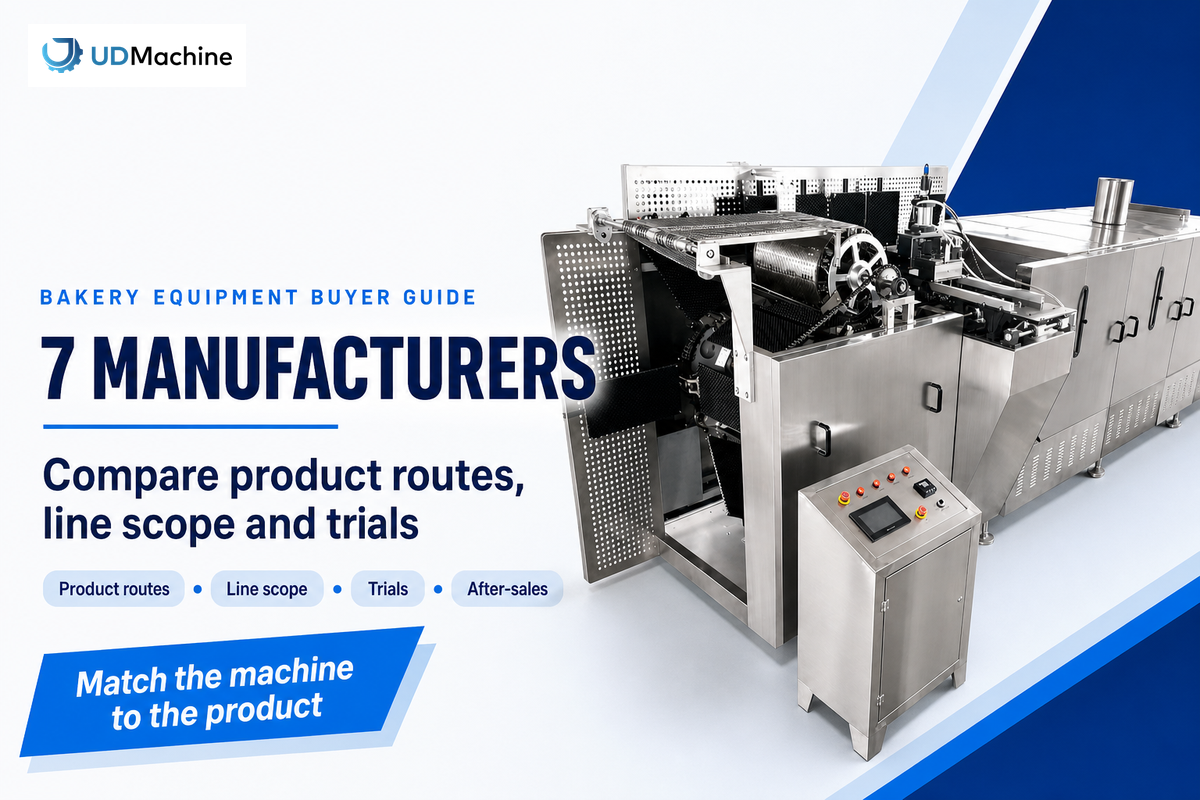
Industrial bakery equipment manufacturers are suppliers of bakery production machinery; they differ most by the products and processes their machinery is designed to address. AMF, Rademaker, RONDO, Reading Bakery Systems, Bühler, GEA and UDTECH deserve consideration for particular product routes. Bread plants and croissant producers as well as wafer producers should consider distinct shortlists, even though all three need to bake at scale.
This document summarizes publicly available equipment portfolios followed by the questions that transform a shortlist into a workable quotation. The companies aren’t ranked. UDTECH publishes this guide and is included for its specialized equipment; no independent head-to-head performance test was conducted.
Industrial bakery equipment manufacturers: a product-route comparison
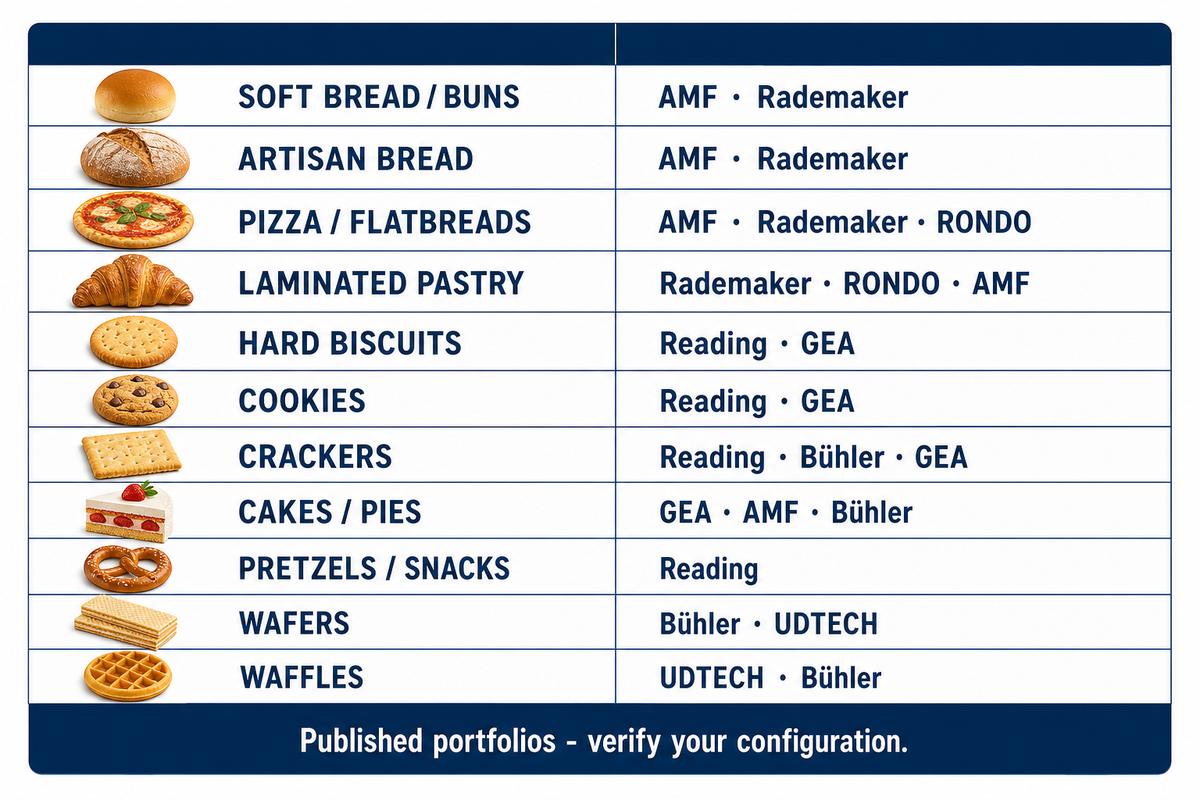
The formation route of the final product drives an effective industrial bakery equipment manufacturers list. The Bake-Route Atlas below maps eleven product routes to seven suppliers’ published portfolios. Each row narrows the initial discussion; inclusion in the Atlas doesn’t imply acceptance of your recipe, a complete plant definition, or complete service coverage at your location.
| Product route | Published portfolio to examine | Limitations / not suitable for |
|---|---|---|
| Soft bread and buns | AMF; Rademaker | A bread label does not specify the dough-handling route. |
| Artisan bread and rolls | AMF; Rademaker | Verify the intended dough and finished texture in trials. |
| Pizza and flatbreads | AMF; Rademaker; RONDO | Topping, proofing and freezing are separate scope questions. |
| Laminated pastry and croissants | Rademaker; RONDO; AMF | A sheeter alone does not establish a complete laminated line. |
| Hard-dough biscuits | Reading Bakery Systems; GEA | Confirm forming tools, oven arrangement and recipe suitability. |
| Cookies and soft biscuits | Reading Bakery Systems; GEA | Depositing and other forming options are not interchangeable. |
| Crackers | Reading Bakery Systems; Bühler; GEA | A cookie reference does not verify your cracker process. |
| Cakes, pies and filled products | GEA; AMF; Bühler baking technologies | Define the forming, filling and baking modules individually. |
| Pretzels and baked snacks | Reading Bakery Systems | Ask which products were demonstrated on the proposed system. |
| Wafers and rolled wafers | Bühler; UDTECH specialty machinery | Flat wafers, cones and rolled wafers need distinct configurations. |
| Waffles and pancakes | UDTECH; Bühler waffle technologies | Batter and dough-based products require their own trials. |
Use the matrix to eliminate obvious discrepancies then compare prices. Suppliers may manufacture several relevant machines without providing all conveyors, cooling sections or packaging connections. Request the scheduled equipment list and the entity responsible for completing the production line.
The product-route table summarizes the suppliers’ own published ranges. Source examples: https://amfbakery.com/; https://www.gea.com/en/products/bakery-equipment/; https://www.readingbakery.com/. The sections below explain the individual scope and its limits.
AMF Bakery Systems for bread and bun production
AMF Bakery Systems publishes applications for soft bread and buns, artisan bread and rolls, pizza, cakes and pastries. Its equipment spans from mixers to post-packaging automation. For a bread producer, that makes AMF a candidate to discuss several connected stages, with the actual boundaries defined in the project proposal.
Obsolete controls can stop an otherwise usable line. AMF’s public Schmidt Baking case describes a discontinued servo motor that halted bun production; the company reports an emergency repair followed by modernization. That case supports asking about replacement controls and spares, but it does not establish a guaranteed response time for another factory. For a retrofit, ask the supplier to identify unsupported components in the retained equipment before agreeing the shutdown schedule.
Official website: amfbakery.com
AMF refers to innovation center trials, parts, repairs and training. Describe your unique needs on the product brief for this discussion. Merely having an example of an existing bun doesn’t answer the question of if a different dough, pan or packing configuration will work on the quoted equipment.
The American Society of Baking’s dough-dividing guidance explains the move from bulk dough to individual pieces and identifies several divider types. Bread can also follow a sheeting-and-cutting route. Describe the desired product rather than demanding that every industrial bakery use the same divider and rounder configuration.
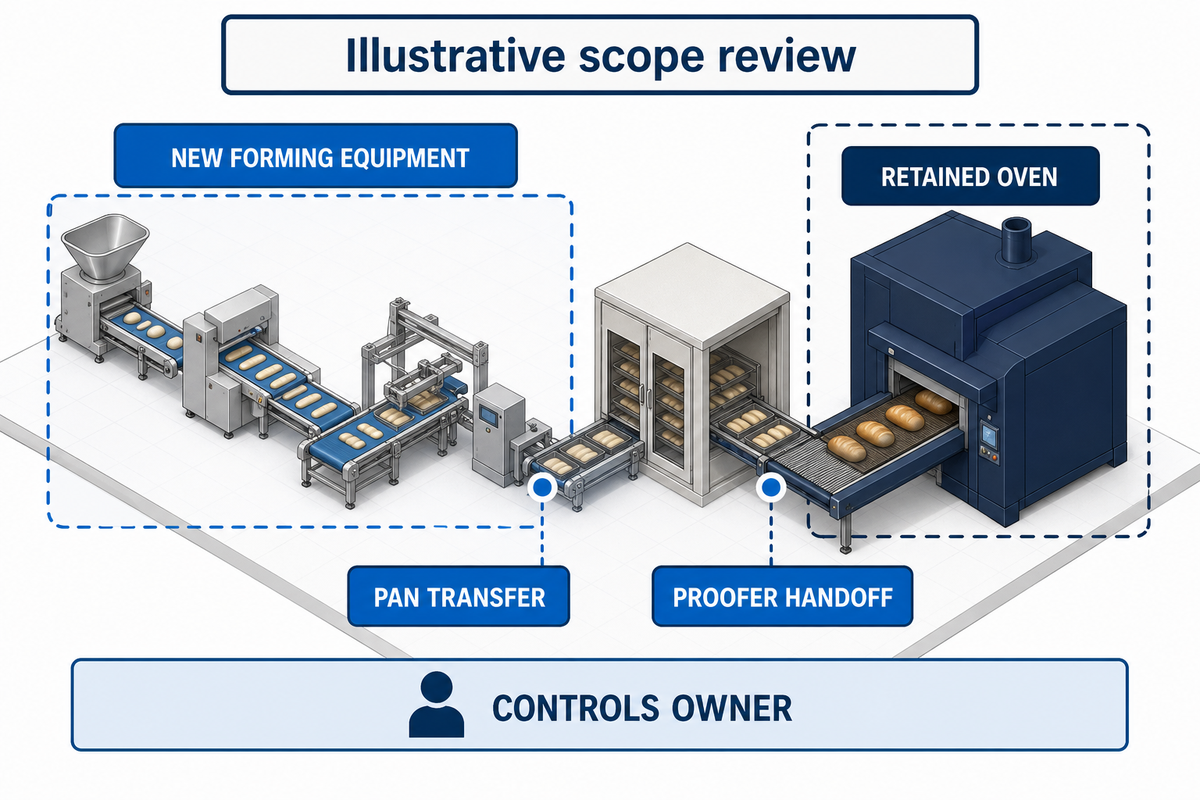
Consider a hypothetical bakery replacing a bun line while keeping its oven. The new divider may meet the desired piece weight, but the proposal must also address how pans arrive, how the proofer feeds the oven, and who sets the controls in the old and new sections. During the review, the baker should bring the current pan arrangement and production schedule along with the product samples. If cooling or bagging isn’t included in the supplier’s responsibility, name the party that accepts those interfaces. The most useful comparison is between proposals for that complete task rather than between two isolated forming speeds. The trial plan should follow the retained equipment boundary as closely as the new equipment boundary.
Pastry sheeting: Rademaker and RONDO
Rademaker and RONDO both offer dough-handling systems that include bread and pastry. Compare the proposed sheeting, laminating, and make-up stages against your finished product. Compact sheeters, industrial laminating lines and bread systems can all handle dough to fulfill significantly different production requirements.
A pastry trial should include the change between products. For example, when a bakery alternates filled croissants and unfilled pastry, record changeover downtime, dough scrap and the first acceptable pieces after restart. Those losses remain unmeasured during a short demonstration at steady speed. Compare saleable output over the same trial schedule, and keep dough input separate from the finished product count; Rademaker’s published dough-capacity range measures the former.
Official websites: rademaker.com; rondo-online.com
Rademaker’s industrial Bread Line page lists 500–9,000 kg of dough per hour and describes transfer after shaping to a proofer, freezer or oven. This range represents published data from one source relating to the named dough family. Note that this isn’t a guarantee of a packaged and saleable output. Also, the separate compact Radini range shouldn’t be used in lieu of this data.
RONDO differentiates dough sheeters, block and laminating lines, make-up lines and ASTec industrial systems. Published data on these systems includes applications for croissants, donuts, pizza and bread products. Ask the pastry machine manufacturer which systems belong to the proposed configuration and which require additional equipment.
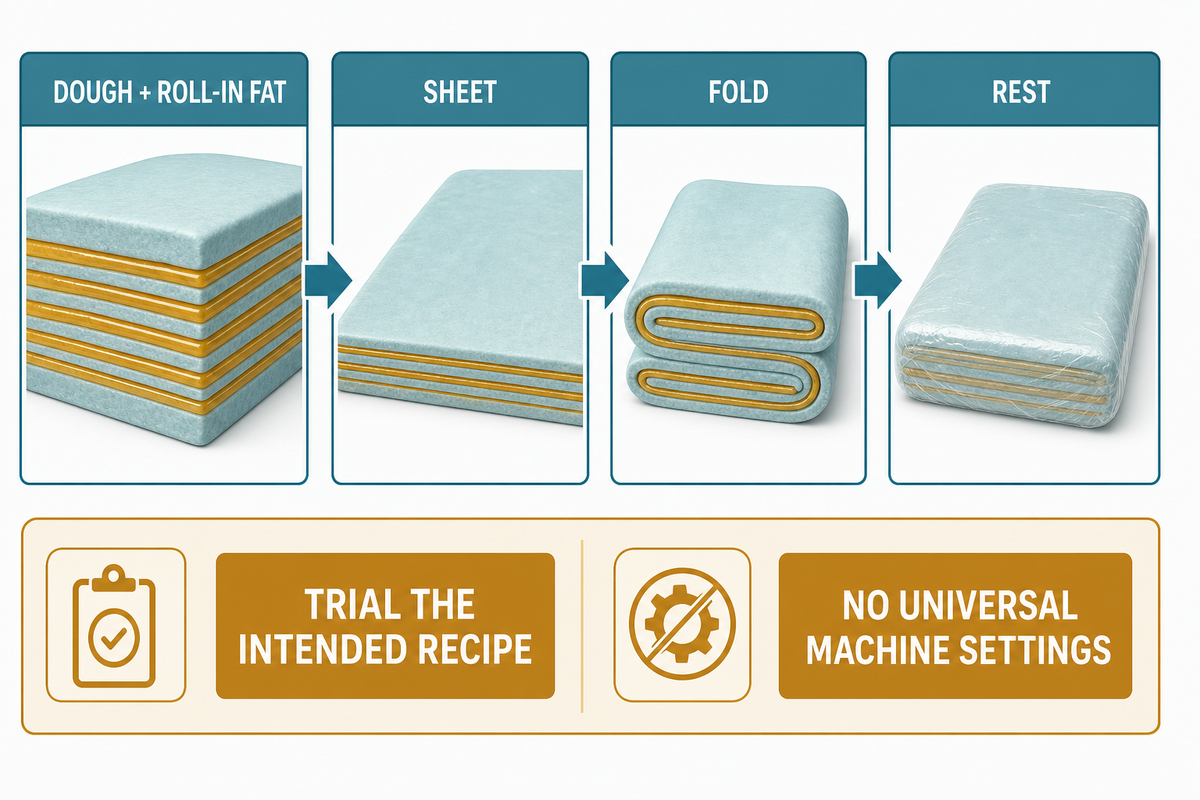
For croissants, ASB describes alternating dough and roll-in-fat layers, with sheeting, folding and rest prior to the final shaping. A 2024 puff-pastry formulation study demonstrates why the fat system is important to the final product and therefore points to the final product quality. Neither source provides universal machine settings. Request the supplier to laminate your dough and fat; verify a recipe change before presuming it justifies purchasing another machine.
For an artisanal product moving into high-volume production, capture the texture and appearance that must be retained through the change. Tailor the trial to those product criteria: they determine high-quality bakery output for this project before throughput is assessed.
Biscuit and cracker bakery machines: Reading and Bühler
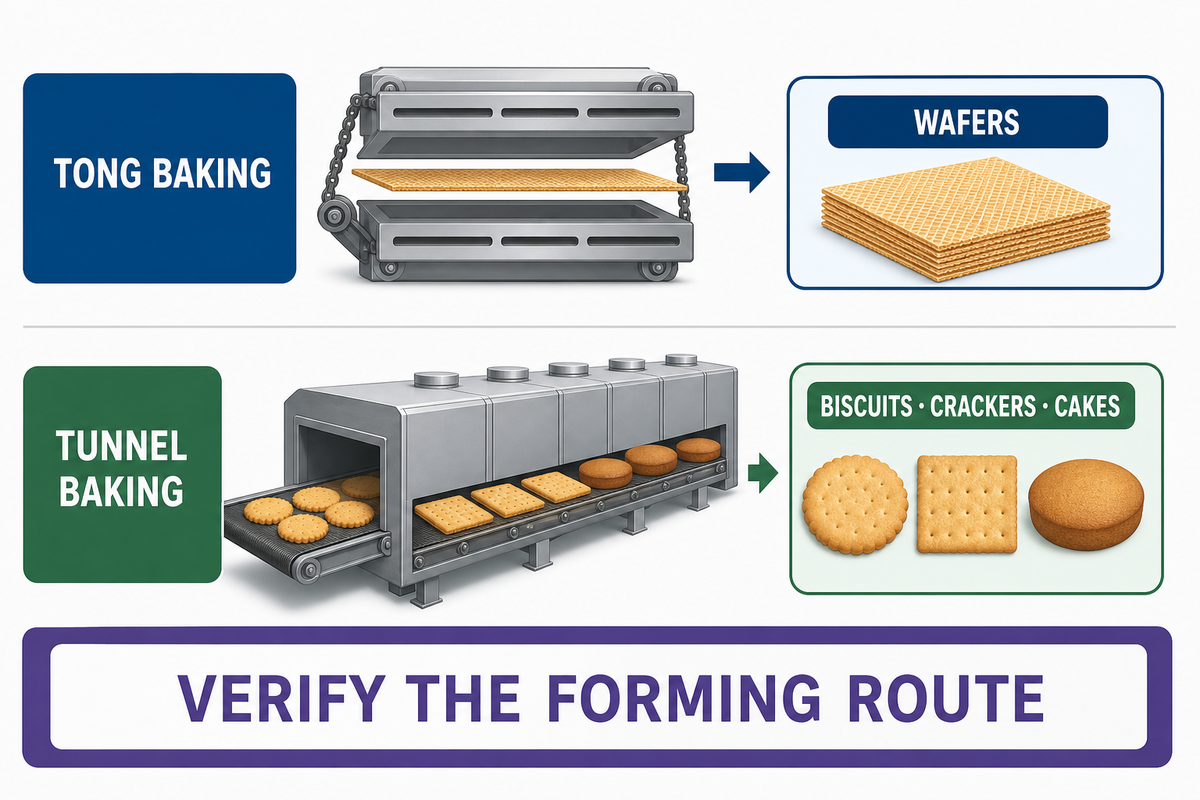
Reading Bakery Systems and Bühler publish equipment routes for biscuits, crackers and other baked products. Reading also lists pretzel and snack systems, while Bühler separates several forming and baking technologies. Start the comparison with the actual biscuit or cracker, then establish which forming method and oven arrangement the supplier proposes.
Official websites: readingbakery.com; buhlergroup.com
Reading distinguishes hard-biscuit and soft-biscuit systems, development trials, aftermarket rebuilds, and upgrades. Franz Haas and Meincke product groups from Bühler address wafer tong baking contrasting with tunnel baking for biscuits, crackers, and cakes. These distinctions are useful compared to treating every industrial oven as the same asset.
Think about a producer of cookies considering adding crackers in the same production line. The brochure may put both products under the same equipment family. However, the buyer still needs a trial for each recipe. The review should show how dough will reach the former, show the changes between products, and indicate how the oven reaches the new baking condition. Ask where the first acceptable product is collected post changeover and how the startup product is separated. If the seller does a demo only for the current cookie, the requirement to provide crackers is still unresolved. This will help determine whether the deal covers production of both products.
The 2026 Baking Business report on cookie and cracker lines mentions changeover, sanitation, and oven-settling constraints through named equipment specialists. For smaller specialty applications, check the scope of UDTECH biscuit and mini-bun equipment; that category doesn’t establish the same industrial cracker capability.
Oven settling after a product change needs a place in the trial schedule. Measure the interval to the first acceptable product under the agreed recipe and loading condition; the published trade report identifies the constraint but supplies no universal settling time.
GEA equipment for cake and cookies
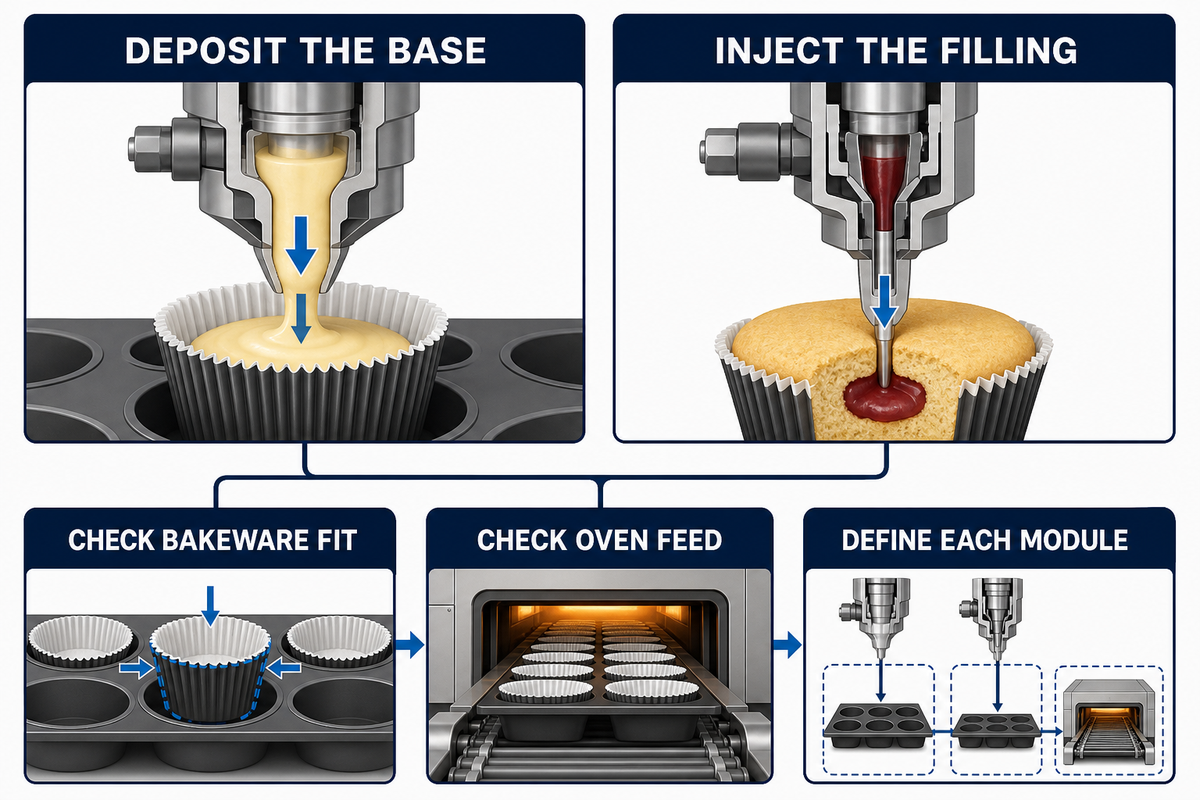
Under the bakery equipment portfolio of GEA, the Comas and Imaforni technologies are included, along with tunnel ovens, depositors, pie systems, and injectors, among others. Cake or cookie projects can start with a specified forming or filling requirement. GEA also publishes a broader bakery application. Therefore, this shortlist shouldn’t be considered as its complete scope.
The GEA catalogue separates base formers, side injectors, top injectors and cup denesters. Its top-injector description includes loose products on a conveyor and products held in indented trays; the denester listing covers paper cups, aluminium foils and plastic containers. These are configuration questions for a factory using retained trays, rather than evidence that any quoted machine fits them. Ask GEA to identify the proposed handling arrangement and verify it with your actual bakeware.
Official website: gea.com
For a filled cake, one should distinguish depositing the base of the product from injecting the filling. Cup placement, baking, and transfer may belong to different modules. The quote should indicate where each of the products enters and leaves the system, along with their condition at that point of the process, as opposed to emphasizing the central machine.
Resolve an early practical objection: can a new depositor work with the existing bakeware and oven feed? Ask for a demo using the intended material and container. Buying a larger range of equipment doesn’t answer that interface question on its own.
For example, a cake plant adding a filled product needs more than a satisfactory deposit weight. A trial can follow the product through release from the tray, transfer to filling and delivery to packing. Record product scrap and unplanned downtime at those transfers, then name the supplier responsible for each unresolved cause. Include the intended filling in the demonstration because acceptance with a substitute does not answer how the production recipe behaves.
UDTECH specialty lines for wafers and waffles
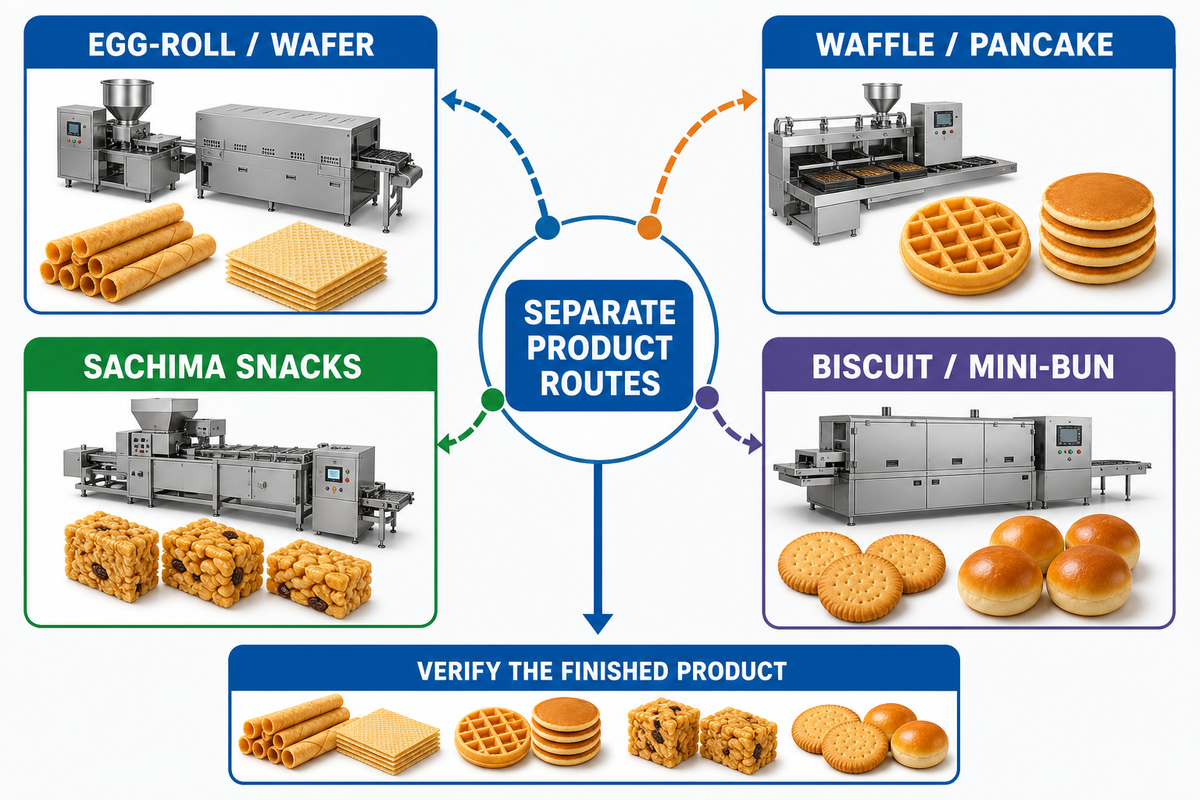
UDTECH’s published specialty groups include machinery for egg-rolls and wafers, pancake and waffle lines, sachima snack lines, and biscuit and mini-bun equipment. These groups target specific equipment for the baking industry. The reviewed public scope doesn’t establish general industrial bread or laminated-pastry turnkey capability.
Access the official website: udmachine.com. The UDTECH company background identifies Suzhou UDTECH Technology Co., Ltd.
For wafer and egg-roll machinery, prospective customers must determine the finished product. A rolled wafer is a different requirement from a filled savory roll. To maximize useful trial time, bring product samples or a clear product specification to the discussion about capacity, heating and forming.
The same applies to waffle and pancake lines: describe whether the proposed product uses batter or dough, its shape, and the next required operation. Adjacent sachima snack lines should be treated as their own process route. The diverse range of products on a website is a starting point for a discussion, not evidence that one configuration makes them all.
Oven, mixer, proofers and bread slicers: assign each interface
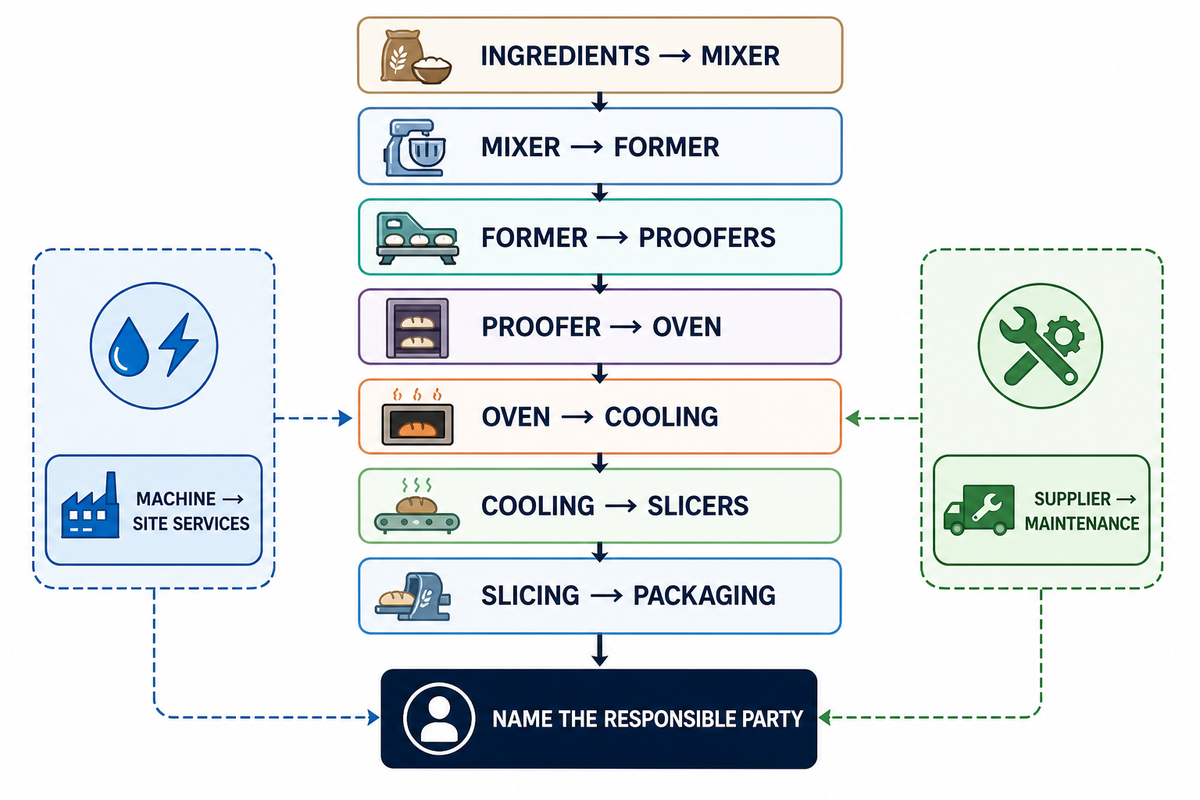
The Supplier Responsibility Split is a worksheet for identifying who supplies each machine, connects it and demonstrates the agreed result. Industrial baking equipment often joins existing assets or third-party modules. Clear commercial ownership helps prevent gaps, while the bakery retains its own operating, food-safety and employer responsibilities.
| Interface | Written responsibility | Limitations / not suitable for |
|---|---|---|
| Ingredient supply → mixer | Who supplies feeding, weighing and dust controls? | Mixer capacity alone cannot define the feeding system. |
| Mixer → forming | Who matches batch delivery to the former? | Nominal rates may describe different dough conditions. |
| Former → proofers | Who supplies transfer and product carriers? | Proofing does not belong to every product route. |
| Proofer → oven | Who coordinates loading and the line sequence? | An oven-only offer may exclude those controls. |
| Oven → cooling | Who establishes handoff conditions and cleanability? | Baked output still needs appropriate downstream handling. |
| Cooling → bread slicers | Who verifies the product condition and guarded transfer? | A slicer demonstration is not a complete-line acceptance test. |
| Slicing → automated packaging | Who supplies synchronization and format changes? | Different product sizes may need separate adjustments. |
| Machine → site services | Who designs and approves utility connections? | Machine supply does not establish facility readiness. |
| Supplier → plant maintenance | Who trains, services and coordinates covered work? | A service agreement cannot erase the employer’s duties. |
What does a turnkey bakery line actually include?
The definition of turnkey must be included in the offer. Name all machinery, including ovens and mixers, along with integration work, installation and acceptance responsibilities. Determine whether an oven uses convection, or another heating method, what utilities it uses, and what connections the buyer is responsible for. NIST’s equipment pre-purchase guide treats installation, use, maintenance, and end-of-life as separate issues to be resolved.
For a US project, involve the plant’s safety team before accepting the layout. 29 CFR 1910.263 addresses bakery equipment, including guarding, flour-handling, and oven safeguards. Ask how the proposed assembly addresses those applicable requirements, including dust containment and combustion hazards. General equipment catalogues don’t suffice for this assessment.
This also includes food-safety. 21 CFR 117.40 covers equipment cleanability and protection against allergen cross-contact. Address access around conveyors, slicers and shared food contact surfaces and adjacent areas. These purchasing questions allow for a facility-specific review; they don’t replace the bakery’s safety and food safety programs.
Choose a supplier with a comparable quotation and after-sales plan
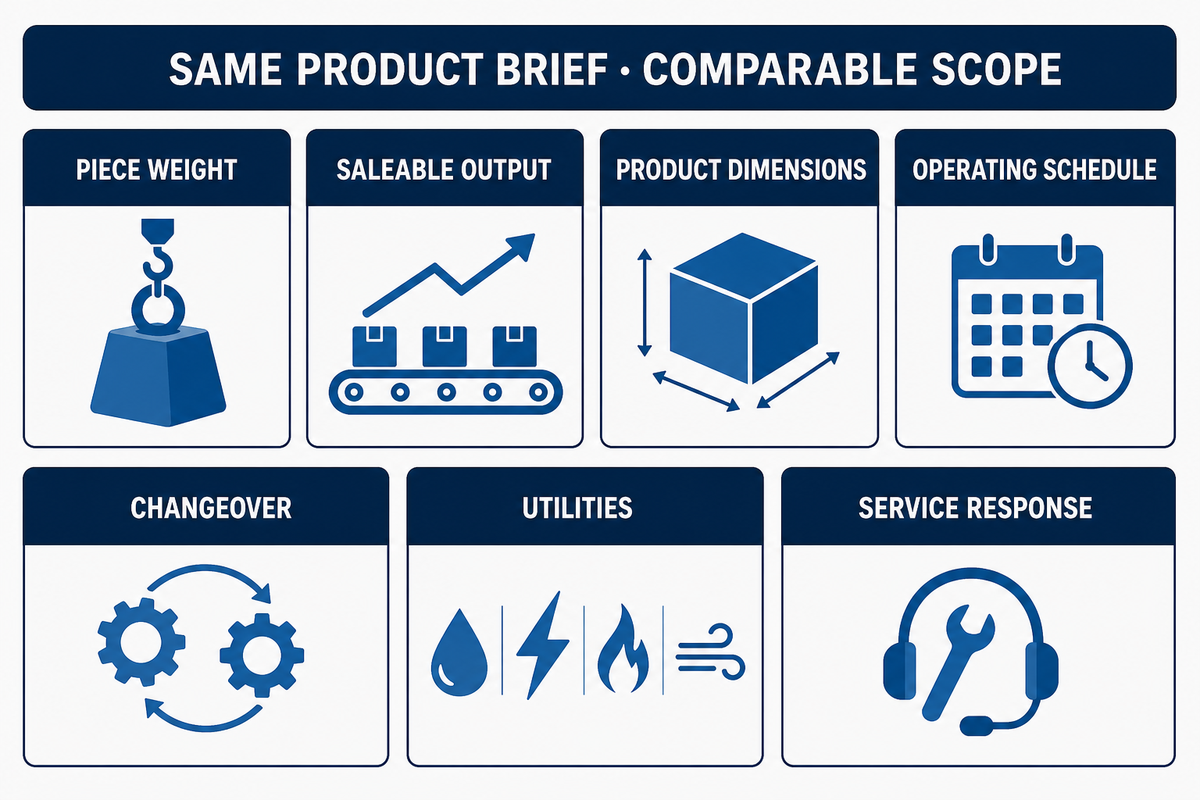
Comparable quotations describe the same product, required output and division of work. Provide each supplier with the same description, and then separate the supply of machines from the provision of installation, training, and continued service. Only after the terms of the machines and the related work and acceptance conditions have been evaluated can price be considered significant.
Add these questions to the request. The ranges must come from your products and production plan; there’s no standard/universal specification for bakery machines.
RFQ checklist — define these before requesting a price:
| Parameter | Recommended range | Why it matters | How to verify |
|---|---|---|---|
| Piece weight | Your minimum/maximum, g per piece | Defines forming requirements | Weigh trial samples |
| Saleable output | Required pieces/h or kg/h | Makes output units comparable | Agree product and test conditions |
| Product dimensions | Your size envelope, mm | Affects carriers and transfer | Check drawings and samples |
| Operating schedule | Planned h/shift and shifts/day | Defines the intended duty | Match the production plan |
| Changeover | Product-pair target, minutes | Exposes time outside steady running | Observe the agreed change |
| Utilities | Site values and supplier loads, with units | Identifies facility work | Review with the site engineer |
| Service response | Contracted hours and service coverage | Separates response from actual repair | Name the support team and exclusions |
“Automation and recipe control systems can store parameters for each SKU, allowing rapid changeovers”
How are settings saved? Which adjustments remain manual? See how the supplier demonstrates the change. A high-speed trial on one product can’t answer all the changeover queries. The equipment’s performance and efficiency must be assessed over the agreed sequence of operations consisting of the start, normal operating cycle, and cleaning.
When not to buy: unresolved scope on a new or used line
Stop a purchase when a critical part, interface or acceptance condition has no owner. Though attractive to some, advertising as ‘used’ in a marketplace won’t answer the bakery’s documentation, control, and support needs. An AMF public Schmidt Baking case summary states an obsolete servo stopped a ‘25-year-old bun line.’ As an example, this case doesn’t provide a standard to compare the service life of this component; it shows why we must ask a specific question about component availability.
When evaluating a ‘used line purchase’, compare that purchase to the cost and the scope of the restoration that would allow the line to operate under a supported arrangement. Along with the controls documentation, ask for available replacement parts and evidence of the proposed product running. Find out who checks the safeguards and connections before the equipment is placed into service. The fact that the machine worked at its former site won’t answer the questions regarding the equipment’s state for a new installation. Those concerns prevent comparing the ‘discount’ to a new quote until they are resolved. Refurbishment may still be a reasonable choice when all the missing work is identified and assessed.
Covered servicing by outside personnel also requires coordination between employers under 29 CFR 1910.147(f)(2). The plant isn’t able to completely shift its obligations to the after-sales agreement. Clarify who will perform the work, as well as how it relates to the site’s established energy control program.
Industry outlook: bakery automation and expansion choices
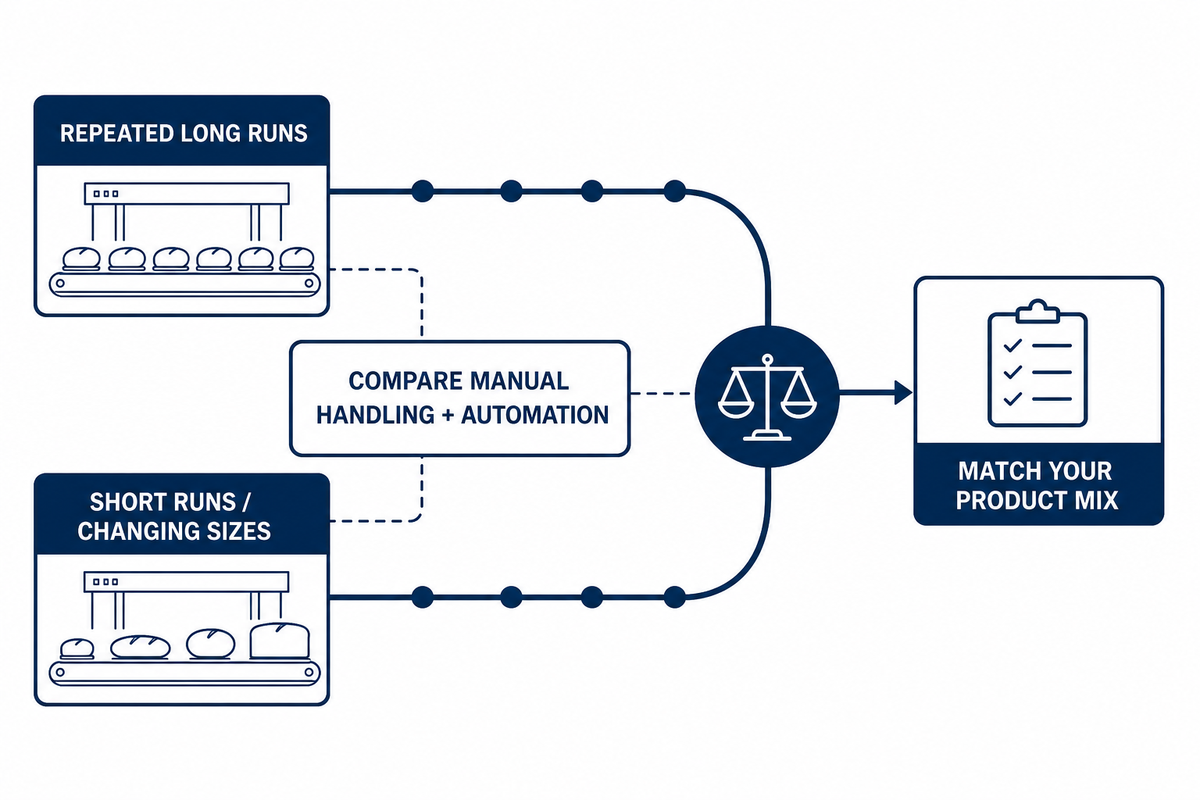
Bakeries considering an expansion should purchase defined options based on the planned product mix. This is a better use of resources than considering any increase in automation as an improvement. The key question is what happens when the bakery switches between products or increases the volume of production. Determine which machines, controls, and site services would require additional work.
Food Business News reported in March 2026 that 44% of respondents planned increased capital investment for 2026 versus 45% for 2025. These survey intentions are market context. They don’t prove growing equipment sales or tell an individual bakery business when to place an order.
In high-volume industrial bakeries, equipment solutions should be assessed against the daily product sequence. Integrated systems can automate transfers and select recipes, but the proposal must identify the automation functions. An order to support new products must identify the products and the additional tooling and/or trials. Have the supplier customize the expansion plan to the current plant, and establish a written boundary between the first purchase and later work.
Ipeka’s discussion of sliced-bread packaging offers a useful counterpoint. Semi-automatic machinery for short runs and multiple sizes may be a good choice. The production task is the key element in identifying the optimal choice. A fully integrated, full-scale installation may suit long production runs. A small production may require a more balanced approach. Evaluate both of these alternatives in the context of your actual baked goods.
Documentation also needs a date and scope. As checked in September 2026, the ISO 14159 catalogue lists the 2002 edition as current while a replacement remains under development. Record the proposed standard edition rather than accepting “latest standards” as a complete answer. The ASB standards page distinguishes equipment safety from sanitation; those references do not replace applicable US requirements.
Submit the finished product along with the required output and current equipment boundaries to UDTECH to discuss a specialty route. Once the proposed product falls within its published scope, you can discuss a specialty bakery line.
FAQ: choosing industrial bakery equipment
Which industrial bakery equipment manufacturers serve the US market?
Verify both the required equipment route and support for the installation location, asking each manufacturer to confirm its contracting entity, installation team, spare-parts location and response arrangements.
For equipment sourced globally, start with manufacturers that can document both the required production process and support for your installation location. This guide compares product routes rather than promising that every listed company has the same US service coverage. Ask each shortlisted supplier to identify the contracting entity, installation team, spare-parts location and response arrangements in its written proposal. Verify these details for your state and equipment model before placing an order.
What is the difference between commercial and industrial bakery equipment?
Compare the production arrangement; the label alone does not define capacity, and industrial equipment usually serves repeated, higher-volume operation while commercial equipment also includes shop and foodservice machines.
Commercial bakery equipment is a broad label that can include machines for shops, foodservice kitchens and larger bakeries. Industrial equipment usually describes a production arrangement intended for repeated, higher-volume operation, but the label alone does not define capacity or suitability. Compare the actual recipe, batch or continuous process, staffing, utilities and downstream equipment. A larger oven does not by itself create a balanced industrial production line.
How should a bakery compare manufacturer quotations?
Give suppliers the same brief and compare the complete equipment and work scope, including controls integration, installation, training and ongoing service, with agreed product and acceptance conditions.
Give every candidate the same product brief and ask for a clearly bounded equipment schedule. Separate the quoted machines from controls integration, installation, training, shipping and ongoing service. Record which party is responsible for each interface and agree on the product and operating conditions used for acceptance. Keep the comparison tied to that scope; two prices are not comparable when one proposal excludes equipment or work that the other includes.
Does the manufacturer provide after-sales service and spare parts?
Service availability needs written confirmation.
Do not infer support from the brand name. Ask who supplies parts, trains operators and responds locally, then put the agreed arrangements and exclusions in the contract.
Can one supplier handle every bakery product?
A broad portfolio does not establish suitability for every recipe: bread, laminated pastry, cookies and wafers follow different routes, so the proposed configuration needs a product trial and clear scope.
No single portfolio description should be treated as proof of suitability for every recipe. Bread, laminated pastry, deposited cookies and baked wafer products follow different processing routes. A supplier may offer several routes, but the proposed configuration still needs a product trial and a clear scope.
How do I use a small bakery equipment list to choose the best industrial bakery equipment manufacturers?
Start with the product you can sell and the process you need to repeat. A small bakery equipment list can identify the machines needed now and the interfaces to reserve for expansion. The best supplier for that plan is the one whose proposed configuration, trial and support fit the brief. This guide offers a product-route shortlist, not a universal ranking or a minimum investment figure.
References & Sources
- Dough Dividing American Society of Baking.
- Croissant American Society of Baking.
- Effect of Margarine Replacement by a Low-Saturated Fat Bigel on Puff Pastry Quality Food and Bioprocess Technology.
- Cookie and cracker line changeovers Baking Business, May 2026.
- Manufacturers: Pre-Purchase Guide for Equipment NIST MEP, 2020.
- 29 CFR 1910.263: Bakery equipment eCFR.
- 29 CFR 1910.147: Control of hazardous energy eCFR.
- 21 CFR 117.40: Equipment and utensils eCFR.
- Capital investment holding steady despite record-low industry outlook Food Business News, March 2026.
- ISO 14159:2002 catalogue and revision status ISO.
- ANSI standards for the baking industry American Society of Baking.

![Egg Roll Machine Energy Consumption [Calculation Guide]](https://udmachine.com/wp-content/uploads/2026/09/electric-egg-roll-machine-guide-featured-768x512.png)