Get in touch with UDTECH Company

Soft Waffle Production Line: Step-by-Step Guide

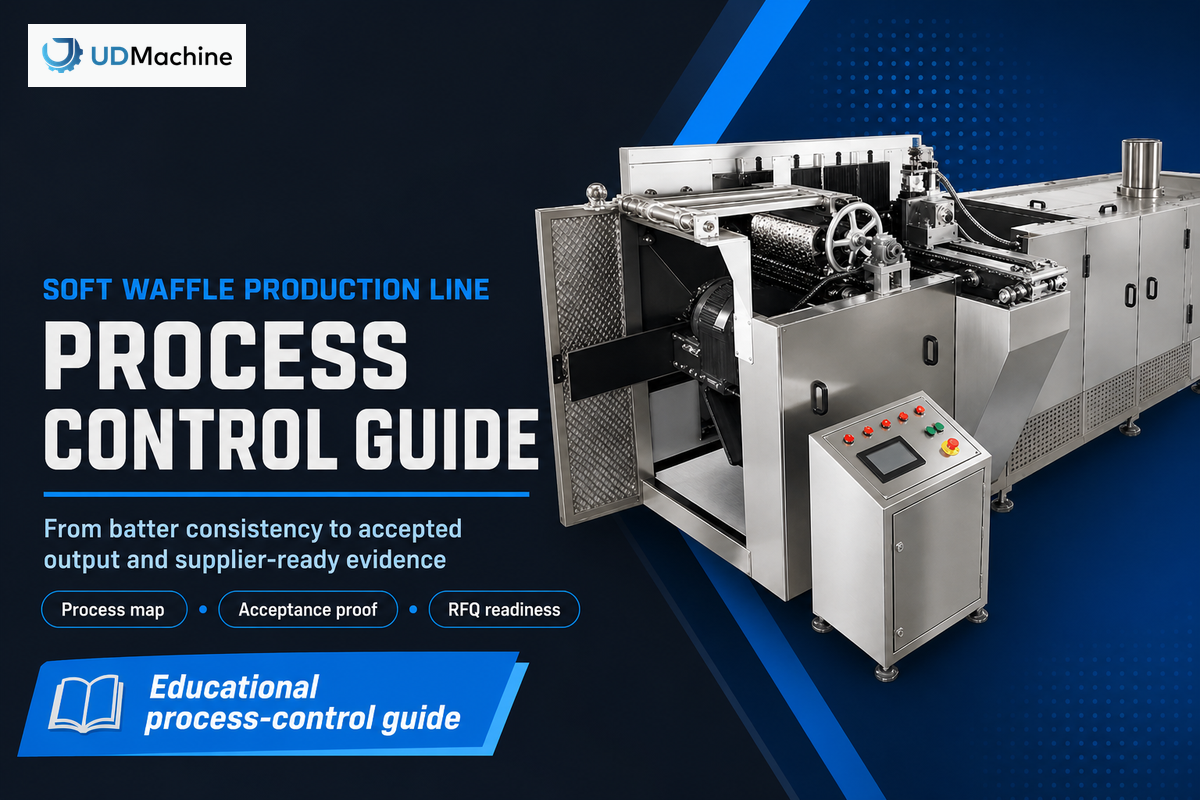
Soft Waffle Production Line quick specs
- Purpose: connect batter condition, mould geometry, baking, cooling, release and packing into one acceptance record.
- Best comparison unit: accepted, packed pieces per hour, not an oven nameplate.
- Core inputs: product drawing, target piece mass, recipe window, mould count, cycle time, utilities and reject definition.
- Evidence standard: run conditions, sample measurements, sanitation access and changeover notes agreed before factory acceptance.
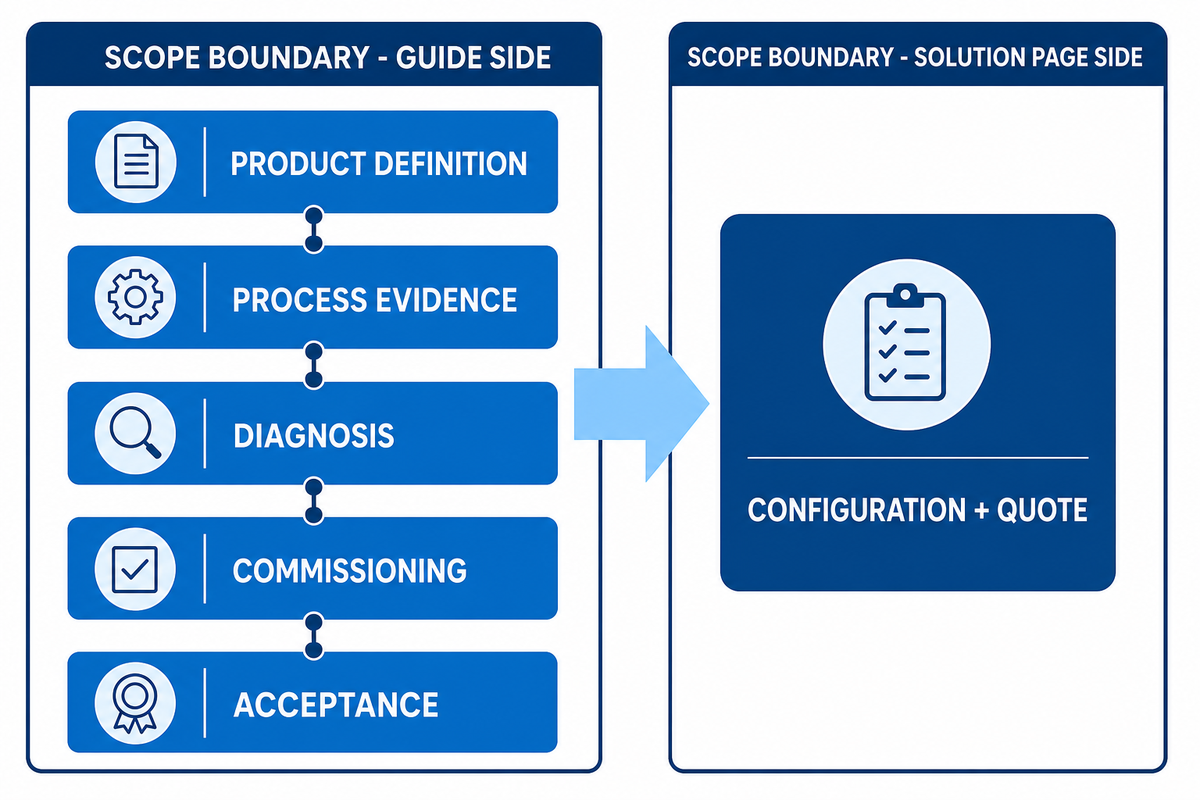
- Scope: buyer education and request-for-quotation preparation; the linked solution page owns commercial configuration and quotation conversion.
A Soft Waffle Production Line is a chain of controlled handoffs, not a single oven. This guide shows how to map those handoffs, expose hidden capacity assumptions and write an acceptance packet that a bakery, integrator and supplier can all sign.
In short: freeze the product geometry first, record batter and bake conditions together, then accept the line on cooled and packed product. The numbers below are source-bound examples, not a promise for any UDTECH model.
Reviewed by the UDTECH technical team. Company history in this article is supplied by UD Company and is not independent proof of soft-waffle performance.
What a soft waffle production line actually controls
To frame the checks, a production line controls a sequence: a stable batter dose enters a defined mould, heat reaches the product for a measured residence time, and a cooled piece leaves without tearing or losing its shape. Buyers should ask “which variable is controlled at each handoff?” The answer becomes a list of records rather than a brochure feature list.
Line balance explains the risk. Fast depositing can still meet a limit when an oven cycle, cooling dwell or packer controls accepted output. Even a line moving moulds at a stated speed may lose saleable pieces through underbake, sticking or a slow changeover. Treat each station as a control point with an owner, an instrument and an acceptance response.
Use the Electronic Code of Federal Regulations equipment guidance as the sanitation boundary for the control records; it is a planning reference, not a machine-performance certificate.
| Station category / type | What to control | Record to request |
|---|---|---|
| Ingredient staging | Lot identity, temperature and pre-mix order | Batch sheet and allergen segregation check |
| Mixing | Time, shear and batter temperature | Mixer recipe revision and batch log |
| Holding hopper | Residence time, agitation and level | Level trend and refill procedure |
| Depositor | Dose mass, position and repeatability | Weighing sample and nozzle setting |
| Mould/iron | Cavity geometry, grease and closure | Drawing revision and release inspection |
| Oven | Zone heat, cycle and residence time | Logged setpoint, actual reading and alarm history |
| Cooling | Dwell, air movement and product temperature | Cooling exit sample and deformation check |
| Handling | Transfer forces and orientation | Jam log and transfer video |
| Packing | Count, seal and finished-pack quality | Accepted count, rejects and changeover time |
An automatic depositor can feed a baking oven through a measured batter stroke. Repeatability comes from a piston dose, plate gap and recipe record. For a buyer, efficiency means saleable pieces per shift; productivity also includes changeover time, energy consumption and operator checks. Ask whether the line uses 304 stainless steel on food-contact surfaces, a cooling cabinet or vertical cooling section, and a cooling conveyor with air cooling. Precise temperature control in a tunnel oven can support stable performance when the supplier documents set-point tolerance, food-grade seals and convenient maintenance access.
A waffle maker is only one component of the machinery: precision comes from matching the depositor, baking plates and release timing. Full automation still needs a documented recipe change and a trained operator.
Key takeaway: sign off each handoff with a measurable record. Readiness begins when records agree from batter batch to packed case.
From batter to packed product: the process map
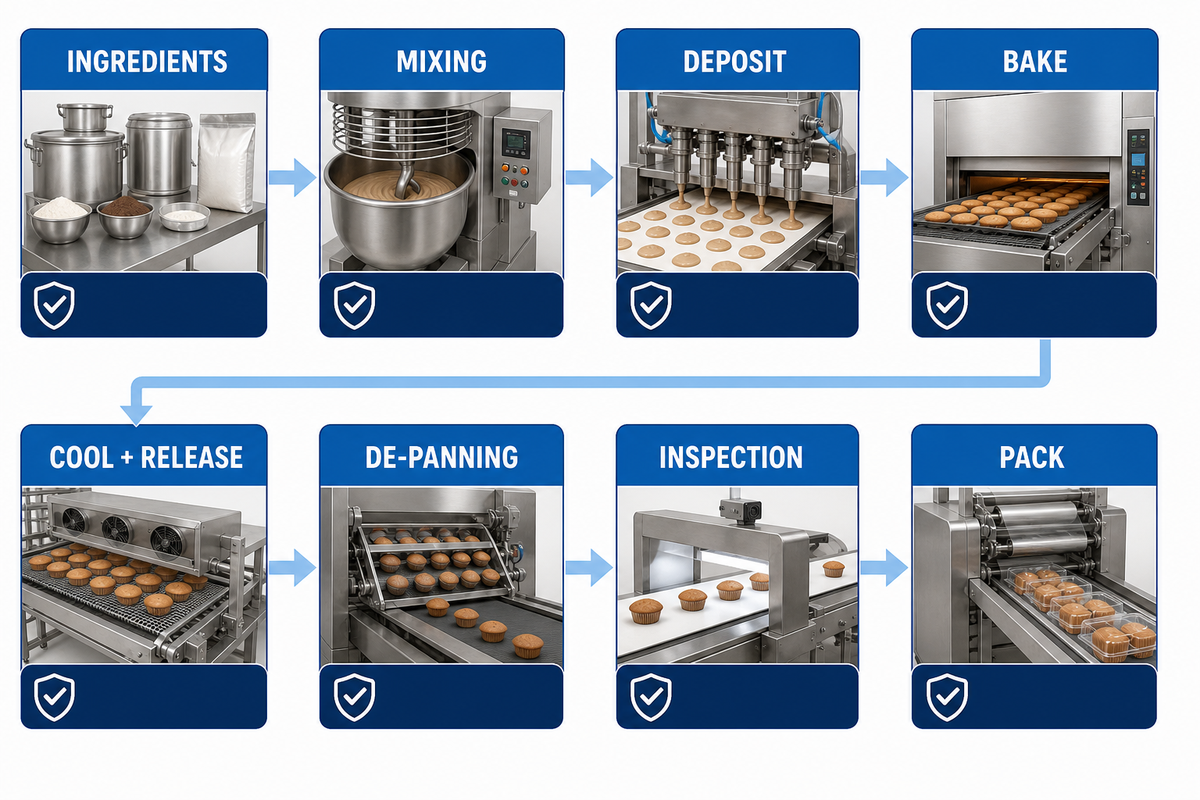
The practical process map starts before the first deposit and ends after cooling and packing. Write the map as a one-page flow with arrows, sensor tags and hold points. This map lets an engineer trace a defect to the earliest abnormal state instead of blaming the last visible station.
Food plants already use this logic in preventive-control systems. The U.S. Food and Drug Administration describes process controls as procedures that keep defined parameters and values within an agreed range, with monitoring and verification records. Apply the same discipline to product quality: identify the parameter, name the instrument, state the sampling interval and define the correction.
- Release the ingredient batch and recipe revision.
- Mix and hold batter inside the agreed time and temperature window.
- Deposit the target mass into the correct mould position.
- Bake for the validated cycle while recording actual zone readings.
- Transfer, cool and inspect release before the packer counts the piece.
A useful companion is UDTECH’s process and acceptance guide for waffle and pancake lines, which covers the wider line architecture. Keep this article focused on measurement and buyer evidence; avoid copying a commercial module list.
An operator facing a recurring jam should record the first abnormal point: dose position, mould closure, release, cooling exit or packer infeed. That timestamp makes a supplier discussion concrete. It also protects the buyer from a false fix, such as raising oven heat when a dose-position error is the actual trigger.
Batter and depositing: where consistency starts
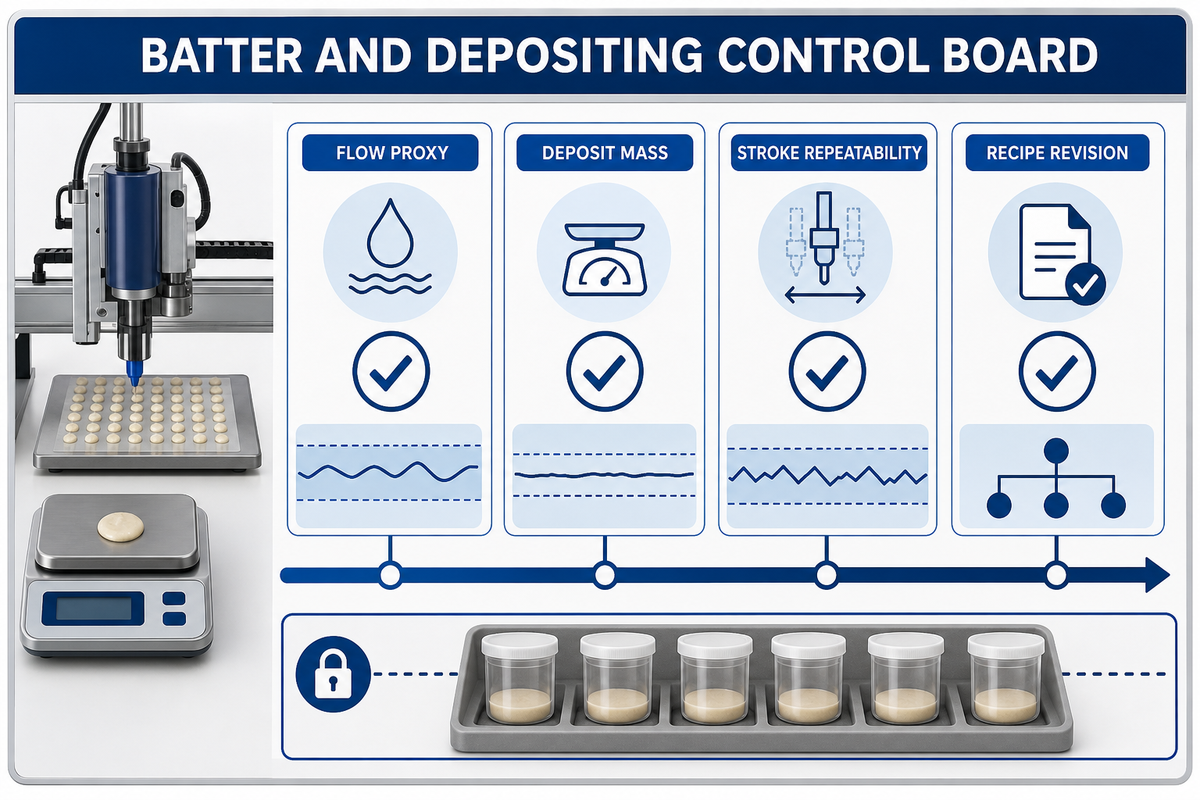
Depositing accuracy depends on batter condition and cavity geometry together. Volumetric settings can repeat a volume while piece mass changes with air, temperature or solids. Ask the supplier to show a weighing sample at startup, mid-run and after a refill, and record the nozzle, pump and agitation settings used for each sample.
Transfer sensitivity explains the risk. Batter that flows well at the hopper may shear, cool or aerate in the feed path. That change alters fill height and the way heat enters the cell. Buyers need a recipe-and-machine window, not a single “accurate depositor” sentence. Record mean mass, the largest deviation, cavity fill and the first visible defect.
A practical hygienic-design checklist from Cornell’s food-safety resource also helps the team mark cleanable surfaces around the hopper and depositor.
How does batter viscosity affect soft-waffle depositing?
Viscosity affects the time needed to fill a cavity and the shape left when the mould closes. Thin batter can spread beyond the intended edge; thick batter can leave a low corner or a tail at the nozzle. Because no universal soft-waffle viscosity window was found in the public research, specify the plant’s measurement method, temperature and acceptable spread rather than borrowing a competitor’s number.
| Check | Method | Decision |
|---|---|---|
| Batter temperature | Measure at mixer exit and hopper inlet | Hold, adjust or release batch |
| Dose mass | Weigh 10 consecutive deposits at three run points | Compare with agreed mass tolerance |
| Position | Photograph cavity fill against drawing | Adjust nozzle path or reject sample |
| Refill response | Capture first pieces after hopper refill | Set a restart hold point |
Key takeaway: a deposit is repeatable only when mass, position and batter condition are logged together. If one field is missing, the acceptance record cannot explain a fill defect.
Baking control: time, heat and mould geometry
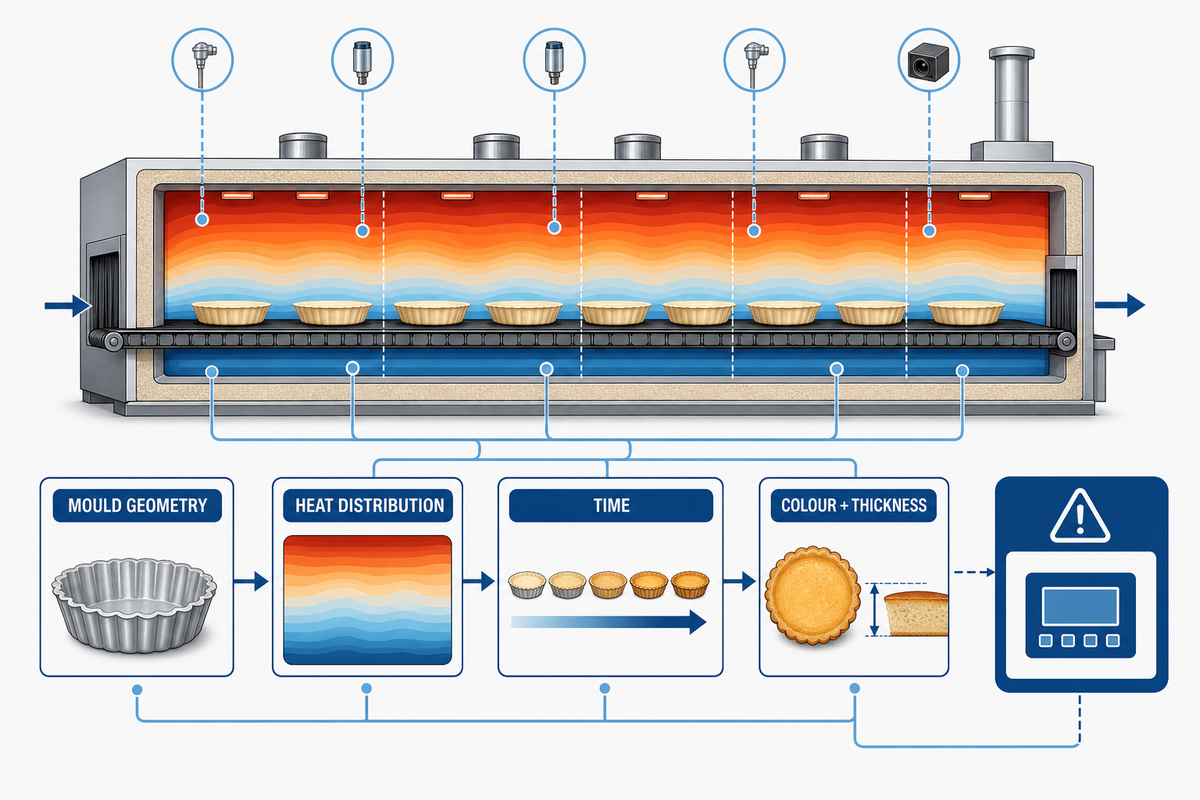
Once depositing is set, bake quality comes from the interaction of residence time, heat distribution and mould geometry. Temperature setpoints are instructions, not proof that the product reached the intended state. Request actual readings by zone, cycle timing, mould identification and a product check at the centre and edge.
Heat path explains the difference. Deep cells, filled designs and thin edges do not absorb energy in the same way. One source-bound vendor table lists a three-minute bake and a 3–3.5-minute oven cycle for one 75-mould configuration; that record is useful for an RFQ field, not a universal target. Use a timed trial to establish your own window.
“All plant equipment and utensils … must be adequately cleanable, and must be adequately maintained.” — 21 CFR 117.40(a)(1), Electronic Code of Federal Regulations.
That public requirement does not define a soft-waffle recipe. It does make the installation and maintenance record part of a responsible bake review. Put the mould drawing, zone map, actual readings and cleaning access on the same trial sheet so a later change can be traced.
Boundary condition: do not transfer a competitor’s time, temperature or pressure to a new product without a controlled trial. The same number can produce a different texture when mass, moisture or cavity depth changes.
Cooling, release and handling without surface damage
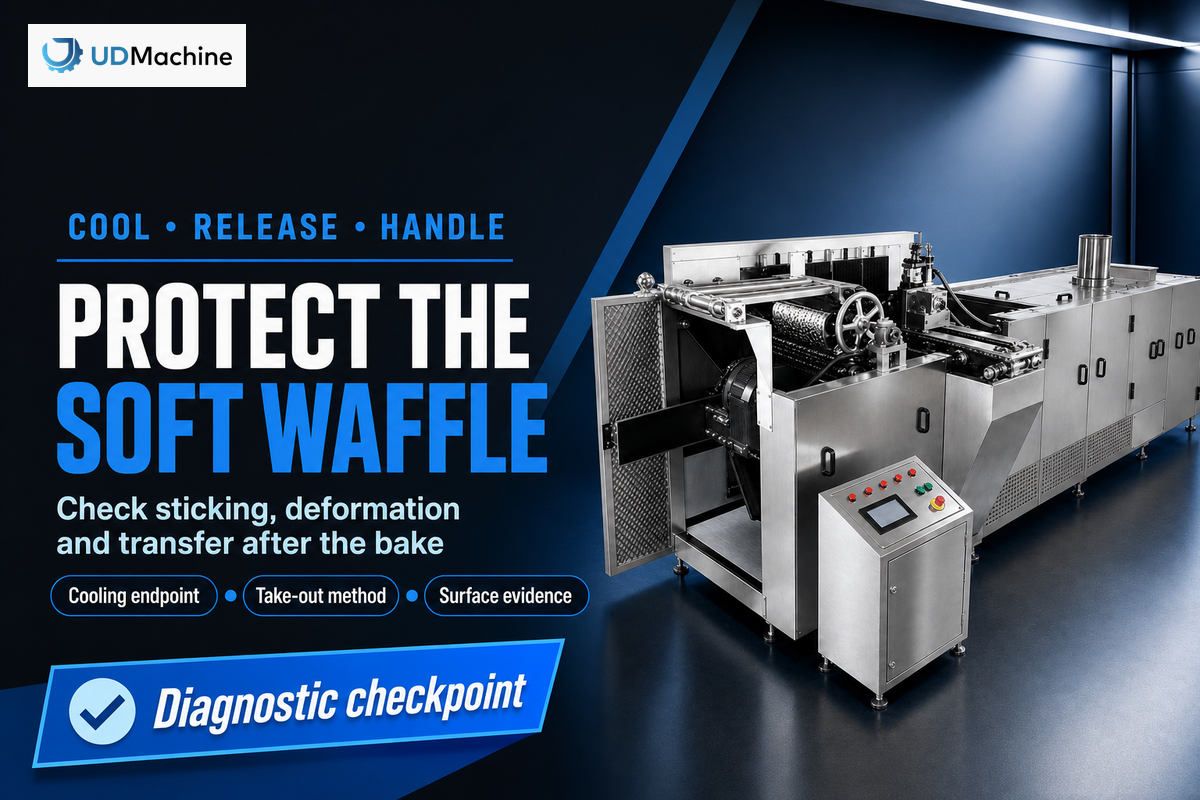
Cooling and release are quality controls, not empty conveyor distance. Soft waffles may leave the iron intact and deform while still warm, or stick when a coating, grease pattern or mould surface is out of condition. Measure product temperature, release force or visible damage at matching points on every trial.
Timing explains the risk. Product structure changes after the heat source stops. Short cooling dwell can push damage into the packer, where it appears as a count or seal problem. Longer dwell may protect shape but lower line rate. Your action is to agree a release window and a defect taxonomy before the supplier runs a demonstration.
Consumer-scale testing also shows why release deserves a record: operators commonly describe sticking and tearing as the first failure they see. That anecdote is not an industrial specification, but it is a useful question for the trial: which surface, grease schedule and cooling condition changed when the defect appeared?
For a research-backed hygiene lens, the PubMed-indexed cleanability review supports checking surfaces and residue paths rather than judging release from appearance alone.
- Sample at mould exit, cooling exit and packer infeed.
- Record intact count, edge tear count, deformation and surface marks separately.
- Photograph the same face and orientation for every sample.
- Log coating or grease change, cleaning event and operator intervention beside the sample.
Key takeaway: accept the product after it has cooled and passed the handoff to packing. Hot, attractive pieces are not yet saleable pieces.
How to size capacity without buying the wrong line
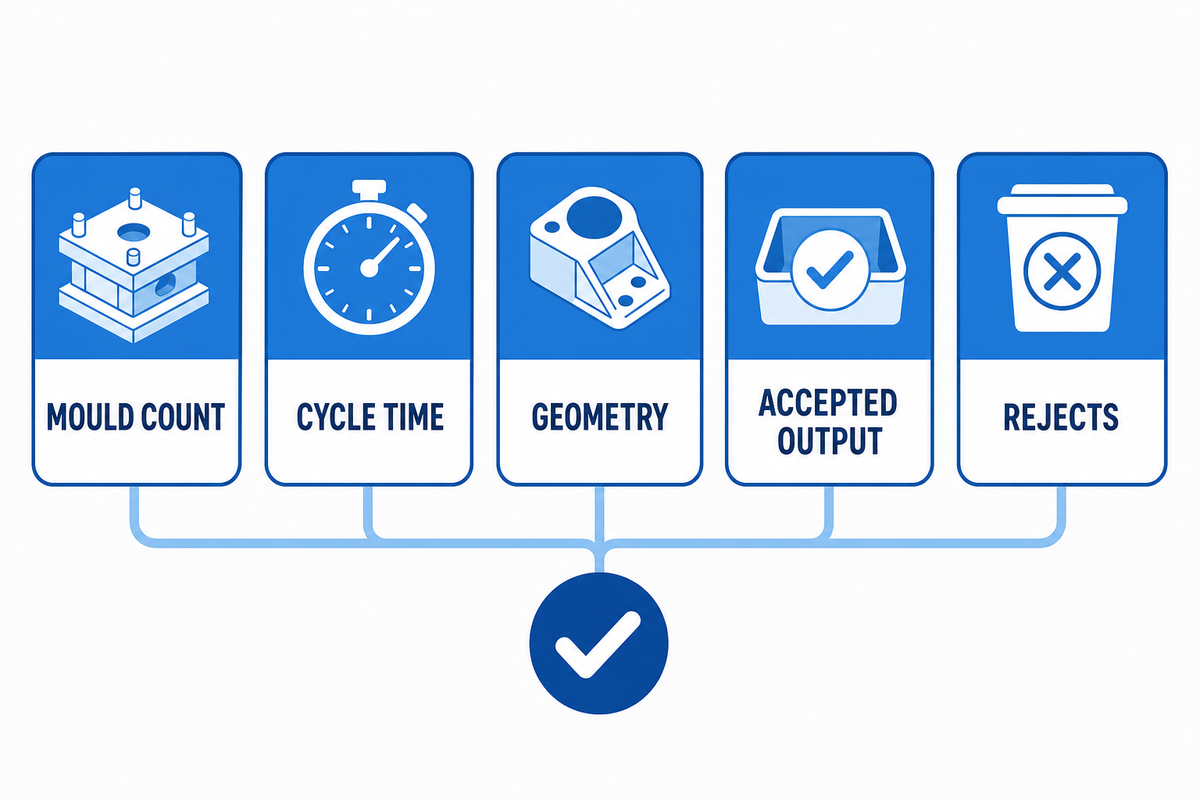
After release is stable, capacity comparisons become fair when every supplier uses the same product geometry, cycle basis and reject definition. Published figures illustrate the problem: one vendor lists 2,800 syrup waffles per hour for a small carousel and 21,000 per hour for a larger integrated line; another lists 5,000–20,000 products per hour depending on size and shape; a third publishes a 10,000–15,000 versus 25,000–45,000-plus benchmark by line class.
Those figures are not contradictory; they answer different questions. The usable metric is accepted pieces per hour after startup, changeover, stoppage and rejects. Buyers can calculate it with a transparent worksheet:
The U.S. Food and Drug Administration preventive-controls overview is a useful reminder that a rate should sit beside monitoring, correction and verification records.
Accepted pieces/hour = moulds × pieces/mould × 3,600 ÷ cycle seconds × availability × first-pass yield.
Worked example: 75 moulds × 1 piece × 3,600 ÷ 180 seconds × 0.85 availability × 0.97 first-pass yield = 1,213 accepted pieces/hour. Replace each input with your own trial data; the result is not a supplier guarantee.
How should a buyer compare waffles per hour across different mould counts?
Convert every offer to the same product and cycle basis. Ask for mould count, cavities per mould, cycle seconds, start-up loss, scheduled cleaning, changeover time and reject allowance. If a supplier cannot disclose one field, label the output as a theoretical rate and keep it out of the purchase acceptance clause.
| Capacity field | Supplier question | Why it changes the decision |
|---|---|---|
| Product code | Which drawing and recipe revision was tested? | Prevents a rate from being attached to the wrong shape |
| Mould count | How many active cavities run in the trial? | Sets pieces per cycle |
| Cycle seconds | Is timing from close to open or from deposit to release? | Avoids different timing boundaries |
| Availability | Which stops are excluded? | Makes planned cleaning visible |
| First-pass yield | What counts as a reject? | Separates moving product from selling product |
| Changeover | How many minutes and how many restart pieces? | Protects a multi-SKU plan |
| Cooling dwell | When is a piece counted as accepted? | Stops hot-piece rates masking deformation |
| Packing rate | Can the packer match the accepted flow? | Exposes the downstream bottleneck |
| Utility limit | What gas, electrical, air and exhaust conditions were present? | Shows whether the rate is repeatable on site |
A 2015–2016 bakery case reported three lines at approximately 85%, 65% and 45% utilisation after expansion and described running at nearly 100% as unsustainable for equipment and people. That is one plant’s experience, not a universal target, but it is a useful reminder to leave headroom in a forecast.
Normalize every offer with the same units: mould count, pieces per mould, cycle seconds, availability percentage and first-pass yield percentage. Utility sheets might show 54 m³/h of gas, 338 kW of electric heating, 6 bar compressed air and a 20–30 °C room range. These are example fields to verify at the site, not guaranteed values for every soft-waffle line.
Add dimensional tolerances such as ±0.5 mm for a cut edge, a documented 180 °C set point, 2 m/s cooling air, a 15-minute warm-up record and a roughly 0.5% reject threshold where your product specification calls for them. Here, the point is to make the acceptance sheet measurable; the supplier should confirm the values for the chosen geometry.
Other useful fields include 1.0 mm plate flatness, 30 seconds of dwell, 10 samples per check, 8 hours of endurance, 4 changeovers per shift and a 24-hour response window for open items. These example units make a request testable without turning a competitor’s brochure number into a promise.
Record a 2 mm batter spread limit and a 3 °C cooling-exit band when those limits are meaningful for the product. Each number should point to a drawing, recipe revision or measurement method.
Key takeaway: put the capacity formula and its inputs in the request for quotation. A high headline rate without a yield basis is a planning risk, not a capacity decision.
Product geometry and recipe flexibility
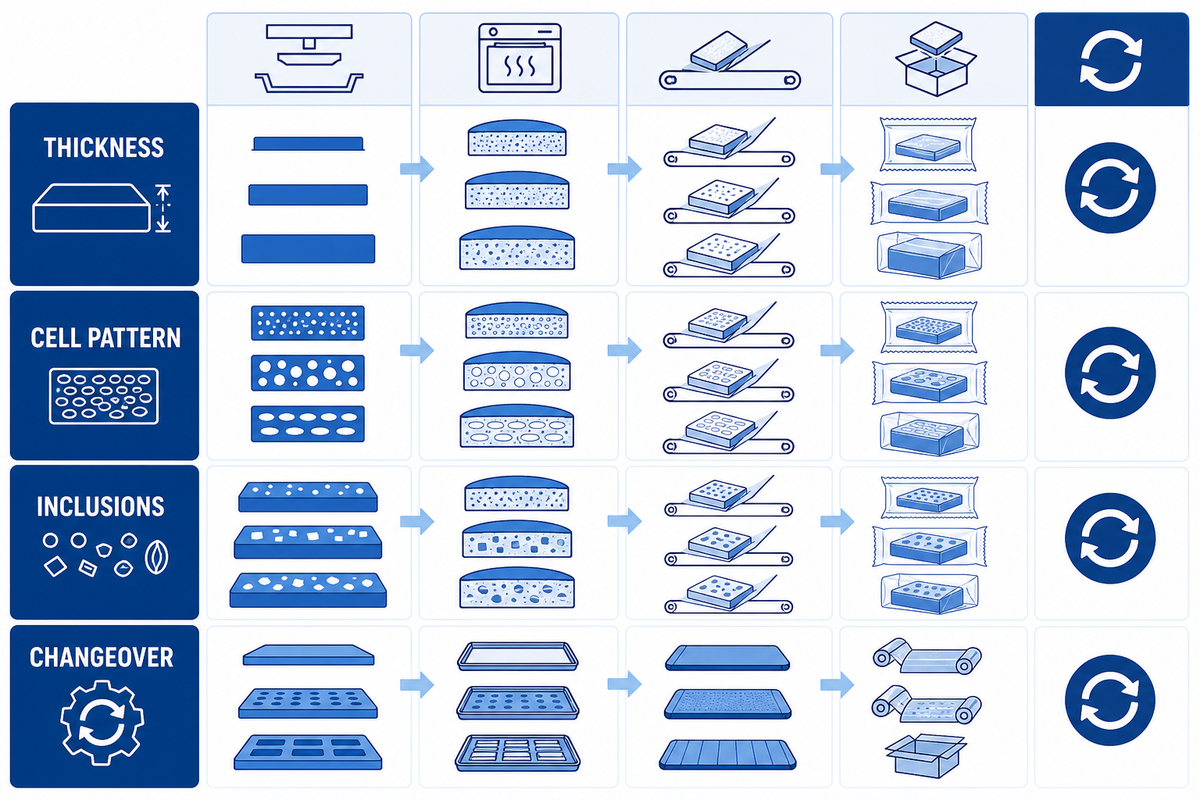
With a rate basis in hand, geometry is the first design input because it controls cavity volume, release path, heat path and packing orientation. Decide whether the product is flat, filled, sandwiched, round, square or a custom shape before comparing line layouts. Flexible plates can widen a product range, but they can also add change parts, cleaning tasks and new acceptance samples.
Trade coverage describes waffle lines that change baking plates and add fillings. Use that as a design prompt, not a promise that one line handles every recipe at one rate. Ask for a matrix showing which parts change, how long the change takes and which controls need a new recipe ID.
When a geometry change affects food-contact construction, compare the drawing with the public NSF/ANSI 4-2025 sanitation summary and then confirm the applicable certification route for the installation.
| Product cluster | Geometry decision | Process question | Acceptance evidence |
|---|---|---|---|
| Thin flat | Edge thickness and flatness | Does the transfer keep the sheet level? | Flatness gauge and edge-break count |
| Deep cell | Cell depth and corner fill | Where is the coldest section? | Centre/edge bake sample |
| Filled | Seal land and fill volume | Does filling alter release or bake time? | Cross-section and leak check |
| Sandwiched | Alignment and compression | Can the handoff preserve the layers? | Layer offset and crush count |
| Round | Diameter and seam | Is seam orientation stable? | Diameter sample and seam photo |
| Square | Side length and corner radius | Does the packer accept the orientation? | Orientation and pack fit |
| Custom relief | Relief height and draft angle | Can the mould release without tearing? | Release video and defect count |
| Variable filling | Fill range and nozzle change | What recipe ID controls the change? | Changeover record |
| Multi-size family | Shared datum and part set | Which components are common? | Part-list and restart trial |
A good geometry brief prevents a buyer from paying for flexibility that is not needed, or discovering that a “universal” mould requires a slower cycle and a new cooling path. Draw the datum, cavity and pack orientation; attach those files to the request for quotation.
Factory acceptance: prove the result, not just machine motion
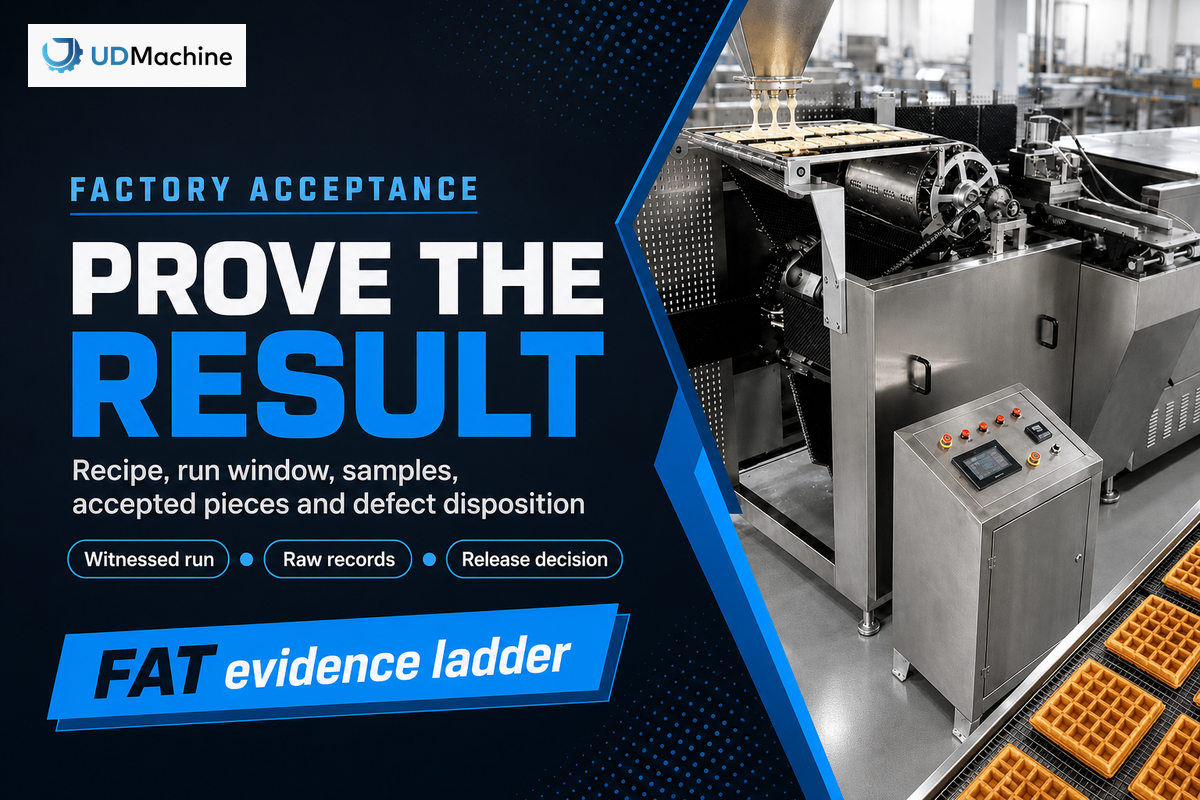
After geometry is frozen, factory acceptance should prove repeatable product under an agreed sample plan. Moving chains, warm ovens and functioning touchscreens demonstrate motion; they do not prove dose mass, cooled release, saleable yield or sanitation access. Write the pass/fail rule before the supplier schedules the trial.
Use the Bake-Release Evidence Ladder: first verify the recipe and geometry, then the process settings, then the cooled product, and finally the packed count. Each rung has a named record. If a rung fails, hold the next rung rather than averaging the failure into a headline rate.
- Rung 1, identity: drawing, recipe revision, ingredient lots and mould ID.
- Rung 2, control: dose, cycle, zone readings, cooling dwell and utility readings.
- Rung 3, product: mass, dimensions, texture proxy, release and deformation after cooling.
- Rung 4, output: accepted count, reject reasons, changeover and restart loss.
For a U.S. installation, 21 CFR Part 117 is a planning reference for cleanability, controls and records where it applies; local food-safety and machine-safety obligations still govern. Acceptance packets should show which requirement is being checked and which party owns the evidence.
The same eCFR section gives the public cleanability and maintenance wording that can be copied into a site-specific acceptance checklist.
Key takeaway: sign the result at the cooled and packed stages. Machine motion belongs in commissioning notes; saleable output belongs in acceptance.
Utilities, sanitation and operator workflow
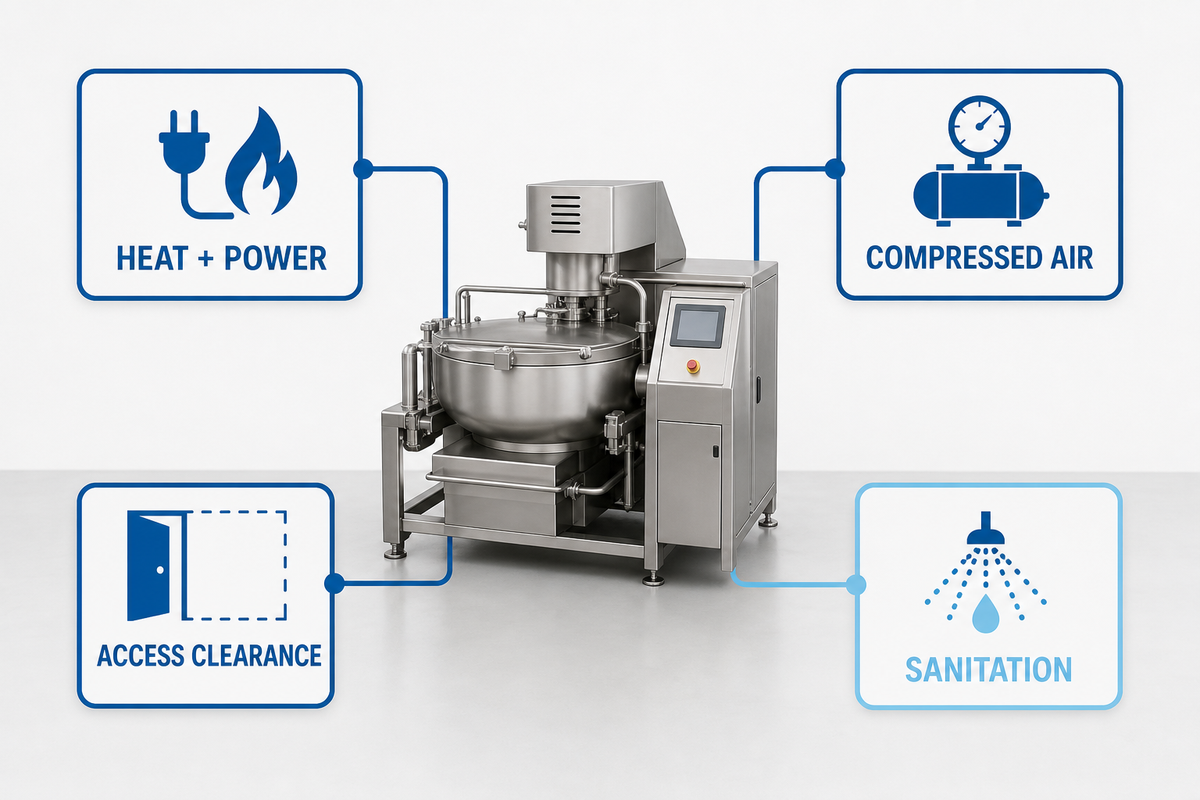
With the acceptance ladder defined, utilities are part of the product trial because gas pressure, electrical demand, compressed air, exhaust and room conditions can change heat and line speed. Ask for a utility schedule with units, normal range, peak demand, connection point and the measurement used during the run. One vendor table may list 54 m³/h gas or 338 kW electric heating for one configuration; those values are design inputs to verify, not a UDTECH specification.
Sanitation must be observable. Under the eCFR equipment provision, equipment must be designed for cleanability and installed to facilitate cleaning and maintenance. Cornell’s food-safety checklist and a PubMed-indexed cleanability review support asking where residue can remain, how an operator reaches it and how the clean state is verified. Turn each question into a drawing mark, access time and inspection record.
Operator workflow closes the loop. Control screens may display a setpoint, but trained operators still need a start-up hold, a refill response, a safe stop, a cleaning release and a changeover checklist. During acceptance, include at least one normal stop and one planned cleaning cycle so the real handoff is visible.
- Record electrical, gas, air and exhaust readings during the same run as product samples.
- Mark food-contact surfaces, removable parts, drains and inspection points on the line drawing.
- Confirm guards, emergency stops, lockable disconnects and access clearances with the site’s safety owner.
- Time a clean-and-restart sequence and record the first accepted piece after restart.
Key takeaway: request evidence at the utility, sanitation and operator interfaces. Demonstration-only lines are not yet ready for a plant.
The RFQ packet that makes supplier quotes comparable
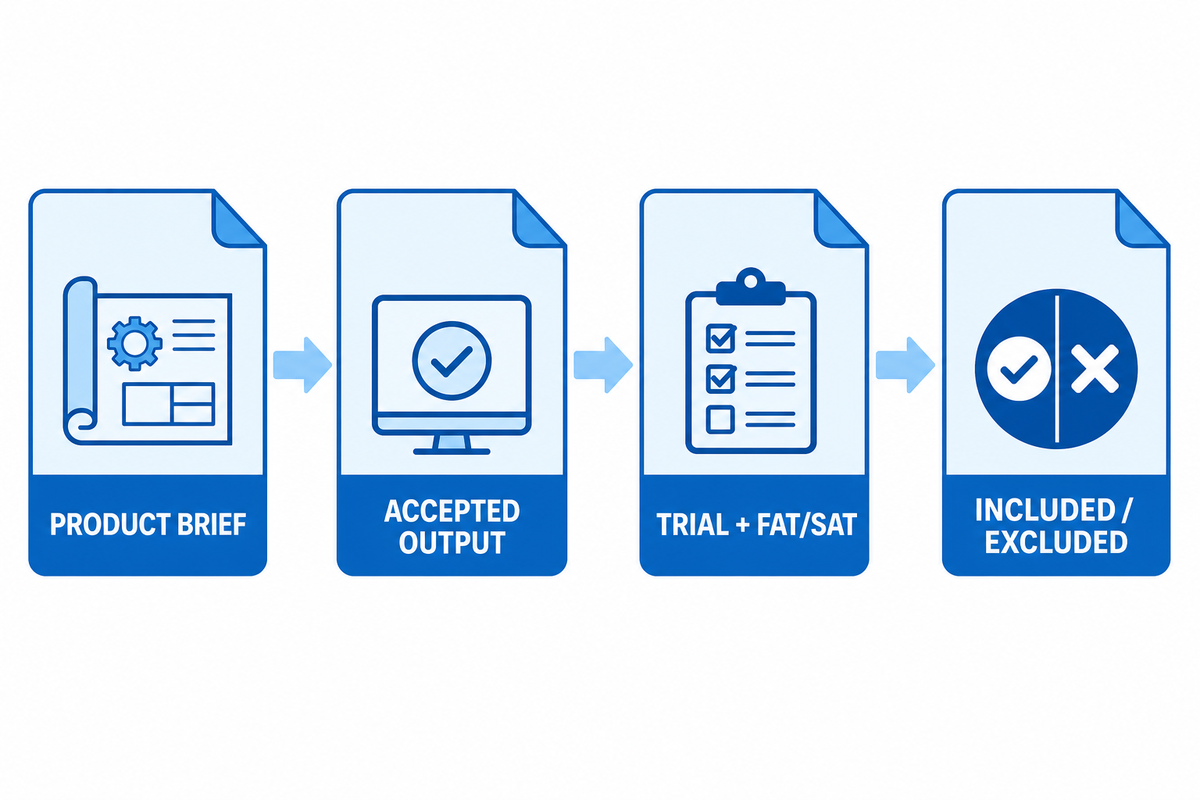
A useful request for quotation is a controlled data packet, not a sentence asking for the “best” line. Include the product drawing, target mass, recipe window, output basis, utilities, layout envelope, sanitation access, acceptance samples and after-sales expectations. This keeps the commercial solution page focused on configuration and quotation while the buyer’s internal team owns the evidence.
For the food-safety fields in that packet, cross-check the FDA preventive-controls reference and list the monitoring and verification record that will be supplied.
Use the soft waffle production line selection checklist when you are ready to review a configured solution. This link is an education-to-solution handoff; this article does not repeat its product modules or quote language.
| RFQ section | Minimum field | Evidence requested |
|---|---|---|
| Product | Drawing, mass, dimensions, filling and pack | Approved revision and sample photos |
| Recipe | Ingredient range and batter test method | Recipe ID and batch record |
| Capacity | Accepted pieces/hour formula | Timed run with rejects shown |
| Moulds | Count, cavities, material and part life | Drawing, spare list and change time |
| Heat | Zone, cycle and fuel/electric basis | Actual logged readings |
| Cooling | Dwell and exit condition | Post-cooling sample and damage count |
| Utilities | kW, gas, air, exhaust, water and floor space | Site survey and peak readings |
| Sanitation | Access, removal, drains and clean release | Cleaning procedure and inspection sign-off |
| Controls | PLC tags, alarms, recipe permissions and data export | I/O list, alarm test and backup file |
| Acceptance | Sample size, tolerance and defect taxonomy | Signed FAT/SAT record and open-item list |
Patent and design language belongs in a separate evidence check. Google Patents records can show that mould-filling or flexible-deposit concepts exist, but a generic patent is not proof of UDTECH ownership or current machine performance. Ask for a publication number and matching assignee before repeating any patent statement.
Key takeaway: a quote becomes comparable when the supplier must answer the same product, process, utility and acceptance fields. Missing fields should be marked “to be confirmed,” never silently filled with a competitor’s number.
How to use company background without overstating a line claim
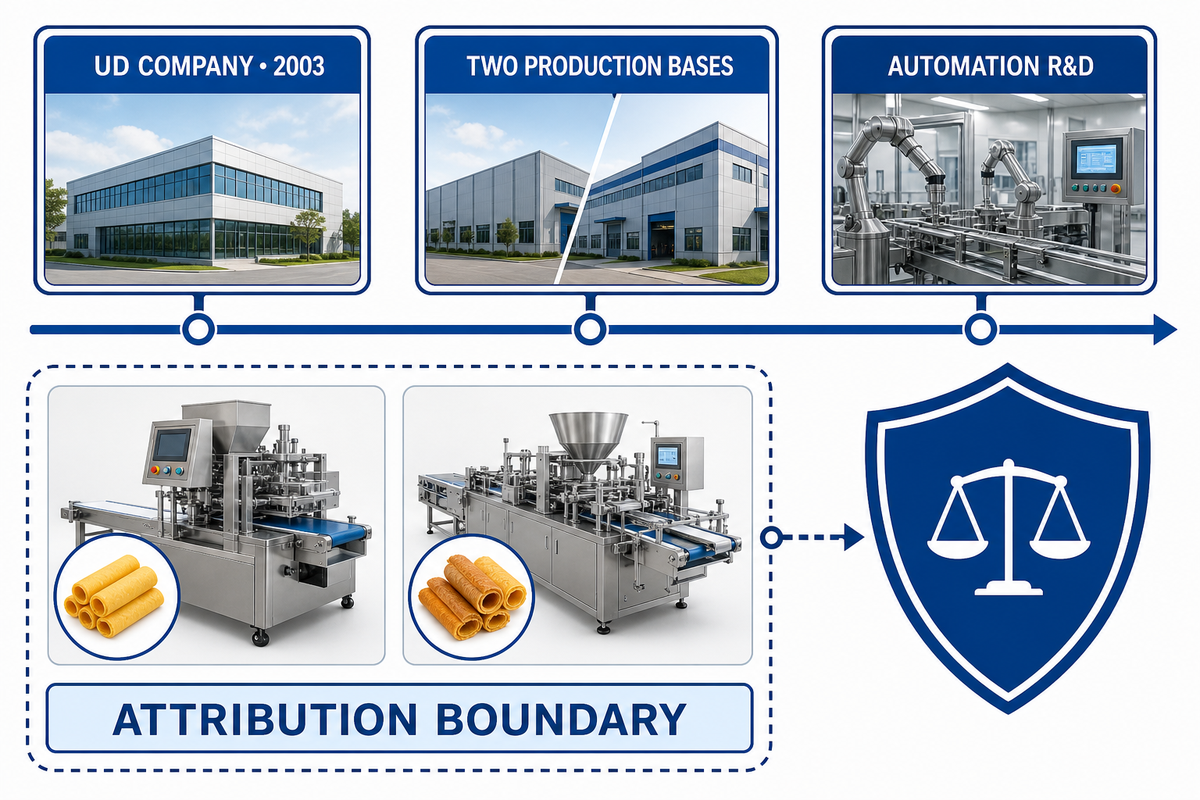
UD Company states that it was established in 2003, invested nearly RMB 200 million in Xinyu’s High-tech Development Zone, covers about 130 acres and operates two major production bases. User-supplied background also says the company develops food-production automation and independently developed egg-roll and phoenix-tail-roll machines with multiple invention patents. Those statements describe company background; they do not establish a soft-waffle capacity, certification or recipe result.
For a buyer, the useful next step is to ask for the evidence that belongs to the specific project: line drawing, test recipe, utility schedule, control list, sample measurements and acceptance report. Keeping company credentials separate from product proof protects both the buyer and the supplier from an avoidable attribution error.
The public equipment-maintenance wording is a suitable example of project evidence; it does not validate UD Company’s capacity or ownership claim.
The distinction also prevents search-intent overlap. Configuration, specifications and quotation remain owned by the existing solution page. This guide owns process control, diagnosis, selection logic and acceptance preparation. Readers can move from the checklist to a configured solution without finding two pages making the same commercial promise.
Frequently asked questions
Finally, use these questions to check whether the product, process and acceptance evidence are ready to compare.
Where a question touches preventive controls, use the FDA reference as context and confirm the plant’s jurisdiction before treating it as a requirement.
What is the most important input for a soft waffle line quote?
Begin with the approved product drawing and target mass because they set cavity volume, cycle, release and packing orientation. Add the recipe window, batter temperature, allowable mass tolerance, target moisture and accepted-piece definition before comparing rates. If the drawing is still moving, record the revision used for the factory trial so a later mould change is not mistaken for a supplier performance issue.
Is a published pieces-per-hour figure a guaranteed output?
No. Treat it as a conditional figure until mould count, geometry, cycle basis, availability, rejects and cooling endpoint are stated. Put accepted packed pieces, the sample method, run duration and utility readings in the acceptance clause. Rates measured at the oven discharge can look attractive while cooling, inspection or packaging creates the real bottleneck, so the endpoint must be named.
Why test cooling if the waffle looks correct at the oven exit?
Cooling changes stiffness and release behaviour. Pieces can leave the iron intact and deform, stick or tear before packing, especially when residual moisture is high or the package traps heat. Sample at oven exit, cooling exit and packed-product staging. Define the defect limits, sample count, room temperature and time to pack before the factory trial, then retain photos with the signed record.
Can one line handle several shapes and fillings?
It may, but flexibility depends on change parts, recipe permissions, cleaning time and a new acceptance sample for each product family. Ask for a changeover matrix instead of assuming one rate applies to every shape.
What should be in a factory acceptance test?
Include identity, process readings, utilities, dose and bake samples, cooled release, accepted count, reject reasons, changeover, sanitation access and open-item ownership. Sign the result only after the packed-product endpoint passes.
Does 21 CFR 117.40 certify a machine?
No. Section 117.40 is a U.S. food-equipment planning requirement covering cleanability, maintenance, installation and controls where applicable. Each plant must confirm jurisdiction, food-safety plan and any certification required for its project.
Related process guides
References & Sources
- Electronic Code of Federal Regulations, 21 CFR 117.40, Equipment and utensils
- U.S. Food and Drug Administration, FSMA Final Rule for Preventive Controls for Human Food
- Cornell Institute for Food Safety, Cleaning, Sanitizing, Hygienic Design
- PubMed, Hygiene and cleanability: a focus on surfaces
- ANSI public summary, NSF/ANSI 4-2025 commercial cooking equipment sanitation
- NSF, Food equipment standards portfolio
- USDA Food Safety and Inspection Service, Food safety basics