Get in touch with UDTECH Company

Phoenix Roll Machine: A Process, Selection, and Acceptance Guide

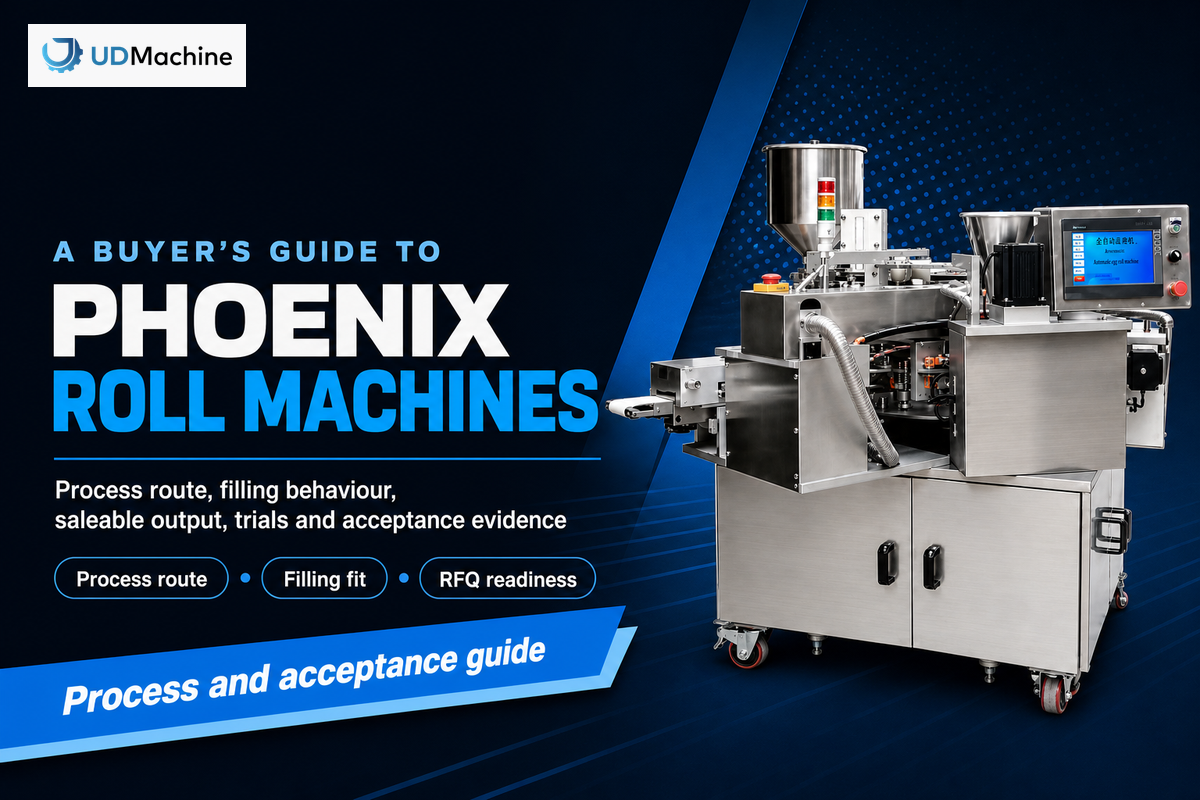
Short answer: a Phoenix roll machine is best evaluated as a recipe-and-line system for producing a repeatable filled wafer roll, not as a single speed number. Phoenix Roll Machine is an industrial forming and filling system for a specified wafer-roll product. The right buying sequence is product definition → forming and heating route → filling behaviour → connected-line bottlenecks → witnessed trials → sanitation and guarding evidence. This guide is intentionally educational. The linked Phoenix roll machine solution page owns model specifications, configuration and quotation details.
What a Phoenix Roll Machine Actually Makes
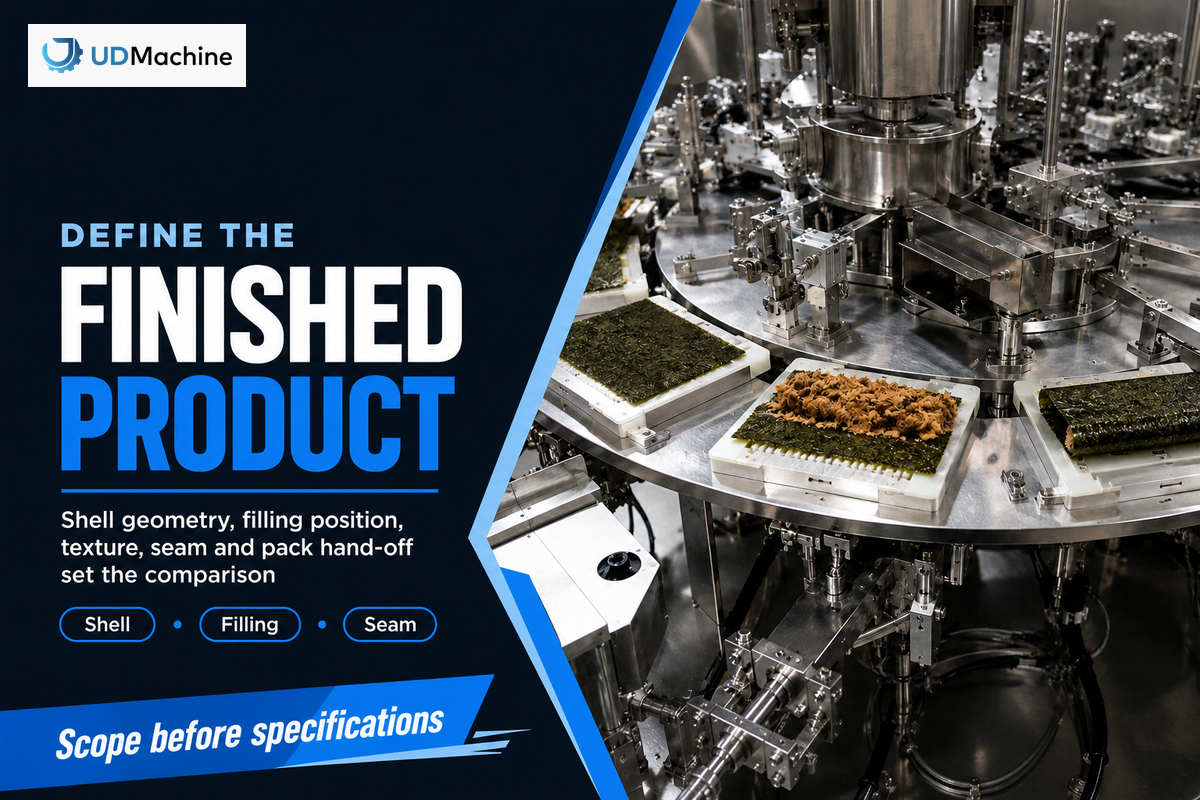
In industrial food conversations, “Phoenix roll” usually refers to a rolled wafer or egg-roll-style shell that may be filled with ingredients such as seaweed, pork floss, powder, cream or another recipe-specific inclusion. The phrase is easy to misread because search results also contain sushi rolls, spring-roll recipes, cannabis pre-roll equipment and metal roll-forming machinery. Confirm the finished food before you compare equipment.
An automatic phoenix roll is still defined by its finished texture, seam and filling stability, not by the label used in a catalogue.
The machine is therefore not defined by its name alone. It’s defined by the shell geometry, filling position, bite and break strength, moisture target, cooling behaviour, packaging format and acceptable cosmetic variation. Any line that makes an attractive empty wafer but cracks after filling hasn’t solved the buyer’s problem.
For background on how food-processing variables can affect texture and finished-product behaviour, use the peer-reviewed discussion in this PMC food-processing reference; it is context for test design, not proof of any Phoenix roll machine’s output.
Scope check: this is a food-process guide for filled wafer/egg-roll products. It is not a sushi-rolling machine, a spring-roll wrapper line, a domestic snack maker or a pre-roll cannabis machine.
How to read catalogue language: search snippets often concatenate labels such as automatic phoenix roll machine egg, phoenix roll machine egg wafer, roll machine egg wafer roll, egg wafer roll biscuit machine and machine egg wafer roll biscuit. Other listings may say electric making machine, rotary bakery maker, roll production, kitchen equipment, China manufacturer or high degree of automation. Treat these as discoverability language; ask for a recipe-bound test report before treating any label as a specification.
Consumer and catalogue modifiers can also obscure a B2B comparison: restaurant, commercial automatic, automatic commercial, tray, customize, automatically, efficiency, rotate, mini, portable, stainless steel commercial, vertical, high output, commercial electric, wholesale, industrial commercial, snack food, factory direct, temperature, high-end, suitable and low price. Use those words to find candidate suppliers, then replace them with measured capacity, utility, hygiene and acceptance evidence in the buying file.
Before requesting a quotation, write a one-page product brief. Include a cross-section sketch, shell dimensions, filling type and particle size, target piece mass, moisture or texture limits, packaging hand-off and the markets in which the food will be sold. That brief becomes the reference for every later trial and acceptance decision.
For a factory buyer, the acceptance file should pair that brief with a recipe-bound test report and explicit acceptance criteria, so a promising sample can be checked against the same evidence later.
Map the Production Route Before You Compare Machines
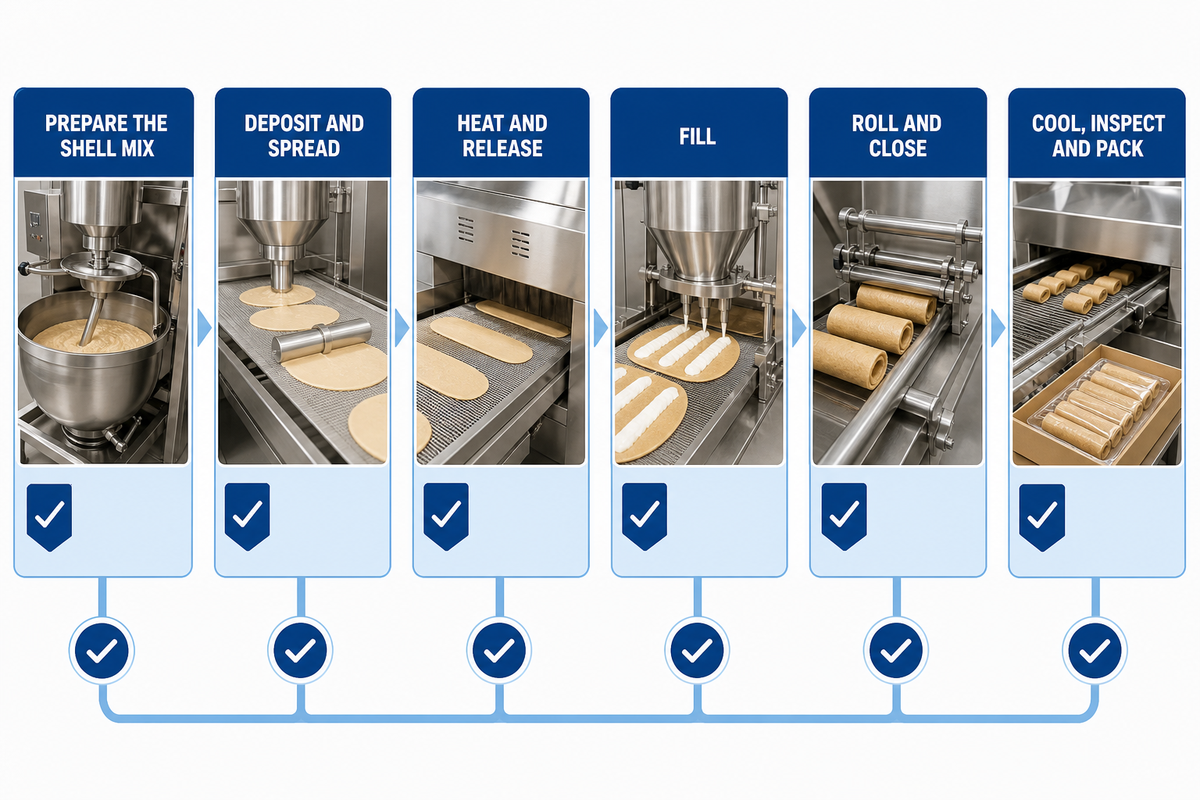
A useful Phoenix roll machine comparison starts with hand-offs, not brochures. Draw the route from ingredient preparation to packed product and label the control variable at each hand-off. The route commonly includes batter or dough preparation, metered depositing, baking or heating, release, filling, rolling, cooling or setting, inspection and packing. Some lines combine stages; the control questions remain separate.
- Prepare the shell mix. Record solids, fat, water, viscosity and temperature at the point of deposit. Recipe changes can move the process window even when the machine settings remain unchanged.
- Deposit and spread. Confirm the amount per cavity or plate, distribution uniformity and the timing between deposit and heat. Uneven thickness becomes a crack or weak seam later.
- Heat and release. Define the heating profile, contact surfaces and release condition. “Baked” isn’t a sufficient acceptance description; specify what the shell must look and feel like when it reaches the next station.
- Fill. Test the real filling, not only water. Measure temperature, viscosity, particle size, pressure and shear sensitivity. Filling that’s stable in a beaker may bridge, string or migrate at production speed.
- Roll and close. Check seam position, overlap, breakage and filling centring. The shell must be strong enough for the rolling force while still meeting the eating texture.
- Cool, inspect and pack. Establish when the product is dimensionally stable. Packing too early can trap heat or shift filling; packing too late can reduce line utilisation.
This map exposes the first major buying risk: the slowest or least stable hand-off sets saleable output. The FAO chapters linked here are historical planning references: they remind readers to normalise throughput, dimensions and cost, but they aren’t current Phoenix-roll specifications or regulatory requirements (FAO capacity-planning guidance). Confirm current local engineering and compliance requirements before freezing a purchase.
Why Filling Behaviour Changes the Machine Design
Filling is often the hidden design constraint. Free-flowing powder, fibrous pork-floss blend, viscous cream and temperature-sensitive compound don’t behave alike. They can require different hoppers, agitators, pumps, nozzles, cut-off methods and cleaning access. Universal depositor claims are meaningful only when the supplier states the tested recipe and operating window.
Measure the variables that can move the result
- Viscosity: record temperature and test method with every sample. Viscosity can shift enough during a run to change dose mass or stringing.
- Particle size and fibre length: note the largest inclusion and whether it can bridge a narrow passage.
- Temperature: document product, hopper and nozzle temperatures. Warm filling may flow well but soften the shell or migrate into it.
- Pressure and shear: identify whether pumping or compression damages the filling structure or changes its apparent flow.
- Cut-off behaviour: measure tailing, drip and the time from dose end to roll closure.
Translate filling tests into a buyer decision
Ask for a trial that uses your production filling at low, nominal and high settings. Weigh a statistically useful sample, inspect the seam and measure rejects by cause. The decision isn’t “did the depositor run?” It’s “did it place the required mass inside an intact shell over the full recipe window without creating an unmanageable cleaning or changeover burden?”
If the supplier has only tested water or a thin surrogate, treat the result as a mechanical demonstration, not a production guarantee. This distinction is especially important when the advertised rate is later used in a return-on-investment model.
When setting those test variables, a peer-reviewed food-processing reference can help the team document texture and recipe conditions without turning a surrogate filling into a performance claim.
Ask the supplier’s test report to identify the factory trial recipe, filling preparation and cleaning reset; those details make a capacity claim reproducible for the buyer’s line.
Capacity Is a Measurement Basis, Not a Headline Number
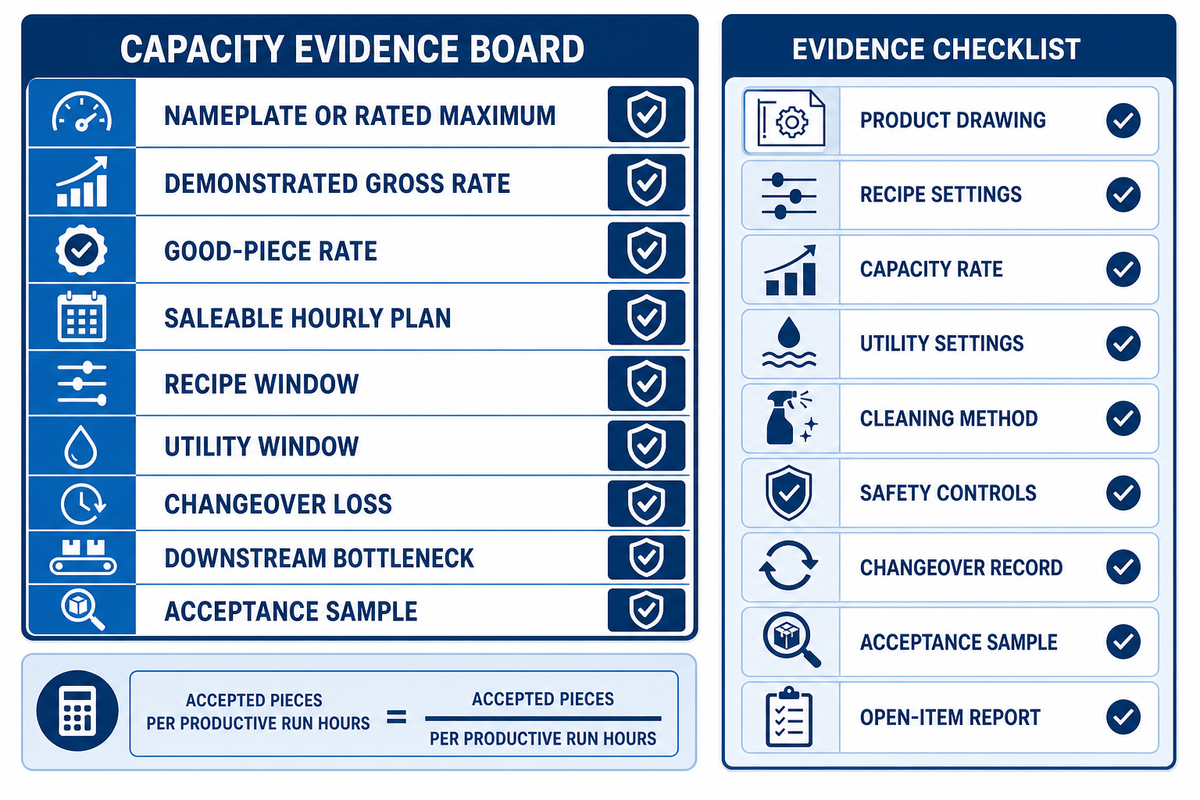
Capacity should be reported as saleable product under stated conditions. Separate four numbers in your worksheet:
| Capacity category | What it means | What to record |
|---|---|---|
| Nameplate or rated maximum | A manufacturer-specified ceiling under defined conditions. | Recipe, shell size, filling, utilities and stated assumptions. |
| Demonstrated gross rate | Pieces produced during a witnessed run before rejects and stoppages. | Run length, pauses, speed changes and operator interventions. |
| Good-piece rate | Accepted pieces after cracks, open seams, underweight doses and cosmetic rejects. | Reject count and reason code by sample interval. |
| Saleable hourly plan | Good pieces adjusted for planned cleaning, changeover and downstream limits. | Availability assumption and bottleneck station. |
| Recipe window | The tested low-to-high range for filling and shell conditions. | Temperature, viscosity method and setting limits. |
| Utility window | The electrical and air conditions present during the trial. | Voltage, frequency, air pressure and flow. |
| Changeover loss | Productive time removed for cleaning, tooling or recipe reset. | Minutes per changeover and restart rejects. |
| Downstream bottleneck | The connected station that limits accepted product flow. | Buffer level, packing rate and stop events. |
| Acceptance sample | The agreed sample used to close a test point. | Sample size, inspection method and sign-off. |
| Evidence category | Supplier report | Buyer decision |
|---|---|---|
| Product drawing | Revision, dimensions and tolerances | Matches the approved brief |
| Recipe settings | Ingredients, temperature and viscosity range | Repeatable at low, nominal and high points |
| Capacity rate | Good-piece rate, run window and reject count | Supports the weekly production model |
| Utility settings | Voltage, air pressure, flow and connected load | Plant utilities can sustain the trial |
| Cleaning method | Disassembly steps, tools and reset time | Allergen sequence is practical and documented |
| Safety controls | Guards, interlocks, stops and isolation points | Local risk review has no open critical item |
| Changeover record | Tooling, recipe recall and restart rejects | Loss is included in the capacity plan |
| Acceptance sample | Sampling method, inspection and sign-off | Results are traceable to the product brief |
| Open-item report | Owner, due date, retest method and closure evidence | Unresolved scope is visible before purchase |
The U.S. Energy Information Administration’s definition of nameplate capacity is a useful analogy: a rated maximum becomes decision-useful only when its conditions are known, and it isn’t the same as demonstrated operating output (EIA nameplate-capacity definition). FAO also notes that equipment for the same purpose can differ in capacity, dimensions and cost, so the comparison basis must be normalised (FAO packaging-equipment planning chapter).
For context only, the supplied UDTECH solution page publishes model-specific line-rate and compressed-air examples. Those first-party figures are configuration context, not a universal Phoenix Roll Machine benchmark. Use the exact values shown on the UDTECH solution page as questions for a witnessed recipe trial, then calculate your own good-piece rate.
The solution page also shows a model-specific utility and footprint schedule. Treat all such first-party values as configuration context; verify the exact utility and layout requirements for the model and options quoted for your plant.
For a controlled trial, choose a productive window such as 30–60 min, or extend to 90 min when drift needs confirmation; log readings at 10 min intervals, and preserve start/middle/end samples. These are recommended measurement practices, not guarantees of any supplier’s output.
A practical protocol can log readings at 10 min, 20 min, 30 min, 40 min, 50 min and 60 min, take 3 samples at each checkpoint, and repeat 2 restart checks at 5 min and 15 min. If temperature is a control variable, example checkpoints might be 20°C, 25°C, 30°C, 35°C, 40°C, 45°C, 50°C, 55°C and 60°C; these are fields to record, not target limits. The point is to expose drift and restart loss with a traceable method, not to create a promised production rate.
Example worksheet line (replace with your actual values): 1 line, 2 filling recipes, 3 checkpoints, 30 min and 60 min run windows, 10 min log interval, 12 kW, 380 V, 0.2 MPa, 0.6 MPa, 0.2 m³/min, 2300 mm × 2000 mm × 1400 mm, 960 kg, plus 20°C and 25°C ambient checkpoints, a 90% provisional acceptance threshold and a 1 mm gauge check where your plant requires them. These examples show the fields to capture; they don’t define a universal specification.
Engineering note: repeat the utility check at 380 V and 0.6 MPa, compare a 12 kW connected-load entry and 0.2 m³/min air draw with the plant utility schedule, then verify 2300 mm × 2000 mm × 1400 mm clearance and a 960 kg floor-load entry. Keep the 20°C and 25°C environmental points and the 1 mm gauge check tied to the approved quality plan. These are example fields copied from the published configuration context, not design limits.
When documenting restart behaviour, record the 1 min, 5 min and 15 min recovery points if those intervals match your quality plan; the purpose is to expose restart rejects, not to create a benchmark.
Practical formula: saleable pieces per hour = accepted pieces ÷ productive run hours. Report the piece mass, filling, shell size, run window, utility conditions, planned stops and reject rate beside the result.
Choose by Finished Product and Changeover Risk
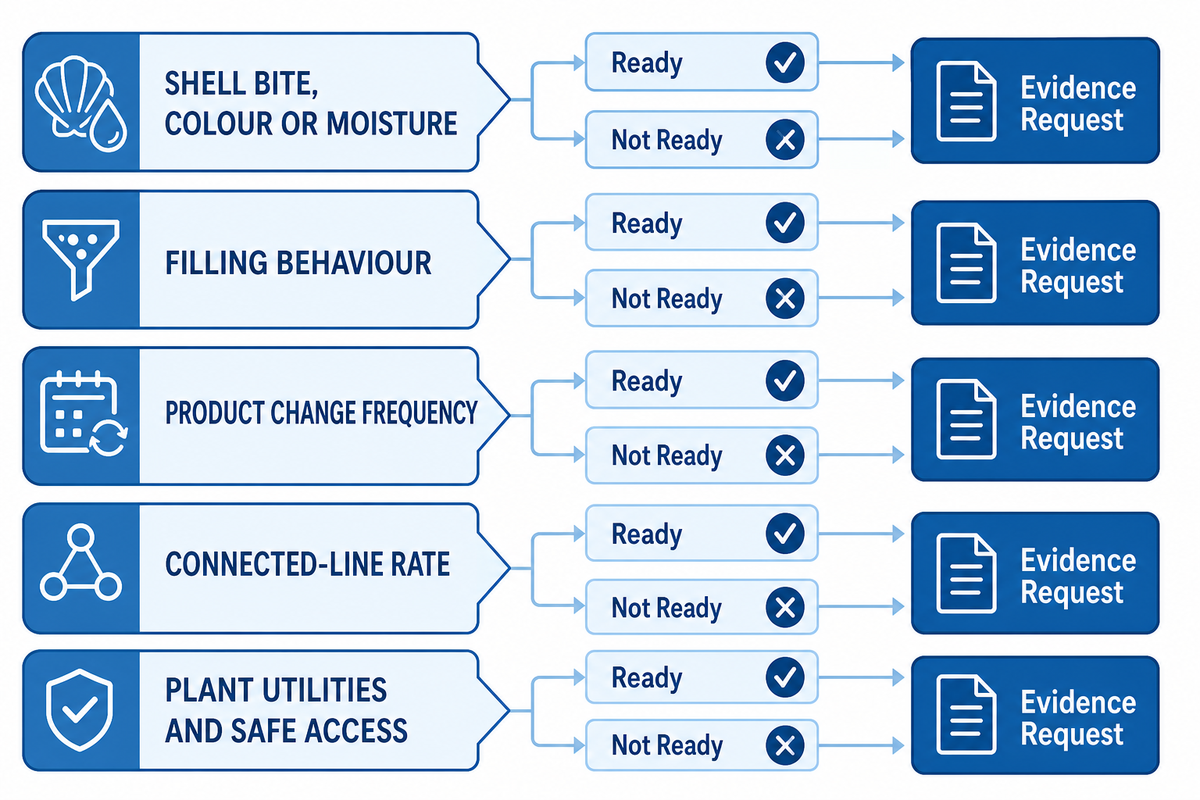
5-Point Phoenix Roll Readiness Map
Use this named map before comparing quotations: product definition, filling window, line bottleneck, sanitation reset and acceptance evidence. If one point is unknown, keep the project in discovery rather than converting an uncertain assumption into a machine specification.
Once the process map and measurement basis exist, compare machine concepts against the product brief. The following decision tree keeps the discussion anchored to outcomes:
- Does the shell need a specific bite, colour or moisture window? If yes, prioritise heat-control and cooling evidence before speed.
- Is the filling free-flowing, fibrous, particulate or viscous? If it isn’t free-flowing, require a recipe-specific depositor trial and cleaning plan.
- Does the product change frequently? If yes, score tool-less access, recipe recall, washdown time and allergen segregation, not only nominal output.
- Can upstream and downstream stations sustain the same good-piece rate? If no, size the bottleneck or plan buffering rather than buying more speed at one station.
- Can the plant provide the required utilities and safe access? Confirm electrical phase, compressed air quality, ventilation, drainage, guarding and maintenance clearance with the plant team.
High automation can reduce repetitive handling, but it can also make a poorly understood recipe fail faster. For uncertain demand, filling stability or product geometry, a semi-automatic pilot route may be the better first step. When comparing an automatic phoenix roll machine, ask for the recipe-bound evidence and the changeover burden before you treat automation as the default. The right level of automation is the one that produces accepted food within a controllable operating window.
Use the EIA distinction between a rated maximum and demonstrated output in this capacity-definition reference as a prompt to compare evidence and changeover risk, while leaving the applicable legal requirements to your quality team and local authority.
An industrial buyer can ask each supplier to attach a factory test report to the quotation, then compare the same process window instead of comparing promises.
Commissioning and Trial Design
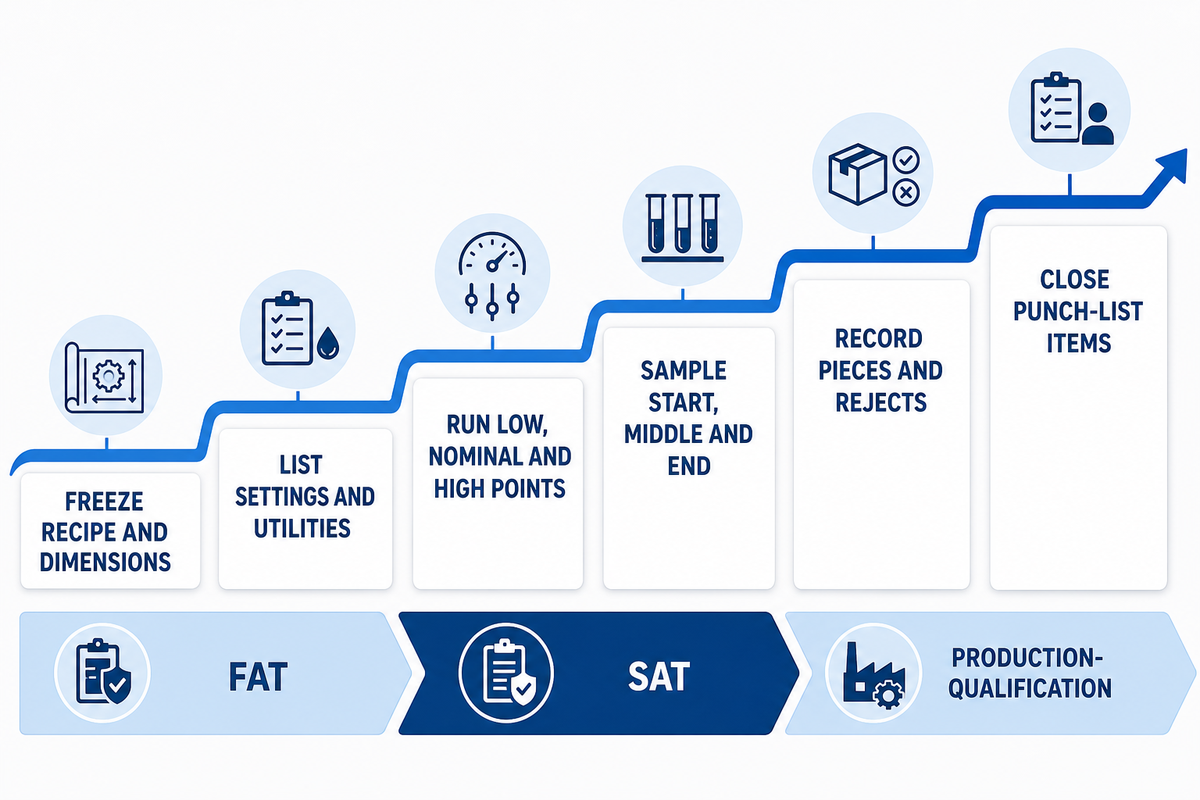
Commissioning should turn promises into evidence. Treat factory acceptance testing (FAT), site acceptance testing (SAT) and production qualification as related but distinct activities. ISA-105 describes structured readiness checks, punch-list tracking, documentation and completion criteria for FAT/SAT/SIT work (ISA-105 standards series).
Build a recipe-bound trial protocol
- Freeze the recipe version, ingredient lots, shell dimensions and filling preparation method.
- List the machine settings, utility readings and calibration status before the run.
- Run low, nominal and high points for the settings that define the process window.
- Sample at the start, middle and end of the run; don’t select only attractive pieces.
- Record good pieces, every reject mode, dose mass, seam quality, shell breakage and operator intervention.
- Write punch-list items with an owner, due date, retest method and closure evidence.
The EIA capacity definition linked here is a measurement reference included to illustrate why a commissioning record should state its conditions and distinguish a rated maximum from demonstrated output (EIA capacity definition). It does not define the legal protocol for this line. Check current rules for the destination market, then let your quality team and local authority decide the applicable protocol.
Include the whole line in acceptance
A single machine can pass while the line fails. Include depositor feed, oven or heating stability, cooling, inspection, packing speed, cleaning reset and the operator workload in the acceptance record. If downstream packing backs up, the machine’s gross rate isn’t the plant’s saleable rate. If changeover takes longer than the production window, the weekly output model must show that loss.
Fault Atlas: Cracks, Migration, and Uneven Rolls
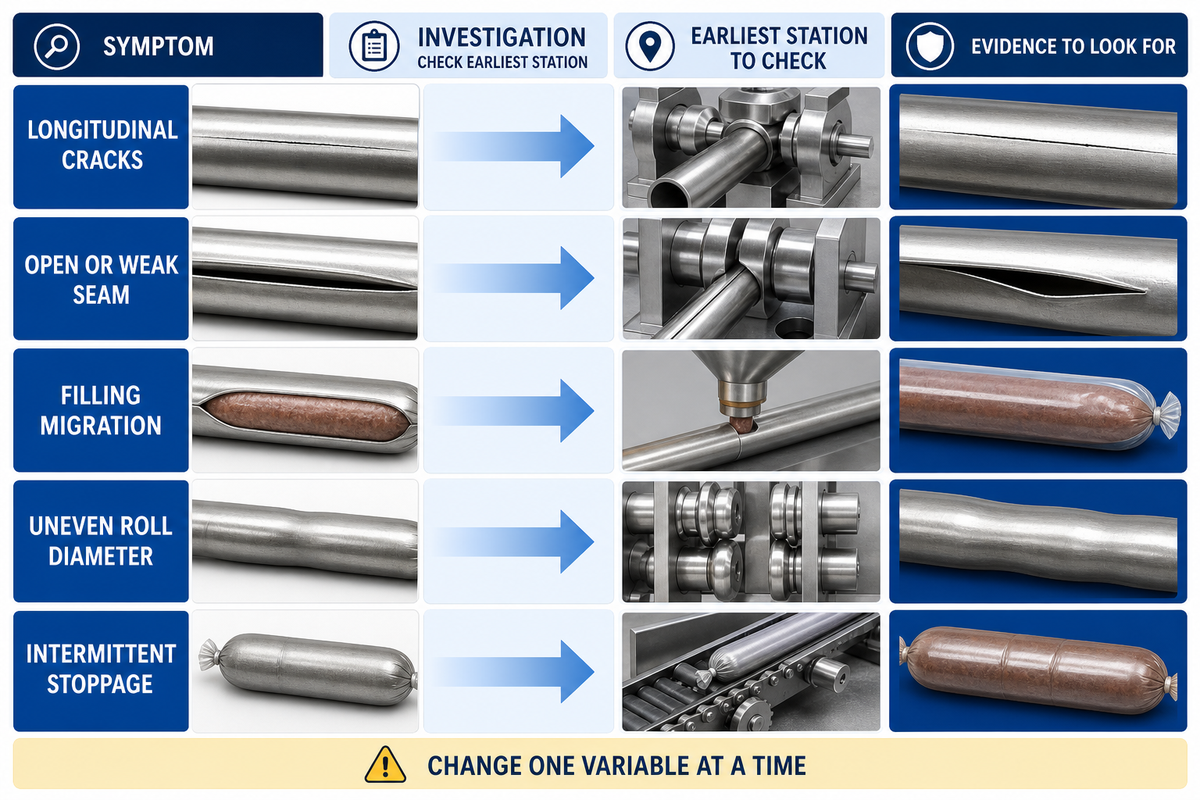
Use a fault atlas to turn symptoms into controlled tests. Change one variable at a time and preserve the sample that demonstrates the failure.
| Observed symptom | Likely investigation path | Evidence to collect |
|---|---|---|
| Longitudinal cracks | Shell thickness, release condition, roll force, shell temperature and filling dose. | Cross-section photos, shell mass, temperature log and station timing. |
| Open or weak seam | Overlap geometry, shell flexibility, filling placement and closure timing. | Seam-width sample, dose-centre record and reject count by minute. |
| Filling migration | Filling temperature, viscosity, pressure, cut-off tailing and cooling delay. | Recipe window, viscosity method, nozzle setting and migration distance. |
| Uneven roll diameter | Deposit uniformity, guide alignment, shell moisture and roller synchronisation. | Diameter map across lanes and start/middle/end samples. |
| Intermittent stoppage | Bridging, sensor fouling, compressed-air variation, safety interlock or downstream backup. | Alarm history, utility trend and restart checklist. |
Don’t “fix” a crack by simply increasing speed or pressure. That can hide the symptom while increasing filling damage or operator risk. First isolate whether the defect begins before filling, at filling, during rolling or during cooling; then retest the smallest change that can disprove the leading hypothesis.
A peer-reviewed food-processing reference is useful background when deciding which texture, temperature and formulation variables belong in the fault log; it does not replace a recipe-bound machine trial.
During a factory trial, give the operator a test report sheet for the failed sample, station, setting and retest result; this turns a visual complaint into an auditable production check.
Hygiene, Allergen Changeover, and Operator-Safety Boundaries
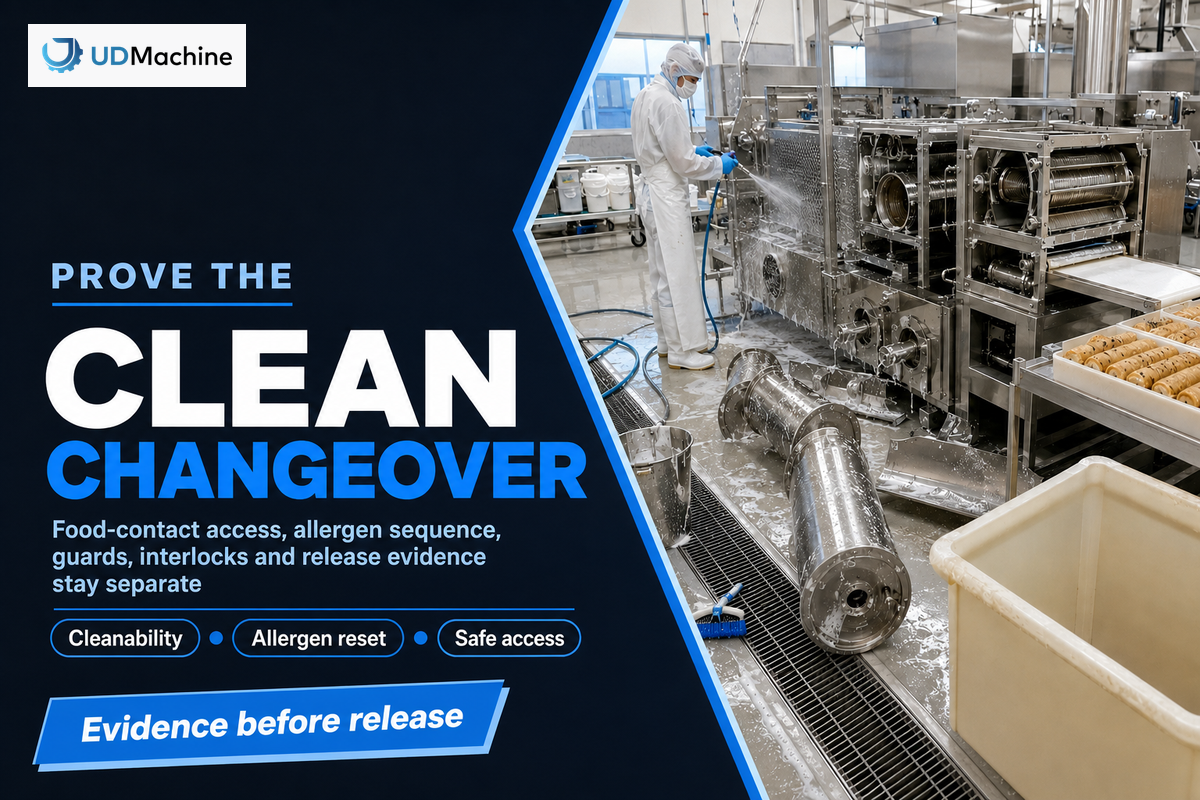
Food hygiene and occupational safety overlap in the physical layout, but they aren’t interchangeable. Even a surface can be easy to clean and still expose an operator to a nip point; a guard can protect an operator while creating a difficult-to-clean shadow area. Review both disciplines separately before commissioning.
Hygiene and allergen controls
FSIS sanitation guidance is a government planning reference for maintaining sanitary conditions in food-processing establishments (FSIS sanitation performance standards guide). For a Phoenix roll line, translate that principle into access and evidence: identify food-contact surfaces, define the cleaning method, state the allergen sequence, inspect hard-to-reach areas and document the release decision. The specific legal standard depends on the market and product.
- List every filling and allergen handled by the line.
- Define dry-clean, wet-clean or validated hybrid steps for each contact zone.
- Set visual inspection points and, where required, swab or analytical verification.
- Record disassembly time, tools required, lost product and restart checks.
Guarding and maintenance access
Ask the supplier to demonstrate guards, interlocks, emergency stops, isolation points and safe access during cleaning and maintenance. The guarding document should show what happens when a sensor trips, when a cover is opened and when energy is isolated. Keep the occupational-safety review with the plant’s competent person; this article doesn’t grant a certificate or replace a local risk assessment.
Build an RFQ That Can Be Accepted
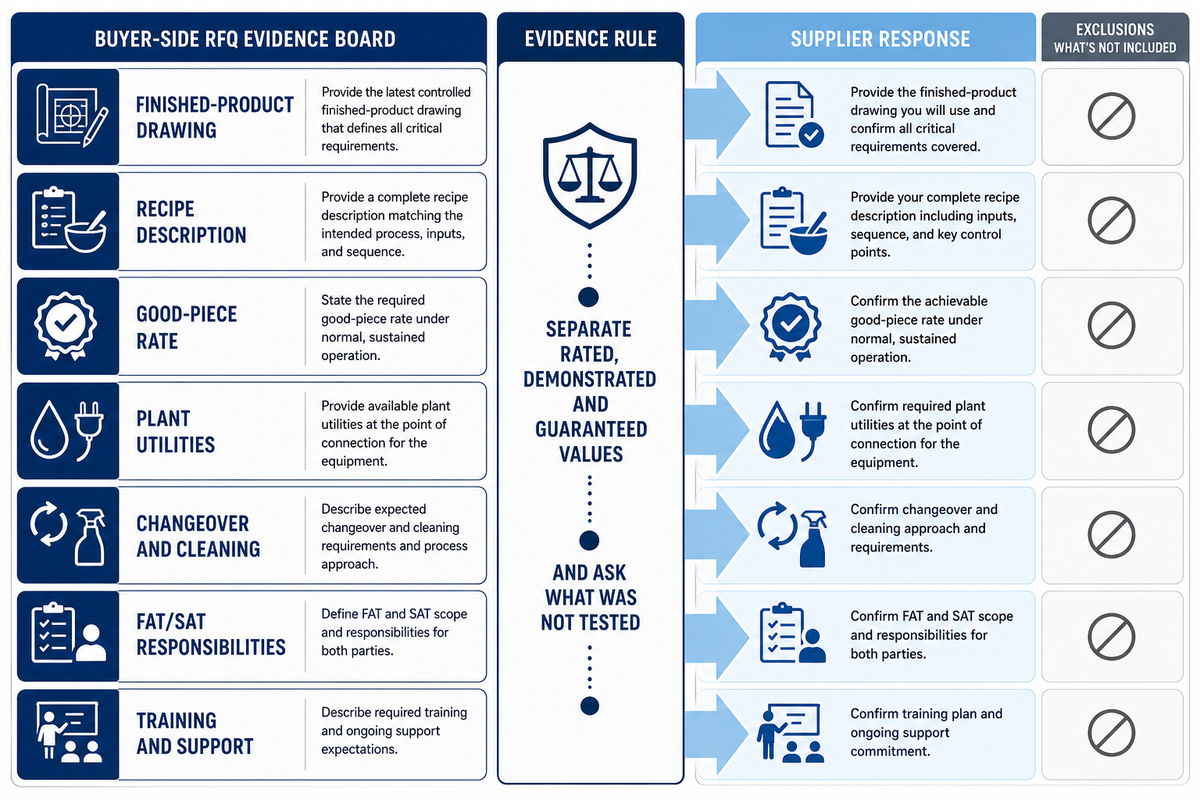
A strong request for quotation is also a draft acceptance plan. Include enough detail that two suppliers must answer the same question:
- Finished-product drawing, shell dimensions, filling location and target piece mass.
- Recipe description, viscosity method, particle-size range, temperature range and allergen list.
- Required good-piece rate, run window, reject definitions and sampling method.
- Electrical, compressed-air, ventilation, drainage, floor-loading and ambient conditions.
- Changeover sequence, cleaning method, access time and spare-parts expectations.
- FAT/SAT responsibilities, video or data deliverables, punch-list closure and warranty evidence.
- Training, manuals, language, remote support, installation boundaries and commissioning travel.
Ask each supplier to separate “rated”, “demonstrated” and “guaranteed” values. Ask what wasn’t tested. An honest limitation is more useful than a polished number with no recipe, utility or reject basis. Keep the sale decision tied to this evidence, not to a catalogue headline.
For the validation and record-keeping side of an RFQ, point the quality reviewer to the EIA distinction between rated and demonstrated capacity in this capacity-definition reference as background, then document the destination market’s current requirements separately.
Require every supplier to include the factory trial recipe, utility log and test report identifier, so procurement can trace the quoted Phoenix roll machine to the evidence reviewed.
Working rule: a Phoenix roll machine is credible only when its recipe-bound, saleable output survives filling, cleaning, a safety review and a witnessed trial.
Choose a Phoenix roll machine supplier that will document those conditions in the quotation and acceptance record, rather than sending a price with untested assumptions.
When a Phoenix Roll Route Is the Wrong Investment
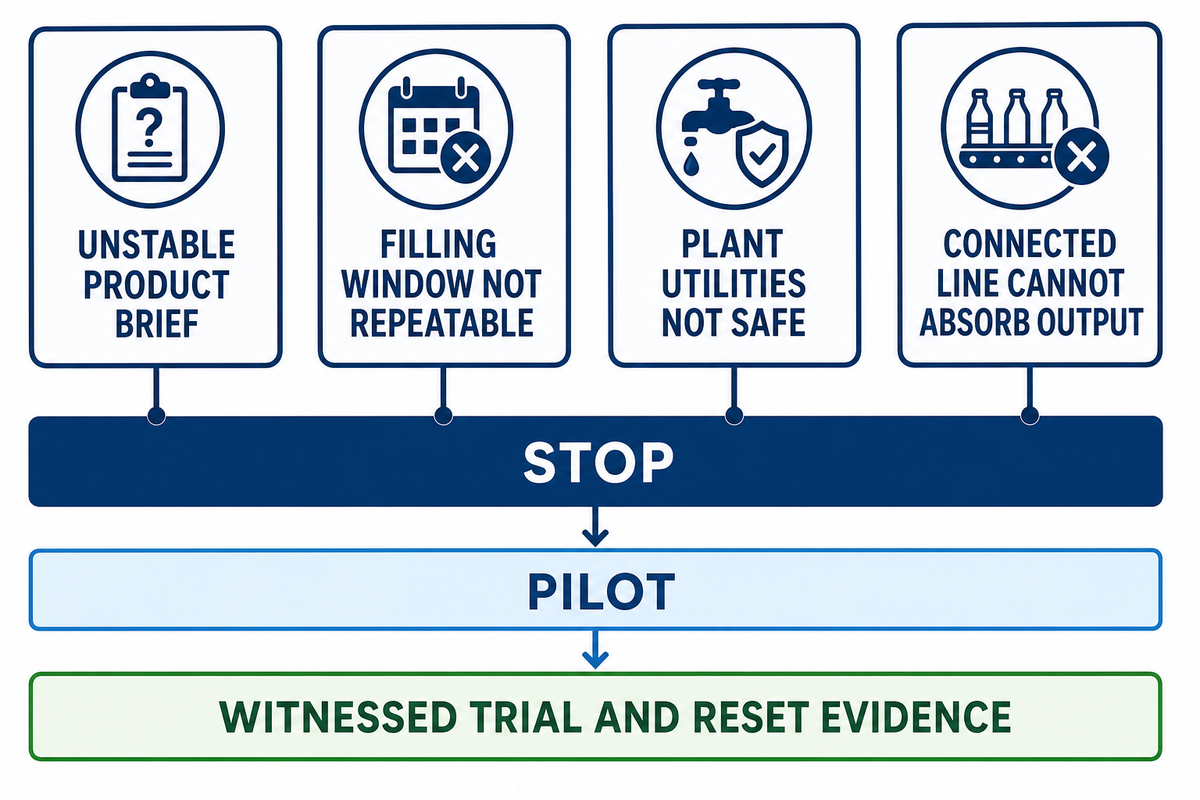
Don’t force this route when the product brief is unstable, the filling can’t hold a repeatable window, the plant can’t provide safe utilities, or the connected line has no way to absorb the output. Choosing a slower pilot, contract manufacturing or a different forming concept may protect the launch better than a high-speed purchase.
Before committing, ask the supplier for a factory test report and a current utility schedule; unresolved evidence is a reason to keep the project in pilot discovery.
Capacity language is another stop signal: the EIA nameplate-capacity definition is a useful reminder that a rated maximum is conditional and should not be treated as demonstrated saleable output.
Likewise, don’t treat a company history or patent statement as proof of your future output. UD Company states that it was established in 2003, invested nearly RMB 200 million in its Xinyu, Jiangxi facilities, operates two production bases and independently developed fully automatic egg-roll and phoenix-tail-roll equipment. The company also states that the series hold multiple invention patents and has been well received domestically and internationally. These are company-supplied background claims; verify the current evidence, scope and applicability during supplier due diligence.
The best investment decision is the one that survives a witnessed trial, a cleaning reset, a safety review and a realistic weekly production model, not the one with the largest headline capacity.
Frequently Asked Questions
How should a procurement team use this guide?
Use it as a pre-RFQ worksheet. First freeze the finished-product definition and the filling window, then map every process hand-off and identify the likely bottleneck. Next, ask suppliers to run the same recipe-bound trial and report rated, demonstrated and accepted output separately. Keep sanitation, guarding, changeover and punch-list evidence in the same file as the commercial quotation. This sequence makes proposals comparable and reduces the risk of buying a machine that only performs under a laboratory surrogate.
What should be attached to a final acceptance record?
Attach the approved product drawing and recipe revision, utility readings, calibration records, run start and end times, sample results, reject reasons, alarm history, cleaning reset time and an open-item list. Include photographs or data exports where they help a reviewer reproduce the decision. The record should state which results are first-party demonstrations, which requirements come from the buyer’s food-safety program and which items remain subject to local occupational-safety review. Signed documents without these traceable inputs are difficult to defend later.
Is a small pilot useful before buying a fully automatic line?
Pilots are useful when product geometry, filling behaviour or demand forecast is still uncertain. Use the pilot to freeze the shell recipe, measure dose stability, observe cracks and migration, estimate cleaning and changeover time, and identify the first bottleneck in the connected route. It should produce a decision record, not just a demonstration video: list the recipe revision, settings, utility readings, accepted pieces, rejects and unresolved questions. Pilots can’t prove long-term uptime or local compliance, but they can prevent an expensive mismatch between the filling and the rolling mechanism. If the pilot output is lower than the commercial plan, update the capacity model before requesting a final quotation. If it’s stable, carry the same measurements into FAT and SAT so the acceptance criteria remain traceable from first sample to installed production.
What is a Phoenix Roll Machine?
A Phoenix Roll Machine is an industrial food system used to form and roll a wafer or egg-roll-style shell, often around a recipe-specific filling. The name isn’t a universal technical standard, so buyers should define the finished product, shell geometry, filling, texture and packaging hand-off first. Search results can also refer to sushi, spring rolls or unrelated roll-forming equipment; those meanings should be excluded in the request for quotation.
Add the target piece mass, filling temperature, particle size and acceptable seam to the product brief. Doing so lets a supplier demonstrate the actual process instead of presenting an empty-shell video as proof. It also keeps this guide’s planning intent separate from a solution page’s model and quotation content. The same brief gives quality, engineering and procurement teams one shared reference when they review trial data, cleaning evidence, guarding records and the final commercial proposal.
How do I compare Phoenix roll machine capacity?
Compare accepted good pieces per productive hour, not only the machine’s rated maximum. Put the recipe, shell size, filling, utility conditions, run duration, planned stops and reject count beside every result. Separate nameplate, gross demonstrated rate and saleable rate. Witnessed trials using the real filling and the connected downstream equipment are the most useful comparison because they expose bottlenecks and quality losses that a short empty-shell test can hide.
Can one depositor handle every Phoenix roll filling?
No universal answer is safe. Powder, fibre, cream and particulate fillings differ in viscosity, temperature sensitivity, particle size, bridging risk and shear response. Ask for a trial with your actual recipe at low, nominal and high settings. Record dose mass, tailing, seam quality, migration and cleaning time. If a supplier has tested only water or a thin surrogate, treat that result as a mechanical demonstration rather than a production guarantee.
What should a factory acceptance test include?
A factory acceptance test should identify the frozen recipe and product drawing, list machine settings and utility readings, run a defined sample window, and record good pieces and every reject mode. Include calibration status, alarms, operator interventions, cleaning reset and a punch list with owners and retest criteria. FAT doesn’t remove the need for site acceptance or production qualification when installation, utilities, downstream equipment or local quality requirements can change the result.
Why do filled wafer rolls crack after a successful empty-shell run?
An empty-shell run doesn’t reproduce the load, moisture contact, temperature change or closure timing created by a real filling. Cracks can begin with uneven shell thickness, an aggressive roll force, a filling that’s too cold or too hot, dose overload, poor overlap or delayed cooling. Preserve failed samples, map the defect location and test one variable at a time. The objective is to identify the earliest station that creates the weakness.
How should allergen changeover be validated?
Start with an allergen map and a written cleaning sequence for every food-contact zone, including depositor parts, guides, rollers and collection surfaces. Define visual inspection and any swab or analytical method required by the plant’s food-safety program. Record disassembly tools, cleaning time, rinse or dry conditions, inspection results and restart approval. Requirements vary by market and product, so use the applicable authority and your validated sanitation program rather than a generic supplier promise.
Does a patent prove that a Phoenix roll machine will perform better?
No. Patent records can show that an invention or mechanism was claimed, but they don’t prove current production performance, durability, food-contact compliance, service quality or suitability for your recipe. Treat patent language as one due-diligence input. Ask for recipe-bound trial data, drawings, maintenance information, guarding evidence and acceptance criteria. Any supplier patent or “leading technology” statement should remain attributed until independently verified.
When should I request a Phoenix roll machine quotation?
Request a quotation after you can describe the finished product, shell and filling, target good-piece rate, utilities, changeover, sanitation and acceptance evidence. Prices without those inputs are difficult to compare because suppliers may be quoting different machines, options or assumptions. Send the same product brief to each supplier, ask them to mark rated versus demonstrated values, and require a written list of exclusions, installation boundaries, training and commissioning deliverables.
References & Sources
The following sources support planning principles only; they don’t certify a Phoenix roll line or replace local regulatory review.
- Food and Agriculture Organization: capacity and plant-planning guidance
- Food and Agriculture Organization: packaging-equipment planning chapter
- U.S. Energy Information Administration: nameplate capacity definition
- International Society of Automation: ISA-105 standards series
- U.S. Department of Agriculture FSIS: sanitation performance standards guide
Next step: use the checklist above to prepare a recipe-bound RFQ, then review the configured equipment and quotation details on the solution page linked near the top of this guide. Request a process-fit discussion.