Get in touch with UDTECH Company


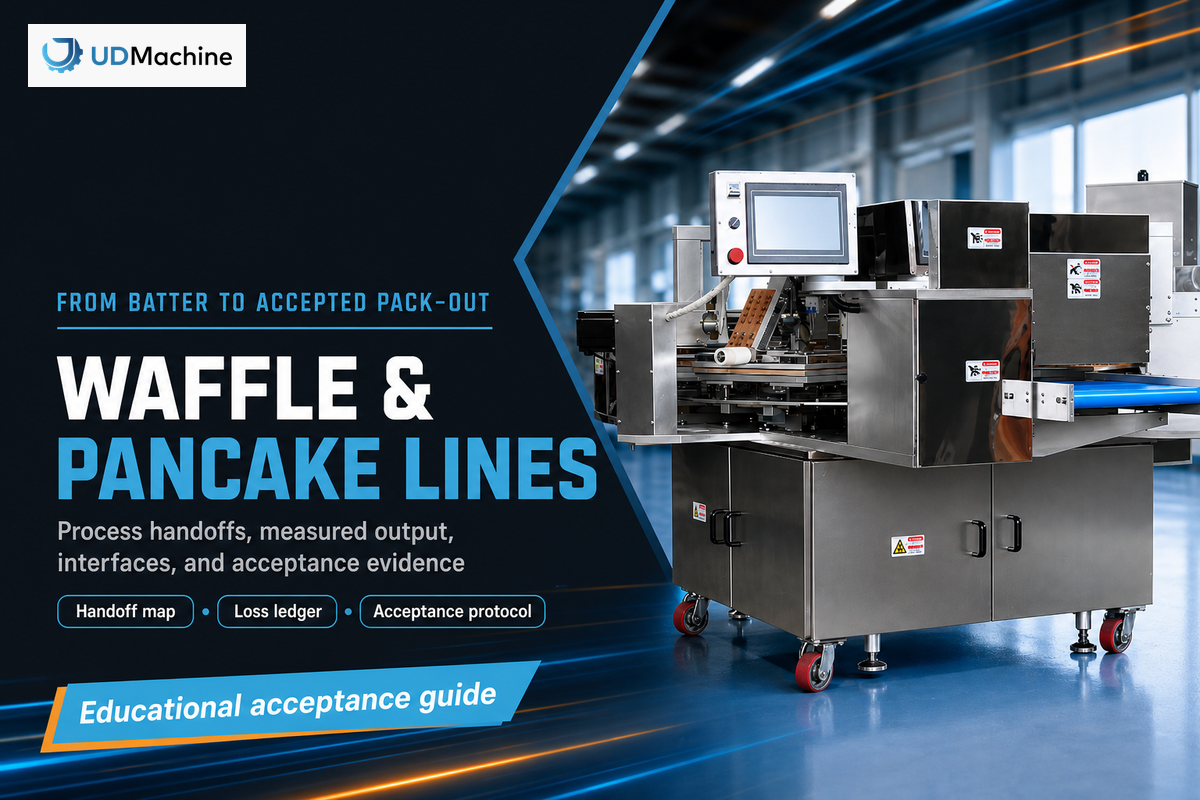
Waffle & Pancake Production Lines are linked production systems that move controlled batter through depositing, baking, release, cooling, and packaging interfaces. Compare them on a frozen product basis, measured saleable output, recorded losses, site interfaces, and reproducible acceptance evidence. A model name or nominal pieces-per-hour figure doesn’t establish what a plant will pack and release.
| Guide purpose | Prepare a comparable trial, evidence request, and acceptance protocol |
|---|---|
| Primary output | Accepted units or packs at a named measurement point and time window |
| What stays outside | Supplier-specific models, utility figures, prices, quotations, and unverified performance claims |
| Evidence boundary | One acceptance run supports a bounded decision; it does not prove sustained capability |
This guide is written for bakery owners, production managers, project engineers, quality teams, and buyers preparing a request for quotation. It follows industrial waffles and industrial pancakes from batter delivery to the packaging handoff, then turns that path into observations, loss codes, interface ownership, and pass-or-fail records.
It isn’t a catalogue and it doesn’t rank suppliers. Its aim is to make two proposed lines comparable without copying a capacity figure from one product format, recipe, or test into another.
Bottom line: first freeze what will be made and how it will be judged. Then measure accepted pack-out, attach every loss to a process handoff, verify site and safety interfaces, and write the acceptance protocol before the trial start.
1. Start With the Comparison Boundary

Process guides and commercial solution pages should answer different questions. Commercial pages can own available waffle and pancake line configurations, model-specific output, utilities, layout, and quotation. This guide owns the method used to check whether those commercial answers are complete and comparable.
That distinction matters when both URLs use the same focus phrase. Repeating a model table, estimator, product selector, or quote form here would create competing commercial intent. A process-and-acceptance article instead helps the buyer prepare better inputs for the commercial conversation.
| Decision | This guide owns | The solution Page owns |
|---|---|---|
| Output | Measurement point, exclusions, sample window | Supplier configuration and stated capacity |
| Site fit | Interface owner and acceptance evidence | Proposed footprint and utilities |
| Commercial choice | Evidence pack supplied with the enquiry | Model selection, pricing, lead time, quotation |
Use this boundary as a routing rule. If a question asks “which configuration can the supplier quote?”, it belongs on the commercial page. If it asks “what must we record to compare two trials fairly?”, it belongs in this guide.
2. Trace the Seven Handoffs From Batter to Pack-Out
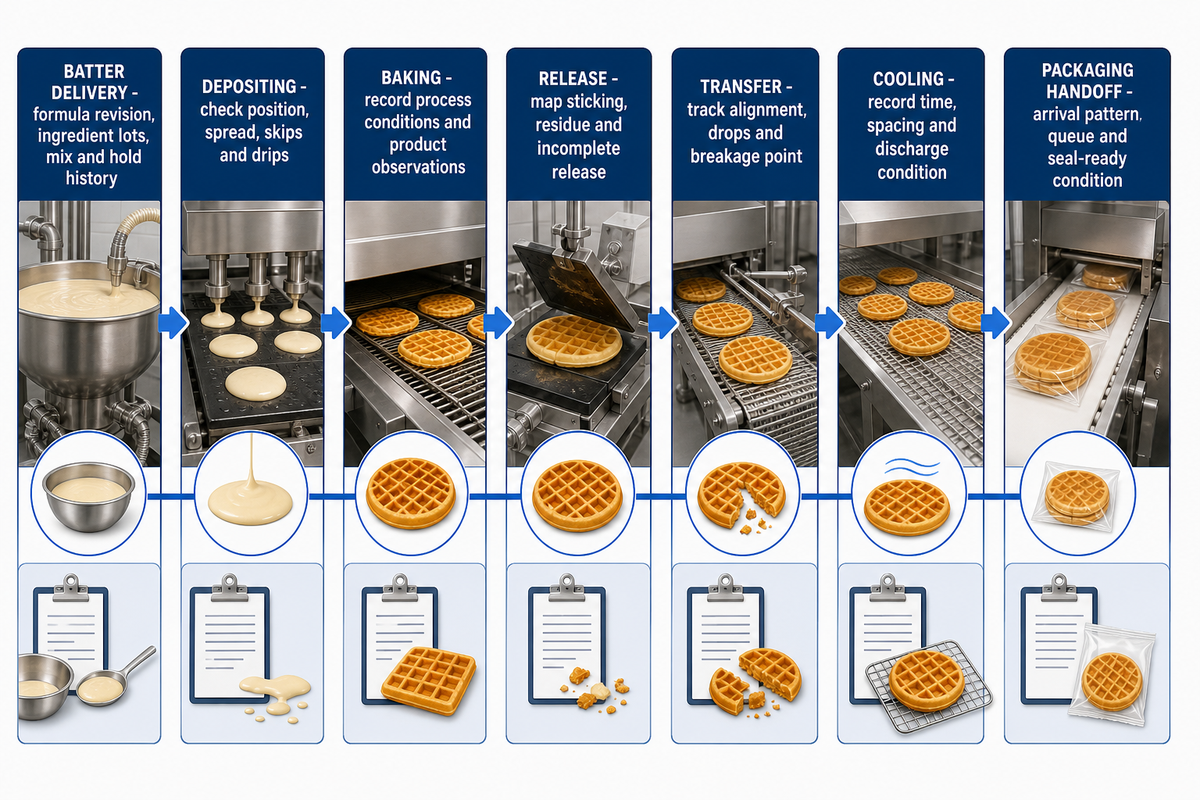
Seven-Handoff Acceptance Map separates batter delivery, depositing, baking, release, transfer, cooling, and packaging handoff. Different waffle and pancake line designs may use different hardware, but the map keeps the production line comparison tied to observable handoffs. It’s an original audit method, not an industry standard and not a claim that every line uses identical hardware.
At each boundary, write down the incoming product state, the observable result, the loss code, and the next owner. This prevents the station where a defect becomes visible from being mistaken for the station that created it.
| Handoff category | Freeze or observe | Evidence leaving |
|---|---|---|
| Whole-run control | Trial ID, synchronized clocks, count boundary, exclusions | One traceable record joining all seven handoffs |
| Batter delivery | Formula revision, ingredient lots, mix and hold history | Named batch released for the trial |
| Depositing | Deposit check method, position, spread, skips and drips | Deposit observations by head or plate position |
| Baking | Recorded process conditions, thermal control, and product observations | Color, dimensions, texture or qualified quality result |
| Release | Sticking location, residue, incomplete release | Released unit or coded release loss |
| Transfer | Flip, pickup, alignment, drop and breakage point | Transfer damage code or intact unit entering cooling |
| Cooling | Cooling time, spacing, and condition at discharge | Pack-ready unit at a named point |
| Packaging handoff | Arrival pattern, queue, misses, seal-ready condition | Accepted pack or a packaging-interface loss |
Each map should follow the actual project. Pancakes may need flipping before discharge; a moulded waffle may release through a different mechanical path. Add or rename a boundary when the product route changes, but don’t combine separate losses merely to preserve a neat seven-row table.
Whole-run rows are control records, not eighth product handoffs. They join the seven handoffs to one trial identity and clock. This map also makes delayed effects visible: product that looks acceptable at release may still deform in transfer, block on a cooling conveyor, or reach the packaging line in an unstable arrival pattern. Name those physical boundaries even when cooling or packaging equipment is outside the supplier’s scope.
3. Freeze the Product Before Comparing Two Lines
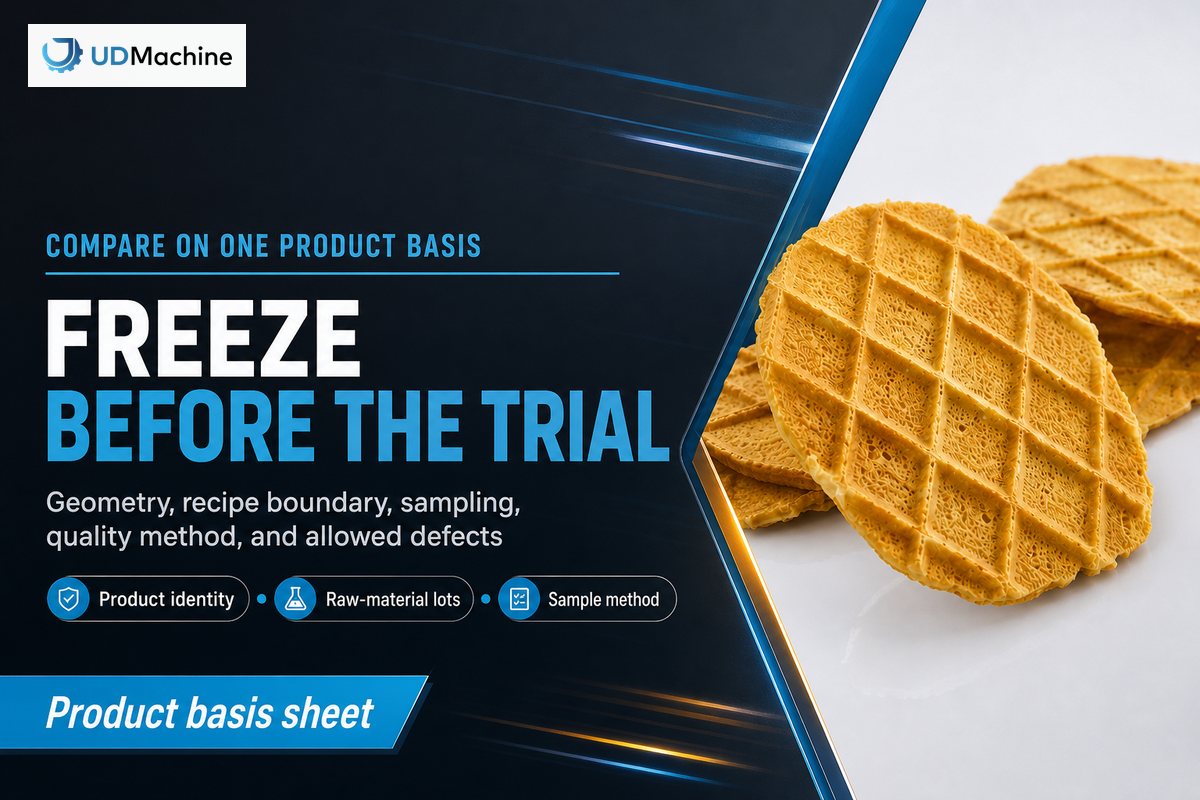
Fair comparisons start with a Product Basis Sheet signed before the run. Product name alone isn’t enough. Record the formula revision, ingredient specifications, deposited batter mass or qualified proxy, product geometry and finished dimensions, quality limits, pack format, sampling age, and the conditions that make a unit acceptable.
For pancakes, functional raw-material properties may matter as much as the ingredient label. One peer-reviewed study of 13 Korean wheat cultivars associated flour protein, gluten-related measures, solvent retention, amylose behavior, and mixing time with pancake dimensions or texture. That study doesn’t provide a universal industrial setting, but it shows why “same flour type” can be an incomplete control statement. See the bounded pancake flour study.
Waffle release is also multi-factor. In a separate pilot-scale study, changing starch and flour formulations materially changed sticking and take-off breakage under the reported test conditions. That evidence supports a fault-isolation rule: don’t call a release observation a mechanical fault until recipe, environment, bake condition, plate condition, and removal damage have been separated. Its limits and methods remain attached to the fresh-egg-waffle study.
Product Basis Sheet: minimum fields
- Formula revision, ingredient lots, and functional specifications that the plant controls
- Batter preparation: mix sequence, mix end time, hold time, and the plant’s qualified batter-condition method
- Batter depositor basis, finished geometry, product quality method, and allowed defects
- Warm-up disposition, sample location, sample age, inspection method, and pack format
- Trial duration, planned interruptions, exclusions, and stop rules
If two proposals can’t run the same product basis, don’t force a direct production capacity comparison. Treat them as different use cases and document what changed.
For a retail-ready product, precision cannot be inferred from a depositor nameplate or a brand label. A versatile automatic line still needs batch-to-batch evidence for deposit weight, baking plates, uniformity, cooling, packaging throughput, operator intervention, and food safety release criteria. Ask the manufacturer to tie each capability claim to the agreed sample plan.
4. Turn a Trial Run Into Measured Saleable Output
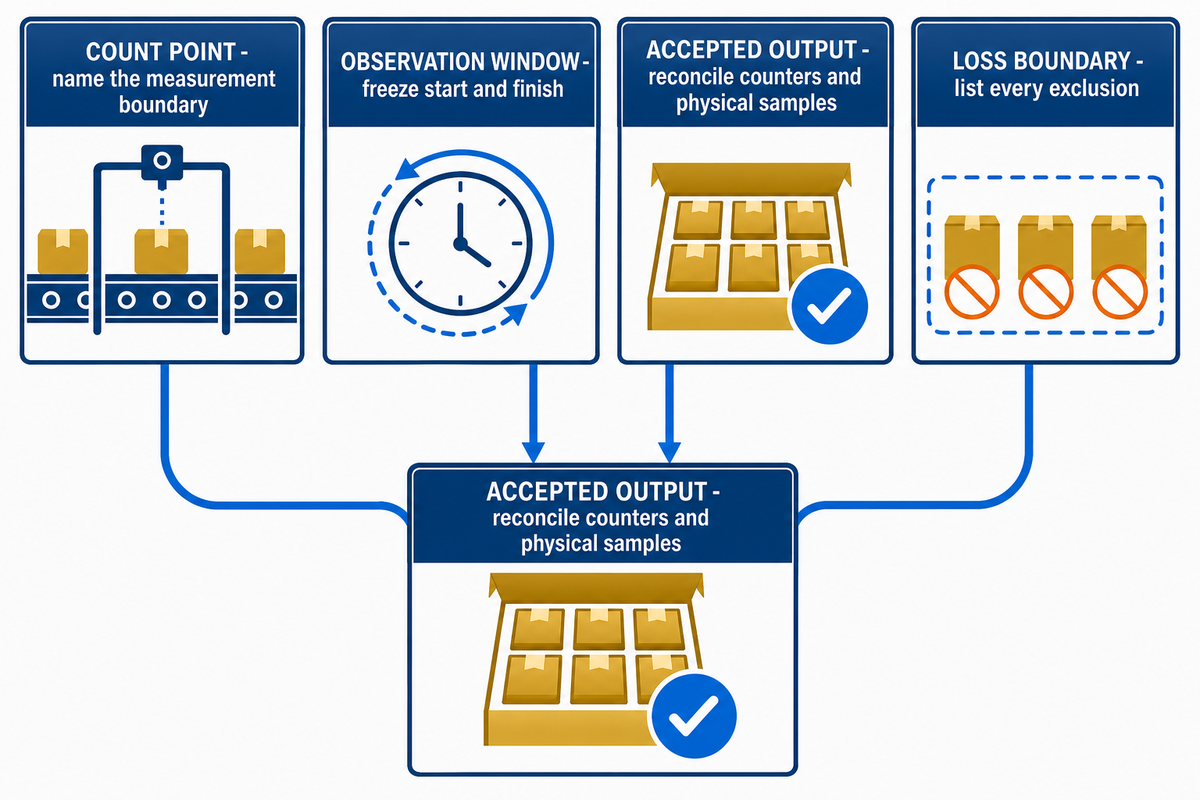
Measured saleable output is accepted product divided by the recorded observation time at a named point. Target output must use the same unit and boundary. Numerators must exclude units that fail the agreed product or packaging criteria. Denominators must state planned uptime and whether warm-up scrap, planned stops, changeover time, the cleaning process, starved supply, and downstream blockage are included.
For a time-normalized rate, use: accepted units ÷ observation minutes × 60. Report accepted packs per hour only when pack count and pack format are also frozen. Pieces per cycle, pieces per hour, kilograms per hour, and packs per shift answer different questions and shouldn’t share one unlabeled “capacity” column.
Illustrative calculation: a trial records 7,800 accepted units during a 120-minute observation window.
Measured saleable output = 7,800 ÷ 120 × 60 = 3,900 accepted units per hour. This arithmetic is an example, not a UDTECH line result or a recommended acceptance target.
Keep a separate count for total units produced. Accepted yield for the same window is accepted units divided by total observed units. Don’t silently remove trial failures from the denominator; record the exclusion rule before the run.
Do
- Name the count point
- Freeze the observation window
- Reconcile counters and physical samples
- List every exclusion
Don’t
- Copy nominal speed into accepted output
- Mix pieces, mass, and packs
- Discard warm-up without agreement
- Treat one run as long-term capability
Treat the recorded trial as bounded evidence. Factory acceptance tests can support contractual decisions for the named product, conditions, duration, and measurement method; they can’t, by themselves, prove performance across future ingredient lots, shifts, startups, sanitation cycles, or plant conditions. Sustained-capability claims therefore need separate evidence plans that sample the variation the plant expects to encounter.
If sustained capability matters, specify follow-up evidence across defined lots, operators, shifts, and operating states. Keep that study separate from the bounded delivery acceptance run.
5. Assign Every Loss to a Handoff
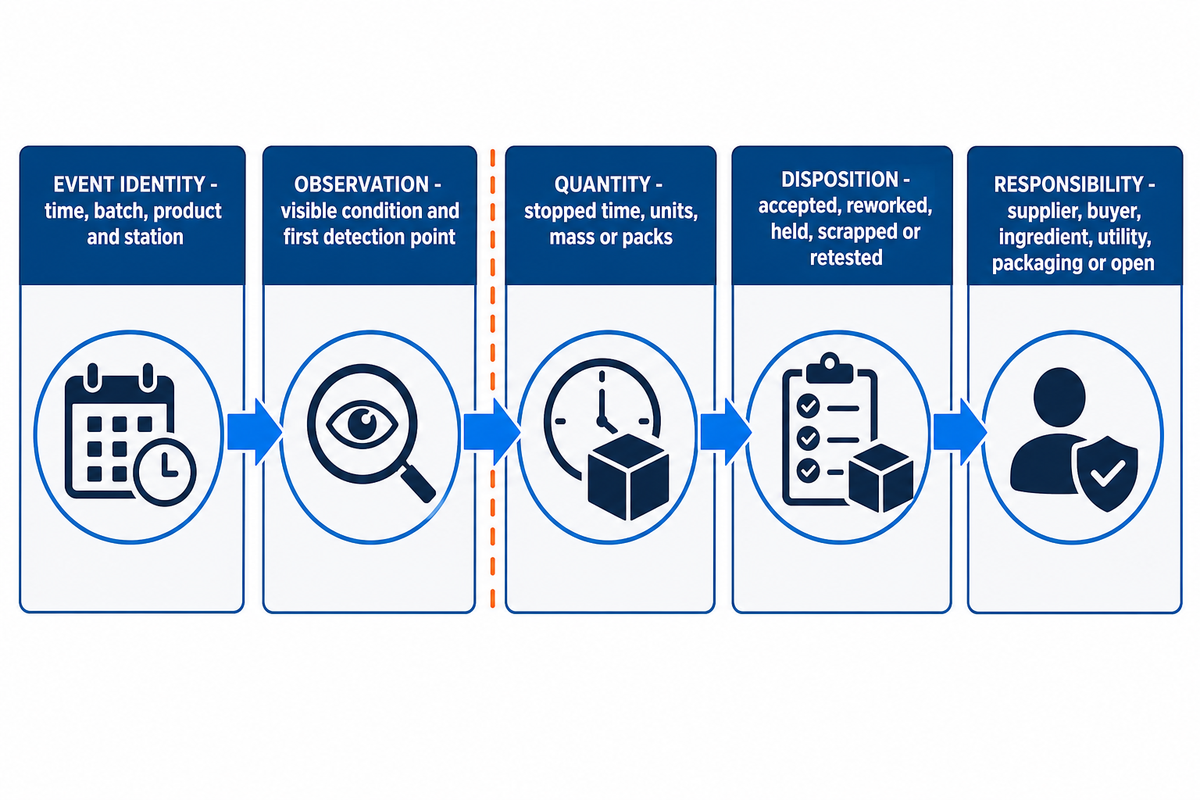
Measured-Output Loss Ledger entries give every stopped minute, rejected unit, and yield loss a time, location, observation, disposition, and owner. They don’t begin with a cause. Causes are assigned only after the team can trace each event to evidence.
This distinction prevents a common fault-isolation shortcut. “Sticking,” “uneven color,” “broken at pickup,” and “wrapper miss” are observations. Each may have several recipe, thermal, mechanical, timing, or downstream contributors.
| Ledger field | Record | Avoid |
|---|---|---|
| Event identity | Start time, end time, batch, product, station | “Line issue” with no timestamp |
| Observation | Visible condition and where first detected | Writing an assumed cause as a fact |
| Quantity | Stopped minutes, units, mass, or packs | Combining time loss and quality loss |
| Disposition | Accepted, reworked, held, scrapped, or retested | Counting held product as saleable |
| Responsibility | Supplier, buyer, ingredient, utility, packaging, open | Assigning blame before investigation |
A University of Illinois Chicago food-manufacturing study reported that precise stop-reason capture exposed downtime and microstoppages missed by traditional records, including equipment- and product-specific patterns. That supports the logging method, not a universal efficiency target. Review the bounded food-manufacturing study summary.
Review the ledger by handoff after the run. The largest loss category isn’t automatically the first action; first check whether its observation is repeatable, whether the measurement system is credible, and whether the event belongs to the line or to an external interface.
6. Build an Interface Owner Register Before the RFQ

Interface Owner Register entries assign each plant connection to the supplier, buyer, or a named third party before quotation and acceptance. Each interface register entry should cover the delivery point, design information, installation work, test method, and evidence required to close the item.
Exact items depend on the proposed line and site. Common headings include utility load, electrical supply, fuel or heating interface, exhaust, combustion air, compressed air, water, drainage, floor loading, installation clearance, maintenance access, ingredient supply, downstream controls, product accumulation, and emergency or safety interlock circuits.
| Interface | Owner question | Acceptance evidence |
|---|---|---|
| Utilities | Who supplies, conditions, protects, and connects? | Approved drawing, measured condition, signed test |
| Physical space | Who confirms access, loading, clearance, and drains? | Site survey and installation-release record |
| Controls | Who owns signals, interlocks, data, and fault recovery? | Signal list, cause-and-effect test, fault log |
| Product handoff | Who controls feed, queue, spacing, and rejection? | Defined boundary test at agreed operating states |
One adjacent Food Engineering case on a nutrition-bar conveyor records both a validated sanitation duration and Ethernet/PLC handoffs to upstream and downstream equipment. Those values belong to that case and aren’t waffle-line benchmarks. What matters here is the specificity of the record: interface, method, product, and result are named. See the adjacent conveyor case.
Open interfaces shouldn’t disappear into “by others.” Give every open item an owner, a due date, and a test that closes it.
7. Request Hygiene and Oven-Safety Evidence
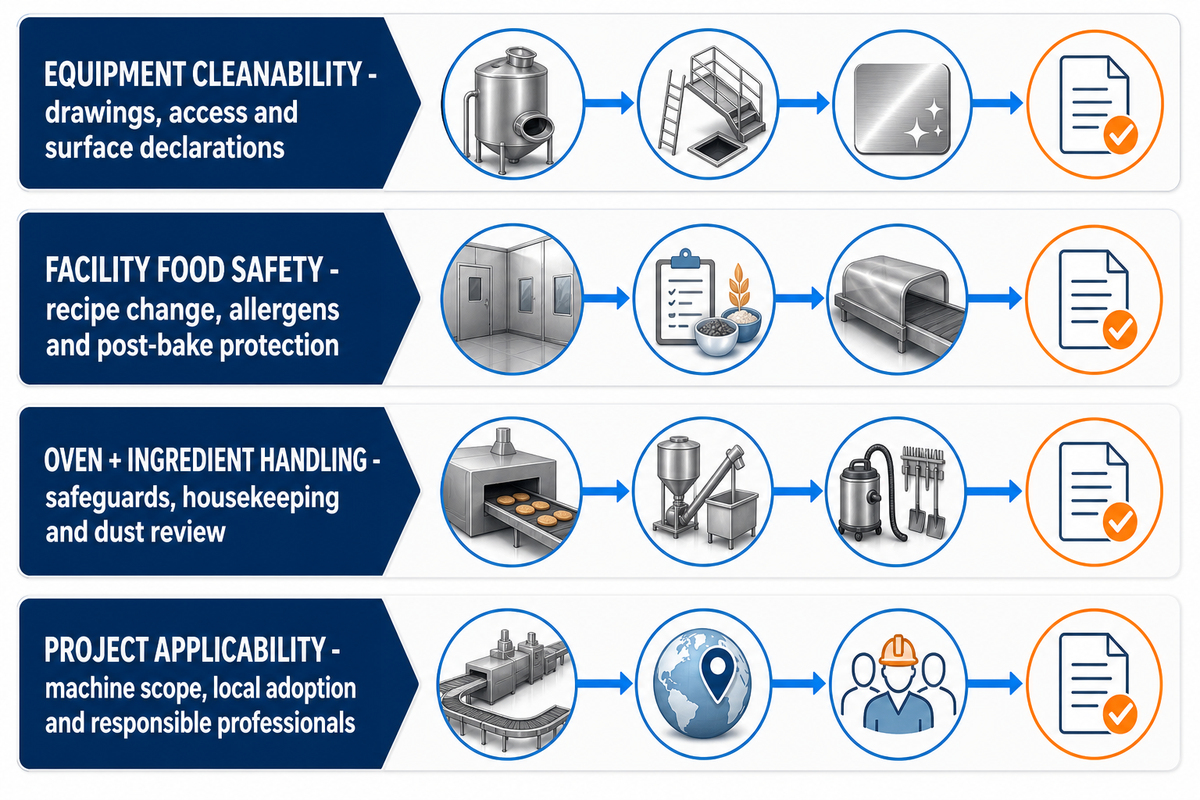
Request evidence tied to the jurisdiction, product, heating method, site, and machine scope. A generic “food grade,” “hygienic,” or “compliant” label doesn’t identify the applicable requirement, the design review, the test, or who’s responsible.
US equipment and facility boundaries
For applicable US operations, the current FDA 21 CFR Part 117 provisions cited here include 21 CFR 117.40, which addresses adequately cleanable equipment, installation that permits cleaning and maintenance of equipment and adjacent spaces, and conditioning of compressed air or other gases introduced into food or used on food-contact surfaces. Ask for drawings, access demonstrations, material or surface declarations where relevant, compressed-air conditioning scope, and a cleaning method that can be verified on the proposed configuration.
Machine acceptance doesn’t replace the facility’s food-safety plan. Current 21 CFR 117.130 addresses written hazard analysis and considers formulation, equipment design, ingredients, processing, packaging, sanitation, and specified ready-to-eat exposure conditions. 21 CFR 117.135 separately addresses applicable process, allergen, and sanitation controls.
Buyers should therefore decide which recipe changes share the line, what allergen changeover evidence is required, how post-bake exposed product is protected before packaging, and which controls belong to the plant rather than the equipment supplier. These are project interfaces, not claims that buying one machine establishes conformity.
Oven, fuel, and ingredient-handling safety
For applicable US bakery equipment, OSHA 29 CFR 1910.263 includes provisions concerning disconnects, inspections, safeguards, and direct-fired oven pre-ventilation. Exact evidence requests depend on the proposed heating system, baking process, baking plates, and installation.
“A main disconnect switch or circuit breaker shall be provided.”
OSHA, 29 CFR 1910.263(l)(8)(iii). Verify current applicability for the installation.
Don’t stop the site review at the oven. OSHA’s combustible-dust overview lists sugar, starch, and flour among food materials whose finely divided dust can become explosible when suspended at the right concentration under suitable conditions. Ingredient receiving, dumping, mixing, conveying, extraction, housekeeping, and dust collection need a site-specific hazard review.
European standards as verification prompts
Public metadata for EN 1672-2:2020 describes basic hygiene and cleanability concepts for food-processing machinery and notes that machine-specific standards can add or vary requirements. This article doesn’t reproduce paid clauses or infer project conformity.
ISO’s official page identifies ISO 13577-2:2023 Edition 2 as the published standard for combustion and fuel-handling systems in industrial furnaces and associated processing equipment. ISO also lists a later Edition 3 work item as under development. Do not cite that future item as the current published edition.
Scope note: this section is an evidence-request framework, not an applicability determination or a declaration that a standard applies to every waffle or pancake line. Confirm the current requirements, machine scope, local adoption, and project responsibilities with qualified plant, safety, food-safety, and standards professionals.
8. Write an Acceptance Protocol With Pass/Fail Criteria
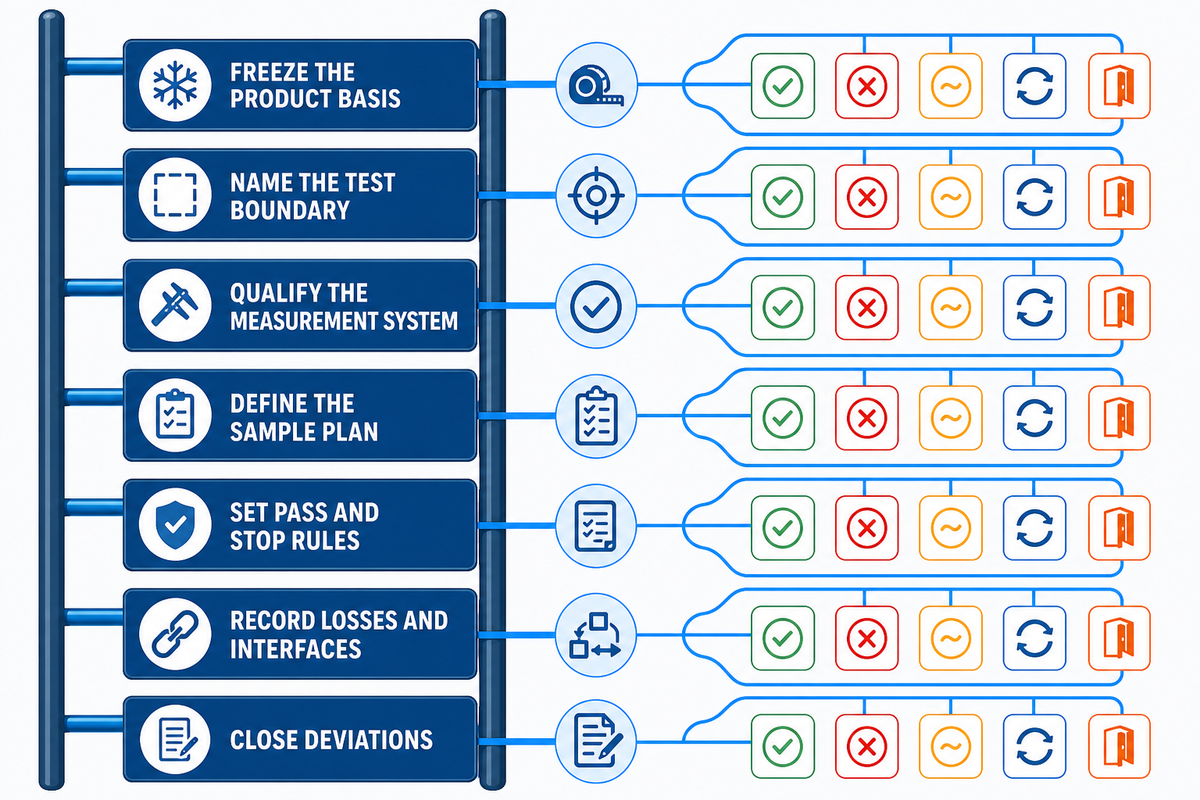
Write the protocol before the machine run, and make every criterion observable. A useful protocol names the product basis, test location, duration, operating states, measurement methods, sample plan, pass limits, exclusions, stop rules, responsibilities, records, and the method for resolving an open result.
Separate the factory acceptance test from the site acceptance test. Factory testing can examine the supplied scope under the available utilities, product, and packaging conditions. Site testing can confirm installed interfaces, plant utilities, upstream and downstream integration, safety functions, sanitation access, and performance at the final boundary.
- Freeze the product basis. Attach the approved formula revision, functional ingredient specifications, dimensions, pack format, quality methods, and allowed defects.
- Name the test boundary. State what equipment, controls, utilities, people, ingredients, and packaging are included or excluded.
- Qualify the measurement system. Identify instruments, counter locations, calibration or accuracy status, timestamps, inspection repeatability, and counter reconciliation.
- Define the sample plan. Record lots, sample locations, sample number, frequency, handling, test method, and result owner.
- Set pass and stop rules. State each limit, the allowed observation window, what triggers a pause, and which conditions invalidate the run.
- Record losses and interfaces. Use the same loss codes and owner register throughout the test.
- Close deviations. Classify each item as passed, failed, conditionally accepted, retest required, or open with an owner and date.
Protocol review becomes easier when the team sees a completed example before writing the real values. This worksheet is intentionally fictitious. Its numbers demonstrate units, tolerances, sampling, and exclusions; they aren’t UDTECH data, supplier capabilities, product settings, or recommended acceptance limits.
| Test category | Illustrative entry only | What the real protocol must state |
|---|---|---|
| Observation window | 120 min | Start, finish, operating states, and included stops |
| Warm-up | 20 min, recorded separately | Disposition and pre-agreed exclusion rule |
| Deposit basis | 50 g ± 2 g | Qualified method, sample location, frequency, and tolerance |
| Diameter | 100 mm ± 3 mm | Sample age, orientation, instrument, and acceptance band |
| Thickness | 12 mm ± 1 mm | Named locations, compression method, and reporting rule |
| Ambient record | 23 °C and 50% | Sensor location, time basis, and permitted operating range |
| Product sample | 10 units every 15 min | Lot linkage, randomization, handling, method, and owner |
| Scale check | 0.1 g display resolution | Calibration or accuracy status and suitability for the tolerance |
| Dimensional check | 1 mm display resolution | Instrument identity, technique, and repeatability |
| Pack format | 5 units per pack | Accepted pack definition and handling of partial packs |
| Counter reconciliation | 1 min check every 30 min | Machine, manual, rejection, and pack-out count boundaries |
| Follow-up capability study | 3 lots across 3 days | A separate plan reflecting expected sources of long-run variation |
Real values should come from the buyer’s product requirements, qualified methods, risk assessment, and contractual agreement. This example also shows why display resolution isn’t the same as measurement accuracy, and why a tolerance shouldn’t be written until the method can distinguish a pass from a fail with enough confidence.
Measurement credibility belongs inside the protocol. Even a precise-looking number can be wrong if instruments are out of calibration, counters use different boundaries, manual inspections disagree, or clocks can’t align the event with the product. For applicable US verification activities, 21 CFR 117.165 addresses instrument calibration or accuracy checks and, where product testing is used as an appropriate verification activity, scientifically valid written procedures with lot linkage, sample number, and sampling frequency.
Don’t copy that regulatory sampling language into every contract without an applicability review. Use it to expose the questions a credible protocol must answer: what’s sampled, which lot does it represent, who samples it, how often, by which method, and what decision follows?
Finally, state the inference limit. Passing one bounded run means the agreed evidence passed for that run. Claims about sustained capability require a separate plan across the variation the plant expects to encounter.
9. Prepare the Evidence Pack Before Commercial Selection

Evidence packs turn this guide into a usable enquiry and RFQ checklist. They should contain the Product Basis Sheet, Seven-Handoff Acceptance Map, measured-output definition, loss ledger fields, Interface Owner Register, applicable hygiene and safety evidence requests, draft acceptance protocol, spare parts list, and a list of open assumptions.
Attach buyer-owned evidence as well: current site drawings, utility conditions, upstream and downstream boundary information, ingredient and package specifications, cleaning expectations, and the plant’s required documentation format. Mark unknowns as unknowns instead of replacing them with competitor values.
Use UDTECH’s waffle and pancake line configuration page for model-specific capacity, utilities, layouts, and quotation discussion. Send the evidence pack with the enquiry so the proposed configuration can be checked against the same product, site, and acceptance basis.
This article deliberately publishes no UDTECH patent, certification, company-scale, customer-result, market-leadership, or performance claim. Those statements require attributable proof and product-level relevance before they belong in a buyer’s evidence pack.
Ready for a technical configuration review?
Bring the product basis, target measurement point, site interfaces, and acceptance criteria. Useful proposals should answer those inputs without turning an untested assumption into a performance promise.
Frequently Asked Questions
What is the best way to compare waffle and pancake production line capacity?
Freeze the product, deposited basis, finished geometry, quality limits, pack format, test duration, and count point. Then report accepted units, mass, or packs for that named window, with exclusions and losses shown separately. Keep total produced, accepted, held, reworked, and scrapped quantities distinct. Don’t compare one supplier’s nominal pieces per hour with another supplier’s accepted packaged output.
Does a passed factory acceptance test prove long-term line performance?
No. It proves only that the agreed criteria passed within the recorded factory test boundary. Sustained capability across ingredient lots, shifts, startups, sanitation cycles, operators, utilities, and plant conditions needs a separate evidence plan. That plan may use several named lots and operating states selected for the plant’s actual variation. It should also define how startup loss, planned cleaning, external starvation, packaging blockage, and held product are treated. Both factory and site tests should state their inference limits explicitly, so a bounded delivery decision isn’t repeated later as a permanent output guarantee.
Why can waffle sticking not be assigned to the machine immediately?
Sticking can interact with formulation, batter condition, plate condition, bake conditions, environment, release timing, and take-off handling. First record where sticking begins, the plate position, residue pattern, and whether the product was already damaged before removal. Compare the same product basis and sampling method. Change a bounded factor only after the recipe, test method, and operating conditions are visible.
What should be included in a waffle or pancake line acceptance protocol?
Include the product basis, supplied scope, observation window, measurement system, sampling plan, quality and output criteria, loss codes, safety functions, exclusions, stop rules, deviation handling, and signatures. Every pass criterion needs a method and an owner, plus a note when site retest is required.
Is a machine’s hygiene declaration enough for a food plant?
No generic declaration replaces a project-specific review. Confirm cleanability, access, materials or surface evidence where relevant, compressed-air scope, cleaning method, allergen changeover needs, post-process exposure, drainage, site hygiene controls, and the requirements applicable in the installation market. Ask which document, drawing, test, or inspection supports each answer. Record who owns any unfinished site work and how it will be closed before food production. Separate equipment evidence from the facility’s own food-safety responsibilities and from local approval decisions.
References & Sources
- eCFR, 21 CFR 117.40: Equipment and utensils
- eCFR, 21 CFR 117.130: Hazard analysis
- eCFR, 21 CFR 117.135: Preventive controls
- eCFR, 21 CFR 117.165: Verification of implementation and effectiveness
- OSHA, 29 CFR 1910.263: Bakery equipment
- OSHA: Combustible Dust, An Explosion Hazard
- ISO 13577-2:2023, published Edition 2 metadata
- EN 1672-2:2020 public scope metadata
- Waffle production: influence of batter ingredients on sticking
- Influence of flour characteristics on pancake quality attributes
- UIC repository: stop-reason and microstoppage study summary